“You’re the nurse I insulted an hour ago,” Reyes said. “Yes, sir.” He looked around the room.
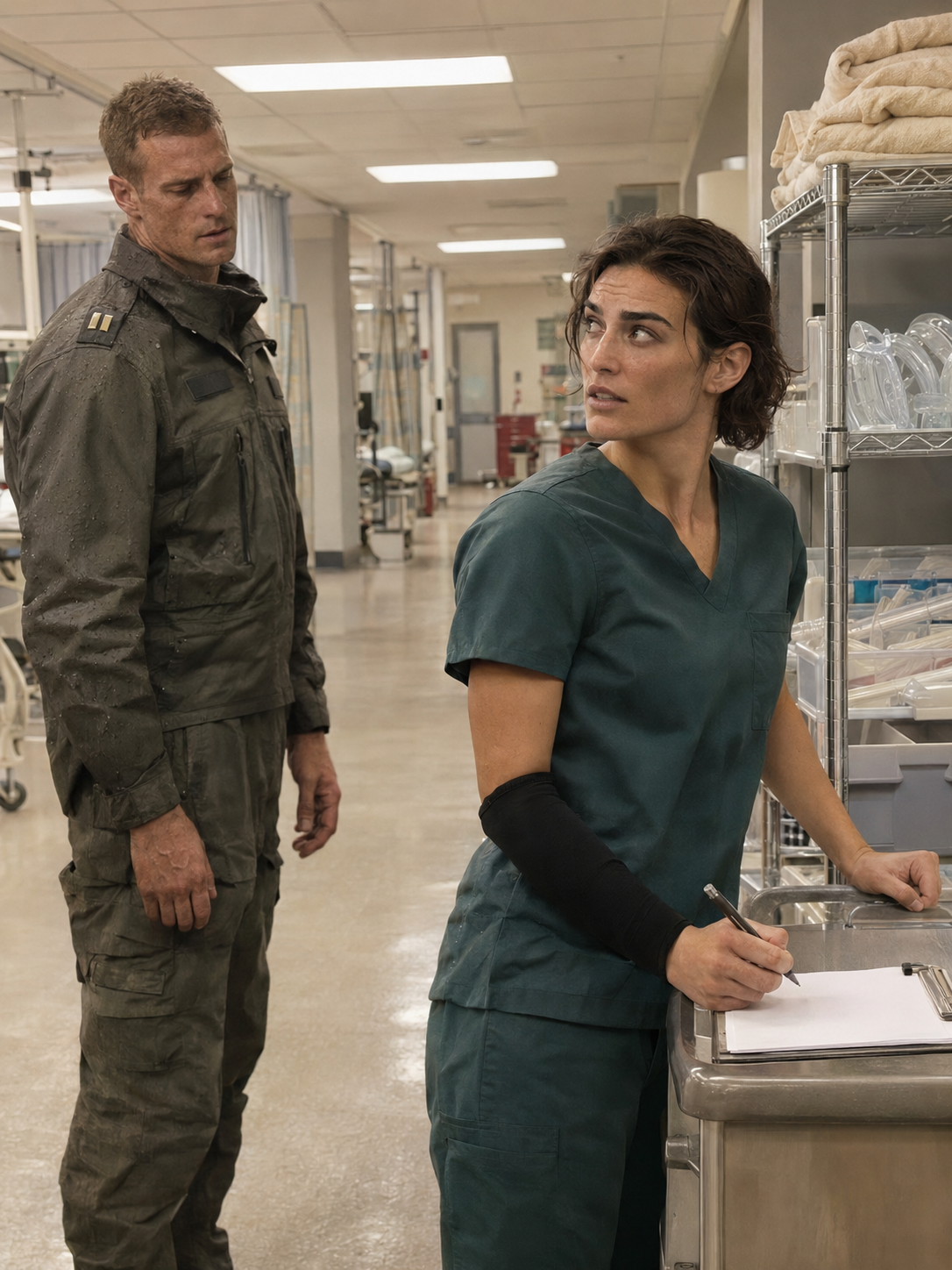
“You’re the nurse I insulted an hour ago,” Reyes said. “Yes, sir.” He looked around the room. “You’re also the reason I’m alive, and apparently the reason this negotiation didn’t become an international incident.” “Also, yes, sir.” He closed his eyes briefly, almost managing a laugh. “I owe you an apology that will take longer than tonight.”
“You owe General Braun an apology first,” I told him. I reminded him that the general had nearly been pushed into signing away the spring testing window, the condition meant to protect the sailors who would eventually serve aboard ships using that radar system. General Braun looked at me for a long moment, then offered his hand. He thanked me on behalf of his government and apologized for misjudging the room.
Shaw closed her notebook. She would need a full statement and would be making calls about my former work. I told her I expected that. Richter was led away in handcuffs, still trying to negotiate with people who had stopped listening. I felt no satisfaction watching him go. I was relieved that Reyes’s pulse was steady and that, at last, the people in the room were listening to the right person.
Hoffman stayed behind for a moment. “Eight years is a long time to disappear,” he said. “What will you do now that this room knows who you were?” I looked at Reyes, at Hail, and finally at my own hands. They were steady and uncovered. “I honestly don’t know yet,” I said.
Three days later, I sat in a plain conference room across from Director Whitfield, who had driven down from Washington to meet me. He read from a thick file: eight years with the agency, a Central Europe rotation, and the Kesler network I had recruited and run until it was compromised. The file said I had officially separated from service six years earlier for personal reasons.
“That’s the file,” I said. Whitfield pointed out that it did not mention the four years I had spent at a naval hospital, or the operation I had stopped at the dinner. He described it as an eleven-million-dollar effort to sabotage a defense partnership. “I wasn’t hiding,” I told him. “I was healing. There’s a difference, even if it looks the same from the outside.”
Reyes was seated beside Whitfield. His right hand was still stiff, though his doctors expected the problem to fade within a month. He had insisted on attending the meeting and had spent much of the previous three days apologizing. I had finally asked him to stop making every conversation about his regret.
Whitfield said the agency wanted me back, with full reinstatement, restored field rank, and three open postings in Central Europe. I thought of Stuttgart and Evo Kesler, of the week he trusted me with his life and the two weeks before he died. Then I thought of the twelve-hour hospital shifts, the patients who needed steady hands, and the work that had helped put something back together in me.
“No,” I said. “Not full reinstatement. I’m not going back to the field.” Reyes leaned forward, but I continued. I would consult part-time on cases like this one, where medical knowledge and field experience needed to be in the same room. I would keep my nursing license and my patience, and they could call if something similar ever happened again. I hoped it would not happen often.
Whitfield exchanged a glance with Reyes, then nodded. “We can work with that.” Later that afternoon, I walked back through the Naval Medical Center toward the ward. My patients had broken bones, postsurgical fevers, and ordinary problems that did not involve a foreign intelligence operation. I was glad to be going back to them.
General Hoffman was waiting near the entrance in a civilian coat, on his way to the airport. He handed me a small velvet box from General Braun. Inside was a medal with German script engraved along its edge, an unofficial recognition for services to the Federal Republic. “Officially, none of this happened,” Hoffman said.
“Officially, I’m a nurse who got lucky,” I answered. Hoffman allowed himself a faint smile. He had met very few lucky people who counted exits in every room. That habit, he said, came from mistakes luck refused to forgive. I closed the box without opening it again in front of him. He told me to take care of myself and hoped the next table I sat at would not need saving.
He walked down the corridor, leaving me with a medal from a government that officially did not know my name, in a hospital that had never quite let me go. Richter’s case would take months. Federal charges were being layered with foreign-bribery statutes, while Pham Dynamics issued a statement denying knowledge of his actions. I suspected the company’s part in the matter would not be settled quickly.
I pushed through the ward doors and found Hail waiting with a clipboard. He still had the same nervous, apologetic energy he had carried at the dinner, but now he was focused on a patient chart. “Bedford’s asking for you specifically,” he said. “He says the last nurse who helped him made him feel like someone actually had his back.”
I took the chart and read the notes. For the first time in eight years, I could imagine that the two halves of my life might not have to remain strangers. Courage is not always loud. Sometimes it is the quiet decision to keep showing up as the person the moment needs, even when the world has mistaken your role for the whole of you. The question is whether you will be ready when that moment arrives.
THE END. I’ve shared the complete story, and I truly hope it touched your heart. If this story moved you, please , like, and share the post. Thank you for reading! ❤️
✓ Lynn R. Adams
“You’re the nurse I insulted an hour ago,” Reyes said. “Yes, sir.” He looked around the room. “You’re also the reason I’m alive, and apparently the reason this negotiation didn’t become an internation…