THE TWINS HE NEVER KNEW WERE HIS
##
He gave his ex-wife twenty dollars and walked away. Then he looked into the eyes of her twin babies—and saw the truth that could destroy everything he believed about their past.
Genre: Emotional Family Drama · Second-Chance Romance · Betrayal · Hidden Secrets · Slow-Burn Romance
## CHAPTER 1: THE WOMAN ON THE ROADSIDE
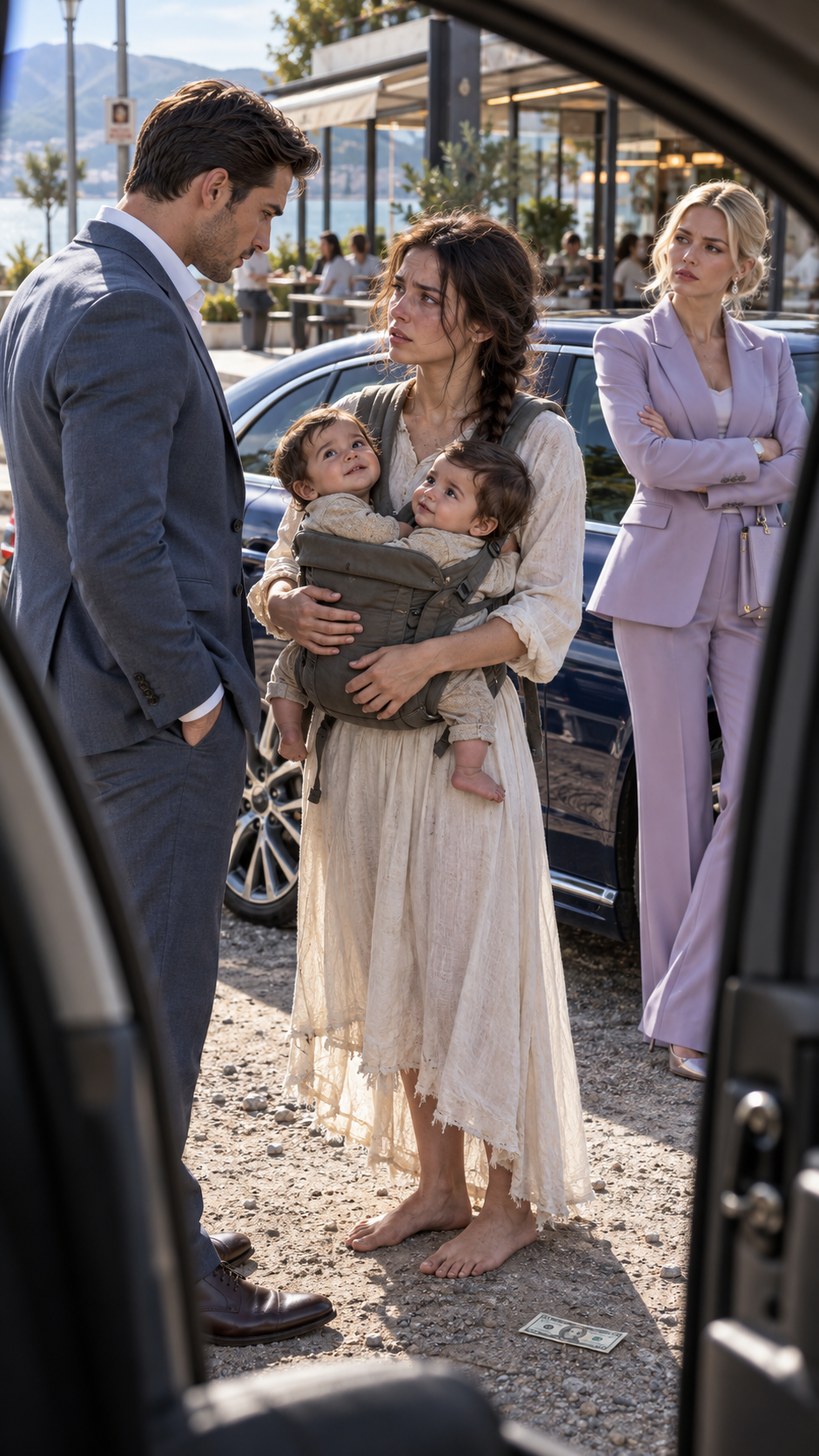
The first thing Bennett Whitmore noticed was that the woman standing beside the road had no shoes.
The second was that she was carrying two babies.
The third was that she was his ex-wife.
For one terrible moment, the world seemed to stop moving.
The afternoon sunlight stretched across the narrow country road outside Willow Creek, turning the dry grass golden. Bennett had been driving toward his family’s estate when Felicity asked him to slow down.
“There’s someone up ahead,” she said, glancing over her sunglasses. “Probably another person looking for money.”
Bennett barely listened.
Then he saw the woman.
Her faded blue dress hung loosely from her shoulders. Her dark chestnut hair had escaped its braid, falling in tangled strands around a face he once knew better than his own.
Josephine.
Three years.
Three years since their divorce.
Three years since she’d disappeared from his life without a single explanation he could understand.
And now she was standing beside a dusty road, holding two babies against her chest.
“Bennett?” Felicity asked. “Why are you stopping?”
He didn’t answer.
His hands tightened around the steering wheel.
Josephine hadn’t seen him yet. She was struggling to adjust the straps of a worn double baby carrier, her bare feet shifting uncomfortably on the hot gravel.
One baby began crying.
She lowered her head and whispered something, gently rocking from side to side.
The tenderness of that simple movement struck Bennett harder than he expected.
He remembered Josephine standing in their kitchen years ago, holding a tiny pair of baby shoes she’d bought on impulse.
Someday, she’d said, smiling.
He had kissed her forehead.
Someday soon.
That promise had died with their marriage.
“Bennett, don’t tell me you know her.”
Felicity’s voice pulled him back.
He opened the car door.
“Wait here.”
“Bennett!”
But he was already walking.
Josephine looked up when his shadow fell across the gravel.
Her expression changed instantly.
First confusion.
Then recognition.
Then something that looked almost like fear.
“Bennett?”
He stopped several feet away.
“Josephine.”
She stared at him as though he were a ghost.
He had imagined seeing her again more times than he cared to admit. In those imaginary encounters, she was always beautifully dressed, confident, perhaps accompanied by the man she’d supposedly left him for.
He had imagined himself indifferent.
He had imagined walking away without feeling anything.
Instead, he was staring at her blistered feet.
“What happened to you?”
Josephine shifted the babies higher against her chest.
“Nothing.”
“You’re standing beside a road without shoes.”
“My car broke down.”
“Where?”
“A few miles back.”
“Why didn’t you call someone?”
Her expression tightened.
“I did.”
“And?”
“No one answered.”
He looked toward the empty road.
“Where are you going?”
“Into town.”
“That’s another six miles.”
“I know.”
One of the babies stirred.
Josephine instinctively placed a protective hand against the child’s back.
Bennett glanced at the carrier.
Twins.
Both appeared to be around two years old, with thick dark hair and round cheeks.
He felt an unexpected pressure in his chest.
“You have children.”
Josephine looked away.
“Yes.”
“You remarried?”
“No.”
The answer came quickly.
Too quickly.
Before he could ask anything else, Felicity stepped out of the car.
Her heels clicked against the pavement.
“Bennett, darling, we’re already late.”
Josephine’s gaze moved to the blonde woman approaching them.
Felicity was everything Josephine no longer appeared to be.
Immaculate.
Expensive.
Untouched by hardship.
Her cream designer blazer fitted perfectly, and the diamond bracelet around her wrist flashed in the sunlight.
Felicity looked Josephine up and down.
“Oh.”
The single word carried enough contempt to fill the silence.
“So this is Josephine.”
Bennett turned sharply.
“Felicity.”
“What? You told me about her.”
Josephine lowered her eyes.
Felicity smiled without warmth.
“Although I must admit, I expected something rather different.”
“That’s enough,” Bennett said.
Felicity ignored him.
“Are you asking for money?”
Josephine’s face flushed.
“No.”
“Then why are you standing here?”
“My car broke down.”
“How unfortunate.”
Bennett could hear the satisfaction in her voice.
He reached into his pocket.
His wallet contained several large bills, but his fingers stopped on a twenty.
He didn’t know why he chose it.
Perhaps because he was angry.
Perhaps because seeing Josephine like this made him remember every humiliation of their divorce.
Perhaps because some wounded part of him still wanted her to understand what she’d thrown away.
He held out the money.
“Here.”
Josephine stared at the bill.
“I don’t need your money.”
“Then use it for the children.”
Her eyes lifted to his.
Something broke across her expression.
Not gratitude.
Not relief.
Pain.
“I said I don’t need it.”
“Josephine, don’t be stubborn.”
“I’m not being stubborn.”
“You’re barefoot on the side of the road with two babies.”
Her voice trembled.
“And you think twenty dollars will fix that?”
Bennett stiffened.
Felicity gave a small laugh.
“Apparently it’s not enough.”
Josephine’s face went pale.
Bennett felt the old anger rise.
Three years ago, he’d begged Josephine to explain why she’d betrayed him.
She’d said nothing.
She had signed the divorce papers and walked away.
And now she stood before him, looking at him as though he had been the cruel one.
“Take it,” he said.
Josephine shook her head.
“No.”
His fingers loosened.
The bill slipped from his hand and fluttered onto the gravel.
For a moment, nobody moved.
Then Josephine slowly looked down.
The money lay between them.
A thin piece of paper separating two people who had once promised to share everything.
“Let’s go,” Felicity said.
Bennett turned toward the car.
He had taken three steps when he heard a baby laugh.
It was a small, delighted sound.
Unexpectedly bright.
He stopped.
Behind him, Josephine was murmuring to the twins.
“Shh, Oliver. It’s all right.”
Another giggle followed.
“Don’t encourage your brother, Noah.”
Bennett turned.
The baby on the left was looking directly at him.
Dark brown eyes.
Thick, slightly wavy hair.
A small dimple near his chin.
And when the child smiled, one corner of his mouth lifted higher than the other.
Bennett forgot how to breathe.
He knew that smile.
He saw it every morning in the bathroom mirror.
The second baby turned his head.
The same eyes.
The same dark hair.
The same crooked smile.
Bennett took one slow step forward.
Josephine’s expression changed.
She tightened her arms around the twins.
“Bennett,” she whispered.
He barely heard her.
His mind was racing backward through dates.
Their divorce.
The last night they had spent together.
The months after she disappeared.
The age of the children.
He looked from one baby to the other.
Then back at Josephine.
“How old are they?”
She said nothing.
“Josephine.”
Her lips parted.
“Please.”
“How old?”
Her eyes filled with tears.
“Two.”
Bennett felt the ground shift beneath him.
“Two years old?”
She nodded.
He stared at the children.
Behind him, Felicity’s voice rose sharply.
“Bennett, get back in the car.”
He didn’t move.
One of the babies reached toward him with a tiny hand.
Bennett looked at Josephine.
And for the first time in three years, his voice held no anger.
Only fear.
“Josephine…”
He swallowed.
“Are those my sons?”
## CHAPTER 2: THE QUESTION SHE COULDN’T ANSWER
Josephine had imagined this moment a thousand times.
In some versions, Bennett discovered the truth through a photograph.
In others, one of the boys found him years later, asking why their father had never come home.
But never, in all her nightmares, had she imagined standing barefoot beside a country road while Bennett Whitmore looked into the faces of his children.
“Answer me,” he said.
Josephine tightened her hold on the carrier.
“Bennett, please. Not here.”
“Are they mine?”
His voice rose.
Oliver startled and began crying.
Josephine immediately rocked him.
“You’re frightening them.”
Bennett stepped backward.
The accusation struck harder than he expected.
He looked at the frightened child and forced himself to lower his voice.
“I’m sorry.”
Felicity approached them.
“What exactly is happening?”
Neither answered.
She looked at the twins, then at Bennett.
“Oh, for heaven’s sake.”
Bennett turned.
“Felicity, go back to the car.”
“You’re not seriously entertaining this, are you?”
“Go back.”
Her expression hardened.
“She disappears for three years, turns up with two children, and suddenly you’re supposed to believe they’re yours?”
Josephine’s face went white.
“I never said that.”
“Of course you didn’t. You don’t have to. The implication is obvious.”
“Felicity,” Bennett warned.
But Felicity had already stepped closer.
“Do you have any idea how many women try to attach themselves to wealthy men through children?”
Josephine’s eyes flashed.
“Don’t speak about my sons that way.”
“Then explain why you’ve brought them here.”
“I didn’t bring them here for him.”
“How convenient.”
Bennett moved between them.
“Enough.”
For a moment, Felicity seemed genuinely shocked.
He had rarely spoken to her like that.
“Bennett—”
“Get in the car.”
She stared at him.
Then, with a bitter laugh, she turned away.
“Fine. But don’t say I didn’t warn you.”
The car door slammed.
Silence settled over the roadside.
Josephine stared at the gravel.
Bennett watched her carefully.
“Look at me.”
She didn’t.
“Josephine.”
Slowly, she raised her eyes.
“Are Oliver and Noah my children?”
A tear slipped down her cheek.
He felt his chest tighten.
“Just tell me the truth.”
She drew a shaky breath.
“Yes.”
The word was barely audible.
But Bennett heard it.
For several seconds, he couldn’t move.
The countryside seemed impossibly quiet.
Even the wind had stopped.
“Yes?” he repeated.
Josephine nodded.
“They’re your sons.”
He looked at the babies again.
Two little boys.
His little boys.
He had missed their first breaths.
Their first smiles.
Their first steps.
He didn’t know their favorite foods, what frightened them, or how they liked to be held.
He hadn’t even known they existed.
“Why?”
Josephine closed her eyes.
“Bennett—”
“Why didn’t you tell me?”
“I tried.”
The answer stopped him.
“What?”
“I tried to tell you.”
His expression darkened.
“No.”
“I did.”
“Don’t lie to me.”
She flinched.
Bennett saw it and immediately hated himself.
But the memories were rushing back too quickly.
The photographs.
The messages.
The night his mother had called him into her study.
The evidence of Josephine’s supposed affair.
Her refusal to defend herself.
He remembered standing in their bedroom, holding a photograph of her entering a hotel with another man.
He remembered asking whether she loved him.
And he remembered her silence.
“You left me,” he said.
Josephine shook her head.
“That’s not what happened.”
“You signed the papers.”
“Because I had no choice.”
“You always had a choice.”
She laughed once.
A broken, humorless sound.
“That’s easy for you to say.”
Bennett stared at her.
“What does that mean?”
Josephine looked toward the car.
Felicity was watching them through the windshield.
“I can’t do this here.”
Bennett followed her gaze.
Then he looked down at Josephine’s feet.
The blisters were worse than he’d first realized.
One heel was bleeding.
His anger faltered.
“Where’s your car?”
“On Millstone Road.”
“How long have you been walking?”
“About an hour.”
“With both babies?”
She nodded.
He closed his eyes briefly.
Whatever had happened between them, the children had done nothing wrong.
“Come with me.”
Josephine immediately stepped back.
“No.”
“I’ll take you into town.”
“We’ll manage.”
“Josephine.”
“I said no.”
Her refusal was so immediate, so frightened, that Bennett went still.
“Are you afraid of me?”
She looked at him.
For a moment, he thought she might tell him everything.
Instead, she whispered, “I’m afraid of what happens when people find out.”
He didn’t understand.
“Find out what?”
She shook her head.
One of the boys reached toward Bennett again.
Oliver.
Bennett knew instinctively which one he was, though he couldn’t have explained how.
The little boy stretched his fingers.
“Da?”
The sound was uncertain.
Perhaps meaningless.
Perhaps simply a toddler’s attempt at a word.
But Bennett felt something inside him collapse.
Josephine quickly kissed Oliver’s hair.
“Sweetheart, no.”
Bennett looked at her.
“Has he seen my picture?”
She hesitated.
Then nodded.
“Sometimes.”
“Why?”
Her voice broke.
“Because I didn’t want them growing up believing their father never existed.”
He stared at her.
“Then why didn’t you bring them to me?”
Josephine’s tears fell freely now.
“Because the last time I tried, someone made sure I understood what would happen if I did.”
Before Bennett could respond, a horn sounded.
Felicity leaned out of the car.
“We’re leaving. Now.”
Bennett didn’t even turn.
“Take the car.”
Felicity blinked.
“What?”
“Drive to the estate. I’ll find another way.”
“You cannot be serious.”
“I am.”
Felicity stepped out again.
“Your mother is expecting us.”
“Tell her I’m delayed.”
At the mention of his mother, Josephine stiffened.
Bennett noticed.
It was a small reaction.
But unmistakable.
“Josephine?”
She shook her head.
“Please don’t tell Eleanor you saw us.”
His stomach tightened.
“Why?”
“Just promise me.”
“Why would my mother care?”
Josephine looked at him with an expression he had never seen before.
Not anger.
Not bitterness.
Something closer to despair.
“Because she already knows.”
Bennett felt the blood drain from his face.
“Knows what?”
Josephine’s voice was barely a whisper.
“That you have sons.”
Behind them, Felicity went completely still.
And Bennett realized that the woman he had once loved was not the only person who had been keeping secrets.
## CHAPTER 3: THE HOUSE WITH THE BLUE DOOR
The cottage stood at the end of a narrow lane, hidden behind overgrown rosebushes and an old wooden fence.
Its blue front door had faded almost to gray.
Bennett parked the borrowed roadside-assistance vehicle beside a crooked apple tree and stared through the windshield.
“This is where you live?”
Josephine nodded.
“It’s small, but it’s ours.”
Small was an understatement.
The cottage looked as though a strong winter storm might carry away its roof.
A cracked flowerpot stood beside the steps. One window had been repaired with clear tape. The garden was full of weeds, though someone had carefully planted marigolds along the path.
Bennett looked toward the back seat.
Oliver and Noah were sleeping in the child seats the roadside-assistance driver had helped them obtain from Josephine’s disabled car.
Their tiny heads leaned toward each other.
For the first time since learning the truth, Bennett allowed himself to study them without interruption.
Noah had a faint crescent-shaped birthmark near his left ear.
Oliver’s hair curled more tightly above his forehead.
They were not identical.
But both carried pieces of him.
The realization filled him with wonder and grief in equal measure.
Josephine unfastened her seat belt.
“Thank you for the ride.”
He turned toward her.
“That’s all you’re going to say?”
She stared ahead.
“What do you want me to say?”
“That you’ll explain everything.”
“I already told you—”
“You told me my mother knew about my sons.”
Josephine closed her eyes.
“Please don’t start again.”
“How am I supposed to react?”
“I don’t know.”
“You don’t know?”
Her voice rose suddenly.
“No, Bennett, I don’t! I’ve spent three years trying to survive. I don’t know how to explain everything in one afternoon.”
The twins stirred.
Both adults immediately fell silent.
Josephine looked over her shoulder.
When the boys settled, she rubbed her forehead.
“I’m sorry.”
Bennett stared at her.
She looked exhausted beyond anything he’d ever seen.
Not merely tired.
Worn down.
As though every day had demanded more than she possessed.
He remembered the woman he’d married.
Josephine had been a talented illustrator who loved bright scarves, terrible detective novels, and dancing barefoot in the kitchen.
She used to sing while making breakfast.
She laughed easily.
She believed every problem could be solved with patience and enough coffee.
The woman beside him looked as though she had forgotten how to laugh.
“Let me help you get them inside,” he said.
She hesitated.
Then nodded.
They carried the sleeping boys into the cottage.
Inside, everything was clean but painfully modest.
A secondhand sofa sat beneath a window. Children’s drawings covered one wall. Two tiny pairs of shoes rested beside a woven basket of toys.
Bennett noticed a small wooden table in the corner.
On it stood a jar of paintbrushes, several unfinished illustrations, and an old laptop with a cracked screen.
“You’re still drawing.”
Josephine glanced toward the table.
“When I can.”
He picked up a sheet of paper.
It showed two little boys beneath an enormous moon.
The drawing was beautiful.
“Did you make this?”
“Yes.”
“It’s wonderful.”
She looked surprised.
Then uncomfortable.
“Thank you.”
He set it down carefully.
Josephine carried Noah into the bedroom.
Bennett followed with Oliver.
The boys shared a small room decorated with hand-painted stars.
There were two narrow beds, each covered with a different quilt.
Above them hung a framed illustration of a father bear holding two cubs.
Bennett stopped.
The bear had dark hair and a crooked smile.
His throat tightened.
“Josephine.”
She turned.
“Did you draw that?”
“Yes.”
He stared at the picture.
“Is that supposed to be me?”
Her silence answered him.
He lowered Oliver into his bed.
The little boy stirred and caught Bennett’s finger.
His hand was impossibly small.
Bennett stood frozen.
Oliver tightened his grip.
For a moment, the room contained nothing but the sound of the child’s breathing.
Bennett slowly sat beside the bed.
“Hello, Oliver,” he whispered.
The boy opened his eyes.
He studied Bennett sleepily.
Then smiled.
That same crooked smile.
Bennett’s eyes burned.
“I’m your dad.”
The words came out before he could stop them.
Josephine turned away.
He heard her quiet sob.
Oliver released his finger and drifted back to sleep.
Bennett remained beside the bed for another minute.
When he finally stood, Josephine was waiting in the hallway.
“Don’t do that again,” she whispered.
He looked stunned.
“Do what?”
“Tell them things you might not be able to keep.”
His expression hardened.
“I’m not leaving them.”
“You don’t know what you’re saying.”
“They’re my children.”
“And you’re Bennett Whitmore.”
He stared at her.
“What is that supposed to mean?”
“It means you have a life. A family. A woman waiting for you.”
“Felicity isn’t my wife.”
“Not yet.”
Bennett looked away.
His mother had been pushing him toward an engagement for months.
Felicity came from a wealthy family with extensive business connections.
Their relationship was convenient.
Predictable.
Safe.
It had never felt anything like his marriage to Josephine.
But he wasn’t ready to examine that truth.
“Tell me about Eleanor,” he said.
Josephine’s face closed.
“No.”
“You said she knew.”
“I shouldn’t have said anything.”
“But you did.”
She walked into the kitchen.
Bennett followed.
“Did she meet the boys?”
Josephine began filling a kettle.
“Josephine.”
Her hands trembled.
He stepped closer.
“Did my mother know you were pregnant?”
The kettle slipped from her fingers and struck the sink.
She gripped the counter.
“Yes.”
Bennett felt sick.
“When?”
“Before the divorce was finalized.”
He stared at her.
“And she didn’t tell me?”
Josephine shook her head.
“Why?”
She looked toward the children’s room.
Then back at him.
“Because she told me you already knew.”
Bennett frowned.
“What?”
“She said you’d seen the medical records. That you didn’t believe the babies were yours.”
“That’s a lie.”
“I know that now.”
“I never saw any medical records.”
Josephine covered her mouth.
For a moment, neither spoke.
Then Bennett asked the question that had been forming since the roadside.
“What did she threaten you with?”
Josephine’s eyes filled again.
Before she could answer, someone knocked at the door.
Three sharp knocks.
Josephine went rigid.
Bennett turned.
Through the frosted glass, he could see the silhouette of a tall man.
A familiar voice called from outside.
“Josephine? It’s Daniel.”
She exhaled shakily.
Bennett looked at her.
“Who’s Daniel?”
She didn’t answer.
The man knocked again.
“Josephine, open the door. We have a problem.”
A pause.
Then the words that made Josephine turn deathly pale.
“Eleanor Whitmore knows Bennett is here.”
## CHAPTER 4: THE MAN WHO KNEW TOO MUCH
Daniel Mercer was not the man Bennett expected.
He was tall, broad-shouldered, and dressed in a dark green work jacket over a clean white shirt. His sandy hair was neatly trimmed, and he carried a leather folder beneath one arm.
He looked at Bennett.
Then at Josephine.
Then back at Bennett.
“Well,” Daniel said quietly. “I suppose the truth finally caught up with everyone.”
Bennett stepped forward.
“Who are you?”
“Daniel Mercer.”
“That doesn’t answer my question.”
Daniel glanced at Josephine.
“Do you want me to explain?”
She nodded reluctantly.
“Daniel helped me when I moved here.”
“Helped you how?” Bennett asked.
“Found me a place to live. Helped with the boys. Made sure I had work.”
Bennett’s jaw tightened.
“And what exactly is your relationship?”
Daniel studied him for a moment.
“I’m her friend.”
“Just a friend?”
Josephine looked sharply at Bennett.
“You don’t get to ask me that.”
He turned toward her.
“I’m trying to understand.”
“No. You’re trying to decide whether I betrayed you again.”
The accusation silenced him.
Daniel set the folder on the kitchen table.
“I think we have more important things to discuss.”
Bennett folded his arms.
“Such as?”
“Your mother’s attorney called me twenty minutes ago.”
Josephine gripped the back of a chair.
“What did he say?”
“He wants to discuss the children.”
Bennett frowned.
“Why would my mother’s attorney be calling you?”
Daniel hesitated.
“Because I’m Josephine’s attorney.”
The room fell silent.
Bennett stared at him.
“You said you were her friend.”
“I am.”
“And her lawyer?”
“Yes.”
Bennett looked at Josephine.
“Why do you need a lawyer?”
She said nothing.
Daniel answered.
“Because your mother threatened legal action against her before the twins were born.”
Bennett felt the old familiar sensation of his world shifting.
“On what grounds?”
“Initially? Alleged fraud. Later, she threatened to challenge Josephine’s fitness as a mother.”
“That’s absurd.”
“Yes,” Daniel said. “It was.”
Bennett pulled out a chair.
“Start from the beginning.”
Daniel looked toward the hallway.
“The children?”
“Asleep,” Josephine whispered.
Daniel sat.
“Three years ago, Josephine came to my office with a letter from Eleanor Whitmore’s legal team. It alleged that she had attempted to secure a financial settlement through a fraudulent pregnancy claim.”
Bennett stared at him.
“I never authorized anything like that.”
“I believe you.”
“Why?”
“Because Josephine has been telling me for three years that you didn’t know.”
Bennett looked at her.
She stood near the sink, her arms wrapped tightly around herself.
“Why didn’t you contact me directly?”
“I did,” she said.
“When?”
“After the first appointment. After the ultrasound. After I learned there were two babies.”
Bennett shook his head.
“I never received anything.”
“I sent letters.”
“Where?”
“Your office. Your apartment. The estate.”
He stared at her.
“I received nothing.”
Daniel opened his folder.
Inside were copies of several letters.
The first was dated nearly three years earlier.
Bennett recognized Josephine’s handwriting immediately.
He read the opening lines.
Bennett, I know you may not want to hear from me, but there’s something important you need to know.
His hands tightened.
The letter continued.
I’m pregnant. The doctor says everything looks healthy. I don’t know whether you’ll believe me, but these babies are yours.
Bennett stopped reading.
He looked at the date again.
It was six weeks after their separation.
His vision blurred.
“You wrote this?”
Josephine nodded.
“Yes.”
He turned to the next page.
A second letter.
Then a third.
In the final one, she had written:
I’m not asking you to come back to me. I’m only asking you not to punish our children for what happened between us.
Bennett lowered the papers.
“I never saw these.”
Daniel nodded.
“That’s what I suspected.”
“How do you know they were intercepted?”
“We don’t know for certain. But we have delivery records showing that two reached addresses controlled by the Whitmore family.”
Bennett stared at the documents.
His mother had always managed family correspondence.
After his divorce, she’d insisted he needed protection from unwanted contact.
He had agreed.
He’d been too angry and too hurt to question her.
Now he wondered what else he’d allowed her to control.
“What did Eleanor offer you?” he asked Josephine.
She looked down.
“Money.”
“How much?”
“Enough to disappear.”
“Did you take it?”
Her head snapped up.
“No.”
Bennett nodded slowly.
He had expected that answer.
And hated himself for needing to ask.
Daniel leaned forward.
“Josephine refused the settlement. After that, the threats became more serious.”
“What threats?”
Daniel glanced at Josephine.
She nodded.
“Tell him.”
“Your mother’s attorney claimed they had evidence Josephine was emotionally unstable and financially incapable of raising children. They warned that if she attempted to establish paternity, the Whitmore family would seek custody.”
Bennett stood abruptly.
“That’s insane.”
“Perhaps. But Josephine was pregnant, unemployed, and facing a legal team with nearly unlimited resources.”
“I would never have allowed that.”
Josephine looked at him.
“You weren’t there.”
He turned.
Her voice remained quiet.
“You weren’t there when I was sick. You weren’t there when the doctor said one baby wasn’t growing properly. You weren’t there when I spent three nights in the hospital wondering whether I would lose Noah.”
Bennett felt something twist inside him.
“I didn’t know.”
“I know.”
“Josephine—”
“I know you didn’t know, Bennett. But I didn’t know that then.”
He sat slowly.
For a long moment, no one spoke.
Then Daniel opened another section of the folder.
“There’s something else.”
Bennett looked up.
“What?”
“The photograph.”
His pulse quickened.
“What photograph?”
“The one that ended your marriage.”
Bennett went still.
He remembered it perfectly.
Josephine entering a hotel beside a man in a dark coat.
His mother’s private investigator had provided several photographs.
One showed the man touching Josephine’s back.
Another showed them disappearing through the entrance together.
Bennett had confronted her that evening.
She had refused to explain.
“That photograph was real,” he said.
Daniel nodded.
“Yes.”
Bennett frowned.
“Then what are you suggesting?”
“That you were given the wrong explanation.”
He slid a business card across the table.
Bennett picked it up.
The name printed on it was familiar.
Dr. Adrian Vale.
A reproductive medicine specialist.
Bennett looked at Josephine.
Her eyes were wet.
“Adrian was my doctor,” she whispered.
“Your doctor?”
She nodded.
“We were trying to have a baby, Bennett.”
He stared at her.
“Before the divorce?”
“Yes.”
Bennett looked at the business card again.
“Why didn’t you tell me?”
Josephine gave a broken laugh.
“I was trying to surprise you.”
Daniel’s expression grew serious.
“The hotel housed a private medical conference. Dr. Vale was meeting Josephine there because the clinic was being renovated.”
Bennett’s mind raced.
The photograph.
The accusation.
Josephine’s silence.
His mother’s insistence that the marriage was beyond repair.
He looked up.
“Why didn’t you explain this when I confronted you?”
Josephine’s face crumpled.
“Because by then, your mother had already shown me photographs of you with Felicity.”
Bennett froze.
“What photographs?”
Josephine looked at him.
“Pictures of you kissing her.”
His breath caught.
“I never kissed Felicity while we were married.”
“I know that now.”
Daniel quietly closed the folder.
Bennett stared at Josephine.
Two people.
Two sets of photographs.
Two betrayals that had never happened.
And one marriage destroyed.
Then Daniel spoke again.
“There’s something you need to understand, Bennett.”
Bennett turned.
Daniel’s expression was grim.
“Those photographs weren’t the only things manipulated.”
He reached into his folder.
And placed a sealed medical report on the table.
## CHAPTER 5: THE LIE BENEATH THE LIE
Bennett stared at the sealed envelope.
For several seconds, he couldn’t bring himself to touch it.
“What is that?”
Daniel rested his hands on the table.
“A report from the fertility clinic Josephine attended.”
Bennett looked toward her.
She stood beside the kitchen counter, her face drained of color.
“Josephine?”
She shook her head.
“I don’t know what he’s talking about.”
Daniel’s expression softened.
“I only received it this morning.”
“From whom?”
“Dr. Vale’s former administrative assistant.”
Bennett picked up the envelope.
His name was written across the front.
BENNETT WHITMORE.
The handwriting was unfamiliar.
He opened it.
Inside were three pages.
The first contained dates, medical terminology, and a summary of Josephine’s consultations.
The second was a copy of a consent form.
The third was a letter.
Bennett read it silently.
Then again.
His hands began trembling.
According to the report, Josephine had undergone preliminary fertility testing shortly before their separation.
But the consent form included something else.
An authorization to release her medical information to Eleanor Whitmore.
Bennett looked up.
“Did you sign this?”
Josephine took the paper.
Her eyes moved across the page.
“No.”
“That’s your signature.”
“It’s not mine.”
Daniel nodded.
“We believe it was forged.”
Bennett stood.
“Why would my mother want her medical records?”
“Because,” Daniel said carefully, “the records would have established that Josephine was receiving fertility treatment rather than meeting another man for an affair.”
Bennett stared at him.
“She knew.”
Daniel didn’t answer immediately.
“The records suggest someone requested information about Josephine’s appointments before the divorce.”
Bennett walked toward the window.
Outside, the afternoon sun had begun to fade.
He remembered his mother’s voice.
She’s deceiving you, Bennett.
You deserve a wife who understands your responsibilities.
Some women marry into families like ours for what they can take.
He had believed her.
Not because Josephine had ever been dishonest with him.
But because Eleanor Whitmore had spent his entire life convincing him that love was dangerous and trust was a weakness.
Bennett pressed his palm against the window frame.
“What else?”
Daniel exchanged a glance with Josephine.
“There’s a possibility the photographs of you and Felicity were also staged.”
Bennett turned.
“How?”
“Josephine was shown pictures from a charity dinner. Felicity appeared to be kissing you outside the venue.”
Bennett remembered that evening.
He’d been ill.
A migraine had forced him to leave early.
Felicity had helped him into the car.
He remembered her leaning close to say something.
He remembered nothing resembling a kiss.
“Someone photographed us from an angle that made it look different,” he said slowly.
“That’s one possibility.”
Bennett closed his eyes.
The memory of Josephine’s face during their final argument returned with brutal clarity.
He had accused her of sleeping with another man.
She had stared at him in disbelief.
Then she’d asked one question.
Do you really think I’m capable of that?
He had answered yes.
And something in her had gone quiet.
At the time, he’d mistaken that silence for guilt.
Now he understood it might have been heartbreak.
“Why didn’t you fight for us?” he asked.
Josephine looked at him.
“I did.”
“No. You stopped talking. You signed the papers.”
“Because you told me you hated me.”
He flinched.
She stepped closer.
“You stood in our bedroom and said you wished you’d never met me.”
Bennett remembered.
Every word.
He had said them because he wanted to hurt her as badly as he believed she’d hurt him.
“I was angry.”
“I know.”
“I didn’t mean it.”
“You meant it when you said it.”
He had no defense.
Josephine wiped her cheek.
“Your mother came to see me two days later. She told me you wanted the divorce finalized quickly. She said you were already moving on with Felicity.”
“That wasn’t true.”
“I didn’t know that.”
Her voice trembled.
“Then I discovered I was pregnant. And suddenly I had two lives to protect.”
Bennett looked toward the hallway.
“Oliver and Noah.”
She nodded.
“I thought if I could just keep them safe, nothing else mattered.”
Daniel stood.
“I should go. You two need to talk.”
Bennett looked at him.
“Can you leave the documents?”
“Copies, yes.”
“Thank you.”
Daniel hesitated.
Then placed a hand on Josephine’s shoulder.
“Call me if anything happens.”
Bennett watched the gesture.
For a moment, jealousy rose.
Then shame followed.
Daniel had been there when Bennett hadn’t.
He had helped Josephine survive.
That was something Bennett owed him gratitude for, not resentment.
After Daniel left, the cottage fell quiet.
Josephine began clearing cups from the table.
Bennett stopped her.
“Sit down.”
“I’m fine.”
“You’re shaking.”
She looked at her hands.
Then slowly sat.
He filled a glass with water and placed it before her.
For a moment, the gesture felt painfully familiar.
He used to bring her water when she worked late at her drawing desk.
She used to complain that he worried too much.
Now she accepted the glass without looking at him.
“Tell me about them,” he said.
Josephine looked toward the children’s room.
“What do you want to know?”
“Everything.”
She gave a sad smile.
“That could take a while.”
“I have time.”
“Do you?”
The question hung between them.
Bennett pulled out a chair.
“I want to make time.”
Josephine studied him.
Then she began.
“Oliver was born first. Seven minutes before Noah. He’s fearless. He climbs everything, even things that shouldn’t be climbed.”
Despite himself, Bennett smiled.
“And Noah?”
“He’s quieter. He watches people before deciding whether he likes them.”
“Sounds sensible.”
“He gets that from you.”
Bennett looked down.
Josephine continued.
“Oliver loves strawberries. Noah hates them. They both love trains. And neither will sleep unless I read the same ridiculous story about a rabbit who loses his hat.”
“What’s it called?”
“The Rabbit and the Rainstorm.”
“I’ll buy a copy.”
“We already have one.”
“Then I’ll learn it.”
Josephine’s eyes filled.
Bennett reached across the table.
He stopped before touching her hand.
“Can I?”
She looked at him.
After a long moment, she nodded.
He gently covered her fingers with his.
Her hand was cold.
“I’m sorry,” he whispered.
Josephine closed her eyes.
He wanted to say more.
He wanted to apologize for every missed birthday, every sleepless night, every moment she’d needed someone and found herself alone.
But there weren’t enough words.
So he sat quietly, holding her hand.
For the first time in three years, neither pulled away.
Then Bennett’s phone rang.
His mother’s name appeared on the screen.
He stared at it.
Josephine’s hand tightened beneath his.
“Don’t answer.”
Bennett looked at her.
“Why?”
She swallowed.
“Because she never calls unless she already knows what you’re going to say.”
The phone continued ringing.
Bennett answered.
“Mother.”
Eleanor Whitmore’s voice was calm.
“Bennett, darling. I understand you’ve had an unexpected reunion.”
His expression hardened.
“Where are you?”
“At home, of course.”
“Did you know Josephine was pregnant?”
A pause.
Then Eleanor sighed.
“I was hoping we could discuss this privately.”
“Answer me.”
Another pause.
“Yes.”
Bennett closed his eyes.
“Did you know the children were mine?”
Eleanor’s voice changed.
“Son, there are things you don’t understand.”
“Did you know?”
“Yes.”
The room seemed to tilt.
Bennett gripped the phone.
“And you kept them from me?”
Eleanor spoke with chilling certainty.
“I did what was necessary to protect this family.”
Then she added:
“And if Josephine has shown you those documents, you should know she isn’t telling you the whole truth.”
## CHAPTER 6: THE PRICE OF A FAMILY NAME
Bennett had spent thirty-six years believing his mother was the strongest person he knew.
Eleanor Whitmore had built an empire from the remains of her late husband’s struggling investment firm. She negotiated million-dollar deals without raising her voice. She remembered every betrayal and forgave almost none.
As a child, Bennett had admired her.
As a young man, he had feared disappointing her.
As an adult, he had mistaken her control for protection.
Now he stood in the marble entrance hall of Whitmore House and wondered how much of his life had truly belonged to him.
“Your mother is in the library, sir,” the housekeeper said.
“Thank you, Margaret.”
He walked past the staircase.
Family portraits lined the walls.
His father.
His grandparents.
Generations of Whitmores who had valued reputation above almost everything else.
He stopped outside the library.
Then opened the door.
Eleanor sat behind an antique mahogany desk, reading a document.
She didn’t look surprised to see him.
“Bennett.”
He closed the door.
“Tell me why.”
She removed her glasses.
“I assume we’re discussing Josephine.”
“We’re discussing my sons.”
Eleanor’s expression tightened.
“Biological connections do not automatically make someone family.”
Bennett stared at her.
“Don’t ever say that again.”
She leaned back.
“I see you’re emotional.”
“I’m furious.”
“Then perhaps we should wait until you’re capable of having a rational conversation.”
“No.”
His voice echoed through the library.
Eleanor went still.
Bennett stepped closer.
“You knew Josephine was pregnant. You knew Oliver and Noah existed. You watched me spend three years believing my marriage ended because my wife betrayed me.”
Eleanor folded her hands.
“Your marriage was already failing.”
“Because you made me believe she was having an affair.”
“I presented you with information.”
“False information.”
“Information that raised legitimate concerns.”
Bennett placed copies of the medical documents on her desk.
“Did you forge this signature?”
Eleanor glanced at the papers.
“I have no knowledge of a forgery.”
“Did you authorize someone to obtain Josephine’s records?”
“I had a responsibility to protect your interests.”
“That isn’t an answer.”
She stood.
“Your father left you a legacy, Bennett. A company. A name. Responsibilities that Josephine never understood.”
“She understood me.”
“She understood the man you wanted to be. Not the man you needed to become.”
Bennett shook his head.
“You hated her because she wasn’t wealthy.”
“I distrusted her because she was unsuitable.”
“She was my wife.”
“And she would have dragged you into a life beneath your potential.”
The words landed like stones.
Bennett stared at the woman who had raised him.
“She loved me.”
Eleanor’s expression flickered.
Then hardened.
“Love doesn’t sustain an empire.”
“No,” Bennett said quietly. “But neither does cruelty.”
Eleanor looked away.
For a moment, he thought he saw regret.
Then she reached for a folder.
“There’s something you should see.”
Bennett didn’t move.
She slid the folder toward him.
Inside were photographs of Josephine and Daniel Mercer.
One showed Daniel carrying Oliver.
Another showed him leaving Josephine’s cottage.
A third showed Josephine hugging him outside a courthouse.
Bennett studied the images.
“What’s your point?”
Eleanor seemed surprised.
“Surely you can see—”
“That a man helped her when nobody else did?”
“Daniel Mercer has been involved in her life for years.”
“He’s her attorney.”
“He’s also unmarried.”
Bennett closed the folder.
“You’re doing it again.”
Eleanor frowned.
“What?”
“Showing me photographs and expecting me to invent a betrayal.”
Her face changed.
Bennett stepped back.
“Not this time.”
He turned toward the door.
“Bennett.”
He stopped.
“If you insist on involving those children in your life, there will be consequences.”
He looked over his shoulder.
“Are you threatening my sons?”
“I’m reminding you that you’re chairman of Whitmore Holdings.”
“And?”
“The board expects stability.”
Bennett stared at her.
For the first time, he saw the machinery clearly.
The company.
The family name.
His relationship with Felicity.
All of it connected by obligations he had never fully questioned.
“You arranged my relationship with Felicity.”
Eleanor’s silence confirmed it.
“Did she know about Josephine?”
“Felicity understood what was best for you.”
“Did she know about the boys?”
Eleanor looked toward the window.
Bennett felt cold.
“Mother.”
She said nothing.
He nodded slowly.
“That’s all I needed.”
He left without another word.
Outside, Felicity was waiting beside his car.
She looked immaculate in a pale silk blouse and tailored trousers.
“Bennett.”
He stopped.
“Did you know?”
Her smile disappeared.
“About what?”
“Oliver and Noah.”
She hesitated.
It was barely a second.
But he saw it.
“Felicity.”
She sighed.
“Your mother mentioned there might be children.”
Bennett stared at her.
“When?”
“About a year ago.”
“A year?”
“I didn’t know whether they were yours.”
“You never asked me?”
“Your mother said the situation had been handled.”
He laughed bitterly.
“Handled.”
Felicity stepped closer.
“Bennett, please be reasonable. We have a future together.”
“Do we?”
Her expression hardened.
“Don’t throw away everything we’ve built because of a woman who abandoned you.”
“Josephine didn’t abandon me.”
“You don’t know that.”
“I know enough.”
Felicity reached for his arm.
He stepped away.
“Don’t.”
She froze.
Bennett looked at her for a long moment.
“Whatever this relationship was, it’s over.”
Her face went pale.
“You can’t be serious.”
“I am.”
“Your mother will never accept it.”
“My mother doesn’t get to decide whom I love.”
The words surprised him.
Not because they were untrue.
But because he hadn’t intended to say them.
Felicity stared at him.
Then her expression turned cold.
“You think Josephine will simply take you back?”
“No.”
“You think three years of suffering can be erased with an apology?”
“No.”
“Then what exactly are you hoping for?”
Bennett looked toward the distant hills.
“I don’t know yet.”
Felicity laughed sharply.
“You’re making a terrible mistake.”
“Maybe.”
He opened his car door.
“But this time, it’ll be mine.”
He drove away before she could answer.
Halfway down the estate road, his phone vibrated.
A message from Daniel Mercer.
We have a serious problem. Josephine just received a custody petition.
Bennett pulled over.
He opened the attached document.
At the top was the name of the petitioner.
Eleanor Whitmore.
His mother had made her move.
## CHAPTER 7: THE NIGHT THE TRUTH CAME HOME
Josephine was sitting on the kitchen floor when Bennett arrived.
Oliver and Noah were asleep.
A stack of legal papers lay beside her.
She had been reading the same paragraph for twenty minutes, but the words no longer made sense.
Petition for emergency guardianship.
Concerns regarding financial instability.
Questions about the children’s living conditions.
She had always known this day might come.
Still, seeing Eleanor Whitmore’s name at the bottom of the document made her feel as though the walls were closing in.
A knock sounded.
She stiffened.
“Josephine? It’s Bennett.”
She didn’t answer immediately.
He knocked again.
“Please open the door.”
Slowly, she stood.
When she opened it, Bennett took one look at her face and stepped inside.
“I saw the petition.”
Josephine nodded.
“Daniel sent it to you?”
“Yes.”
She tried to smile.
“Your mother doesn’t waste time.”
Bennett’s expression darkened.
“She’s not going to take them.”
Josephine looked at him.
“You can’t promise that.”
“I can promise I’ll fight.”
She closed the door.
For a moment, neither spoke.
Then Josephine said, “I can’t do this again.”
Bennett looked at her.
“What?”
“I can’t spend another year being frightened every time someone knocks. I can’t keep wondering whether one bad day will be used as evidence that I’m an unfit mother.”
Her voice cracked.
“I can’t lose them.”
Bennett stepped closer.
“You won’t.”
“You don’t understand.”
“Then help me understand.”
Josephine covered her face.
“I have spent every day since they were born trying to be enough.”
He remained silent.
“I work when they sleep. I take whatever illustration jobs I can find. Sometimes I skip meals because groceries cost more than I expected.”
Bennett felt his stomach twist.
She continued.
“I know the cottage isn’t beautiful. I know their clothes aren’t expensive. But they are loved, Bennett. Every single day, they are loved.”
He gently took her hands.
“Look at me.”
She shook her head.
“Josephine.”
Finally, she raised her eyes.
“I know they’re loved.”
Tears spilled down her cheeks.
“I know because I’ve seen it.”
He swallowed.
“And I’m going to make sure no one uses your sacrifices against you.”
She stared at him.
“You can’t fix everything with money.”
“I know.”
“Do you?”
He nodded.
“I used to think I could.”
For a moment, the only sound was the refrigerator humming.
Then a small voice came from the hallway.
“Mama?”
They turned.
Noah stood in the doorway, clutching a stuffed rabbit.
His hair was tangled from sleep.
Josephine wiped her cheeks.
“Hello, sweetheart.”
Noah looked at Bennett.
His eyes widened.
Then he smiled.
“Ben.”
Bennett froze.
Josephine gave a watery laugh.
“He heard me say your name earlier.”
Noah walked toward him.
Bennett crouched.
“Hello, Noah.”
The little boy held out his rabbit.
Bennett accepted it carefully.
“Is this your friend?”
Noah nodded.
“Bun.”
“Hello, Bun.”
Noah giggled.
Then, without warning, he leaned forward and wrapped his tiny arms around Bennett’s neck.
Bennett closed his eyes.
He had negotiated contracts worth hundreds of millions of dollars.
He had spoken before rooms full of investors.
He had built a reputation for remaining calm under pressure.
But nothing had prepared him for the weight of his son’s arms.
He held Noah gently.
Josephine watched from the doorway.
Something softened in her expression.
Not forgiveness.
Not yet.
But perhaps the beginning of trust.
Later, after Noah was back in bed, Bennett found Josephine sitting on the sofa.
“Can I stay tonight?”
She looked startled.
“What?”
“On the sofa. In case anything happens.”
She hesitated.
“Bennett—”
“I’m not asking for anything else.”
He glanced toward the children’s room.
“I just want to be here.”
Josephine studied him.
Then nodded.
“All right.”
She brought him a blanket.
It was the same faded green blanket they’d bought during their first winter together.
Bennett recognized it immediately.
“You kept this.”
Josephine looked down.
“It was warm.”
He smiled faintly.
“Of course.”
She turned toward her bedroom.
“Good night.”
“Josephine?”
She stopped.
“Thank you.”
“For what?”
“For letting me stay.”
Her expression softened.
“Good night, Bennett.”
He watched her disappear down the hallway.
Then he sat on the sofa, listening to the quiet breathing of his children.
For the first time in years, he felt close to something resembling home.
But sleep wouldn’t come.
At midnight, he opened his laptop and began reviewing the documents Daniel had sent.
Something bothered him.
The dates.
The clinic records.
The photographs.
Everything seemed connected.
Yet one question remained unanswered.
Who had actually carried out Eleanor’s instructions?
Bennett searched through archived company expenses from three years earlier.
His mother had used private investigators before.
If she’d hired someone to follow Josephine, there might be a record.
At a.m., he found it.
A payment to a consulting firm.
Then another.
Then a third.
All approved through the office of Whitmore Holdings’ executive vice president.
Bennett stared at the name.
Felicity’s father.
Richard Ashford.
He opened the final invoice.
The description was vague.
Personal risk assessment and reputational protection.
But attached to it was a reference number.
Bennett copied the number into the company archive.
A file appeared.
He clicked it.
Inside were scanned photographs.
Josephine entering the hotel.
Bennett leaving the charity dinner.
And a document labeled:
Operation Separation — Final Report.
Bennett opened it.
His hands went cold.
The report described a coordinated effort to dissolve his marriage and prevent future contact between him and Josephine.
It listed the people who had approved the operation.
Eleanor Whitmore.
Richard Ashford.
And Felicity Ashford.
Bennett stared at the screen.
Then he reached for his phone.
Before he could dial Daniel, another file caught his attention.
A recording.
Dated the night Josephine had signed the divorce papers.
He pressed play.
His mother’s voice filled the room.
“She’ll leave quietly. I’ve made sure of it.”
Then Richard Ashford spoke.
“And if the pregnancy becomes an issue?”
A pause.
Eleanor answered.
“Then we make certain Bennett never learns the children are his.”
Bennett sat motionless.
The recording continued.
And then Felicity’s voice said something that changed everything.
“What if Josephine refuses to disappear?”
Eleanor’s reply was cold.
“Then we’ll give her a reason to be afraid.”
## CHAPTER 8: THE EVIDENCE THEY COULDN’T BURY
By morning, Bennett had listened to the recording fourteen times.
Each time, he hoped he’d misunderstood something.
Each time, the voices remained unmistakable.
His mother.
Richard Ashford.
Felicity.
The three people who had spent years insisting they wanted what was best for him.
He sat at Josephine’s kitchen table as dawn filtered through the curtains.
A cup of untouched coffee stood beside his laptop.
He had barely slept.
At six thirty, Josephine entered the kitchen.
She stopped when she saw him.
“You’re awake.”
Bennett looked up.
“There’s something I need to show you.”
She glanced at his expression.
“What happened?”
He hesitated.
Part of him wanted to protect her from hearing the recording.
But that instinct was dangerously familiar.
Too many people had decided what Josephine should and shouldn’t know.
He wouldn’t become one of them.
“I found evidence,” he said.
“Of what?”
“Of what they did to us.”
He turned the laptop toward her.
Josephine listened without moving.
When Eleanor’s voice spoke about keeping Bennett from his children, Josephine covered her mouth.
When Felicity asked what would happen if she refused to disappear, Josephine began trembling.
Bennett stopped the recording.
“I’m sorry.”
She shook her head.
“Play the rest.”
He hesitated.
“Josephine—”
“Please.”
He pressed play.
Richard Ashford spoke next.
“The investigator has prepared the photographs. Once Bennett sees them, the marriage should collapse on its own.”
Felicity laughed softly.
“He already trusts me more than he trusts her.”
Eleanor replied.
“Then don’t disappoint me.”
The recording ended.
Josephine stared at the screen.
For a long time, she said nothing.
Then she whispered, “I thought I was losing my mind.”
Bennett looked at her.
“What?”
“After the divorce, I kept replaying everything. Every conversation. Every photograph. Every moment I could have said something differently.”
Her eyes filled.
“I thought maybe I’d somehow caused it.”
Bennett reached toward her.
She pulled away.
Not angrily.
Instinctively.
He stopped.
“I’m sorry,” he said again.
Josephine stood.
“I need a minute.”
She walked into the garden.
Bennett watched through the window as she sat beneath the apple tree.
He wanted to follow her.
Instead, he gave her space.
An hour later, Daniel arrived.
He listened to the recording once.
Then again.
His expression grew increasingly serious.
“Where did you find this?”
“In the company’s internal archive.”
“Who had access?”
“Senior executives. Possibly the legal department.”
Daniel leaned back.
“We need to preserve the original file and its metadata. If this was obtained through authorized access, it may be extremely important.”
Bennett nodded.
“I’ve made copies.”
“Don’t alter anything. And don’t confront the people involved until we’ve secured the evidence.”
Bennett gave a bitter smile.
“You’re about twelve hours too late.”
Daniel looked up.
“What did you do?”
“I called Felicity.”
Josephine appeared in the doorway.
Both men turned.
“What did she say?” she asked.
Bennett looked at her.
“At first, she denied everything.”
“And then?”
“She told me I was being ungrateful.”
Daniel exhaled.
“Did she admit anything?”
“She said my mother had saved me from making the biggest mistake of my life.”
Josephine looked down.
Bennett’s voice softened.
“She was wrong.”
For a moment, their eyes met.
Then Daniel cleared his throat.
“We also need to address the custody petition.”
He opened his folder.
“The petition alleges Josephine is financially unstable and that the children would be better served by temporary placement with Eleanor.”
Bennett’s expression darkened.
“That’s not happening.”
“Under ordinary circumstances, Eleanor’s petition would face serious obstacles. She’s not a parent, and poverty alone isn’t grounds for removing children from a loving home.”
Josephine exhaled shakily.
“But?” she asked.
Daniel hesitated.
“But we should expect her legal team to make the situation as unpleasant as possible.”
Bennett leaned forward.
“What can I do?”
“First, establish legal paternity.”
“Done.”
Daniel raised an eyebrow.
“You haven’t completed testing.”
“Then arrange it.”
“Second, document your intention to be involved in the children’s lives.”
“I’ll do whatever is necessary.”
“Third, we need to demonstrate that the children are safe and well cared for.”
Bennett looked toward Josephine.
“They are.”
“I know,” Daniel said. “But we need evidence the court can review.”
Josephine sat slowly.
“And what about Eleanor?”
Daniel’s expression hardened.
“We challenge her petition. And if the evidence supports it, we pursue claims related to the forged documents and threats.”
Bennett nodded.
“Good.”
Daniel closed the folder.
“There’s one more thing.”
He looked at Bennett.
“The investigator who took those photographs is still alive.”
Bennett went still.
“Where?”
“About forty miles from here.”
“Will he talk?”
“He contacted my office last night.”
Josephine frowned.
“Why?”
Daniel hesitated.
“Because he heard Eleanor was pursuing custody.”
“And?”
“He says he has spent three years regretting what he did.”
Bennett stood.
“Then let’s go.”
They met the investigator that afternoon.
His name was Martin Cole.
He was sixty-two, with tired eyes and a nervous habit of twisting his wedding ring.
He lived in a modest house near the river.
When Bennett entered, Martin looked ashamed.
“I knew you’d come eventually.”
Bennett remained standing.
“Tell me everything.”
Martin lowered his eyes.
“I was hired to gather information about your wife.”
“By whom?”
“Richard Ashford.”
“And my mother?”
“She approved the payments.”
Bennett clenched his jaw.
Martin continued.
“At first, it was ordinary surveillance. Then they asked me to produce photographs that would suggest an affair.”
“You fabricated them?”
“I selected angles. Cropped frames. Removed context.”
“Did you know she was innocent?”
Martin nodded.
“Yes.”
Bennett took a step forward.
Daniel gently touched his arm.
Martin’s voice shook.
“I was told it was a family matter. That no one would be seriously harmed.”
Bennett stared at him.
“You destroyed a marriage.”
“I know.”
“You helped keep two children from their father.”
Martin’s eyes filled.
“I didn’t know about the children until later.”
Josephine spoke for the first time.
“But you knew about the photographs.”
Martin looked at her.
“Yes.”
“And you said nothing.”
He lowered his head.
“I’m sorry.”
Josephine stared at him.
Then she said quietly, “Your apology doesn’t give my sons back the years they lost.”
Martin began crying.
Nobody comforted him.
After a moment, he opened a drawer.
Inside was a small external drive.
“I kept everything.”
Bennett stared.
“Everything?”
“Original photographs. Instructions. Payment records. Messages.”
He handed the drive to Daniel.
Then he said something none of them expected.
“There’s also a video from the night Mrs. Whitmore visited Josephine after the pregnancy was confirmed.”
Josephine went pale.
“What video?”
Martin looked at her.
“The security camera outside the clinic.”
He swallowed.
“It recorded more than anyone realized.”
Daniel carefully took the drive.
“What exactly did it record?”
Martin looked at Bennett.
“Your mother didn’t just threaten Josephine with a custody battle.”
He paused.
“She told her that if she ever contacted you again, she would make sure you lost everything.”
## CHAPTER 9: THE DAY EVERYTHING FELL APART
The courthouse smelled of polished wood, old paper, and rain-soaked coats.
Josephine sat beside Daniel, her hands folded tightly in her lap.
Across the aisle, Eleanor Whitmore looked as composed as ever.
She wore a dark navy suit, a pearl necklace, and an expression of absolute confidence.
Bennett sat beside Josephine.
Not across from her.
Not behind his mother.
Beside her.
That simple fact mattered more than he could explain.
“Are you all right?” he whispered.
Josephine nodded.
“I’m trying to be.”
He looked at her hands.
“Would it help if I held your hand?”
She glanced at him.
For a moment, he thought she’d refuse.
Then she placed her hand in his.
His fingers closed gently around hers.
They didn’t speak again until the judge entered.
The hearing began with Eleanor’s attorney presenting concerns about the children’s living conditions.
He described Josephine’s modest income.
Her aging cottage.
Her limited savings.
He questioned whether she could provide long-term financial stability.
Josephine listened quietly.
Every word felt like a judgment against the years she’d spent doing everything she could.
Then Daniel stood.
“Your Honor, the petitioner is attempting to equate financial wealth with parental fitness.”
He placed photographs on the table.
They showed Oliver and Noah playing in the garden.
Sleeping peacefully in their beds.
Laughing while Josephine read to them.
“These children are healthy, cared for, and deeply attached to their mother.”
The judge examined the photographs.
Daniel continued.
“The petition also omits a crucial fact. The children’s father, Bennett Whitmore, is present, acknowledges paternity subject to formal confirmation, and intends to participate fully in their upbringing.”
Eleanor’s attorney rose.
“Your Honor, paternity has not yet been legally established.”
Daniel nodded.
“Correct. Testing has been completed, and the report is expected shortly. Mr. Whitmore is prepared to testify regarding his intentions.”
The judge turned toward Bennett.
“Mr. Whitmore?”
He stood.
“Yes, Your Honor.”
“Do you intend to assume parental responsibility if paternity is confirmed?”
“Absolutely.”
“Have you discussed this with the children’s mother?”
“Yes.”
“And what is your position regarding this guardianship petition?”
Bennett looked directly at his mother.
“I oppose it.”
Eleanor’s expression didn’t change.
But her fingers tightened around her pen.
The judge nodded.
“Please sit.”
Daniel then introduced evidence concerning Eleanor’s previous communications with Josephine.
The opposing attorney objected.
Daniel explained the relevance.
The judge reviewed the documents privately.
Minutes passed.
Josephine stared at the clock.
Bennett held her hand.
Finally, the judge looked up.
“These allegations are serious. They may warrant separate proceedings, but today we are considering whether there is sufficient justification for emergency guardianship.”
Eleanor’s attorney stood again.
“Your Honor, the petitioner has acted out of concern for her grandchildren.”
The judge looked at him.
“Concern alone does not establish grounds for removing children from a fit parent.”
Josephine’s breath caught.
The judge continued.
“On the evidence presented, I find no sufficient basis for the requested emergency guardianship order.”
For a moment, Josephine didn’t understand.
Daniel leaned toward her.
“The petition is denied.”
She stared at him.
“Denied?”
He nodded.
“Yes.”
Josephine covered her mouth.
Bennett squeezed her hand.
Across the aisle, Eleanor sat perfectly still.
The judge continued with procedural directions regarding paternity and any future parenting arrangements.
But Josephine barely heard them.
All she knew was that she could go home to her children.
Nobody was taking them away.
When the hearing ended, she stood on trembling legs.
Bennett caught her elbow.
“Careful.”
She looked at him.
Then she began to cry.
Not the quiet tears she’d learned to hide.
Deep, shaking sobs that seemed to come from three years of fear.
Bennett held her.
For once, she didn’t pull away.
Outside the courtroom, Eleanor approached them.
“Josephine.”
Josephine stiffened.
Bennett stepped forward.
“Mother, don’t.”
Eleanor looked at him.
“I want to speak to her.”
“She doesn’t owe you a conversation.”
Josephine gently touched his arm.
“It’s all right.”
Bennett hesitated.
Then stepped aside.
Eleanor faced Josephine.
For a moment, neither woman spoke.
Finally, Eleanor said, “I never intended for things to become so complicated.”
Josephine stared at her.
“Complicated?”
Eleanor’s jaw tightened.
“I believed I was protecting my son.”
“You threatened me while I was pregnant.”
Eleanor looked away.
“You don’t understand the pressures surrounding this family.”
Josephine’s voice remained quiet.
“I understand that my children almost grew up without their father.”
Eleanor said nothing.
“I understand that you watched me struggle when you knew Bennett would have helped.”
A tear slipped down Josephine’s cheek.
“And I understand that you thought your family name mattered more than two little boys.”
Eleanor’s expression changed.
For a moment, she looked old.
Not powerful.
Not untouchable.
Simply old.
“I made mistakes,” she said.
Josephine nodded.
“Yes.”
Eleanor looked at Bennett.
“Son—”
He shook his head.
“Not today.”
They walked away together.
Outside, the rain had stopped.
The clouds were breaking apart.
Josephine stood on the courthouse steps and breathed deeply.
For the first time in years, the air felt different.
Lighter.
Bennett stood beside her.
“What happens now?” she asked.
He looked at her.
“We figure it out.”
She gave a small, tired smile.
“That sounds frightening.”
“It is.”
He smiled faintly.
“But I think we can manage.”
She looked toward the parking lot.
“Oliver and Noah are waiting with Daniel’s sister.”
“Then let’s go see them.”
They started down the steps.
Halfway to the car, Bennett’s phone rang.
He glanced at the screen.
The laboratory.
He stopped.
Josephine turned.
“What is it?”
Bennett answered.
“Hello?”
He listened.
His expression changed.
“Yes. Please send the report.”
He ended the call.
Josephine stared at him.
“The test?”
He nodded.
His phone vibrated.
A document appeared.
He opened it.
For several seconds, he said nothing.
Then he looked at Josephine.
His eyes were shining.
“The results confirm it.”
She swallowed.
“Bennett…”
He smiled through tears.
“I’m their father.”
Josephine began crying again.
He pulled her into his arms.
And for one brief, beautiful moment, the past seemed less powerful than the future.
Then his phone rang again.
This time, it was his company’s general counsel.
Bennett answered.
The attorney’s voice was urgent.
“Mr. Whitmore, there’s been an emergency board meeting.”
Bennett frowned.
“What emergency?”
A pause.
Then the answer.
“Your mother and Richard Ashford have filed a motion to remove you as chairman.”
## CHAPTER 10: THE CHOICE THAT CHANGED EVERYTHING
The boardroom occupied the forty-second floor of Whitmore Tower.
Its glass walls overlooked the city Bennett had spent his adult life trying to conquer.
For years, he’d entered that room believing success meant control.
Control over negotiations.
Control over risk.
Control over the future.
Now, standing outside its doors, he realized how little control he’d ever possessed over the things that mattered.
His phone vibrated.
A message from Josephine.
The boys are having breakfast. Oliver has somehow managed to get oatmeal in his hair. Noah says you should come see.
Bennett smiled.
He typed a reply.
Tell Noah I’ll be there as soon as I can. And tell Oliver to save some oatmeal for me.
A second message appeared.
Good luck today.
He stared at those three words.
Then wrote:
Thank you for believing I can do this.
Josephine replied a moment later.
I believe you can make the right choice.
Bennett slipped the phone into his pocket.
Then entered the boardroom.
Eleanor sat at the head of the table.
Richard Ashford stood beside the windows.
Felicity occupied a chair near her father.
Several board members looked uncomfortable.
Bennett took his seat.
“Let’s begin.”
Eleanor folded her hands.
“Bennett, this is difficult for all of us.”
He looked at her.
“Then let’s not waste time.”
Richard cleared his throat.
“The board has concerns regarding your recent personal decisions.”
Bennett leaned back.
“Which decisions?”
“Your renewed involvement with Josephine Whitmore.”
“Josephine Mercer,” Bennett corrected. “She kept her maiden name after our divorce.”
Richard frowned.
“Whatever name she uses, the situation has created reputational risk.”
Bennett looked around the table.
“Reputational risk?”
“Yes.”
“Would you like to discuss the company’s reputation?”
Richard hesitated.
Bennett placed a folder on the table.
Inside were copies of the investigator’s records, financial transactions, and correspondence related to the campaign against Josephine.
He had already supplied the originals to independent counsel.
“Because I believe we have much more serious problems than my personal life.”
Eleanor’s expression hardened.
“Bennett, be careful.”
He looked directly at her.
“I intend to be.”
He turned toward the other directors.
“Three years ago, company resources were used to finance an operation targeting my wife.”
Richard stood.
“That’s an outrageous accusation.”
Bennett continued.
“The operation involved manipulated photographs, unauthorized attempts to obtain private medical information, and payments to an investigator.”
Felicity went pale.
Richard pointed at him.
“You have no right to bring private family matters into this boardroom.”
Bennett opened the folder.
“Company funds were used.”
Silence.
He slid copies across the table.
“That makes it a corporate matter.”
One director adjusted his glasses.
“Are these authentic?”
“The original records have been preserved. Independent forensic review is underway.”
Richard looked toward Eleanor.
For the first time, Bennett saw genuine fear in his face.
Eleanor remained composed.
“You are allowing emotion to cloud your judgment.”
Bennett shook his head.
“No, Mother. Emotion clouded my judgment three years ago, when I believed you without asking questions.”
He stood.
“Today, I’m asking questions.”
He looked around the room.
“I will cooperate fully with an independent investigation. I will also support the appointment of an interim chair while the allegations are examined.”
Several directors exchanged surprised glances.
Eleanor stared at him.
“You’re stepping aside?”
“Temporarily, pending the investigation.”
“You’re surrendering your position.”
“I’m protecting the company from the people who misused it.”
Richard’s face flushed.
“This is absurd.”
Bennett turned toward him.
“You can explain your role to the investigators.”
Felicity stood.
“Bennett, please.”
He looked at her.
For a moment, he remembered the woman who had stood beside him at charity dinners, smiled for photographs, and promised him a future.
He had mistaken convenience for companionship.
He had mistaken agreement for loyalty.
“I’m sorry,” Felicity whispered.
Bennett studied her.
“Are you sorry for what you did?”
She looked down.
“Or because you were caught?”
She said nothing.
He nodded.
“That’s what I thought.”
The meeting continued for nearly three hours.
By the end, the board had voted to commission an independent investigation, restrict the implicated executives’ access to relevant records, and appoint an interim chair.
No criminal charges had yet been filed.
No court had decided liability.
But the machinery of secrecy had finally stopped operating without scrutiny.
Bennett left the building shortly after noon.
He didn’t feel victorious.
He felt exhausted.
And strangely free.
For the first time in his life, he had chosen something over the Whitmore name.
He drove directly to Josephine’s cottage.
When he arrived, the front door was open.
He heard laughter from the garden.
Oliver was sitting in a small plastic pool, splashing water everywhere.
Noah stood beside him, carefully dropping toy boats into the water.
Josephine sat on the grass, laughing.
Bennett stopped at the gate.
The sight struck him with unexpected force.
This was what he had almost lost forever.
Not the company.
Not the estate.
Not the money.
This.
Two little boys.
A woman laughing in the sunshine.
A home that didn’t need marble floors to feel beautiful.
Oliver spotted him first.
“Ben!”
He climbed out of the pool.
Water streamed down his clothes.
Bennett crouched just in time to catch him.
“Hello, trouble.”
Oliver wrapped his wet arms around his neck.
Bennett laughed.
“Well, now I’m wet too.”
Noah approached more slowly.
He held out a blue toy boat.
“For you.”
Bennett accepted it.
“Thank you, Noah.”
Noah smiled.
Then raised his arms.
Bennett lifted him too.
For a moment, he held both sons against his chest.
Josephine watched from the grass.
Her eyes were shining.
“How did it go?” she asked.
Bennett looked at her.
“I stepped aside as chairman.”
Her smile faded.
“Bennett…”
“It’s all right.”
“Are you sure?”
He nodded.
“For the first time in a long time, I think I am.”
She stood.
He lowered the boys gently.
They immediately returned to their pool.
Josephine approached him.
“You didn’t have to give up your career.”
“I haven’t.”
“But the company—”
“The company will survive.”
He looked toward the children.
“I almost lost something far more important.”
Josephine was quiet.
Then she whispered, “You don’t have to prove anything to me.”
Bennett looked at her.
“I know.”
“Do you?”
He nodded.
“I’m not doing this because I expect you to forgive me.”
Her eyes filled.
“Then why?”
“Because it’s the right thing to do.”
He took a breath.
“And because I want to become someone my sons can be proud of.”
Josephine looked away.
For a moment, she seemed unable to speak.
Then she reached for his hand.
Bennett stared at their joined fingers.
She smiled faintly.
“You’re learning.”
He laughed softly.
“Slowly.”
“Very slowly.”
They stood together beneath the apple tree.
The afternoon sunlight filtered through the leaves.
For a moment, everything was peaceful.
Then Oliver shouted from the pool.
“Mama! Daddy!”
Bennett froze.
Josephine turned.
Oliver was holding up a yellow boat.
“Daddy, look!”
Bennett stared at him.
The word echoed through his chest.
Daddy.
Josephine looked at Bennett.
Her eyes filled with tears.
“Well,” she whispered, “I suppose he made his decision.”
Bennett laughed through his own tears.
He walked toward the pool.
“I’m looking, Oliver.”
The little boy grinned.
And Bennett knew he would remember that moment for the rest of his life.
## CHAPTER 11: THE HOME THEY CHOSE
Six months later, Bennett Whitmore learned that forgiveness rarely arrived as a single extraordinary moment.
It came quietly.
In small gestures.
In ordinary mornings.
In the spaces between words.
It came when Josephine allowed him to pick up the twins from nursery school without checking his location every fifteen minutes.
It came when she called him because Noah had a fever.
It came when Oliver fell asleep against his chest during a thunderstorm.
And sometimes, it came when Josephine smiled at him without immediately remembering why she’d stopped smiling three years earlier.
Their lives had changed.
But not in the way Bennett once imagined.
He hadn’t bought Josephine a mansion.
He hadn’t insisted she move into Whitmore House.
He hadn’t tried to erase her difficult years with expensive gifts.
Instead, he had helped repair the cottage.
He’d learned how to fix a leaking tap.
He’d painted the kitchen walls.
He’d assembled two bookshelves, badly enough that Josephine had laughed until she cried.
He’d learned the difference between Oliver’s favorite blue cup and Noah’s nearly identical one.
He’d learned that bedtime could take forty-five minutes.
And that being a father meant showing up even when nobody was watching.
The independent investigation into Whitmore Holdings had concluded months earlier.
The board had referred evidence of misconduct to the appropriate authorities and pursued recovery of misused company funds. Civil proceedings remained ongoing, and the authorities were still reviewing potential offenses.
Richard Ashford had resigned.
Felicity had moved abroad.
Eleanor had lost her executive authority and was no longer involved in company management.
Bennett had chosen not to return as chairman.
Instead, he established a smaller investment firm with a focus on supporting family-owned businesses.
The work was demanding.
But he controlled his schedule.
And every evening, he came home in time to read The Rabbit and the Rainstorm.
Josephine had also begun rebuilding her career.
A children’s publisher had accepted her first illustrated book.
Its title was Two Little Stars.
The story followed two brothers searching for a missing constellation.
Bennett had read the manuscript three times.
He cried every time.
On a cold Saturday morning in November, Josephine found him standing in the garden.
He was wearing an old sweater and holding a small wooden box.
“What are you doing?” she asked.
Bennett turned.
“Planning something.”
She narrowed her eyes.
“That sounds dangerous.”
He smiled.
“Probably.”
She approached him.
Inside the box were several small metal plaques.
Each bore a name.
OLIVER.
NOAH.
JOSEPHINE.
BENNETT.
She looked up.
“What are these?”
“Markers for the garden.”
Josephine frowned.
“The garden?”
He nodded toward the apple tree.
“I thought we could plant four rosebushes.”
She stared at him.
“Four?”
“One for each of us.”
Her expression softened.
“Bennett…”
“I know it’s sentimental.”
“It’s very sentimental.”
“Should I pretend it was your idea?”
She laughed.
He smiled.
Then his expression grew serious.
“Josephine, can I ask you something?”
She nodded.
“Do you ever regret letting me back into your life?”
Her smile faded.
She looked toward the cottage.
Through the window, the twins were playing with wooden trains.
“I was afraid,” she said.
“I know.”
“Sometimes I still am.”
Bennett nodded.
“I understand.”
She turned toward him.
“But I don’t regret it.”
He exhaled.
Josephine stepped closer.
“You’ve been here. Every day. Even when it was difficult.”
“I should have been here from the beginning.”
“Yes,” she said gently. “You should have.”
He lowered his eyes.
Then she touched his cheek.
“But we can’t change the beginning.”
Bennett looked at her.
“We can only decide what happens next.”
He covered her hand with his.
For a moment, they stood quietly beneath the bare branches.
Then Bennett reached into his pocket.
Josephine’s eyes widened.
“Bennett.”
He smiled nervously.
“Before you panic, this isn’t what you think.”
He opened a small velvet box.
Inside was her old wedding ring.
Josephine stared.
She had left it behind the day she moved out.
Bennett had kept it.
Not because he expected her to return.
But because he had never found the courage to throw it away.
“I found this in my desk last month,” he said.
Her eyes filled.
“I thought you sold it.”
He shook his head.
“I couldn’t.”
She looked at the ring.
For a long moment, neither spoke.
Then Bennett closed the box.
“I’m not asking you to marry me.”
Josephine blinked.
“You’re not?”
“Not today.”
She laughed through her tears.
He smiled.
“I’m asking whether you think we might have a future.”
Josephine looked toward the house.
Then back at him.
“We already have one.”
His breath caught.
She took the box from his hand.
“But if you ever ask me to marry you again, Bennett Whitmore, you’d better make it romantic.”
He laughed.
“How romantic?”
“Extremely.”
“Flowers?”
“Obviously.”
“Candles?”
“At least a hundred.”
“Music?”
“Preferably something better than the jazz playlist you used on our first date.”
Bennett grinned.
“You loved that playlist.”
“I tolerated it because I liked you.”
He stepped closer.
“And now?”
Josephine looked into his eyes.
For a moment, the years between them seemed to disappear.
“I think,” she whispered, “I’m falling in love with you again.”
Bennett’s smile faded.
His eyes filled.
He touched her cheek.
“Josephine…”
She shook her head gently.
“Don’t promise me forever.”
He swallowed.
“Why not?”
“Because we both know promises can break.”
He nodded.
“Then what should I promise?”
She smiled.
“Tomorrow.”
Bennett rested his forehead against hers.
“Tomorrow,” he whispered.
“And the day after?”
“That too.”
She laughed softly.
Then she kissed him.
It wasn’t the desperate kiss of two people trying to recover everything they’d lost.
It was gentle.
Careful.
A beginning rather than an ending.
From inside the cottage, Oliver shouted.
“Daddy!”
Bennett pulled back.
Josephine smiled.
“Duty calls.”
They hurried inside.
Oliver was standing on the sofa, pointing toward the window.
“Snow!”
Tiny white flakes drifted past the glass.
Noah pressed both hands against the window.
“Snow,” he whispered.
Bennett lifted him.
Josephine picked up Oliver.
Together, they watched the first snowfall of winter.
Later that evening, after dinner, Bennett sat on the sofa with both boys tucked against him.
Josephine curled beside them.
He opened their favorite book.
“Once upon a time,” he began, “there was a little rabbit who lost his hat.”
Oliver interrupted.
“Again!”
Bennett laughed.
“We haven’t even started.”
“Again!”
Noah giggled.
Josephine rested her head against Bennett’s shoulder.
Outside, snow covered the garden.
Inside, the cottage glowed with warmth.
Bennett looked down at his sons.
Then at the woman beside him.
He remembered the roadside.
The twenty-dollar bill.
The bare feet.
The terrible moment he’d almost walked away.
He wondered how many lives were changed by a single decision.
How many families were lost because someone refused to ask one more question.
How many years could disappear between pride and regret.
He kissed Oliver’s hair.
Then Noah’s.
Then Josephine’s forehead.
And he continued reading.
One year later, Bennett and Josephine married again.
There were no photographers.
No society reporters.
No elaborate reception.
Only a small ceremony in the garden beneath the apple tree.
Daniel stood beside Bennett.
Josephine wore a simple ivory dress.
Oliver and Noah carried the rings in a small wooden box.
They were three years old now.
Old enough to understand that something important was happening.
Young enough to become distracted by a butterfly halfway through the ceremony.
Everyone laughed.
When it came time for their vows, Bennett took Josephine’s hands.
“I once believed love was something I could protect by controlling everything around me,” he said.
His voice trembled.
“I was wrong.”
Josephine’s eyes filled.
“I can’t give you back the years we lost. I can’t undo the pain I caused by failing to trust you.”
He swallowed.
“But I can spend the rest of my life showing you that I have learned what love truly means.”
Josephine squeezed his hands.
Bennett looked toward the twins.
“It means showing up.”
Then back at her.
“It means listening.”
His eyes shone.
“And it means choosing you, even when choosing you requires courage.”
Josephine began crying.
When it was her turn, she took a shaky breath.
“I once thought losing you meant losing everything.”
She looked toward Oliver and Noah.
“But life gave me two reasons to keep going.”
Bennett smiled through tears.
“And when you came back, I was terrified.”
She paused.
“Not because I didn’t love you.”
Her voice softened.
“But because I did.”
Bennett closed his eyes.
Josephine continued.
“I can’t promise we’ll never hurt each other. I can’t promise every day will be easy.”
She smiled.
“But I promise to keep choosing honesty over fear.”
Then she whispered:
“And tomorrow, Bennett. I promise you tomorrow.”
He laughed through his tears.
They exchanged rings.
When the officiant pronounced them husband and wife, Oliver shouted, “Kiss Mama!”
Everyone laughed again.
Bennett pulled Josephine close.
And kissed her beneath the apple tree.
Two little boys clapped.
The garden filled with laughter.
And for the first time in years, Bennett Whitmore felt no need to look backward.
Because everything he loved was standing right in front of him.
That night, after the guests had gone and the children were asleep, Josephine found Bennett standing by the garden gate.
He was holding something.
A small, worn piece of paper.
She stepped beside him.
“What is that?”
He looked down.
“A reminder.”
She frowned.
Bennett opened his hand.
Inside was a twenty-dollar bill.
Not the original one from the roadside.
That bill had disappeared long ago.
But the same denomination.
The same small amount that had once represented all the bitterness between them.
Josephine looked at it.
Then at him.
“Why are you carrying that?”
Bennett smiled sadly.
“Because I never want to forget how close I came to walking away from everything that mattered.”
Josephine took the bill.
She studied it for a moment.
Then folded it carefully and placed it inside his jacket pocket.
“You don’t need money to remind you.”
He looked at her.
“What do I need?”
She took his hand.
“Just come home.”
Bennett smiled.
Then he wrapped his arms around her.
“I will.”
Above them, the stars shone over the little cottage.
Inside, their sons slept peacefully.
And the man who had once believed his greatest achievement would be building an empire finally understood something far more important.
A fortune could buy a house.
Power could command a room.
A famous name could open almost any door.
But none of those things could create a family.
That required love.
Trust.
Forgiveness.
And the courage to stay.
THE END.
✓ Lynn R. Adams
## He gave his ex-wife twenty dollars and walked away. Then he looked into the eyes of her twin babies—and saw the truth that could destroy everything he believed about their past. Genre: Emotional…