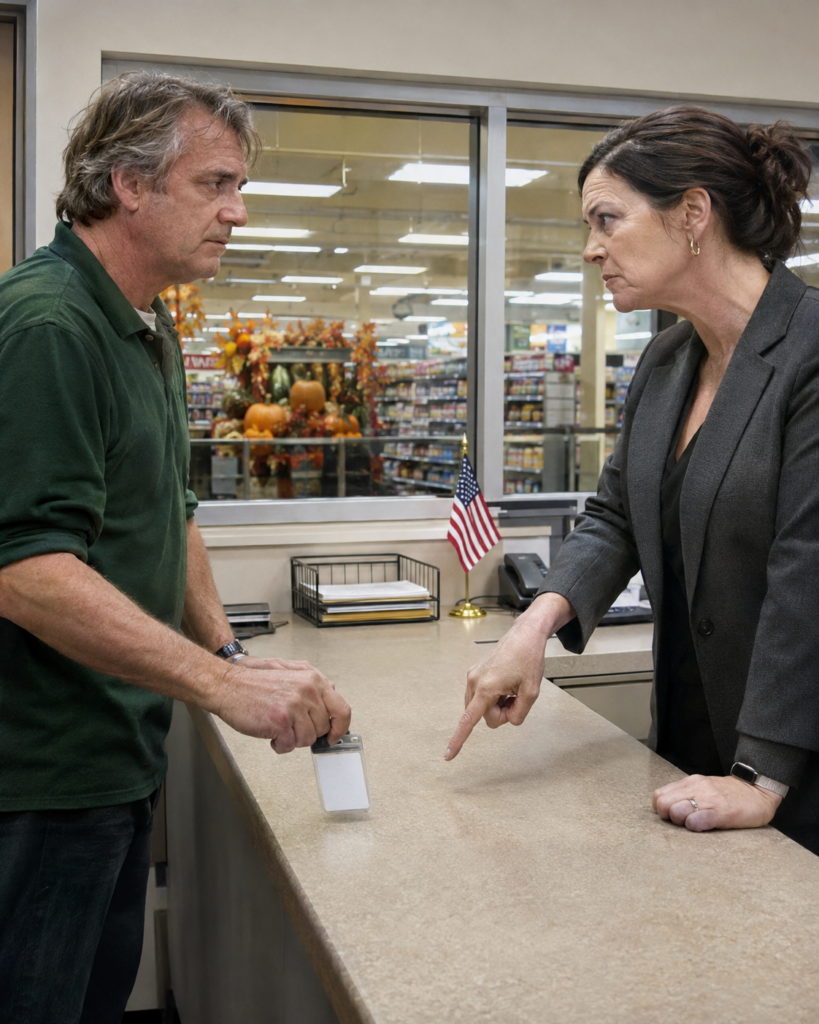
“You’re fired. Badge on the counter.” My boss said that because I wouldn’t give up the Thanksgiving leave she’d approved eight weeks earlier. I’d worked nights at that grocery store for fourteen years, and my daughter was already driving home to spend the holiday with me. I’d arranged a qualified replacement and documented every responsibility. Sloan Gallagher told me she could put ten people in my place by morning. By the next morning, all twenty members of my night crew had walked out. But before leaving, we’d finished every one of the 412 Thanksgiving orders.
My Boss Fired Me for Taking Thanksgiving Leave. Then an $80 Million Buyer Found the Missing Report.
The first thing Joanne Reyes said when she called me on Thanksgiving morning was, “Ray, the appendix you warned Sloan about isn’t in the report we sent to Crestline.”
I stood in my kitchen with a dish towel over one shoulder. My daughter, Lucy, was upstairs getting dressed, and the turkey we’d prepared the night before was waiting in the refrigerator.
Twelve hours earlier, I’d been fired from the grocery store where I’d worked for fourteen years.
Now the company’s chief operating officer was calling my personal phone.
“I know,” I said.
There was a pause.
“You know?”
“I sent Sloan the figures three weeks ago. She told me to put the exceptions in an appendix. I prepared the material and sent it to her office. I never saw the final packet.”
Joanne let out a slow breath.
“Crestline wants to know whether our ninety-nine-point-one-percent order accuracy was achieved by the software or by people correcting the software.”
“Both,” I said. “But if you want to know how much of each, you’ll need to look at the work logs.”
“I found your binder. Three hundred forty-two manual overrides in ninety days.”
“Those are the ones we formally recorded.”
Then she asked, “What do you mean by that?”
I looked toward the staircase. Lucy had driven several hours to spend Thanksgiving with me. For two years in a row, she’d come home expecting a holiday dinner and found an empty house because I’d been called into work.
This year, I’d promised her I would be there.
“Joanne, are there still customers waiting for their orders?”
“Some. We’re working through them.”
“The handwritten labels are grouped by pickup window. Otis put the overflow orders on the numbered staging shelves. The shelf map is in the front of my binder.”
“We found it. That’s how we’ve been getting the orders out.”
“I need you to come in and explain the system.”
I looked at Lucy’s coat hanging beside the door.
“Not today.”
“Ray, this is serious.”
“I know it is. That’s why I’ve been reporting it for months. I’ll meet with you tomorrow and answer every question I can. But today I’m staying home with my daughter.”
Joanne didn’t argue immediately.
Then she said, “All right. Tomorrow. And Ray?”
“I’m putting the final operating-cost certification on hold until we understand these numbers.”
I closed my eyes for a moment.
That was the first time anyone above my direct manager had treated our reports as something worth investigating.
After the call, I set my phone facedown on the counter.
Lucy came downstairs in an old college sweatshirt.
“Was that work?”
Her expression changed.
“Are you going in?”
She watched me, waiting.
“I’m making breakfast,” I said. “Then we’re cooking Thanksgiving dinner.”
She leaned against the doorway.
“Are you sure?”
I understood why she asked.
For two years, I’d given her reasons not to believe me.
My name is Ray Novak. I was fifty-nine years old, and for fourteen of those years, I’d worked nights at a grocery store that belonged to a regional chain preparing to sell itself to Crestline for approximately eighty million dollars.
Most customers never saw the people on my shift.
We arrived when the parking lot was nearly empty. We checked refrigerated deliveries, prepared online pickup orders, stocked shelves, corrected inventory problems, and made sure the morning crew had something resembling an orderly store to open.
I was proud of that work.
I knew which freezer door stuck in damp weather, which loading dock needed an extra inspection after heavy rain, and which supplier regularly mislabeled its produce cases.
I could tell from the sound of a pallet jack whether one of its wheels needed replacing.
Those weren’t things anyone put in a financial presentation.
They were simply the details you learned after doing a job long enough to care whether it was done well.
For years, our store had depended on people knowing those details.
Then the company began introducing automated pickup systems, electronic inventory assignments, and new scheduling software.
I wasn’t against the technology.
A good system could save us hours of unnecessary work. It could reduce mistakes and make complicated orders easier to prepare.
The trouble was that our systems didn’t always do what their reports claimed.
When something went wrong, my crew fixed it.
And because the customer usually received the correct groceries in the end, the problem disappeared from the figures management liked to show.
We’d been doing that for months.
My boss, Sloan Gallagher, called it adaptability.
I called it work.
The difference became important when Crestline started examining the company’s operations.
Crestline wasn’t buying one little grocery store. It was considering the purchase of our regional chain, including the locations, equipment, customer relationships, and systems that kept the business running.
Our store was one of the busiest pickup locations, especially during the holidays.
Management wanted it to demonstrate that automated fulfillment could handle heavy demand with fewer labor hours.
Sloan oversaw the store’s operations and contributed to the reports being prepared for the sale.
She reminded us constantly that the buyer expected efficiency.
“Crestline isn’t interested in a business that relies on one employee knowing where everything is,” she told me during a meeting.
I agreed with the principle.
A business shouldn’t collapse because one person takes a vacation.
That was why I’d spent weeks preparing for mine.
Eight weeks before Thanksgiving, Sloan approved my leave request.
Otis, another certified supervisor, agreed to cover the shift. We reviewed the delivery schedule together, checked the ordering procedures, and confirmed that he had the necessary access to handle exceptions.
I prepared a handoff binder with emergency contacts, equipment instructions, vendor numbers, staffing notes, and the recurring problems we’d encountered with the pickup system.
I didn’t leave anything to chance.
After missing the previous two Thanksgivings, I wanted one holiday with my daughter that wasn’t interrupted by a call from the store.
Lucy lived several hours away. She worked hard, had her own apartment, and rarely asked me for anything.
But she’d always loved Thanksgiving.
When she was little, we used to make breakfast together while the turkey cooked. She liked arranging the biscuits on a baking sheet, even though she never left enough space between them.
As she got older, we watched old movies after dinner and argued about which leftovers belonged in sandwiches.
Those ordinary traditions became harder to maintain after I moved into night work.
The first Thanksgiving I missed, I told her I’d probably be home by noon.
She spent most of the day alone in my house.
The following year, I promised the situation would be different.
Then another staffing problem kept me at the store.
By the time I arrived home, she’d already packed her car.
She hugged me before leaving, but I could tell she was disappointed.
This year, when my leave was approved, I sent her a photograph of the signed request.
She responded with a message.
Don’t make me eat pumpkin pie by myself again.
I wrote back.
Not this year. I promise.
The problems with the new pickup system had started well before Thanksgiving.
At first, they were small enough that we could handle them without delaying customers.
A locker would fail to release an order. A pickup window would disappear from the display. Two bags from different orders would receive the same staging instruction.
We reported those issues through the company’s electronic ticket system.
Most tickets received an automatic acknowledgment.
Very few resulted in a useful explanation.
One night, a customer arrived for a large grocery order that the software said had been placed in a locker.
The locker was empty.
We eventually found the bags on a staging shelf where an employee had placed them after the assigned compartment failed to open.
The customer received everything she’d ordered, but we spent nearly twenty minutes finding it.
The system recorded a successful pickup.
It didn’t record the twenty minutes.
I began keeping a separate log.
I wrote down the date, the order issue, the employee who corrected it, and the approximate time required.
Otis helped me organize the records. Other employees added notes when they encountered problems.
We weren’t trying to build a case against anyone.
We wanted management to understand how much extra work the system required.
Six weeks before Thanksgiving, the night crew submitted a letter requesting changes to scheduling and operating procedures.
Several employees had received last-minute schedule revisions that made it difficult to arrange childcare or transportation.
Others were concerned that new workers were being assigned to equipment they hadn’t been properly trained to use.
We also asked for a reliable procedure to record time spent correcting automated orders.
The letter had twenty signatures.
Sloan’s office acknowledged receiving it.
Nobody answered the concerns.
Three weeks before Thanksgiving, I sent Sloan an email specifically about the financial reports being prepared for Crestline.
I explained that the system’s accuracy figure reflected orders after employees corrected many of the errors.
I asked her to include our manual-override hours, training requirements, and backup procedures in the operating-cost analysis.
She replied that the buyer needed a clear presentation of the main results.
The exceptions, she said, should go in an appendix.
I prepared the appendix.
I included our override logs, examples of recurring problems, and estimates of the time required to correct them.
I sent it through the usual management channel.
Then I went back to work.
I thought the information would eventually reach the people who needed it.
I was wrong.
The scheduling freeze came shortly afterward.
An announcement appeared in the employee system explaining that all previously approved time off during the Thanksgiving period would be suspended.
Managers were instructed to maintain full staffing for the holiday rush.
I understood why the company wanted coverage.
But my replacement had already been arranged.
Otis was qualified. He knew the systems and the crew. My absence wouldn’t leave the store without supervision.
I took the leave approval, staffing plan, and handoff binder to Sloan’s office.
She glanced at the documents.
“The freeze applies to everyone.”
“My leave was approved eight weeks ago.”
“Circumstances changed.”
“I’ve arranged coverage.”
“We need experienced people on the floor.”
“Otis is experienced.”
Sloan leaned back in her chair.
“Ray, you know what’s riding on this weekend.”
“Then don’t make this difficult.”
I tried again.
“The problem isn’t whether I’m here. The problem is that the software is still assigning orders to locker spaces we don’t have.”
She waved that away.
“The system is performing within its targets.”
“It assigned forty orders to twelve lockers last night.”
“The team completed the orders, didn’t they?”
“Because we moved the overflow and labeled everything ourselves.”
“Then the process worked.”
I stared at her.
“That wasn’t the automated process.”
Her expression hardened.
“I don’t have time to debate terminology.”
“I have a daughter driving home for Thanksgiving.”
“And I have an eighty-million-dollar transaction that could be affected by a poor holiday performance.”
I placed the approved leave form on her desk.
“I’m taking the leave we agreed to. Otis will cover the shift.”
She looked at the form, then at me.
“Then you’re fired.”
For a moment, I thought I’d misunderstood.
“Excuse me?”
“Badge on the counter, Ray. We can put ten people in your place by morning.”
Fourteen years of night shifts.
Fourteen years of missed weekends, broken equipment, emergency deliveries, and last-minute requests to cover somebody else’s absence.
And that was how it ended.
I removed my badge.
I set it on the counter beside her desk.
Then I asked one question.
“Who’s responsible for the four hundred twelve Thanksgiving orders that still need to be ready for pickup?”
Sloan looked annoyed.
“The staff can handle them.”
“Then Otis needs the current staging information. The locker assignments are wrong again.”
She told me to finish the turnover and leave.
That was the last instruction she gave me as my boss.
I went back to the night crew.
Otis was waiting near the pickup staging area.
He looked at my empty shirt pocket.
“She fired you?”
“Over Thanksgiving?”
He shook his head.
For a moment, neither of us said anything.
The room was full of packed grocery bags, rolling carts, and printed order tickets.
Families all over town were counting on those groceries for the next day.
Some were buying enough food for twelve people. Others had ordered one small turkey, potatoes, and a pie.
Those customers didn’t know anything about our scheduling dispute.
They shouldn’t have had to.
I told Otis what Sloan had said and explained that he was now responsible for the remaining shift.
Then I asked him to gather the crew.
I didn’t make a speech about loyalty.
I told them the truth.
I’d been fired over approved Thanksgiving leave.
I also told them I wasn’t asking anyone to resign.
Some employees had mortgages. Some supported children or aging parents. One young man had only recently started earning enough to pay his bills without help from his family.
Losing a paycheck wasn’t a small thing.
But the crew had heard enough.
An employee named Alma told us she’d received a schedule change with only three hours’ notice the previous week.
Miguel said he’d been worrying about his mortgage ever since the company began cutting labor hours while assigning more work to the remaining staff.
Others mentioned the letter we’d submitted six weeks earlier.
Nobody had received a response.
Otis listened, then held up his hand.
“Before anybody decides what they’re doing, we need to finish these orders.”
He looked around the group.
“Whoever stays isn’t a traitor. Whoever leaves isn’t a hero. You’ve all got households to think about.”
That settled the immediate argument.
We went back to the orders.
Because the locker software was unreliable, Otis directed the employees with system access while the rest of us used the manual staging plan.
Every bag received a label with the customer’s name, order number, and pickup time.
Refrigerated items stayed in the appropriate temperature-controlled areas. Dry goods were arranged by pickup window, and the order sheets showed exactly where each part of a customer’s purchase could be found.
We checked the counts.
Then we checked them again.
By the time the work was finished, all 412 Thanksgiving orders were prepared.
The shelves were stocked, the handoff was complete, and the morning crew had the information it needed.
Only then did people make their decisions.
One by one, the members of the night crew told Otis they were leaving.
Some had already been looking for other jobs.
Others decided that night.
Otis was the last to speak.
He looked at the twenty people who’d spent the evening working beside him.
“I can’t ask you to trust a company that won’t answer you,” he said.
He chose to leave, too.
When the shift ended, all twenty members of the crew walked out.
We didn’t damage anything. We didn’t hide the orders or interfere with the morning staff.
We simply left the work completed and refused to continue under the same conditions.
I stood in the parking lot with my coworkers while the sky began to lighten.
One employee was crying.
Another was already on the phone with his wife.
Miguel stared at his car keys.
“I don’t know how I’m going to explain this at home.”
I didn’t have an answer.
That worried me more than anything Sloan had said.
Then Otis put a hand on my shoulder.
“Go home, Ray.”
I looked at the store.
For fourteen years, I’d been the person who stayed when something went wrong.
This time, there was nothing more for me to do.
I got in my car.
Lucy was sitting at the kitchen table when I came home.
She’d arrived the evening before and fallen asleep waiting for me.
Now she was wearing a sweater I’d bought her years ago, holding a mug of coffee with both hands.
“You’re home early,” she said.
I hung up my coat.
“I lost my job.”
She put down the mug.
“What happened?”
I told her.
I explained the approved leave, Sloan’s decision, and the twenty employees who’d left after finishing the orders.
Lucy listened without interrupting.
When I finished, she looked toward the window.
“Fourteen years,” she said.
“Are you okay?”
“I don’t know yet.”
She stood and came around the table.
Then she hugged me.
I expected her to say something about finding another job or fighting the termination.
Instead, she said, “I’m glad you’re here.”
That nearly undid me.
We had breakfast and went to sleep for a few hours.
Later, we prepared the turkey together.
I was worried about my retirement savings, my health insurance, and the fact that starting over at fifty-nine would be harder than it had been at forty-five.
But when Lucy asked whether we should make biscuits from scratch, I took out the flour.
We had time.
That felt unfamiliar.
On Thanksgiving morning, the store’s problems began almost as soon as customers arrived.
I learned the details in pieces.
Otis received a call from a former coworker on the morning shift. He sent me a message saying the pickup lockers weren’t releasing orders correctly.
Another employee reported that a customer had opened her assigned locker expecting a turkey for eleven people and found a ham.
The staff eventually located her correct order using our handwritten labels.
Other customers were waiting while employees searched the staging areas and requested supervisor overrides.
Without the trained night crew, simple corrections took longer.
Joanne Reyes arrived after being notified that the pickup operation was falling behind.
She was the company’s chief operating officer, several levels above Sloan.
I’d met her only twice in fourteen years.
I knew she was involved in preparing the business for the Crestline sale.
What I didn’t know was that she had already begun questioning the accuracy of the holiday-performance report.
Later, she told me that the handwritten labels caught her attention.
They were everywhere.
On paper bags, cooler racks, and staging shelves.
Each carried information the automated system was supposed to provide reliably.
She asked why employees had prepared so many manual labels.
Nobody could give her a complete explanation.
Then she found my handoff binder.
The first section explained how to retrieve orders when the locker assignments failed.
The second contained equipment and staffing procedures.
Farther back were the operating logs.
Ninety days.
Three hundred forty-two recorded manual overrides.
Joanne had opened the binder expecting emergency instructions.
Instead, she’d found a record of work that the company’s financial presentation barely acknowledged.
She contacted the people responsible for preparing the sale documents.
When they compared the binder with the information sent to Crestline, they found my warning email to Sloan.
And they found Sloan’s response.
Put the exceptions in an appendix.
There was no appendix.
That discovery led to the phone call in my kitchen.
Lucy watched me put the phone down.
“Is the store in trouble?” she asked.
“Possibly.”
“Are they asking you to fix it?”
“They want me to explain what happened.”
She pulled out a chair.
“Dad, can I tell you something without you getting upset?”
“Of course.”
She sat down.
“Every time that store had a problem, you acted like it was your responsibility to save everybody.”
I leaned against the counter.
“It was my responsibility to keep things running.”
“While you worked there, yes.”
I didn’t answer.
“But you let them make you responsible for things you couldn’t control. You’d work extra hours, cover somebody else’s shift, and fix equipment problems. Then you’d come home exhausted and say they couldn’t have managed without you.”
“They probably couldn’t have on some nights.”
“Then they needed more people and better systems.”
I looked at her.
She continued carefully.
“I’m proud of how hard you work. I always have been. But I spent two Thanksgivings waiting for you because somebody at that store knew you’d come in if they called.”
The words hurt because they were true.
“I thought I was doing the right thing,” I said.
She reached for my hand.
“I don’t want you to stop caring about people. I just want you to care about yourself, too.”
We sat quietly for a while.
Then she stood.
“Come on. We have potatoes to peel.”
I picked up the peeler.
For once, the store had to find its own way through the day.
Thanksgiving dinner wasn’t perfect.
The turkey was a little dry near the breast. Lucy added too much salt to the mashed potatoes, and I forgot to put the rolls in the oven until everything else was ready.
We ate anyway.
We talked about her work, a neighbor who had bought an enormous dog for a tiny apartment, and an old family vacation where I’d driven us in the wrong direction for nearly an hour.
We didn’t spend the meal discussing Crestline.
At one point, Lucy looked at the clock.
“It’s almost four.”
“Last year, you were still at work.”
She reached for another roll.
“I’m glad you’re home.”
After dinner, we washed the dishes together.
My phone stayed on the counter.
It rang once, but I didn’t answer until we’d finished putting everything away.
The call could wait.
The following afternoon, Joanne met me in a small conference room at the company’s regional office.
I wore the same clean work jacket I’d worn to the store for years.
I hadn’t yet decided whether I was looking for another job, asking for my old one back, or simply explaining why the company’s numbers were wrong.
Joanne greeted me at the door.
“Thank you for coming.”
“You said you had questions.”
“I have quite a few.”
A finance manager and a human resources representative were already seated.
Joanne had my binder on the table.
She’d placed colored tabs beside several pages.
“I’d like to begin with the 342 overrides,” she said.
I opened the log.
“That’s the number of formal corrections we recorded over ninety days.”
“What counts as a correction?”
“Anything that required a supervisor to intervene in an order the system couldn’t complete as assigned. Failed locker releases, duplicate staging locations, inventory mismatches, and certain pickup errors.”
“Does every manual correction appear here?”
The finance manager looked up.
“Some fixes didn’t require a supervisor override. An employee might move overflow bags to a staging shelf or correct a mislabeled tote before the order reached the customer. We wrote down many of those incidents, but the software didn’t have a category for all of them.”
Joanne turned a page.
“How much time did this take?”
“It varied. Sometimes two minutes. Sometimes half an hour. We’d have to compare the logs with staffing records to calculate a reliable total.”
The finance manager pointed at another report.
“Those employees were already being paid.”
“So the labor expense was already in the company’s payroll.”
“That’s right.”
He looked confused.
“Then what cost is missing?”
“The hours weren’t being counted as part of running the automated pickup operation,” I explained. “They were often included under general stocking or overnight store labor. The buyer’s report shows what the machines supposedly cost to run, but it doesn’t show how much employee time was needed to make the system work.”
Joanne looked at him.
That was the issue.
The company hadn’t necessarily failed to pay the employees.
It had failed to account properly for the work those employees performed.
The automation looked cheaper because some of its operating costs were recorded elsewhere.
The finance manager turned back to me.
“And the ninety-nine-point-one-percent accuracy?”
“That was measured after we corrected orders.”
“Can you prove it?”
“I can show you how we processed them. I can’t give you a reliable automated-only accuracy figure because the company didn’t measure it separately.”
Joanne leaned forward.
“Explain that.”
I took a blank piece of paper.
“Suppose the system assigns an order to the wrong locker. My crew notices, moves the order, labels it, and makes sure the customer gets the right groceries. The final order is correct.”
“So the customer-accuracy report counts it as successful.”
“Which it was.”
“Yes. But if you use that number to claim the software handled the order correctly without human intervention, you’re measuring the wrong thing.”
The room was quiet.
I continued.
“If Crestline wants to know whether customers received the right orders, the final accuracy number is useful. If it wants to know whether this system can operate with fewer employees, it needs different information.”
Joanne looked down at the binder.
“That’s what you were trying to tell Sloan.”
“And she told you to put it in an appendix.”
The finance manager asked whether I had a copy of the appendix I’d prepared.
“I have the original file and the email showing when I sent it.”
“Please provide both.”
I looked at Joanne.
“I will. But I’m not the only person who knows this work. Otis knows the system. So do the other employees.”
“I’d like to speak with them.”
“Then they need to be compensated for their time. They’re no longer on your payroll.”
Joanne considered that.
“That’s fair.”
I felt a small measure of relief.
For once, the people who’d done the work weren’t being treated as an afterthought.
Joanne asked about the forty orders assigned to twelve locker spaces.
I showed her the incident report.
The system had assigned forty orders to a locker bank that physically contained twelve usable compartments.
The crew moved the overflow orders to appropriate staging areas and created a manual retrieval list.
The problem wasn’t that forty bags had been crammed into twelve lockers.
The problem was that the system had generated assignments for spaces that weren’t available.
“Why didn’t the software reject those assignments?” Joanne asked.
“I don’t know. I reported the problem and asked for someone to check the configuration.”
She made a note.
That afternoon, she asked a technical manager to review the installation records.
The explanation came several days later.
The locker bank had originally been planned as a larger installation. The final site had only twelve compartments, but part of the configuration still reflected the earlier capacity.
The software could therefore generate assignments based on space the store didn’t actually have.
The issue had been reported repeatedly, but the tickets had been closed or marked resolved without confirming that the configuration matched the physical installation.
It was a simple enough problem to understand.
That made it harder to excuse.
My crew had been spending time correcting an error that should have been fixed at its source.
Before I left the meeting, Joanne asked about my termination.
I gave her a copy of the leave approval.
Eight weeks before Thanksgiving.
I showed her the staffing plan with Otis listed as my qualified replacement, along with the confirmation that he had agreed to cover the shift.
Then I showed her the scheduling-freeze announcement.
Joanne studied the documents.
“Sloan says the freeze was necessary to protect holiday operations.”
“I understand why management wanted coverage. I had arranged coverage.”
“Was there any concern about Otis’s qualifications?”
“None that was raised with me.”
“Did you refuse to complete your assigned work?”
“No. The crew finished all 412 orders before leaving.”
She looked up.
“And Sloan told you she could replace you with ten people by morning?”
“Those were her words.”
Joanne didn’t react dramatically.
She wrote something down.
Then she said, “Human resources will review the circumstances.”
I wasn’t sure what that meant.
At fifty-nine, I knew better than to mistake a polite sentence in a conference room for a promise.
I thanked her for the meeting.
As I reached the door, she called my name.
“Why did you keep such detailed records?”
I thought about the binder.
“Because when something goes wrong at three in the morning, somebody has to remember how we fixed it.”
She nodded.
I went home.
The next week was difficult.
I had enough savings to manage for a while, but I couldn’t ignore what losing fourteen years of steady employment meant.
Health insurance, retirement contributions, and a regular paycheck were no small things at my age.
I spent one morning reviewing my finances and another updating a résumé I hadn’t touched in years.
Describing fourteen years of work in a few lines was harder than I’d expected.
I wrote that I supervised overnight operations, handled inventory, managed staff, and coordinated order fulfillment.
That didn’t quite capture what I did.
But I didn’t know how to fit a broken freezer seal, a missing delivery, and an angry customer expecting Thanksgiving dinner into a résumé.
Lucy called regularly.
She offered to help with applications.
I appreciated it, though I wasn’t ready to admit how uncomfortable I felt looking for work again.
Meanwhile, I kept in touch with my former crew.
Otis was worried.
His household depended on his income, and he was already contacting other stores about openings.
Alma had picked up temporary shifts elsewhere.
Miguel was reviewing his bills with his wife, trying to work out how much time he had before he needed another paycheck.
I felt responsible for them.
Otis wouldn’t let me pretend I’d forced their decisions.
“We knew what we were doing,” he told me over coffee.
“Some of you couldn’t afford it.”
“Neither could you.”
I looked down at my cup.
He continued.
“We didn’t leave because you told us to. We left because they’d stopped listening long before they fired you.”
I wanted to believe him.
Still, I couldn’t forget the people behind those twenty decisions.
One employee had a new baby.
Another was helping her father pay for prescription medications.
They hadn’t walked out of a movie scene.
They’d walked away from real paychecks.
That mattered.
Joanne contacted the crew members individually and offered to compensate them for voluntary interviews about the operating system.
Several agreed.
Others wanted nothing to do with the company.
I didn’t pressure them.
When Otis attended his interview, he brought his own notes.
He explained how the locker assignments failed, how morning pickup orders were staged, and how employees used manual labels to prevent customers from receiving the wrong bags.
Alma described what last-minute schedule changes had done to her childcare arrangements.
Miguel spoke about training new employees on equipment that still required supervisor intervention.
Their accounts supported the logs.
The company could no longer dismiss the problems as one disgruntled supervisor’s complaints.
Joanne also requested a broader review of the automated pickup operations at other stores in the chain.
The results weren’t identical everywhere.
Some locations had well-configured systems and reliable procedures.
Others had recurring exceptions that were handled by experienced workers but poorly recorded in management reports.
That was important.
It meant the technology wasn’t automatically a failure.
It also wasn’t automatically a success.
The company had been making decisions without enough reliable information to distinguish one from the other.
Two weeks after Thanksgiving, Joanne invited me to another meeting.
This time, Crestline’s representatives would attend.
I hesitated.
I’d never sat across from people deciding whether to spend eighty million dollars on a business.
Most of my meetings involved delivery schedules and broken equipment.
Joanne asked whether I would explain the operational records.
I agreed on one condition.
“I’ll describe what I know. I’m not going to guess at figures I can’t verify.”
“That’s exactly what we need,” she said.
The meeting took place in a room with large windows and a long polished table.
Crestline sent two people from its operations and financial teams.
Neither seemed interested in dramatic speeches.
They had spreadsheets, questions, and a clear understanding of how much money was at stake.
One of them asked me to explain a manual override.
I described the process.
He asked how often employees needed to intervene.
I pointed to the recorded cases and explained the limits of the available data.
Then he asked a question that changed the direction of the meeting.
“If we acquired this chain and reduced overnight staffing based on the projected automation savings, what would happen to customer accuracy?”
I looked at him.
“You’d be taking away part of the process that’s currently making the reported accuracy possible.”
“How much would accuracy fall?”
“I can’t give you a number I haven’t measured.”
“Fair enough. What would you need to measure it?”
I explained that the company would have to track first-pass automated results separately from final customer outcomes.
It would also need to record the labor spent correcting errors, the training required for those corrections, and the costs of keeping backup procedures available.
The Crestline representative turned to Joanne.
“Was this distinction included in the financial model?”
Joanne answered before anyone else could.
“Not adequately.”
He looked at the report in front of him.
“The model describes the process as highly automated. The labor assumptions are based on that description.”
“Yes,” Joanne said.
“And the operating team was reporting uncounted manual intervention?”
“Before the report was distributed?”
Joanne glanced at me.
Nobody raised their voice.
Somehow, that made the exchange more serious.
The representative closed the folder.
“We’re not saying human involvement is unacceptable. Grocery operations require people. But we need to know what we’re buying.”
I thought about all the nights my crew had spent quietly correcting orders.
For years, their competence had hidden the weakness of the numbers being used to measure their jobs.
Now the buyer wanted those same workers’ knowledge because the reports couldn’t explain what was happening.
Sloan attended the second half of the meeting.
I hadn’t seen her since she’d fired me.
She wore a dark suit and carried a folder beneath one arm.
When she noticed me, her expression tightened.
She sat down across the table.
Joanne explained that the review had identified material differences between the automated pickup assumptions and the actual operating procedures.
Sloan responded quickly.
“The customer-accuracy figure was correct.”
“After manual corrections,” Joanne said.
“That’s standard operational practice. Employees are part of the process.”
“Then their labor should have been included in the automation cost analysis.”
“It was included in overall store payroll.”
The Crestline representative leaned forward.
“But not allocated to the automated fulfillment model we were given.”
Sloan looked annoyed.
“The figures were prepared under tremendous time pressure. The purpose was to show the business’s performance, not document every minor exception.”
I opened my folder.
“Those exceptions are what keep the pickup service working.”
She turned toward me.
“Ray, you supervised a team that was responsible for handling normal problems. That’s what employees are paid to do.”
“Then why are you acting as though correcting orders was some extraordinary burden?”
“Because the company was using those corrected orders to argue that it could operate with fewer employees.”
Sloan glanced at Joanne.
“This is exactly the sort of misunderstanding I was concerned about.”
I felt the old pressure to stop talking.
For fourteen years, she’d been my boss.
She knew how to make a room feel as though disagreement was an inconvenience.
But I wasn’t sitting there as her employee anymore.
I took out the email I’d sent three weeks before Thanksgiving.
“You asked me to prepare the manual-override figures and backup procedures for the appendix.”
“I remember.”
“I sent them.”
“I received a great deal of material during that period.”
“Did you include my appendix in the report?”
She didn’t answer immediately.
Joanne spoke.
“We’ve reviewed the documents distributed to the board and Crestline. The appendix isn’t there.”
Sloan folded her hands.
“The main report included all the significant performance indicators.”
The Crestline representative looked at her.
“Who decided those labor exceptions weren’t significant?”
Sloan remained silent for a moment.
Then she said, “I made the judgment that they didn’t alter the overall value of the business.”
Joanne’s expression changed.
“You had the information and chose not to include it?”
“I believed the operating model was sound.”
“You told Ray to prepare an appendix.”
“And I believed the final presentation needed to remain focused.”
The representative beside me wrote something down.
I watched Sloan’s face.
For the first time, she looked less angry than frightened.
After the meeting, Sloan found me in the hallway.
She looked toward the conference-room door before speaking.
“You didn’t have to bring that email into the discussion.”
“I was asked what I reported.”
“You know how much pressure we were under.”
“Crestline was questioning everything. If the sale falls apart, people could lose their jobs.”
I thought about the twenty people who had already lost theirs.
“Sloan, we were trying to keep the store running.”
“And I was trying to keep the company alive.”
She sounded genuinely exhausted.
I could believe that she had been under pressure from above. I could believe she’d spent months worrying that an unfavorable report would cost her career.
But that didn’t explain why she’d ignored the concerns of the people working for her.
“You could have told them what the system actually required,” I said.
She shook her head.
“You’ve never had to sit in those board meetings.”
“No,” I replied. “But I’ve stood in front of a customer who needed groceries for her family and watched the locker display tell her that her order didn’t exist.”
“That isn’t the same thing.”
“I know. Both matter.”
She looked away.
After a moment, she said, “I didn’t expect everyone to leave.”
“I didn’t, either.”
“I thought they’d stay once they understood the consequences.”
“They understood the consequences.”
Her eyes returned to mine.
“Do you think this is going to fix anything?”
“I don’t know.”
I meant it.
I hadn’t left the store with a plan to embarrass her, derail the sale, or become some kind of spokesman for the night shift.
I’d wanted to spend Thanksgiving with my daughter.
And I’d wanted the work my crew performed to count for something.
Sloan looked at me for another moment.
Then she walked away.
I never had another private conversation with her.
The Crestline transaction didn’t collapse that afternoon.
Real business decisions rarely happened so neatly.
The buyer requested updated operating figures, additional testing, and a clearer explanation of the labor required to support the automated systems.
The company agreed to extend its review process.
The proposed eighty-million-dollar transaction remained under discussion, but the original cost assumptions could no longer be used without revision.
The board wasn’t pleased.
Joanne told me later that several directors wanted to know why the discrepancy had reached the buyer before being resolved internally.
She accepted responsibility for the company’s failure to verify the operating reports more carefully.
Sloan was placed on administrative leave while the company reviewed her handling of the reports, the crew’s complaints, and my termination.
Eventually, her employment ended.
I didn’t receive a detailed account of every internal finding, and I didn’t ask for one.
I knew what the records showed.
Sloan had received warnings about the system, instructed me to prepare supporting information, and approved a presentation that omitted it.
That was enough to explain why the company no longer trusted her to oversee the operation.
There were no dramatic arrests or public confrontations.
The company simply had to account for decisions that had been hidden behind a polished set of numbers.
Joanne called me again in early December.
This time, she didn’t begin with a financial report.
“I’d like to talk about the night crew,” she said.
“What about them?”
“We want to offer the employees who resigned an opportunity to return.”
“Under what conditions?”
“We’re reviewing scheduling procedures, training requirements, and the pickup system. I believe we can make meaningful changes.”
“I hope so.”
“Would you help us speak with them?”
I considered the request.
“I’ll let them know you’re interested. But I won’t ask anybody to come back based on promises.”
“That’s fair.”
“They need the details in writing.”
Joanne agreed.
A week later, the company sent individual offers to the former employees.
The offers recognized prior service for those who chose to return, described the available positions, and explained the immediate scheduling changes management intended to make.
The company also offered paid training on the revised pickup procedures.
Not everyone accepted.
Some employees had already found other work.
Others no longer trusted the company and preferred to move on.
I respected those decisions.
Twelve of the twenty eventually returned.
The other eight pursued different jobs or chose not to come back.
Otis was among those who returned.
He called me before signing.
“They’re offering me the overnight supervisor position,” he said.
“You earned it.”
“They’ve also agreed to document the backup staffing and override procedures.”
He hesitated.
“Do you think I’m making a mistake?”
I thought about our conversation in the parking lot on Thanksgiving morning.
“You’re the only one who can decide what your household needs.”
He laughed softly.
“Using my own words against me?”
“Only the good ones.”
He accepted the position.
I was glad.
He had always been capable of running the shift. He simply needed an employer willing to let him do it properly.
The company began changing the pickup process.
The technical team corrected the locker configuration so the software could no longer assign forty orders to a twelve-compartment bank.
That was the easy part.
The harder work involved procedures.
Management introduced separate measures for automated first-pass performance and final customer-order accuracy.
Employees were instructed to record manual interventions through a designated process, with the time associated with those corrections assigned to the appropriate operating costs.
The company also revised training schedules and established written backup procedures for equipment failures.
I wasn’t under the illusion that every mistake would disappear.
No grocery operation runs perfectly.
Deliveries arrive late. Equipment fails. Customers change orders. Employees make mistakes.
What mattered was that management had begun measuring the work required to correct those problems.
The company also replaced the blanket approach to holiday scheduling with clearer approval and staffing procedures.
Previously approved leave couldn’t simply be canceled through a broad announcement without review of the coverage already arranged and the actual operational need.
There were still circumstances in which schedules might need to change.
But the company had to account for those decisions rather than assuming employees would rearrange their lives whenever a manager demanded it.
The crew’s earlier letter finally received a written response.
Six weeks after sending it, we’d been ignored.
Now every item had an answer.
Some changes took time. Others required new staffing budgets.
But the concerns were no longer sitting unanswered in an inbox.
Joanne asked me whether I wanted to return to my old position.
That surprised her.
“You’ve spent fourteen years there.”
“Your crew respects you.”
“I respect them.”
“Then why not come back?”
I thought about Lucy and the two empty Thanksgivings.
“I don’t want to go back to being the person everyone calls because the system doesn’t work.”
Joanne listened.
“I’d rather help make sure the system works when the person responsible for it takes a day off.”
She smiled a little.
“That’s actually something I wanted to discuss.”
The company was creating a small operations-improvement role focused on training, process documentation, and evaluating manual interventions at its stores.
Joanne asked whether I’d consider a fixed-term assignment helping develop the procedures.
It was tempting.
The work was familiar, and I liked the idea of using what I’d learned to prevent the same problems from happening elsewhere.
But I asked for the terms in writing.
I wanted regular daytime hours, a defined scope of responsibility, and clear expectations about after-hours calls.
I also wanted the job to involve the employees who actually performed the work.
Not just managers looking at charts.
Joanne agreed to prepare a proposal.
I took it home and reviewed it carefully.
Lucy read it, too.
“You’d be good at this,” she said.
“Do you want to do it?”
“I think so.”
She pointed to the section describing work hours.
“Then make sure they mean this.”
“I intend to.”
I signed a six-month agreement.
It didn’t make me an executive, and it didn’t turn me into a wealthy consultant.
It gave me a chance to do useful work without returning to the exact arrangement that had cost me so much time with my daughter.
That was enough.
The next several months were busy.
I visited different stores, spoke with employees, and compared the procedures management believed were in place with what actually happened during a shift.
Sometimes the differences were small.
A training guide referred to equipment that had been replaced two years earlier.
A backup process depended on a supervisor who no longer worked at the location.
A report measured the time required to prepare an order but not the time required to correct it when something went wrong.
Other problems were more serious.
At one location, employees had developed their own handwritten method for tracking refrigerated overflow because the electronic system couldn’t handle certain large orders.
When I asked why they hadn’t reported the issue, an older employee shrugged.
“We did. Nobody came.”
I recognized that answer.
Instead of telling him to open another ticket and hope for the best, I asked him to show me the process.
We documented it, checked the system settings, and brought in the people responsible for making changes.
The employees helped test the revised procedure.
Not every solution was expensive.
Sometimes the problem was a setting.
Sometimes it was a poorly designed screen.
Sometimes a manager needed to give an employee enough time to explain what was going wrong.
I kept remembering the question Crestline’s representative had asked:
What would happen if the company reduced staffing based on projected automation savings?
I couldn’t answer it honestly back then.
Now part of my job was helping the company gather the information required to answer questions like that before making staffing decisions.
Crestline eventually agreed to proceed with the acquisition after the operating review and revised financial terms were completed.
The deal took longer than originally planned.
The price and performance conditions changed to reflect the updated cost projections and the additional work required to stabilize the systems.
There was no instant financial disaster.
The business still had customers, valuable locations, experienced employees, and equipment that could work well when configured and supported properly.
But the buyer no longer had the same picture of an almost fully automated operation.
The revised plans included the labor, training, and backup capacity needed to deliver the service customers expected.
For me, the most important evidence of change wasn’t the completed transaction.
It was what happened during ordinary shifts.
Otis began sending me periodic updates about the pickup operation.
The reports showed manual interventions alongside the final customer results.
When an override occurred, someone could identify why it happened, how long it took, and whether the problem required a system fix or additional training.
The numbers didn’t always look as impressive as the old presentations.
They were more useful.
And when employees asked for help, their requests were no longer dismissed simply because the customer had eventually received the correct groceries.
A few weeks after the sale closed, Joanne invited me to lunch.
She wanted to discuss whether I’d consider a longer-term position.
We met at a quiet restaurant near the regional office.
She thanked me for the work I’d done.
Then she asked a question I hadn’t expected.
“Ray, do you think we would have discovered these problems if the night crew hadn’t left?”
I thought about it.
“Eventually, probably.”
“But not before the sale?”
“I don’t know.”
She stirred her coffee.
“I’ve been thinking about that.”
“For months, we received reports showing strong customer results. We saw complaints about scheduling and equipment, but they were treated as local issues. We didn’t connect them to the financial model.”
“Because the customers were still getting their orders.”
I considered the people who’d been packing bags in the middle of the night.
“When you’ve got a good crew,” I said, “they can make a bad process look good for a long time.”
Joanne looked at me.
“And eventually?”
“Eventually, they get tired. Or they leave. Then you find out how much they were holding together.”
She was quiet for a moment.
“I wish we’d listened sooner.”
She didn’t ask me to forgive the company.
I appreciated that.
Instead, we talked about the work that still needed doing.
I agreed to continue in a regular operations-training role with a defined schedule.
I kept my pension and retirement planning in mind, and I made sure the new arrangement wouldn’t require me to return to constant overnight emergency coverage.
For the first time in years, my calendar looked like something I had a say in.
Lucy noticed the difference before I did.
I was sleeping regular hours.
I had dinner at home most evenings.
When she called, I wasn’t always standing in a loading dock or whispering over the noise of an overnight delivery.
We began visiting each other more often.
Sometimes she came to my house for a weekend. Other times I drove to hers and helped with small repairs she’d been putting off.
One Saturday, while we were fixing a loose kitchen cabinet, she asked whether I missed the night shift.
“Sometimes.”
She looked surprised.
“I miss the people. I miss knowing exactly what needs doing.”
“You still know what needs doing.”
“It’s different when you’re not the one standing there at three in the morning.”
She tightened a screw.
“Do you regret leaving?”
I thought about the months after Thanksgiving.
There had been days when I was frightened.
I’d worried about money and whether I’d made a mistake at an age when starting over wasn’t easy.
I’d worried about the twenty employees who had left with me.
Some had found work quickly. Others had struggled.
Not everyone had ended up in the same place, and I couldn’t pretend the decision had been painless.
But I also remembered the approved leave form in Sloan’s office, the binder nobody wanted to read, and my daughter’s empty place at the Thanksgiving table.
“No,” I said. “I don’t regret it.”
Lucy nodded.
Then she handed me another screw.
“Because this cabinet still needs you.”
The following November, Otis called me the week before Thanksgiving.
I was sitting at my desk reviewing a training schedule.
“Got a minute?” he asked.
“We’re looking good for the holiday rush.”
“That’s encouraging.”
“The locker assignments have been stable. We added another backup supervisor to the schedule, and the overflow plan is tested.”
“Any concerns?”
“A few. Nothing we can’t handle.”
“That sounds like a normal grocery store.”
He laughed.
Then he said, “I wanted you to know something.”
“I’ve approved my assistant supervisor’s Thanksgiving leave.”
“She submitted it two months ago. Her replacement is trained, and the handoff is complete.”
I leaned back in my chair.
“Then you’ve done your job.”
He was quiet for a second.
“You know, I still have your old binder.”
“I’m surprised it hasn’t fallen apart.”
“It’s in a cabinet. We use the updated procedures now.”
“That’s how it should be.”
I asked whether he needed anything else.
“No,” he said. “Just wanted to tell you.”
After we hung up, I looked at my calendar.
My Thanksgiving leave was marked in blue.
No emergency notice.
No scheduling freeze.
I shut down my computer at the end of the day and went home.
Lucy arrived the day before Thanksgiving with two grocery bags and a pie she’d bought from a bakery near her apartment.
She walked through the front door and set everything on the kitchen counter.
“I brought dessert.”
“I can see that.”
“Don’t start. You liked it last year.”
“I liked the one we made better.”
“You only say that because you burned the crust.”
I helped her unpack.
There were potatoes, green beans, butter, and a small package of rolls.
She held up the turkey I’d already bought.
“Are we cooking this tonight?”
“Tomorrow morning.”
“What time?”
“Whenever you get up.”
She smiled.
That evening, we sat at the kitchen table making a list of what still needed to be done.
I found an old pad of labels in the drawer.
It was the same kind we’d used at the store before the company finally fixed its pickup procedures.
Lucy watched me write TURKEY on one and stick it to the roasting pan.
“Dad, I think we can identify the turkey without a label.”
“Old habits.”
She laughed.
Then she picked up the pen and wrote another label.
LUCY’S PIE — HANDS OFF.
She pressed it firmly onto the bakery box.
I shook my head.
“That’s unnecessary.”
“Not after what happened to last year’s pie.”
We finished preparing the vegetables and put everything away.
Before going upstairs, Lucy paused in the kitchen doorway.
“Thank you for being here.”
I looked at the clock.
There was still time to sleep before morning.
“Wouldn’t miss it,” I said.
The next afternoon, when the turkey was ready, I carried the platter to the table.
Lucy pulled out my chair.
Six place settings would have been unnecessary. It was just the two of us, the way we’d planned.
She waited until I sat down.
Then she reached for my hand, smiled, and said, “Happy Thanksgiving, Dad.”
I squeezed her hand.
“Happy Thanksgiving, sweetheart.”
And this time, I stayed for dinner.
✓ Lynn R. Adams
My Boss Fired Me for Taking Thanksgiving Leave. Then an $80 Million Buyer Found the Missing Report. The first thing Joanne Reyes said when she called me on Thanksgiving morning was, “Ray, the appendi…