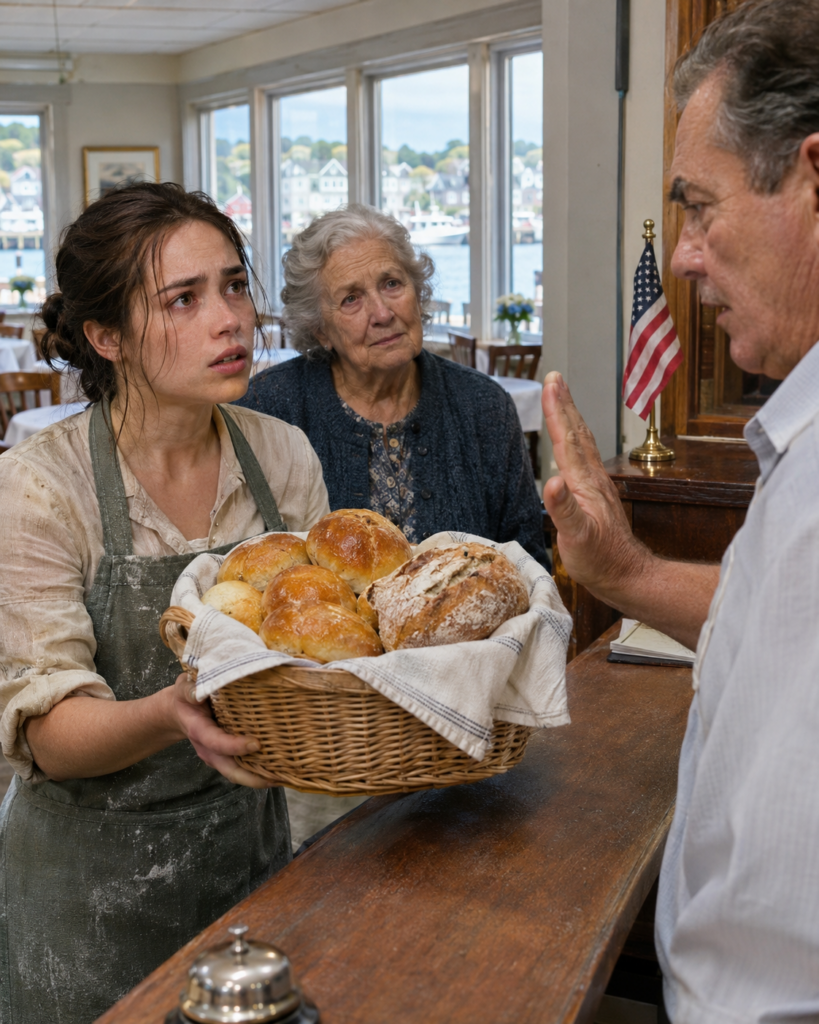
“Your bread smells good, Maya. But breakfast is over.” The hotel owner said that after I’d spent the morning preparing bread I couldn’t sell. I was twenty-two, dreaming of opening my own bakery, yet I kept arriving after my customers had already eaten. An elderly woman named Nurma watched me walk away with the unsold bread and said something that stayed with me: “Late bread is still bread, but it is no longer breakfast.” Then she invited me to meet her at the harbor before the first fishing boat left.
The Hotel Owner Turned Away My Bread. Then the Ovens Went Dark on the Biggest Morning of My Life.
Nurma was already opening the iron door of her old coal oven when I came through the gate.
“Put the trays on the table,” she said. “And close that gate behind you. You’re letting the wind in.”
I stood there with two covered trays in my arms, trying to catch my breath. Less than twenty minutes earlier, the electricity had gone out across half of Bell Haven. My kitchen oven had stopped heating, the refrigerator light had disappeared, and every carefully arranged plan I’d made for the coastal festival had suddenly become useless.
At least, that was what I’d thought.
Now I could see orange light inside the brick oven behind Nurma’s cottage.
“You started the fire?” I asked.
“Before dawn. Like we agreed.”
“But the power wasn’t out then.”
“No. It wasn’t.”
She pulled on a thick glove and adjusted the vent beneath the baking chamber.
“You wanted a backup, Maya. A backup has to be ready before something goes wrong.”
I had no time to argue with that.
The festival judges were scheduled to taste our bread at eleven. Elena Hart, a well-known café owner, was coming to choose a local baker for a one-year supply contract. I’d spent three weeks preparing, and I had saved for months to afford the ingredients, equipment, and entry fee.
At twenty-two, I was still baking in a cramped kitchen behind my rented apartment. Winning that contract wouldn’t make me rich, but it might give me the steady income I needed to build a real bakery.
Losing it wouldn’t mean the end of my dream.
I knew that.
But standing in Nurma’s yard, looking at the dough I’d spent all night preparing, it certainly felt as though the dream was slipping away.
“How much can we bake?” I asked.
Nurma looked at the trays.
“That depends on what you’ve brought and how well you’ve prepared it.”
I uncovered the first tray. Under the linen were eight small honey-oat loaves made from my grandmother’s recipe.
The second held rosemary loaves sprinkled with coarse sea salt.
In the back of my car, I had another tray of breakfast rolls.
Nurma pressed a finger lightly against one of the honey loaves. The dough rose back slowly.
“These are ready. The rosemary loaves can wait a little longer. Where’s your notebook?”
I reached into my apron pocket.
For months, Nurma had made me write down everything: mixing times, proofing temperatures, oven settings, how long each batch took, and what I would do if something failed.
At first, I’d thought she was being unnecessarily strict.
That morning, my notebook was the only reason I could look at my dough without panicking.
I opened it to the page labeled Festival Morning.
Nurma read the baking schedule, then glanced at the clock above her back door.
“We won’t make everything,” she said. “You’d better decide what matters most.”
I looked at the trays.
There had been a time when I would have tried to save every loaf, rushed the baking, and ended up with thirty disappointing pieces of bread.
I knew that version of myself very well.
“Eight honey loaves, eight rosemary loaves, and enough breakfast rolls for the judges,” I said. “Anything else is extra.”
Nurma nodded.
“Good. Now let’s get to work.”
The iron door opened again, and the heat reached my face.
I picked up the first loaf.
For once, I wasn’t late because I’d slept through my alarm. I was facing a problem nobody could have predicted with certainty.
The difference was that I had somewhere to go and a plan for what to do when I got there.
Still, the morning was far from saved.
The coal oven wasn’t like the electric one in my kitchen. Heat gathered near the back wall, the temperature changed whenever the door opened, and the heavy baking stones held warmth differently from metal racks.
If I loaded the loaves carelessly, I could burn the bottoms before their centers finished baking.
I knew because I’d done exactly that during my first practice session.
Nurma handed me the wooden peel.
“Show me what you remember.”
I slid the first loaf onto the hot stone, then the second. My hands were shaking enough that the third loaf tipped slightly.
“Slow down,” she said. “You’re not behind yet.”
I steadied the peel and corrected the position.
By the time all eight loaves were inside, sweat was running down my back despite the cold morning air.
Nurma closed the door.
From somewhere beyond her cottage came the low horn of a fishing boat leaving the harbor.
I heard it and looked at the clock.
A few months earlier, that sound had usually meant I’d already missed my best customers.
Now I was standing beside a working oven before most of the town had eaten breakfast.
I had Nurma to thank for that.
But I also knew how close I’d come to wasting the chance she’d given me.
When I first met her, I was a young woman with a lot of ambition and very little discipline.
I lived in Bell Haven, a small coastal town where fishing boats left before sunrise and the streets around the harbor grew busy long before most visitors woke up.
My grandmother had taught me to bake when I was a child.
She had a narrow wooden table, a flour tin with a dented lid, and a habit of letting me knead dough until my small arms were tired.
Whenever I complained that the bread was taking too long, she’d tell me to cover it and find something useful to do.
“Good bread doesn’t like being hurried,” she used to say.
I remembered that lesson.
What I hadn’t understood was that patience with dough was different from wasting time.
I loved the peaceful parts of baking. I loved measuring flour, working butter into soft dough, watching a loaf rise beneath a clean towel, and waiting for the warm smell to fill the kitchen.
I imagined opening a little bakery with a few wooden tables near the front window.
Fishermen could stop there before work. Travelers could have tea while waiting for the morning ferry. Someone spending a lonely afternoon could sit with a book without feeling rushed.
I could picture the sign over the door.
I could picture the cups, the baskets, and the counter.
What I couldn’t seem to manage was getting my bread ready when people actually wanted to buy it.
Most nights, I stayed awake too long.
Sometimes I searched online for bakery equipment I couldn’t afford. Sometimes I worked on designs for a future storefront. Sometimes I convinced myself that I needed one more recipe before I could call myself a serious baker.
Then morning came, and I wanted another half hour in bed.
That half hour often became an hour.
By the time my bread was ready, the harbor workers had eaten. The fishing boats had returned. The hotel breakfast service was ending.
I’d carry my baskets through town, smiling and pretending I wasn’t worried.
The truth was that I was worried about money almost every day.
My rent wasn’t expensive by city standards, but it was expensive to someone who earned money one loaf at a time.
Flour, eggs, butter, and fuel all had to be paid for whether I sold the bread or not.
On bad days, I ate my mistakes.
On worse days, I gave them away and told people I was being generous.
One morning, after spending hours making a particularly good batch of honey-oat bread, I went to the largest hotel in town.
The owner had bought from me before. He liked my bread, and he had told me there might be room for a regular order if I could deliver it consistently.
I had arrived late twice already.
That morning, I arrived even later.
The breakfast room was nearly empty when I entered carrying my basket.
Mr. Mercer, the hotel owner, was standing beside the service counter reviewing a clipboard.
He looked at me, then at the basket.
“Your bread smells good, Maya,” he said. “But breakfast is over.”
“I know I’m late. I had trouble with the dough.”
He didn’t raise his voice.
“I had thirty guests asking for breakfast at seven. I can’t serve them at nine because that’s when the bread happens to arrive.”
“I can leave these for tomorrow.”
“Tomorrow I need tomorrow’s bread.”
I looked down at my basket.
There were days when I’d felt people in Bell Haven didn’t take me seriously because I was young.
But Mr. Mercer wasn’t dismissing my age.
He was telling me something I didn’t want to hear.
“I need someone I can count on,” he said. “If you want to sell to a hotel, you have to work on the hotel’s schedule.”
I left with every loaf I’d brought.
Across the street, an elderly woman was sitting outside a little tea shop.
She watched me pass, then called my name.
That was how I met Nurma.
She’d once operated a breakfast stall near the harbor. People told me later that she’d served fishermen and dockworkers for so many years that some customers couldn’t remember a time when she hadn’t been there.
Her stall had closed after standing for long mornings became too hard on her knees.
But she still rose before dawn.
When she saw my basket, she asked what had happened.
I told her.
She listened without interrupting.
Then she said, “Late bread is still bread, but it is no longer breakfast.”
It wasn’t particularly comforting.
I remember wishing she’d simply told me that Mr. Mercer was being unfair.
Instead, she pointed toward the harbor.
“Meet me there tomorrow morning before the first fishing boat leaves.”
“Because you say you want to feed people who work early. I think you ought to see what early looks like.”
I promised I’d come.
The next morning, I woke when my alarm sounded, reached over to silence it, and closed my eyes for what I told myself would be five minutes.
When I reached the harbor, the boat had gone.
Nurma was still waiting.
“I’m sorry,” I told her.
She looked at the empty water.
“Don’t apologize to me. I didn’t miss anything.”
I was embarrassed enough to arrive earlier the next morning.
But I hadn’t laid out my clothes, cleaned my worktable, or prepared the dough.
I spent twenty minutes searching for my apron and another fifteen finding a clean container.
By the time I reached the harbor, I was late again.
Nurma asked what time I’d gone to bed.
I told her.
Then she asked what I’d done the evening before.
I began explaining how much I had to accomplish.
She held up a hand.
“Maya, I asked what you did. Not what you meant to do.”
That question stayed with me.
The next evening, I cleaned my kitchen before I sat down to dinner. I measured the dry ingredients for the next day, prepared the dough that needed a slow rise, laid out my clothes, and put my phone across the room.
I even checked that my shoes were beside the door.
When the alarm rang, I had to get out of bed to turn it off.
I was tired.
I didn’t suddenly become a person who loved waking at four in the morning.
But I got up.
I arrived at the harbor with warm bread before the first boat departed.
Nurma was waiting near the dock.
She bought a roll, broke it open, and examined the inside before taking a bite.
“Good,” she said.
I waited for more.
“Now do it again tomorrow.”
It sounded simple.
It turned out to be the hardest part.
Getting up early once was a victory I could celebrate.
Getting up early every day required me to change the way I lived.
I had to stop treating the evening as time that belonged entirely to me.
I had to plan purchases, prepare ingredients, wash equipment, and go to bed when there were still things I might have enjoyed doing.
Some mornings, I made it to the harbor on time and sold almost nothing.
Other mornings, a customer wanted a loaf I hadn’t baked.
I learned to ask questions.
What did people buy on workdays? What lasted well in a lunch bag? Which customers wanted something sweet, and which just wanted a substantial slice of bread with their tea?
The fishermen liked sturdy rolls they could eat with one hand.
Hotel guests preferred sliced loaves that stayed soft until breakfast ended.
Travelers bought whatever smelled best when they passed my basket.
I began making smaller batches based on what people actually ordered.
I learned to keep a little money aside instead of immediately spending every good day’s earnings.
And I stopped making excuses when something went wrong.
After several weeks of reliable deliveries, Mr. Mercer agreed to try my bread again.
He started with a small order.
I delivered it on time.
The next day, I delivered another.
Eventually, I had a regular place on his breakfast counter.
He never apologized for turning me away that morning.
He didn’t need to.
I understood now why he’d done it.
By the time the announcement about the coastal festival arrived, I had enough money saved to consider entering.
The festival was one of Bell Haven’s biggest annual events. Visitors came for the fishing demonstrations, music, local crafts, and food stalls along the waterfront.
This year, Elena Hart was attending.
She owned a successful café farther along the coast and wanted to find a local baker who could supply fresh bread for the next year.
The organizers called it a competition, but Elena’s requirements were practical.
She needed bread that tasted good, held its quality, and could be delivered reliably.
I knew the first two parts were within my reach.
The third was the very thing I’d spent months learning.
When I told Nurma I wanted to enter, she asked what would happen if I won.
“I’d finally have a real chance to grow,” I said.
“That wasn’t my question.”
I sat at her kitchen table and looked at her.
“How much bread would you have to make? Where would you make it? How would you get it there?”
“I haven’t won anything yet.”
“That’s why now is a good time to think.”
I went home and did something I wouldn’t have thought to do a year earlier.
I worked out the numbers.
I estimated how much flour and fuel I’d need for a larger order. I called a food-service supplier about regular deliveries. I visited a shared commercial kitchen in a neighboring town and asked what it would cost to rent space during the early hours.
The manager showed me the ovens, storage shelves, and loading area.
There was no guarantee that the hours I wanted would remain available.
But at least I knew there was a possible next step if the competition went well.
When I showed Nurma my figures, she pointed out expenses I’d forgotten.
Cleaning supplies.
Transportation.
The wages I’d eventually have to pay someone if I couldn’t handle everything alone.
Each new number made the contract look less like a prize and more like a responsibility.
There were evenings when I wished I could return to imagining a pretty storefront and leave the difficult parts to someone else.
But I kept working.
Then Nurma suggested I practice with her old coal oven.
I was surprised.
The oven stood behind her cottage beneath a small roof. It had a separate firebox and a brick baking chamber that retained heat after the coal was banked.
It was the oven she’d used when she ran her harbor stall.
The outside looked weathered, but she’d kept the interior and chimney in good condition.
“Why would I need that?” I asked.
“Because ovens fail. Electricity fails. Deliveries are late. You’ll make mistakes. Anyone who depends on one perfect morning is going to be disappointed.”
So I practiced.
The first batch was too dark on one side.
The second was pale in the middle.
On the third attempt, I finally learned how to judge the heat by the bricks and how quickly the surface of the dough began to set.
A week before the festival, Nurma told me to prepare a backup batch at her cottage.
“If nothing goes wrong, we’ll have extra bread for the harbor,” she said.
The evening before the festival, I brought her some of the fuel and left my baking schedule on her kitchen table.
I went home, prepared the dough, cleaned every tray, and placed my alarm where I couldn’t reach it from bed.
When the lights went out the next morning, I knew exactly where to go.
And that was why I was standing in Nurma’s yard when the first batch came out of her oven.
The honey-oat loaves were a little darker than the ones I made at home.
I lifted one and tapped the bottom.
It sounded right.
Nurma cut a small heel from the loaf we’d made for tasting.
We waited a moment for the steam to settle, then tried it.
The crumb was soft and evenly baked. The crust had a deeper flavor than usual, with a faint toasted sweetness from the oats.
Nurma chewed thoughtfully.
“Good enough to serve,” she said.
I smiled for the first time that morning.
Then I checked the clock.
“We still have to bake the rosemary loaves.”
“Then don’t stand there smiling at me.”
I reached for the next tray.
By eight-thirty, we’d finished the loaves I’d chosen for judging and a small batch of rolls.
Not everything had survived.
Two rolls had spread too much while waiting, and one rosemary loaf had caught too much heat along its bottom edge.
I set those aside.
A year earlier, I might have tried to hide the flaws or offer excuses.
Now I knew that selling bread I wasn’t proud of wouldn’t help me build the business I wanted.
I packed the good loaves into clean baskets, lined them with cloth, and labeled each batch.
Nurma helped me carry the last basket to my car.
“Will you come?” I asked.
“Once I make sure this fire is safe.”
She glanced at my face.
“And once you’ve stopped looking as though you’re going to faint.”
I laughed, though I still felt nervous.
At the gate, she caught my arm.
“Maya, listen to me. The bread is done. Whatever happens now, talk about it honestly.”
Then I drove toward the waterfront.
The festival grounds were already crowded when I arrived.
Colorful tents stretched along the harbor road. Volunteers moved boxes between stalls, musicians tested their speakers, and the smell of fried seafood drifted across the square.
Some businesses on the waterfront still had electricity. Others were running on portable generators.
I passed a bakery truck with a large silver oven inside.
A woman in a clean white apron was arranging pastries behind its display window. Everything looked polished and professional.
My bread was in the back of a small car.
For a moment, that difference bothered me more than it should have.
I parked, checked my watch, and carried my first basket toward the registration tent.
A volunteer looked at my name on the list.
“Maya? We were wondering if you’d make it.”
“There was a power outage.”
“We heard. A few vendors had trouble.”
“I managed to bake my entries.”
She pointed toward my assigned table.
“Get them set up. The judges will start at eleven.”
I had made it.
But as I uncovered my bread, a new worry began.
I’d been so focused on getting here that I hadn’t thought much about what I’d say when Elena Hart stood in front of me.
Other bakers had printed menus, matching signs, and photographs of their businesses.
One had a brochure showing three different production kitchens.
I had a handwritten card with my name and the words Fresh Bread from Bell Haven.
My table looked plain.
I straightened the cloth, arranged the loaves, and placed a cutting board beside them.
A woman from the next stall glanced over.
She was perhaps forty, with flour on one sleeve and the confident movements of someone who’d worked in kitchens for years.
“Those smell wonderful,” she said.
“Thank you.”
“Did you get caught in the outage?”
“Yes. I baked them in a coal oven.”
She raised her eyebrows.
I nodded toward Nurma’s neighborhood.
“An old oven behind a cottage. I practiced with it in case something happened.”
“Well, that’s a good thing you did.”
She introduced herself as Rosa and offered me a clean cloth when mine slipped onto the ground.
Her display was beautiful, with pastries arranged on wooden stands.
I was glad she’d spoken kindly.
It reminded me that the other bakers weren’t enemies. They were people who, like me, wanted their work to be noticed.
A few minutes later, I saw Mr. Mercer approaching.
He stopped in front of my table and examined the bread.
“You made it,” he said.
“Just barely.”
“I heard about the electricity.”
“Nurma’s old oven saved my morning.”
He picked up one of my business cards.
“Are you still bringing tomorrow’s hotel order?”
“Yes. I prepared that batch separately. It’ll be there on time.”
He looked pleased.
“Good. The guests have started asking for your honey bread by name.”
I tried not to show how much that meant to me.
Mr. Mercer glanced toward the judging area.
“I’m glad you entered, Maya.”
“Thank you.”
He hesitated.
“Don’t forget to tell them what you’ve had to do to get here.”
After he left, I stood for a moment with the business card box in my hand.
I remembered the day he’d turned me away.
Back then, I’d thought he was the person standing between me and my dream.
Now he was one of the customers who depended on me.
That mattered more than any apology.
As the morning went on, visitors stopped to smell the bread. A few asked whether I had any for sale.
I had brought a handful of extra rolls, and those went quickly.
A fisherman I recognized from the harbor bought two.
“You’re usually down by the dock,” he said.
“Festival today.”
“I know. I almost didn’t recognize you without the basket on your arm.”
He took a bite and smiled.
“Same bread, though.”
I watched him walk away.
My hands were still nervous, but I no longer felt as though I didn’t belong.
At eleven, the judges began moving between the tables.
Elena Hart was easy to recognize.
She was a middle-aged woman with short dark hair, practical shoes, and a small notebook in her hand. Two festival organizers accompanied her.
She wasn’t dressed like a celebrity.
She looked like someone who had spent years running a busy business.
At the first tables, I watched her taste small samples and ask questions.
She wanted to know how long dough was fermented, whether bread could be sliced cleanly for sandwiches, and how well it kept its texture the following morning.
She asked about delivery schedules.
She asked about ingredients.
She listened carefully to the answers and wrote things down.
When she reached my table, I stood a little straighter.
“Good morning,” I said. “I’m Maya.”
“Elena Hart.”
She offered her hand, then looked at my loaves.
“Which would you recommend I try first?”
“The honey-oat bread. It’s based on my grandmother’s recipe.”
I cut a slice.
She smelled it, then tasted a small piece without speaking.
I resisted the urge to explain every ingredient.
She took another bite.
“How much honey?”
“Just enough to soften the flavor. I want people to taste the oats and the wheat.”
She nodded, then reached for the rosemary loaf.
“And this one?”
“It’s made for breakfast sandwiches, but it’s good with soup, too. The crust is firmer, and there’s less sweetness.”
She tasted it.
“Interesting.”
The other judges tried both breads.
For a few seconds, they talked quietly among themselves.
Then Elena looked at me.
“Where do you bake?”
“In a small kitchen at home right now. I also have access to an older coal oven when I need it.”
“Did you use that today?”
“The power went out before sunrise. My regular oven stopped working.”
She looked at the bread again.
“You changed ovens on the morning of the competition?”
“I’d practiced on the second oven. I knew what I could bake there and what I couldn’t.”
“How many loaves did you lose?”
I hadn’t expected that question.
“Three that I wouldn’t sell. And I left some dough unbaked because there wasn’t enough time.”
“Why didn’t you bring everything?”
“Because the bread I brought needed to be right.”
Elena wrote something in her notebook.
Then she asked a question that made my excitement fade.
“If I needed fifty loaves delivered six mornings a week, could you do that?”
I opened my mouth.
The answer I wanted to give was yes.
I could already imagine what fifty loaves a day might mean for my savings.
But fifty loaves were very different from the batches I delivered around Bell Haven.
And she hadn’t asked whether I wanted the work.
She’d asked whether I could do it.
“Not from my home kitchen,” I said.
Elena waited.
“I’ve visited a shared commercial kitchen in the next town. They have larger ovens and early-morning rental hours. I’ve worked out the cost and a production schedule, but I haven’t rented the space yet.”
“Do you have your figures?”
I reached under the table for my folder.
She took it.
Inside were ingredient costs, projected baking hours, fuel expenses, and an estimated delivery route.
The pages weren’t fancy. I’d written them carefully, then made a clean copy.
Elena studied the figures while I stood beside my bread.
“This price leaves you a pretty narrow margin,” she said.
“Do you know what you’ll do if flour prices rise?”
“I’ve allowed a little for that. But I still need to check the numbers before agreeing to a final price.”
She looked up.
“That’s a better answer than pretending the price will never change.”
I wasn’t sure whether that meant she liked me or thought I wasn’t ready.
She turned another page.
“And who helps you?”
“Right now, nobody regularly.”
“Can you keep up six mornings a week without help?”
“I don’t think that would be a good long-term plan.”
“Then don’t build a business around it.”
She returned my folder.
“Thank you, Maya.”
I watched her move to the next stall.
My stomach felt hollow.
I’d told the truth, but I wondered whether I’d just talked myself out of the biggest opportunity of my life.
Rosa leaned over from the neighboring table.
“How did it go?”
“I think she liked the bread.”
“She asked if I could supply fifty loaves six mornings a week.”
Rosa gave a sympathetic whistle.
“That’s a lot for one person.”
“I told her I couldn’t do it alone.”
I stared at her.
“If you win by promising something impossible, you’ll spend the next year wishing you hadn’t.”
She went back to rearranging her pastries.
I thought about that while the judges finished their rounds.
An hour later, the organizers gathered the bakers near the small festival stage.
The crowd had grown. Music from another part of the harbor drifted across the square, and people stood beneath the tents holding paper plates and cups of coffee.
Elena stepped to the microphone.
She thanked the entrants and spoke briefly about why she wanted a local supplier.
Her café used bread every morning, she explained, and customers noticed when it was good.
But a café also depended on knowing that the bread would be there when the doors opened.
I felt Nurma’s words echo in my head.
Then Elena announced three bakers whose work she wanted to discuss further.
Rosa was one of them.
Another was a baker from a larger town farther inland.
And the third was me.
For a moment, I wasn’t sure I’d heard correctly.
Rosa turned toward me and smiled.
“Go on,” she whispered.
I stepped forward.
The audience applauded, but I was watching Elena.
She shook our hands and thanked us.
Then she made it clear that the competition wasn’t finished simply because our bread tasted good.
She wanted to see whether the baker she chose could produce consistent quality in a working kitchen, handle orders, and deliver on schedule.
She would offer the leading candidate a paid trial before signing the full one-year contract.
That seemed entirely fair.
It also meant I hadn’t won anything yet.
After the announcement, Elena asked to speak with me beside my table.
“I liked your honey-oat loaf very much,” she said.
“Thank you.”
“And I liked the way you answered my questions.”
I tried not to smile too soon.
“Your bread has character, Maya. It tastes like something people would come back for.”
I felt warmth rise in my face.
“But I need reliability as much as I need flavor,” she continued. “My customers won’t know you’ve had a difficult morning. They’ll only know whether their breakfast is ready.”
“I understand.”
I thought of Mr. Mercer’s empty breakfast room.
“Yes,” I said. “I do now.”
Elena looked toward the harbor.
“I’d like you to visit my café next week. Bring your production plan and a revised price. If we’re comfortable with both, we can discuss a trial.”
I could hardly believe it.
“Really. But take your time with the numbers. I don’t want a supplier who can’t afford to stay in business.”
She shook my hand again.
“That’s not good for either of us.”
After she left, I stood behind my table until the noise of the festival seemed to return around me.
I was one step closer.
Not to a prize handed to me for having a difficult morning.
To an opportunity that would require more work than anything I’d done before.
I wanted to call Nurma immediately.
Before I could reach for my phone, I saw her approaching through the crowd.
She walked slowly, carrying a small cloth bag, and stopped in front of my display.
“Well?” she asked.
I told her.
She listened with the same calm expression she’d worn when I first met her outside the tea shop.
Then she looked at the remaining bread.
“Did they like it?”
“Did they eat it?”
“Most of their samples.”
“Then you did your job.”
“Nurma, Elena Hart wants me to visit her café.”
“That’s wonderful.”
She smiled then, and I saw how pleased she really was.
But she didn’t let me get carried away.
“When is the meeting?”
“Next week.”
“What do you need to take?”
“My production plan. And a better price.”
“Then I suppose you have some work to do.”
I looked at her.
“Do you ever just celebrate something?”
She reached into her bag and took out two small cups of tea.
“I thought we might start with this.”
We sat behind my stall and drank tea while the afternoon crowd moved past.
I hadn’t won the contract.
I didn’t know whether I ever would.
But I had made it through the morning, and I’d done it without pretending that everything was easy.
That felt worth celebrating.
The following week, I drove to Elena’s café.
It stood on a busy corner in a coastal town larger than Bell Haven. The front windows looked onto a street lined with small shops, and customers were still coming in for coffee when I arrived.
Inside, the café smelled of toasted bread and freshly ground beans.
Elena showed me the kitchen, the storage area, and the shelves where deliveries were checked each morning.
Then she introduced me to her manager, who asked practical questions I hadn’t considered.
Could my loaves be delivered unsliced?
How much would the weight vary from one batch to another?
Would I use the same flour supplier every week?
Could I supply a written ingredient list for each recipe?
What would happen if I became sick?
I took notes.
By the time we sat down to discuss the contract, I felt as though I’d learned more in an hour than I had in several weeks of dreaming about a bakery.
Elena reviewed my revised figures.
“You’ve raised your price.”
“Because my first price didn’t properly cover the kitchen rental, delivery time, and help I’d eventually need.”
She studied the page.
“I’m glad you caught that before we signed anything.”
“I was afraid you’d think it was too expensive.”
“I’m not looking for the cheapest bread in the county. I can buy that already.”
She laid the paper on the table.
“I’m looking for someone who can supply good bread consistently and still be here next year.”
We talked for nearly another hour.
By the end, Elena offered me a four-week paid trial supplying a smaller daily quantity. The bread would be evaluated for quality, consistency, and punctual delivery.
If the trial went well, we would discuss the full one-year agreement.
I accepted.
Then I drove home and sat in my car outside my apartment for several minutes.
I’d wanted an opportunity.
Now I had one.
And suddenly I was frightened by how much depended on what I did next.
I called Nurma.
“She offered me the trial,” I said.
There was a pause.
“Are you happy?”
“Then why do you sound as though someone gave you bad news?”
I looked at the folder on the passenger seat.
“Because I’m scared I can’t do it.”
“Of course you’re scared.”
“That’s all you have to say?”
“You’ve never supplied that much bread before. It would be strange if you weren’t worried.”
I leaned my head against the seat.
“What if I fail?”
“Then you’ll have to find out why. But you haven’t failed yet, Maya. Right now, you have a contract to prepare for.”
I laughed softly.
“Do you have a simple answer for everything?”
“No. I just don’t see the point in worrying about Thursday when you haven’t finished Tuesday.”
Over the next two weeks, I learned how different it was to prepare for a regular wholesale customer.
I rented early-morning hours at the shared commercial kitchen.
The place was clean and well equipped, but it didn’t feel like home.
I had to work around other businesses’ schedules, label everything carefully, and leave the space ready for the next person.
I learned how to use a larger mixer and a commercial oven.
The first time I loaded a full rack, I nearly knocked a tray against the door.
The kitchen manager, a woman named Denise, watched me recover it.
“Don’t fight the equipment,” she said. “Let it do what it’s designed to do.”
I thought of Nurma teaching me to use the wooden peel.
Different ovens.
Same problem.
I was still learning how to work without rushing.
I also had to decide what to do about my customers in Bell Haven.
The hotel expected its morning delivery. The fishermen liked finding bread near the dock. A handful of regulars had begun ordering loaves for their families.
I couldn’t take Elena’s opportunity and simply abandon the people who’d helped me reach it.
So I changed the way I handled those orders.
I set clear pickup times and stopped promising special batches at the last minute.
I arranged for a nearby tea shop to hold a limited number of prepaid loaves each morning, paying the owner for the trouble.
Mr. Mercer agreed to a regular standing order as long as I confirmed any changes in advance.
For the first time, I wasn’t just making bread.
I was building a schedule that other people could depend on.
That was harder than I’d imagined.
The four-week trial began on a Tuesday.
I arrived at the commercial kitchen before three in the morning.
My dough had been prepared the previous evening, and the first loaves went into the oven on schedule.
By five-thirty, the bread was packed.
I checked every label, counted every loaf, and loaded the car.
At Elena’s café, the manager signed for the delivery.
I looked at the clock.
I drove back toward Bell Haven with the windows slightly open, letting the cold air keep me awake.
When I reached Nurma’s cottage, there was already a light in her kitchen.
She opened the door wearing her old cardigan.
“And the bread?”
She stepped aside.
“Come have breakfast.”
I sat at her table and ate toast while she made tea.
For a few minutes, I felt like a child who’d brought home a good report card.
Then I remembered that I had twenty-three more trial mornings to get through.
The first week went smoothly.
The café liked the honey-oat bread. The manager said it sliced well and held its shape.
A few customers asked whether they could buy whole loaves.
Elena called to tell me the rosemary bread was especially popular with the breakfast sandwich crowd.
I was thrilled.
I worked harder.
Perhaps too hard.
I began taking every extra order I thought I could manage.
When someone asked for another dozen rolls, I said yes.
When a regular customer wanted a different recipe for the following morning, I tried to fit it in.
I stayed up late adjusting batches and then rose before three.
By the second week, I was exhausted.
One evening, I sat at my kitchen table looking at a page of orders and realized I’d forgotten to eat dinner.
The next morning, I nearly mixed the wrong amount of salt into a batch.
I caught the mistake before the dough went into the oven, but it frightened me.
I’d spent months learning not to waste mornings.
Now I was in danger of ruining them by taking on more than I could handle.
That afternoon, I went to see Nurma.
She was sitting on her porch sorting dried herbs into small jars.
I told her what had happened.
She set down the jar.
“How many hours are you sleeping?”
She looked at me.
“Try again.”
I admitted that I’d been getting four or five hours on some nights.
“And how long do you intend to keep that up?”
“Just until the trial is over.”
“And after the trial?”
I didn’t answer.
Nurma folded her hands in her lap.
“Maya, getting up early was never the whole lesson. You were supposed to learn how to run your day.”
“No, I don’t think you do. You’re still letting your work decide everything for you. It’s just happening at a different hour.”
I stared down at my hands.
She wasn’t wrong.
I’d once imagined that having more customers would make everything easier.
Instead, each new customer needed something from me, and I didn’t yet know how to decide which requests I could accept.
“I don’t want Elena to think I can’t manage,” I said.
“Then manage. That includes knowing when you need help.”
I looked toward her old oven.
“You helped me.”
“Because you listened and learned. But I’m not going to get up at two every morning and run your bakery for you.”
She said it kindly.
Still, I felt embarrassed.
I had been treating help as something I should only ask for when I was desperate.
I hadn’t thought of it as something a responsible business owner might plan and pay for.
The next day, I spoke to Denise at the shared kitchen.
She knew a young woman named Ivy who had experience packing baked goods and wanted part-time early-morning work.
I met Ivy that afternoon.
She was friendly, quick with numbers, and more interested in a reliable schedule than in hearing about my dreams.
I appreciated that.
I showed her the expected hours, explained the work, and told her honestly what I could afford to pay.
She agreed to try a few shifts.
Her first morning wasn’t perfect.
She arranged the honey-oat loaves in the wrong delivery crates, and I forgot to explain why the café wanted certain batches separated.
We had to repack everything.
But we caught the problem before leaving.
On the drive to the café, I apologized.
“I should have explained the system better.”
Ivy shrugged.
“Now I know. Tomorrow will be easier.”
With Ivy handling the labels and packing, I had more time to check the baking.
We finished earlier.
I went home and slept for six uninterrupted hours that afternoon.
It was the first time in weeks I hadn’t fallen asleep worrying that I’d forgotten something.
I began to understand why Nurma had insisted that good preparation was more than setting an alarm.
A business needed a way to keep working when one person was tired, sick, or distracted.
It needed routines that someone else could understand.
It needed a little room for things to go wrong.
And things did go wrong.
During the third week, one batch of honey-oat loaves came out slightly smaller than usual.
The dough had been portioned unevenly, and I hadn’t noticed until the loaves were baked.
They tasted fine.
But the café had been ordering consistent sizes for its sandwiches.
I could have delivered the bread and hoped nobody complained.
Instead, I called the manager.
“I have part of today’s order ready,” I said. “But some loaves are smaller than the agreed size.”
“How many?”
There was a pause.
“Can you replace them?”
“Yes, but the replacements won’t arrive with the first delivery.”
“We need the bread for the breakfast rush.”
“I understand. I can bring the correct loaves later this morning, and I won’t charge for the eight that are wrong.”
The manager sighed.
“Send the bread you have. We’ll use what we can, but I need the rest as soon as possible.”
I delivered the first order, went back to the kitchen, and baked the replacements.
I lost time and money.
More importantly, I knew I’d disappointed a customer whose trust I was still earning.
That evening, Elena called.
“I heard about the undersized loaves,” she said.
My heart sank.
“What happened?”
I explained the measuring mistake and how I’d corrected it.
“What will you change?”
“I’ve added a weight check before shaping and another before the trays go into the oven. Ivy and I will both sign off on the count.”
Elena was quiet for a moment.
“I’m not happy the order was wrong,” she continued. “But I’m glad you told us before we discovered it ourselves.”
“I’m sorry.”
“I believe you. Let’s see how the rest of the trial goes.”
After the call, I sat at my table and stared at the notebook in front of me.
I wanted to believe the mistake hadn’t hurt my chances.
But I couldn’t know that.
All I could do was make sure it didn’t happen again.
The next morning, I arrived at the kitchen on time and checked every portion.
Ivy checked them too.
We weren’t fast at first.
Then the new routine became familiar.
By the fourth week, we’d stopped losing time to avoidable confusion.
The bread was consistent.
The café manager began placing the crates on the receiving shelf without needing to open every one.
When I asked whether everything was all right, she smiled.
“If something’s wrong, Maya, I’ll tell you.”
“I know you will.”
On the final morning of the trial, I delivered the bread and waited while the manager counted it.
All the loaves were there.
The weights were correct.
The delivery was early.
She signed the paperwork and handed it back.
“Good work,” she said.
I thanked her.
Then I walked outside and stood beside my car.
Four weeks earlier, I had been frightened by the thought of supplying a café.
Now I’d done it.
Not perfectly.
But honestly, and well enough that the people involved knew what to expect from me.
I drove to Bell Haven and stopped at Nurma’s cottage.
She was in the garden, moving slowly between her plants.
I helped her carry a watering can to the porch.
“The trial is finished,” I said.
“You’ve been counting the days every time you come here.”
“Elena wants to meet tomorrow.”
Nurma nodded.
“What are you going to ask her?”
I looked at her.
“Whether I got the contract.”
“Of course. What else?”
I thought for a moment.
“I suppose I need to ask what happens if the café orders more bread than we can make.”
“That’s one.”
“And what happens during holidays. And whether the price changes if ingredient costs go up.”
I sat on the porch step.
“What if asking all those questions makes me seem difficult?”
Nurma lowered herself carefully into the chair beside me.
“Would you rather ask them now or argue about them later?”
I knew the answer.
We stayed outside for a while, listening to gulls calling over the rooftops.
Eventually, Nurma spoke again.
“Do you remember the first morning I asked you to meet me at the harbor?”
“Unfortunately.”
“You came late.”
“And you were angry with me for pointing it out.”
“I was embarrassed.”
“You were both.”
She smiled, then looked at the garden.
“I didn’t know whether you’d keep coming. A lot of people say they want to change when things are difficult. Most mean they want the difficult part to disappear.”
I turned toward her.
“Why did you keep helping me?”
She considered the question.
“Because you came back.”
Her answer was so simple that I didn’t know what to say.
She reached for the watering can.
“And because your bread was good. I wasn’t going to let you waste it forever.”
The next day, I met Elena at her café.
She had the trial records spread across a small office desk.
I could see delivery times, quality notes, customer feedback, and the adjustments we’d made after the undersized loaves.
My stomach tightened when I noticed that incident written in the margin.
Elena closed the folder.
“I’d like to offer you the one-year supply contract,” she said.
For a moment, I could only stare at her.
Then I managed, “Thank you.”
She smiled.
“You’ve earned it.”
I felt my eyes fill with tears.
I blinked quickly, embarrassed.
Elena slid a draft agreement toward me.
“Before you celebrate too much, we need to settle a few details.”
I laughed through my tears.
“That sounds familiar.”
She raised an eyebrow.
“Someone I know is always telling me that.”
We spent the next hour discussing the contract.
The café would begin with a regular daily quantity, with larger orders arranged in advance.
We agreed on delivery times, quality standards, and a price that accounted for my production costs.
There were provisions for reviewing prices if major ingredient costs changed, and clear expectations about what would happen when either side needed to adjust an order.
I asked every question I’d written down.
Elena answered them without making me feel foolish.
At one point, she leaned back in her chair.
“You’re more confident than you were at the festival.”
“I’ve made enough mistakes since then to know what I need to ask.”
“That helps.”
She picked up her pen.
“Are you ready?”
I looked at the agreement.
A year earlier, I could barely deliver a basket of bread to the hotel before breakfast ended.
Now I was sitting across from a café owner who wanted to buy my bread every week for a year.
I thought about my grandmother’s table.
I thought about the mornings I’d wasted.
I thought about Nurma standing beside her coal oven, waiting for me to stop panicking and begin working.
Then I signed.
I didn’t rush out to buy a bakery sign that afternoon.
I wanted to.
Instead, I went back to the shared kitchen, told Ivy the news, and sat down with the numbers.
The contract meant steady income, but it also meant steady expenses.
We needed reliable equipment access, flour deliveries, packaging supplies, transportation, and enough help to keep the work manageable.
I increased Ivy’s regular hours and began training her to handle more of the production.
We wrote down the recipes in exact measurements, not because I wanted to make baking mechanical, but because customers deserved the same good bread every morning.
I kept my small home kitchen for testing new recipes.
I also kept the harbor orders that had supported me when nobody outside Bell Haven knew my name.
Some days were still difficult.
There were mornings when I wanted to stay in bed.
There were deliveries that took longer because of roadwork, weeks when flour cost more, and afternoons when I’d rather have been doing anything except cleaning equipment.
But I no longer mistook difficulty for failure.
I knew how to adjust a schedule.
I knew when to ask for help.
And I knew that agreeing to every request wasn’t the same as taking good care of my customers.
Months passed.
I saved what I could.
The café contract remained steady, the hotel continued ordering, and more people began asking where they could buy my bread directly.
At first, I directed them to the tea shop near the harbor.
Then I began taking preorders for weekend pickup.
Eventually, I had enough customers that the space I rented for production felt too far from the people I wanted to serve.
One afternoon, while walking back from the harbor, I noticed a vacant shop on a narrow street just beyond the waterfront.
It had once been a repair store.
The paint was peeling around the windows, and one of the shutters hung crookedly.
But the front room was bright.
There was space for a counter, a few tables, and a small display.
I stood on the sidewalk looking through the glass.
It wasn’t the elegant bakery I’d imagined at seventeen.
It was smaller.
The rent would be another expense, and the building needed work.
But for the first time, I could look at a place like that and ask practical questions instead of merely picturing flowers in the windows.
I called the number on the rental sign.
Over the next several weeks, I visited the shop with people who knew more about buildings and equipment than I did.
I learned what it would cost to make the space suitable for baking and serving customers.
I checked whether the lease terms made sense.
I priced used equipment.
I compared the numbers with my savings and what the business could reliably earn.
Then I took everything to Nurma.
She sat at her kitchen table while I spread out the papers.
“You want this one?” she asked.
“I think so.”
“Because I could keep selling the café bread from the production kitchen while using this place for morning customers. I’d start small. Just bread, tea, and a few things we already know people buy.”
She nodded.
“What about the rent?”
I showed her.
“And the repairs?”
I showed her those figures too.
“And if the first month is slow?”
I turned to another page.
“I’ve left enough money aside to cover the basics. I don’t want to spend every dollar just to open the door.”
Nurma looked at me over her glasses.
“You’ve thought about it.”
“I’ve tried.”
She studied the papers for another few minutes.
Then she reached for her cup.
“Well, Maya. I think you should go and see whether the landlord will agree to your terms.”
I stared at her.
“You think I should do it?”
“I think you’re ready to make the decision.”
That was different from telling me everything would turn out perfectly.
And somehow, it meant more.
The lease took time to settle.
So did the repairs.
There were weeks when I wished I hadn’t started.
The plumbing cost more than expected. A secondhand counter needed work before it could be installed. I had to postpone buying the tables I’d wanted because a better oven mattered more.
I painted the walls myself after work, with Ivy helping on her days off.
Mr. Mercer heard about the shop and offered me some used shelves the hotel no longer needed.
I accepted after checking that they were sturdy and suitable for the space.
Rosa, the baker I’d met at the festival, visited one afternoon and showed me how she’d arranged her display so customers could see the bread without crowding the counter.
I began to understand that building a business wasn’t always about proving I could do everything alone.
Sometimes it was about respecting what other people knew.
When the shop was finally ready, I spent an entire evening standing behind the counter, trying to decide where to put my grandmother’s old recipe notebook.
The cover was worn, and several pages had flour stains.
I could have placed it on a shelf where customers would see it.
Instead, I put it in a drawer beneath my worktable.
I still used it.
I didn’t need it to become a decoration.
The night before opening day, I made one final inspection.
The tables were clean. The cups were stacked. The bread baskets were lined, and the first day’s orders were written on a board beside the kitchen.
I checked the oven.
Then I checked it again.
Ivy caught me.
“If you look at that oven one more time,” she said, “I’m going to start charging you.”
“I’m nervous.”
“Of course you are. It’s your bakery.”
I looked around the room.
For years, I’d imagined the moment when I’d have a place of my own.
I had expected it to feel like a great celebration.
Instead, I felt tired, excited, grateful, and a little frightened.
There were bills to pay.
There were customers who might not come.
There were things I would learn only after opening the door.
But this time, I wasn’t waiting for a lucky opportunity to solve everything.
I had a schedule on the wall, bread ready for the oven, and enough experience to know what to do if the morning didn’t go exactly as planned.
Ivy went home.
I cleaned the last worktable, set my clothes beside the bed in the little room above the shop, and put my alarm across from the mattress.
Then I turned out the light.
At four the next morning, I got up.
The street outside was dark.
Beyond the rooftops, I could hear the harbor beginning to stir.
I washed my hands, tied on my apron, and started the first batch.
By a quarter to five, the bakery smelled of fresh bread.
I arranged the honey-oat loaves in the front basket and placed the rosemary bread beside them.
The tea was ready.
A few minutes before opening, someone knocked on the door.
It was Nurma.
She stood outside in her old cardigan, holding a small paper bag.
I hurried to let her in.
“You’re early,” I said.
She looked at the clock.
“I wanted to see whether you’d be ready.”
I laughed and stepped aside.
She walked slowly around the little room, looking at the tables and the display.
Then she sat in the chair nearest the window.
“Tea?” I asked.
“Yes, please.”
I brought her a cup and a warm roll.
She placed the paper bag on the table.
“What’s this?” I asked.
Inside was a small brass bell, polished but clearly old.
It had once hung above the counter at her harbor stall.
I lifted it carefully.
“The spring still works,” she said. “I checked.”
I turned it over in my hands.
“Are you sure?”
She smiled.
“It’s been sitting in a drawer long enough.”
I carried it to the door and fastened it above the frame where we’d left a place for a bell.
Then I opened the bakery.
The first fisherman stepped inside with damp sleeves and cold hands.
The brass bell rang.
“Morning,” he said. “Got anything warm?”
I looked at the clock.
It was five o’clock, and the fishing boats hadn’t left yet.
Behind me, Nurma lifted her tea.
I reached for a fresh loaf.
“Plenty,” I told him. “Breakfast is ready.”
✓ Lynn R. Adams
The Hotel Owner Turned Away My Bread. Then the Ovens Went Dark on the Biggest Morning of My Life. Nurma was already opening the iron door of her old coal oven when I came through the gate. “Put the …