When the powerful HOA president suddenly accused quiet widower Michael Bennett of building
Part 2: A seven-year-old fence suddenly becomes Linda’s convenient target
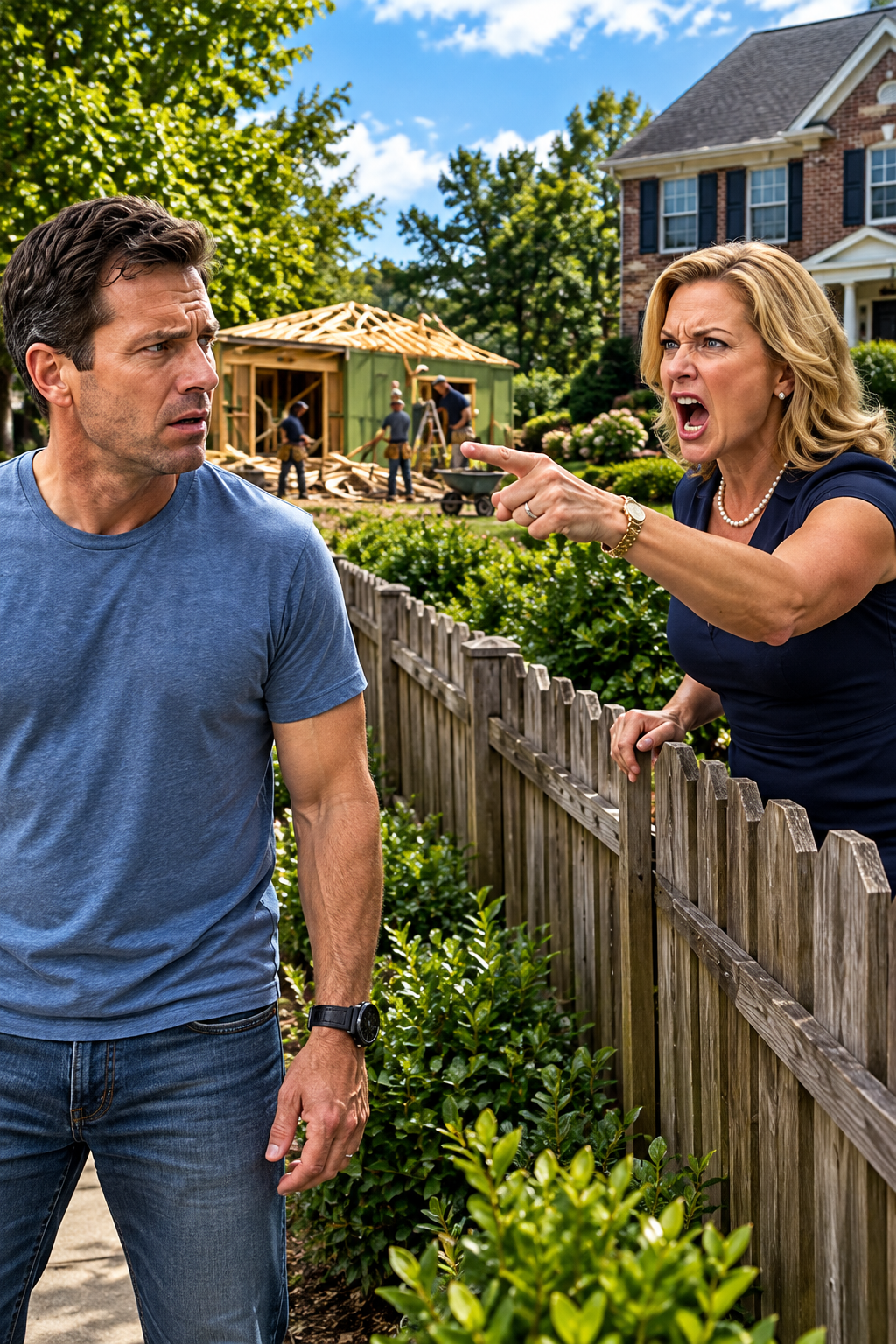
Michael read the enforcement notice three times before he allowed himself to react, not because the language was confusing but because the timing was almost too obvious to believe, since the cedar fence had stood in the same place for seven years without receiving a single warning, question, informal comment, or request for documentation. The letter claimed an unnamed concern had been raised regarding a possible boundary encroachment and cited an obscure section of the HOA rules requiring him to obtain a licensed survey within thirty days, with every dollar of the cost assigned to him whether the accusation proved legitimate or not. If the survey found a violation, the fence would have to be moved within sixty days, while if the fence proved legal, the association would graciously consider the matter closed as though forcing a homeowner to spend more than a thousand dollars proving his innocence required no explanation. Michael placed the letter beside his coffee and looked through the glass doors toward the fence, remembering the contractor who had installed it, the permit he had pulled, and the visible corner markers they had used when laying out the posts. Nothing about the fence had changed, which meant the only meaningful change was happening on the other side of it.
The next afternoon Michael drove to the community center and asked to speak with Linda, and when she entered the conference room less than five minutes later with a folder in her hands and a composed expression already prepared, he knew she had expected him to come. She explained that the HOA had a duty to protect recorded boundaries and then casually claimed his fence had always looked slightly questionable to her, a statement that would have been more convincing if she had not spent seven silent years walking past it. Michael did not accuse her of targeting him, did not mention the suspicious size of her new addition, and did not give her the emotional confrontation she seemed prepared to manage. He simply said he understood the notice, confirmed that he would obtain the required survey, thanked her for explaining the association’s position, and walked out while she watched him leave with the calm certainty of someone who believed the next move had already been decided. That certainty followed him all the way home, and instead of making him angry, it made him careful.
The following morning he called Harrow Land Services, a respected county surveying company whose records appeared on plats, subdivision maps, property disputes, and municipal filings stretching back decades, because if Linda wanted measurements, Michael intended to give her measurements nobody could dismiss. The estimate was painful, nearly sixteen hundred dollars once administrative filing costs were included, but Michael scheduled the earliest available appointment and decided immediately that he would not warn Linda when the surveyors were coming. Over the next two weeks construction continued behind her home with remarkable speed, lumber arriving before breakfast, framing rising across the rear of the property, and workers moving with the focused urgency of a crew following an expensive schedule. Tom Marsh, Michael’s next-door neighbor, leaned over their shared fence one evening and quietly asked whether Michael thought Linda’s project looked awfully close to the back boundary, while Eleanor Vance across the street made the same observation with considerably less diplomacy. Michael told both of them that professional measurements would settle whatever questions existed, but privately he began wondering whether Linda’s complaint had less to do with his fence than with creating doubt about the location of a line she desperately needed to remain uncertain.
Part 3: The survey proves Michael innocent and reveals Linda’s nine-foot mistake
The survey crew arrived at seven forty-five on a humid August morning, and within minutes the quiet backyard looked like a temporary engineering site, with tripods, measuring equipment, orange stakes, data collectors, and two professionals moving methodically through Michael’s property while neighbors developed sudden reasons to spend unusual amounts of time outdoors. Gerald Oaks, the lead surveyor, was a weathered man in his late fifties whose calm manner suggested that property arguments had long ago stopped surprising him, and he began by studying the existing markers and recorded subdivision data before taking a single measurement. Michael gave him the HOA notice, explained that the fence placement had been challenged, and deliberately said nothing about Linda’s addition because he wanted the results untouched by suggestion, suspicion, or neighborhood politics. Gerald nodded, reviewed the paperwork, and told Michael that his team would establish the parcel boundaries from the recorded control points and compare every relevant improvement against those lines. Then he went to work, and for the next three hours the land became more important than everybody’s opinions about it.
By nine o’clock Tom was inspecting roses he had ignored for most of the summer, Eleanor had discovered an urgent need to sweep her back steps, and a younger couple farther down the street stood beside their fence holding coffee mugs while making no effort whatsoever to disguise their curiosity. Linda appeared briefly in her kitchen window and remained there motionless as orange stakes began forming a clean line behind Michael’s fence, each marker converting an argument into something visible and difficult to reinterpret. Michael noticed her but refused to stare back, because the entire purpose of hiring professionals was to remove personalities from the question, and he was determined not to contaminate that process by turning it into theater. At one point Gerald crouched beside a fence post, checked the instrument reading, looked toward the neighboring construction, and remained unusually still before writing something in his field notebook. Michael saw the pause, recognized the expression of a professional who had found something unexpected, and decided not to ask.
Shortly before noon Gerald packed away the primary equipment and joined Michael on the back porch, where he opened his notes and delivered the result Michael had hoped for: every fence post was inside Michael’s recorded property boundary, with no encroachment, no easement violation, and no meaningful placement error. Michael felt an immediate release of tension, but before he could fully enjoy it, Gerald told him there was another issue his team was professionally required to document because confirming Michael’s northeastern boundary had necessarily established the adjoining line behind Linda’s property as well. According to the measurements, the new foundation and framing behind Linda’s house extended roughly nine feet beyond the rear setback allowed by the recorded development plan and local zoning regulations, meaning a substantial portion of her expensive addition appeared to sit outside the legal building envelope. Michael said nothing for several seconds because the irony was almost too perfect: Linda had used her office to force him to establish a boundary she apparently had been hoping nobody would examine closely. Gerald explained that the formal survey would include the finding, would be filed through ordinary channels, and would likely reach municipal officials automatically, and Michael gave the only answer he needed to give: proceed exactly as professional procedure required.
Part 4: The city arrives, construction stops, and Linda loses control
The completed report reached Michael two days later, and instead of forwarding it to neighbors or marching into an HOA meeting with copies, he sent it privately to Patricia Ewen, the real estate attorney who had handled his purchase years earlier and whose greatest professional talent was making emotional disputes sound boring enough to solve. Patricia reviewed the documents, confirmed that Michael’s fence was unquestionably compliant, and explained that the setback problem on Linda’s parcel appeared significant because exceeding the permitted line by more than nine feet was not the kind of technical mistake officials could casually excuse. She advised Michael to do absolutely nothing beyond preserving his records, because the report was already moving through the channels where it belonged and inserting himself aggressively could transform a clean factual issue into a personal conflict. Michael appreciated the advice because it matched his instincts perfectly. Linda had demanded a survey, the survey had been completed, and now the truth needed no salesman.
Six days later a municipal vehicle parked outside Linda’s house, and a building inspector wearing a reflective vest walked behind the property carrying a clipboard, camera, and measuring equipment while the unfinished addition stood above her like physical evidence waiting to be questioned. Michael watched only briefly from his study before returning to work, but Tom later described seeing Linda approach the inspector with a thick folder of permits and the confident urgency of someone certain paperwork would restore the world to its proper shape. According to Tom, the inspector compared those documents against the newly recorded survey, took additional photographs, measured several points, and listened while Linda’s voice gradually climbed into the controlled higher register people use when certainty begins slipping away in public. The inspector did not argue with her and did not appear impressed by her position in the homeowners association, because municipal setback lines did not change depending on who chaired neighborhood meetings. She thanked Linda, returned to her vehicle, and left Linda standing in the driveway with the folder still open in her hands.
Four days later a red-bordered stop-work notice appeared on the framing behind Linda’s house, ordering construction to cease immediately while the violation underwent formal review, and the crew that had arrived almost every weekday that summer suddenly disappeared. For the first time since June, the property became unnaturally quiet, with exposed lumber, unfinished walls, and sections of foundation sitting beneath the sun as though someone had frozen the project midway through a sentence. Residents began connecting the sequence of events, first through cautious conversations beside mailboxes and then through stories about enforcement letters Linda had issued over the years for violations so small they now seemed almost absurd. One homeowner remembered being ordered to remove a Christmas wreath because it had appeared four days before the approved decorating period, while another recalled paying contractors to correct landscaping details after receiving citations he had never been convinced were being applied equally across the neighborhood. Michael refused to participate in the growing celebration, because as satisfying as some neighbors found the reversal, he understood that the strongest position he possessed was also the simplest one: his fence was legal, Linda’s addition was not, and everything else could be decided without him.
Part 5: A second survey destroys Linda’s final defense before the zoning board
Linda responded exactly as Michael expected someone in her position would respond: she hired another surveying firm, one located outside the immediate county and therefore less vulnerable to any accusation that the first company had been influenced by local relationships. For nearly two weeks another set of technicians measured her property, reviewed recorded plats, located control markers, checked setback requirements, and produced a second independent report that Linda’s attorney submitted as part of her appeal. The difference between the two surveys was approximately two inches, a meaningless variation in practical terms and nowhere near enough to change what mattered, because both firms concluded that the addition extended more than nine feet beyond the legal rear setback. The line had not moved, the house had not moved, and no amount of procedural sophistication could transform nine feet into compliance. For the first time since Michael had known her, Linda was facing a rule she could not interpret, administer, soften, or redirect herself.
The zoning appeal hearing took place six weeks after the stop-work order, and Linda arrived with an attorney, construction documents, permits, and arguments intended to demonstrate why the partially completed addition should be allowed to remain despite the boundary problem. Michael did not attend because he was not technically a party to the case, had filed no complaint against her, and had no interest in sitting inside a government meeting room watching professionals discuss consequences that existed regardless of his presence. Instead he made dinner with Caleb, helped him study for a history exam, answered two work emails, and went to sleep before the hearing had even finished. Two weeks later a thick municipal envelope arrived containing the board’s written decision, and Michael read all fourteen pages at his kitchen table before reaching the conclusion that could have been expressed in a single sentence. The structure could not remain as built.
The violation was too substantial for ordinary discretionary relief, and the eastern portion of the foundation and framing that crossed the permitted setback had to be removed, with Linda receiving ninety days to restore the area and bring the project into compliance. She had the option to pursue further litigation, but doing so would have required significant legal expense while challenging two nearly identical professional surveys and a municipal decision grounded in recorded documents rather than interpretation. She did not appeal. On a cold October morning, almost exactly three months after she had signed the letter demanding Michael prove where his own fence belonged, construction vehicles returned to Sycamore Lane carrying saws, demolition tools, dumpsters, and workers whose assignment was no longer to build Linda’s dream addition but to remove the portion that should never have existed. Michael heard the first saw start from inside his kitchen and experienced no surge of triumph, only the strange recognition that a conflict he had never asked for was finally reaching the conclusion created by the person who had started it.
Part 6: Linda watches her addition come down as neighborhood power shifts
Demolition sounded completely different from construction, because building had filled the summer with steady progress while removal arrived in violent bursts of cutting, cracking, lifting, and heavy material dropping into dumpsters before the yard went quiet again. Michael could have stood at the window and watched every beam come down, but the idea felt strangely empty, so he spent most of those two days working in his study, preparing dinner, helping Caleb revise an essay, and living the ordinary life Linda’s accusation had briefly disturbed. From time to time he heard another section being dismantled and understood what was happening without needing the visual proof. He did not hate Linda, although he no longer trusted her, and he discovered that seeing consequences arrive was different from enjoying somebody’s humiliation. By the second evening the illegal section was gone.
Tom stopped beside Michael’s fence after sunset with his hands inside his jacket pockets and observed that Linda’s addition looked dramatically smaller, delivering the comment carefully because neither man wanted to transform an obvious fact into cruelty. Michael replied that the contractor would probably redesign the remaining structure properly and that once it was finished, it might still become a perfectly good room, which was not sarcasm but a sincere prediction. Tom studied him for a moment, nodded, and changed the subject to Caleb’s school schedule. That small exchange captured what Michael wanted the entire episode to become: not a victory parade, not a vendetta, but a completed correction that no longer required emotional fuel. The neighborhood, however, would not return to exactly what it had been before.
Linda remained HOA president until the end of her term, but something inside the association changed almost immediately, and residents who once treated her decisions as unquestionable began requesting documentation, comparing enforcement histories, and asking whether rules were being applied consistently. Monthly newsletters grew shorter, violation letters became less frequent, and the board gradually focused on issues that actually affected shared property values rather than minor aesthetic deviations that had once generated unnecessary conflict. When spring elections arrived, Linda’s name was absent from the ballot, and nobody publicly asked why. Robert Gallagher, a retired civil engineer known more for spreadsheets than speeches, became the new president after promising clearer procedures, lower administrative costs, and consistent standards. Michael voted for him on a rainy afternoon, drove home, started preparing dinner, and felt something he had not expected from the entire experience: relief not because Linda had lost power, but because the neighborhood seemed to be remembering what power was supposed to be used for.
Part 7: Michael’s son learns why patience can defeat power without revenge
One evening after dinner, while Caleb washed dishes and Michael dried them, the sixteen-year-old finally asked the question Michael had quietly suspected was coming: had his father known from the beginning that the survey would expose something wrong with Linda’s addition. Michael considered the answer carefully because he understood that teenagers listen most closely when adults believe they are merely talking, and he wanted Caleb to learn the correct lesson rather than the dramatic one. He admitted that he had suspected the addition looked too close to the boundary, especially given his engineering background, but suspicion and knowledge were different things and pretending otherwise would have been another form of manipulation. Linda had required him to commission a survey, and Michael’s only deliberate choice had been to hire professionals whose work could survive scrutiny from anyone who challenged it. Everything that happened afterward came from what existed on the ground, not from anything Michael invented.
Caleb asked whether it felt good watching Linda lose, and Michael surprised himself by answering immediately that he had never thought of the situation that way because losing and winning suggested two people had been playing the same game. Linda had tried to create a game, certainly, one in which Michael became defensive while uncertainty around the property lines worked to her advantage, but he had refused to accept the role she assigned him. Instead of attacking her credibility, he verified his own position. Instead of gathering allies, he gathered documentation. Instead of trying to defeat someone powerful, he allowed accurate information to enter a system where power eventually had to answer to reality.
Caleb nodded thoughtfully, placed the final plate in the cabinet, and then asked whether there was any leftover soup, ending the conversation with the effortless practicality of a teenager whose philosophical attention had reached its natural limit. Michael laughed, warmed him a bowl, and later found himself thinking that the entire summer might have given his son something more durable than any lecture he could have planned. There would always be people who used titles, rules, money, reputation, confidence, or institutional authority to make others doubt what they knew, and the instinctive response would often be to fight louder, faster, and more aggressively. Yet there were situations in which the strongest response was almost painfully boring: document everything, choose competent people, remain consistent, and refuse to lie even when exaggeration would make your side more satisfying. Michael hoped Caleb would remember that long after he forgot the details of the fence.
That winter Eleanor Vance stopped Michael on the sidewalk while carrying groceries and thanked him for the way he had handled the entire conflict, explaining that she had seen neighborhood disputes become vicious before and had expected this one to end with public accusations, lawsuits, divided friendships, and years of bitterness. She had watched Michael refuse every opportunity to humiliate Linda, even when the facts would have made humiliation easy, and she believed that restraint had prevented Maple Grove from becoming permanently poisoned by the scandal. Michael helped carry her bags to the porch and told her he had simply wanted the matter resolved correctly. Walking home through the bare trees, he realized that was perhaps the only part of the story he felt genuinely proud of. He had not controlled what happened to Linda, but he had controlled what happened to him.
Part 8: The truth redraws more than property lines and leaves lasting peace
By the following May, contractors returned to Linda’s house and began rebuilding the addition inside the legal setback, using a smaller design that respected the boundary the original construction had tried to exceed. Michael watched the new framing rise from his kitchen window with no particular satisfaction, because months of distance had transformed what once looked like the center of a neighborhood crisis into ordinary construction again. The revised room was finished by summer, landscaped neatly, and eventually blended into the property so naturally that newcomers to Maple Grove would never have guessed part of it had once been demolished under a city order. Linda and Michael crossed paths occasionally at the grocery store or community center, usually exchanging only a restrained nod. Neither apologized, neither reopened the argument, and strangely, Michael found that enough.
Robert Gallagher’s HOA administration proved almost aggressively uneventful, which Michael considered a tremendous improvement, and board meetings returned to topics such as drainage, landscaping contracts, reserve funds, shared lighting, and maintenance schedules. Residents still received enforcement notices when genuine violations occurred, but notices now cited clear standards, included photographs or documentation, and explained appeal procedures in language designed to resolve problems rather than intimidate homeowners. Michael never joined the board and rejected Tom’s joking suggestion that he should run for president, because surviving one confrontation with neighborhood bureaucracy had not awakened any hidden political ambition. He preferred Thursday lawn cutting, Saturday grocery shopping, engineering projects that mattered, and evenings when Caleb’s music leaked through the ceiling slightly louder than necessary. Ordinary life had become precious to him long before Linda ever sent that letter.
Years later, after Caleb left for college, Michael finally replaced several weathered sections of the cedar fence, and when the contractor arrived to estimate the work, Michael handed him a copy of the recorded survey without hesitation. The orange stakes Gerald Oaks had planted were long gone, but their measurements remained in county records, legal documents, HOA files, and Michael’s own carefully labeled folder inside a cabinet. The contractor checked the line and smiled, saying there was certainly no ambiguity about where the fence belonged. Michael smiled back because the comment carried an entire history the younger man could not possibly know. Then he authorized the work and went inside.
What remained with Michael was not the pleasure of watching Linda fail, because that feeling had never arrived in the satisfying form neighbors occasionally assumed it must have, but rather a deeper understanding of how authority can quietly become dangerous when people begin confusing their ability to enforce rules with the belief that they personally define reality. Linda had possessed the title, the letterhead, the board presidency, the procedural knowledge, and years of social authority, while Michael had possessed almost nothing dramatic except a seven-year-old fence and the willingness to let qualified strangers measure it. She had chosen the battlefield, written the notice, cited the regulation, and ordered the evidence collected. Yet evidence had no loyalty to the person who requested it. Once the instruments were placed on the ground, the numbers belonged only to the truth.
Sometimes Michael imagined what might have happened if Linda had simply ignored his fence, finished her construction quickly, and avoided creating the official survey that eventually exposed the violation, and the thought always carried an uncomfortable possibility that her strategy might have succeeded. But arrogance has a peculiar appetite: it rarely stops after achieving enough control, because the person enjoying that control begins believing every additional move will work simply because the previous ones did. Linda had not been defeated by Michael’s clever revenge, because there had been no revenge plan. She had been defeated by her own insistence on forcing reality to be measured. And reality, once measured accurately, had refused to cooperate with her.
On quiet autumn afternoons Michael sometimes stood in his backyard with coffee while maple leaves gathered along the base of the fence, listening to distant lawn equipment and the familiar sounds of a neighborhood settling into evening. Linda’s smaller addition stood legally behind her home, Robert’s latest HOA newsletter waited unread on Michael’s kitchen counter, and Sycamore Lane looked almost exactly the way it had before that strange summer began. Yet something important had changed beneath the ordinary surface, because residents understood their rights better, the board understood its limits better, and Michael understood more clearly why patience was not the same thing as weakness. He had never needed to scream, threaten, retaliate, expose Linda publicly, or become more ruthless than the person who challenged him. He had simply stood where he had always had every right to stand and allowed the line between truth and power to become impossible for anyone to ignore.
✓ Lynn R. Adams
Part 2: A seven-year-old fence suddenly becomes Linda’s convenient target Michael read the enforcement notice three times before he allowed himself to react, not because the language was confusing bu…