When the new HOA president ordered me to remove 240 bee colonies from the lab behind my North Carolina home, I showed her the county map proving she had no authority over that land. She fined me anyway, then called a vote to redraw the boundary—and what happened when my neighbor counted those ballots changed everything…
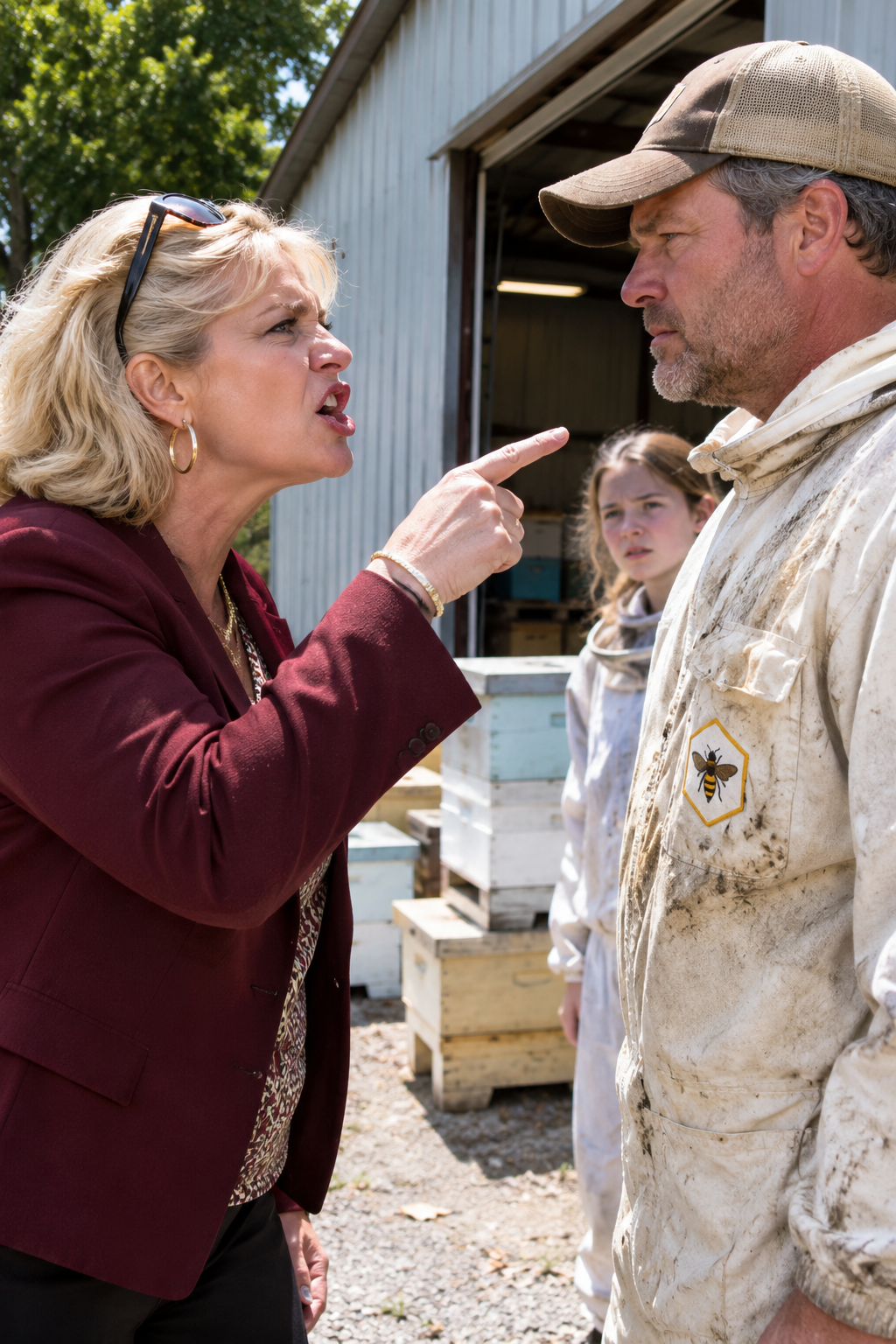
When the new HOA president ordered me to remove 240 bee colonies from the lab behind my North Carolina home, I showed her the county map proving she had no authority over that land. She fined me anyway, then called a vote to redraw the boundary—and what happened when my neighbor counted those ballots changed everything…
My name is Everett Bradley. I’m in my late forties, married, and the father of a thirteen-year-old girl named Nora. We live on four and a half acres at the edge of Creekstone Estates in North Carolina’s Piedmont region, where I bought our land in 2012, before the subdivision was much more than red clay and deer trails.
Behind our house stands a forty-by-sixty-foot metal building that holds my queen-bee breeding lab. I maintain 240 colonies and raise queens for orchards and farms across the Southeast. It’s a real agricultural business bringing in about $185,000 a year, registered with the North Carolina Department of Agriculture, with annual inspection certification, hive records, and queen-tracking logs.
On a good morning, the building smells of wax and clover honey. The steady hum inside has been part of our family’s life for years. Nora helps inspect frames on Saturdays, sliding them carefully from the hives the way I’ve shown her since she was nine, with some of the old equipment still bearing the wear of my father’s hands.
Then Gail Prescott moved into the neighborhood. Gail was fifty-two, drove a white Lexus SUV, and had a habit of arriving with enough perfume to announce her before she knocked. Eight months after moving in, she ran unopposed for president of the homeowners association, and the neighborhood started receiving violation notices almost immediately.
There were twenty-six notices in her first thirty days. Martha Keene’s mailbox was supposedly the wrong shade of white, Doug Pittman’s trash can remained curbside too long, and the Sullivans’ truck tire extended six inches beyond their driveway line. People who’d lived peacefully beside one another for years began checking their mail with dread.
My turn came when Gail appeared at our door carrying a cease-and-desist letter she’d printed on HOA letterhead. It ordered me to remove all agricultural equipment within thirty days because of odor and noise complaints. She spoke as though the matter had already been decided, then waited for me to agree.
I didn’t argue on the porch. I drove to the county clerk’s office and pulled the original subdivision plat. The developer had included 3.8 acres of my property in the HOA map, but the remaining 0.7 acre—the part containing my lab—had never been brought under the HOA covenants.
That distinction mattered. The building was on my land, but outside the association’s recorded boundary, on unincorporated county land. I called Gail, offered the plat reference and a copy of the filing, and explained why the HOA had no authority over that parcel; she hung up before I finished.
Two weeks later, a $500 fine arrived for an allegedly unpermitted agricultural structure. I highlighted the lab parcel on the plat and mailed the map and register-of-deeds record to the HOA board by certified mail. Gail sent a second $500 fine with exactly the same wording.
This time I called county code enforcement. Connie Suttles checked the records and confirmed that the lab stood outside the HOA boundary and had an active agricultural exemption. She put that conclusion in writing at my request, and I mailed it to the board along with the other documents.
Instead of answering, Gail emailed all sixty-four Creekstone households, warning of an urgent health hazard on my property. She described managed, state-inspected colonies as an infestation and raised fears about children being stung and property values declining. I knew bees could pose risks to people with severe allergies, but her message presented my lawful operation as if nobody had ever inspected it.
The next morning, Dale Weaver, a sixty-year-old retired electrician who lived three doors down, forwarded me her email. He came by later with a jar of honey I’d given him and set it on the kitchen table. “If she shuts you down, I have to buy store honey,” he said. “I’m not doing that.”
Then his face grew serious. He’d overheard Gail telling Sandra Moore she wanted a special vote to extend the HOA boundary over my entire four-and-a-half-acre lot. I set down my coffee and asked him to repeat it, because that would turn a campaign of nuisance letters into an attempt to change the rules themselves.
I still couldn’t understand why she was willing to go so far. The lab had been operating long before she became president, and I believed North Carolina’s Right to Farm protections gave established agricultural operations important defenses against ordinary nuisance complaints. But I also understood that a costly dispute could hurt my family even if we eventually won.
The following Thursday, Gail came by while I was out. Nora had been loading frames into my truck for our weekend inspections and was sitting on the porch steps when I returned. “That neighborhood lady said your bug farm is done,” my daughter told me, rubbing a little dirt from her palms. “She said she’ll clear it herself if you won’t.”
What bothered Nora most was the word bugs. She knew the difference between a swarm of unwanted insects and carefully managed breeding colonies. I told her she had done the right thing by staying out of the argument, though I didn’t like knowing an adult had delivered a threat through my child.
On Monday, an official-looking notice announced a special HOA meeting for Thursday evening at the Creekstone Clubhouse. The sole agenda item was an amendment bringing the full acreage of every homeowner’s lot within the covenant boundaries. My name wasn’t in the motion, but everyone who had followed the letters knew whose land was at stake.
Thirty-two homeowners came. The room smelled of lemon cleaner and old carpet, and Gail stood at the front in a blazer beside a projector showing the proposed boundary map. My entire property was marked in red, while Dale settled into a chair directly behind me.
Gail spoke for several minutes about consistent neighborhood standards and unified governance. She never said queen bees or Everett Bradley. When I raised my hand, she said I had a conflict of interest and wasn’t allowed to speak, though she was the one proposing to change my property’s status.
From the back of the room, Nolan Hargrove, who’d lived in the neighborhood for twenty-one years, objected loudly enough for everyone to hear. A few neighbors laughed, but Gail called for paper ballots before the argument could grow. We waited as the votes were counted at the front table.
Eighteen voted yes and fourteen voted no. Gail smiled and announced that the amendment had passed, and for a moment I felt as though the floor had shifted under my chair. Then Dale stood up with a copy of the covenants in his hand.
“Article Nine, Section Three,” he said. “You need sixty-seven percent of all sixty-four homeowners to amend these covenants. That’s forty-three votes, Gail. You got eighteen.” Gail said she’d check with the association attorney; Dale reminded her she’d canceled the legal retainer to save money, and she abruptly adjourned the meeting. The vote had failed, but as she gathered her papers without acknowledging that fact, I knew she wasn’t finished. Part 2…..
Three days later, Gail emailed all sixty-four homeowners with the subject line “Amendment approved.” She claimed the vote had passed by a majority of those attending, even though the recorded covenants required forty-three approvals. Brenda Caviness replied to everyone, “I voted against this. This is not what happened,” and Gail removed her from the mailing list.
Around that time, a trail camera I’d placed near my lab alerted me to Gail’s white Lexus sitting on my land at one afternoon. It remained there for twelve minutes, about thirty feet from the door. The image didn’t prove she’d entered, but it was enough to make me install two high-definition cameras, one outside the entrance and another inside the building, both with backups.
The next Monday at in the morning, I found two men in reflective vests measuring along the lab’s north wall. A white pickup outside my gate carried the words Tri-County Demolition. One of the men said a woman from the association had scheduled the building for removal and represented herself as its owner.
I told them to stop and called the sheriff’s office. A deputy arrived about twenty minutes later, established that I hadn’t authorized the work, and sent the crew away. That afternoon, Tri-County faxed me its $8,500 demolition contract, bearing Gail Prescott’s signature in the property-owner field beneath my building’s address.
I put the contract in my filing cabinet with the plat map, the code-enforcement letter, and the two fines. I wasn’t interested in a shouting match; I wanted proof of exactly what she’d done. I had no idea I’d soon need a larger folder.
On Thursday, while I was in the kitchen warming leftover chili, an interior-camera notification appeared on my phone. Gail was standing inside my locked lab, taking photographs between the rows of hives. I watched her move toward colony 41, swat at the workers circling her head, and knock a frame loose.
The frame fell onto the concrete and cracked, damaging brood cells. Gail brushed off her blazer, walked out, and shut the door. The entire visit lasted eight minutes, and my cameras recorded it from inside the building until she drove away.
I later pieced together how she’d gained access: the subdivision kept a master key for common-area facilities, and my old padlock happened to have a compatible, common keyway. Whatever Gail thought that key entitled her to do, it didn’t give her permission to enter my private agricultural building. I saved the footage to a USB drive, changed the lock to a hardened, restricted-key model, and kept the cameras recording.
That was when Dale called with news from the county planning office. A rezoning application sought to turn three adjoining residential parcels into a commercial strip-mall development. The parcels were Gail’s lot, a vacant lot beside it, and mine.
I opened the public county GIS and planning records that night. Gail had filed the application four months earlier, and a pre-agreement named Crestline Partners, a developer from Charlotte. Crestline would construct the project if Gail delivered all three parcels cleared and rezoned.
The terms also named Gail as a silent investor entitled to a $320,000 finder’s fee when the deal closed. I sat at the kitchen counter with the document in front of me, hearing Nora’s music upstairs and realizing why Gail had spent months trying to make my lab disappear. It wasn’t only a disagreement about bees.
Creekstone’s election-disclosure paperwork contained a $2,000 campaign contribution from Crestline Partners. And on the rezoning application, Gail had listed herself as the authorized representative of the owner of my lot. I’d never signed anything or given her permission to speak for me.
I printed forty-one pages and called Dale. He arrived the next evening with Rusty Bowman, a real estate attorney from Siler City and an old fishing friend of Dale’s. We sat at the worn picnic table behind my house while the colonies settled for the night and Rusty worked through every document and recording.
Rusty said the demolition contract, rezoning representation, and unauthorized entries gave us serious grounds to pursue action, but the evidence needed to be properly preserved and handled. He warned me not to provoke Gail or interfere with my own business to draw her back. “Keep raising your queens,” he said. “Let the cameras show what happens.”
He also told me to file a written objection to the rezoning application, notify the state Department of Agriculture about threats to the registered apiary, and keep every original record. The rezoning deadline was five weeks away. I filed the objection, contacted the department, and received case number AG20241138.
Waiting didn’t mean doing nothing. Every morning, I inspected hives, packaged queen shipments, and checked the footage after Nora went to bed. Rusty believed Gail might make another mistake as the deadline approached; I hoped she would simply stop.
Part 3 Instead, Gail posted on Nextdoor that I’d refused a safety inspection and that the HOA was exploring ways to protect neighborhood children. She tagged the county health department. Webb Collier, an inspector in his mid-fifties, visited on Thursday and spent ninety minutes reviewing ventilation, hive spacing, sanitation, and chemical storage.
When he finished, Webb told me the apiary was among the cleanest he’d inspected in the county and filed a favorable report. Gail didn’t share that result. The next Monday, an animal-control officer arrived because someone had reported hundreds of aggressive bees attacking children; after walking the perimeter, she wrote that she’d found no evidence of aggressive behavior or a public-safety threat.
Then, on Wednesday at 11:08 p.m., my exterior camera caught a vehicle idling near the fence with its headlights off. Something arced over the fence, and the vehicle drove away. The recording showed a white Lexus SUV and four digits of its plate that matched Gail’s.
At dawn, I found three white pellets near hive 14. They looked like mothballs, and I knew enough about naphthalene to be concerned about contamination and the bees. I photographed them where they lay, carefully preserved what I could, and called Rusty rather than attempting to clean up the area myself.
The Department of Agriculture sent an inspector the next day to collect and document the pellets and examine the nearby colonies. The new evidence went into case AG20241138. The inspector estimated that, without intervention, as many as five colonies and roughly $23,000 in queens and production might have been at risk.
I added a motion-activated floodlight to the outside of the building. Gail, meanwhile, mailed all sixty-four households a request for a $1,200-per-home special assessment to fund legal action against my bee farm. Eleven homeowners objected within a day, and Dale organized a letter demanding a review of HOA finances; thirty-one homeowners signed it.
With the rezoning deadline closing in, I tried to focus on my work. On a Tuesday morning, I loaded forty-six mated queen bees into my truck for an orchard near Raleigh, kissed Nora goodbye, and left at . While I was away, my phone showed another exterior-camera alert from the lab, time-stamped 10:15 a.m.
I pulled into a gas station and opened the live footage. Gail’s white Lexus was parked by the building, and she stood at the door holding orange-handled bolt cutters. I had replaced the padlock after her earlier visit, but this time she cut through it, let the broken lock drop, and went inside.
On the interior feed, the hives stood in six rows of metal shelving, their ventilation fans humming. Gail lifted her phone to take pictures, then began jerking frames from the colonies. She pulled from colonies 23, 30, and 38 with enough force to tear comb and scatter worker bees.
I watched her pull another frame and then a fifth, one bearing capped queen cells. It struck the concrete and split, damaging two cells. The humming grew louder and sharper as disturbed colonies reacted to what was happening around them.
Gail began swatting at the bees and hurried for the door. She stumbled against the frame, ran across the gravel, and shut herself inside the Lexus while bees swirled around the windshield. The cameras showed her driving away and the bees gradually returning toward the lab.
I sat in the gas station parking lot for a moment, my hands locked around the phone. I’d been angry over the letters and the lies, but watching breeding stock I’d cared for day after day being damaged was different. Then I turned the truck around and drove home.
Inside, twelve frames were pulled or knocked loose, three queen cells were destroyed, and exposed brood needed attention. I put on my protective suit and spent the afternoon stabilizing the colonies, working row by row until the worst of the agitation subsided. The immediate damage came to about $4,800 in queens and frames, with another estimated $22,000 lost from the disrupted breeding cycle.
That evening, I called Rusty and told him the padlock, the frames, and everything that happened inside had been recorded in high definition. He listened without interrupting. “I’ll have the papers ready by morning,” he said.
Final Nine days later, fifty-one of Creekstone’s sixty-four households turned up for the quarterly HOA meeting. The clubhouse held the same folding chairs and tired coffee pot, but it didn’t feel like the same room. Gail sat at the front with her blazer, agenda, and gavel, behaving as if the last several weeks had been ordinary association business.
Dale came in beside me, and Rusty carried a briefcase on my other side. Inspector Holt from the North Carolina Department of Agriculture took a seat near the back. Gail read through the treasurer’s report, landscaping, and pool hours before finally asking whether anyone had new business.
Dale stood and asked that I be allowed to address the board. Gail tried to refuse, but he cited the bylaw giving homeowners in good standing three minutes to speak. She made a dismissive motion toward the front, and Rusty stepped forward with five tabbed folders.
He first showed the recorded plat and the county’s letter confirming that my 0.7-acre lab site was outside the HOA covenant boundary. He explained why the two fines against the lab lacked a valid basis. Then he showed that the amendment had received eighteen of the forty-three votes needed, despite Gail’s announcement that it had passed.
His third folder contained the rezoning application listing Gail as my authorized representative. The fourth held the Tri-County Demolition contract identifying her as the owner of my building. I watched neighbors lean toward one another as they saw the signatures and heard how those representations had been made without my consent.
Finally, Rusty plugged in the USB drive, and the projector showed what the security cameras had captured. Gail appeared on the screen cutting my lock, entering the lab, pulling frames from the hives, and scrambling back outside when the disturbed bees surrounded her. Nobody needed an explanation of what the orange-handled cutters were doing in her hands.
The room went quiet before Nolan Hargrove let out an astonished laugh. A few others joined him, more from the sudden release of tension than anything funny about what had happened to the bees. Gail stood and grabbed her purse, but before she reached the exit, a Randolph County sheriff’s deputy approached her.
He served her with a criminal-trespass summons issued by the county magistrate and asked her to acknowledge receipt. Gail signed as the room watched. Inspector Holt remained by the back wall, and I stayed in my chair because I had nothing useful to add.
Rusty told the board that the potential combined consequences—including agricultural penalties, civil claims, enhanced damages being pursued, fees, and refunds—were estimated at approximately $218,000. It wasn’t a check in my pocket that night, and the claims still had to go through the appropriate processes. But it was the first time the cost of Gail’s actions had been laid out where the entire neighborhood could hear it.
After she left, Dale moved to remove her as board president. The vote was forty-eight to three. I’d expected a long argument; instead, neighbors who’d spent months being intimidated by one letter after another finally took their own association back.
Within a week, Gail’s attorney contacted Rusty about settling the civil matters. The criminal trespass case proceeded separately, and she accepted a plea agreement involving twelve months of supervised probation, a $5,000 fine, and an order barring her from coming within five hundred feet of my property. I heard afterward that the judge had stressed the difference between authority over HOA property and access to somebody else’s locked building.
The civil dispute was settled out of court. The final breakdown Rusty gave me was $45,000 in county agricultural penalties, $85,000 for civil fraud damages, $66,000 in enhanced agricultural-interference damages, $21,000 in legal fees, and a $1,000 refund of the two improper HOA fines—a total of $218,000 in financial consequences. Gail’s insurance didn’t cover her fraudulent conduct, and she paid the settlement herself.
The county planning department rejected the rezoning application because Gail had no ownership or authority over one of the three necessary parcels. Crestline Partners withdrew its pre-agreement, and the $320,000 finder’s fee Gail had counted on disappeared. Three months later, she sold her house at a reported $40,000 loss and moved to a condo development in Greensboro.
Creekstone held a special election, and Dale became interim HOA president. He stood before the neighbors and announced he wouldn’t be buying a gavel: if he ever needed to bang on something, his shoe would do. The new board reviewed Gail’s twenty-six violation notices and threw out fourteen of them.
Martha Keene got her mailbox fine refunded, and Doug Pittman received an apology for the trash-can citation. The Sullivans’ truck really had been beyond the driveway line, so that one stood; they were able to laugh about it. Slowly, the neighbors started waving from their driveways again.
I used some of the settlement money to establish the Creekstone Pollinator Scholarship, an annual $2,500 award for a Randolph County high school student studying agriculture or environmental science. The first recipient was a seventeen-year-old girl from Asheboro who hoped to study entomology at NC State. Hearing her talk about insects reminded me of Nora at the workbench.
Every spring after that, I opened the lab for what Dale called Hive Day. The first year, eighty-five people came to see the queens and learn about breeding and colony care. Dale cooked at the grill, and Nora sold our honey for twelve dollars a jar from a folding table with a sign she’d painted herself.
By late afternoon, charcoal smoke mingled with clover honey, and the familiar hum from the metal building carried across the yard. I’d never wanted a fight with the HOA, or a lawsuit, or a reason to keep folders of evidence in my filing cabinet. I wanted to raise healthy bees and teach my daughter to take pride in work done carefully, and at last we were able to do that in peace.
THE END. I’ve shared the complete story, and I truly hope it touched your heart. If this story moved you, please , like, and share the post. Thank you for reading! ❤️
✓ Lynn R. Adams
When the new HOA president ordered me to remove 240 bee colonies from the lab behind my North Carolina home, I showed her the county map proving she had no authority over that land. She fined me anywa…