When the HOA president told me she owned the timber rights to my family’s woods, I thought her signed logging contract was the worst surprise of the morning, until I followed the orange paint deeper into my property…
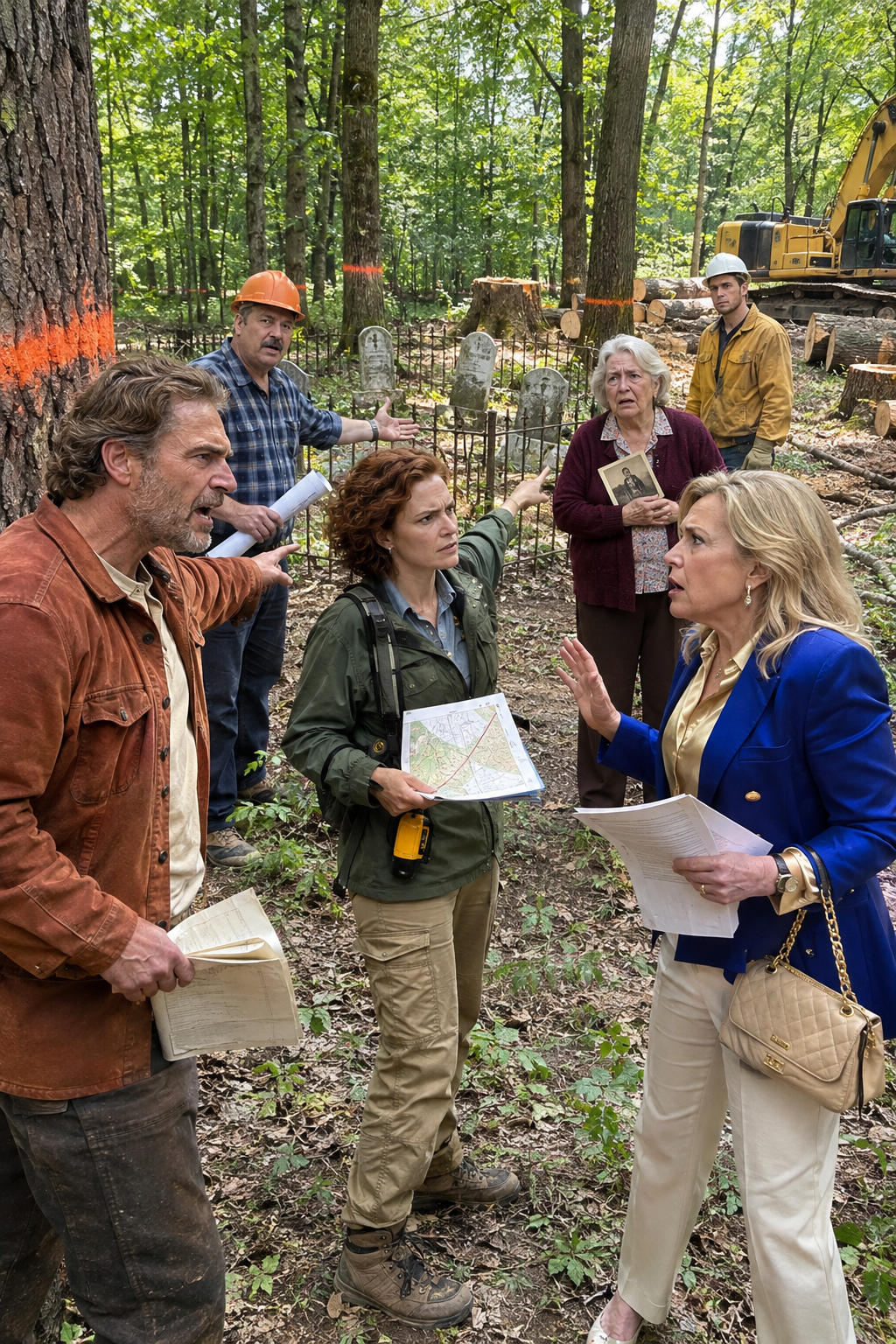
When the HOA president told me she owned the timber rights to my family’s woods, I thought her signed logging contract was the worst surprise of the morning, until I followed the orange paint deeper into my property…
“Move your truck or I’ll have it towed,” Vanessa Cole shouted across my wood lot. She stood between my pickup and a skidder loaded with freshly cut logs, wearing a spotless red jacket while mud and sawdust covered the ground behind her. Until that morning, I had no idea anyone had hired a crew to cut my trees.
I asked who had given them permission. Vanessa, the president of the neighboring homeowners association, pressed a red folder against my chest and told me the HOA owned the timber rights. She said it with such certainty that I almost forgot the eighty-year-old white oak lying in twenty-foot sections behind her.
That oak had been standing when I drank my first cup of coffee. Now its bright stump sat among churned-up dirt, with the pale center of the wood exposed to the air. I could see tracks running toward the timber, and I could hear the skidder idling while a crewman watched us from beside the load.
The logger introduced himself as Rick Dalton. He had been watching Vanessa and me, but the moment he heard her claim, his expression changed. He pulled me aside, opened his company’s contract, and pointed to a section beneath the provisions about access and payment.
The HOA was named as the party authorizing the harvest. In that same agreement, the association represented that it had the authority to grant the commercial logging rights described there, and Vanessa’s signature was at the bottom. I read the language twice, careful not to confuse what she had promised Rick’s company with what she actually had a right to do.
“Are you cutting any more today?” I asked Rick. He looked over at his loaded machine and then toward the trees still standing beyond it. “Not until this gets cleared up,” he said, and he told one of his men to photograph the logs exactly where they lay.
The chainsaws fell silent, one after another. Rick instructed the crew not to move the load or another machine until his boss and the company attorney reviewed the dispute. Vanessa insisted the board had approved the project, but Rick told her his company had been hired to harvest timber, not decide who owned the right to sell it.
Five minutes earlier, she had been giving orders as if she owned the whole hillside. Now the equipment was standing still, and Rick’s signed agreement had become a question nobody on that muddy road could answer. I wasn’t claiming the paperwork proved everything in my favor; I just knew a signature wasn’t the same thing as ownership.
By noon, the crew had gone, leaving the logs and the damage behind. I walked the wood lot alone, past the place where the eastern ground falls toward a seasonal creek and up through the older oaks and hickories. My family had held this land long enough that the bends and slopes felt more familiar than the streets around the new subdivision.
The houses lay beyond the western edge of my property, separated from my pasture by a strip of trees. Years before, when those homes were being built, the developer had asked for limited access to maintain a screening buffer between the new lots and the farm. I had understood that to mean trimming dangerous limbs, clearing storm debris, and keeping brush under control.
Nobody had mentioned selling timber or bringing in heavy logging equipment. Yet I also remembered signing documents during the development, and I knew better than to rely on memory alone. That afternoon I dragged a dented metal file box from my office closet and spread old closing papers, tax records, and correspondence across the desk.
Near the back was a developer’s letter stapled to a reference sheet with an instrument number. It referred to a recorded maintenance right along the western buffer, but it did not include the full legal language or the exhibit showing the area. I stared at that number because it was the first thing I had found that might explain what Vanessa believed she could do.
Then an email arrived from the HOA office with the subject “Notice of interference with authorized vegetation management.” Vanessa accused me of obstructing approved work in an area subject to association maintenance rights and warned that the board reserved its remedies. Her words had shifted from “timber rights” at the wood lot to “vegetation management” on paper.
I printed the email and laid it beside the developer’s reference sheet. One document suggested there was a limited maintenance right; the other had been used to justify a commercial harvest. I couldn’t settle that difference at my kitchen table, especially without knowing what the recorded instrument actually said.
The next morning, I phoned the county records office to ask for a certified copy of the instrument. Then I called Rick, not to ask him whose lawyer would win, but to find out exactly where the HOA had told his company to cut. He went quiet for a moment before saying, “Daniel, you’re going to want to walk that line yourself.”
I put on my boots and went outside with a notebook and my phone. Rick agreed to meet me at the western tree line just after sunrise, without his crew or his equipment. He had already reported the dispute to his company and made it clear he was showing me what his people had been given, not deciding whether it was lawful.
He unfolded a laminated harvest map on the hood of my pickup. A red line followed the subdivision boundary, a green band traced the edge of my land, and pale yellow blocks reached farther into the woods. I leaned over the hood, trying to understand why the colored shapes extended so far beyond the narrow buffer I remembered.
Rick pointed at the yellow blocks. “Those are the harvest zones,” he said, explaining that they ran roughly 150 feet into the property in some sections and farther in others. He had not drawn the map; it was the scope supplied for the work, and his crew had marked trees according to those instructions.
We started from the southern end. I recognized the fresh ruts and sawdust around the cut stumps, but soon I saw orange stripes on standing trunks. There was a hickory beside the trail, then two mature oaks farther uphill, then more trees beyond a shallow drainage swale.
I asked whether all of them were scheduled for removal. Rick nodded and said anything carrying orange paint had been approved for the harvest as far as his crew had been told. I took a wide photograph of each marked tree and another close enough to capture its stripe, then photographed nearby landmarks so its position wouldn’t be lost later.
Rick took photographs on his company phone too. He recorded stumps, tracks, and marked trees because he knew his employer might need to explain exactly what had been done. Every step farther from the houses made the word “maintenance” sound less like what I was seeing.
I stopped counting at thirty-seven marked trees. We were on the northern slope by then, so far inside my family’s woods that the subdivision roofs had disappeared behind the trunks. I thought back to the harvest map Rick had shown me and realized the oak already on the ground might be only the beginning of what Vanessa had authorized. Part 2…..
IF FACEBOOK BROUGHT YOU HERE, HERE’S THE CONTINUATION YOU’VE BEEN WAITING FOR. ENJOY! 👇 Around nine that morning, another truck pulled into my driveway with Hart Forestry Consulting printed on its door. Owen Hart stepped out carrying a diameter tape, a rangefinder, blue flagging, and a field notebook. A cattle farmer I knew had recommended him after a storm-damage dispute, and I had asked him to document the cutting and the marked area without guessing at a legal answer.
Owen started with the visible stumps, recording species, measurements, and locations, then traced the machine ruts and the apparent limits of the work. He tied blue ribbons where he needed reference points, careful not to confuse his markings with the logger’s orange paint. Rick continued documenting the same area for his company, and neither man claimed the woods belonged to the HOA.
At a large white oak marked for cutting, Owen stopped and looked back toward the subdivision. He asked whether the association had described the job as buffer maintenance, and when I said yes, he measured the distance and made another note. He would not give me a quick price for the damage, because a credible assessment would have to account for timber volume, market conditions, site disturbance, and restoration.
By lunch, he had logged the stumps he could see and dozens of standing trees marked for removal. His preliminary field map showed that the proposed cutting extended far beyond the narrow western strip I had associated with HOA access. The evidence was there in the soil and on the trunks, whether or not Vanessa ever admitted what she had signed.
Rick left before noon, and Owen stayed to finish his notes. When I got home, a certified envelope from the HOA management office was waiting at the storm door. It accused me of interfering with authorized vegetation management and demanded that I allow access to the western maintenance area by Friday, three days away.
I called Rick to ask if the association had told his company to return Friday. He said it had asked, but his boss would not send a crew back without clearing the contract problem. That was a relief, although the letter on my table made it plain Vanessa intended to push ahead.
Later that day, her SUV rolled into my driveway. Vanessa stood on the gravel in a red blouse beneath a dark coat, clutching another folder, and told me the board expected access on Friday. I asked how wide the maintenance buffer was, because their marked harvest zone reached hundreds of feet into my land.
She looked down at a highlighted paragraph, searched behind it for an exhibit, and closed the folder without giving me a number. Instead, she told me to speak with counsel and said the board would not abandon a valid contract just because I disliked its terms. I told her I intended to get legal advice and watched her drive away.
That evening, Owen emailed his preliminary map. I placed it beside the certified notice and wrote one question in my notebook: If this was buffer maintenance, why had someone laid out a commercial logging operation so deep into my woods? Friday morning, I carried that question to property attorney Laura Bennett, along with the documents I had collected.
Laura separated Rick’s contract, Owen’s map, Vanessa’s notices, and my old reference sheet into piles. She asked what we knew had been recorded, not what either side had said about it. By late morning we were at the county records building, where a clerk located the instrument number and supplied a certified copy without interpreting it for us.
The document came from the subdivision’s original development and covered several matters, including utilities, drainage, and access. The section concerning my western wooded edge granted the HOA a right to enter a designated buffer for maintenance, storm cleanup, removal of dangerous vegetation, and preservation of the screening function between homes and agricultural land. An attached exhibit showed the area that right applied to.
Laura cautioned me against declaring victory just because the wording sounded different from Vanessa’s contract. A title researcher spent the afternoon following earlier deeds, the subdivision plat, easements, releases, and later recorded filings. We found a continuous chain of documents but no separate recorded grant identified as timber rights or commercial harvest authority.
“That tells us what the public records show,” Laura said, “not everything the board thought it had.” She wanted the association’s own paperwork next. Rick called while she was checking the board’s public minutes and old notices, and he said his office had heard from the HOA again about returning to work and about payment.
His company was being paid for cutting and hauling, while proceeds from merchantable timber were to be accounted for separately with the association. With his boss’s approval, Rick sent the relevant contract page to Laura. It was one more reason the job could not be dismissed as ordinary brush clearing.
In meeting minutes from three months earlier, the board had discussed a “buffer restoration initiative” and recovery of value from harvestable material. A treasurer’s report projected roughly $14,000 in offset from that material, and the next meeting connected the expected revenue to repairs needed on a retaining wall near the community entrance. The association had budgeted money from timber growing on my parcel.
I sat across from Laura with the minutes in my hands. I was angry about the oak, but seeing those numbers made the decisions feel deliberate in a different way: somebody had estimated commercial value and put it into a budget. Laura noted that the documents were evidence of what the board planned, not proof of every legal question still in dispute.
She sent preservation letters to the HOA, its management company, and Rick’s employer, asking them to retain contracts, maps, marking instructions, board messages, photos, payments, and records showing how the harvest area had been defined. Rick’s attorney replied that the crew would stay away while the authority question was reviewed. The management company forwarded the matter to HOA counsel.
Vanessa’s response was short. She said the project had been properly approved, the board stood by its authority, and I was mischaracterizing vegetation management. From then on, she wanted communications to go through counsel.
At home, my dining room table disappeared under the logging agreement, recorded buffer instrument, title records, association minutes, and Owen’s photographs. Each group of papers answered a different question: what the HOA had been granted, what Vanessa had promised, what the board expected to earn, and where the machines had gone. Owen was now preparing a formal forestry assessment of the physical and economic damage.
Part 3 Two days later, Laura asked me back to her office. She put the maintenance instrument on one side of her desk and Rick’s contract on the other, with the HOA budget minutes between them. Then she pointed to Vanessa’s signature beneath the representation that the association could grant those commercial logging rights.
Laura drafted a letter asking HOA counsel to identify the authority for commercial harvesting, cutting outside the designated buffer, and taking proceeds from timber on my property. She wrote separately to Rick’s attorney, requesting that the suspension remain in place. The third notice went to the HOA’s liability insurer, with the key documents attached.
She explained that acting beyond the powers granted to an association could raise questions lawyers sometimes call ultra vires. It did not mean an insurance policy automatically stopped applying, nor did it establish that Vanessa was personally liable. The insurer might defend while reserving its rights, and coverage and individual responsibility would depend on the facts and policy terms.
That distinction mattered. I wanted accountability, but I had no interest in claiming a legal outcome Laura had not established. She pointed again to the roughly $14,000 in expected timber revenue and said anyone reviewing the claim would want to know how a maintenance project came to be treated as a source of income.
The letters went out that afternoon. Rick’s attorney confirmed the crew would remain off my property, and HOA counsel asked the management company for the complete project file. Soon afterward, the insurer opened a claim and said it was reviewing coverage while reserving its rights.
Vanessa was copied on the insurer’s request for board approvals, project communications, maps, contracts, and the records she had relied on in signing the deal. She was given ten business days to supply the material. For weeks she had sent deadlines to me; now a separate institution was asking her to document her own decisions.
Eleven days later, Owen delivered his final forestry assessment, forty-three pages documenting the stumps he could identify, their species and sizes, the machine ruts, disturbed soil near the drainage swale, and standing trees marked for removal. It included estimated timber value and the costs and impacts associated with soil stabilization, regeneration, and restoration. It did not make the missing mature oaks any less real, but it gave the dispute a measured account of the damage.
Laura sent the report to HOA counsel, Rick’s attorney, and the insurer. Rick’s company confirmed in writing that no crew would return without new authorization acceptable to the parties involved. The insurer requested the full project file and approval history, and Vanessa stopped contacting me directly.
Three days later, the HOA called a special board meeting. Laura accompanied me, and Vanessa sat at the center of the table in a red blazer with the same folder she had brought to my driveway. The treasurer slid a budget sheet toward her and asked why a project described as cleanup showed $14,000 in anticipated timber revenue.
Vanessa said the value of the timber was incidental. The association’s attorney asked her to show the authority to sell it, and she turned pages in her folder without finding an answer she could put on the table. He reminded the directors that the insurance carrier had reserved its rights and that nobody should promise coverage for any person or claim while the review continued.
When the treasurer asked whether Vanessa could face personal exposure, the attorney declined to make that determination. He told her that her interests might not be identical to the association’s and suggested she consider separate counsel before answering more questions about the contract. Vanessa set her papers down, and the room was quiet.
The vice president moved to suspend every project involving the Mercer property, freeze remaining payments tied to the logging contract, and send the complete file to association counsel and the carrier. Another director seconded the motion. Vanessa objected that the board was panicking over one neighboring landowner with a lawyer, but the treasurer reminded her that the landowner had not put those timber proceeds into the budget.
The motion passed, with Vanessa voting against it. The management company froze the remaining payments, the contractor stayed out, and the association’s attorney instructed the board not to authorize further entry on my land without written legal review. I was glad the project had been taken out of Vanessa’s hands, but the stumps and ruts were still there when I went home.
Outside the meeting, Laura told me we were not finished. The documents had forced an examination of the project, and Owen’s report had put figures around the damage, but stopping the chainsaws was only the first part of protecting the place. Somebody still had to pay for the repairs and the loss.
Final Six weeks later, machines returned to the wood lot, this time carrying materials for restoration rather than logs. A small crew brought erosion matting, seed, hand tools, and a forestry plan Owen had helped prepare. They reshaped the damaged access route, stabilized soil near the drainage swale, and placed protective fencing around areas where new trees could establish themselves.
The first replacement plantings went in before the weather turned. Nothing about the work made those old oaks reappear, and nobody suggested the check would replace the decades it had taken them to grow. But for the first time since I heard the saws, there was a plan for the ground instead of another argument over a folder.
The settlement put the obligations in writing. The insurer funded the covered part of the property-damage claim, while the HOA paid the remaining agreed amount using association funds and a structured settlement approved by its board. Timber proceeds held during the review were redirected into the resolution rather than the retaining-wall budget, and Rick’s company was paid for work it had properly performed before the dispute was identified.
Laura insisted on written payment terms and restoration commitments. The HOA also adopted a new contractor-approval policy: when work involved land outside common areas owned by the association, the board would need a written scope, documentation of its authority, and legal review before an officer signed. I knew that policy could spare another landowner the morning I had endured.
Vanessa had not resigned at the special meeting. She served another month as president while the claim and contractor records were handled, then lost that officer position when the board chose another director to lead it. She remained a board member, and there was no courtroom scene or dramatic removal, just a change in who could act for the association.
I saw her again while I was checking protective sleeves around new saplings along the western edge. She stopped on the subdivision side of the buffer and told me the board had approved the restoration schedule. I said I knew; she looked past me at the damaged woods for a moment, then walked away without opening a folder.
By spring, the ruts had softened, native ground cover was returning, and young oaks and hickories stood where Owen’s plan called for them. I knew I might never live to see some of those trees mature. What mattered was that they were growing under a plan I had approved, and the next decisions about that ground belonged to the people with the right to make them.
One morning, I walked the western edge with coffee in my hand while light filtered through a canopy that was still too thin. The woods were not what they had been, but the saws were gone and so was the orange paint. I stood there a while, listening to the quiet and watching the new leaves move.
THE END. I’ve shared the complete story, and I truly hope it touched your heart. If this story moved you, please , like, and share the post. Thank you for reading! ❤️
✓ Lynn R. Adams
When the HOA president told me she owned the timber rights to my family’s woods, I thought her signed logging contract was the worst surprise of the morning, until I followed the orange paint deeper i…