When the HOA president told me my grandfather’s bridge was an eyesore, I showed her the deed proving it wasn’t hers to control. Three months later, after eight days away on a construction job, I drove home through
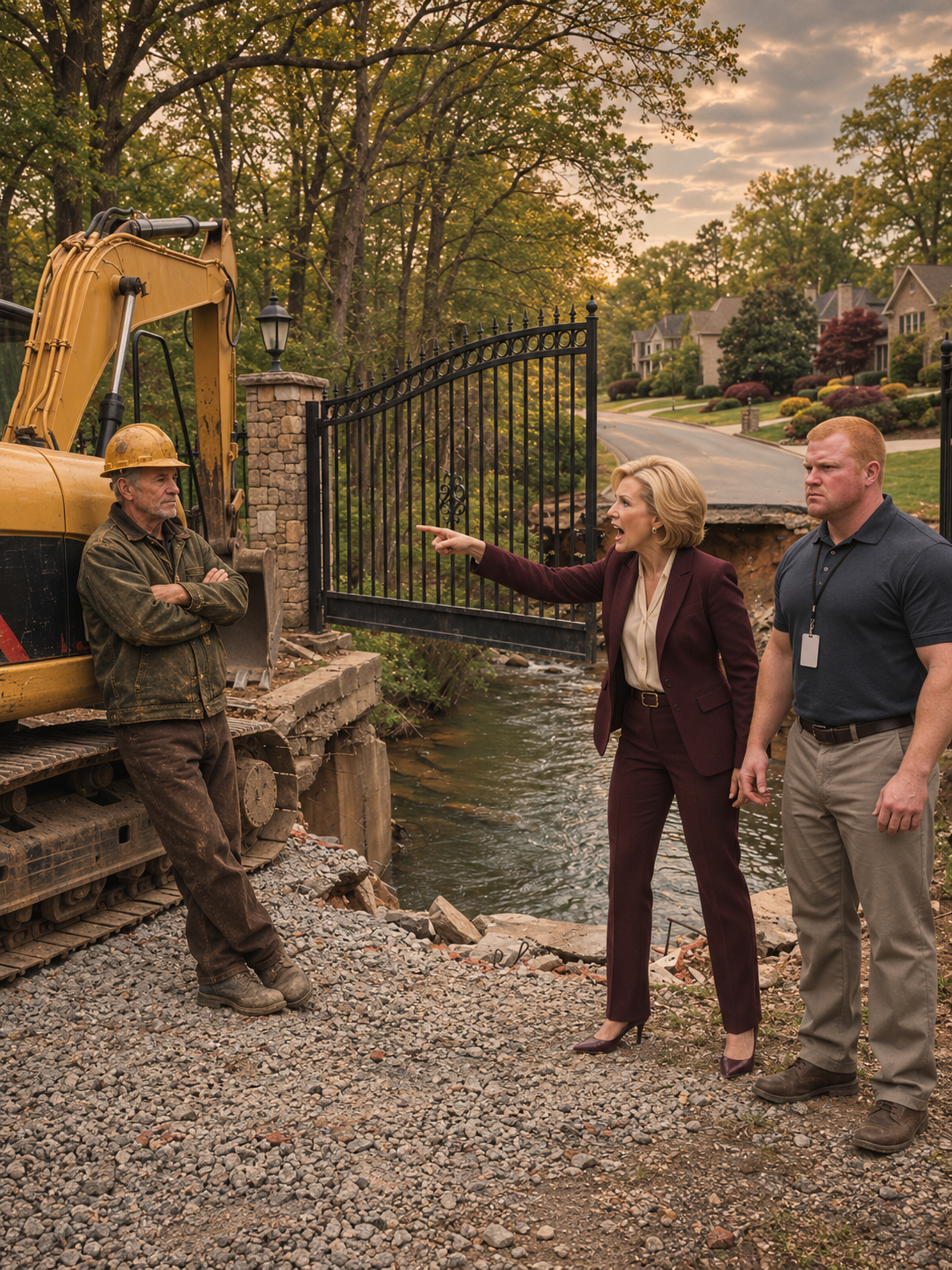
When the HOA president told me my grandfather’s bridge was an eyesore, I showed her the deed proving it wasn’t hers to control. Three months later, after eight days away on a construction job, I drove home through pouring rain and found an eight-foot iron gate across my only driveway, with a notice demanding $15,420 before I could enter my own property…
The first letter arrived on thick, cream-colored paper, the kind people use when they want an ordinary demand to look official. At the top was the crest of Oak Creek Estates, a neighborhood I did not live in and had never agreed to join.
According to its architectural review committee, my bridge violated the community’s “Tuscan-inspired aesthetic guidelines.” They wanted plans for a masonry facade and ornamental railings within thirty days, as if an HOA could order me to remodel a bridge my grandfather had built with his own hands.
My name is Noah Collins. My family has owned twelve wooded acres beside Miller’s Creek since the 1970s, and in 1985 my grandfather built the heavy steel-and-timber crossing that connected our property to the county road. It rested on thick concrete supports, strong enough for loaded logging trucks, and for most of my life I never gave its appearance a second thought.
From my front porch, I could hear water running over rocks ten feet below the crossing. There were trees as far as I cared to look and no neat lawns to mow for anybody else’s approval. That quiet was one of the reasons I stayed.
Three years earlier, a developer had bought two hundred acres of farmland on the other side of the creek. The fields became Oak Creek Estates, rows of big beige houses with matching landscaping, and the developer paved Sycamore Drive right up to the entrance of my bridge. He had tried to buy my land first, but I refused; my property remained separate from the new association.
Then Brenda Carmichael became HOA president. She kept a close eye on paint colors, landscaping and every visible corner of the development, and apparently she could see my old bridge from her house on the hill. To her, the exposed steel and the woods behind it spoiled a view she wanted to control.
I laughed when I read the first letter, crumpled it and tossed it in the fireplace. Nobody had asked my grandfather for decorative railings when he was hauling equipment across that creek, and I wasn’t about to spend fifty thousand dollars making his practical bridge look like the entrance to an Italian restaurant.
Two weeks later, another envelope showed up. This one listed a $500 fine for failing to comply and a $1,000 fine for an “unapproved structure,” even though the structure had been standing long before Oak Creek Estates existed. I wrote “RETURN TO SENDER — NOT IN HOA” across it in thick black marker.
The letters kept coming, and the amounts climbed. I answered the same way because I believed the deed and the county survey settled the question. What I didn’t understand yet was that Brenda took my refusal personally.
One humid Tuesday, I was under my F-350 changing the oil when I heard hard heels tapping on the bridge planks. I rolled out on my creeper and found Brenda standing beside Greg Tolson, a broad, red-faced man in a tight polo shirt who acted as the association’s unofficial enforcer.
“Mr. Collins,” Brenda said, with the practiced smile of somebody already certain she was going to win, “we thought a face-to-face conversation might clear up this misunderstanding.” I wiped my hands on a rag and told her there was no misunderstanding: the HOA had no authority over my land, my creek or my bridge.
Greg stepped forward. He said my “rusted-out eyesore” met their private road, which supposedly gave the association an easement and made me subject to its bylaws. Then he told me I owed nearly three thousand dollars and warned that they could put a lien on my property.
I didn’t argue with him in the driveway. I went inside, took my deed and the official county survey from the fireproof safe, and spread them across the hood of the truck. The boundary line ran exactly where the pavement ended; there was no HOA easement across my bridge.
“Your developer wanted this property and I said no,” I told them, tracing the line with a grease-stained finger. “He built right up to my boundary anyway. That doesn’t make me a member of your association, and it doesn’t give you the right to threaten my home.”
Brenda stared down at the map while Greg went quiet. For a moment, I thought the paperwork had finally done what plain words couldn’t. But Brenda folded her arms and said the bridge was a security liability, and that Oak Creek Estates would protect its borders.
I watched them walk away across the planks my grandfather had bolted together. The threat sounded like one more excuse to send letters, and when those letters stopped over the next three months, I took the silence as a sign the matter was finished. I had work to do, and I was glad not to think about Brenda Carmichael.
I’m an independent heavy-machinery contractor, mostly doing land clearing and foundation work. In late October, I accepted a good-paying job two states away and spent eight days moving earth, eating drive-through dinners and sleeping in a cheap motel. By the end, I wanted nothing more than a shower and my own bed.
I came down Sycamore Drive just after midnight on a Friday, with rain hammering the windshield and my truck’s high beams catching the wet asphalt. As I rounded the last bend, something tall and black filled the road where the approach to my bridge should have been. I hit the brakes so hard my tires slid, stopping inches from it.
An eight-foot wrought-iron gate stood across the entrance, fixed between two new concrete pillars. One pillar was at the edge of the HOA pavement, and the other stood in the dirt on my side of the boundary; the bars were locked with a keypad and a heavy weatherproof padlock. My grandfather’s bridge was still visible beyond them, but I couldn’t get my truck onto it.
I put on my rain slicker, grabbed a flashlight and walked to the bars. A laminated notice was fastened there with plastic ties, claiming Oak Creek Estates had restricted the crossing for “community safety.” It said the property owner would receive a remote and entry code only after settling all fines and gate-installation costs.
At the bottom, in plain numbers, was the balance: $15,420. Underneath was Brenda Carmichael’s name. I stood in the rain looking at a gate built while I was out earning a living, a gate that kept me from the house my family had owned for decades.
I called the police. About twenty minutes later Officer Jenkins arrived, read the notice and listened while I explained that they had planted a concrete support on my land and sealed off my only usable driveway. He looked uncomfortable even before I finished.
Jenkins told me Brenda had already filed a report asserting the gate was on HOA property and the boundary was disputed. He said he couldn’t order it removed on the spot without court authority, and warned me not to tear it down with my truck because I could end up facing a property-damage charge.
“You’re telling me I can’t go home,” I said, looking past him at my own dark windows across the creek. He told me to call a property lawyer Monday, got back into his cruiser and drove away, leaving me beside the locked gate with the water rising below it. Part 2…..
IF FACEBOOK BROUGHT YOU HERE, HERE’S THE CONTINUATION YOU’VE BEEN WAITING FOR. ENJOY! 👇 I stood there a while after Jenkins left, listening to the rain strike the iron bars. The creek was swollen and moving fast, but there was no other practical way to reach the house from where my truck sat, so I took my duffel and picked my way down the muddy bank beside the bridge.
The water reached my waist. Once, the current pushed so hard against my legs that I grabbed a rock to keep my balance, and by the time I climbed onto my own side I was shaking with cold. I had worked eight days to come home and somehow ended up sneaking into my own property like a stranger.
In the morning I woke with a headache and looked through the trees toward Sycamore Drive. Brenda’s house sat on a small hill overlooking the crossing, and she was on her back balcony in a robe with a coffee mug, facing the new gate. I couldn’t know what she was thinking, but I knew she could see the road was blocked.
Monday morning I called David Hayes, a property lawyer with a strong reputation in our county. I explained the deed, the survey, the gate and the fact that a pillar had been poured on my side. He agreed I had a serious claim, but said resolving it through an injunction, a court-ordered survey and a hearing could take four to six months and cost around $10,000 in fees.
“So I pay them fifteen thousand dollars, or I cross freezing water until spring?” I asked. David didn’t pretend there was an easy answer, and he told me not to destroy the gate while the dispute was unresolved. I hung up and walked down to the creek, holding the phone so tightly my fingers ached.
I stood on my land and looked at the iron bars. Brenda had built something expensive and sturdy, and everybody kept telling me what I couldn’t do to it. Then I looked beyond the bars at the timber deck and the two long steel girders underneath, and thought about something I did own without question.
The bridge was my grandfather’s, not Brenda’s. If I couldn’t use it to reach my house, I didn’t have to leave it sitting there for her to control, either. That thought was less satisfying than it first sounds; moving a bridge isn’t like moving a farm gate, and I knew better than most people what could go wrong around suspended steel.
I called Tommy Mitchell, a friend I’d worked with for fifteen years who ran a commercial crane-and-rigging company. Two years earlier I’d pulled one of his excavators out of a mud bog, and he’d been promising to return the favor ever since. When I asked if he could help move forty tons of steel and timber, he went quiet.
“Are you stealing a bridge, Noah?” he finally asked. “No,” I said, looking at the crossing. “I’m taking my own out.” He asked when, and I told him Friday night, when the road would be quiet and we could work without a neighborhood audience.
Friday brought cold fog off Miller’s Creek. I was waiting on my side with my Caterpillar 320 excavator when Tommy’s convoy arrived on Sycamore Drive around in the morning: a Liebherr mobile crane, and a flatbed driven by his foreman, Chuck. The road lights turned the mist pale around the brand-new iron gate.
Tommy got out with a thermos and studied how closely the concrete pillars sat to the bridge. “You weren’t exaggerating,” he said. I showed him exactly where the deed placed the boundary and repeated the condition that mattered most to me: we were not to scratch, bend or disturb the HOA’s gate.
We worked the way we did on machinery jobs, keeping our voices low and watching the loads. Chuck and I freed the thick timber decking, and Tommy lifted each section away with the crane before we went on to the steel. I could feel the old planks under my boots and remembered my grandfather talking about how much work it had taken to set them in place.
By early morning the deck was gone, and the two long I-beams were all that still crossed the creek. Tommy took the weight with the rigging while we released the fastenings at the concrete supports. A beam shifted and gave a deep metallic groan; none of us moved until it was steady again.
One girder went onto the ground on my side, and then the second. By about the pieces of my grandfather’s bridge lay safely inside my property and Tommy’s crew was packing up. I was exhausted, and the creek still separated my home from my truck, but the gate had not been touched.
Across the ravine the iron bars stood straight, the padlock was still fastened and the keypad light still blinked. Behind the gate, where a bridge had always been, there was now a ten-foot drop to rocks and fast water. Looking at it, I felt a quick flash of triumph followed by the sobering realization that somebody could get hurt if they opened those bars without looking.
Part 3 I couldn’t sleep, so I made a pot of coffee and carried an Adirondack chair to the edge of my land. As the fog thinned around , I kept my eyes on the far end of Sycamore Drive, hoping whoever came first would see the missing crossing before getting anywhere near the edge.
Greg Tolson arrived in his customized electric golf cart with a clipboard balanced on the steering wheel. He parked near the gate, got out and punched the keypad, paying more attention to the lock than to what lay beyond it. The mechanism clicked and the gate began to swing toward the creek.
He was polishing a mark off the handle when he started forward. “Hey, Greg!” I called across the water, and he looked up, then down. His next step stopped short as he saw empty air where the timber planks had been, and he stumbled backward onto the pavement.
For a few seconds he sat there staring at the creek. Then he scrambled away from the edge and shouted, “Collins! Where’s the bridge?” I lifted my coffee mug and said, “Decided I didn’t like the Tuscan look anymore.” The joke came out dry, but my hands were still tight around the mug.
Brenda arrived about twelve minutes later, jogging down from her house in yoga pants with a phone pressed to her ear. She saw the open gate, the empty crossing and the pieces of steel lying on my bank. Her anger turned her face red, and she demanded to know how I could destroy community property.
“I didn’t touch your gate,” I told her. “The bridge is mine, just like the survey says.” She threatened to have me arrested, and before long Officer Jenkins returned to the road he’d visited in the rain the week before.
Jenkins walked to the pavement’s edge, looked down into the ravine and then across at me. He asked Brenda whether her gate had been damaged; she said no, but insisted I’d stolen the bridge itself. He reminded her that ownership of the crossing had been the very point of the boundary dispute, then turned his attention to the obvious danger in front of him.
“You’ve got a gate people can open directly over a drop,” he said. Whatever arguments remained about property lines, that was a public-safety problem nobody could ignore. He contacted the county, and before the morning was over officials were examining the end of the road.
Inspector Miller from the zoning office arrived and inspected the concrete footings beside the creek. He asked who had approved work so close to a protected waterway, including the pillar placed at the bank. Brenda began to say the HOA had authority to secure its neighborhood, but Miller wanted permits, not explanations about neighborhood rules.
He identified unpermitted construction near the creek and the unguarded drop created by the gate, and issued an emergency safety citation and a stop-work order. He also told Brenda and Greg that the county would require the gate and pillars removed and the disturbed bank restored. Whatever the HOA thought it had accomplished, the county was treating its new entrance as a hazard.
When Greg asked about the cost, Miller said the applicable penalties could run $2,000 a day, counted from installation, and gave the association forty-eight hours to address the removal order. Brenda went silent. For the first time since this began, I watched her listen to someone who wasn’t interested in her opinion of my bridge.
David Hayes came out as well, reaching my side by using the old dirt roads behind my property. He took notes while the officials dealt with the gate. I was relieved to have him there, because I knew removing my own bridge didn’t mean all the legal and safety questions had magically disappeared.
There was another decision I wanted to put on the record. I told Inspector Miller about an old county logging road that touched the back three acres of my land, a route I’d never developed into a driveway because my grandfather’s bridge had always been easier. I asked what was needed to change my access and address to that rear route and permanently decommission the creek crossing.
Brenda looked up at the word “permanently.” “What does that mean?” she asked. I looked across the water at the empty concrete supports and told her, “It means the bridge isn’t coming back.”
Final Over the next three weeks, Tommy and his crew helped me grade a private gravel driveway from the back of my acreage to the main county highway. It followed the old logging-road connection, and I arranged to have the property’s access recognized from that direction. For the first time in years, getting home no longer meant driving through Oak Creek Estates.
The change took money, equipment and a good deal of work, but it was work I understood. I spent days on the excavator, shaping the grade and watching the gravel settle where we’d made a new route through the trees. At the end of each shift I could drive up to my house without seeing Brenda’s gate or wondering whether someone had changed a keypad code.
The HOA had a much harder time with what came next. The county’s penalties over the gate and the creek-bank violations eventually exceeded $25,000, and the association was also responsible for undoing the unpermitted work. Its insurer would not cover the expenses because the board had proceeded without the legal advice and permits it needed.
Residents who had never met me were told they had to pay an extra $600 each through an emergency special assessment. I didn’t enjoy that part; most of those families hadn’t voted to put a gate across anybody’s driveway. But once the bills reached their mailboxes, they started asking Brenda and the rest of the board questions that no threat of a lien could answer.
A special HOA meeting followed. Brenda was removed as president in a nearly unanimous vote of no confidence, and Greg resigned from his role before the association could push him out. I heard about the meeting afterward; I didn’t go, and I had no wish to become a permanent fixture in their neighborhood politics.
The county required the association to hire a demolition crew to remove the iron gate and break out the concrete pillars. That job cost another $8,000. With the bridge gone and Sycamore Drive ending at a steep creek bank, the HOA then had to install a heavy steel guardrail and flashing yellow hazard lights to protect anyone coming down the road.
The lights ran day and night. From the direction of Brenda’s back balcony, the tidy neighborhood entrance she’d wanted now ended in industrial steel and blinking warnings. I didn’t need to stand there and watch her reaction; the view itself said enough.
I still had the girders, the old timber and the chains from my grandfather’s bridge lying on my land. Throwing them away felt wrong, and rebuilding the crossing would have meant returning to the same argument. So I used my excavator to move the steel up the bank, set the beams together as an upright abstract sculpture, and arranged the old chains and broken timber around them.
I registered the piece with the county as private artwork. From my side of Miller’s Creek it looked rough, rust-colored and a little stubborn, just like the bridge had always looked to me. Through the trees, it was also visible from Brenda’s kitchen window, a reminder that something doesn’t have to match a neighborhood’s preferred style to belong where it stands.
Sometimes I think about the night I first saw that locked gate, how small I felt staring at my own house from the wrong side of the water. I didn’t get the bridge back, at least not in the form my grandfather built, and the fight cost time and work I would rather have spent elsewhere. But I kept my home, made a better way into it and learned that protecting a boundary sometimes means choosing not to cross it again.
THE END. I’ve shared the complete story, and I truly hope it touched your heart. If this story moved you, please , like, and share the post. Thank you for reading! ❤️
✓ Lynn R. Adams
When the HOA president told me my grandfather’s bridge was an eyesore, I showed her the deed proving it wasn’t hers to control. Three months later, after eight days away on a construction job, I drove…