When the HOA president showed up at my ranch gate with two cattle trailers and a lease for my pasture, I thought someone had made a terrible mistake, until I saw whose name was on the contract…
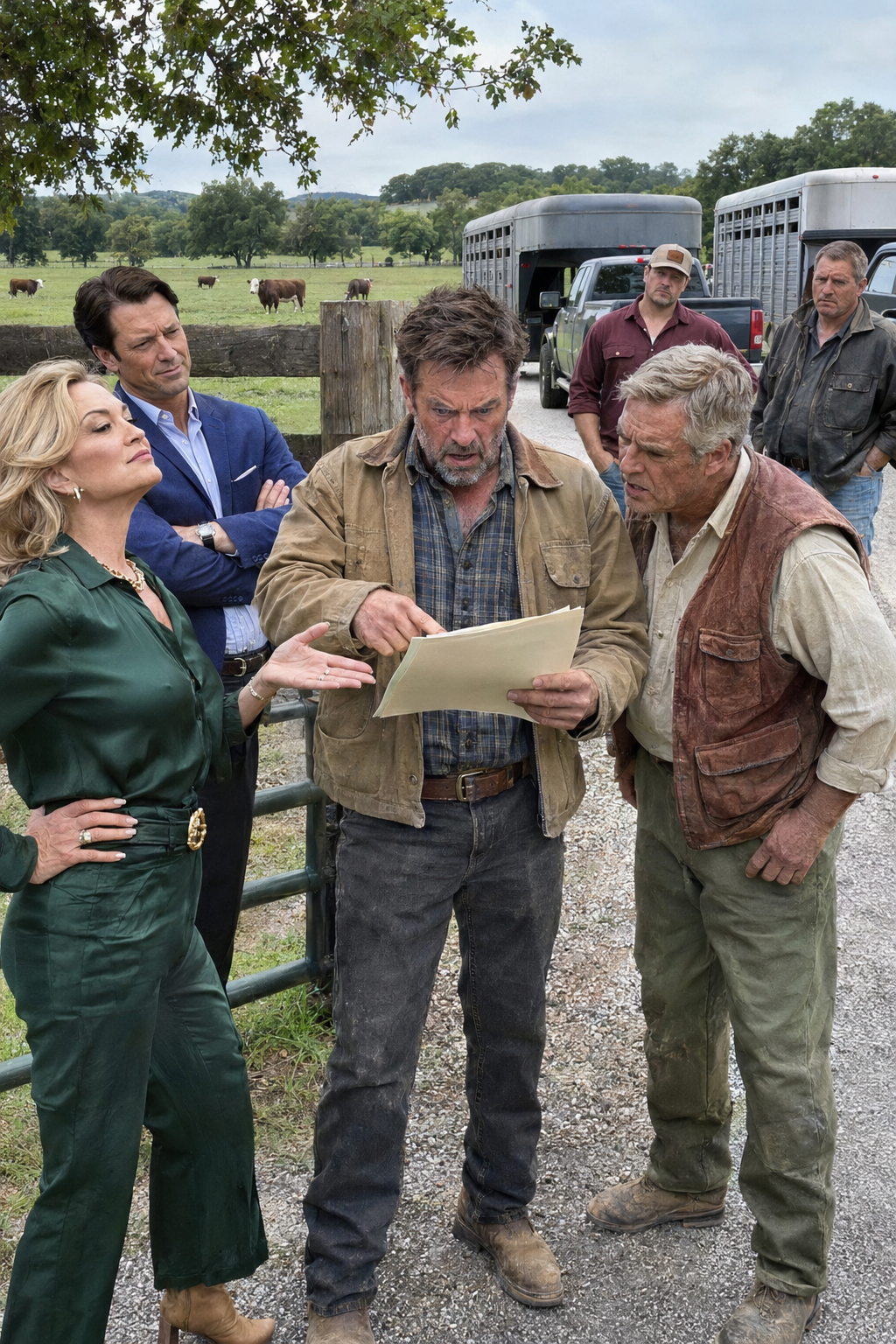
When the HOA president showed up at my ranch gate with two cattle trailers and a lease for my pasture, I thought someone had made a terrible mistake, until I saw whose name was on the contract…
Vanessa Crowley stood beside my open gate in a crimson blazer, holding a packet of papers against her chest. Behind her, a steer stepped down the ramp of the second stock trailer, and the first animals were already spreading across the south pasture I had spent all spring bringing back after winter.
“What are you doing on my property?” she asked when I took out my phone. I looked past her at the hired hand who had unlatched my interior gate without asking, then started recording the trailers, truck, license plates, and cattle moving toward my water trough.
“I’m documenting what’s happening,” I said. Vanessa told the crew to keep unloading, as though the matter had been settled before I walked outside.
My name is Owen, and I own 112 acres beside Juniper Trace, a subdivision built after the surrounding agricultural tract was divided. The south pasture is 18 acres of that ranch, not a neighborhood common area, and my family had worked that ground long before the houses and streetlights arrived.
I knew exactly what went into keeping it usable. I had repaired the fences, maintained the water line, reseeded thin grass, planned livestock rotations, and paid the property taxes that came with owning it.
A cattle operator in dusty boots approached us. He looked about sixty, with a sunburned face and the tired patience of someone who had hauled animals since before sunrise.
“Everything good here?” he asked. “No,” I said at the same moment Vanessa answered, “Yes.”
“Did anybody tell you who owns this ground?” I asked him. He said he had been told the Juniper Trace Homeowners Association controlled the agricultural buffer and could lease it for seasonal grazing; when I asked whether he had verified that, he looked at Vanessa instead of answering.
“You have a valid agreement,” Vanessa told him. “Keep unloading.” I told him plainly, with my phone still recording, that I had never signed a grazing agreement with his company and had never given Juniper Trace permission to rent my pasture.
I didn’t block the trailer or go near the cattle. They were living animals, and starting a shouting match beside a moving stock trailer would not help them or me. The animals were already moving across a field I needed for my own rotation later that week, and every minute of arguing meant more of them settling around water and grass that had not been offered to their owner.
“Let me see the lease,” I said to Vanessa. She told me to request it from the association, though she was standing on my ranch while people used that very document to put livestock there.
At last she angled the cover toward me. I read “Seasonal Grazing Lease” and, beneath it, “Juniper Trace Homeowners Association,” listed as the lessor, the party supposedly entitled to rent out the land.
When I raised the phone to get a clearer picture, she pulled the packet back. “You don’t have permission to photograph association records,” she said, while a steer bumped my trough and the float valve began hissing water into the tank.
That sound worried me more than her tone. The trough was part of a system I used for my own stock rotation, and nobody had asked what eighty unfamiliar cattle would do to the water supply or where my animals were supposed to go later that week.
Vanessa followed me while I filmed the gate line and the places her crew had entered. She accused me of obstructing authorized agricultural management; I told her I was recording the intrusion, not stopping the workers.
By noon, the cattle had scattered through the grass and looked almost as though they belonged. I stood at the fence looking at an ordinary pasture scene made wrong by one fact: these were not my cattle, and nobody with the right to speak for me had invited them.
The phrase Vanessa kept repeating was “agricultural buffer.” Years earlier, county planning requirements had created a separation area between new houses and working ranchland, partly so homeowners would understand that dust, tractors, livestock, and early mornings came with living beside a farm.
The buffer was real. But I had never understood a planning designation to mean that a homeowners association owned whatever land happened to fall beneath the lines on its map.
Inside, I took my file box from the cabinet beside my desk. My deed, survey, tax statements, and county parcel record all showed the south pasture within my ownership, with no deed transferring those 18 acres to Juniper Trace.
Buried among the old papers, however, was an agricultural buffer maintenance agreement recorded years before Vanessa became president. The developer and the association were named in it, and so was the parcel that later became mine, but my copy was incomplete.
I could see why Vanessa might have believed the HOA had some role there. I couldn’t see how a responsibility for maintaining a buffer could become permission to rent my ground for four months, and I wasn’t about to pretend I was a title expert just because my name was on the deed.
I printed the current county property record and laid it beside the old agreement and my survey. Each document seemed to answer a different question, and I needed to know which one, if any, gave Juniper Trace the power it was claiming.
Before sunrise the next morning, I found the first damage. The cattle had crowded the south trough, bent its galvanized riser, and cracked a fitting, leaving a ten-foot patch of grass muddy from water running into it.
Farther down the fence, an interior hot wire was on the ground. A fiberglass post had snapped, another leaned sideways, and hoofprints cut across a strip I had reseeded six weeks earlier.
I shut off the water, took photographs, checked the meter, measured the trampled ground, and marked its corners with orange flags. Then I called my usual ranch plumber and asked him to describe the damage specifically on his invoice, rather than simply writing “repair.”
At , the operator texted to ask whether we could talk. His name was Ray Danner, and when I called, he said he didn’t want trouble and had relied on Vanessa and an HOA management committee telling him the field was cleared for use.
“What did they actually give you?” I asked. “A lease and a buffer map,” he said, adding that the association had received an upfront grazing fee.
I asked him to email the full agreement. Ten minutes later, an eleven-page PDF arrived, showing a four-month term, permission for up to ninety cattle, and Juniper Trace named as the lessor of an area described only as the agricultural buffer on Exhibit C.
I turned to that exhibit and found my entire south pasture shaded inside a thick boundary line. There was no deed reference, surveyor’s certification, or recorded title document showing the HOA owned it, and I finally understood the problem wasn’t just the cattle at my gate; someone had used that map to sell access to my land. Part 2…..
IF FACEBOOK BROUGHT YOU HERE, HERE’S THE CONTINUATION YOU’VE BEEN WAITING FOR. ENJOY! 👇 The map looked official at first glance, with roads labeled and neat boundary lines around the shaded acreage. But it carried no explanation of the legal right behind those lines, and Ray confirmed that the HOA had supplied it without saying whether it came from a recorded survey or deed.
“Ray, if somebody showed you a colored map of my kitchen, would that mean they could rent out my house?” I asked. He was quiet for a moment, then said, “Owen, if they couldn’t lease that field, I need to know before I make this worse.”
He had a business to protect, and I wasn’t interested in making an enemy of a man who had been told the ground was available. I told him to speak with his attorney, while I tried to get the original records rather than argue about the drawing someone had stapled to his contract.
By then my plumber had replaced the cracked fitting and reset the trough riser. I repaired the hot wire, kept the damaged grass marked, and put the photographs, measured areas, meter reading, and itemized invoice into a folder on the kitchen table.
Just after eleven, Vanessa emailed me a formal-looking notice titled “Interference with authorized agricultural management.” It warned me not to move livestock, remove temporary fencing, interrupt water access, or interfere with contractors, and said the HOA might pursue enforcement costs if I continued.
I read it twice, standing beside the kitchen counter. Their cattle had broken my equipment, but the written warning made it sound as if I were the person who had disrupted an ordinary maintenance job.
I didn’t reply in anger. I printed the notice, filed it with the lease, and called the county recorder’s office to ask how to obtain every recorded document associated with the old agricultural buffer agreement, including exhibits and amendments.
The clerk explained how to search using the recording number. My copy was missing attachments, so I spent the afternoon matching names and dates instead of treating the first page of an old agreement as the final word.
Ray drove back around two, alone this time. He stayed outside the gate until I met him and handed over a printed copy of the lease, complete with the signatures.
Vanessa had signed for Juniper Trace as president, and below her signature appeared another description: “Authorized Agricultural Manager.” Ray said that wording was already on the form when he received it, and he had not been shown a title report or an ownership affidavit.
He had received the lease, the map, and an email saying the association’s counsel had reviewed the program, but he had never seen the legal advice itself. “Keep the copy,” he told me, when I tried to hand the papers back. “I don’t want to stand here later pretending I didn’t know there was a question.”
That afternoon I compared the lease map with my old survey. The shapes were similar, but the boundary lines didn’t match exactly, and a note in the lower corner said only that the map came from a buffer exhibit, without a recording number or surveyor’s name.
I was at the recorder’s office before it opened the next morning. The clerk located the original agreement, two amendments, a legal description, three exhibits, and a later notice identifying Juniper Trace as a successor party entitled to enforce parts of the agreement.
I bought certified copies and read them in my truck. They created vegetation-maintenance duties and a way for specified parties to demand compliance, but the language I saw did not say that title to my pasture had ever passed to the HOA.
There was still enough legal language to make me cautious. I drove to an agricultural title company and met Laura Bennett, an examiner with gray at her temples who read each instrument in the order it had been recorded instead of giving me an answer from across the table.
She checked my deed and worked backward through the earlier deeds. The chain showed the south pasture remaining inside my fee-owned parcel, without a later conveyance carving it out for Juniper Trace.
Laura found the buffer agreement in the record too, which meant it couldn’t simply be ignored. She explained that a recorded obligation burdening land is different from a deed conveying ownership, and that the HOA appeared to have enforcement rights under that obligation.
Then she placed the certified original buffer exhibit beside the simplified version Ray had been given. The recorded map showed parcel boundaries beneath the buffer overlay, while the lease version shaded the management area as though the whole space were one property.
At the bottom of the original was a note missing from Ray’s copy: “Buffer designation does not alter underlying fee ownership.” Laura pointed to it with her pencil and reminded me that a note on a map wasn’t a substitute for analyzing the complete agreement.
I took a photograph for my records anyway. The HOA’s map made the land look available to rent; the recorded exhibit showed the buffer crossing acreage that still belonged to individual owners, including me.
I left Laura preparing a preliminary title report and drove straight to the Juniper Trace management office. I handed over a written request for the board minutes, committee materials, financial projections, vendor proposals, and records behind the grazing decision, because I wanted to know how a maintenance arrangement had become a lease with Vanessa’s signature on it.
Part 3 Three days later, the first packet came by email, and the numbers explained why the board had liked Vanessa’s proposal. Juniper Trace had been paying more every year for mowing and brush control along the subdivision edge, while insurance recommendations made the maintenance work harder to postpone.
A board presentation compared mechanical mowing, contracted goats, and seasonal cattle grazing. The cattle option carried the lowest projected net cost, partly because the association expected the operator to pay a grazing fee instead of the HOA paying a vegetation contractor.
I understood the temptation. Keeping a common budget under control matters to homeowners, but saving them money didn’t give their association rights over a neighbor’s property that the recorded agreement had never granted.
I searched the packet for an ownership opinion, a recorded grazing easement, a deed, or an agreement signed by the landowners. There was none, and there was no title report showing that Juniper Trace possessed a right to lease my 18 acres.
A legal memorandum appeared in the meeting records but was withheld as attorney-client privileged, which I didn’t challenge. The minutes summarized counsel’s advice as relating to the HOA’s authority to enforce vegetation maintenance obligations, a narrower statement than Vanessa’s claim that the association controlled the entire buffer for any management purpose.
The board’s vote had been four to one. The dissenting director had asked that counsel confirm whether the association could lease rights it didn’t own, and I found no follow-up in the materials answering that question before the cattle arrived.
I sat with the printed minutes and tried not to make more of them than they proved. They showed somebody had recognized a problem and asked a sensible question; they didn’t prove Vanessa had deliberately deceived anyone.
By the end of the week, Laura’s preliminary title report arrived. It confirmed that my parcel remained intact and that Juniper Trace held certain enforcement rights under the buffer agreement, but it identified no HOA fee ownership, grazing easement, or recorded leasehold interest in the pasture.
I made an appointment with Daniel Price, a real estate attorney, and carried in the deed, certified agreement, recorded exhibits, both versions of the map, lease, repair records, and board papers. I told him I wasn’t looking for a speech about winning; I needed to know what the documents actually allowed.
He read for nearly an hour, stopping at the notice provisions and the amendments. Instead of announcing a verdict, he asked, “Before those cattle showed up, did the HOA ever send you a written notice that you weren’t maintaining the buffer?”
“No,” I said. There had been no demand to cut weeds, mow brush, repair a fence, or cure a maintenance problem, and I hadn’t received a formal warning under the agreement’s procedures.
Daniel asked for proof of what I had been doing on the ground. I showed him the ranch notebook where I recorded seed, mowing, water checks, fertilizer, fence work, and rotation dates, along with older invoices and photographs.
Most entries were as dull as a person could imagine. A fence post purchased on a Tuesday, grass seed ordered in spring, a section mowed before the weather turned; I had kept them because running a ranch gets expensive when you can’t remember what you did.
“These predate the dispute,” Daniel said, looking through the pages. I nodded, and he explained that ordinary records made in the course of work were useful when somebody later suggested a pasture had been neglected and needed emergency management.
The remaining board records arrived that afternoon, including Vanessa’s presentation. A director had specifically asked whether the HOA needed adjacent landowners’ consent, and the minutes recorded Vanessa answering that the buffer was under association control for management purposes.
I thought about how easily those words could sound convincing in a meeting room. A board member hearing “management authority” might picture weeds getting cut, while a ranch owner hearing the same words from behind a cattle trailer might picture somebody taking over his gate and water trough.
At our next meeting, Daniel laid five documents across his table: my deed, the buffer agreement, the recorded exhibit, the grazing lease, and the board packet. “These all concern the same land,” he said, “but they aren’t all granting the same kind of right.”
He tapped the deed first. That established my ownership; the buffer agreement placed specific duties on the property; the recorded exhibit located those duties; and Ray’s contract purported to give somebody else access and use of my field for four months.
The budget documents helped explain why the association had wanted to do that, but a financial incentive wasn’t a property interest. I finally had a clearer picture of the mistake I was trying to challenge, though we still had to deal with the HOA’s strongest argument.
Daniel turned the buffer agreement toward me. “They may have the right to make sure this land is maintained,” he said, “but the question is whether that right includes giving another person possession of it.”
Part 4 Daniel drew three boxes on a yellow legal pad and labeled them enforcement, limited remedy, and possession. An enforcement right could let Juniper Trace demand that an owner carry out duties; a limited remedy might allow specific work after notice and failure to cure; possession was the very different right somebody would need before leasing the ground to another person.
“If the association can require you to repair a shared fence, that doesn’t make it the owner of your field,” he said. “And if a county can require someone to cut weeds, it can’t automatically rent out the person’s backyard.”
The recorded agreement did provide a process for addressing neglected vegetation. But Daniel couldn’t find an independent grant allowing Juniper Trace to take general control of the pasture, collect grazing rent, or give a third party four months of access rights.
Another clause specified that the agreement created no estate in the land beyond its defined rights. Alongside the map’s note about underlying ownership, that made Vanessa’s interpretation look broader than the documents themselves.
“What if they say cattle are just a cheaper way to cut grass?” I asked. “That’s the argument they’ll make,” Daniel said, and I appreciated that he didn’t pretend their position was ridiculous.
He explained that even if grazing could sometimes serve as vegetation management, we still had to ask whether the agreement permitted that particular remedy, whether the required notice and opportunity to fix a problem had occurred, and whether it could be carried out through a revenue-producing livestock lease. In my case, no maintenance default notice had preceded the trailers, and my records showed regular work on the pasture.
Ray’s contract wasn’t a brief order for a crew to clear brush. It gave his company livestock access, water access, temporary fencing rights, and a defined grazing term, while the HOA collected an upfront fee.
For the first time, I felt I could explain what bothered me without raising my voice. My ownership and my maintenance obligations could both be real, while the HOA’s supposed authority to rent my pasture could still be unsupported.
Daniel prepared a formal demand, careful to say no more than our evidence justified. It asked Juniper Trace to end any grazing arrangement affecting my parcel, allow no more livestock or unauthorized equipment onto the ranch, preserve the emails and records, identify who approved the lease, and produce whatever instrument it believed granted the right to sign it.
We also requested reimbursement for the documented damage to the riser, hot wire, reseeded ground, and water use. The deed, certified agreement, original recorded map, and preliminary title report went with the letter by email and certified mail.
Ray received a separate notice and called that evening. His attorney was reviewing everything, he said, and he wouldn’t bring another animal into the field while the ownership question remained unresolved.
Juniper Trace’s attorney acknowledged Daniel’s letter the following morning. Vanessa sent her own short email later, saying the board rejected our reading of its authority and maintained that the grazing program was permitted under the buffer agreement.
I forwarded her message to Daniel. He answered, “Then they can prove it,” and I left the matter there instead of replying to her directly.
The next morning, Ray called with the decision that finally let me unclench my shoulders. His attorney had advised him to suspend the arrangement and remove the cattle rather than keep his company inside a property dispute between the HOA and me.
The trailers came back that afternoon. This time Ray’s crew asked before opening the gate, loaded the animals in manageable groups, gathered the temporary panels, and left my water line alone.
I recorded the removal just as I had recorded the arrival. When the last trailer rolled away, I could hear the wind in the fence again instead of cattle pressing against it, but the muddy patch and flattened new grass were still there.
Two days later, the association’s attorney confirmed a temporary suspension of additional grazing. The same letter refused to accept our interpretation and expressly reserved the board’s right to restart the program.
I showed Daniel that sentence. Removing Ray’s cattle had stopped the immediate damage, but it wouldn’t protect my land if the board still believed it could bring in another operator whenever it chose.
Daniel recommended asking the court to determine the scope of the recorded agreement and stop further unauthorized third-party grazing while that issue was resolved. I agreed, knowing that going to court would mean filings, expenses, and weeks in which the pasture still had to be cared for.
Part 5 Daniel filed an action seeking declaratory and injunctive relief, and nothing about the process looked like the courtroom scenes on television. There were pleadings, responses, exhibits, notices, and dates on the calendar, while I continued checking the fence and walking the strip of grass the cattle had chewed down.
Juniper Trace argued that seasonal grazing was a reasonable vegetation-control method and that the agreement’s maintenance authority was broad enough to allow it. Daniel didn’t deny that cattle could manage vegetation; he argued that a maintenance obligation did not, by itself, give the association the right to lease my land to an operator for a fee.
At the hearing, the judge had the recorded agreement, its amendments, both maps, the deed and title report, Ray’s lease, my maintenance records, and the board minutes. Vanessa sat behind the association’s attorney in another crimson jacket, listening while the lawyers addressed the court.
The judge focused on whether the agreement clearly authorized Juniper Trace to grant third-party grazing access, and whether more livestock could cause harm before the parties resolved that legal question. Nobody was deciding criminal guilt, assigning blame for every bent post, or putting a price on the damaged pasture that day.
The court granted temporary injunctive relief preventing the HOA from authorizing third-party grazing, livestock entry, or similar possessory use of my parcel while the underlying dispute was resolved. It wasn’t a final ruling on every provision of the buffer agreement, and Daniel made sure I understood the difference.
Still, I went outside the courthouse knowing the board could no longer treat its interpretation as permission to act first. It would have to establish its authority before putting someone else’s animals back through my gate.
Vanessa passed me in the hallway without a word. I didn’t follow her or ask for an apology; I had spent enough time speaking to a person who thought holding a packet of papers meant she could decide what those papers said.
Daniel stayed behind to speak with the HOA’s attorney. When he came out, he told me the association wanted to discuss a resolution, and we agreed to keep the conversation centered on specific rights and provable costs.
A week later, Juniper Trace formally ended Ray’s grazing arrangement as it applied to my ranch and suspended the wider buffer grazing program pending legal review. That removed the risk of an immediate return, but it did not restore my pasture or settle who would pay to repair what had been damaged.
The next round was less dramatic and more exhausting. I provided photographs of the bent riser, the broken hot wire, the hoof damage, the original seed work, and the reseeding and restoration needed after the cattle left.
Daniel reviewed the water readings, repair bills, and labor figures with me. He pushed back when I was tempted to count a stretch of ordinary seasonal wear as cattle damage, because a narrow, credible claim was worth more than a large number nobody could substantiate.
We also documented the legal expense directly related to stopping the grazing arrangement. There was no demand for a spectacular payout and no claim that every brown patch on the ranch had been caused by Juniper Trace.
The association wanted to negotiate which costs it would reimburse and how the buffer agreement would be handled in the future. Daniel insisted that any settlement had to address more than money: it had to make clear the HOA couldn’t sign another grazing lease over my parcel just because a map labeled it part of an agricultural buffer.
I kept working the ranch while the lawyers exchanged drafts. Every time I passed the south gate, I could see the orange flags I’d placed beside the worst damage, and I knew getting those flags out of the ground would mean more to me than hearing Vanessa admit she was wrong.
Final The written settlement eventually gave me the answer I had wanted from the beginning. Juniper Trace canceled the grazing lease as to my property and acknowledged that it held no leasehold interest, grazing easement, or general authority to permit third-party livestock use on the south pasture.
The association’s legitimate rights under the agricultural buffer maintenance agreement remained in place. What changed was the understanding that any future action had to follow the agreement’s actual notice, cure, and remedy procedures rather than treating a shaded buffer map like a deed.
Juniper Trace reimbursed the documented repair and restoration costs and paid an agreed portion of my legal expenses. The amount mattered to the association and the homeowners, but it was nothing like the enormous settlements people sometimes imagine when they hear about a property dispute.
I didn’t need an enormous settlement. I needed a repaired water line, a safe fence, a chance for the grass to grow back, and the assurance that another trailer wouldn’t appear at my gate because somebody had found a cheap way to manage weeds.
The consequences reached beyond my pasture. At the next annual meeting, homeowners wanted to know how a proposal advertised as saving money and bringing in grazing fees had ended with lawyers, a canceled agreement, and repair bills.
The board adopted a policy requiring documented title review and written legal approval before signing agreements involving land outside the HOA’s ownership. It was a practical fix, and I hoped it would keep the next ranch owner from having to collect license plate numbers while cattle walked through an open gate.
Vanessa completed the remainder of her term, but she wasn’t chairing meetings by election time and didn’t return as president. I heard about the change without celebrating; whether she held an office had never mattered as much to me as what she believed that office let her do.
Ray and I ended up on decent terms. He did not pay the property-damage claim because the settlement placed responsibility on the association that had represented it could lease the land, and he had cooperated in removing his cattle.
Before we parted, he told me, “If I lease pasture around here again, I’m checking the deed before unloading.” I said that sounded cheaper than finding out after the cattle were already in the field, and he gave a rueful little laugh.
By early fall, the south pasture was recovering. I’d replaced the damaged section of line, reset the posts, reseeded the worst ground, and adjusted the trough where its riser had been hit.
The orange evidence flags came out one at a time. The temporary panels were gone, the legal folders returned to their cabinet, and the gate latch belonged to my daily routine again rather than an argument over somebody else’s contract.
Months later, I cut a clean first row of hay across that field. There was no crimson blazer at the fence and no stock trailer blocking the entrance, only the mower behind me and a straight windrow forming across ground my family had cared for long before Juniper Trace existed.
The buffer agreement still existed, and so did the neighborhood. Its legitimate maintenance rights had never been the problem; the problem was someone stretching those rights until they looked like ownership, then expecting everybody else to accept the difference without asking.
I think about Laura tapping a pencil against a recorded map, Daniel sorting rights into three boxes, and Ray choosing to pull his cattle rather than make the damage worse. Each of them did more to solve the problem than another shouting match at my gate would have.
When somebody claims authority over land you own, a calm question can be more powerful than an angry answer: which exact document gives you the right you’re exercising? I learned that a paper trail doesn’t need to be dramatic to matter; it just needs to lead back to what the documents actually say.
THE END. I’ve shared the complete story, and I truly hope it touched your heart. If this story moved you, please , like, and share the post. Thank you for reading! ❤️
✓ Lynn R. Adams
When the HOA president showed up at my ranch gate with two cattle trailers and a lease for my pasture, I thought someone had made a terrible mistake, until I saw whose name was on the contract… Vanes…