When the HOA president ordered a loader driver to cut the chain on my gravel pit, she was standing on land my father had worked for twenty years. I’d already caught her crew taking stone for eight Tuesdays, and I’d found a $9,500 charge in the neighborhood’s road budget. She thought I was blocking a community project out of spite. I wanted her to explain whose gravel she’d been using…
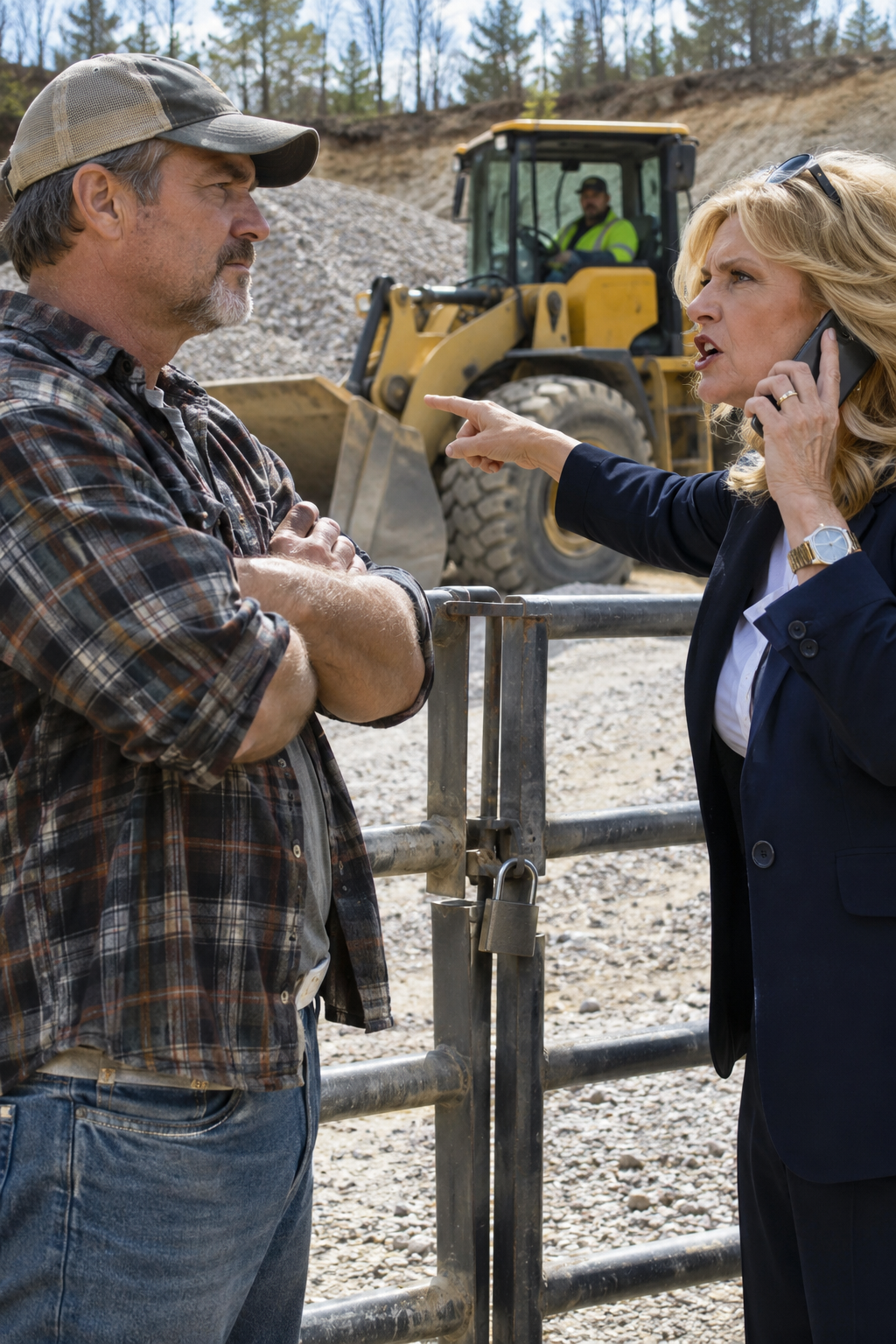
When the HOA president ordered a loader driver to cut the chain on my gravel pit, she was standing on land my father had worked for twenty years. I’d already caught her crew taking stone for eight Tuesdays, and I’d found a $9,500 charge in the neighborhood’s road budget. She thought I was blocking a community project out of spite. I wanted her to explain whose gravel she’d been using…
My name is Fletcher Townsend. Our four acres at the end of Ridgeline Estates predate the subdivision. My father bought the place in 1996, found a good gravel deposit in the northeast corner, and spent twenty years working it. He sold to contractors and maintained the access road.
Dad died three years ago. He left me the house, the land, and the pit, and I kept operating it around my regular job. I still walked the rim, hearing stone under my boots. He said the land gave back what you put in, if you showed up.
Ridgeline had forty lots, most built long after our place. The HOA formed ten years ago. I paid dues for common-area upkeep. Then Diane Caldwell, who lived in the big colonial on lot four, became president three years ago. Soon we got fines for mailboxes, trailers, and parked boats.
A year later, Diane proposed a “community partnership.” She wanted free gravel for roads and drainage, calling it my contribution. I told her the pit was private property and I wasn’t giving anyone open access. She smiled, said she understood, and left.
In early March, the HOA newsletter announced a $35,000 road resurfacing project. It promised local materials for the two loop roads. I supported fixing potholes. I didn’t know they meant my gravel.
Checking stock for a Friday pickup, I found tire tracks too wide for my customer’s truck. Deep ruts led to a fresh cut in the south bank. I suspected a confused county crew until I found new tracks the next week.
I bought a $40 solar trail camera at the hardware store and mounted it on a fence post. Six days later, just after six Tuesday morning, a yellow loader appeared on my phone. The Ridgeline Estates HOA logo was right on its cab. The operator loaded a waiting flatbed.
I replayed the eleven-minute recording and checked earlier footage. Another Tuesday, same machine, same route. The tracks suggested at least six weeks of theft: roughly twenty cubic yards per visit, 120 yards total, worth about $1,800. My father would have recognized those cuts in the bank immediately.
That afternoon I drove to Diane’s house and played the video on my phone. She stood with iced tea on her porch and barely glanced. She said the pit was beside a community access corridor and the board had authorized use of nearby resources. I told her it was on my deed, not theirs.
She set down her glass. “We’ll see what the board says,” she told me. “Road work starts in three weeks. Don’t make this difficult for yourself.” Then she closed her screen door. She hadn’t denied taking a single load.
Two days later, an HOA notice fined me $250 per day, starting Monday, for failing to cooperate with community infrastructure access. I searched all forty-six pages of the HOA bylaws for easement and access rules. Nothing gave the HOA permission to mine gravel from a homeowner’s land. The supposed obligation wasn’t there.
I ordered certified property records from the county assessor. While I waited, another Tuesday came and another loader appeared on the camera, even though Diane knew I was watching. The plat map showed Dad’s original survey lines. The pit was entirely on my parcel, thirty feet inside the nearest HOA boundary.
Then I requested the February board minutes. Diane had told the directors that gravel reserves next to the community corridor were available for the road project at “no acquisition cost.” Four directors had voted for the project, with one opposed. She hadn’t mentioned the reserves lay behind my fence, on Dad’s private land.
I wanted to confront her again, but the minutes raised a second problem. If the gravel was supposedly free, why was the road budget so large, and what did it include? I put the minutes beside my deed and waited to find the numbers.
My neighbor Nolan Moore from lot twelve came over one Saturday carrying a dues notice. The HOA was asking each household for another $200 a quarter toward road materials. He recognized Dad’s pit in my camera footage. As alternate treasurer and backup signatory, Nolan could access HOA finances.
Before we could compare the figures, Diane emailed all forty homeowners claiming that one resident was threatening to delay their road improvements over a personal dispute. She didn’t name me; neighbors still called. One man said I was being petty; another told me not to ruin the roads. That night I sat watching the ruts from my porch.
A letter soon arrived from Prescott, Hayes, and Whitfield, the HOA’s law firm, asserting a prescriptive easement over the access corridor and even the gravel area. A second letter came from the county road department after Diane complained about an obstruction to road safety work. Neither changed my deed. Both promised an expensive fight.
Then Nolan came back with his laptop. He pulled up the resurfacing budget and pointed to a line I hadn’t seen: “Gravel procurement contractor delivery — $9,500.” Diane had promised free materials while charging homeowners. There was no supplier invoice, delivery receipt, purchase order, or named vendor attached to that payment in the records we could access.
Worse, the money had already left the operating account. The portal didn’t show where it finally went. But the question was plain enough: why had $9,500 been disbursed for gravel that workers were taking from me for nothing?
I took the deed, survey, videos, minutes, budget page, and notices to a real-estate attorney two towns over. Craig Hutton said I could lock my gate and Diane’s brief trespass didn’t establish an easement. He said the financial discrepancy needed a proper accounting. He mailed a cease-and-desist to every director.
By then I had saved images from eight consecutive Tuesdays. Craig demanded an accounting of $9,500 within ten business days. Diane responded by calling an emergency board meeting at her house and excluding me. Nolan reported a three-to-two vote to keep access open pending legal review, without examining my evidence.
She also moved the road schedule forward three days. The new plan called for the loader to collect gravel on Monday the twenty-fourth, before paving on the twenty-fifth. On Sunday evening I drove to the pit with a heavy chain, a hardened padlock, and a laminated private-property sign. I locked the gate, adjusted the camera, and alerted the sheriff’s dispatcher.
Monday morning I arrived at with my evidence folder on the passenger seat and a thermos of untouched coffee. At a loader came up the road, followed by the paving company’s flatbed. The operator saw my chain and sign, stopped his engine, and called Diane. Through the speaker I heard her order him to cut the chain.
He told her the owner was standing there. Diane told him not to move and said she was coming. When she pulled up in her white SUV, the contractor’s foreman had already made it clear he wanted no part of breaking a lock. I stood beside my truck while Diane walked straight toward me, demanding that I open the gate and stop sabotaging her $35,000 project.
I held up my certified deed and pointed to the surveyed line thirty feet beyond the pit. She refused to look at it, insisting the board had authorized her to use the land. The loader stayed still; the contractors ignored her orders. Diane started calling board members, and I reached for the folder that held the question she still hadn’t answered. Part 2…..
Two directors pulled up within ten minutes, then Nolan arrived behind them. Diane gathered them near the gate and announced that I was trying to hold the neighborhood hostage for money. “He wants us to pay him for gravel that’s been a community resource since day one,” she said. The paving foreman folded his arms and kept a careful distance from both of us.
I started to answer, but another car came down the access road. Craig Hutton stepped out with a folder under his arm; I’d let him know the loader was at the gate. He introduced himself as my attorney and asked the directors to look at three things before anybody touched my chain. We laid the papers across the hood of my truck.
First came the certified deed and survey. Craig traced the boundary with a pen, showing that the nearest edge of the pit was thirty feet inside my property and had never been designated as common land. One of the directors, a tall man from lot nine, leaned over the map. He kept checking the line as though moving his eyes might change it.
Next Craig set out eight dated photographs from the trail camera. The HOA loader was visible at my gate every Tuesday, its bucket taking gravel from the south bank. Craig explained that I’d confronted Diane after seeing the first recordings and that the work had continued. Diane said the board had authorized access, but neither director could point to a grant of permission from me.
Then Craig placed the February minutes beside the approved budget. He showed them Diane’s assurance that materials would come from adjacent reserves at no acquisition cost, followed by the $9,500 procurement and delivery entry. “There is no supplier invoice or delivery receipt,” he said. “Mr. Townsend’s gravel was taken without his consent. Where did this money go?”
For several seconds nobody answered. Diane finally called the charge a contingency for future material needs. The director from lot nine asked why money marked for procurement had already been disbursed if no gravel had been purchased. She tried to describe standard budgeting practice, but the other director wanted a vendor name and a payment record. Diane couldn’t supply either one.
Nolan opened the financial records he had access to and explained that the disbursement led to an account where Diane was the sole authorized signatory. He was careful to say that the portal alone could not establish what she’d done with the money. It was enough to make the directors stop discussing my chain and start asking who had approved that account. Diane looked toward her SUV instead of answering.
The board representatives at the gate moved to suspend Diane’s authority over the project and the association’s finances until an independent review could be arranged. Three supported the action, with Diane abstaining; the remaining director wasn’t there. The foreman told his crew to pack up. No gravel was leaving my property that morning.
About ten minutes later, a sheriff’s deputy arrived in response to the report I’d made the previous evening. He photographed the gate and sign, accepted copies of the deed and camera records, and took my statement. He also took Diane’s identifying information for follow-up. He didn’t pronounce anyone guilty on the roadside, and I was grateful he didn’t pretend that was his job.
Diane stood beside her white SUV through most of it, her hands stiff at her sides. When she finally drove away, she was staring straight ahead through a windshield dusty from the gravel road. I felt no urge to cheer. The crew had gone, but my father’s pit still had eight weeks of scoop marks, and forty households still deserved an answer about the $9,500.
The board hired an independent accountant recommended by its interim legal counsel. Eleven days later, the audit found no matching vendor invoice, purchase order, delivery confirmation, or supplier agreement for the procurement charge. The $9,500 had been transferred to a separate account opened under the HOA’s tax identification number. Diane was its sole signatory, and the other directors hadn’t known it existed.
At the next full board meeting, Nolan read the accountant’s findings aloud. All five directors were there. The vote to remove Diane from the presidency was unanimous, and her board seat was vacated under the association’s procedures. For years she’d controlled meetings by speaking first and speaking firmly; this time the paperwork did the talking.
Final Two weeks later, the board and Craig submitted a joint criminal complaint to the county district attorney. The complaint documented 160 cubic yards taken from my pit, worth $2,400 at the market rate, and the missing $9,500 in HOA funds. Investigators pursued allegations of property theft, fraud, and embezzlement. Diane was arrested at her lot-four home on a Thursday afternoon and released on bond that evening.
Nolan called to tell me. I didn’t go looking for a photograph or drive past her house. I’d wanted the gravel taking stopped, the money accounted for, and my deed respected. Knowing a neighbor had been arrested over a dispute that began with a simple request for free material didn’t make the neighborhood feel any better.
The new HOA counsel contacted Craig about settling the civil side. The association agreed to pay me $3,800 for the gravel taken, along with additional compensation for damage to the pit’s access road. It rescinded every fine Diane had imposed on me, a total of $1,250. The claimed prescriptive easement was withdrawn in writing, and Diane was made personally responsible for the association’s outside legal expenses.
I signed the settlement at the same kitchen table where I’d studied the bylaws and unrolled Dad’s survey. For weeks there had been envelopes stacked there, each one making the situation a little worse. Now there was one set of papers closing the civil dispute. I put the signed copy in the folder with the deed instead of throwing the folder away.
The road project was finished about six weeks behind Diane’s original schedule. This time the board hired a legitimate supplier from a county quarry and paid $6,200 for the gravel. That was $3,300 less than the unexplained amount Diane had budgeted while helping herself to mine. Fresh asphalt went down, the shoulders were graded, and the roads looked the way they’d been promised.
Over the following weeks, three neighbors who had called after Diane’s email came by my house to apologize. One told me he should have asked what was happening before accusing me of holding up the work. I told him the same thing I told the others: all of us had been given a story that left out the most important fact. They’d believed the president because they’d had no reason to think she’d lie about whose land the gravel came from.
Nolan was elected interim president at the next quarterly meeting, without opposition. One of the first rules adopted was plain: the HOA couldn’t enter private property or use an owner’s materials without written consent kept in the board’s records. It wasn’t an elaborate policy. It was the sort of thing I had assumed nobody needed to be told.
One Saturday, a couple of weeks after the dust had settled, I went out to the pit without a pickup scheduled or a document to deliver. The trail camera was still blinking green on the fence post. I considered taking it down, then thought of Dad reminding me to trust people but keep my receipts. I left it mounted and walked to the rim.
Rain had softened the cuts on the south bank, though I could still tell where the unauthorized loader had bitten into the gravel. Behind the trees, the creek made the same sound I remembered from when I was twelve and helped Dad haul buckets while he worked the old excavator. I stood with my boots sinking a little into the loose stone and let the place be quiet again.
On the drive home I passed the new stretch of road, its black surface smooth and its yellow center line fresh. It was good work, finally paid for honestly. My father’s land was still mine, and the pit was still there for the customers who came with permission. Diane had to answer to the courts now, but I was done arguing with her.
Dad used to say the land gave back what you put into it, as long as you showed up. For a while I’d thought showing up meant checking deliveries and keeping the access road clear. That spring it meant holding a chain in place, saving evidence, and refusing to let somebody else’s title erase the work he’d done. I went home and put the kettle on, with gravel dust still on my boots.
THE END. I’ve shared the complete story, and I truly hope it touched your heart. If this story moved you, please , like, and share the post. Thank you for reading! ❤️
✓ Lynn R. Adams
When the HOA president ordered a loader driver to cut the chain on my gravel pit, she was standing on land my father had worked for twenty years. I’d already caught her crew taking stone for eight Tue…