When the HOA chair put a new lock on my grain shed and started moving emergency supplies inside, I thought one woman had overstepped, until an insurance call and the board’s own minutes showed how far this had gone…
When the HOA chair put a new lock on my grain shed and started moving emergency supplies inside, I thought one woman had overstepped, until an insurance call and the board’s own minutes showed how far this had gone…
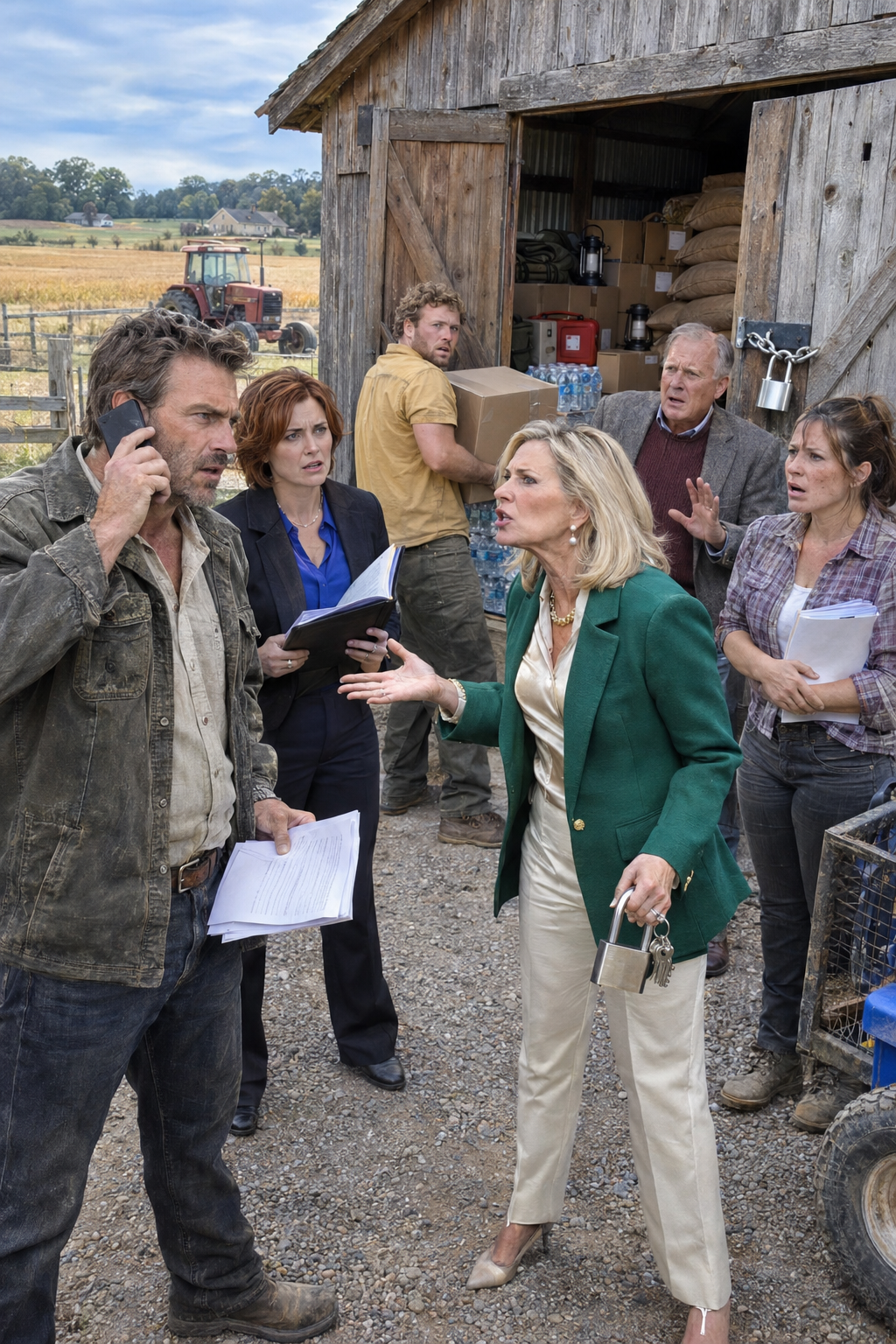
I answered my phone without taking my eyes off Vanessa Hail. She was standing outside my grain shed with a clipboard while volunteers carried boxes through a doorway that had been mine to open since my father owned the ranch. “Mr. Mercer, this is Allison Grant with Prairie Mutual,” the caller said. “I’m calling about a change-of-occupancy request for an outbuilding on your farm policy.”
I asked what kind of change she meant. Allison explained that someone had described my grain shed as a community emergency storage facility operated by Cedar Ridge Homeowners Association, and her office needed to know whether I had approved it. I looked at the new padlock, the folding carts, and the cases of bottled water being wheeled inside. “No,” I said. “I haven’t authorized any of that.”
Allison asked whether I had agreed to the storage, volunteer access, or a change in who controlled the building. I told her no each time. She didn’t offer an opinion about the HOA’s legal rights; she said only that the submitted use didn’t match the farm structure listed on my policy. She would put the request on hold, email me a reference number, and seek verification.
When I hung up, Vanessa folded her arms. “Insurance problem?” she asked. “Not mine,” I said, and asked her to show me whatever gave Cedar Ridge authority to take over my building. She lifted her clipboard as though it answered the question. “The board activated this site this morning. You’ll get the documents the board decides you’re entitled to.”
Behind her, a volunteer carried a carton of first-aid supplies into the room where I kept mineral supplements. Another worker checked cases of water against a printed inventory list. Nobody looked like they were sneaking around; they looked like people who’d been told all the permissions had already been arranged. That was what made the scene so unsettling.
I photographed the open doorway, the pallets, the temporary sign, and the locksmith’s sticker on the new hardware. Vanessa told me I couldn’t photograph HOA emergency operations. “I’m photographing my grain shed,” I said. I didn’t touch the lock or shove past the workers, but I wrote down the delivery truck’s name, the locksmith’s company, and the time before asking everyone to leave until they could show written authority.
Vanessa gave me a tight smile. “That’s not how this works.” Maybe she believed it. I went back to the house instead of arguing, because five minutes earlier I had thought I was dealing with one overconfident HOA chair and a bad lock. Now I knew someone had sent an insurance company paperwork claiming my building had a different purpose.
The shed wasn’t an unused barn on a forgotten corner of the place. I kept feed supplements, seed, fencing hardware, veterinary supplies, mineral blocks, belts, grease, and small equipment there, with everything arranged so I could find it during calving and hay season. My father had painted its old green doors years before we replaced them with steel sliders. The brass grain scoop he’d hung near the scale was still inside.
Cedar Ridge had been built across the county road long after my father bought the ranch. Most of the homeowners were decent neighbors; a few bought hay from me, and some waved as they drove by. I’d let a snowplow turn around at my south entrance once, and I’d given the association ice during a summer power outage. Those were favors between neighbors, not permission to take control of my property.
I spread my deed, the county parcel sketch, tax statement, and insurance schedule over the dining room table. Each identified the same ranch parcel and farm outbuilding, with no reference to an HOA storage facility. I made copies, saved the insurer’s reference number, and started a timeline: the lock I found at , my confrontation with Vanessa at , and Allison’s call at . Vanessa had acted as if a file existed somewhere; I wanted to know what was in it.
The next morning, a box truck was backed up to the shed before I’d finished feeding the cattle. The temporary paper sign was gone, replaced with a white board calling the building Cedar Ridge’s North Emergency Depot and restricting access to authorized personnel. There were orange cones, a folding table, and more volunteers checking a list. Vanessa stood beside the truck in a dark red blazer, directing the unloading.
“You were told not to interfere with emergency operations,” she said as I approached. I told her I still hadn’t seen proof of permission. She waved the driver forward anyway, and out came water, blankets, lanterns, plastic totes, portable generators, and cartons of medical supplies. To make room, someone had pushed one of my feed bins out of place and dented another along the corner.
They’d also blocked the center aisle with three pallets, right where I needed to bring in that morning’s feed delivery. I asked Vanessa to clear it. “No,” she said, adding that the building was serving an emergency preparedness function. When I pointed out there was no current emergency, she said, “You don’t get to decide when preparedness begins.”
At , my feed supplier called from the county road. I redirected him to the machine barn, where the delivery would have to be unloaded by hand and moved again later. By , I was carrying fifty-pound bags between buildings instead of checking my north pasture fence. I saved the delivery receipt, recorded the extra work, and photographed the dented bin from several angles.
Just after ten, Vanessa emailed a formal notice declaring the depot active under Cedar Ridge’s emergency operations plan. It ordered me not to remove supplies, obstruct volunteers, change locks, or interfere with access. The attachment showed a map with a South Assembly Point, a Clubhouse Coordination Center, and a North Emergency Depot. The northern circle was near my property, but the pages had no parcel number, owner’s name, or signed agreement.
The plan listed the supplies to be stored and the preparedness chair’s duties, including coordinating access and stocking. Vanessa had highlighted those lines before sending it to me. It described what Cedar Ridge wanted to do, not why it could use my shed. I replied, “Please provide the document that gives Cedar Ridge HOA authority to occupy and control access to my grain shed.”
Seventeen minutes later, she wrote that the board had already approved activation and supporting records were being assembled. I saved both messages and called Prairie Mutual again. A representative told me the occupancy inquiry had come through an insurance broker connected to a Cedar Ridge vendor, asking about coverage or a classification change for temporary emergency storage. He couldn’t see any owner authorization attached to the file.
That afternoon, the HOA management company emailed minutes from a special board meeting held two weeks earlier. Most of the pages concerned ordinary storm planning: generators, volunteer contacts, and supply inventories. Then I reached a section called emergency site readiness. Vanessa had recommended activating the North Emergency Depot before the next severe-weather window.
One board member had asked whether the location was cleared for operational use. The minutes didn’t record the answer, only the motion that followed: activate the North Emergency Depot and authorize the preparedness chair to coordinate stocking, access, and vendors. It passed four to one. I sat at the dining room table and read the vote again.
This hadn’t started with volunteers misunderstanding directions on the morning I found the lock. The board had approved a depot before the supplies arrived, and someone had told vendors and an insurer the site was available. I emailed the management company asking for every record behind the phrase “cleared for operational use.” If four board members had voted to use my building, I needed to see what had convinced them it was theirs to vote on. Part 2…..
IF FACEBOOK BROUGHT YOU HERE, HERE’S THE CONTINUATION YOU’VE BEEN WAITING FOR. ENJOY! 👇 The answer didn’t arrive as a simple letter. At the next morning, the management company sent a link to a shared folder holding thirty-seven files: board packets, maps, checklists, insurance correspondence, vendor invoices, email chains, a locksmith order, and a folder called North Depot supporting documents. I downloaded all of them before opening anything. If a link stopped working or a document disappeared, I wanted to have the same set the management company had provided.
I started with the locksmith’s invoice. Redline Access Systems had replaced the shed’s exterior padlock and hasp and supplied three keys to the HOA emergency coordinator. Under client notes, someone had typed, “Site control confirmed by HOA. No owner access restrictions anticipated.” I read that line several times because it sounded authoritative while proving only what someone had told the locksmith.
I called Redline and reached a service manager named Curtis. He confirmed Cedar Ridge had ordered the work and Vanessa Hail was the contact, but he was careful about what he could say. “Our technician doesn’t verify property ownership,” he explained. “We rely on the ordering party to confirm they have authority.” I thanked him and wrote his explanation next to the invoice number.
The supply vendor’s emails followed the same pattern. Six days before the lock was changed, a vendor had asked Vanessa to confirm the North Emergency Depot delivery address and whether someone would have keys. Her reply gave my ranch address and assured them the site was secured and available for association use. To two outside companies, she’d represented the same thing: Cedar Ridge controlled my grain shed.
Then I opened a county emergency management packet for a regional community preparedness mutual aid program Cedar Ridge had joined the previous year. It covered useful things like storm communications, generators, volunteer coordination, and supply locations. There was nothing suspicious about an association wanting to prepare for bad weather. But in the checklist for private support locations, one line caught my eye: “Private site authorization attached.”
The box beside that line was blank. A note below said private locations required separate site documentation maintained by the participating organization. I couldn’t tell whether the missing attachment had legal significance, and I wasn’t going to invent an answer. I could tell the county program expected the group to have its own supporting paperwork before treating another person’s building as a depot.
I searched the downloaded documents for “authorization.” Most results concerned spending, purchases, or volunteers, but one file was named site authority legacy. It contained an agreement nearly ten years old between Cedar Ridge’s original developer and the association. The agreement permitted storage of landscaping tools, seasonal decorations, traffic cones, and emergency materials in a maintenance structure with an adjoining gravel area.
For a moment, I wondered whether I’d finally found the piece Vanessa was relying on. Then I reached the legal description: Lot M2. I pulled up the county map and checked it twice. Lot M2 was the old maintenance area inside Cedar Ridge near a service entrance; my ranch and grain shed stood across the county road, several hundred yards north.
The agreement itself was genuine. It just named a different lot, a different building, and land owned under a different chain of title. I drew one line beneath “Lot M2” on the printed copy. It was the first piece of paper that explained how the HOA could have convinced itself it had an old right, and also why that explanation might be wrong.
By lunchtime, the dining room looked like an accountant’s office after a storm. I made three columns on a legal pad: what Cedar Ridge claimed, what the papers actually showed, and what was missing. The emergency plan named a depot; the board had voted to activate it; the vendors had been told the site was secured. What I still hadn’t found was a document authorizing Cedar Ridge to occupy my specific building.
I contacted Melissa Grant, a real estate attorney who’d handled an access dispute for a cattle operation two counties away. I sent her my deed, the county sketch, the insurance correspondence, the minutes, the vendor records, the locksmith invoice, the mutual aid packet, and the developer agreement. I told her I wanted the paperwork traced, not a confident guess over the phone. She called back and asked, “Do you have a current title report?”
I had my deed, but Melissa wanted more. A recorded right might appear somewhere in the parcel history even if it wasn’t in the documents I kept at home, she explained. She ordered a title search and formally requested any lease, easement, license, covenant, right-of-entry agreement, site-use agreement, or other instrument the association believed applied. She was checking their strongest possible explanation before making demands.
Vanessa replied before the management company did. She claimed the association had long-standing emergency access rights under the original development records, and told me my “council” should review the governing history before making unsupported demands. Melissa forwarded the message with a short note: “Good. Now we know what she says the source is.” I didn’t answer Vanessa.
The title report was due the next day, and the grain shed remained under the HOA’s lock. Its pallets still blocked my normal work area, and I had feed and fencing jobs piling up. I wanted to drive down there and reclaim everything with my own hands. Instead I waited for the paper trail, because Vanessa’s confidence had already spread through the board, the vendors, and the insurer, and it would take more than a shouted argument to untangle it.
Part 3 The following morning I read the title search at Melissa’s office. It listed the ordinary history of my ranch: my ownership, an old mortgage release, utility easements, a county road reference, and a drainage reservation near the southern edge. It showed no recorded right for Cedar Ridge to possess, stock, lock, or operate my grain shed. Melissa didn’t act as if that alone settled every question.
“An absent entry in a title report answers one category of question,” she said. “We still need to examine what they’re actually claiming.” We laid the old developer agreement next to the parcel sketch. The agreement concerned Lot M2 within the subdivision; my grain shed was on my ranch across the road, and the report showed no recorded instrument connecting the two.
Another batch of management company records arrived while we were comparing pages. One email, sent by the HOA president three days before the board vote, asked Vanessa whether the paperwork for the North site existed. She had replied, “Covered under legacy development authority. I’ll include reference in the activation file.” Melissa asked the management company for that reference immediately.
Later that afternoon, they sent a one-page internal site sheet. At the top was my grain shed’s address, identified as North Emergency Depot. Under “site control basis,” someone had entered “legacy developer authority,” and the supporting reference was the Cedar Ridge Storage and Maintenance Agreement for Lot M2. There was the connection I had been hunting: an internal sheet attached an agreement for one property to the address of another.
I wanted to phone Vanessa the moment I saw it. Melissa stopped me. “We know what these records say,” she told me. “We don’t know everything about why she did it, and we shouldn’t claim we do.” That distinction mattered because the old agreement was real; nobody had presented us with a forged deed or confessed to a scheme.
Melissa arranged the materials in order on the conference table. The emergency plan established Cedar Ridge’s intentions, while the board minutes showed what its directors had approved internally. Neither one, by itself, gave the association a right to occupy my property. The locksmith order and vendor emails showed outsiders relied on Vanessa’s assurance, but an assurance wasn’t an ownership record or a signed permission slip.
The county packet was no substitute, either. Its mutual aid program provided a way to coordinate preparedness activities, not a blanket right to take over a privately owned farm building. The unchecked authorization box pointed us back to the same unanswered question. Where was the property-specific approval Cedar Ridge was supposed to have kept?
When we returned to the internal site sheet, the problem could be stated without any courtroom theatrics. Cedar Ridge had an old agreement for Lot M2, and it had a new plan naming my shed as North Emergency Depot. Someone had used the first to justify the second, even though the legal descriptions didn’t match. No record produced so far filled the gap between them.
Melissa drafted a formal demand. She stated that I owned the grain shed, hadn’t consented to the association’s entry or control, and had not been shown any document granting it rights over my parcel. She demanded that Cedar Ridge stop using the shed, stop sending vendors there, identify any other claimed authority, and preserve the relevant correspondence, including messages about “site control confirmed.”
The letter went to the HOA president, management company, and association’s attorney. It didn’t accuse Vanessa of committing a crime, threaten an arrest, or pretend a judge had already decided anything. What I needed was a response from the people responsible for the decision, not another argument in the driveway. I checked the sent email twice before I went back out to the cattle.
Just after five, Cedar Ridge’s attorney answered. The association had received the demand and was reviewing the documents supporting the depot designation. There would be no further expansion of the site pending that review. The reply didn’t give me the building back, and it didn’t admit the board had been wrong.
But the wording was different from Vanessa’s. Two days earlier, she had spoken as if the board vote settled everything. Now the association’s own counsel was examining whether the authority underneath that vote existed. I read the email again, then put it with the other records. It was the first sign that someone besides Vanessa was willing to test the story against the documents.
Part 4 The next morning, an email arrived from Paul Weller at the county emergency management office. He said the county couldn’t locate a private site authorization for my grain shed in Cedar Ridge’s participation file. He also made clear that the county wasn’t adjudicating a property dispute. Its mutual aid program didn’t independently grant associations a right to occupy private buildings.
About an hour later, Melissa forwarded Cedar Ridge’s next message. Its attorney had directed that all stocking and access activity at the North Emergency Depot stop immediately: no more vendors, no more supplies, and no changes to the locks while the records were reviewed. The attorney wanted a special board meeting that afternoon. Meanwhile, Prairie Mutual had opened an incident review and requested my photographs and the relevant vendor documents.
At , Melissa and I joined the board meeting by video. Vanessa was at the conference table in a red blazer, her thick folder open in front of her. The HOA president sat near the association’s attorney, while other board members joined remotely. There was no crowd and no angry speech from me; the attorney asked questions and waited for answers.
He began by asking Vanessa when she’d identified my shed as North Emergency Depot. She supplied a date and said she’d relied on the original development authority. When he asked which document, she slid across the same legacy agreement we’d examined. He looked down at it, then asked, “Where is the agreement for Mr. Mercer’s parcel?”
Vanessa said the original development documents had always supported emergency use. He repeated the question, more quietly: “Where is the agreement for this parcel?” She glanced at the president and said the board had approved activation. “That’s not what I asked,” the attorney replied.
Vanessa turned pages in her folder. At last she said she had believed the property was covered by longstanding authority. The attorney asked whether she had a signed site-use agreement for my ranch. She said no. He asked about a lease, a license, or any written authorization from me; the answers were no again.
The president leaned back in his chair, and the room stayed silent for a moment. I didn’t feel like cheering. I was thinking about the feed bins, the workers who’d been told where to unload, and how many ordinary people had acted on a statement nobody checked against a map. The emergency plan hadn’t been the problem; treating an old permission for a different piece of land as permission for mine had been.
The association’s attorney recommended ending the depot designation immediately, removing HOA property, restoring my approved access hardware, and preserving all communications about the site. The board voted unanimously to accept that recommendation. Vanessa didn’t vote because she wasn’t a board member; she was the preparedness chair who’d presented the plan. The president directed the management company to coordinate the removal through Melissa rather than Vanessa.
By evening, I had a written schedule. Vendors would arrive the next morning, inventory and photograph their supplies, and take them away. A locksmith would remove the HOA’s replacement hardware and install hardware I approved. Prairie Mutual asked that the damaged bin remain undisturbed until an adjuster could see it.
I drove down before dark and looked at the shed from the gravel lane. The white depot sign was still on the wall, and the pallets were still visible through the doorway. I wasn’t pretending the trouble had vanished: there was damage to assess, work I’d lost time on, and reimbursement to settle. But nobody was saying anymore that the board’s vote gave Vanessa the last word about my building.
Final The removal crew arrived a little after eight the next morning, and this time nobody drove through my gate without calling first. A management company representative checked the inventory while workers carried out water, blankets, lanterns, medical kits, generators, and plastic totes. An insurance representative documented the shed before things were moved. I watched from outside and let the people assigned to the work do it.
The white depot sign came down. Then the pallets went onto the truck, one after another, with everything checked against the HOA’s list. The workers weren’t acting as if they were clearing out their own building now. They were removing an association’s supplies from a private structure whose owner was standing right there.
The locksmith took off the replacement hasp and padlock, filled the screw holes, and installed the hardware I’d approved. He put every new key directly into my hand. No copy went to Vanessa, a volunteer, or the HOA office. I slipped the keys into my pocket and finally walked the open center aisle again.
The adjuster photographed the dent in the feed bin, damage along a storage rack, and gouges in the concrete where pallets had been dragged. These weren’t enormous losses, and I didn’t ask anyone to pretend otherwise. Over the following two weeks, Cedar Ridge’s insurer and management company reimbursed documented repairs, the locksmith cost, and a reasonable amount for the extra labor and disruption from rerouting the feed delivery. I got the expenses addressed, not some life-changing settlement.
The following month, Cedar Ridge adopted a new policy for emergency sites. Any building the association didn’t own would need written authorization identifying the exact owner, parcel, and structure before it could be designated for storage, staging, shelter, or distribution. The association’s attorney would review the paperwork before activation, and vendors couldn’t be told “site control confirmed” without that authorization on file.
Vanessa lost the authority to approve private emergency sites, though she remained involved with the association. I never received the dramatic apology some people might have wanted. The board president sent a short letter acknowledging that the grain shed had been designated and used without adequate property-specific authorization. I put it in the file with the title report and the invoices.
A few days later, I moved the feed bins back, fixed the shelving, and swept up torn shrink wrap, cardboard dust, and gravel left by the pallet jack. The brass scoop was still hanging where my father had put it. I left it there, put the mineral blocks on their usual rack, and made room for the next delivery.
When the supplier who’d been rerouted pulled up again, the aisle was clear. We unloaded the feed exactly where it belonged, and I went back to checking fences and feeding cattle instead of studying legal descriptions over dinner. By the time the truck headed down the county road, dust was settling over the lane and the west pasture was quiet.
I stood in the doorway a moment before closing it. Cedar Ridge hadn’t needed a secret conspiracy to create this mess; an old agreement, a mistaken assumption, and enough confidence to act without checking the parcel had done the job. The problem finally ended when those assumptions had to answer to the actual records. I slid the new lock into place because this time the decision was mine.
THE END. I’ve shared the complete story, and I truly hope it touched your heart. If this story moved you, please , like, and share the post. Thank you for reading! ❤️
✓ Lynn R. Adams
When the HOA chair put a new lock on my grain shed and started moving emergency supplies inside, I thought one woman had overstepped, until an insurance call and the board’s own minutes showed how far…