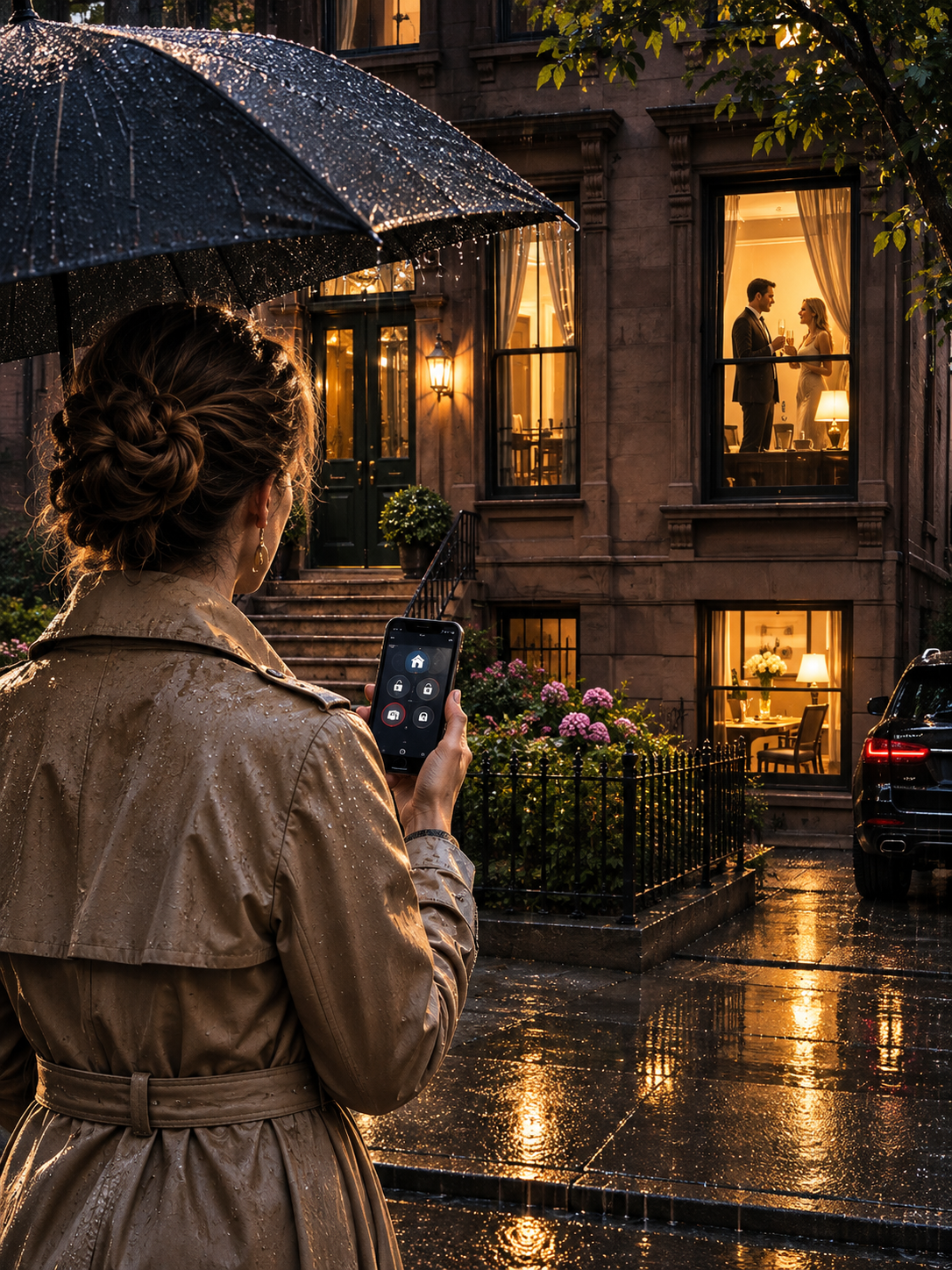
When my Uber turned onto Crescent Hill Drive, the lamp in my basement studio was glowing even though
IF FACEBOOK BROUGHT YOU HERE, HERE’S THE CONTINUATION YOU’VE BEEN WAITING FOR. ENJOY! 👇 I asked Felicity to take off the smock. Devon started to speak, but I kept my eyes on her, and she untied it without another word. She folded it carefully and laid it on the hall chair where my grandmother used to set her sewing basket when she visited.
Devon said Felicity was helping him with measurements for the Whitfield listing. According to him, my studio had the best light for spreading out plans, and the security cameras were only experiencing technical problems. I reminded him that three feeds had stopped working, his shared location was unavailable, and he had just texted me from an imaginary dinner.
“I came back early,” he said. “I didn’t want you worrying.” That explanation might have satisfied me on another night, but his car had been hidden in the alley and he had used a room I had explicitly kept private. I asked him to stop telling me what he’d meant to do and tell me what he had actually done.
The officer asked about the house. When Devon referred to it as a private family matter, the officer noted that I was the property owner. I’d heard that fact from my accountant and family for years, but I had rarely corrected Devon when he spoke in public as though we’d bought and restored the place together.
Joanna arrived a few minutes later, still in her dark coat. She listened to the camera details, glanced at the folded smock, and asked Devon to explain why Felicity had been working inside my studio. He repeated that they were preparing a client presentation.
“Then show me the presentation,” I said. Felicity stood very still, and Devon gave her a quick look. She reached into her canvas tote and brought out a thick portfolio with clear sleeves, then set it on the hall table between us.
The cover sheet was for a Heritage Commission grant application under Devon’s development firm’s name. Page two contained pencil elevations from a mill-building feasibility study I’d prepared fourteen months earlier. My handwriting filled the margins, and my initials were still faintly visible in a corner.
I turned the next page, then the next. Seven pages of my original research and drawings had been inserted as if they belonged to his firm’s site analysis. I’d declined to bid on that mill project because I already had too much work, but Devon apparently had no trouble using the study to support a grant application without asking me.
He called it background material and said he assumed I’d find the commission process too complicated to take on. “You knew I’d say no,” I replied. “So you answered for me and used my work anyway.” Felicity sat on the bottom stair, staring at her hands, and I couldn’t tell whether she regretted participating or merely regretted being caught.
I looked at Devon and told him exactly what he had crossed: my private studio, my drawings, my professional reputation, and the house I’d restored before we met. I’d come home expecting dinner and a quiet evening, and he’d been texting that he missed me while Felicity wore my grandmother’s smock.
Joanna documented the materials and helped us discuss a voluntary departure for that night, with the property and belongings to be addressed formally afterward. Devon packed a bag rather than continue the confrontation. At the door, he told me I was making the situation ugly, as though naming what he’d done was the most damaging part of it.
“You brought someone into my studio and used my work without permission,” I said. “Ugly was already here. I’m just the one who turned the lights on.” He looked away, and then he left.
The next morning Joanna sent the Heritage Commission notice of the disputed materials, supported by my original dated work. Within forty-eight hours the application was suspended while the commission reviewed it. Devon’s firm described the problem as a private misunderstanding, but the paperwork was much more specific.
He called twice that week and later accused me by text of letting my sister turn our marriage into a war. I wasn’t asking Joanna to punish him on my behalf. I wanted the commission to know where those drawings came from and to make decisions using an accurate record.
Divorce proceedings began, and we established a formal inventory of property. For several weeks I worked at the dining-room table because I didn’t want to enter the studio yet. I told myself the overhead lighting upstairs was better for winter drafting; it was easier than admitting how much that room had changed for me.
Part 3 Two weeks after the night I came home, Devon’s office arranged for a courier to collect his belongings. The printed list contained clothes, books, copper pots he’d owned before our marriage, and a drafting lamp I barely remembered. The last entry said his business staging materials were stored in the garage.
I opened the garage and found seventeen boxes, sample books, presentation boards, a rack of fabric swatches, and two framed renderings of rooms I’d decorated. Their appearance in his listing photographs had helped create the impression that his firm designed spaces like the ones in my home. I’d never agreed to turn our house into his portfolio.
I photographed and inventoried the items, giving the courier a copy. For the business materials I provided the address of Felicity Howe’s design studio on Commonwealth Avenue and asked that they be delivered there rather than kept in my garage. I didn’t go along to see her reaction when the boxes arrived on Thursday at nine.
Six weeks after Joanna’s notice, the Heritage Commission formally declined Devon’s firm’s grant application because the supporting research had been improperly sourced. The commission also wrote to me, acknowledging the quality of my drawings and expressing interest in working together in the future. I kept that letter with the original feasibility study, where it belonged.
The divorce took four months. There were arguments over belongings and claims about what Devon had contributed to the house, including one remarkable phrase from his attorney about the property’s “aesthetic profile.” Joanna answered with ownership records and documentation of the restoration I’d completed before the marriage.
In February I signed the final papers wearing my grandmother’s jade ring. I wanted something familiar on my hand, not a symbol for anybody watching. Devon asked to speak in the courthouse hallway afterward, and I agreed with Joanna nearby.
He looked tired. He said he’d persuaded himself the grant application would also help my reputation by bringing my drawings before the commission. I asked whether he’d believed that when he first copied them or only later. “Later,” he admitted, looking down.
He said he didn’t know when he’d started thinking of the house as his. I told him it had happened gradually: first the way he said “we” when people praised my restoration, then the way he treated my studio and my drawings as available to his business. I knew he had lived there too, but living beside someone’s work didn’t make him its author.
“I’m sorry,” he said. I believed he was sorry in that moment, but I didn’t mistake the apology for a reason to undo what had happened. I said I knew, then walked away before he could ask me to make the conversation easier.
Final Spring came to Crescent Hill Drive with buds on the maples and the neighbor’s lawn mower starting up on the first warm weekend. In April I repainted the front porch railings, even though the old paint was holding up well. I wanted to put my own hands on the house again.
One Tuesday in March, I finally went downstairs to the studio I’d avoided all winter. The room still smelled faintly of graphite, linseed oil, and the cedar millwork I’d stripped and refinished during the restoration. My grandmother’s smock hung clean and empty on its hook behind the door.
Her amber desk lamp sat on the oak drafting table. When I switched it on, the light fell across the paper exactly as I’d planned when I argued over those north-facing window wells years earlier. I remembered my grandmother using the same lamp to hem curtains and write letters, then sitting under it simply because she said it helped her think.
I brought out the original mill elevations with my notes in the margins and a coffee ring from a November morning. I sat down, uncapped my pencil, and went back to the work I had loved long before Devon knew me. There was no audience, no confrontation, and no one waiting to claim the drawing as theirs.
On that Sunday in the Uber, I’d thought the light in my studio meant the end of something. It had, but the ending was not the whole story. Now the light was on because I had switched it on myself, in a room and a home that were still mine.
THE END. I’ve shared the complete story, and I truly hope it touched your heart. If this story moved you, please , like, and share the post. Thank you for reading! ❤️
✓ Lynn R. Adams
IF FACEBOOK BROUGHT YOU HERE, HERE’S THE CONTINUATION YOU’VE BEEN WAITING FOR. ENJOY! 👇 I asked Felicity to take off the smock. Devon started to speak, but I kept my eyes on her, and she untied it wi…