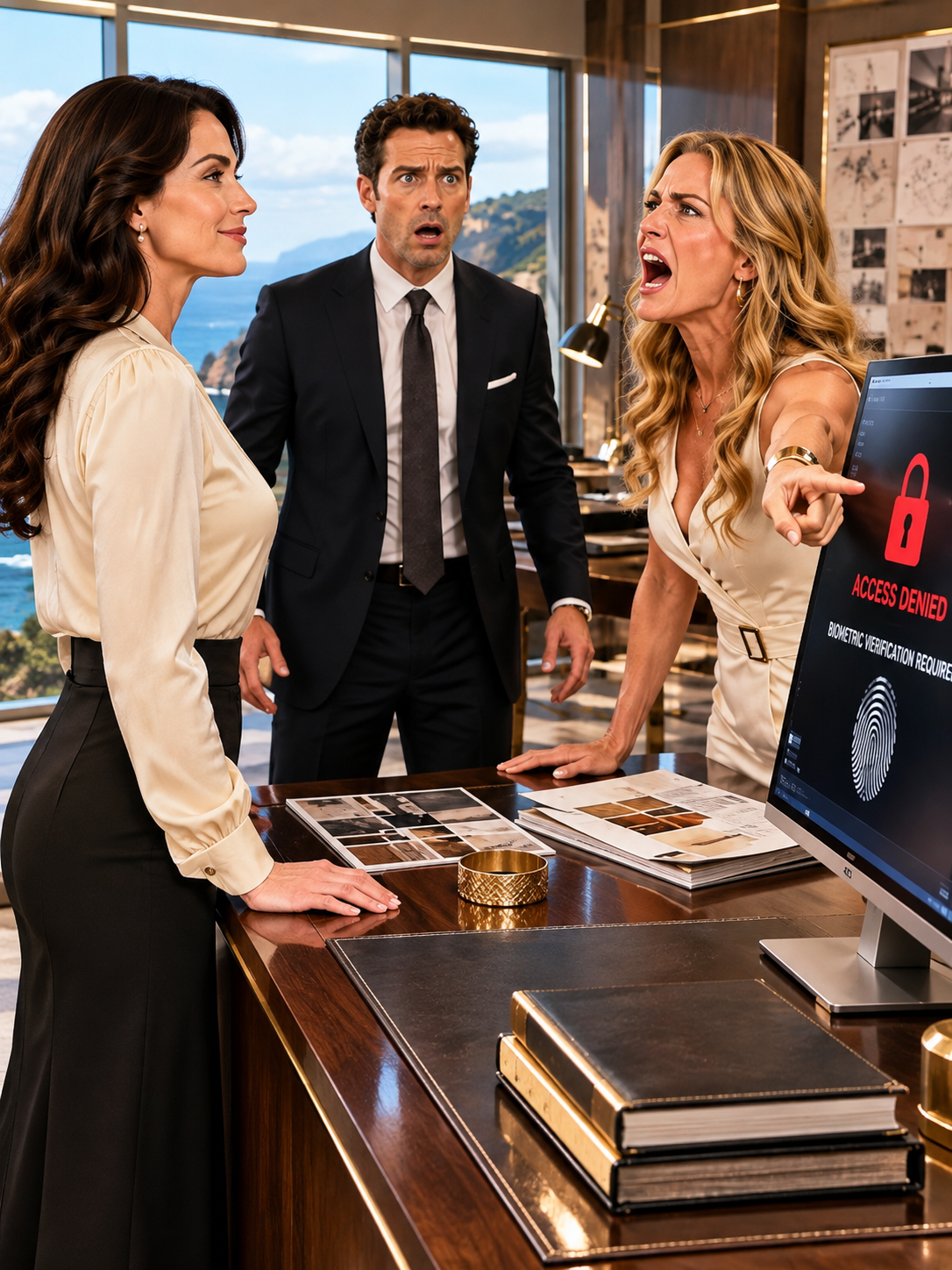
When my husband’s assistant shoved me against my grandmother’s drafting table and announced
IF FACEBOOK BROUGHT YOU HERE, HERE’S THE CONTINUATION YOU’VE BEEN WAITING FOR. ENJOY! 👇 Reese hadn’t just allowed Kira to take credit for my work. He’d been describing my legal ownership as something to get out of the way. I asked Ellis whether he’d tell the truth about that conversation in front of the investors and press tomorrow night. “Yes,” he said, without bargaining or asking what he might gain.
I looked through the window at the dark water. Upstairs, someone was preparing to announce my replacement. But for the first time that day, I understood exactly which question I needed to ask Reese—and I had someone willing to confirm what he’d already said when I wasn’t in the room.
At eleven that night, Reese found me in the old site trailer at the edge of the property. I’d kept it standing because fourteen pages of the original resort sketches were still pinned to its walls. They showed what I’d imagined before anyone else had stood on that cliff and believed the project could work.
“Kira overstepped,” he said as he sat across from me. “I’ll speak to her.” I put my phone on the laminate table with the resignation letter on the screen. “She signed my name to a letter I didn’t write.” He looked at the photograph and then away.
I’d seen that movement before, whenever a contractor’s bill exceeded the budget and he wanted me to absorb the problem. I asked whether he’d told the board I was stepping away from creative work. He didn’t answer. I asked whether he’d promised Kira my position.
“I said the company would restructure after the opening,” he finally replied. “I said she’d have more visibility. She made assumptions.” I asked whether he’d instructed her to prepare a resignation letter with my signature. His hand settled on the back of an empty folding chair, but he gave me no answer.
I reminded him that I appreciated what he’d contributed in the early years. He’d helped turn my ideas into operating properties, and I wasn’t going to erase that. But the creative methodology, original archive, and intellectual property had been assigned to me personally when we incorporated. I’d never transferred them to the company.
“You stood beside me while I built the design practice,” I said. “That doesn’t make it yours to give away.” He looked exhausted rather than angry. For a moment I could see the man I’d once trusted, and that made it harder to continue, not easier.
“Tomorrow you’re going to introduce a creative director who can’t explain the first design decision on this property,” I told him. “I’m going to let you make that introduction.” He stared at me. “Then the people in that room can decide what they’re actually being shown.”
I left him in the trailer. In the smallest suite, the one overlooking the estuary instead of the ocean, I sat on the bed with my original concept book open on my knees. The forged signature hurt in a different way from the press kits or the bracelet. Somebody had decided my consent could be manufactured because my silence had been so easy to borrow.
I thought about every time Kira had spoken for me at a vendor meeting and I’d corrected the record privately afterward. Every time Reese called her our design lead, I’d responded by arriving with even more complete drawings. I’d been trying to protect the appearance of a united company while the truth quietly disappeared from public view.
Before midnight, I sent a formal notice setting out my intellectual-property ownership and objecting to unauthorized use. I prepared a correction for the press event and wrote Ellis about a possible independent consulting arrangement. I wasn’t certain what the board would do, or how quickly any dispute could be resolved. But I was no longer leaving the record to other people.
The next evening the courtyard filled with investors, journalists, staff, and the craftspeople whose work made the resort recognizable. I arrived after the first course in a deep green linen blazer, my grandmother’s gold cuff on my left wrist and the concept book under my arm. Ellis was seated toward the back. When he saw me, he stood without trying to draw attention.
Reese met me near the terrace stairs. “The introduction starts in fifteen minutes,” he said. “Please don’t turn this into something it doesn’t have to be.” I told him I intended to protect the people who had built the place and correct a public falsehood about my work.
“We can discuss attribution later,” he said. “You told the board I stepped back. You let a letter with my signature circulate, and you described my ownership to a buyer as a domestic complication.” I kept my voice low. “There isn’t a private correction that can undo a public announcement.”
I walked to the long artisan’s table. The New Mexico ceramic artist was there, along with the ironworker who had made the custom corridor fixtures. Bet reached across the table and laid her hand over mine. “We were starting to wonder,” she said. “I’m here,” I answered.
Reese took the stage and spoke about vision, growth, and a new creative direction. Then he invited Kira to the podium as Pembbrook Design Group’s new creative director. She wore a white dress and smiled as though the introduction had already settled every question.
I stood and walked toward the stage. Reese shifted toward the stairs, then stepped aside when he noticed the journalists watching. Kira tightened her grip on the podium. I took the microphone and said my name.
“I designed this resort,” I told the courtyard. “I’ve designed every Pembbrook property for the past eight years, alongside the craftspeople sitting here tonight.” I held up one of the revised press kits. “Three days ago, my name was removed from these materials. Last night, I found a resignation letter with a signature I did not write.”
“That was a draft,” Kira said quietly. “It was signed and sent to three board members,” I replied. I explained that I had been in San Francisco with a client, not withdrawing from the company. When I came back, my work had been reassigned on paper and my grandmother’s bracelet was on someone else’s wrist.
Part 3 I opened the concept book on the podium. The designs, correspondence, and documented methodology were mine, and the corporate agreements had never transferred their ownership. I announced that I was formally withdrawing permission to use those assets and establishing Pembbrook Studio as an independent practice, subject to the legal steps required to protect my rights.
The ceramic artist began applauding. The ironworker joined her, and then Bet stood. Other people followed, but I wasn’t looking for applause. I watched Kira turn toward Reese, her expression suddenly stripped of the confidence she’d worn in the studio.
“You told me the papers were filed,” she said. “You said she’d agreed.” Reese leaned toward her. “Lower your voice.” “You said we were done waiting,” Kira answered. The microphones carried enough that nearby guests heard them.
Reese looked toward Ellis. “You’ve been speaking with us. Tell them this is a private matter being misrepresented as business.” Ellis stood and explained that Reese had approached the Harrington Group six weeks earlier about an acquisition. In the proposal, my ownership was described as a domestic complication to be resolved before closing.
“The Harrington Group declined,” Ellis said. He explained that the design methodology was the reason his company had been interested in the first place. He didn’t claim to settle our ownership dispute; he told the room what Reese had proposed and how his group had responded.
Kira looked at Reese again. “You told me the Harrington money was confirmed. You showed me a letter with her signature.” Reese insisted he’d said the matter was in progress. “You told me it was done,” she replied. “You said we were done waiting for her to be gone.”
I stood beside the podium without interrupting. I hadn’t planned their exchange, and I didn’t know what Kira had been told privately. I only knew that the promises they’d made to each other were becoming audible now that I had stopped covering for them.
I left the concept book on the podium long enough for the journalists to see the dated drawings, then carried it back down the steps. The event continued in a strained, quieter way. I didn’t stay to watch Reese explain himself to people he’d assured that the transition was settled.
The months afterward were less dramatic than the courtyard scene and far more demanding. Lawyers reviewed the incorporation records, design licenses, contracts, and correspondence. The board examined the intellectual-property documentation and confirmed that the methodology, client archive, and brand identity system could not be transferred or licensed without my written authorization.
The hotel group still owned and operated its real estate. I didn’t pretend otherwise, and I couldn’t simply take the buildings with me. What it could no longer do was market my creative system as an asset Reese was free to sell. That distinction changed the company’s prospects more than any speech I could have made.
Reese resigned as chief executive the following month. The trade press called it a strategic restructuring, a phrase that sounded familiar after years of listening to him smooth difficult facts into tidy announcements. I knew the departure didn’t undo the years we’d worked together or the harm of how we’d ended them.
Kira was dismissed for falsifying an internal document. She challenged the decision and released messages between herself and Reese that supported the promises and timeline she’d described at the event. They also showed how much she’d relied on assurances he could later deny. I didn’t excuse her choices, including taking my bracelet and trying to erase my name, but I could see how she’d mistaken his confidence for a guarantee.
I stopped following the arguments between them. There was no satisfaction in reading every new account of who had misled whom. I needed to hire people, set up contracts, and build a practice that wouldn’t depend on my husband’s permission to exist.
Pembbrook Studio opened in a converted warehouse in Oakland with three designers and a project manager. We signed a consulting agreement with the Harrington Group to restore a mid-century hotel north of Bodega Bay. Much of its original terrazzo flooring had been hidden under newer materials for decades, and I wanted to find out what could be saved.
Ellis visited the studio while I was on a rolling ladder studying a materials board, a grease pencil tucked behind my ear. I told him I was finishing a thought and didn’t climb down. “Finish it,” he said, and sat on a bench without making me feel watched.
Four minutes later I came down. He handed me decaf coffee with cinnamon and no sugar. It was a small detail, but after years of having my decisions translated into somebody else’s language, I noticed people who listened to what I actually said.
“I want to be clear about something,” I told him. “I’m not interested in being anyone’s inspirational story about surviving a bad marriage. I’m a designer rebuilding a practice. If that’s what interests you, we can talk.”
“I’m interested in the work,” he said. “I’m also interested in you. I understand those are separate conversations, and I’m willing to have them at the pace you choose.” I thought of the glass of water in the alcove and the way he’d answered my request for the truth without negotiating.
Instead of answering the personal question, I asked about the Bodega Bay ballroom. Its old carpet and dropped ceiling might be hiding the original terrazzo. I wanted a careful test before we approved any restoration plan. “Thursday at seven in the morning?” I asked. “I’ll be there,” he said.
Final My divorce was finalized on a Tuesday morning in April. I signed my own name in my own handwriting, then drove north on Highway 1 with the windows down. I cried for much of the drive, not because I wanted to reverse the decision, but because thirteen years of notes and eight years of building a shared business had contained real hopes as well as real damage.
Reese kept the real estate interests that belonged to him. I kept my drawing board, archive, methodology, client relationships, and the handwritten record of how I’d done the work. We had both contributed to the life we’d built, but the distinction between those things mattered, and it had finally been acknowledged.
Ellis was waiting in the parking lot at Bodega Bay when I arrived. He handed me coffee, noticed my red eyes, and didn’t make me explain them. We went into the old ballroom together, our footsteps muffled by carpet that had covered the floor since the eighties.
Near the far wall, I knelt and ran my fingers along the edge where the flooring met the baseboard. There was a ridge beneath the carpet. “There’s terrazzo under here,” I said. “I can feel the original profile.” Ellis crouched nearby and asked how I could tell without lifting it.
I showed him the line where the surface met the base, then explained why a restoration specialist needed to remove a small section carefully before we committed to the work. I knew someone in Fresno who could do it without damaging the substrate. “Call them,” he said. “We’ll plan around what the building needs.”
When I stood, we were close enough that I could see the dust on his jacket from the old room. I liked him, and I didn’t feel the need to deny it. But I was still learning what it meant to occupy a space without making myself smaller for somebody else’s comfort.
“I’m not ready to call this anything yet,” I said. “I know,” he answered. “I’m not asking you to.” He glanced around the covered floor and the tall windows. “I’m ready to build something worth building.”
“Starting here,” I said. He picked up the site map and handed me the end of the measuring tape. I took it and went back to work, in a room where the original material was still waiting beneath everything that had been laid over it.
I hadn’t won back the life I’d imagined with Reese. That life was over. What I had reclaimed was the right to sign my own name, make my own decisions, and be recognized for work I could prove was mine. I didn’t need anyone to announce that I belonged there. I was already doing the work.
THE END. I’ve shared the complete story, and I truly hope it touched your heart. If this story moved you, please , like, and share the post. Thank you for reading! ❤️
✓ Lynn R. Adams
IF FACEBOOK BROUGHT YOU HERE, HERE’S THE CONTINUATION YOU’VE BEEN WAITING FOR. ENJOY! 👇 Reese hadn’t just allowed Kira to take credit for my work. He’d been describing my legal ownership as something…