When I was six, I handed a towering biker
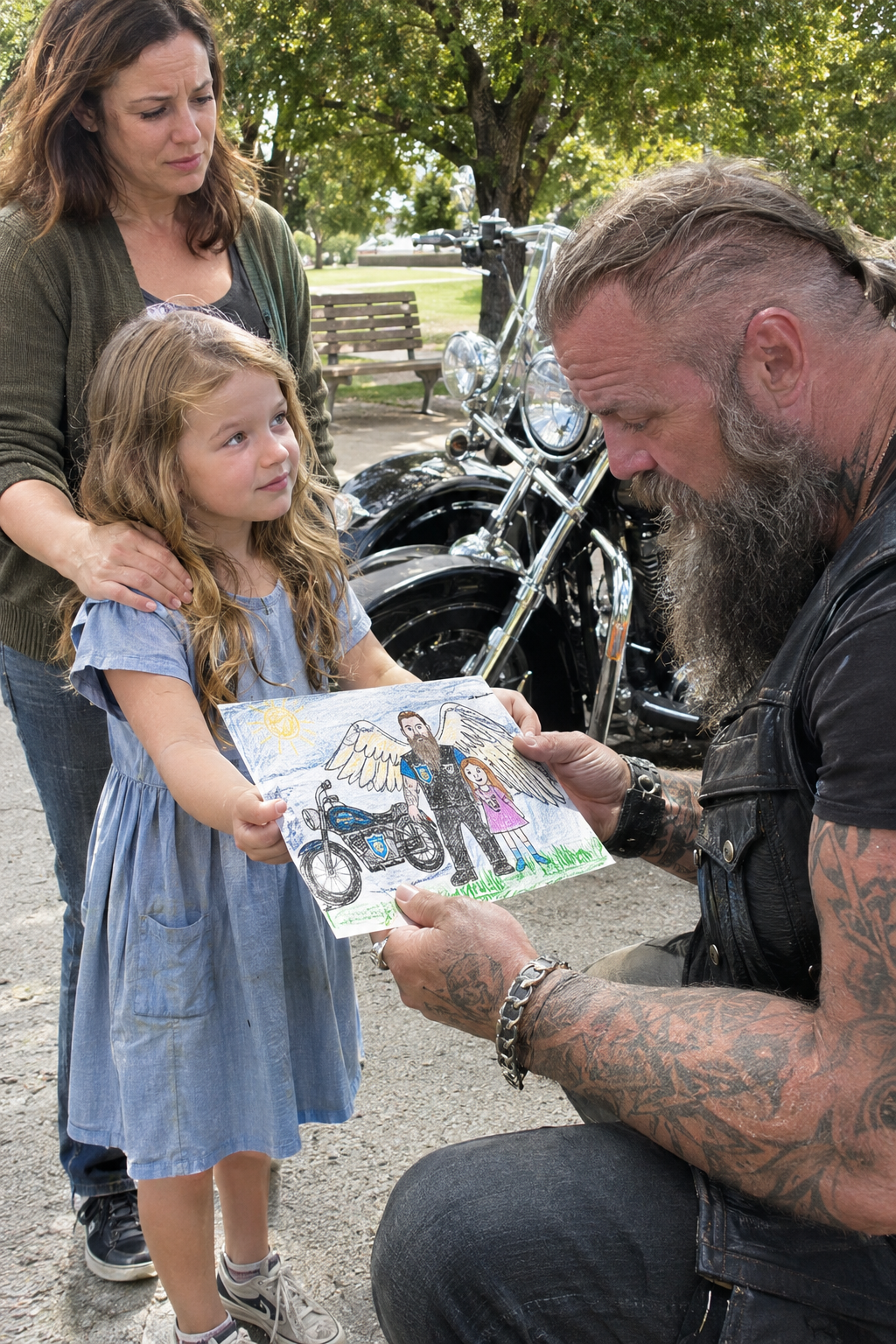
When I was six, I handed a towering biker a crayon drawing of my late father’s motorcycle, hoping he’d like it, but one tiny detail made his hands tremble and turned an ordinary Saturday into something neither of us expected…
I was six years old when I learned that the people who look frightening from a distance can sometimes be the ones who make you feel safest. I learned it in a city park in Oakdale, California, with a box of crayons under my arm and my mother watching every step I took.
My name is Sophie Chen. Back then, I hardly spoke to anyone outside my family, and even at school I preferred sitting with paper and crayons to joining the noisy games on the playground. My teachers called me quiet, but there was a reason I had so much trouble finding words.
My dad, Officer David Chen, had died two years earlier. I was four when he was killed during a convenience store robbery, and for a long time I understood only that he had gone to work and hadn’t come home. Mom later told me he had stepped between a gunman and three customers, saving their lives even though he was struck by four bullets.
The details were too much for a little girl, so I held on to smaller things. I remembered Dad laughing at the kitchen table, the feel of his uniform when I hugged him, and the low rumble of the Harley-Davidson Road King he rode on weekends. He had restored that motorcycle himself, polishing the chrome until I could see my face in it.
After he died, Mom sold the motorcycle. She never said she regretted it, but I saw how she stopped at the window whenever another bike passed our apartment. I couldn’t bring Dad’s bike back, so I started drawing it instead.
I drew black motorcycles, silver motorcycles, motorcycles with clouds around their wheels. Some had my dad sitting tall in the saddle, and others had empty seats because I couldn’t remember his face clearly that day. Mom kept the drawings in a cardboard box under her bed.
Once, while she was sorting laundry, she asked why I drew bikes so often. I told her, “Because Dad was happy when he rode one, and I remember him when I draw.” She folded the same small T-shirt twice before she could answer.
Mom’s name was Rachel, and she worked as a nurse and picked up shifts as a waitress to keep us in our modest Oakdale apartment. I knew her shoes were always by the door and that she slept whenever she could. I didn’t understand rent or bills, only that she was tired and still found time to sharpen my crayons.
One Saturday morning she brought home a flyer for a Road Kings Motorcycle Club charity event at Oakdale City Park. The club was raising money for the local children’s hospital, and there would be food, music, and rows of bikes to see. “Would you like to go?” she asked, and I said yes before she finished talking.
We arrived around noon. Motorcycles stood in long, shining lines, their engines making a sound I felt in my chest. I moved slowly from one to the next while Mom stayed close enough that I could reach for her hand.
People wore leather vests and laughed in loud voices, but nobody bothered us. The Road Kings had a tough look, yet I saw members helping with the food tables and greeting families who had come to support the hospital. It felt like a place Dad would have enjoyed.
Then I found a black-and-chrome Harley Road King. The broad seat, the gleaming metal, even the way it stood on its kickstand reminded me of the motorcycle Dad had loved. I stayed in front of it so long that Mom crouched beside me to ask if I was all right.
“You like that one?” a deep voice asked behind us. Mom straightened quickly and slipped her arm around my shoulders. Standing there was the biggest man I’d ever seen, about six feet five, with tattooed arms, a beard reaching down his chest, and a leather vest that read “Crusher, President.”
He noticed Mom holding me tighter. “Sorry,” he said with a small, almost embarrassed smile. “I know I can look scary. That’s my bike, a ’98 Road King. Your girl’s got good taste.”
I stared up at him and managed to whisper, “My daddy had one like it.” His expression softened, and he asked whether Dad enjoyed riding. I nodded, then said the words that still felt strange in my mouth: “My daddy died.”
The man didn’t try to fix what I’d said or rush past it. He lowered his voice and told me he was sorry, and that losing a father was terribly hard. For some reason, that made it easier to ask him a question I’d never have asked another stranger.
“Can I draw your bike?” I said. “Of course you can,” he answered, pointing toward a nearby bench. “Take all the time you need.”
I sat with my sketchpad on my knees while Mom stood beside me. The big man stayed near the motorcycle, patient as other members of his club came by to speak with him. I heard someone call him Crusher, and he answered without taking his eyes off my drawing for long.
For twenty minutes, I worked on the bike’s heavy shape, its wheels, and the chrome. Then I added the big man beside it, not as a monster but with angel wings spreading behind his shoulders. I drew a little girl tucked safely behind him, because that was how I wanted the world to feel again.
Near the handlebars, I put small police patches like the ones I remembered seeing on Dad’s uniform. They weren’t perfect, and one was barely bigger than my thumbprint. But I wanted something of Dad in the picture, too.
When I finished, I stood in front of Crusher and held out the page with both hands. “This is for you,” I said. “Thank you for letting me draw your motorcycle.” He accepted it carefully, as if the paper might tear, and smiled at the bike I’d made.
Then his eyes moved to the little police markings. His smile faded, and his fingers started shaking against the edge of the page. He looked from the picture to me and asked, very quietly, “Sophie, was your daddy a police officer?”
“Yes, sir. His name was Officer David Chen,” I answered. “Mommy says he saved people.” The man went so pale that even I noticed, and he crouched to my height before asking what my mother’s name was.
“Rachel Chen,” I said, pointing behind me. He looked up at Mom as though he was trying to recognize someone after a very long time. “Rachel? You’re David’s wife?” he asked.
Mom’s hand rose to her mouth. “Yes,” she said. “Did you know him?” The man swallowed and looked back at the drawing, and when he spoke again his rough voice had almost disappeared.
“Know him? David was my best friend growing up. I’m Michael Harrison. I taught him to ride motorcycles.” Mom whispered, “Michael? David talked about you,” and I realized the giant stranger was someone Dad had loved long before I was born.
Michael told us he’d joined the Marines and later the Road Kings, and that he and Dad had lost touch over the years. He had heard that David became a police officer and later that he died, but he’d never known where to find us or that Dad had a daughter. He touched the corner of my picture and said, “Your father was the best man I ever knew.”
I put my arms around his neck before I could feel shy again. He knelt there holding me, the drawing caught carefully between his fingers, while Mom wiped her cheeks with the back of her hand. I thought I’d come to the park to look at a motorcycle, but I’d found someone who could tell me stories about my dad. Part 2…..
IF FACEBOOK BROUGHT YOU HERE, HERE’S THE CONTINUATION YOU’VE BEEN WAITING FOR. ENJOY! 👇 Michael held on for another moment, then pulled back and looked at me. “Your dad and I were like brothers,” he said. “That makes you family, Sophie.” I asked if I could call him Uncle Mike, and he gave a shaky little laugh before saying he’d like that very much.
Mom apologized for never reaching out after Dad died. Michael told her there was nothing to apologize for, because she’d been trying to survive and he was the one who had drifted out of touch. He asked permission to keep my drawing, then stood with it pressed against his vest.
A few Road Kings gathered when they saw their president upset. Michael introduced us as David Chen’s family and told them Dad had been his oldest friend. One member quietly said they should do something to help, and Michael nodded, but he didn’t explain what he had in mind.
Before we left, he asked Mom where we lived and promised we’d hear from him. In the car I talked more than I had in months, asking whether Uncle Mike knew Dad in school and whether they used to ride together. Mom said yes to what she knew, then admitted there were stories she wanted to hear, too.
That evening, Michael called an emergency meeting of thirty Road Kings. I know what happened because he told me years later, and because some of the men never stopped talking about the night he brought my picture into their clubhouse. He passed it around and explained who my father was and how Mom had been working two jobs.
“We can’t undo losing David,” he told them, “but we can be here for his family now.” All thirty members offered to help. Michael contacted Road Kings chapters in five states, shared our story through their network, and began collecting donations and practical supplies.
Within twelve hours, they’d raised $25,000. Michael said later that he was grateful for every dollar but didn’t want the money to be the only thing we remembered. He wanted me to see, with my own eyes, that the people my father had loved had not forgotten him.
On Sunday at five in the morning, a rumble outside our apartment grew loud enough to wake Mom. She peered through the curtains, then came to my bedroom and gently shook my shoulder. “Sophie, honey, there’s something you need to see.”
The parking lot and street were filled with motorcycles. About two hundred riders from eight Road Kings chapters stood together, their bikes lined up as far as I could see. Neighbors had come outside in slippers and dressing gowns, wondering why so many strangers were gathered at dawn.
Mom took my hand and we went downstairs. Uncle Mike came toward us in his leather vest, smiling as if he’d only dropped by to say hello. “Your dad protected people,” he told me. “These are some people who want to look after you and your mom.”
Men began carrying forward boxes of school supplies, books, art materials, clothes, and toys. One brought a pink bicycle that was just my size, and another offered to help me choose a helmet. I barely knew what to touch first, but I kept glancing at Mom to make sure she was seeing it, too.
Then Michael handed her an envelope. Inside was the $25,000 they had raised to help with rent, bills, and my future. Mom’s knees buckled and she sat on the curb, overwhelmed, saying she couldn’t possibly accept so much from people who barely knew us.
“We know David,” Uncle Mike answered, sitting beside her rather than towering over her. “And we want to know you. Family ought to show up before there’s another emergency.” Mom held the envelope with both hands for a long time before she could thank him.
A local news crew, in the area after the charity event, arrived while the neighbors were still gathered. Michael showed the reporter my drawing and explained that Dad had been his childhood best friend. He spoke about plans to establish an education fund for me and continued help for Mom, but he made sure the cameras knew this was about honoring Dad, not about the club getting attention.
The report aired that evening and spread much farther than our little town. Donations came from people who had never met us, and the education fund grew to $150,000 by the end of that week and $300,000 by the end of the month. Mom worked with the people managing the fund so that the money set aside for my future stayed there.
We still lived in our ordinary apartment, but Mom could finally stop picking up waitress shifts and focus on nursing. She came home with enough energy to ask about school and look through my latest drawings. For the first time I could remember, she was sometimes free on a Saturday afternoon.
Uncle Mike came by most weeks. He took me for ice cream, explained what the different parts of a motorcycle did, and said he might teach me to ride when I was much older. Other Road Kings became familiar faces, helping with a broken shelf, offering rides when Mom’s schedule got complicated, and appearing at school events she couldn’t leave work to attend.
I remained a quiet child, but the quiet stopped feeling quite so lonely. At my birthday party, classmates crowded around to ask about the men in leather vests who had come to celebrate with us. I told them those were my uncles, and they’d known my dad.
The Road Kings eventually started the Officer David Chen Memorial Ride to help families of fallen first responders. Its first fundraiser brought in $50,000, and I rode along in a properly secured sidecar while Uncle Mike led the procession. My original drawing was reproduced for the charity’s materials, with the winged rider and little girl becoming a symbol the members recognized immediately.
At seven, I stood in front of a crowd of nearly two thousand people at one of those memorial events. My hands shook around the microphone as I told them my daddy had died protecting strangers and his friends had helped protect me and Mom. When I finished, I searched the front row for Uncle Mike, and he was standing with everyone else, applauding.
By ten, I wanted other children to discover what drawing had given me. I started Art for Heroes, inviting classmates to make pictures for police officers, firefighters, military members, hospital workers, and anyone serving their communities. Road Kings volunteers helped deliver the drawings, and schools beyond Oakdale began joining us.
One firefighter wrote to say a child’s picture of him rescuing a cat had arrived when he was exhausted and thinking about leaving his job. He kept it near his work locker and said it reminded him of the good days. I didn’t imagine a drawing could solve everything, but his letter taught me that a small kindness can reach someone at just the right moment.
When I was twelve, I spoke at a national community-policing conference with roughly five hundred officers and community leaders present. I held up a framed copy of my childhood drawing and told them how a shy girl had reached out to a stranger who turned out to be her father’s friend. I said trust begins when people see the human being in front of them.
Uncle Mike waited for me afterward near the back of the room. He hugged me and said Dad would have been proud, and I asked something I’d wondered since I was little: “Do you think Dad can see me?” Michael answered, “I believe he can, kiddo,” and didn’t pretend he knew more than that.
At fifteen I helped design posters and organize charity rides for the club. One member joked that I practically belonged to the Road Kings already, but Michael reminded him I was still a kid. He said an honorary vest would be waiting when the time was right, and I was more excited than I’d been about any birthday present.
At sixteen, nearly three hundred bikers came to celebrate my birthday. Uncle Mike gave me a custom leather vest with my name, an honorary Road Kings designation, and my old drawing embroidered on the back. It wasn’t the club’s full colors, but when I slipped it over my shoulders, I felt the same careful welcome I’d felt at six.
He told the room that, before meeting me, he’d become harder and more distant from the things he used to care about. Dad’s daughter turning up with a box of crayons had reminded him that brotherhood had to mean more than riding together. I leaned against him as he spoke and told him he’d given Mom and me a family we hadn’t known how to ask for.
Part 3 At eighteen, I graduated as valedictorian. Fifty Road Kings sat in the front row while I spoke about the people who’d helped me become brave enough to stand at a microphone. I announced that I wanted to study art therapy so I could sit with grieving children who didn’t yet have the words to describe what hurt.
The Road Kings funded my college education, and I chose a local school because I wanted to stay close to Mom and the community that had raised me. During my training, I volunteered at a children’s grief center. One afternoon, an eight-year-old boy whose father had died in combat sat beside me without speaking.
He hadn’t spoken at the center in months, so I didn’t ask questions. I drew quietly until he took a crayon and made a soldier with wings, then whispered, “That’s my dad.” I stayed beside him while he told me a little more, and afterward I told the director that I’d known what it was like to need paper before words.
I graduated with honors at twenty-two and took a job at the children’s hospital the Road Kings had been fundraising for on the day we met. Mom called it a full circle, and she was right. I sometimes walked past the hospital’s fundraising display and remembered being six, too shy to ask a stranger if I could borrow his attention.
With donations from the Road Kings and our community, the hospital opened the Sophie Chen Center for Pediatric Healing Arts. I worked with children facing serious illness, grief, and frightening changes in their families. I couldn’t promise to make any of it disappear, but I could offer a table, a few colors, and a place where nobody demanded an answer too quickly.
At twenty-five, I received an emerging-leader award from a national art-therapy organization. During my speech I spoke about Dad, Mom, and the bikers who had believed in one little girl’s picture. Afterward, a program director asked whether my approach could reach children in other cities.
Over the following months, our partners helped bring the program to fifty cities, with Road Kings chapters offering volunteers where they could. I never wanted untrained volunteers doing therapists’ work; their role was to transport supplies, raise funds, and make families feel welcome. The clinicians handled clinical care, and the bikers did what they had always done best: showed up.
By thirty, I was directing a nonprofit that served ten thousand people and speaking about creative support for children dealing with loss. I had written a book, but I still lived in Oakdale and visited Uncle Mike most weeks. He teased me about my busy calendar while reminding me to eat lunch and take a day off now and then.
Mom was fifty-eight by then and volunteered with the nonprofit whenever her nursing schedule allowed. Uncle Mike, seventy, rode less often, though he still turned up for the important events. They were both older, and I began noticing that the people who had once carried me through trouble sometimes needed a hand carrying things themselves.
At thirty-two, I met James, a firefighter volunteering with a Road Kings fundraiser. His father had also died in service, when James was twelve, and he understood why anniversaries could make a perfectly ordinary afternoon feel heavy. We spent as much time talking about our families as we did about anything else.
Two years later, we married at a Road Kings gathering, with about two hundred riders attending in their formal leather. Uncle Mike walked me down the aisle. When I told him he’d been a second father to me, he squeezed my hand and whispered that walking beside me was the greatest honor he could imagine.
James and I later had a daughter, Grace, and then a son we named David after my father. By three, Grace was drawing motorcycles, and at five she was handing her pictures to the uncles just as I had. Mom would look at the crayon-covered kitchen table, shake her head, and smile as though she could see two generations sitting there together.
When I was thirty-eight, Uncle Mike told us he had terminal cancer. I visited often and brought Grace when he felt well enough for company. He tried to reassure me that I could manage without him, but I told him, “You’re not a job you’ve finished. You’re my dad, too.”
He said he’d never had children of his own and that knowing me had given him a kind of fatherhood he hadn’t expected. Six weeks later, he died with members of the Road Kings and our family close by. We had time to tell him we loved him, which was a gift I hadn’t been given with my first father.
At his funeral, five hundred Road Kings came alongside officials, friends, and families who’d benefited from the memorial rides. I talked about the man behind the beard and tattoos, the one who remembered which ice cream flavor I liked and always read the notes on the backs of children’s pictures. Then I placed my original drawing in his casket and whispered, “Show Dad. Tell him we’re all right.”
I kept copies of that picture, but letting the first one go felt right. The Road Kings kept reproductions at their headquarters and on their memorial materials. Each year, children we’d helped sent more drawings, and I thought Uncle Mike would have liked how crowded the walls had become.
Part 4 Years later, when Grace was thirteen, she stood beside me at a major anniversary gathering for the Officer David Chen Memorial Ride while James held our four-year-old David. The event had grown to thousands of supporters, and our records showed that the rides had raised $12 million and helped eight hundred families over the years. I told the crowd the figures mattered, but so did the visits, meals, and people who kept turning up long after the cameras left.
Grace, thirteen, asked to speak. She held up a picture showing two winged riders—Grandpa David and Uncle Mike—protecting a small girl. She said she had never met either man but knew their kindness through the way people treated our family, and she wanted other grieving children to feel that kind of care.
I put my arm around her when she finished. She smiled at me in that shy, familiar way, and for a second I remembered the bench in the park. The first drawing had helped me find an uncle; now my daughter was discovering what she wanted to give others.
By fifty, our healing-arts programs reached hundreds of communities, with thousands of trained professionals and many more volunteers. I’d published five books, and our work had helped tens of thousands of children, but the important moments still happened one child at a time. Some days a child spoke; some days they only drew a line, and we respected both.
Grace was fifteen and beginning to talk about studying art therapy herself. My son David, six, filled notebooks with motorcycles, people he admired, and family scenes. Mom, now seventy-eight, still volunteered when she felt up to it, and James had become a fire chief who treated the families of his firefighters with particular care.
On my fifty-fifth birthday, the Road Kings renamed their scholarship the Officer David Chen and Michael “Crusher” Harrison Memorial Scholarship. I looked at the two names side by side and thought about how little those men resembled each other on the outside. Both had taught me that protecting someone can mean risking your life, or simply refusing to disappear when that person’s life gets difficult.
At sixty, I stepped back from leading the nonprofit and let therapists I’d trained take responsibility for its daily work. I kept visiting children, teaching when asked, and joining memorial rides. Grace had become an art therapist herself, and I loved seeing another generation discover how a drawing could make a hard conversation easier.
At seventy, I received a lifetime achievement award. A therapist who had once been an eight-year-old child at our grief center introduced me, telling the audience how sitting beside someone with a box of crayons had helped him speak after losing his father. He said he’d gone on to help hundreds of children himself, and I could hardly listen without thinking of the boy’s careful first drawing.
I told him afterward that the credit wasn’t mine alone. There had been his courage, his family, the trained people who cared for him, and a long chain of helpers stretching back to one noisy Saturday in Oakdale. Still, when I returned home, I set his note beside a photograph of Uncle Mike and allowed myself to feel proud.
I spent the next few years close to family, still working when I could and filling sketchbooks for my grandchildren. When my health declined, Grace sat beside me with pencils and paper, the way I had once sat with frightened children. I had spent a lifetime saying that love doesn’t always need words, and I was grateful my daughter understood.
Final My name is Grace, Sophie’s daughter, and I’m the one telling the rest. Mom died peacefully at seventy-five, surrounded by family, friends, Road Kings, and people whose lives had crossed hers. I spoke at her funeral because she had taught me how to find words even when my hands were shaking.
Thousands came to honor her, including three generations of bikers and adults who had once sat across an art table from her as children. I told them that my mother wasn’t born brave in the loud, showy way people sometimes imagine. At six she was a shy little girl who missed her dad, and she had simply offered someone a picture.
We buried her beside Uncle Mike. Her headstone described her as a daughter, mother, and healer, and our family chose the words, “She drew angels and became one.” Copies of her first drawing remained with the Road Kings and with our family, while the original had gone with the man who’d treasured it.
The programs Mom helped build continued under the therapists she had trained. The Road Kings kept supporting the memorial scholarship and rides, and our own children learned about Officer David Chen and Michael Harrison through stories rather than photographs alone. I tried to teach them what Mom taught me: kindness matters most when it turns into dependable action.
Thirty years after Mom’s death, I stood at another great Road Kings memorial gathering, now seventy, holding my five-year-old great-granddaughter, also named Sophie. She had drawn a motorcycle with four winged riders—David, Uncle Mike, Mom, and James—watching over a little girl. She offered it to me shyly and said, “Angels protect us, Grandma Grace.”
I held her close while motorcycles rumbled beyond the crowd. “They do,” I told her. “And they taught us to protect each other.” I thought of my mother standing in a city park with a sheet of paper, and of a man who could have taken the drawing, said thank you, and walked away—but didn’t.
That is what our family has carried forward. Not a promise that one act of kindness solves every sorrow, but the knowledge that a kind response can become a visit, a friendship, a scholarship, a profession, and a place for someone else to feel less alone. It began with a little girl and her crayons, and it kept going because people chose to stay.
THE END. I’ve shared the complete story, and I truly hope it touched your heart. If this story moved you, please , like, and share the post. Thank you for reading! ❤️
✓ Lynn R. Adams
When I was six, I handed a towering biker a crayon drawing of my late father’s motorcycle, hoping he’d like it, but one tiny detail made his hands tremble and turned an ordinary Saturday into somethin…