When I was seven, I gave my only cold
When I was seven, I gave my only cold water to a stranger wearing a Hells Angels jacket, and by breakfast the next morning, two thousand motorcycles were gathering outside my grandmother’s little Arizona home…
I was seven years old the summer I learned that fear can tell you one thing while the person in front of you tells you another. My name was Lily Martinez, and I lived with my grandmother, Rosa, in Saguaro Springs, Arizona, a town of 623 people where everybody knew when a stranger came through.
We lived in a little adobe house off Desert Rose Road. The summer heat could reach 115 degrees, and on the worst afternoons Abuela closed the curtains and made me stay near the air conditioner. She had worked as a nurse years earlier and knew exactly what that heat could do.
My mother, Lucia, had died when I was three. Abuela raised me after that, and although she never let me forget how much I was loved, I knew what it meant to look toward a doorway and wish someone could walk through it again. My father had left before I was born, so the two of us were our own small family.
On July 14, the weather warnings said to stay inside. Then our cat, Whiskers, slipped out, and I imagined him somewhere under the burning sun without any water. I followed Abuela through the kitchen, begging her to let me look.
“Mija, it’s too hot,” she told me. “He’ll come back when he’s ready.”
“What if he can’t?” I asked. “What if he’s hurt?”
She studied my face, the way she did when I reminded her of my mother. Finally she said, “Ten minutes, then straight home. Promise me.” I promised, and she handed me a bottle of cold water with ice in it.
Outside, the air felt like the inside of an oven. I walked along Desert Rose Road calling for Whiskers, checking beneath bushes and parked vehicles. My shirt stuck to my back before I reached the far bend, and even the gravel seemed to give off heat.
I was turning around when I noticed a shape on the shoulder. At first I thought someone had dropped a bundle of dark clothes. Then I saw a boot, an arm, and the broad back of a man lying facedown in the dirt.
He wore a black leather jacket despite the temperature. His arms were tattooed, and the patch on his back showed the skull and wings I’d heard adults whisper about. Hells Angels. Abuela had always warned me to keep my distance from men wearing those colors.
I stood still for a moment, with my water bottle sweating in my hand. The man was enormous to me, and I couldn’t tell whether he might wake up angry. But then I saw his chest barely move, and the thought of walking away frightened me more.
“Mister?” I said, leaning close enough for him to hear. “Are you okay?”
He didn’t answer. His face was painfully red, his lips were cracked, and the skin around his eyes looked dry. I had seen Abuela help sick people before, but I had never been alone with someone who seemed so close to dying.
I tried to remember what she’d taught me about getting someone out of the heat. I couldn’t lift him, not even a little. So I unscrewed my bottle and let the cold water run carefully over his head and neck.
His eyelids moved. I held the bottle near his mouth, and when he was awake enough to swallow, he managed a couple of small sips. Then he looked at me with gray eyes that seemed unable to focus.
“Kid,” he whispered.
“I’m getting my abuela,” I told him. “Please stay here. Please keep breathing.”
I ran harder than I ever had, leaving my bottle on the roadside. By the time I pushed through our front door, my throat hurt so badly I could hardly get the words out. “Abuela, there’s a man on the road. I think he’s dying.”
She grabbed her phone and followed me. I saw her hesitation when she recognized his jacket, but it lasted only a moment. She knelt beside him, checked his weak, racing pulse, and told me to bring clean towels and more water while she called 911.
His motorcycle was down in a ditch a short distance away, its metal twisted against the sand. Abuela kept talking to him as we cooled him with wet towels. He was drifting in and out, and I watched her face to learn whether I ought to be terrified.
The ambulance was about twenty minutes away. With careful effort, we got him into our air-conditioned house and kept cooling him while we waited. Once his eyes found me and he whispered, “You gave me your water.”
I nodded because I was suddenly too shy to speak. “Thank you, little angel,” he murmured, and his eyes closed again. I sat nearby, listening for every breath until the paramedics came through our door.
One of them recognized him. His name was Marcus Stone, nicknamed Hammer, and he was a high-ranking national officer in the Hells Angels. The paramedic’s expression made Abuela tighten her grip on my shoulder, though she didn’t move away from the stretcher.
Before they took him, Marcus opened his eyes again. “What’s your name, kid?” he asked. I told him, and he said slowly, “Lily Martinez. I won’t forget.”
After the ambulance left, Abuela hugged me so hard I could feel her heart pounding. She admitted she’d been afraid of that jacket, then told me something I carried for years: “Whatever else that man has done, today he was a person who needed help. You saw that first.”
That night I lay awake thinking about his cracked lips and the way he’d said my name. Abuela checked on me twice, telling me the hospital had people who knew how to care for him. Neither of us had any idea what he had set in motion with his promise.
The next morning, while Abuela made breakfast, a low rumble rolled across the house. It grew into a noise so deep that the windowpanes trembled. She looked outside, set down what she was holding, and told me to stay behind her.
Motorcycles were coming down our street in lines that seemed to have no end. Black leather flashed among the chrome, and the vacant lots filled until there was hardly room to move. Later we learned there were two thousand of them surrounding our little home.
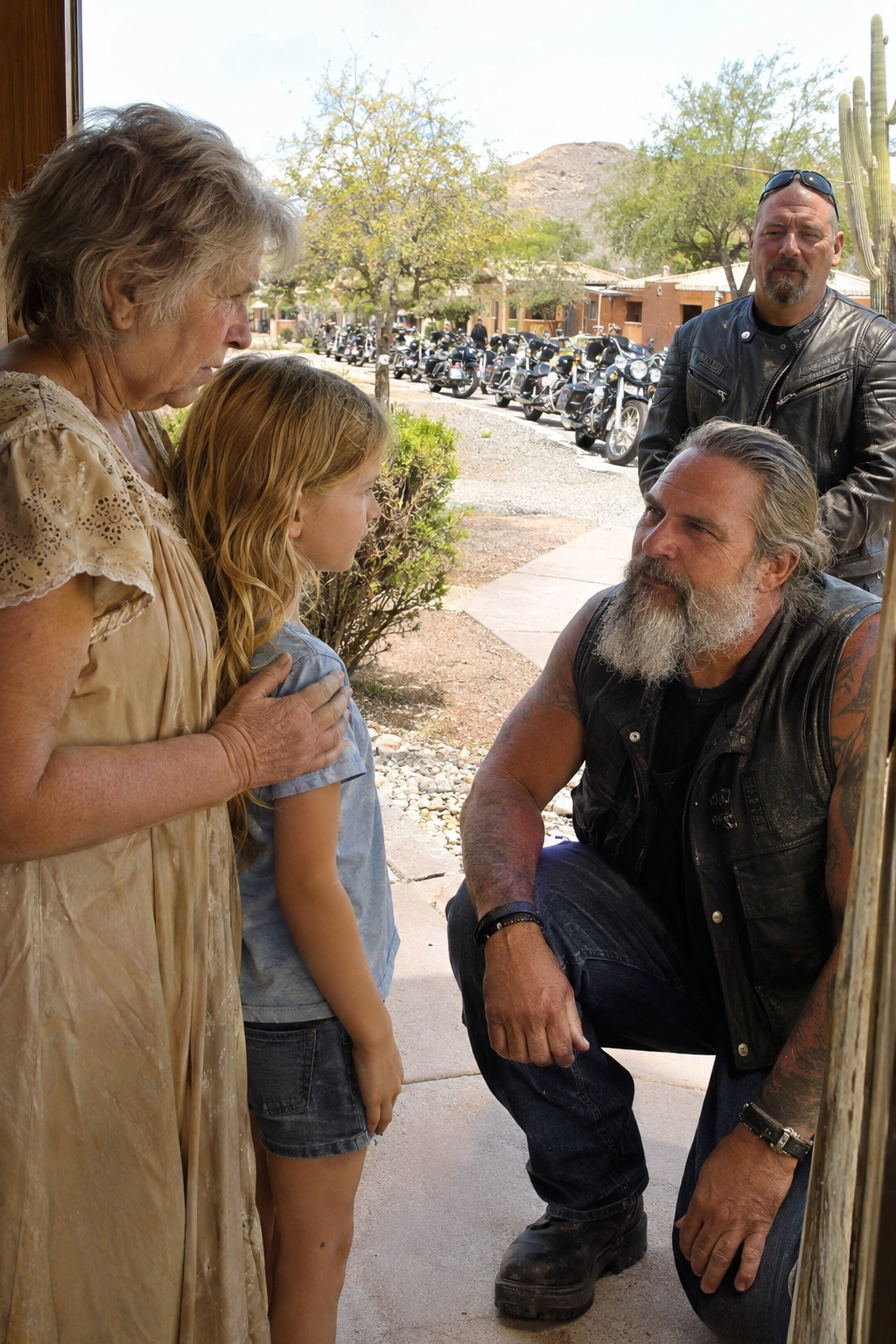
A large man with a salt-and-pepper beard approached our front door while the others waited outside. He introduced himself as Thomas Riley, called Thunder, and asked whether Lily Martinez was inside. Abuela put one hand protectively across me and demanded to know what he wanted.
The man lowered his voice. “Your granddaughter saved our brother Marcus,” he said. “He called from the hospital this morning. We’re not here to frighten you, ma’am. We came to thank her.” Then he knelt so he could look me in the eyes, and everyone behind him went quiet. Part 2…..
IF FACEBOOK BROUGHT YOU HERE, HERE’S THE CONTINUATION YOU’VE BEEN WAITING FOR. ENJOY! 👇 “Are you Marcus’s friends?” I asked him. Thunder nodded and said they had ridden together for years. “He’s been our brother for thirty-five years,” he told Abuela. “You gave him back to us.”
He held out a little leather vest made for a child. It had my name embroidered on it beneath the words “Honorary Angel,” with a halo instead of wings. I looked at Abuela before touching it, and she gave me the smallest nod.
Thunder said the vest meant I would always have friends among them. Then he raised his hand, and the engines fired up together. Two thousand riders lifted their fists in a salute that seemed to shake our whole street for five full minutes.
Our neighbors came out with their phones, trying to understand what they were seeing. Abuela kept a hand on my shoulder, but the fear in her face had begun to change. When the engines quieted, Thunder said Marcus had arranged an education fund so I could attend any college I chose.
Abuela told him we couldn’t accept something so large. He answered that Marcus had insisted and that nobody expected anything in return. She didn’t promise him an answer that morning, but I could see how much the offer unsettled her.
A black SUV stopped near the house, and Marcus stepped out on crutches. He looked pale and exhausted, but he had come anyway. He knelt with difficulty in front of me and said the doctors told him the heat had nearly caused his organs to fail.
“Why did you help me?” he asked. I didn’t know what answer he expected. “Because you needed help,” I said. “Abuela says that’s what you do.”
He took out a silver necklace with a small angel pendant. It had belonged to his daughter, Lucia, who died in a car accident five years earlier when she was eight. When I told him my mother’s name was Lucia, too, he stared at the pendant for a long moment before placing it in my hand.
“Maybe you’d like to keep this,” he said quietly. “You have a lot of people looking out for you now.” I closed my fingers around it, aware that he wasn’t giving me an ordinary present.
Thunder called for three cheers, and the riders answered him. Then they filed slowly past our house, each one raising a hand as he went. It took about four hours for them all to leave, and by noon news crews were showing up in Saguaro Springs.
Abuela mostly kept me inside while she spoke for us. She said I had done what a person should do when somebody needed help, and thanked Marcus’s friends for their kindness. Soon our story was everywhere, followed by letters, gifts, and donations from people we’d never met.
I didn’t understand being called a hero. I still worried about Whiskers, still had chores, and still wanted Abuela to tell me stories about Mama. The world seemed to think something enormous had happened, while I kept remembering how small and frightened that man had looked on the roadside.
That evening Marcus came back alone. Abuela poured him iced tea, and I listened from close by while he explained why he’d been riding that road. He believed someone in his club had sabotaged his motorcycle and left him stranded in the heat on purpose.
He didn’t yet know who had arranged it. Abuela asked whether helping him might put us in danger, and Marcus said he had friends keeping watch on the house. I remember her jaw tightening as she told him a child’s safety had to come before anybody’s club business.
Three days later, I was drawing on the porch when a man in a suit pulled up. He said his name was Mr. Harrison and claimed to be from a newspaper. When he asked where Marcus was staying, I remembered Abuela’s warning about strangers and went straight inside.
Abuela came out to find him looking toward our window. She asked for press credentials, but he couldn’t produce any. As she ordered him to leave, his pleasant expression disappeared, and he said she couldn’t protect me forever.
A motorcycle pulled up just then. A rider known as Razor put himself between the stranger and our porch, and the man hurried back to his car. Razor noted his license plate and called Marcus.
Marcus phoned within half an hour. The visitor was Daniel Voss, an associate of Gerald Cain, Marcus’s vice president. Marcus said Cain was the man he now believed had sabotaged the bike, and Voss had come looking for information he could use against him.
Abuela pulled me into her lap after the call. I could feel her hand shaking against my back, though she tried to keep her voice calm. “If someone asks about Marcus, you come tell me,” she said. “Every time.”
That night Marcus and Thunder arrived with a plan to move us temporarily to a guarded place outside Phoenix. Abuela resisted leaving the house and everything familiar, but finally agreed after they promised we could return as soon as it was safe. I packed a few favorite things and thought we were going on a strange vacation.
While we were away, Marcus confronted Cain in front of the club membership. He presented a recorded statement from Voss describing Cain’s orders and the plan to take control after Marcus died. Voss had agreed to cooperate in the hope of receiving favorable treatment, although that wasn’t something the club itself could guarantee.
Cain demanded proof, and the recording answered him. Thunder and the members voted to expel Cain, take his patch, and ban him from their chapters. Marcus later told Abuela that he’d wanted the betrayal exposed in front of everyone, not settled by another act of violence.
Four days after we left, we came back to our own house. My toys were where I’d left them, and Whiskers rubbed against my ankles as though nothing had happened. Marcus stopped by that evening and told Abuela the immediate threat had passed.
“Will you still visit now?” I asked him in my pajamas. He looked toward Abuela before saying, “If she’ll have me.” She told him the door was open, and he began showing up for coffee, books, and long conversations about motorcycles.
At first our town didn’t know what to make of it. A man some people feared sat at our kitchen table helping me understand things, while Abuela reminded him to take off his boots at the door. He could be gruff with grown-ups but patient when I asked a dozen questions about an engine.
At my next birthday, about two hundred riders came with presents. Christmas brought more gifts than I knew where to put, though the best part was having people who remembered me. Once, after classmates said bikers were all bad, Marcus admitted he and his friends were imperfect and had earned some of their reputation.
“Then why are they nice to me?” I asked. He said, “Because you treated me like a person before you knew anything about me. We ought to learn to do the same.” I liked that he didn’t pretend a kind act erased every wrong choice a grown-up might have made.
Six months after the rescue, two thousand riders returned for a celebration in Saguaro Springs. This time the town was expecting them, and the mayor declared Lily Martinez Day. I put on my little vest and told the crowd what Abuela had taught me: when somebody needs help, who they are shouldn’t be the first thing you ask.
Thunder stood beside Marcus as the applause rose. Later I sat on Marcus’s shoulders watching fireworks, with Abuela close enough to reach for my hand. For a while, I thought that was the last surprising chapter of our story.
A year after I found Marcus, however, Gerald Cain began building a rival crew with former members who were angry about his expulsion. People close to the situation reported that he had been watching my school and Abuela’s routines. His plan, Marcus was told, was to take me and use me to hurt him.
Marcus refused the suggestion that he should settle it himself. He contacted FBI agent Sarah Chen, who was already investigating Cain’s activities, and passed along what he knew. Thunder and trusted associates helped document movements and conversations for investigators rather than confronting Cain in the street.
Final Within seventy-two hours, authorities had evidence of a kidnapping plan, weapons purchases, and related criminal activity. FBI agents and local officers raided Cain’s compound before anyone could reach me. Cain and eight followers were arrested, with federal accusations involving a kidnapping conspiracy, weapons, and racketeering.
A case like that didn’t end on the day of an arrest. It took legal proceedings before Cain was convicted and sentenced to decades in prison. When Marcus finally told us the danger had been addressed, Abuela sat down as though her knees had given out.
I hugged him so tightly that he laughed and winced at the same time. “You don’t have to be brave every minute,” he said. “Sometimes it’s enough to tell someone you’re scared.” I had needed to hear that more than I realized.
By my ninth birthday, the town knew our unusual family. The club rented the community center, and two hundred bikers joined our neighbors for a party with a huge motorcycle-shaped cake. Marcus gave me a pink bicycle with little angel wings on its training wheels.
He ran beside me while I learned to ride. On the day I finally balanced without him, he stopped in the road smiling, and I heard him whisper that Mama would have been proud. Abuela watched from the porch with her hands folded together.
Around that time I began asking about the father I’d never met. Abuela told me he’d left before I was born because he hadn’t been ready to be responsible for a child. She said his decision had nothing to do with my worth, and Marcus sat beside us because she had asked him to.
After thinking about it, I looked at Marcus. “Are you my dad now?” I asked. He seemed startled and told me he didn’t want to replace anybody, but I told him he already taught me things, protected me, and loved me.
He pulled me close and said he’d be honored if that was what I wanted. I told him it was. Abuela wiped her eyes with the corner of her sleeve, and after that the word “Dad” felt natural in my mouth.
Two years after the roadside rescue, when I was nine, Marcus formally adopted me with Abuela’s support. In court he promised to love and care for me, remembering the daughter he’d lost. My name became Lily Stone, and I kept Martinez as a middle name to honor my mother and grandmother.
The club held another celebration, this time with three thousand bikers and visitors from far away. An elderly member called Ghost, who’d belonged to the brotherhood since its early years, told Marcus he hoped the kindness I’d shown would become part of its legacy. Marcus later said I’d given him a second chance at fatherhood.
Not everybody in Saguaro Springs welcomed the club around children. Some parents circulated a petition opposing bikers on school grounds, and I was hurt when I heard about it. Marcus didn’t tell me the neighbors were foolish; he said people had reasons for their worries and that trust had to be earned.
With help from Abuela and Dad, I wrote the school board. I explained that people wearing those jackets had protected me, and asked the board to judge actions rather than clothing. After local news covered the letter, the petition was withdrawn and the school board publicly supported Dad’s involvement in my education.
Some members also began volunteering, mentoring young people, teaching motorcycle safety, and helping on community projects. I noticed the change most in small things, like the way neighbors who once crossed the street began stopping to talk. It didn’t make every disagreement disappear, but it gave people a chance to know one another.
Abuela was seventy-six when her health began to decline. Dad moved us into a larger home with room for someone to care for her, and he paid for the help she needed. She tried to protest, but he told her she’d made a family for him and it was his turn to look after it.
One evening Abuela called us to her bedside. She said she wasn’t leaving that day, but wanted us to know how happy the years since the rescue had made her. “You saved each other,” she told us, holding both our hands. “That’s how family works.”
Three years after I found Dad, I was ten and speaking to people about compassion. I had addressed an audience at the United Nations and written a children’s book called The Angel and the Biker, with its proceeds going to programs for young people. I was proud of that work, but what mattered most was still getting home to Abuela.
She died peacefully in her sleep at seventy-seven. The town came to her funeral, along with five hundred bikers who wanted to honor the woman who had opened her door to a stranger. I kept looking for her in the crowd, forgetting for a second at a time that she was gone.
Dad stayed close during those months. When I said Abuela was with Mama now, he put his arm around me and said he hoped they both knew how loved they were. He never tried to hurry my grief or replace the stories Abuela had told me.
Life went on with school, sports, friends, and chores. I gave talks about helping people, and Lily’s Angel Project grew into a national effort encouraging children to respond to others with compassion rather than prejudice. I still had ordinary days when I was annoyed about homework or forgot to put things away.
Five years after the rescue, when I was twelve, Saguaro Springs hosted a charity event called Lily’s Ride. Ten thousand bikers participated, and the event raised more than two million dollars for children’s hospitals and programs teaching people about the dangers of extreme heat. I stood onstage and told the crowd about the water bottle I’d left beside a stranger in the dust.
I didn’t tell them that everybody wearing a Hells Angels patch was perfect. They weren’t, and no one was. I told them that a person could be more complicated than a reputation, and that doing one good thing shouldn’t stop any of us from choosing the next good thing.
Dad was fifty-eight by then, his hair grayer than in the first photograph of us together. After the event we sat on our porch and watched the sunset over the desert. I asked whether he ever wondered what would have happened if I hadn’t found him that July afternoon.
“I wouldn’t be here,” he said. “And I wouldn’t have you.” He pulled me close, and I told him I loved him. “Love you too, mija,” he answered, as naturally as Abuela once had.
I asked whether I could wear a real club patch when I turned eighteen. Dad laughed and said we could have that conversation when the time came. Then he reminded me that, honorary vest or not, I still had math homework waiting inside.
The walls of our home held photographs of me with Abuela, Mama, Dad, and the people who’d shown up over the years. Our story had traveled through news reports and documentaries, and helped inspire heat-safety efforts, but the part I held closest was much smaller. One day I saw someone lying alone in the heat, and I refused to leave him there.
That road had almost been the end of Dad’s life. Instead, it became the place where our family began. When he ruffled my hair and followed me inside, I could still hear a motorcycle somewhere in the distance, but I no longer mistook its sound for an answer about the person riding it.
THE END. I’ve shared the complete story, and I truly hope it touched your heart. If this story moved you, please , like, and share the post. Thank you for reading! ❤️
✓ Lynn R. Adams
When I was seven, I gave my only cold water to a stranger wearing a Hells Angels jacket, and by breakfast the next morning, two thousand motorcycles were gathering outside my grandmother’s little Ariz…