When I moved into Brook Hollow, I expected the usual HOA headaches: a warning about trash cans,
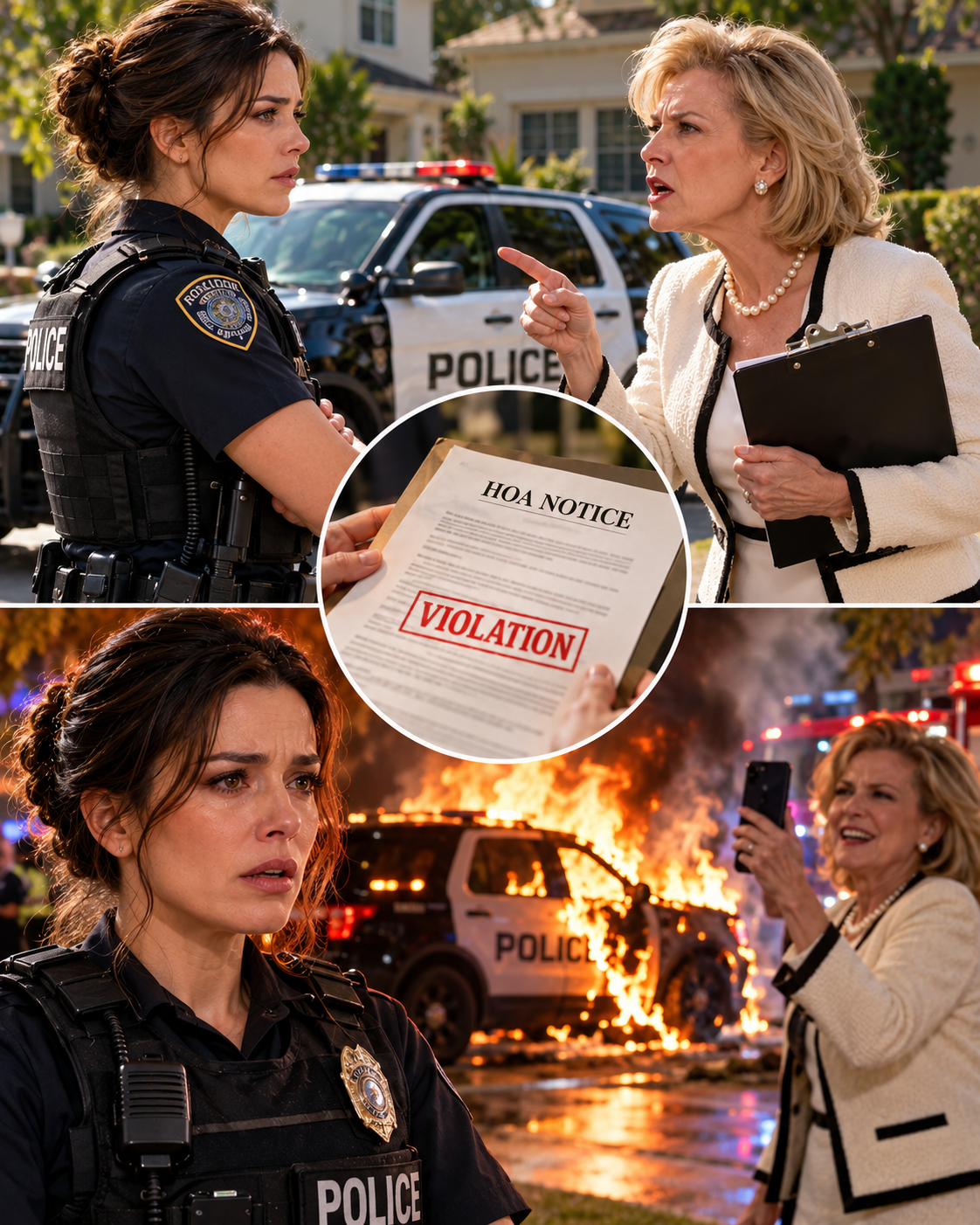
Part 2: Mildred used HOA paperwork to turn rumors into threats
Mildred stopped sending simple notices and began writing letters that looked official until you read them closely. Each one carried the HOA logo, her signature, and a confident reference to a rule that could not be found anywhere in the charter. She accused me of “concealing a professional risk,” despite the fact that no such disclosure requirement appeared in the purchase documents. Another letter claimed my presence could “alter the residential character” of Brook Hollow. I responded with page numbers, dates, and copies of the documents she kept pretending not to see.
I reminded her that the patrol SUV was a city vehicle, assigned to me by the department, and parked on a public street. The HOA did not own the curb, the road, or the vehicle. I attached the city parking ordinance and a letter from my department confirming the vehicle was authorized at my residence. I also included the purchase approval showing the association had been informed of my profession before closing. The response came back with a single sentence: “The board reserves all rights to protect neighborhood values.” It did not explain which right she meant.
At the next HOA meeting, Mildred stood at the front of the clubhouse and delivered a speech about newcomers who abused their privileges. She never used my name, but she described a “large marked government vehicle” parked near a family home. She said uniforms could make children feel unsafe and that people with authority should show more restraint than ordinary residents. Several heads nodded, partly because she spoke with the certainty of someone quoting law. I sat in the second row with my hands folded, listening as she transformed an ordinary parking arrangement into a threat to the community.
When the meeting ended, I asked the board for the specific bylaw that applied to my vehicle. Mildred said the rule was “under review,” then added that the board did not need to wait for a written amendment before taking reasonable action. I asked whether the board had voted on that action. She said the details would be in the minutes. The minutes, when they arrived, contained no record of a vote. They did include a note stating that “a resident’s vehicle situation had been discussed.” I saved that page beside the letters.
Three days later, a certified notice gave me seventy-two hours to remove the patrol SUV from the street or face fines and possible towing. The letter did not identify a towing company, a lawful authority, or a section of the charter. I knocked on Mildred’s door that evening and told her directly not to touch the vehicle or arrange for anyone else to touch it. I explained that it was government property and that interference could bring serious criminal consequences. She looked at me as if I had insulted her family. “The HOA is above city rules in this community,” she said.
I went home without raising my voice, but I did not sleep well. I recorded the date and time of the conversation in my notebook, then exported every email and voicemail to a secure drive. I asked the department’s fleet supervisor to confirm the car’s equipment and document its condition. I checked the exterior cameras and adjusted one angle so the curb and driveway were visible without filming inside anyone else’s home. Mildred believed fear meant obedience. I knew from experience that fear often made people careless.
Part 3: A fake deadline pushed the feud toward a felony
The neighborhood grew quieter around me after the meeting. People still went about their lives, but conversations stopped when I came close, and one parent pulled a child’s bike away from the curb as I walked past. I knew Mildred had been talking about me, though I could not prove exactly what she had said. I did not blame the neighbors for hesitating; most people do not want an argument with the person who controls the warning letters. What bothered me was that the HOA had allowed one person’s assumptions to become the neighborhood’s official story.
I asked the board for a hearing and requested that the management company attend. My message was brief: I wanted the alleged rule identified, the enforcement process explained, and the seventy-two-hour deadline suspended until the board reviewed the documents. The management company replied that it had not issued the notice and had not approved a towing request. That answer made me more concerned than the letter itself. Mildred had signed the notice as president, but she had not consulted the people responsible for enforcing the rules.
At the hearing, I laid out the purchase approval, parking code, department letter, and the HOA’s own charter. I spoke for less than five minutes and answered every question. Mildred spent the next twenty minutes explaining how my vehicle made the neighborhood feel unsettled. She talked about “the atmosphere of authority,” “the appearance of danger,” and “the kind of people future buyers might imagine living nearby.” When I asked which bylaw prohibited the car, she said she was not required to repeat a rule I had already been shown. A few residents shifted in their chairs.
The board did not vote to tow the patrol vehicle, but Mildred left the hearing insisting that the deadline remained in effect. She followed me into the parking lot and said the association had ways to handle residents who refused to cooperate. I asked what she meant, and she replied that “people who handle problems” had already been contacted. The phrase stayed with me on the drive home. I called the HOA manager and asked for a written confirmation that no towing request had been made. The manager sent it before the end of the day.
I also contacted my supervisor and the department’s legal liaison, giving them copies of the notices and explaining the threat. They told me to leave the vehicle where it was permitted, avoid confronting Mildred alone, and report any interference immediately. I followed that advice. I added a second camera covering the curb and the front walkway, and I told two nearby neighbors that the car was city property and that the department knew about the dispute. One of them admitted Mildred had asked whether the SUV could be “removed quietly.” He had told her he knew of no legal way to do that.
That evening, I found a fresh orange sticker on the driver’s window. It said the vehicle was in violation and would be removed after the deadline. The sticker had been placed on the outside of the glass, where the camera caught a person approaching and walking away. The image was grainy, but the time stamp was clear. I sent the footage to the HOA manager and asked the board to preserve all communications about the vehicle. Then I made dinner and tried to forget about it. The threat was still just paper, I told myself. I did not know that the next warning would arrive in the form of fire.
Part 4: The fire revealed what every threat had been building toward
It happened on a hot afternoon after an early shift. I had parked the patrol SUV at the curb, locked it, and gone inside to shower and sleep. The house was quiet except for the ceiling fan, turning lazily in the bedroom. I had barely drifted off when a sharp boom cracked through the windows. The car alarm began shrieking outside, and a second later, the smoke detector in the hallway started wailing. I sat up, disoriented, then ran toward the front door.
The hood of the patrol vehicle was burning. Flames curled over the front edge, and dark smoke rolled upward against the bright sky. I saw Mildred standing several yards away with her phone raised, filming. She was shouting that I had been warned and that this was what happened when people ignored HOA enforcement. I stopped at the threshold, suddenly aware of the fuel, the electrical system, and the possibility of something worse. I yelled for everyone to stay back and called emergency services.
I had a fire extinguisher inside the garage, but I did not rush into the smoke. I told the dispatcher exactly what I could see and waited for instructions while neighbors gathered at a distance. The flames shifted toward the windshield, and the heat shimmered above the hood. Mildred kept filming, repeating that the rules mattered more than badges. I heard a neighbor tell her to stop talking, but she laughed and said she was documenting the consequences of my behavior.
Fire crews arrived within minutes, followed by patrol officers and a fire investigator. The street filled with red lights, radios, and the smell of burned plastic. One firefighter used an extinguisher before the flames reached the windshield, then the crew opened the hood only after securing the scene. The investigator asked everyone to step back and began photographing the damage. Mildred tried to explain that it was an HOA matter, but nobody treated it that way. An investigator had found evidence consistent with an accelerant near the front of the vehicle.
The patrol SUV was more than a car; it was a piece of city equipment, and the fire had endangered everyone on the block. Officers separated the witnesses and asked me to provide the history of the dispute. I gave them the letters, the emails, the orange sticker, and the recordings. A neighbor showed them a doorbell camera clip of someone approaching the vehicle shortly before the explosion. My own exterior camera had captured Mildred arriving just before the flames appeared, phone already raised. She had told everyone she came to film an enforcement action, not to call for help.
The investigator asked Mildred to put her phone down while officers documented the scene. She refused at first, insisting she was the HOA president and had a right to record. One officer repeated the request, and she finally lowered it, still arguing that the board had authority over the vehicle. The confidence drained from her face when the investigator asked whether she knew what had started the fire. She said she had no idea, then immediately added that I had been warned. The words hung in the air between us, and the camera kept recording.
Part 5: The patrol car captured the moment Mildred lost control
The investigator reviewed the camera footage at the scene, while another officer collected witness names and asked residents not to delete their recordings. My patrol vehicle’s onboard system had captured the impact and the first alarm sequence, while the house camera recorded the sidewalk and Mildred’s arrival. The footage did not show every detail of how the fire began, but it preserved her words and the timing. A neighbor’s camera covered the curb from another angle. Together, the recordings gave investigators a sequence they could compare with the physical evidence.
Mildred continued insisting that she had only come to document the vehicle’s removal. When an officer asked who had arranged that removal, she said the board had “handled it.” The board members present looked at one another, then said no such decision had been made. She switched explanations, claiming she meant a formal warning, then said I had staged the incident to embarrass her. The fire investigator asked her to stop speculating and answer only what she knew. That was when she turned toward the gathered neighbors and shouted that I had caused all of this by refusing to obey.
I gave my statement in the back of a patrol vehicle while the investigator photographed the burned hood. I explained the timeline from the first notice to the threat outside the clubhouse. I made clear that I had not touched the vehicle since parking it, and that I had no access to the camera recordings except through the department’s approved system. The officers collected the original letters and copied the emails from my secure folder. I also gave them the management company’s confirmation that the HOA had never authorized a tow. Every document had a date, and every date mattered.
The fire marshal found residue that required laboratory testing before anyone could identify a specific accelerant. Officers secured Mildred’s phone under the applicable investigative process and asked her to come to the station for an interview. She kept saying she would speak only to the HOA attorney. The lead officer explained that the fire was being investigated as a suspected arson involving public property, not as an association dispute. Mildred’s face tightened at the word arson. She looked around, perhaps expecting one neighbor to step forward and tell the officers she had been misunderstood.
No one did. The same residents who had once avoided eye contact now stood together behind the tape, answering questions and handing over footage. One woman said she had heard Mildred threaten that “the car would be gone by Friday.” Another remembered seeing her walk near the curb with a small container earlier that day, though she could not say what was inside it. The investigator wrote everything down without promising anyone a particular outcome. I watched Mildred’s phone disappear into an evidence bag and felt the strange stillness that comes when a dispute leaves your control.
That night, I sat at home with the front windows open and the burned smell still lingering in the air. The patrol SUV had been towed to a secure facility, and the department had arranged another vehicle for me. I was safe, but I kept replaying the boom and Mildred’s voice. The HOA had not been able to make the fire disappear or turn it into a rule violation. The next morning, the board sent an email suspending all enforcement actions related to my vehicle. The notice was formal and careful, written in a tone that suggested they had finally understood how serious the situation had become.
Part 6: The neighborhood watched her authority collapse under investigation
Within forty-eight hours, the HOA board called an emergency meeting. Three members resigned before it began, each citing concern about the association’s exposure and the president’s unilateral actions. The remaining members voted to suspend Mildred’s access to association records and official communications while the investigation continued. The management company took control of the files and transferred copies of every notice, meeting record, and email to the investigators. The HOA’s attorney instructed the board not to discuss the criminal case publicly. For the first time, Mildred had no microphone and no letterhead to hide behind.
The police department kept me away from the case after I gave my statement, as it should have. I was a witness and the owner of the residence where the vehicle had been parked, not the investigator. Detectives interviewed the neighbors, reviewed the cameras, and compared the fire evidence with the recordings. The department’s internal fleet unit documented the damage and estimated the cost of replacing the vehicle and its equipment. The fire marshal submitted samples for testing, and the city’s legal office preserved the repair and response invoices. I went back to work when cleared, though my route home felt different every night.
Mildred’s lawyer issued a statement saying she had been misunderstood and that the incident arose from a long-running neighborhood disagreement. The statement did not explain why she had threatened the vehicle, why she had announced that the fire was enforcement, or why she was filming before anyone else arrived. Her attorney asked residents not to speculate, and the investigators made the same request. But the story had already spread through Brook Hollow. People who had believed Mildred’s version of me began apologizing for keeping their distance. I accepted the apologies without asking anyone to choose sides.
The HOA’s accounts were temporarily restricted from paying legal bills unrelated to ordinary association business, and an outside administrator was appointed to review the board’s spending. The city filed a claim seeking restitution for the patrol vehicle, emergency response, and hazardous cleanup. The association itself was not charged with setting the fire, but it had to explain why its president had issued threats without authority and used official resources to pursue a personal conflict. Residents demanded a special meeting to review the charter and elect interim officers. Nobody wanted another president who believed a title could replace a vote.
The criminal case moved faster than I expected because the evidence had been preserved from the beginning. The laboratory confirmed the presence of an ignitable liquid on material collected near the vehicle. Investigators matched the timeline with the camera footage and interviewed the people who had seen Mildred near the curb. The recordings also captured her statements before the firefighters arrived, when she claimed the fire was HOA enforcement. The prosecutor reviewed the full file, including the messages and the certified letters. Months earlier, those papers had seemed like petty harassment. Now they showed a pattern of escalating threats.
Mildred was arrested after investigators obtained the required legal authorization. She was charged with arson involving a government vehicle, destruction of public property, and reckless endangerment, along with related offenses supported by the evidence. The charge was not based on her being HOA president, or on my being a police officer. It was based on the fire, the physical evidence, and the recorded timeline. At the station, she reportedly insisted she could not be arrested because she was the head of the HOA. The arresting officer answered that the HOA did not grant immunity from state law.
Part 7: The evidence answered every excuse Mildred tried to invent
The first court appearance was brief, focused on procedure and release conditions. Mildred’s attorney argued that she had no prior criminal record and that the dispute had been exaggerated by a hostile neighbor. The prosecutor presented the threatening letters, the meeting minutes, the certified notice, and the video clips showing Mildred at the scene. The judge ordered her not to contact me or the witnesses and barred her from acting on behalf of the HOA while the case was pending. Outside the courthouse, reporters asked whether I felt vindicated. I said I wanted the case handled fairly and the neighborhood left in peace.
The trial took place several months later. I testified about the patrol vehicle, the notices, and the threat Mildred made at her door. I described the exact sequence of events without adding what I could not know. The fire investigator explained the evidence recovered from the scene, and the department’s fleet specialist documented the damage. Neighbors testified about what they had seen and heard, while the video footage showed Mildred arriving before the first emergency call. The prosecutor did not need to portray her as a cartoon villain; her own actions were enough.
Mildred’s defense argued that she had been trying to enforce HOA rules and that her statements were taken out of context. The prosecutor played the full recordings rather than edited clips, including the moments before and after her claims of “HOA enforcement.” Her earlier letters established that she had been told the vehicle was city property and that the HOA had no authority to remove it. The board members testified that no vote had authorized a tow or any action against the vehicle. The jury heard the complete timeline, not just the parts each side wanted to emphasize.
The verdict came after deliberation. Mildred was found guilty of the arson and related charges, with sentencing left to the judge after a review of the applicable state guidelines. The court ordered restitution for the patrol vehicle replacement, investigative expenses, emergency response, and cleanup, totaling approximately $187,000. A lien was authorized against her home to secure payment, subject to the court’s order and state procedure. She was also prohibited from contacting me or the witnesses and barred from holding an HOA position in the community. Her authority had ended long before the verdict; now the law had put that reality in writing.
At sentencing, the judge addressed the danger of setting fire to a vehicle on a residential street. The patrol car was parked near homes, nearby vehicles, and people who had been sleeping or coming home from work. Mildred had called the incident enforcement, but a private association had no power to punish someone by setting property alight. The court imposed a nine-year state prison sentence, with parole eligibility governed by the state’s rules and the specific counts of conviction. When the sentence was read, Mildred looked toward the residents in the gallery. No one stood to defend her.
Part 8: I returned to duty while the block learned to breathe
The HOA entered a period of external oversight after the case. The remaining board members hired a professional management company, reviewed every enforcement notice from the previous two years, and created a clear appeal process. Residents could see the governing documents, meeting minutes, and budget without asking a board officer for permission. The association also adopted a rule requiring a recorded board vote before any fine or enforcement action could be issued. It was not a dramatic reform, but it addressed the quiet conditions that had allowed one person to act as if the neighborhood belonged to her.
The city replaced the patrol SUV, and I returned to my regular shift. The new vehicle was the same model, the same markings, the same radio, and the same camera system. The first night I parked it outside my house again, I stood on the sidewalk for a moment and listened to the engine tick as it cooled. A few curtains moved, but nobody turned away when I waved. One of the children who had stopped biking past my home rode by with his father and called out hello. I waved back, then went inside.
I did not celebrate Mildred’s prison sentence. The fire had been dangerous, and the consequences were serious, but the neighborhood was still dealing with the damage she had left behind. Residents had lost trust in one another, several board members had resigned, and the association had spent money on lawyers and repairs instead of community needs. The restitution order would not bring the old patrol vehicle back or erase the fear of that afternoon. What mattered was that the case had been decided on evidence, and the HOA could no longer use its title to threaten people outside its authority.
At the first meeting under the new management, residents filled the clubhouse. Mark—one of the neighbors who had quietly opposed Mildred’s tactics—asked for a copy of the revised enforcement procedures. The manager handed it to him and explained how any homeowner could appeal a notice. People asked about landscaping, parking, and holiday decorations, but nobody was afraid to ask. A woman who had once avoided my gaze apologized for believing the rumors. I told her I understood; fear travels quickly when no one has the full story.
The patrol SUV still parks at the curb when I am home, because the department authorizes it and the city street allows it. I keep the camera records and the HOA documents, not because I expect another attack, but because facts are easier to protect when they are organized. The orange notices are in a folder now, filed beside the court’s final orders. I rarely open it. When I do, I remember how a dispute over a vehicle became a test of what a neighborhood believed about power. The lesson was not that every conflict ends in handcuffs; it was that a clipboard does not make someone above the rules.
One evening, after a long shift, I sat on my porch with a glass of iced tea and watched the sun fade behind the houses. The street was ordinary again: sprinklers clicked, a dog barked, and someone down the block laughed as they carried groceries inside. My patrol car reflected the last strip of light beneath the trees. No one called it dangerous. No one demanded I hide it. Brook Hollow had not become perfect, but it had become a place where neighbors could disagree without turning a private grudge into official policy. I went inside, locked my door, and finally felt at home.
✓ Lynn R. Adams
Part 2: Mildred used HOA paperwork to turn rumors into threats Mildred stopped sending simple notices and began writing letters that looked official until you read them closely. Each one carried the …