When Donovan Horn arrived at his ex-wife’s mountain pottery studio,
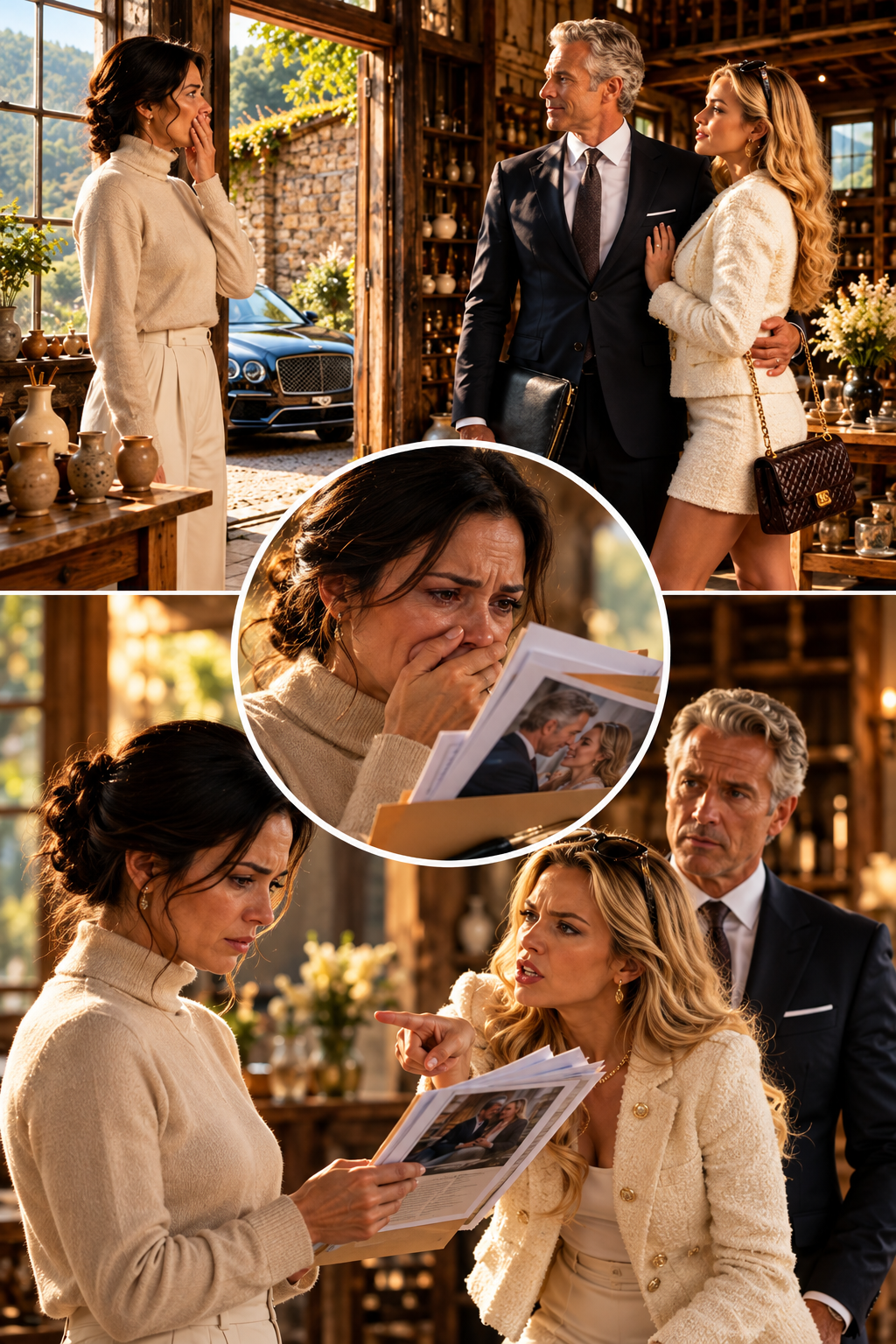
Part 2: I chose clay after he mistook patience for surrender again
Donovan had built his life on other people’s foundations, though he would never have described it that way. He had a sharp jaw, silver at his temples, and the polished confidence of a man who believed the world was an arrangement of things he had not yet acquired. Tessa’s hand rested near the designer tote on her lap as she watched the road. She rarely asked questions that might complicate the picture she wanted to present. The mountain drive was not part of that picture.
Donovan had told his attorney, Griffin Oats, that delivering the waiver in person was simply practical. Griffin had advised against it. There was no legal reason to hand over the document himself, and a courier would be standard. But Donovan wanted to see Cesaly’s face when she realized what she had lost. He wanted the signature, but he also wanted the moment. He had pictured her in a cramped room, surrounded by unsold pots, trying to make a living from a hobby.
They reached the gravel lot. Tessa stepped carefully around a puddle, holding her tote against her side. Donovan walked ahead, envelope in hand, convinced that the building’s condition proved his old judgment correct. The heavy chestnut front door opened without resistance. He entered with the comfortable expectation of dust, clutter, and the sadness of unrealized potential. The image he had kept alive for six years lasted about four seconds.
The mill’s interior had been transformed. The stone walls had been repointed and left exposed, their roughness now deliberate and architectural. The sagging ceiling had been replaced by open timber beams that rose more than twenty feet overhead. Clerestory windows poured mountain light across honey-colored oak floors. Reclaimed wood tables displayed ceramics arranged with the precision of a gallery exhibition.
Donovan knew little about pottery, but he recognized quality. Deep indigo bowls and raw umber vessels stood beneath the lights, alongside sculptural pieces displayed on walnut pedestals. Brass tags showed prices ranging from hundreds to thousands of dollars. On the far wall, framed articles from the New York Times, Architectural Digest, and other publications formed a record of Cesaly’s success. One photograph showed her work installed in the lobby of a hotel in Charleston.
A young woman in a canvas apron was trimming a large vessel beside a wood-burning kiln. When Donovan asked for Cesaly, she pointed him toward the back studio. He walked past the gallery and into the former grain-storage room, where six industrial pottery wheels stood in two rows. Shelving held work at every stage, a separate glazing station glowed under dedicated lights, and a second kiln stood near a system controlling humidity.
At the far end, an open door framed a flagstone terrace and the mill race. Cesaly stood outside with a ceramic mug in both hands, watching the stream beneath the birch trees. She was forty-one, tall and lean, with her dark hair pulled back. She wore dark linen trousers and a simple oatmeal-colored sweater. When she turned at the sound of his footsteps, her face showed neither fear nor nostalgia. She looked at him with calm attention, as if he were a visitor who had arrived without an appointment.
Part 3: The mill became an empire while he pursued bigger land
“Donovan,” Cesaly said. Her voice was low and measured, unchanged by the years. Tessa had followed them into the production room, phone half-raised as she studied the kilns and the worktables. Her expression shifted between curiosity and the quick calculation of someone deciding whether a place would make good content. Donovan recovered quickly. “You’re looking well.”
“You look like you’re trying to project something,” Cesaly said. It was not cruel; it was an observation. Donovan introduced Tessa, who offered a polished smile. Cesaly nodded once, did not comment on the engagement ring, then looked back at him. “You could have sent Griffin.” Donovan said he wanted to handle the matter personally. “I know you did,” she replied.
He switched into the confident tone he used in boardrooms. Meridian Retreats was co-developing a luxury wellness resort in the Weaverville corridor. The project was valued at $47 million, and groundbreaking was scheduled for spring. The parcels along the ridge were essential to the full site plan. During title review, his attorneys had found a secondary easement tied to the old mill deed. Meridian wanted it formally released before wiring the final tranche.
“It’s a formality,” Donovan said, tapping the envelope. “Sign this, and I’ll give you $75,000 for the inconvenience. You can put it toward the building. I noticed the roof could use attention.” The silence that followed was not a pause of shock. Cesaly did not look at the paper or calculate what the offer could buy. She stood with her hands relaxed at her sides, in the quiet of someone who knew more than the people around her.
Tessa had been studying the price tags. “Are these pieces in hotels?” she asked. “We supply fourteen properties currently,” Cesaly replied, without looking away from Donovan. Tessa lowered her phone. Cesaly carried her mug to the glazing station and set it on the counter. She did not reach for the envelope. “Seventy-five thousand,” she repeated, tasting the number without asking a question.
“It’s more than fair for a dormant easement release,” Donovan said. “Your attorneys will tell you the same thing.” Cesaly’s gaze stayed steady. “My attorney already told me about the easement.” Donovan’s expression sharpened. “Then you understand it’s a formality.” “I understand that you believe it’s a formality.”
She picked up a low, wide bowl in progress and slowly turned it in her hands. The piece had a deeply ribbed exterior, each line carrying the pressure of her fingers. “The original language wasn’t dormant,” she said. “It was written as a continuous-use right tied to the mill race. Four years ago, I ran the water through the clay-processing system when I installed the kiln infrastructure. That made the easement active.”
Donovan called it a stretch. Cesaly told him three land-use attorneys and a water-rights specialist from Chapel Hill had reached the same conclusion. She set the bowl down. An active easement connected to the water corridor affected more than the resort’s lot lines. It affected permitting across the ridge. Until the right was properly negotiated, Meridian could not break ground.
Part 4: He offered seventy-five thousand for the water rights I owned
“Griffin should have found this eighteen months ago,” Cesaly said, not unkindly. The language was buried in a 1923 deed, in a secondary addendum three pages into the file. It was easy to miss if a title search focused only on standard easements instead of water rights. She had found it four years earlier while researching permits for the kiln installation. Since then, she had kept using the mill race and documenting every part of the process.
Donovan reached for his phone. He called Marcus Webb, the project attorney who had spent eight months working on the Meridian deal. The call rang three times before Marcus answered. His voice already carried the strain of someone delivering news he wished had arrived differently. “Tell me you’ve seen the 1923 addendum,” Donovan said. Marcus asked where he was. “At the mill. Tell me.”
“We pulled it this morning,” Marcus said. “We’ve been in review since seven. Her kiln system has drawn from the mill race for four years. That constitutes continuous use under North Carolina water-rights law.” Donovan’s jaw tightened. “Then we negotiate the release. What’s the number?” Marcus paused. It was not that simple. Meridian’s lead counsel had received a letter from Cesaly’s attorneys two days earlier.
The letter formally identified the water right as a material encumbrance on the development corridor. The partnership agreement Donovan had signed fourteen months earlier allowed Meridian to restructure the deal if a title defect had not been disclosed during due diligence. The clause was on page forty-seven. Meridian had exercised it that morning. Donovan insisted they could not do that when they had already signed a letter of intent and a development agreement.
“The defect clause supersedes the agreement if there’s an undisclosed encumbrance,” Marcus replied. “It’s standard language, Donovan. I should have ordered a full chain-of-title review on the mill property. That’s on me, and I’ll own it. But you need to hear the rest.” Meridian did not want to abandon the project. They wanted the ridge and the corridor, but they did not want uncertainty hanging over the title.
They had contacted Cesaly’s attorneys directly two days earlier. They wanted to negotiate a separate agreement for the water easement with her. The studio went completely still. Donovan could hear the mill race beyond the open door. He ended the call without saying goodbye and placed his phone on the worktable, carefully, as if precision could restore control. “You knew,” he said.
“I’ve known about the addendum for four years,” Cesaly replied. “I knew about Meridian’s interest in the corridor for about eight months. When I learned who they had partnered with, I asked my attorney to place a notification flag on the title.” Meridian’s due-diligence team had found the right in its review and cross-referenced her building permits. That was how they learned it was active.
Tessa had gone very still near the doorway. “Why didn’t you sell them the release when they first called?” she asked. Cesaly turned to her and answered with the same steady attention she gave every question. “Because I didn’t want to sell a release. I wanted to negotiate something of actual value.” Then she looked at Donovan. He had come to buy her signature for $75,000 because he believed a person with less money would accept the exit he offered.
Part 5: Meridian’s phone call exposed the deal he had already lost
Donovan’s phone vibrated on the worktable. He ignored it. Cesaly crossed her arms, not defensively, but with the settled assurance of someone standing in a place she had built. “You’re good at identifying value in things and acquiring their use as cheaply as possible,” she said. “That can be useful in development. But you made a mistake with me. You confused quiet with unambitious. You confused patient with passive.”
“What exactly do you think you’ve negotiated?” Donovan asked. His voice had lost some of its boardroom certainty. Cesaly took out her phone, tapped the screen twice, and set it faceup between them. The email came from Rosalyn Fitch, senior vice president of acquisitions at Meridian Retreats International. Its subject line read: “Executed Term Sheet: Horn Mill Properties and Milra Water Rights Easement.”
The message confirmed that Meridian had agreed to a negotiated easement license, not a release. Cesaly would retain the underlying water right in perpetuity, while granting Meridian a conditional, limited license for the resort. The agreement required the resort to maintain the mill race in its current functional state. It also made Horn Mill Ceramics a named creative and material partner in the development.
Meridian would commission site-specific ceramic installations for all seven indoor and outdoor gathering spaces. Cesaly’s studio would design and produce them exclusively over three years, with an option to renew for future Meridian properties. The first phase was valued at $1.3 million. In return, the studio received preferential supplier status for Meridian’s Southeast openings for the next decade.
The message continued. Because of the undisclosed encumbrance, Meridian was restructuring its co-development agreement with Horn Development. Donovan’s company would retain a fourteen-percent equity stake instead of forty. Five percent of the revised structure had been offered to Horn Mill Properties as part of the creative partnership. Cesaly’s studio now held equity in the $47 million resort Donovan had spent three years trying to assemble.
For a long moment, Donovan stared at the screen. He had told investors and journalists that he could see potential in overlooked places. He had believed it without ever examining the claim. He had looked at the mill and seen a depreciating liability. He had looked at Cesaly and seen someone who had chosen to remain small. The evidence around him now said he had been wrong about both.
“How long have you been planning this?” he asked. “I haven’t been planning anything,” Cesaly said. “I’ve been building something. Those are different things.” She refilled her mug from an insulated carafe and did not offer him any. Four years earlier, she had found the addendum, recorded it properly, and kept working. When Meridian entered the corridor, she did not call Donovan. She documented the right and let thorough people do their work.
His phone vibrated again. This time, he looked at the screen. Six missed calls appeared: three from Marcus, one from his chief financial officer, one from a Raleigh equity partner, and one from a number he did not recognize. A voicemail notification sat beneath them. When he played it, an Asheville reporter asked for comment on the Meridian partnership restructuring and the water-rights dispute. The news was already moving beyond the mill.
Part 6: My quiet negotiation changed the resort’s future and ownership
Tessa lifted her tote from the worktable and held it against her chest. Her practiced ease had disappeared. She looked from the email to Donovan, then toward Cesaly, taking in what the changed ownership meant. “The venue deposit is nonrefundable,” she said. “I need to know if this is a significant loss or something you can manage with the Raleigh properties.”
Donovan started to answer, then stopped. Tessa continued, with the precise focus of someone who had been conducting her own risk assessment. She had structured brand partnerships around the resort’s opening, its launch campaign, and the assumption that Horn Development would control forty percent of the project. Now that figure was fourteen, and Cesaly’s studio had creative control over the installation design.
“I need to understand what I’m aligned with before I sign a prenuptial agreement next month,” Tessa said. “I aligned myself with a developer, not a minority stakeholder in someone else’s vision.” She looked directly at Cesaly. There was no warmth in her expression, but there was respect: the involuntary recognition of leverage when it was finally impossible to ignore.
Then Tessa walked out through the production room, past the pottery wheels and the works in progress, and through the main gallery. Her heels struck the gravel path at a measured pace until she reached her car. She did not look back. The studio fell quiet again, apart from the water moving outside and the muted hum of the kiln.
Donovan stood beside the worktable, reading the term sheet again. He tried to take in its details the way he should have read the foundational documents of every deal he had ever structured: slowly, completely, without assuming someone else had checked the parts that mattered. “Eleanor would have caught it,” he said aloud, though he meant Cesaly. She looked up. “My name is Cesaly.”
He blinked, then apologized. “I know. I’m sorry.” For once, the apology did not arrive as a tactic or a negotiation. He looked around at the stone walls, the beams, the pieces on the shelves, and the light moving across the floor. “I’ve always confused you with someone smaller than you actually are,” he said. Cesaly did not answer.
Six years earlier, they had sat across from each other in a mediation office. Donovan had told her she did not understand the scale of his ambitions, that she thought too small and cared too much about making things with her hands. He had given her the deed to a building he considered a write-off and forty thousand dollars. While she signed, he checked his watch three times.
“What you didn’t understand,” Cesaly said, “is that I knew exactly what I was building. I knew what this building could become before you bought it. I knew what the mill race was worth before you dismissed it.” She looked around at the finished studio. “I didn’t fight you in mediation because there was nothing I needed to fight for in that room. Everything I needed was already here.”
Donovan suggested he could still restructure the partnership, or talk directly to Meridian. He still owned fourteen percent, he said, as if naming the number might restore the position he had lost. “That isn’t nothing,” he added. “No,” Cesaly said gently. “It isn’t. But it’s not my problem to fix.”
Part 7: His fiancée saw the numbers and walked away alone that afternoon
“Go home,” Cesaly told him. “You have people waiting for answers, and a journalist who’ll write the story with or without your comment. Focus on that.” She had contractors arriving the next morning to begin installation design for the Meridian commission. She did not want to carry the energy of their old marriage into work she had earned.
Donovan stood there a moment longer, then picked up his phone and the manila envelope. He folded the waiver once and slid it into his jacket. The paper felt weightless, almost absurd, now that he understood what it had been meant to buy. He walked through the production studio, past the wheels and glazing station, and back into the gallery.
He passed the press wall without looking at the articles again. At the heavy chestnut door, he stepped out into the gravel lot. The Bentley sat alone; Tessa had driven separately, a detail he had forgotten in the confusion. He got behind the wheel but did not start the engine. Through the windshield, the old mill looked much as it had when he arrived.
The granite walls were still dark with age. The mill race flowed steadily along the foundation. The sign above the door was legible even from the lot: “Horn Mill Ceramics, Established 2018.” Cesaly had kept the name he shared with her. She had taken the place he handed over as a consolation and built it into something more valuable than he had imagined.
He started the engine and drove back up the mountain road. The valley closed behind him. In the studio, Cesaly stood on the flagstone terrace with both hands around her ceramic mug. The water looked like strong tea in the shade and hammered bronze in the sunlight. It moved with the patient purpose of something that had been running long before any argument was made along its banks.
Her phone chimed. A message from Rosalyn Fitch asked if she was all right, adding that the story was already moving on the wire. Cesaly typed back: “I’m fine. See you Thursday for the site walkthrough.” Then she locked the phone and placed it on the terrace railing. A blue heron landed on the opposite bank, without ceremony, and stood in the shallow current.
Donovan’s day did not improve after he left the mountain. Marcus called again to explain that the revised deal was binding, though there was still a path to preserve the reduced stake. The company’s investors wanted a clear account of the title review and the missing disclosure. The reporter’s questions were direct, and the answers would be public whether he liked them or not.
At the office, Donovan read the agreement from beginning to end. Page forty-seven contained the clause Marcus had mentioned. The signature at the bottom was his. He had trusted the broad outline, skimmed the details, and assumed the people around him would keep him from being surprised. For years, his success had depended on other people noticing what he chose not to see.
Part 8: He finally understood what I had built without him there
The Meridian deal went forward in its amended form. Horn Development retained its fourteen-percent share and remained involved in construction, but the balance of control shifted. Cesaly’s studio held five percent through Horn Mill Properties and a ten-year preferred supplier agreement. Her team began designing the resort’s installations: a long wall of ceramic forms for the lobby, sculptural lighting for the dining room, and weather-resistant pieces for the garden terraces.
The work was demanding, but it was the kind of demanding Cesaly welcomed. She worked with architects, landscape designers, and Meridian’s operations team to ensure that every installation belonged to its space. The water license protected the mill race, and the agreement required the resort to respect the flow that had made her studio possible. Her business gained a major commission without surrendering the right that gave the mill its character.
Donovan and Cesaly did not become friends. He had not earned that, and she did not need to offer it. Their conversations concerned contracts, construction schedules, and the boundaries of the easement. In those meetings, he listened more carefully than he had during their marriage. Whether that change came from regret or necessity was not something Cesaly needed to determine.
Tessa postponed the wedding. A week later, she ended the engagement. The venue deposit was indeed nonrefundable, but she said it was cheaper than making a lifelong decision based on a version of Donovan that no longer existed. He did not argue with her. For the first time, the people close to him were making decisions without waiting for him to define the story.
The first resort installation was unveiled two years later. The lobby wall held dozens of ceramic shapes in layered blues and warm earth tones, each one made by hand in the old mill. Guests stopped to study the surface, where no two pieces were exactly alike. The design honored the mountain and the working waterway without turning either into a decoration.
At the opening, Cesaly stood beside Rosalyn Fitch, whose team had negotiated the easement. A regional magazine photographed them beneath the installation. The article described the partnership as an unusual collaboration between a regional developer, a hospitality group, and an independent ceramics studio. It did not describe Cesaly as Donovan’s ex-wife. That omission felt like a small victory, though it should have been ordinary.
The studio expanded after the resort opened. Cesaly hired additional apprentices and established a paid training program for young artists from nearby towns. She made sure the business could grow without turning every decision into a race for scale. The mill remained a workplace, a gallery, and a place where people learned how to shape clay with their hands.
Years later, when a reporter asked her whether the resort deal had been revenge, Cesaly considered the question before answering. “Revenge would have meant building my life around his mistakes,” she said. “I was building a business before he arrived, and I kept building it after he left.” She did not need Donovan to fail in order for her work to succeed.
The reporter asked if she had ever regretted taking the mill in the divorce. Cesaly looked toward the east windows, where the afternoon light rested on the stone. “No,” she said. “I knew it had potential.” She had not been waiting for anyone to recognize it. She had simply been willing to do the work.
Part 9: The water kept running long after the deal ended quietly
On the anniversary of the resort’s opening, Cesaly returned to the mill race before sunrise. The air smelled of wet leaves and wood smoke. She carried a mug from the first set she had ever fired in the renovated kiln, its blue glaze imperfect but still beautiful. The water moved past the foundation in the same direction it had always moved.
She thought of the woman she had been in the mediation office, listening to Donovan explain what she did not understand. That woman had been tired, but not defeated. She had signed the papers, taken the mill, and left without trying to persuade him that she knew what she was doing. There had been nothing to gain from arguing with someone who had already decided not to listen.
The years had added more than money to the old building. They had added apprentices, customers, friendships, hard days, and work Cesaly was proud to put her name on. The mill did not become valuable because Donovan had once owned it. It became valuable because she knew how to recognize what was there and how to make it stronger.
By then, she no longer thought of her success as a response to his underestimation. His visit had been dramatic, and the phone call had changed the terms of the resort deal. But neither moment had created the business. The work had begun years before his car climbed the mountain road, one fired vessel at a time.
The morning sun reached the terrace. Cesaly set her mug on the railing and went inside. Her team was waiting in the production room, and a new order had arrived from a hotel in Charleston. She reviewed the drawings, discussed the timeline, and assigned the first pieces to the apprentices. The day unfolded around decisions that belonged to her.
Donovan called once, several months after the opening, to discuss a possible amendment to the resort’s supplier agreement. The conversation remained professional. Before they hung up, he said he had been thinking about what she told him in the studio: that quiet was not the same as passive. Cesaly said she hoped he remembered it. She did not ask whether he had finally understood everything else.
Her story with Donovan had ended long before the Bentley reached the mill. The divorce had closed their marriage, though the old assumptions took longer to leave. He had mistaken her patience for surrender and her craft for a hobby. She had mistaken his confidence for curiosity. What remained was not bitterness, but the clarity to see each of those errors for what it was.
At dusk, the kiln’s warmth filled the studio, and the last pieces of the day cooled on their shelves. Cesaly walked once more to the terrace. The heron stood on the far bank, still and watchful, then lifted into the evening sky. The mill race continued under it, carrying the light downstream.
Inside, the sign above the door bore the name she had chosen and the year she had begun. Cesaly returned to her worktable, where a fresh piece waited to be shaped. She pressed her hands into the clay, steady and sure. The water kept running, and so did she.
✓ Lynn R. Adams
Part 2: I chose clay after he mistook patience for surrender again Donovan had built his life on other people’s foundations, though he would never have described it that way. He had a sharp jaw, silv…