When a homeowners association president shut off the trough serving Silas Mercer’s forty cattle
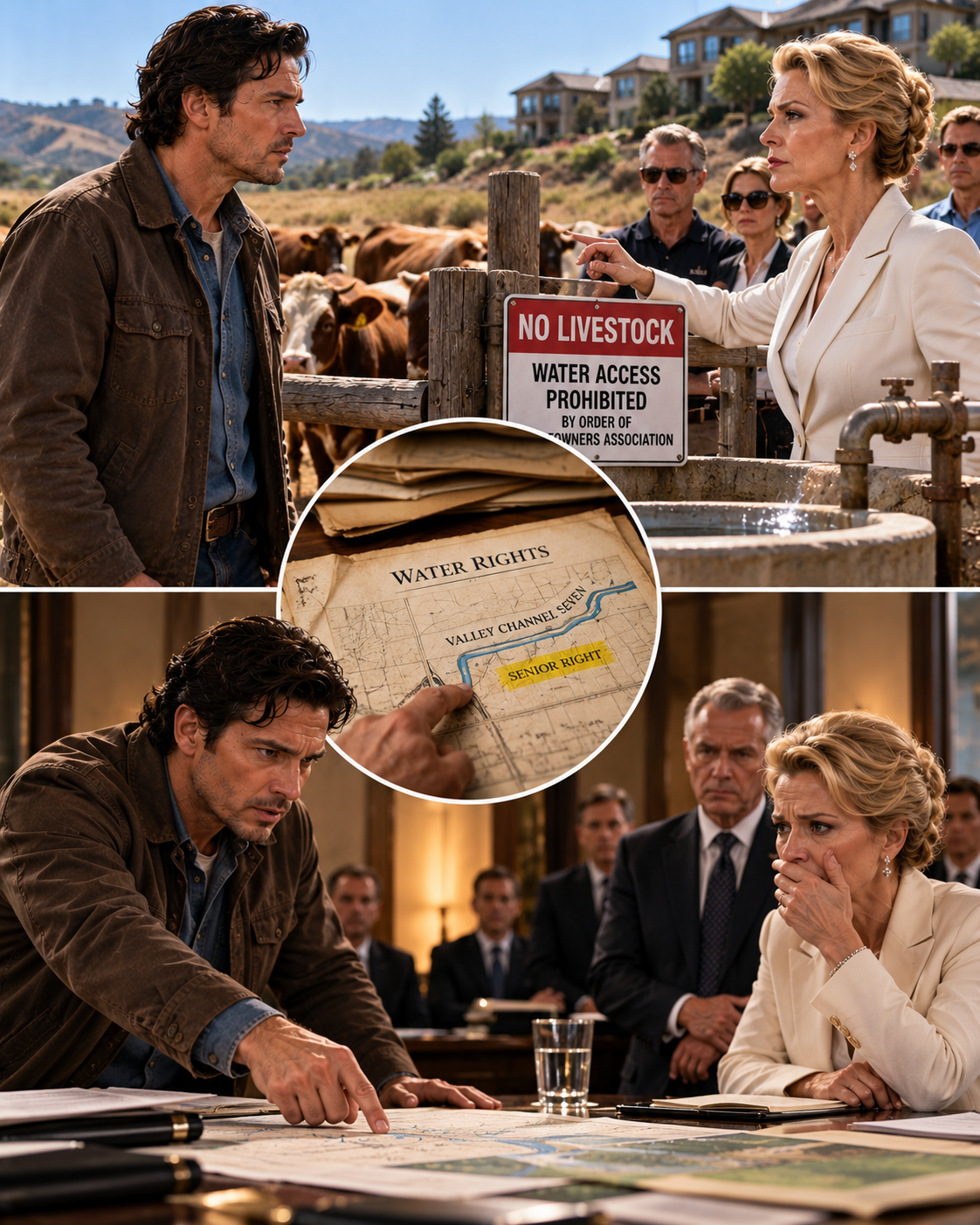
Part 2: His father’s forgotten records revealed a boundary nobody had respected
Silas remembered that map spread across the same table when he was a boy. His father had weighted its corners with coffee mugs and explained that owning land meant understanding promises made by people who might already be dead. Back then, Silas had wanted to go outside and help repair an engine instead. Now he traced the blue channel with one rough finger, following it from the northern ridge past the ranch and toward the subdivision reservoir. He wished, with a sudden childish desperation, that he could ask his father to explain it once more.
Before dawn, he filled the temporary troughs and drove into town. He reached the recorder’s office early enough to drink most of his coffee on the steps while delivery trucks rattled along Main Street. The clerk remembered his father and found the old parcel references without making Silas explain why he looked exhausted. She brought maps, recorded agreements, and the subdivision’s original development documents to a table beneath fluorescent lights. None of it resembled the sweeping authority printed on Marbel’s sign.
The association held a maintenance easement along certain pipes and structures. The common strip around the old watering point was subject to earlier agricultural access provisions, which the developer had accepted when the surrounding land changed hands. Maintaining the concrete and mowing the grass did not erase those provisions. More significantly, nothing Silas examined gave the association ownership of all water moving through the channel. He took notes until his fingers cramped, separating what the records established from what he merely hoped they meant.
One discovery spoiled his first rush of relief. The senior water right identified on the survey was held by Gideon Vale, a rancher who had left the valley nearly twenty years earlier. His family had retained it when selling other assets, and subsequent records showed agricultural deliveries under arrangements Silas had never needed to understand. His own ranch’s historical access mattered, but it was not the same thing as owning that senior allocation. Marbel had confused two different kinds of authority, and Silas could not afford to answer her mistake with another.
He took copies to Orson Pike, whose law office occupied the floor above the hardware store. Orson was sixty-one, wore reading glasses repaired with an ugly strip of tape, and knew enough local history to distrust any sentence beginning with everyone understood. He listened while Silas described the closed valve, the fines, and the borrowed water tank. Then he examined the papers and called a specialist who worked with the region’s water records. Silas appreciated that he asked questions before offering certainty.
By late afternoon, Orson had a practical beginning. He would demand restoration of the established livestock access while verifying the relevant rights, delivery arrangements, and limits with the appropriate records and officials. He also wanted to locate Gideon, because a lawful purchase might give Silas lasting security beyond winning this particular argument. “Do not buy a legend about your family,” he warned, sliding the survey back across the desk. “Find out exactly what exists, exactly what survives, and exactly what responsibility would come with your name on it.”
On the way home, Silas stopped at the cemetery above the north pasture. He had no habit of asking the dead for instructions, and he did not begin that evening. Instead, he sat beside the stone and admitted aloud that he was tired of discovering important things only after they became emergencies. Wind moved through the grass his father had never stopped trying to improve. When Silas stood, he carried no answer back to the truck, only a determination to learn enough that the next generation would not need one.
Part 3: Her threatening letters arrived while he hauled survival by hand
Marbel answered Orson’s first letter with another notice. This one described unauthorized livestock use of a shared community feature and included a running total of penalties that Silas had never agreed to pay. A second communication warned about sanitation concerns without identifying any contamination test or explaining the separation between the irrigation system and household drinking water. Silas read both while his boots dried beside the back door. He understood the purpose even before he understood every sentence: she wanted him to feel surrounded.
Nine years as association president had made Marbel accustomed to gratitude. She had improved neglected landscaping, pushed through repairs nobody wanted to fund, and built reserves that residents praised at annual meetings. Silas knew those accomplishments were real because Dela complained about them honestly, giving credit even while describing the woman as unbearable. Somewhere along the way, useful work had become proof, in Marbel’s mind, that her judgment should not require permission. A rancher challenging her boundaries now sounded to her like an attack on everything she had built.
Dela attended the next open meeting and returned with a copy of an attorney’s letter. Marbel had presented it as confirmation that earlier agricultural access had expired, but its wording depended on facts the association had apparently supplied rather than independently established. When Dela asked who owned the water itself, Marbel answered by describing who maintained the trough. Several residents nodded, mistaking an answer about concrete for an answer about rights. Dela asked again until the chairman told her they needed to move forward.
At sixty-one, Dela had little patience for being moved forward past an unanswered question. She operated the neighboring ranch and also owned a small home inside the subdivision where her sister lived, giving her reason to attend its meetings and inspect its records. She spread the letter across Silas’s kitchen table and said that Marbel was counting on everyone finding this too dull to investigate. Then she went outside to check the borrowed tank’s hitch while he called Orson. It was the sort of kindness that left no room for refusing help.
The hauling became the center of his days. He arranged feed around trips to town, watched fuel costs rise, and woke at night convinced he had forgotten to fill a trough. One afternoon, a young heifer stood apart from the herd, breathing harder than he liked, and he called the veterinarian instead of guessing. The animal recovered with prompt care and reliable water, but the visit emptied money he had set aside for a roof repair. He sat on the truck’s tailgate afterward, furious that his best efforts still felt like arriving late.
That evening, Orson called with Gideon Vale’s number and an update on the access demand. Temporary arrangements were being negotiated, but the larger dispute would not disappear simply because Marbel allowed a valve opened under protest. Silas dialed the number while watching the herd settle beyond his kitchen window. A rough voice answered after six rings and asked who was calling. When Silas explained, the man stayed quiet long enough for him to hear a television murmuring somewhere in the background.
Finally, Gideon asked whether Silas was Thomas Mercer’s boy, and the question unsettled him more than he expected. He had been responsible for the ranch for eleven years, yet someone still remembered him through his father. He answered yes, then heard the television fall silent as Gideon lowered its volume. The older man said Thomas once stayed through a freezing night to help pull a stranded calf from a ditch. Silas knew nothing about that night, but by the end of the call he had an invitation.
Part 4: A forgotten rancher offered power with one unsettling condition attached
Gideon lived two counties away at the end of a road the navigation system abandoned before the pavement did. Silas arrived after arranging for Dela to supervise the morning water delivery. The house had a sagging porch, a still windmill, and a row of empty planters beneath windows faded by years of sun. Gideon stood outside before Silas shut off the engine, watching him with the suspicion of someone who had once signed papers he regretted. He looked older than sixty-six until he spoke, and then the sharpness returned.
He asked whether Silas represented a developer. Silas said he represented forty cattle and a ranch that could not keep paying to truck in water indefinitely. That earned him a look, followed by an invitation to coffee that tasted as though it had been waiting since yesterday. Inside, he laid out the survey, the notices, and the documents Orson had marked for further review. Gideon read slowly, pausing longest over Marbel’s assertion that historical use no longer mattered.
He had not left the valley willingly. A brutal drought, an expensive loan, and one failed attempt to borrow his way into another season had forced him to sell most of his operation. He retained the water right, and documented leases had kept deliveries going to qualifying agricultural users after his departure. The income helped, but the right also became the last thread tying him to a life he could no longer bear to visit. Silas listened without telling him that everything happened for a reason.
Gideon retrieved an accordion folder from a cabinet beside the stove. It contained contracts, delivery records, and an appendix to the original infrastructure agreement that Silas had not found among the copies available in town. The document described narrow maintenance permissions and preserved specified access and delivery obligations. Gideon warned that owning the right would not mean owning every drop in the valley or disregarding everyone downstream. “If you buy it expecting a throne, you will be disappointed,” he said.
Then he asked what Silas intended to do with it. Silas could have offered a polished answer about stewardship, but exhaustion made him honest. He said he wanted his cattle watered, his ranch secure, and Marbel to understand how it felt when someone else could refuse her. Gideon watched him until the last part became uncomfortable in the quiet room. Silas finally added that wanting revenge was not the same as trusting himself to build a life around it.
The older man nodded and said they could discuss a sale after the records were checked. He wanted independent advice, a fair price, and written protection for the legitimate users whose arrangements already depended on the allocation. Silas agreed, then spent another hour listening to the history behind names he recognized from his father’s files. Before he left, Gideon handed him a photograph of the old channel clearing crew, his father standing near the edge in a battered hat. On the drive home, Silas placed it on the passenger seat and found himself talking aloud to a man who could no longer answer.
He stopped at a roadside diner before the last stretch home and spread his notes beside a plate of eggs. In the photograph, his father looked younger than Silas was now, smiling at something beyond the frame. It occurred to him that the men who seemed fearless in childhood had probably spent entire nights wondering whether they were ruining everything. He folded the photograph carefully before paying. Gideon had not offered a rescue, and somehow that made the possibility feel sturdier than the certainty Silas had wanted.
Part 5: Buying the right cost him nearly everything he had saved
The purchase did not happen over a handshake. Orson coordinated with a water specialist to examine the right’s status, permitted uses, existing arrangements, and requirements for recording the transfer. Gideon’s continued leases and delivery records mattered, especially after the association had insisted that old claims disappeared through inactivity. Silas wanted speed, but every unresolved question could become the next expensive argument. He kept hauling water until an interim agreement restored limited trough service while the parties continued disputing their positions.
Money was the obstacle no map could solve. The proposed price reflected something more valuable than a strip of dry pasture, and Silas did not have a secret investment account waiting to rescue him. He sold a spare tractor, emptied the equipment fund, and postponed improvements he had already postponed twice. Gideon agreed to carry part of the purchase price under documented terms after both men received advice. It helped without making the obligation imaginary, and Silas calculated the payments until the numbers followed him into sleep.
One evening, he stood inside the barn watching light fall through a hole above the feed storage. He could hear his father telling him that neglected repairs charged interest in their own way. For a moment, the entire plan seemed like an extravagant response to a woman who might eventually lose an election. Then a calf pressed its nose through the rails, looking for the bucket in his hand. He remembered that future access should not depend on whether the next president happened to like him.
Dela found him at the kitchen table surrounded by figures. He admitted that he was afraid he had confused protecting the ranch with proving he could not be pushed around. She studied the payment schedule, asked what happened after a poor calf market, and refused to reassure him until he answered. Together they worked through a smaller operating reserve, a borrowing limit, and repairs that genuinely could wait. When she finally said the plan looked possible, he believed her because she had first made it harder.
The closing took place in a modest office with a tired printer and no sense of occasion. Gideon signed deliberately, then rested his hand on the folder before passing it across. Silas felt relief, fear, and the strange weight of responsibility arriving together rather than one after another. The completed documents preserved existing obligations and placed the transferred right in his name within its established limits. Outside, Gideon shook his hand and asked him to call occasionally about something other than paperwork.
Marbel appeared at the ranch gate two mornings later, carrying another notice. She had begun explaining that temporary access did not constitute recognition of his claims when Silas placed a copy of the completed transfer on the truck hood. She scanned it, frowned, and asked whether he thought buying paper allowed him to override the board. He told her the purchase secured an actual right, while the historical access dispute still required an honest resolution. For the first time, she left without delivering the speech she had brought.
After her golf cart disappeared, Silas leaned against the truck until his knees felt steady again. He had imagined that moment repeatedly, usually with a better sentence and no fear beneath it. In reality, the victory still required an afternoon repairing fence and a call about the first payment. He carried the original documents inside and placed them in a new weatherproof records case. His father’s old box remained beside it, holding the past, while the new one contained promises Silas would have to keep long after the argument ended.
Part 6: The neighborhood’s confidence cracked when its own records contradicted her
Her next response arrived through additional counsel. The association challenged parts of Silas’s position, questioned the scope of his access, and asserted interests connected to infrastructure residents had relied upon for years. Some issues deserved clarification, Orson explained, even though Marbel’s original claim to control the water was unsupported. Silas hated that the truth did not turn every page from the other side into nonsense. He had spent nearly everything securing certainty and discovered that ownership still came with arguments.
Dela began assembling evidence of the old watering point. She found photographs, dated maintenance receipts, and neighbors who remembered agricultural access continuing while the subdivision was under construction. A retired excavator identified the original pipe route on a map and supplied records of later work. Orson obtained additional documents through the dispute process and compared them with Gideon’s appendix. The story emerging from those records was less dramatic than theft, but more damaging to Marbel’s confidence than another angry accusation.
Years before her presidency, the association had rerouted a pipe segment without obtaining approvals required under the agreement. Later boards treated that altered route as evidence that the association controlled the entire delivery arrangement. Maintenance logs revealed how a practical shortcut had hardened into an assumption nobody checked. Marbel had inherited part of the mistake, but she had chosen to enforce it after receiving documents that should have made her pause. That distinction mattered to Silas because accountability lost meaning when every error became the same offense.
At the next meeting, Marbel tried to rally residents around defending community interests. She described rising legal expenses and suggested that accommodating one neighboring landowner could create problems for everyone. Silas sat beside Orson while homeowners glanced toward him as if he had personally placed the invoices in their mailboxes. Then a new director named Evan, an accountant who rarely spoke, asked what document established the ownership the board had announced. Marbel began discussing the maintenance budget, and Evan quietly repeated the question.
He was not hostile, which made him harder to dismiss. He wanted to know when the board had verified its authority, why the earlier access provisions had been omitted from the notices, and whether counsel had received complete records. Marbel said there had always been an understanding with the ranching families. Silas asked whether she meant the agreement lying open in front of his attorney. The room shifted as residents realized that the supposedly difficult rancher had brought the history their own board had failed to read.
Afterward, a homeowner stopped Silas in the parking lot and admitted she had voted in favor of the restrictions. She thought the cattle were entering an ornamental pond used by children because that was how the dispute had sounded in the neighborhood messages. He explained the separate trough and fenced access, trying to keep his exhaustion from turning into contempt. She apologized, then asked for copies of the documents before the next meeting. It was a small request, but it marked the first time someone approached him wanting information rather than obedience.
That night, he made copies for her and included the pages that described obligations owed to other users. He wanted no advantage gained by leaving out the inconvenient portions, even though doing so would have made his position sound stronger. Dela noticed the extra pages when she stopped by and smiled without comment. They drank coffee while the printer worked, listening to the familiar cattle sounds beyond the open window. For once, the kitchen table felt less like a battlefield and more like a place where work could get finished.
Part 7: The drought gave him leverage and tested what he believed
By late summer, even the subdivision’s oldest trees looked tired. The irrigation reservoir fell, pumping schedules tightened, and the fountain near the clubhouse was shut down to conserve the remaining supply. Household drinking water came from a separate system and was not Silas’s to control, a distinction he insisted people repeat whenever rumors spread. But brown lawns and threatened plantings made the channel’s importance impossible to ignore. Residents who had never wondered where irrigation water originated began asking questions that should have come years earlier.
Silas did not close a gate or waste water to make a point. He continued his authorized use and honored existing delivery commitments while officials and specialists assessed what the available flow could support. The association nevertheless needed an additional temporary arrangement within the permitted allocations to maintain essential plantings through the drought. Its request arrived through counsel with urgent language and none of the certainty that had accompanied Marbel’s fines. Silas read it beneath the same kitchen lamp that had illuminated his father’s map.
For several minutes, he imagined saying no. He pictured Marbel explaining dead landscaping to homeowners who once applauded her warnings about his cattle. There would be satisfaction in that, and he distrusted anyone who pretended otherwise. Then he pictured Dela’s sister carrying buckets to a young tree planted in memory of her husband. The subdivision contained people, not just the woman who spoke as if she owned them.
He called Orson and asked what could safely and lawfully be offered. The answer required coordination, measured deliveries, conservation restrictions, and an agreement that did not promise more water than the channel could provide. Silas authorized a short interim arrangement while longer terms were negotiated, protecting essential uses rather than preserving every stretch of decorative lawn. He refused suggestions that he should inflate the price to punish the board. Recovering reasonable costs and protecting the ranch were enough without making strangers finance his anger.
The permanent proposal demanded recognition of the relevant rights, restoration of established livestock access, withdrawal of the unsupported penalties, and clear procedures for future disputes. It also addressed maintenance responsibilities, measurement, drought planning, and the approvals needed before infrastructure changed. Marbel called those terms an attempt to exploit the shortage until Evan asked which specific condition the association considered unreasonable. She could object to the humiliation of conceding, but that was not a condition anyone had written down. Negotiations continued with counsel and the appropriate technical review rather than speeches about surrender.
During one delivery adjustment, Silas found himself beside Marbel at the channel headworks. She looked tired, her shoes dusty and her clipboard absent for once. He showed her the marked gauge and explained why more water requested downstream could not simply appear upstream. She listened without interrupting, then asked how often he checked the flow during the hottest weeks. When he answered, she looked toward the ranch and seemed, for the first time, to understand that his life involved work her committee had never bothered to see.
On their way back, a child waved from a yard where her parents were spreading mulch around a struggling tree. Silas recognized the family from a meeting but could not remember whether they had supported the restriction. The uncertainty no longer seemed useful enough to resolve. He lifted his hand, and Marbel did the same beside him, an awkward little gesture neither mentioned afterward. Later, he remembered it because almost nothing about the dispute had changed in that instant, except how possible it felt to live there when it ended.
Part 8: He secured the water without becoming the valley’s next tyrant
The final agreement reached the membership after revisions, explanations, and more meetings than anyone wanted. It recognized the transferred right within its legal limits, preserved other legitimate interests, and established the livestock access Marbel had tried to end with a sign. The board withdrew the penalties and approved a process requiring verified authority before future enforcement near shared boundaries. Changes requiring a membership vote followed the proper procedure rather than being announced as accomplished from the front table. Silas signed only after Orson confirmed that the final language matched what they had negotiated.
Marbel addressed the room before the meeting closed. She said she had mistaken maintenance responsibility for broader authority and had continued asserting it after receiving information she should have investigated. She acknowledged that Silas had incurred costs because of the restriction and that her descriptions had misled residents about the cattle’s access. There were no excuses about everyone misunderstanding her intentions. Silas did not applaud, but he felt something in his chest release when she finally used words that matched what had happened.
She remained president through the end of her term under a board that now asked harder questions. An independent review of related rules began, disputed records became available to members, and authority no longer traveled automatically with her signature. She was still impatient and occasionally overbearing, and Silas found that more believable than a sudden transformation. At the next election, she chose not to run and agreed to help with the records transition. Her usefulness survived the loss of the position she had mistaken for her identity.
Before leaving the final meeting, she asked Silas why he had agreed to help while negotiations were still unfinished. He told her he had wanted to refuse, which seemed to surprise her more than any gracious answer would have. Then he said he did not want to spend the rest of his life checking whether his neighbors were miserable enough to balance what she had done. Protecting the ranch required boundaries, but living beside people required something more. She nodded without claiming that his answer erased what she owed him.
Rain arrived in September, first as scattered drops that darkened the dust, then as a steady sound across the patched barn roof. Silas stood in the doorway watching the herd lift their heads while water traced the dry channels beside the fence. The purchase payments remained, the repairs still waited, and the settlement of costs had not made the summer free. But the trough worked, the access was protected, and he no longer woke planning how many hauling trips would keep his cattle alive. Relief felt less like triumph than finally sleeping through the night.
One Saturday, several neighbors helped repair the shade structure beside the livestock trough after asking whether their assistance would be welcome. Silas accepted, provided lunch, and resisted the temptation to turn gratitude into another accounting exercise. Dela supervised with unnecessary enthusiasm while a homeowner admitted he had never handled a posthole digger before. By afternoon, everyone was dusty, hungry, and arguing harmlessly about which sandwiches were best. The new shade would help through another summer, but the afternoon gave Silas something harder to purchase, neighbors whose names meant actual people.
Before winter, he visited Gideon with photographs of the herd and a pie Dela insisted he deliver intact. They sat on the repaired porch discussing weather, old neighbors, and the ordinary indignities of machinery that failed at inconvenient times. When Gideon asked whether buying the right had solved everything, Silas laughed and said it had given him better problems to handle. Back home that evening, he found Marbel’s warning sign gone and water moving steadily toward both pasture and neighborhood. He listened until darkness settled over the valley, then walked inside knowing that what he had secured was not the power to make people thirsty, but the freedom to stop being afraid.
✓ Lynn R. Adams
Part 2: His father’s forgotten records revealed a boundary nobody had respected Silas remembered that map spread across the same table when he was a boy. His father had weighted its corners with coff…