Twenty-three-year-old Clara Whitmore had never traveled farther than thirty miles from her Missouri hometown when
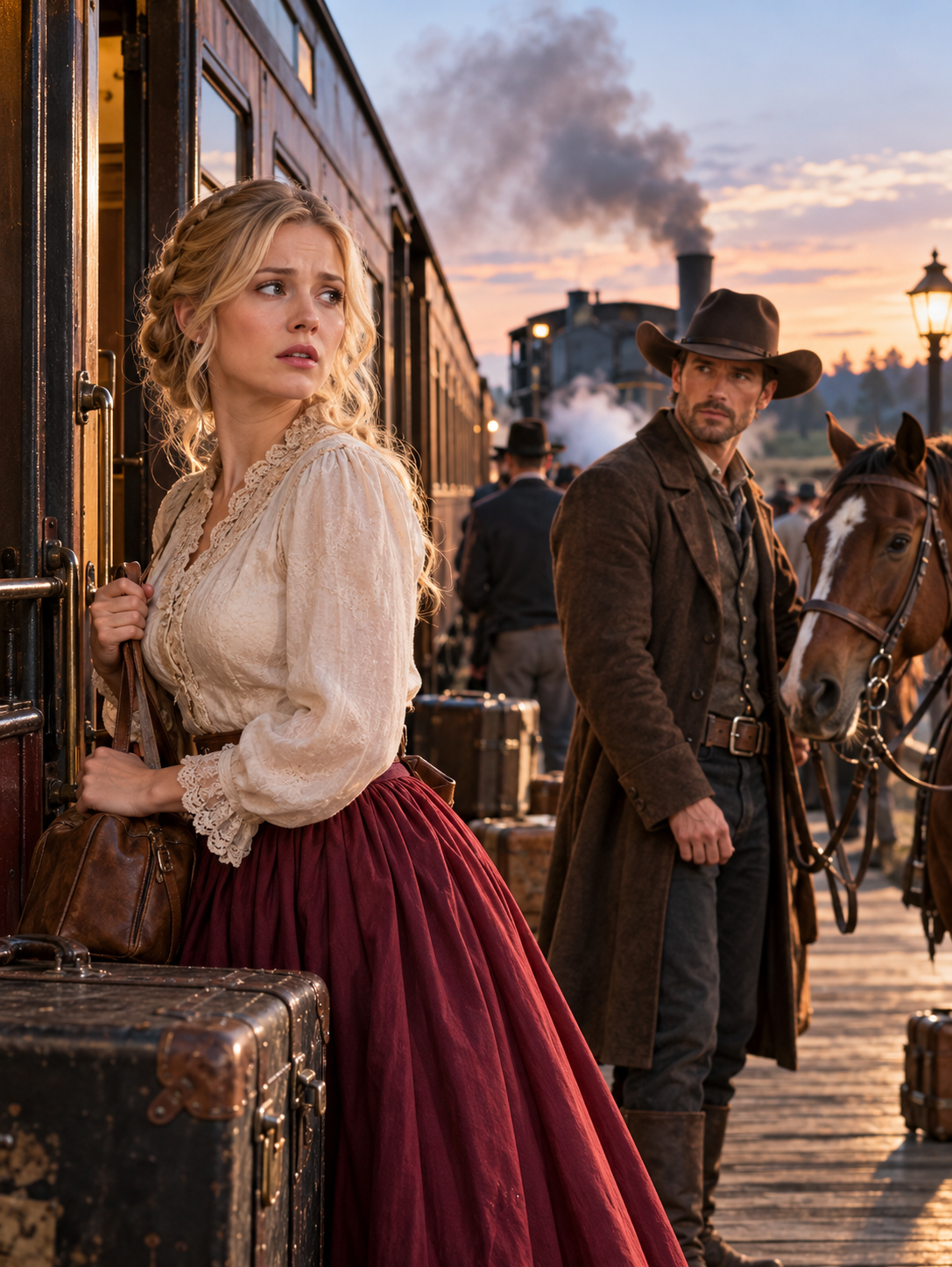
Twenty-three-year-old Clara Whitmore had never traveled farther than thirty miles from her Missouri hometown when she answered a newspaper from a Wyoming rancher seeking a wife. Three months of careful letters convinced her that widower Samuel Reed was quiet, decent, and lonely rather than desperate, so she sold nearly everything she owned and boarded a westbound train with one suitcase, eleven dollars, and his final letter tucked inside her glove. But somewhere across the Nebraska prairie, a stranger boarded carrying information about Samuel that contradicted everything Clara believed. By midnight, she was standing on a freezing station platform with enough money to turn around—and only minutes to decide whether the man waiting hundreds of miles west was offering her a new life or hiding a past she could never escape.
Part 1: Clara boards the westbound train and immediately questions everything ahead.
The first time Clara Whitmore seriously considered abandoning the man she had promised to marry, she was standing alone on a dark Nebraska train platform while snow blew beneath her coat and the conductor shouted that the westbound train would leave in four minutes. In one hand she held the ticket that could carry her toward Wyoming and Samuel Reed, a rancher she knew only through seventeen letters, while in the other she held a newspaper clipping claiming a woman had disappeared from Samuel’s ranch three years earlier. Behind her stood a station office where she could purchase a return ticket to Missouri. Ahead waited a train carrying everything she owned into a prairie darkness so wide it seemed capable of swallowing a person without leaving even a footprint. And somewhere hundreds of miles west, Samuel Reed believed his future wife was still coming.
Three months earlier, Clara had not intended to become anyone’s mail-order bride. She had been living above a dry-goods store in Independence, Missouri, sewing cuffs and collars for twelve cents an hour after her father’s illness consumed nearly every dollar the Whitmore family had saved. Her father died in February, her mother followed from pneumonia in April, and by July Clara discovered that grief did not pause rent, grocery bills, or the interest attached to her father’s debts. Her younger sister Margaret had already married and moved to St. Louis, where three children and a factory-worker husband occupied a two-room apartment too small for another adult. Clara was twenty-three, educated enough to keep accounts, stubborn enough to survive, and increasingly aware that respectable employment for an unmarried woman paid just enough to remain poor forever.
The appeared in the back pages of the Western Homestead Gazette. “Wyoming stockman, age thirty-two, widower, financially stable, seeks practical Christian woman of good character willing to consider marriage and ranch life. No fortune promised. Honest work, secure home, and mutual respect offered.” Clara read it once and laughed. She read it again that evening.
What caught her attention was not the word marriage. It was mutual respect. Most s promised acreage, cattle, prosperity, or a husband who considered himself entitled to gratitude because he possessed a roof. Samuel Reed promised none of those things. His sounded almost reluctant.
Clara waited five days before responding. Her first letter contained no photograph. She informed Samuel that she could cook adequately, sew very well, keep books better than most shopkeepers she had met, and had no interest in marrying a man who wanted unpaid household help with a wedding ring attached. She expected no answer.
His reply arrived thirteen days later. “Miss Whitmore, I laughed at your letter, which I hope does not offend you. I do not need a servant. Mrs. Alvarez, who has managed my household since my first wife died, would probably throw me off my own porch if I attempted to replace her with one. I need companionship, honesty, and perhaps someone willing to tell me when I am being a fool. Your first letter suggests unusual qualifications for the third requirement.”
Clara smiled while reading it. That frightened her more than the . She answered. Samuel answered back.
Seventeen letters followed. He told her about Elk River Ranch outside Laramie, ninety-six cattle, two horses that behaved as though they owned the property, a foreman named Eli Turner who hated paperwork, and Mrs. Rosa Alvarez, who had raised three sons and apparently considered Samuel a fourth. He admitted his first wife, Rebecca, had died three years earlier after an illness. He never dramatized it.
Clara asked directly whether he had loved Rebecca. Samuel wrote back, “Yes. I would not respect you if you expected me to lie about that. Loving someone who died does not mean I intend to ask another woman to live in her shadow.” Clara kept that letter. She read it more often than she admitted.
By October, Samuel asked whether she would consider traveling to Wyoming. Not marriage immediately. Meeting first. If either of them changed their mind, he promised to purchase her return ticket and provide enough money for lodging until she reached Missouri.
That mattered. He gave her an exit before she even arrived. Clara finally sent him a photograph taken at a studio in Independence.
Samuel’s next letter contained his.
He was not handsome in the polished way illustrated magazines favored. Tall, perhaps. Dark hair. Serious face. Strong hands resting awkwardly on his knees.
On the back he wrote: “I look less unhappy in person.”
Clara decided to believe him.
She sold furniture, paid her remaining obligations, packed two dresses, boots, a wool coat, her mother’s sewing kit, three books, and the small silver comb that had belonged to her grandmother. Margaret cried at the station.
“You don’t know him.”
“I know that.”
“He could be anybody.”
“So could the man living next door.”
“That is not comforting.”
“It wasn’t meant to be.”
Margaret hugged her hard.
“If anything feels wrong, come home.”
Clara looked toward the boarding train.
Their childhood house was gone.
Their parents were gone.
The room above the dry-goods store had never felt like home.
Still, she nodded.
The journey west began beneath a gray November sky. For the first hours, Clara watched Missouri farmland slide past the window and wondered whether courage and foolishness looked identical until afterward. She shared her railcar with farmers, traveling salesmen, two families heading toward Nebraska, and an elderly widow named Mrs. Evelyn Parker who had enough curiosity for all of them. By dinner, Mrs. Parker knew nearly everything Clara was willing to tell.
“A husband from a newspaper.”
“A potential husband.”
“Important distinction?”
Mrs. Parker smiled.
“You’re sensible.”
“I’m frightened.”
“The two are not opposites.”
Clara remembered that sentence.
On the second afternoon, they reached Omaha. People boarded and departed. Among the new passengers was a man around forty with a dark mustache, tan coat, and leather valise. He looked at Clara twice.
The third time, he approached.
“Miss Whitmore?”
Clara’s spine straightened.
“You’re going to Wyoming?”
She did not answer.
The stranger smiled.
“My name is Nathan Bell. I knew Samuel Reed.”
Past tense.
Clara closed her book.
“What do you mean?”
Bell lowered his voice.
“You’re traveling to marry him, aren’t you?”
Mrs. Parker immediately stopped knitting.
Clara replied, “Why would you assume that?”
“Because Reed has been advertising.”
That was the first thing Samuel had never mentioned.
Advertising.
Not one .
More than one.
Bell opened his valise.
“I don’t want to frighten you.”
“That sentence usually comes immediately before somebody attempts it.”
Mrs. Parker coughed to hide a laugh.
Bell removed a folded newspaper clipping.
“Ask Reed about Rebecca.”
“I already know Rebecca died.”
Clara looked at the clipping.
The headline was faded.
LOCAL WOMAN MISSING AFTER RANCH DISPUTE.
The article was three years old.
Rebecca Reed.
Samuel’s wife.
Clara’s hands became cold.
Samuel had written repeatedly that Rebecca had died after an illness.
The article said she disappeared following a winter disagreement at Elk River Ranch.
No body mentioned.
No funeral.
No illness.
Bell watched Clara absorb it.
“Reed lies beautifully in letters.”
“How do you know him?”
“I worked near Laramie.”
“That is not what I asked.”
Bell’s smile weakened.
“I knew Rebecca.”
He looked away.
Clara folded the clipping.
“Why are you telling me?”
“Because another young woman traveled west last year after corresponding with Reed.”
Clara felt something inside her tighten.
“What happened?”
“She went home.”
Bell hesitated.
“Anna Mitchell.”
“Where does she live?”
“I don’t know.”
“You expect me to believe you know she returned safely while knowing nothing about where she went?”
Bell’s eyes hardened.
“You ask a lot of questions.”
“I’m trying to help you.”
“Then answer them.”
The train whistle interrupted.
Bell gathered his valise.
“I get off at Kearney.”
He looked toward Clara.
“If you continue west, ask why Reed never found Rebecca’s body.”
Then he walked away.
Mrs. Parker waited until he was gone.
“That man frightened you.”
“Do you believe him?”
“I don’t know.”
That was worse.
That night, the train stopped unexpectedly outside Kearney because blowing snow had covered part of the track ahead. Passengers were transferred briefly to the station while crews cleared it.
Clara stood on the platform with Samuel’s letters inside her coat and Nathan Bell’s clipping in her pocket.
The ticket office was open.
Return fare available.
She had enough money.
The conductor called:
“Westbound passengers! Four minutes!”
Clara watched snow race over the tracks.
Turn around.
Or continue.
She thought of Samuel’s letters.
She thought of the clipping.
She thought of Bell’s evasive answers.
Then she asked herself one question.
If Samuel were dangerous, why had Bell needed to lie to convince her?
Clara boarded the train.
But she no longer traveled west as a woman going to meet the man she might marry.
She traveled west as a woman intending to discover what he had hidden.
Part 2: A newspaper clipping makes Clara suspect Samuel’s darkest secret.
The train moved deeper into Nebraska beneath a sky the color of iron, and Clara spent the next twelve hours reading Samuel’s letters in chronological order. She was no longer searching for romance. She searched for inconsistencies: dates, names, descriptions of Rebecca, mentions of neighbors, unexplained absences, anything that might support Nathan Bell’s story. Mrs. Parker respected her silence until breakfast, when she pushed a cup of coffee across the table and said, “You’re reading those like a prosecutor now.” Clara answered, “Perhaps I should have done that from the beginning.”
Samuel first mentioned Rebecca in his fourth letter. “My wife died in January of 1879 after a long winter sickness. We had no children. I do not speak of her often because I dislike turning grief into a recommendation for myself.” The wording was specific. January 1879.
Clara unfolded Bell’s newspaper clipping.
Dated February 1879.
It said Rebecca Reed had been reported missing “following several weeks of illness and domestic uncertainty.”
Clara noticed something Bell had not mentioned.
The article did not accuse Samuel.
It stated Samuel Reed himself reported Rebecca missing after discovering her horse gone and several belongings removed.
There were searches.
Then one line near the bottom:
Authorities have not ruled out voluntary departure.
Clara read it twice.
If Rebecca disappeared, why did Samuel call her dead?
Perhaps because years passed.
Perhaps because he lied.
Neither answer satisfied her.
She found another detail.
Bell said he “knew Rebecca.”
The article quoted a local freighter named Nathaniel Bell, who told authorities Rebecca had “expressed unhappiness.”
Nathaniel Bell.
Nathan Bell.
Now the stranger’s interest made sense.
Mrs. Parker leaned over.
“You found him?”
“What was he?”
“What did he say?”
“That Rebecca was unhappy.”
“I don’t know.”
Mrs. Parker returned to her eggs.
“People have been unhappy since God invented marriage.”
Clara almost smiled.
Then another thought struck.
Samuel said Rebecca suffered a long illness.
Bell’s article confirmed several weeks of illness.
So Samuel had not invented that part.
Still unresolved.
At North Platte, Clara sent a telegram.
SAMUEL REED, ELK RIVER RANCH, LARAMIE.
ARRIVING AS PLANNED. NEED TRUTH ABOUT REBECCA. DO NOT MEET TRAIN UNTIL I ASK.
The telegraph operator read it.
Then looked at her.
He raised an eyebrow.
She sent a second telegram to the Laramie sheriff.
REQUEST INFORMATION ON REBECCA REED DISAPPEARANCE 1879 AND NATHANIEL BELL. ARRIVING TOMORROW. CLARA WHITMORE.
Mrs. Parker looked impressed.
“I like traveling with you.”
“You make the trip interesting.”
That evening, a response arrived at Sidney station.
FROM SHERIFF EDWARD CALDWELL, LARAMIE.
REBECCA REED LEGALLY DECLARED DEAD AFTER THREE YEARS ABSENCE. NO EVIDENCE OF WRONGDOING BY SAMUEL REED. NATHANIEL BELL QUESTIONED DURING ORIGINAL INVESTIGATION. COME TO OFFICE BEFORE RANCH IF CONCERNED.
Clara exhaled.
Not cleared emotionally.
But legally, Samuel’s words had foundation.
Three years gone.
Legally dead.
Bell had intentionally given her only the first chapter.
Then another telegram came.
YOU DESERVE FULL TRUTH. I SHOULD HAVE TOLD YOU. I WILL NOT COME TO STATION. CALDWELL KNOWS EVERYTHING. IF YOU CHOOSE TO RETURN EAST, TELEGRAPH EXPENSES AND I WILL PAY WITHOUT QUESTION. S. REED.
Clara read it four times.
No defense.
No manipulation.
Only choice.
That frightened her in a different way.
Because she wanted him to be good.
Wanting made judgment dangerous.
Late that night the train entered western Nebraska.
Most passengers slept.
Clara could not.
At 11:40, the train slowed near a small water stop.
A shadow moved outside her compartment.
Then the door opened.
Nathan Bell.
Clara sat upright.
“You said you got off in Kearney.”
“I changed trains.”
Mrs. Parker was asleep two compartments away.
Bell closed the door.
Clara immediately stood.
“Open that.”
“We need to talk.”
“Open the door.”
“You sent Reed a telegram.”
“How do you know?”
Clara’s fear sharpened.
Bell knew too much.
“Did you follow me to the telegraph office?”
“I’m trying to keep you safe.”
“No. You’re monitoring me.”
“Reed will turn you against me.”
“Why would he care about you?”
Bell’s expression changed.
Something personal.
“Rebecca loved me.”
Clara stared.
The missing center.
“She was your lover?”
Bell looked toward the dark window.
“She was going to leave him.”
“Did Samuel know?”
“Not then.”
“Did she leave with you?”
Bell’s silence answered.
Clara felt the entire story rearrange.
“You helped Rebecca disappear.”
Bell snapped, “She wanted out.”
“Where did you take her?”
“Cheyenne.”
“What happened afterward?”
He looked angry now.
Not at Samuel.
“She changed her mind.”
“About you?”
“She wanted to go back.”
“She was sick.”
Samuel had told the truth.
Clara kept her voice level.
“What illness?”
“Her lungs. Doctor said she might not survive the winter.”
Bell’s jaw tightened.
“She wrote Reed.”
“Did you send the letter?”
Clara’s stomach dropped.
“You didn’t.”
“She was confused.”
“You kept her letter.”
“He didn’t deserve her.”
“That wasn’t your choice.”
“She chose me first.”
“And then she changed her choice.”
Bell stepped closer.
“Do you know what Reed would have done if she returned?”
“Neither did she.”
“Where did Rebecca die?”
Bell stopped.
Clara had the answer before he spoke.
“Not at Samuel’s ranch.”
“With you?”
He looked away.
Clara’s hands went cold.
Samuel had spent three years believing his sick wife disappeared.
Bell had known exactly what happened.
“Did you tell Samuel?”
“Why are you telling me now?”
Bell looked at her.
Because here was the motive.
Not protection.
Something else.
“Reed has land.”
Clara stared.
“Land the railroad wants.”
“What does that have to do with Rebecca?”
“Everything.”
Suddenly the romance story vanished.
Bell had not boarded a train to protect a stranger.
He needed something.
“What do you want from Samuel?”
“Lie again and I call the conductor.”
His expression hardened.
“Reed owns the narrow valley the railroad needs for a branch line west of Laramie.”
Clara understood.
“You work for somebody.”
Bell reached for her wrist.
Clara moved faster.
Her mother’s steel hatpin was already in her hand.
She pressed the point against his coat.
“Touch me again.”
Bell froze.
“I don’t want trouble.”
“Then leave.”
“You have no idea what you’re walking into.”
She opened the compartment door.
“But I know exactly what is standing in front of me.”
Bell stepped backward.
Before leaving, he said:
“Ask Samuel why every company trying to buy that valley has failed.”
“And ask what happened to the surveyor last spring.”
Clara’s confidence shifted again.
Another secret.
She locked the door.
Her hands trembled only after he was gone.
By dawn, Laramie was less than one day away.
And Clara now knew Samuel had hidden Rebecca’s disappearance.
Nathan Bell had hidden her death.
Someone wanted Samuel’s land.
A surveyor had apparently vanished.
And she was heading directly toward the center of all of it.
Should Clara finally turn back before reaching Laramie—or confront Samuel face-to-face and risk discovering that Nathan Bell’s lies were hiding an even more dangerous truth?
Part 3: Clara arrives in Wyoming and meets the stranger from her letters.
The prairie changed as Wyoming approached. Nebraska’s broad agricultural land gave way to harsher country, pale grass beneath enormous skies, distant ridges rising like dark teeth against winter light. Clara watched for hours. She had spent her entire life surrounded by farms, towns, churches, and roads that connected one familiar place to another. Wyoming looked as if familiarity had never reached it.
Mrs. Parker departed in Cheyenne.
Before leaving, she hugged Clara.
“You have my address.”
“If the rancher disappoints you?”
“If he scares you?”
“I leave faster.”
“And if he turns out decent?”
Clara smiled.
“That seems to frighten me most.”
Mrs. Parker laughed.
“Good. Means you have something worth risking.”
Clara arrived in Laramie shortly after three.
Samuel was not there.
He had obeyed her telegram.
That mattered.
Sheriff Caldwell’s office sat two blocks from the station.
Clara walked there before collecting anything except her handbag.
Caldwell was sixty, heavyset, silver-haired, with spectacles and the patient expression of someone who had heard every version of every lie in town.
“You’re Miss Whitmore.”
“Reed’s eastern lady.”
“I’m nobody’s lady yet.”
Caldwell smiled.
“I was told you were direct.”
“By Samuel?”
“By the telegram.”
He brought out Rebecca’s file.
Unlike Bell, Caldwell allowed Clara to read everything.
Rebecca had been ill.
A doctor confirmed likely tuberculosis.
She disappeared on January 11, 1879.
Horse tracks led east from Elk River Ranch.
Samuel organized searches for nine days.
Paid private searchers for months.
Placed s in newspapers as far as Denver.
Nathaniel Bell disappeared from the region one day after Rebecca.
Interesting.
Caldwell reopened the investigation when Bell returned eighteen months later.
Bell claimed he had gone to Kansas.
Caldwell suspected Rebecca left with him but could never establish it.
“Why wasn’t Samuel charged?”
“No evidence of crime.”
“Did you suspect him?”
“First week? Everybody suspects the husband.”
Caldwell shook his head.
“Reed nearly froze searching the mountains.”
Clara looked at a faded report.
“Rebecca was declared dead?”
“Court order after three years.”
“Samuel knew legally.”
“So when he told me she died, technically true.”
Caldwell removed his glasses.
“Technically can still hurt.”
Clara appreciated that.
“What about a missing surveyor last spring?”
Caldwell’s eyes sharpened.
“Who told you?”
“He approached you?”
Caldwell leaned forward.
“What did he want?”
“He claimed to protect me. Eventually mentioned Samuel’s land.”
Caldwell cursed under his breath.
The surveyor, Thomas Greene, had not vanished.
He had been found injured after his horse threw him near a canyon.
He returned east afterward.
“Accident?”
“Far as we know.”
“Why would Bell suggest otherwise?”
“Because stories grow teeth faster than facts.”
“Who wants Samuel’s valley?”
Caldwell leaned back.
“Railroad interests. Cattle syndicates. Land agents. Take your pick.”
“Bell associated?”
“Used to work freight contracts for Western Continental Rail.”
There it was.
Clara left the sheriff’s office feeling both safer and more suspicious.
Bell had repeatedly weaponized pieces of truth.
That was more dangerous than simple lying.
Outside, a man stood beside a wagon.
Dark wool coat.
Brown hat held in his hands.
Samuel Reed.
His photograph had not captured his eyes.
They were gray.
He did not approach immediately.
“You told me not to meet the train.”
“So I waited here.”
“You knew I’d visit Caldwell?”
“You could have waited at home.”
“I could have.”
“Why didn’t you?”
He glanced at her suitcase being carried from the station by a porter.
“I wanted to know whether I needed to buy your return ticket.”
Clara studied him.
No seduction.
No dramatic speech.
“That is your decision.”
She appreciated the answer.
“Did Rebecca leave you for Nathan Bell?”
Samuel’s face changed.
“I believe so.”
“Did you know she died with him?”
He went completely still.
Clara watched his eyes.
Real surprise.
Unless he was an extraordinary actor.
“Bell told me last night.”
Samuel sat slowly on the wagon seat.
“He said she died after trying to return to you.”
Samuel looked toward the street.
For almost a minute he said nothing.
Clara expected anger.
“Was she alone?”
“That’s something.”
Clara suddenly understood the man in his letters.
He had spent years grieving uncertainty more than death.
“What happened between you?”
Samuel rubbed his hands together.
“We were unhappy.”
“I married Rebecca because everyone said we were suited.”
“Were you?”
“Did you treat her badly?”
“I don’t think so.”
“That is not the same as no.”
He looked at her.
“You really do ask direct questions.”
Samuel nodded.
“I became distant. Worked too much. Expected her to adapt to a life she hated. I was not cruel. I was not a good husband either.”
Clara believed that more than a perfect defense.
“Why tell me she died?”
“Because legally she did.”
“That is technical.”
“You should have told me she disappeared.”
“Why didn’t you?”
His answer came quietly.
“Because I was afraid you would think I had something to do with it.”
Clara looked toward the west.
“How far is the ranch?”
“Three hours by wagon in good weather.”
“Is the weather bad?”
Samuel looked at the growing clouds.
Clara picked up her suitcase.
“Then we should go.”
Samuel stared.
“You’re coming?”
“To see the ranch.”
“Not to marry me?”
“Samuel, right now I’m not sure I’d let you choose my supper.”
The first real smile.
It changed his entire face.
Part 4: The ranch feels like home until Bell’s real plan emerges.
Elk River Ranch appeared near sunset. The house was larger than Clara expected but far from grand, built from timber and stone with a wide porch facing a valley protected by low ridges. Smoke rose from two chimneys. Cattle moved like dark dots against pale grass.
Mrs. Rosa Alvarez opened the front door before Samuel stopped the wagon.
She was short, round, perhaps fifty, with iron-gray hair and the expression of a woman prepared to judge Clara honestly.
Clara climbed down.
Rosa looked her over.
“You’re thinner than Samuel described.”
Samuel groaned.
“And prettier.”
Clara said, “He described me?”
Clara liked Rosa immediately.
Rosa gave Clara Rebecca’s old bedroom.
Clara almost refused.
Then Rosa explained Samuel had not entered it in nearly three years and had recently cleared Rebecca’s belongings into storage because he thought a guest deserved a room that belonged to the present.
Another detail Bell would never have mentioned.
Days passed.
Clara watched Samuel rather than trusting letters.
He rose before dawn.
Worked beside his employees.
Paid bills on time.
Asked Rosa’s opinion.
Listened when Eli Turner disagreed about cattle feed.
He never entered Clara’s room uninvited.
Never touched her without permission.
Never reminded her how far she had traveled.
On the fourth day he handed her an envelope.
Enough cash for return travel.
“So you don’t have to wonder whether you can leave.”
Clara looked at him.
“You understand that giving me this makes me more likely to stay.”
“I was afraid of that.”
She smiled.
Something began.
Then Bell appeared.
Riding into the ranch yard at noon.
Samuel saw him and went still.
Clara stepped onto the porch.
Bell dismounted.
Reed’s voice was quiet.
Bell looked at Clara.
“You told him.”
Samuel said, “You knew where Rebecca died.”
Bell’s face shifted.
“This isn’t about Rebecca.”
“It is to me.”
Bell removed papers from his coat.
“It’s about the valley.”
There it was.
Western Continental Rail wanted an access strip across Samuel’s western pasture.
Samuel had refused three offers.
Bell now carried a fourth.
Five times the original value.
Samuel did not even read it.
Bell looked at Clara.
“You understand what he’s refusing?”
“A fortune.”
Samuel said, “The rail route would cut Elk Creek.”
Bell shrugged.
“Bridge it.”
“And move winter grazing.”
“Compensated.”
“And the Alvarez homestead?”
Rosa’s family apparently occupied eight acres along the proposed route under an old deed Samuel had promised to protect.
Bell said, “They could relocate.”
Rosa appeared on the porch.
“I could also relocate your teeth.”
Clara hid a smile.
Bell ignored her.
He approached Clara.
“This is who you came to marry. A man who refuses progress because he likes controlling a valley.”
Samuel’s jaw tightened.
Clara asked, “Why do you care?”
“I represent the railroad.”
Bell frowned.
“An honest answer.”
He looked at her.
“You think Reed is honest?”
Samuel glanced at her.
Clara continued.
“He hid part of Rebecca’s story because he was ashamed and afraid. You hid her final days because you were selfish. So perhaps both of you should stop asking me to choose which man has better character.”
Rosa whispered, “I definitely like her.”
Bell’s face darkened.
He turned toward Samuel.
“Last offer.”
“You’ll regret it.”
Samuel did not move.
Bell mounted.
Before leaving, he looked at Clara.
“Ask him what happens when winter closes that road.”
Then he rode away.
Clara waited.
Samuel sighed.
“You’re going to ask.”
“The road floods.”
“If the pass closes and the lower crossing floods, the ranch can be isolated.”
“Dangerous?”
“Sometimes.”
“Why did Bell mention it?”
Samuel looked toward the mountains.
“I don’t know.”
That night, rain began.
By morning, the temperature fell below freezing.
The mountain pass closed.
Then Eli arrived with news.
The bridge over the lower crossing had been damaged.
Not by water.
Several support timbers had been deliberately cut.
Bell’s warning suddenly meant something entirely different.
Part 5: Trapped by winter, Clara learns courage is quieter than romance.
The damaged bridge did not collapse completely. That was important. A rider could still cross carefully, but wagons could not.
Samuel sent Eli toward town with a message for Caldwell.
Clara watched him saddle.
“You think Bell did it?”
Samuel shook his head.
“No proof.”
“But he warned us.”
“Suspicion isn’t evidence.”
That sentence changed something in Clara.
Men in novels were always certain.
Samuel was careful.
Less exciting.
More trustworthy.
Snow arrived that afternoon.
Ranch hands moved cattle toward protected ground.
Clara helped Rosa preserve food and carry water.
Nobody treated her like a guest.
Nobody treated her like a wife either.
She became useful because work existed.
By evening, one hired hand named Peter failed to return from checking the eastern fence.
Samuel organized a search.
Clara said, “I’m coming.”
She stared.
Samuel immediately reconsidered his tone.
“The weather is getting worse.”
“You don’t know the trails.”
“That is why you should stay.”
Reasonable.
She hated it.
Samuel almost looked disappointed that she agreed.
The men returned three hours later with Peter, whose horse had slipped.
Minor injury.
No disaster.
But Samuel’s face was white from cold.
Clara handed him coffee.
He looked at her.
“Thank you.”
“Next time don’t say no like you own me.”
“Rosa explained.”
From the kitchen, Rosa shouted, “Very clearly.”
Clara laughed.
Samuel smiled.
The storm lasted two days.
Isolation did something strange.
It removed performance.
Samuel could not impress Clara with restaurants, society, or gifts.
He fixed roof leaks.
Carried wood.
Checked animals.
Lost arguments with Rosa.
Made terrible biscuits.
Clara saw ordinary life.
That mattered more than courtship.
On the second evening, they sat beside the kitchen stove after everyone slept.
Samuel said, “You almost turned around.”
She looked at him.
“How did you know?”
“Your telegram.”
“Why didn’t you?”
“Bell lied badly.”
“That saved me?”
“For the first hundred miles.”
“And after?”
“Curiosity.”
“Romantic.”
They sat quietly.
Then Samuel asked, “If you leave, will you regret coming?”
That surprised them both.
Clara looked around.
“I needed to know I could cross the country alone.”
“You weren’t entirely alone.”
“But you chose every mile.”
He understood.
Samuel did not ask her to marry him.
That made her trust him more.
The next morning, Sheriff Caldwell arrived with Eli and two deputies.
They examined the bridge.
One set led toward a temporary camp used by railroad survey crews.
Bell denied involvement.
His employer denied authorization.
Then a young survey assistant named Henry Walsh came forward.
Bell had paid two temporary workers to weaken the bridge.
Not to hurt anyone.
Only to create pressure.
If Samuel’s ranch became isolated, he might reconsider access rights.
Bell was arrested on property-damage and related charges.
No grand shootout.
No heroic confrontation.
Clara appreciated how unromantic justice could be.
During Bell’s questioning, something else emerged.
Rebecca Reed’s final letter.
Bell had kept it.
Caldwell recovered it from his valise.
He brought it to Samuel.
Samuel did not open it immediately.
He carried it to the barn.
Clara found him an hour later.
Letter still sealed.
“I don’t know.”
“Want me to leave?”
He finally opened it.
Rebecca’s handwriting filled two pages.
I am sorry.
I thought leaving with Nathan would make me feel alive again. Instead I learned that changing places does not repair what is broken inside you. This is not your fault alone and not mine alone. I was angry that you loved the ranch more easily than you loved me. You were angry that I wanted a life you did not understand.
The doctor here says I may not have long.
I want to come home if you will let me.
Not as your wife if that is impossible.
Only so I do not have to die among strangers.
Samuel stopped reading.
Clara looked away to give him privacy.
He finished.
Then sat motionless.
Bell had stolen three years from him.
Not Rebecca’s life.
That was already ending.
But goodbye.
Clara rested one hand on the wooden rail between them.
Not touching Samuel.
Close enough if he chose.
After several minutes, his hand covered hers.
Part 6: Clara refuses an immediate wedding and forces both hearts to wait.
Bell’s arrest changed the atmosphere at Elk River Ranch, but it did not answer the question that had brought Clara west. Samuel seemed to assume she would leave once the weather cleared. Clara assumed he would eventually ask whether she intended to stay.
Neither spoke.
Rosa became increasingly irritated.
“You two are exhausting.”
Clara looked up from bread dough.
“What did we do?”
“Nothing. That is the problem.”
Samuel entered exactly then.
Rosa pointed a spoon at him.
Clara tried not to laugh.
“Ask me what?”
Rosa left the kitchen muttering in Spanish.
Samuel stood awkwardly.
“I had a speech.”
“Did Rosa ruin it?”
“Completely.”
He sat across from Clara.
“Do you want to remain here?”
“For how long?”
He looked startled.
“I don’t know.”
“Then how can I answer?”
He tried again.
“Would you consider marrying me?”
Clara wiped flour from her hands.
Samuel’s face fell.
She almost enjoyed it.
“Because I met you twelve days ago.”
“We wrote for months.”
“Letters do not snore.”
“I don’t snore.”
“Rosa says you do.”
“Rosa is no longer a credible witness.”
Clara laughed.
Then became serious.
“I came here willing to consider marriage. That is still true.”
“I need to know whether I love this place because it is new.”
Samuel nodded.
“And whether I trust you because Bell was worse.”
“And whether you want me, Samuel, or simply want someone to fill the quiet Rebecca left behind.”
That hurt him.
He said, “I don’t know how to prove that quickly.”
“You can’t.”
Samuel stared.
“If you’re comfortable.”
“Of course.”
“Separate rooms.”
“No wedding date.”
“I find work.”
He frowned.
“You don’t need—”
“I find work.”
“What kind?”
“You need bookkeeping.”
Eli, passing the door, shouted:
Samuel looked offended.
“Everyone conspires against me.”
Clara smiled.
“Apparently.”
She took over ranch accounts gradually.
Within one month she discovered three suppliers charging inconsistent freight fees.
Within two months she reorganized cattle-sale records.
Within three, Samuel admitted she understood the finances better than he did.
That mattered more to Clara than flowers.
Spring arrived.
Wyoming transformed.
Snow withdrew from valleys.
Grass appeared.
Elk Creek roared with runoff.
Clara rode into Laramie alone.
Worked two days each week for a merchant keeping accounts.
Saved her own money.
Maintained her return fund.
Samuel never questioned it.
One evening in May, Clara told him:
“I think I’m staying.”
“For how long?”
She understood the joke.
“Potentially inconveniently long.”
Samuel proposed again.
This time beside the porch.
No ring hidden in food.
No audience.
No kneeling in mud.
“Clara Whitmore, would you marry me?”
She looked at him.
He exhaled.
“Rosa owes me five dollars.”
Clara narrowed her eyes.
“You bet on me?”
“Eli started it.”
She hit him with her glove.
Their wedding was held six weeks later beneath cottonwood trees near Elk Creek.
Sheriff Caldwell attended.
Eli cried and denied it.
Rosa cried and admitted it.
Mrs. Parker traveled from Nebraska after receiving Clara’s letter.
Margaret came from Missouri with her husband.
When the minister asked Clara whether she took Samuel Reed as husband, she looked at the man she once nearly abandoned on a freezing train platform.
And this time she knew exactly what she was choosing.
Part 7: Marriage brings new hardships but never takes Clara’s freedom again.
Marriage did not transform Samuel into a perfect man. It did not transform Clara into a cheerful ranch wife who never missed Missouri.
Their first major argument happened nine days after the wedding.
Samuel purchased twenty new cattle without consulting her.
Clara found the invoice.
“You spent how much?”
“It was a good price.”
“That is not the question.”
“It’s ranch business.”
“I keep ranch accounts.”
“Then ranch business is literally my business.”
Samuel stared.
He apologized before supper.
Clara made mistakes too.
She ordered winter supplies based on Missouri weather estimates.
Rosa found the numbers and laughed until she cried.
“You think this is winter?”
“It says average.”
“Average lies.”
They doubled several orders.
Rosa was right.
Their first married winter tested everyone.
Temperatures plunged.
A barn roof partially collapsed beneath snow.
Three calves became sick.
The stove chimney cracked.
Clara discovered she was pregnant in January and told Samuel by putting a tiny knitted sock beside his breakfast.
He stared for so long she became worried.
Then he cried.
Clara had never seen him cry before.
It frightened him more than it frightened her.
Their daughter Rebecca Clara Reed was born in September.
Clara chose the first name.
Samuel resisted.
“You don’t have to do that.”
“Then why?”
“Because Rebecca existed before me. Erasing her doesn’t strengthen us.”
Samuel kissed her forehead.
They called the child Becca.
Two sons followed over six years.
The ranch expanded.
The railroad eventually built a branch line.
Not through Elk Creek.
A negotiated route crossed the northern edge after engineers designed a bridge protecting the waterway and the Alvarez parcel.
Samuel signed after Clara reviewed every page.
They received enough compensation to improve barns and buy adjacent acreage.
The deal Bell tried to force eventually happened through negotiation.
No damaged bridge required.
Nathan Bell served time and disappeared west afterward.
Clara never saw him again.
Years later, a letter arrived from California.
No return address.
Bell wrote:
I was selfish where Rebecca was concerned. I loved her and convinced myself that meant I had the right to decide what was best for her. I did the same with Samuel’s land. Some men spend their lives calling control by gentler names.
Tell Samuel I am sorry.
Clara gave Samuel the letter.
He read it.
Then burned it.
Not angrily.
Simply finished.
Part 8: Years later, Clara returns to the station where she almost turned back.
Twenty years after Clara first traveled west, Samuel took her east by train for Margaret’s daughter’s wedding. Their children were old enough to tease them about the “newspaper romance.” Becca considered it deeply embarrassing.
“You married someone you never met?”
“We met before the wedding.”
“For six months.”
“More than enough time to discover your father cannot make biscuits.”
Samuel objected.
Becca sided with Clara.
During the trip, the train stopped at Kearney.
Different platform.
Larger station.
Clara stepped outside.
Samuel followed.
“This is where I almost left you.”
“How close?”
Clara pointed toward the ticket office.
“I had money in my hand.”
“You never told me that.”
“You never asked.”
“What stopped you?”
“Nathan Bell was too eager.”
Samuel laughed.
“My marriage exists because Bell was incompetent.”
“That is humbling.”
Clara looked along the tracks.
She remembered herself at twenty-three.
One suitcase.
No parents.
No certainty.
Four minutes to decide.
For years, people told the story as though Clara’s brave decision had been traveling west to marry Samuel.
That was not how she remembered it.
The brave decision was refusing to surrender judgment.
She had not stayed on the train because romance conquered fear.
She stayed because she wanted facts.
She questioned Bell.
Questioned Samuel.
Questioned Caldwell.
Questioned herself.
Then chose.
That distinction shaped everything afterward.
Mail-order marriages were often described as desperate arrangements.
Sometimes they were.
Sometimes lonely women met dangerous men.
Sometimes lonely men expected obedience instead of partnership.
Sometimes people discovered the person behind beautiful letters was nothing like the writer.
Clara had known the risk.
What saved her was not luck alone.
It was the return ticket she insisted on keeping.
The questions she refused to apologize for asking.
The money she kept in her own purse.
The decision to delay marriage even after arriving.
The willingness to leave.
Freedom made love safer.
Not less romantic.
Samuel leaned against a station column.
“If you had gone back, what would you have done?”
Clara considered.
“Sewing, probably.”
“You hated sewing cuffs.”
“Would you have married?”
“Someone handsome.”
Samuel frowned.
“How handsome?”
“Extremely.”
“I regret asking.”
She laughed.
The conductor called passengers.
They walked back toward the train.
Before boarding, Clara looked once more down the tracks.
Somewhere beyond the horizon was Missouri.
Ahead was Wyoming.
The word no longer meant where she came from.
It meant the place she had chosen repeatedly.
Repeatedly.
The train began moving.
Clara sat beside Samuel.
He opened a newspaper.
She noticed the matrimonial s.
Montana farmer seeks practical young woman willing to build life in western territory.
Clara nudged Samuel.
He read it.
“Poor woman.”
“Poor man.”
“You think she’ll answer?”
“What would you tell her?”
Clara looked through the window.
The prairie stretched endlessly beneath evening light.
“I’d tell her to buy two tickets.”
Samuel lowered the paper.
“One west.”
She smiled.
“And enough money for one east.”
Samuel nodded slowly.
“That sounds like you.”
“It should.”
Then he asked:
“And if she never uses the return ticket?”
Clara rested her head against the seat.
“Then at least she stayed because she chose to.”
That night, while Samuel slept beside her and the train rolled through darkness, Clara opened the small handbag she had carried for more than twenty years.
Inside, protected between two pieces of cardboard, remained one old railway ticket.
Kearney to Independence.
Samuel had discovered it years earlier and asked why she kept it.
She had answered simply:
“Because that ticket is the reason I could say yes.”
Not because paper created courage.
Because knowing she could leave allowed her to stay without becoming trapped.
Their marriage lasted forty-three years.
They raised three children.
Survived droughts.
Winter storms.
Cattle losses.
Two recessions.
An argument about a kitchen expansion that became family legend.
They buried Rosa at eighty-one beneath cottonwoods overlooking the house.
Eli retired but continued arriving every morning until Samuel finally threatened to start charging him rent.
Their daughter became a teacher.
One son took over ranch operations.
The youngest became a veterinarian.
Clara continued keeping the books until her hands became too stiff to write neatly.
Samuel never became good at biscuits.
Some things cannot be fixed.
When Samuel died at seventy-five, Clara sat beside him in the same ranch house where she had first arrived with one suitcase.
His final words were not dramatic.
“You stayed.”
Clara held his hand.
Then he was gone.
Years afterward, Becca found the unused eastbound ticket inside Clara’s desk.
“Mother, why did you keep this?”
Clara was eighty-two.
White hair.
Strong eyes.
Still direct.
“That was my return ticket.”
“You almost went back?”
Becca stared.
“Then Dad almost never had us.”
“Doesn’t that frighten you?”
Clara considered.
“Because every life is built on choices that almost went another way.”
Becca sat beside her.
“What made you choose Dad?”
Clara shook her head.
“I didn’t choose him that night.”
“What did you choose?”
“To learn the truth.”
“And after?”
“I chose him later.”
Clara pointed toward the window.
The ranch spread across the valley.
Children ran between barns.
Grandchildren.
Great-grandchildren.
“That is the part people always misunderstand.”
She smiled.
“I did not cross the prairie because I trusted a stranger.”
“I crossed because I trusted myself enough to meet him.”
Clara died peacefully three years later.
Her family buried her beside Samuel beneath the cottonwoods.
Inside her Bible, Becca found Samuel’s first letter.
Beside it was the old return ticket.
And one sentence Clara had written in shaky handwriting:
The bravest journey of my life was never the train west.
It was learning that love is worth choosing only when you are free to turn around.
✓ Lynn R. Adams
Twenty-three-year-old Clara Whitmore had never traveled farther than thirty miles from her Missouri hometown when she answered a newspaper from a Wyoming rancher seeking a wife. Three months of caref…