Three years after their divorce, Dr. Fletcher Crane drove to his ex-wife’s Vermont farmhouse with a forty-three-page
Part 2: The farmhouse was not the failure he expected
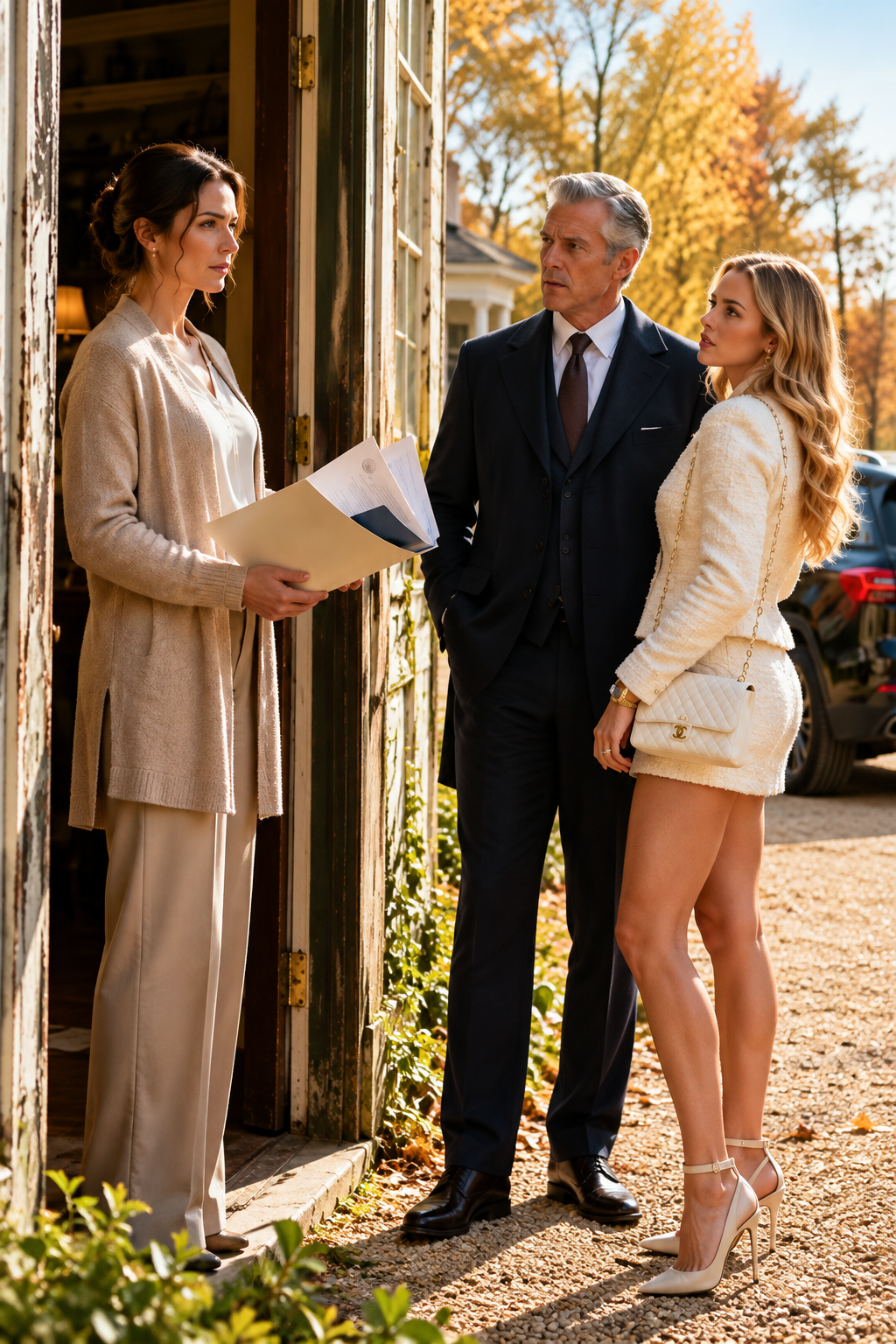
Fletcher knocked on the door. For a moment, only the wind answered. Tatum stayed at the foot of the porch steps, unconvinced they were structurally safe. Then the door opened, and Mave stood there in wool socks, dark trousers, and a heavy oatmeal cardigan. Her auburn hair was loosely pulled back, with a few strands slipping free at her temples. She looked healthy and rested, as if she had paused an absorbing morning to answer the door. Fletcher’s practiced eye registered the fact with private dismay.
“Fletcher,” she said, her voice unhurried and lightly textured, like good paper. She glanced past him at Tatum, waiting in the driveway in a bright white puffer coat. “This is Tatum,” Fletcher said. “My partner. I think I mentioned her in a co-parenting email.” “You didn’t,” Mave replied. “But it’s fine. Come in.” She stepped aside, and Fletcher entered, expecting the sagging exterior to continue inside.
The entry hall was narrow, smelling of wood smoke and something herbal. Bare plaster walls showed the uneven texture of a house added to over generations. Two pairs of children’s snow boots stood by the door beside a folded museum tote bag. Fletcher followed Mave down the hall, expecting peeling wallpaper, secondhand furniture, and the flat despair of a life in financial freefall. Then the hallway opened into a room he did not recognize. The farmhouse’s back half had been rebuilt from the inside out.
The ceiling rose to the full height of the original timber frame, with restored hemlock beams glowing honey-gold above a wide-plank oak floor. A massive stone fireplace anchored the far wall, framed by bookshelves built into the original fieldstone. Two deep-cushioned sofas faced each other across a hand-knotted rug in indigo and sand. Beyond a long island of soapstone and reclaimed chestnut, a professional kitchen opened toward restored barn windows. Through them, Fletcher saw a snow-dusted garden, a greenhouse of iron and glass, and carefully mulched beds waiting for spring.
Above the fireplace hung an abstract canvas in burgundy and bone. Fletcher recognized it from an article about private collections assembled by women scientists. He had seen the painting in Art in America two years earlier. Tatum reached the end of the hallway, stopped, and said, “Oh.” Mave was filling a copper kettle at the sink. “Sit anywhere,” she said. “I was about to make tea.” Fletcher sat at the island, placing his portfolio on the stone. He was a surgeon; recalibration was a professional reflex.
The house had surprised him, but he told himself houses could be financed in many ways. Mave might have borrowed heavily or acquired the painting on credit. He reminded himself she had never been sophisticated about money. Tatum ran one finger along the soapstone, as if estimating its value. Fletcher opened his portfolio. “I’ll be straightforward,” he said. “I know this is an unusual visit.” Mave set the kettle on the stove. “You drove four hours to Vermont on a Tuesday in November without calling. Whatever it is, it isn’t small.”
Part 3: His company’s sale depends on her forgotten work
Fletcher explained that Meridian Health Systems planned to acquire the Crane Vascular Institute for $340 million. The number still felt good to say aloud. The institute had been founded eight years earlier, and its surgical protocols were now adopted by seventeen hospital systems across North America. “The valuation is driven in part by the Crane method,” he said, “and by one other asset that needs attention.” Mave carried her tea to the island and sat opposite him. She wrapped both hands around the mug and looked at his portfolio as if it contained an interesting test result.
“The Heel Path algorithm,” she said. Fletcher blinked. He had not named it yet. Meridian’s due-diligence team had found a documentation gap in the original intellectual-property transfer. The algorithm was listed as a core institute asset, but the predictive vascular-repair model had been developed while Mave was still a listed co-investigator on the original grant. Meridian’s lawyers wanted an assignment confirming that every contribution belonged to the institute. Fletcher slid the forty-three-page document toward her and placed a pen on top.
He apologized for bringing it without warning, then said the close date was approaching. He claimed he wanted to handle the matter personally because they had maintained a respectful relationship. Mave looked at the document, the pen, and Fletcher. “You didn’t develop the Heel Path algorithm,” she said. His face stayed composed. He said the research had been conducted in the context of the institute’s resources and their marriage. Mave answered that she developed the model in their home office on Grant Street using prior research from Johns Hopkins.
The algorithm grew from her doctoral work, private computing time, and eighteen months of late-night research between midnight and three in the morning while Fletcher attended conferences. She had licensed it to the institute under a limited, nonexclusive research agreement, signed during the institute’s second year. Paula had the original executed copy in her office. Fletcher glanced toward the closed office door at the far end of the room. He noticed the brushed-steel handle and a security panel, the kind used in research facilities rather than homes. Mave had not mentioned that room before.
She asked how long ago Meridian had flagged the gap. The acquisition announcement came six weeks earlier, but a deal of that size would have begun due diligence weeks before then. Meridian had known for at least ten weeks. The close was set for December third; it was now November. “You waited until now,” Mave said. “You hoped I wouldn’t have time to consult anyone before your deadline.” The kettle ticked as it cooled, and the crow that had been on the porch rail landed on the garden wall. Tatum looked between them, realizing she had arrived at something more serious than a loose end.
Fletcher said the research had been developed during their marriage, using resources that were “joint by nature.” Mave reminded him that her prior research predated the institute by four years and that the license was specific about what had and had not been transferred. She opened a copy of the original agreement from a drawer and turned to clause seven, subsection C. The license was revocable and nonexclusive. It expired automatically upon an acquisition or change of control. The clause had been there from the start, reviewed and signed by the institute’s founding attorney.
Part 4: One clause could halt a three-hundred-million-dollar deal
The acquisition announcement had triggered the clause six weeks earlier. The Heel Path license had expired automatically, Mave explained. The institute had continued operating the platform without a valid license. Fletcher placed both hands flat on the soapstone counter. The platform drove outcome predictions for every certified residency program; seventeen hospitals depended on it. He accused Mave of threatening patient care to settle a personal score. She said she had not interrupted the system and would not jeopardize patients.
“I’m not vindictive,” she told him. “I have never made a decision about my work based on personal grievance.” The institute could keep using the algorithm, she said, but only under a new agreement with proper attribution and compensation. Without that, Meridian could not acquire an asset the institute did not own. Fletcher pulled out his phone and called Gordon, his lead attorney. He asked him to pull up the Heel Path licensing agreement, specifically clause seven, subsection C. Gordon went quiet while he read.
The lawyer finally said the clause was self-executing. The acquisition announcement had triggered it; the license expired six weeks ago. Fletcher stared at the phone. “The close is in three weeks,” Tatum said. Gordon explained through the speaker that Meridian would not close without clean title to the platform. It drove most of the institute’s proprietary value. Fletcher lowered his phone and looked at the forty-three-page assignment he had brought. “What do you want, Mave?” he asked.
Mave rinsed her empty mug, dried her hands, and carefully folded the linen towel back over the oven handle. Then she walked to the secure office door, pressed her thumb to the panel, and disappeared inside. She was gone for less than a minute. When she returned, she carried a manila folder and set it in front of Fletcher. “This is a licensing proposal,” she said. Paula had drafted it three months earlier, after the acquisition announcement made the coming conversation predictable.
The proposal was eight pages, clean and precise. It granted Hollander Research LLC a perpetual exclusive license for the platform’s clinical and commercial use. In exchange, the company would receive twelve percent of the acquisition value, proper attribution in every published and commercial application, and a named research chair at the institute. The chair would be funded with three million dollars and reserved for women in cardiovascular science. Fletcher read the agreement twice. Twelve percent of $340 million was $40.8 million.
“You could have sent this the day the announcement came out,” Fletcher said. “I could have,” Mave replied. “Why didn’t you?” She held his gaze. “Because I wanted you to come here. I wanted you to drive four hours with your girlfriend and forty-three pages of legal misdirection. I wanted you to expect a woman who had spent three years deteriorating. I wanted you to see what three years of uninterrupted work actually looks like.” Then she held out the folder. “And I wanted to give you the solution.”
Part 5: Tatum sees who Fletcher had spent years overlooking
Fletcher’s phone buzzed on the counter. A text from Melissa, his assistant, said Meridian’s team wanted an emergency call at four. They needed confirmation of the algorithm’s status before deciding whether to pause the closing process. Fletcher looked at the proposal, then at Mave. “You knew exactly when they would find the clause,” he said. “You knew when the pressure would be high enough that I would have to come.” Mave answered, “I built predictive models for a living. I still do.”
Tatum had been standing by the window, watching the garden. Her expression shifted from confusion to something quieter and more private. She turned to Fletcher. “She already had the solution,” she said. “She just waited until you needed it badly enough to drive here yourself.” Mave looked at Tatum, and for the first time since their arrival, there was a warmth in her expression. “It matters,” she said, “that someone who takes everything looks you in the eye when they discover they need something you have.”
Tatum picked up her puffer coat from the stool. She did not make a scene or ask Fletcher to explain himself. She walked back down the hallway and out the front door. A moment later, Fletcher heard her boots crunch over the gravel. He remained at the island with the useless assignment and the proposal that could save the acquisition. Mave refilled the copper kettle as if she were continuing a morning that had been briefly interrupted. He looked around the room again: the restored beams, the fieldstone fireplace, the indigo rug, and the painting that had sold at auction for nearly $900,000.
He asked whether the research chair was what she had wanted from the institute all along. Mave said yes. Fletcher remembered her requesting funding for women in cardiovascular science during the institute’s first years. She had asked every year for four years. He had told her the institute needed to stabilize first and promised they could revisit it. “You never revisited it,” she said. Her voice was not angry. It was as neutral as a fact that had been true for a long time. Fletcher stood and gathered both documents.
He said he would have Gordon contact Paula. Mave told him Paula was expecting the call. He walked through the hallway past the children’s snow boots and the museum tote. Outside, the crow was gone. Tatum sat in the passenger seat with the heat on, staring at her phone. She did not look up when Fletcher got in. They drove through the folded hills of Vermont in silence, bare trees turning gray in the late afternoon. For forty minutes, the only sound came from the tires on the road.
Part 6: The new agreement gives her credit and a future
At last Tatum asked, “She’s going to get about forty million dollars?” Fletcher said yes. She would also receive a research chair and have her name attached to the algorithm in every commercial and published application. Tatum looked out the window. “When you left her, did you think she would be okay?” Fletcher kept his eyes on the road. After a long pause, he answered, “Honestly, I didn’t think about it.” Tatum nodded slowly, as if the admission confirmed something she had already suspected, and returned to her phone.
Back at the farmhouse, Mave poured water over a fresh tea infuser and carried her mug to the window. The greenhouse caught the last November light, its iron frame turning copper in the early dusk. A fieldstone wall ran along the edge of the property, built from rocks farmers had cleared from the land two centuries earlier. The same stone formed the fireplace and chimney. Mave had learned to love the farmhouse for its durability: people had built something lasting from whatever the ground offered. Her phone lit up on the counter.
Paula called to say Gordon had contacted her. Meridian wanted the agreement executed by the end of the week, and its general counsel seemed relieved to have a concrete path forward. The research chair would be funded directly through the foundation by January. Paula said the attribution language was airtight and the initial license payment would reach Hollander Research before closing. Then she paused. “You did it correctly,” she said. “We did it correctly,” Mave answered.
The final agreement took four days to settle. Meridian’s attorneys added protections ensuring the institute could maintain patient care while the new license was finalized. Paula confirmed that the compensation was tied to the transaction value and could not be reduced through later accounting adjustments. The chair’s funding would be restricted to women in cardiovascular science, with a transparent selection process. Mave reviewed each revision herself, line by line, before signing. The money mattered, but so did the conditions that made her contribution visible and gave other researchers a chance she had once been denied.
The acquisition closed on December third. The institute’s board announced the transaction and acknowledged Mave as the creator of the Heel Path predictive model. The research chair would bear her name. Fletcher received the public credit he had earned for building a respected surgical institute, but he could no longer present the algorithm as his invention or the product of his individual genius. The deal went through because the agreement recognized what belonged to whom. Mave did not halt the platform, threaten hospitals, or interfere with patient outcomes. She secured the terms that should have existed from the beginning.
Part 7: Her children return to the home she built
Mave’s children arrived the weekend after the agreement was signed. Their snow boots were the ones Fletcher had noticed by the door: one pair belonging to fifteen-year-old Eli, the other to twelve-year-old Wren. They moved through the farmhouse with the ease of children who had watched their mother restore it room by room. Eli showed Fletcher’s old family photographs to Wren, while she pointed out the new reading nook and the greenhouse. Mave had not rebuilt the house to impress her former husband. She had made a home where the children could feel that life after divorce was not a diminished version of what came before.
The children knew the institute deal had closed, but Mave did not make them responsible for its meaning. She explained that her research would be credited properly and that a new scholarship would support women entering cardiovascular science. Eli asked if Dad would be angry. Mave answered that Fletcher would have to manage his own feelings. Wren asked if they would still see him. “Of course,” Mave said. “Your relationship with your father is yours. You never have to choose between loving him and respecting me.”
Fletcher called a week later to arrange the children’s holiday schedule. For once, he did not try to control the conversation or slip in a demand about the institute. He asked how the kids were settling into winter break and whether the greenhouse needed repairs. Mave answered plainly. Their exchange lasted four minutes. When the call ended, she realized she had not been bracing herself for an argument. That small relief mattered more than she expected. The years of marriage had taught her to anticipate what Fletcher might need before he asked; now she could simply answer what was asked.
The Crane Vascular Institute held a small reception in January to announce the new research chair. Mave attended with Paula and both children. She stood beside the institute’s director while he acknowledged her original work and the years it had continued to guide surgeons. No one called it “the Crane algorithm.” The program listed it as the Hollander Heel Path Model. Mave’s name appeared in the same clean font as the institute’s. She did not feel triumphant. She felt accurate, as if a mislabeled chart had finally been corrected.
Part 8: The garden waits for spring and the work begins again
Fletcher called again in March, this time to ask if he could visit the farmhouse with the children before the snow melted. Mave said yes, then told him the date and time that worked for her. He arrived alone. The rented Porsche was gone, replaced by his own practical sedan. He did not bring a portfolio, a girlfriend, or a prepared speech. He carried a box of books the children had left at his apartment and a small bag of soil-test kits he had promised to pick up for Wren’s school project.
He looked around the great room without pretending he had discovered it for the first time. The beams, the fireplace, the wide-plank floor, and the auction painting no longer seemed like clues to a secret fortune. They were simply parts of a home Mave had built through patient decisions and work. “I should have listened when you first asked for the chair,” he said. Mave told him he should have. He started to apologize, then stopped as if realizing an apology could not demand a response. “I’m sorry I made your work invisible,” he said.
Mave accepted the apology without offering absolution. She told him the children were ready, and he went upstairs to help them bring down their bags. Eli and Wren rushed ahead of him, arguing about who had packed the wrong gloves. Fletcher followed with their coats, and for a moment Mave saw the family they had been before the marriage failed, but she no longer mistook a shared past for a promise of reunion. They could co-parent without pretending the marriage was intact. They could respect one another without rewriting what had happened.
After they left, Paula called to confirm the first grant recipients had been selected for the Hollander Chair. Mave listened as Paula read the names: a surgical resident from Detroit, a biomedical engineer from Baltimore, and a researcher returning to work after caring for a parent. Each had been selected for the strength of her research and the clarity of her questions. Mave wrote the names in her notebook beside a list of seeds she planned to plant when the ground softened. The same page held the future of her work and the ordinary rhythm of the garden.
In four months, she would plant early brassicas, cold-hardy greens, and herbs that returned reliably from their roots. The greenhouse would fill with light, and the kitchen beds would wake under the straw mulch. She had learned there was a particular pleasure in planting things she knew would come back. Fletcher had driven to Vermont expecting a defeated woman and a convenient signature. He left with a contract, a corrected understanding, and a truth he could no longer avoid: Mave had never been waiting for him to recognize her. She had been building a life that did not depend on his attention. The farmhouse settled around her, quiet and solid, and the spring work was already waiting.
✓ Lynn R. Adams
Part 2: The farmhouse was not the failure he expected Fletcher knocked on the door. For a moment, only the wind answered. Tatum stayed at the foot of the porch steps, unconvinced they were structural…