Three weeks before our tenth
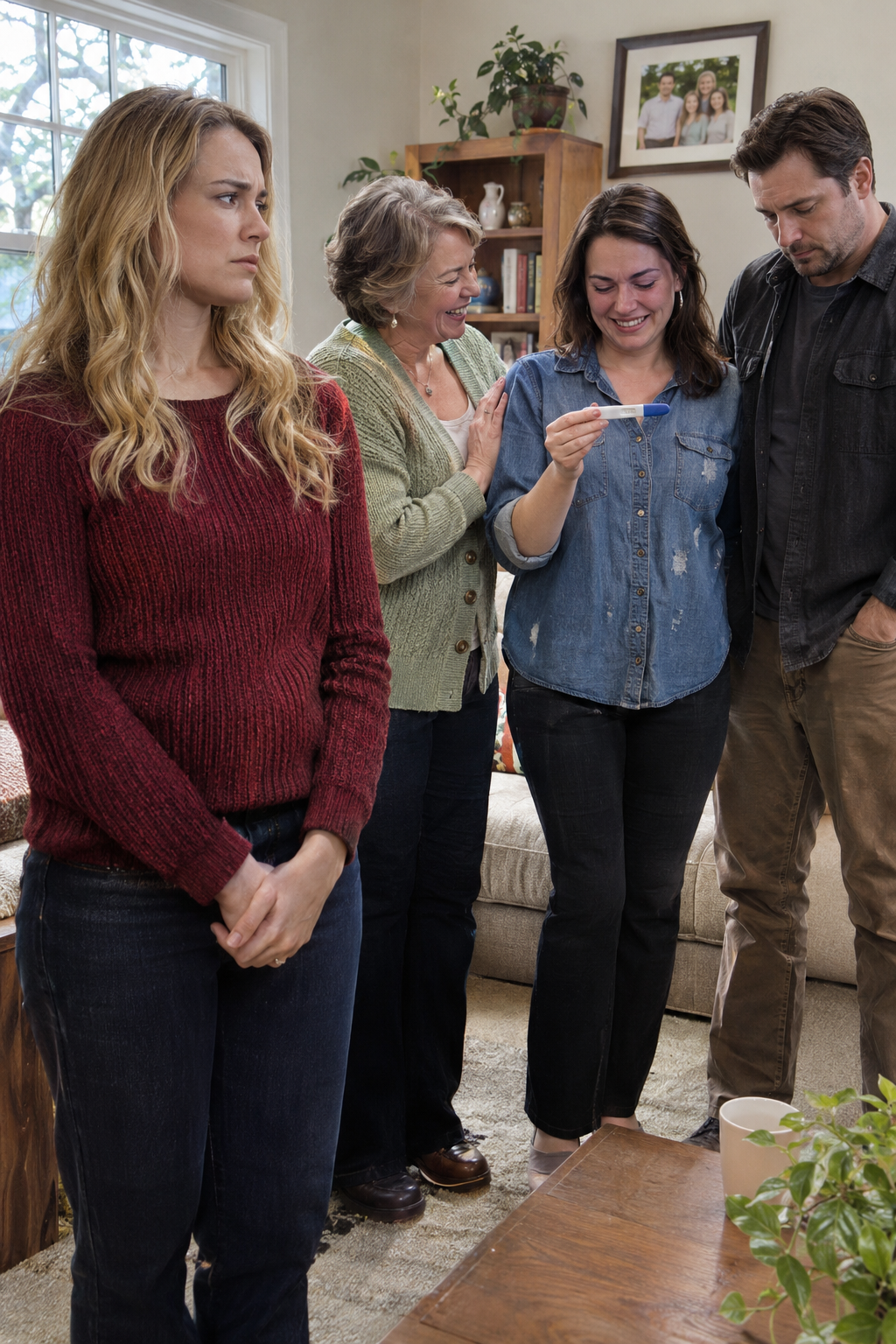
Three weeks before our tenth anniversary, my sister announced she was pregnant, and my husband’s hand trembled as he hugged her. I tried to ignore it—until I found messages proving my own mother knew whose baby it was….
My name is Emma Brooks. At thirty-eight, I thought I understood what it meant to be dependable. I had spent most of my life showing up when my family needed me, and I believed they would show up for me if I ever needed them.
My husband, Matthew, and I lived in a comfortable, ordinary house outside Portland, Oregon. I managed operations for a logistics company, worked long hours, and thought we had built something solid during nearly ten years of marriage. We were even trying to have a child, though that part of our life had become painfully difficult.
My younger sister, Rachel, was two years behind me in age and miles ahead of me at getting forgiven. She could talk her way out of almost anything. When she wrecked our father’s truck at twenty-one, I helped pay for it; when she spent her rent money on a weekend away, I gave her a room; when she borrowed $5,000 and never repaid it, my mother said I should let it go.
“She’s your sister, Emma,” Patricia Brooks would remind me. Those four words could end any argument in our house. My father, Harold, usually stayed quiet, which meant Rachel got another chance and I got another responsibility.
I had paid for part of our parents’ roof repairs. After Rachel’s second DUI, I also paid for rehabilitation because Mom called, frightened and crying, and said they couldn’t lose her. I loved Rachel, and I wanted her to get better, but I sometimes wondered who would take care of me if my life ever came apart.
Matthew seemed different from the people who took and took. He was funny, affectionate, and able to make a grocery run feel like a date. When I brought him home to meet my family, Rachel liked him immediately; they joked together, and I was glad they got along.
She was my maid of honor at our small coastal wedding. The night before, she had been drinking and asked whether I really wanted to settle down, but the next morning she stood beside me in a navy dress and squeezed my shoulder. “You’re doing the right thing, big sister,” she said.
For several years, I was happy. Matthew and I argued over dishes, bills, and ordinary things, then made up over dinner. We talked about having one baby, maybe two. When pregnancy didn’t happen, we started seeing doctors, and every negative test made the next month harder to face.
After almost three years of trying, a doctor told us the fertility problem might be mine. Treatment was possible, but there were no guarantees. I remember sitting in the car after that appointment, unable to buckle my seat belt until my hands stopped shaking.
Matthew reached across the console and said, “We’re a team. We’ll figure it out.” I held on to that sentence through the appointments and the nights I cried quietly in the bathroom. I never imagined it might become another promise he would break.
Around then, Rachel started visiting more often. She said she was lonely and trying to straighten out her life. She came for dinners and games, and sometimes Matthew told me she had stopped by while I worked late to borrow a tool or return something.
I didn’t question it. This was my sister, someone I had sheltered since childhood, and my husband, the man who had held me after every failed pregnancy test. I thought trusting them was the most natural thing in the world.
Then one afternoon in November, a canceled meeting sent me home early. Matthew and Rachel were standing in our kitchen when I opened the door. Nothing was happening, exactly, but they both looked startled, and for a moment neither one moved.
“Hey, Em. Didn’t expect you back,” Rachel said, recovering her smile. Matthew’s cheeks were flushed. He said they were planning a surprise birthday present, even though my birthday was four months away, and he kept looking down at the counter.
I told myself I was reading too much into a strange moment. Rachel flirted with people without thinking, and Matthew was friendly. I didn’t want to turn into a suspicious wife who accused the two people closest to her because of a feeling she couldn’t explain.
Still, things at home began to shift. Matthew kept his phone closer, dressed up for routine errands, and seemed distracted when I talked about another fertility appointment. At night he rolled away and said he was tired. I noticed all of it without knowing what to do with it.
In February, Rachel gathered us at our parents’ house for a Sunday visit. She stood in their living room holding a pregnancy test. Mom squealed and wrapped her in a hug; Dad held her tight, and Matthew stepped forward before I did.
His embrace lasted a little too long. When he turned and hugged me, his hand trembled against my back. I wanted to believe he was just emotional, but I remember staring over his shoulder at Rachel and seeing her quickly look away.
Rachel said she wasn’t ready to say who the father was. Mom immediately told us not to pressure her. I was aching over our own struggles, yet I congratulated my sister because the baby had done nothing wrong and I didn’t want to spoil her moment.
Two weeks later, a stranger called me at work. He introduced himself as Carter, someone who used to date Rachel, and asked whether I was somewhere private. When I said I wasn’t, he hesitated, then told me Rachel had been saying the baby belonged to Matthew.
I felt my stomach drop. Carter said Rachel had been drinking at a bar and had told a friend she had finally beaten me at something that mattered. She had also claimed our parents knew and were helping keep it quiet until they figured out how to deal with me.
I asked if he had proof. He sent screenshots of messages from Rachel discussing Matthew, the pregnancy, and my mother’s plan to keep me from finding out. In one message, Rachel joked that I’d probably help support the baby anyway because I was too decent to turn my back on family.
I left work and parked behind a closed hardware store while rain tapped against the windshield. I read the screenshots again and again, wishing I could make the words mean something else. Instead of going home to demand an explanation, I called a divorce attorney named Martin Hale.
Martin listened, then urged me not to confront anyone before we understood what could be documented and what needed protecting. I spent the next days acting normal while I gathered phone records, bank statements, front-porch security footage, and copies of what Carter had sent. Matthew still sat across from me at dinner and talked about becoming an uncle.
Then he left our shared laptop open on the kitchen desk with his messaging account signed in. I looked at his conversation with my mother and saw something worse than the proof of the affair. Patricia had been advising him about how to keep me in the dark.
“Do not tell Emma until after the birth,” she had written. “Once she sees the baby, she will bond. She will forgive you.” Another message said Rachel wasn’t ready to be a mother, but I was stable and the child deserved stability. My own mother had been planning how to make me raise the child my husband had conceived with my sister. Part 2…..
However, when creating the actual post, the mandatory English sentence above must be kept unchanged. That evening, I found messages from Dad, too. He had written that the situation would destroy me “if handled badly,” as though the problem was how to present the betrayal, not what they had done. I sat in our kitchen looking at the screen until Matthew came home and asked why I was so quiet.
He cooked pasta, lit a candle, and wore the sweater I’d given him for Christmas. When he reached across the table to touch my hand, I let him. I said I was tired because I had already decided he wasn’t going to know what I was planning until I was gone.
Martin helped me work through the legal and financial steps. I opened an individual account, documented our joint savings, and moved only the money he advised could be properly accounted for in the divorce. I secured my personal documents, changed passwords for accounts belonging to me, froze my credit, and asked my employer about relocating to its Denver office.
My transfer was approved. I signed a lease on a small apartment in Colorado and packed only what mattered: two suitcases, papers, my grandfather’s watch, and a framed photograph of the dog I’d loved as a child. I wasn’t trying to erase the marriage or hide assets; I was trying to reach a place where I could think without being surrounded by their lies.
On the evening I left, Matthew was having dinner with my parents and Rachel. I hadn’t been invited. I took off my wedding ring, set it on the kitchen counter, and left a folder beside it containing the evidence, notice of the divorce filing, and one handwritten sentence: “I know everything.”
I drove away in the rain and switched off my personal phone before I reached the highway. My employer knew about the transfer, and anyone with legitimate divorce business could contact Martin. My family no longer had a direct line to me or a chance to talk me into staying.
The divorce was painful even at a distance. Matthew first denied the affair, then admitted it but said Rachel had been with other men and he wasn’t sure about the baby. A DNA test later confirmed that Caleb, the little boy Rachel gave birth to, was his son.
Once he could no longer argue the facts, Matthew begged for another chance. He blamed Rachel for drawing him in, insisted he loved me, and said a baby shouldn’t be punished for the mistakes of adults. I agreed that the baby was innocent, but I couldn’t forget that I had been innocent, too.
My parents wrote letters that I sent back unopened. Rachel left messages from unfamiliar numbers, sometimes crying and sometimes accusing me of breaking up the family. Every plea ended in the same place: someone wanted me to make this easier for everyone else.
The first year in Denver was lonely. I worked, went home, ate whatever was easiest, and slept badly. I missed the life I thought I had, and sometimes I woke up remembering the child Matthew and I had wanted so much.
I didn’t date or go home for holidays. Eventually, though, I began accepting invitations from coworkers, taking walks after work, and building a routine that didn’t revolve around waiting for someone to need me. The quiet felt strange, but it gave me room to recover.
At work, I focused on what I understood: warehouse operations, delayed shipments, wasteful routes, and inefficient systems. After a routing redesign saved the company nearly $2 million, a senior director named Grace Callahan called me into her office. She told me I was capable of more than middle management and introduced me to investors looking for help with struggling regional supply businesses.
I began consulting on weekends and learned how difficult those turnarounds could be. One project nearly collapsed when a major customer left. Still, I kept working, gradually moving into consulting full-time and earning small equity positions in two companies by my third year away.
By the fifth year, I was helping build a logistics technology platform for small manufacturers. By the seventh, the combination of work and equity had made me financially secure in a way I’d never expected. I didn’t want expensive attention or a new audience; I wanted the ability to choose my own life.
Part 3 I heard scattered news from home without looking for it. Matthew and Rachel tried living together after Caleb was born, but their relationship kept collapsing. Rachel lost jobs, began drinking again, cheated on Matthew, and faced legal trouble after another DUI.
My parents spent retirement savings helping with rent, daycare, and legal bills. Dad had a minor stroke, which added medical expenses to everything else. I was sorry to hear he was ill, but I didn’t offer to become the family’s financial solution again.
Eight years after I left, I was in Seattle finishing work on a major acquisition when my assistant, Nora, came to my office. A woman in the lobby had asked for me by name and said she was my mother. For a moment I couldn’t move; then I asked Nora to take her into a small meeting room.
Patricia looked older and worn. She began crying almost as soon as I entered. She told me Dad was sick, Rachel had disappeared for weeks, Matthew was struggling, and Caleb was asking questions he didn’t understand. Then she said, “We need you.”
It struck me that she hadn’t begun by apologizing. She had come with another list of problems and assumed I would help solve them. I reminded her that she had known about Matthew and Rachel, hidden the pregnancy from me, and expected me to care for their child after the truth came out.
“I thought I was protecting everyone,” she said. I told her she had protected Rachel, not me. She pulled a photograph of Caleb from her purse, a boy of about seven with brown hair and wide eyes, and said he was innocent.
“Yes,” I told her. “He is. And so was I.” I didn’t give her money, a promise, or a hug. I watched her leave and realized that the exhaustion I felt was stronger than the anger I’d expected.
Two weeks later, Dad called from a hospital bed. Martin had warned me that family property and emergency-planning matters might eventually need a response, so I answered to hear what Harold wanted. His voice was weak, and when he called me sweetheart, I addressed him by his first name.
He admitted he’d made mistakes, but he still tried to put most of the blame on Mom and Rachel. I told him he had chosen to wait while everyone decided what I could bear. He asked me to visit before his surgery, and after thinking about it, I agreed.
The old house outside Portland looked smaller than I remembered. Paint was peeling and the yard needed attention. My mother opened the door, startled to see me, and I walked into the living room where Rachel, Matthew, and Caleb were waiting near Dad’s recliner.
Rachel looked exhausted, and Matthew looked older than the man I’d left. Caleb peeked out from the hallway, curious about the stranger who had suddenly appeared. I kept my eyes on my father because I hadn’t come to settle scores with a child watching.
Dad said he was sorry. I believed he regretted his decisions, but it was difficult to hear those words after eight years of silence and blame. He asked whether there was any way back to what we had been.
Before I could answer, Rachel accused me of thinking I was better than everyone. She said I’d abandoned a child. I asked how I could have abandoned a son who had never been mine, especially when she and Matthew had made sure I didn’t know the truth until someone outside the family told me.
“You always had everything,” she snapped. I reminded her that I had worked for what I had, while she’d repeatedly relied on other people to rescue her. She moved toward me angrily, then stopped when Caleb stepped fully into the doorway.
I asked Matthew to take his son outside. Instead, he asked me for five minutes to talk and said he had loved me. I told him that love shouldn’t require one person to absorb the consequences of everyone else’s choices.
Part 4 Matthew sank into a chair, overcome, while Mom cried and Rachel muttered under her breath. I looked at them and understood that I didn’t need their suffering to prove I’d been right to leave. I only wanted to finish the visit and go home.
When Dad asked once more whether we could be a family again, I told him no. Before leaving, I handed Mom an envelope with information about a social worker, a financial counselor, and a medical assistance program for Dad. I wanted them to know where help might be available, without offering myself as the help.
Rachel glanced at the papers and asked, “That’s it?” I said it was what I was willing to give. Then I walked onto the porch, where Matthew followed me into air that smelled like rain.
He said he thought about me every day and called the affair the worst mistake of his life. I told him it wasn’t one mistake; it had been hundreds of choices, followed by more choices to hide them. When he said Caleb wondered why his family was sad, that was the one thing that hurt.
“Tell him the truth when he’s old enough,” I said. “Tell him the adults lied, but don’t tell him I abandoned him. He was never my child to abandon.” Matthew nodded, apologized again, and finally let me leave.
The messages resumed after that visit. Mom sent long emails, Dad mailed birthday cards, and Rachel used new numbers to send angry texts until my attorney warned her to stop. Matthew sent a twelve-page letter that I did choose to read.
He admitted that the affair had started while we were going through fertility treatments. He said he’d felt helpless and that Rachel had made him feel wanted, and he kept telling himself their relationship was temporary. When she became pregnant, my mother urged silence, my father advised waiting, and Rachel insisted I’d forgive them.
Near the end of the letter, Matthew said I had been a good wife and didn’t deserve what he’d done. I put the letter away without replying. It was the closest he’d come to taking responsibility, but I no longer needed an explanation to make my life possible.
Dad survived his surgery but never fully recovered. Rachel later went to jail for violating probation. Matthew moved two towns away and found work at a dental office, and Mom eventually sold the old house. I heard the updates in fragments and stopped trying to follow every change.
My life kept growing. I bought a home in Colorado with big windows facing the mountains, adopted a rescue dog named Ranger, and made friends who didn’t measure my love by how much trouble I could absorb. For years, ordinary peace had seemed too much to ask for; now it was how most days felt.
Eventually I met Charles, a widowed pediatric surgeon. He was patient and steady, but being with him didn’t instantly erase what had happened. I still noticed silence, wondered about changes in plans, and sometimes felt anxious when his phone lit up.
On our fourth date, I told him the outline of my marriage and what my family had hidden. He listened and said, “I’m sorry they made love feel unsafe.” He never pushed me to reconcile, and trust developed through small things: keeping his word, showing up when he said he would, and telling me when plans changed.
We married several years later in a simple ceremony in Aspen, with friends and mountains around us. There were no grand speeches or family performances. Mom heard about it through someone else and sent a message saying she hoped I was happy. I didn’t respond, but I was.
Final By the time Caleb was fifteen, nearly fifteen years had passed since I’d left my wedding ring on the kitchen counter. A few months after my wedding to Charles, an unfamiliar number appeared on my phone. The caller was Caleb, now old enough to have found my number in an old email and to ask questions for himself.
His voice was nervous. He said he knew I wasn’t his mother and that he understood something terrible had happened before he was born. Then he apologized, as though any of it had been his doing.
“You did nothing wrong,” I told him. He said Rachel had told him I hated him, and I said I never had. When he asked why I’d left, I explained that the adults closest to me had betrayed my trust, and staying would have harmed me, but none of that was his fault.
He was quiet for a moment, then said he thought everyone was sad because of what they’d done. I told him their feelings were theirs to work through. When he asked if we could meet, I said perhaps when he was older, but never secretly or behind anyone’s back.
Before hanging up, he said he was glad I was okay. I sat with the phone in my hand for a long time, thinking about the little boy who’d been used as an argument against my right to leave. He deserved honesty and kindness, not another adult’s resentment.
When I got home, Charles was making tea. He saw my face, put down the kettle, and held me while I cried for the woman I’d been at thirty-eight: the wife who believed her husband’s promises, the sister who kept rescuing Rachel, and the daughter who still hoped her parents would choose her when it mattered.
I’m fifty-three now. I don’t regret leaving, though I wish I’d recognized sooner how often I mistook endurance for love. My parents’ choices, Rachel’s choices, and Matthew’s choices belonged to them, even when they expected me to carry the cost.
I share a peaceful home with a man who tells me the truth. I have work I care about, friends who respect my boundaries, and a dog who expects dinner on time. I no longer spend my days imagining what I could say to make my family understand. They have their lives, and I have mine.
THE END. I’ve shared the complete story, and I truly hope it touched your heart. If this story moved you, please , like, and share the post. Thank you for reading! ❤️
✓ Lynn R. Adams
Three weeks before our tenth anniversary, my sister announced she was pregnant, and my husband’s hand trembled as he hugged her. I tried to ignore it—until I found messages proving my own mother knew …