Three Tow Companies Abandoned a 76,000-Pound Rig in My Field—Then I Started Dad’s 1950 Farmall and Uncovered the Truth
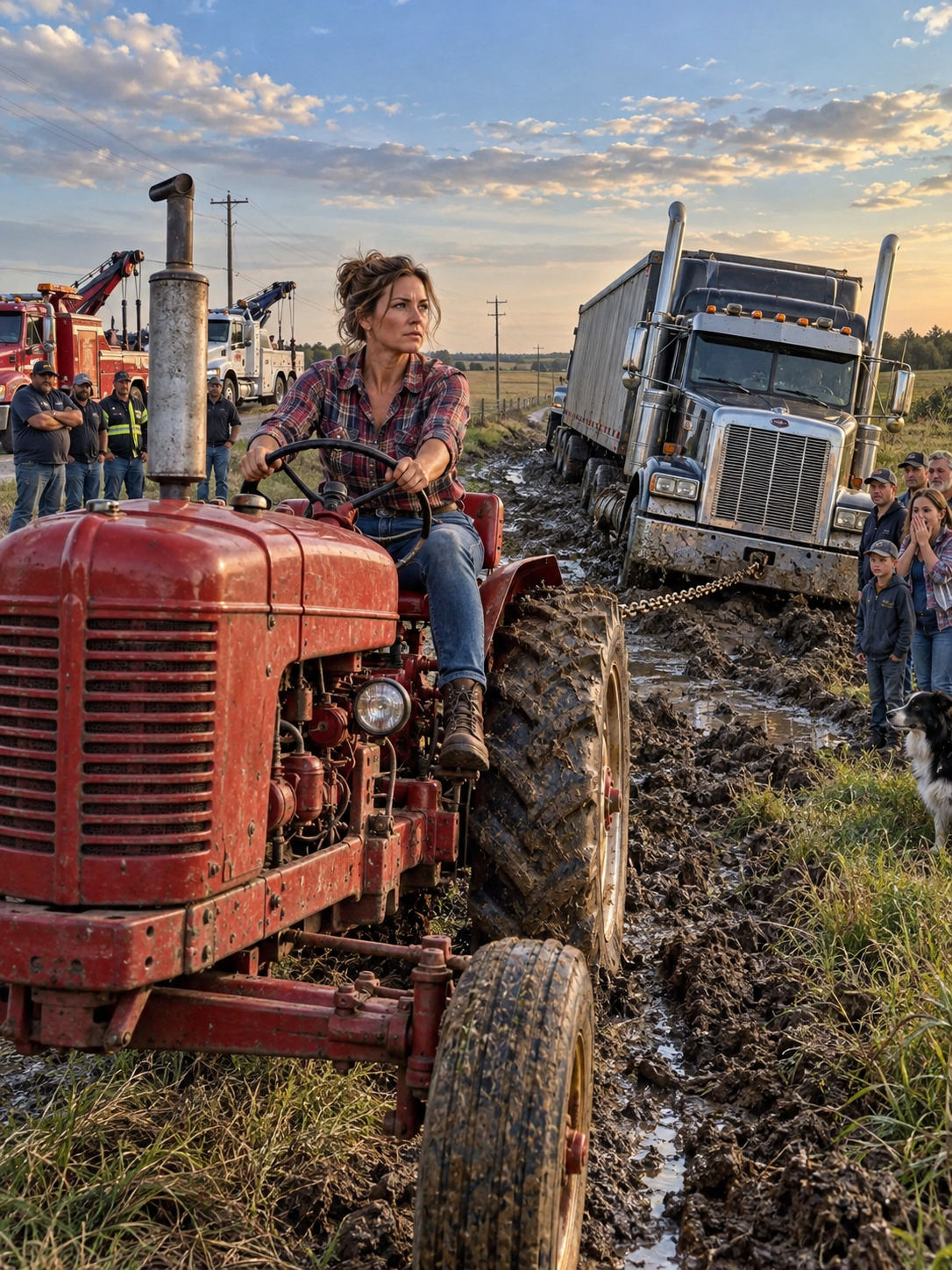
Three Tow Companies Abandoned a 76,000-Pound Rig in My Field—Then I Started Dad’s 1950 Farmall and Uncovered the Truth The third tow truck driver slammed his door, looked me straight in the face, and said, “Lady, your father’s antique tractor couldn’t pull a dead cow out of a ditch, much less a seventy-six-thousand-pound semi.” Then he handed me a bill for $4,800. And before I could ask why I was supposed to pay for a truck that didn’t belong to me, he pointed toward my father’s red 1950 Farmall sitting beneath the barn roof and laughed. “Go ahead. Fire up that museum piece. I’d pay good money to watch you bury it.” The other two tow operators laughed with him. Behind us, a fully loaded tractor-trailer sat crooked in the muddy drainage swale at the edge of our Iowa farm, its left-side wheels sunk deep enough that the trailer leaned toward the creek. Three professional recovery companies had tried to move it. All three had given up. The driver of the rig had been sitting in his cab for eighteen hours. A county deputy was threatening to close the road. And the man who owned the trucking company had just called to tell me that if I didn’t clear the truck before sunset, he’d sue me for every dollar of lost business. I listened to his threat. Then I looked at the old Farmall. The paint was faded. The exhaust pipe was rusted. One rear tire was patched in three places. And on the steering wheel, beneath decades of grease, were the worn spots left by my father’s hands. He had died eleven months earlier. Everyone in the yard knew that tractor meant something to me. They just didn’t know why. My name is Hannah Whitaker. I’m thirty-seven years old, and I own eighty-six acres of farmland outside Cedar Falls, Iowa. At least, that’s what the county records said. The bank had a different opinion. So did my father’s creditors. And so did the man standing beside the stranded semi, smiling like someone who had already decided what my land was worth. His name was Russell Vance. He owned Vance Freight Solutions, one of the largest regional trucking operations in northeastern Iowa. He also owned the development company that had been trying to purchase my farm for the past six months. I had refused every offer. Now one of his trucks was sitting in my field. And the men he’d hired to recover it were telling me that my property was about to become his problem to solve. That should have been my first warning. But the real warning came from the truck driver. He climbed down from the cab, leaned close enough that Russell couldn’t hear, and whispered, “Ma’am, don’t let them tow this rig away until somebody checks what’s actually inside the trailer.” I turned toward him. “What do you mean?” His face went pale. Before he could answer, Russell called his name. “Eddie!” The driver stepped back immediately. Russell smiled. “Everything all right over there?” I looked at the muddy truck. Then at the old tractor. Then at the quiet fear in Eddie’s eyes. “Everything’s fine,” I said. But it wasn’t. Not even close. Because somewhere between the strange arrival of that semi and the three recovery companies that had mysteriously failed to move it, someone had decided my father’s farm was worth more than I knew. Should I let them haul the truck away and protect the little I had left, or trust the instincts my father taught me and find out why everyone seemed desperate to keep me away from that trailer? I remembered what Dad used to say when a piece of equipment stopped working. “Don’t start pulling until you know what’s holding it.” He wasn’t talking only about tractors. And as I would learn before midnight, he had left me one final lesson hidden inside that old red Farmall.
Eleven months earlier, I’d buried my father on a cold November morning. His name was Walter Whitaker. He was seventy-four years old. He’d spent fifty-six of those years farming the same patch of Iowa soil his father had worked before him. Dad was the kind of man who could rebuild a carburetor with a handful of tools, recognize a sick calf from across a pasture, and tell you it was going to rain by the way the cottonwood leaves turned in the wind. He wasn’t sentimental in the usual way. He didn’t write long letters. He didn’t say “I love you” every time we spoke. Instead, he changed the oil in my car when I visited. He packed vegetables from the garden into paper sacks. He called when bad weather was coming. And every winter, he made sure the woodstove in the old farmhouse had enough seasoned oak to last until spring. After Mom died, the farm became his entire world. And when his heart finally gave out, that world became mine. Along with the debts. I still remembered the first meeting with the bank. A young loan officer named Trevor Barnes sat across from me in a conference room that smelled like new carpet and burnt coffee. He slid a folder toward me. “Ms. Whitaker, your father had several outstanding operating loans.” “I know.” “Some of the debt is secured by equipment.” I nodded. “And part of it is secured by real property.” I looked down. The number at the bottom of the statement made my stomach tighten. $286,400. I had expected debt. I had not expected that much. Trevor adjusted his glasses. “The bank would prefer a voluntary resolution rather than foreclosure proceedings.” “How long do I have?” “We can review options, but the next significant payment is due in six months.” I stared through the conference room window. Outside, people were driving to lunch. Going shopping. Picking children up from school. Normal lives. Meanwhile, the ground beneath my feet had just acquired a price tag. That afternoon, I drove home and stood inside Dad’s equipment shed. The old Farmall sat near the back wall. A 1950 Farmall M. Serial number on the plate beneath the seat. A narrow-front tractor with a faded red hood, a gasoline engine, and a personality that could turn a five-minute job into an afternoon. Dad bought it used in 1963. He said it was the first machine he’d ever owned outright. No payments. No promises. Just iron, gasoline, and work. When I was twelve, he taught me to start it. When I was fourteen, he taught me to drive it. When I was sixteen, he let me use it to rake hay. And when I was twenty-one, he told me something I’d never forgotten. “Hannah, a machine doesn’t care if you’re a man or a woman. It cares whether you understand it.” I had laughed. “Then why does Uncle Frank say tractors don’t belong to girls?” Dad had wiped his hands on a rag. “Because Frank doesn’t understand tractors.” That was my father. Now his tractor was worth perhaps three thousand dollars on a good day. The bank wanted almost three hundred thousand. And I was considering selling the farm because I couldn’t see another way. Then Russell Vance appeared. His first offer came in January. $625,000 for the entire property. It was more than enough to clear the debt. More than enough to buy a modest house somewhere. Enough to start over. Russell arrived wearing an expensive wool coat and boots so clean they looked like they’d never touched dirt. He sat at my kitchen table and spread out a map. “Your property is in an excellent location.” “It’s a farm.” “It’s a strategic parcel.” I didn’t like that phrase. He pointed toward the county road. “Industrial expansion is moving north.” “Not through my land.” He smiled. “Everything changes eventually.” I folded the map. “Not interested.” His smile held. But his eyes didn’t. He returned three weeks later. Then again in March. By May, his offer had increased to $790,000. In June, he sent a letter offering $925,000 if I signed before the end of the month. That was when I started wondering why a trucking executive wanted an old farm with worn-out buildings, drainage problems, and soil that hadn’t produced a particularly good crop in two years. I called a local real estate appraiser. He told me development potential could explain the price. But he also said something strange. “Your road frontage is valuable, Hannah. But not nearly that valuable.” I asked what he meant. He shrugged. “Somebody knows something about the area.” I wrote those words in my notebook. Somebody knows something. And I kept refusing.
The semi arrived on a Wednesday morning in September. At a.m., according to my security camera. I was awake because a thunderstorm had rolled through during the night, dropping nearly three inches of rain. The gravel lane was wet. The creek was high. And the drainage ditch along County Road C57 had turned into a ribbon of brown water. I had just poured coffee when I heard the engine. A deep diesel rumble. Then air brakes. Then a metallic bang that shook the kitchen windows. I hurried outside. A white Kenworth tractor attached to a long refrigerated trailer had left the county road and dropped into the drainage swale. Its trailer wheels had slid sideways. The tractor itself remained closer to the road, but the combination was bent at an ugly angle. I could see no obvious collision with another vehicle. Just a heavy truck sitting where no heavy truck belonged. The driver climbed out carefully. “Anybody hurt?” I called. He turned. “No, ma’am.” “Did you hit something?” “Road gave way.” I looked at the shoulder. It was soft. But something about the tire marks bothered me. The truck hadn’t simply drifted off the road. The tracks curved toward my old field entrance. A gate I hadn’t used in years. “What’s your name?” “Eddie Lawson.” “You okay, Eddie?” “Just embarrassed.” He was about fifty. Thin. Weathered face. Gray beard. He looked like the kind of driver who had spent half his adult life watching highways disappear beneath his windshield. “What happened?” He glanced toward the trailer. “Dispatcher changed my route.” “Through here?” “Yes, ma’am.” “Why?” “Supposed to be a shortcut.” I looked toward the narrow county road. A shortcut for a fully loaded seventy-six-thousand-pound combination? That made no sense. Our road wasn’t restricted to trucks, but it wasn’t a sensible route for that kind of shipment. Especially after heavy rain. “Who sent you?” “Vance Freight.” My stomach tightened. Russell Vance. Of course. I looked at the truck again. “What are you hauling?” Eddie hesitated. “Industrial equipment.” “What kind?” “Not sure.” “You don’t know what’s in your trailer?” “I have paperwork.” “That wasn’t my question.” He looked away. I noticed his hands. They were shaking. Not dramatically. Just enough. I recognized fear when I saw it. I offered him coffee. He accepted. We sat on my porch while he called dispatch. Forty minutes later, a recovery truck arrived. The operator walked around the semi twice, looked at the saturated ground, and shook his head. “Need a bigger setup.” By nine, a second company had arrived. They assessed the situation, placed equipment, and began preparing for a recovery. Then their supervisor received a call. He stepped away from us. Spoke quietly. Returned. And announced they couldn’t continue. “Ground conditions,” he said. I looked at the truck. “You knew the ground conditions when you arrived.” He wouldn’t meet my eyes. “Company decision.” He packed up. At noon, a third company arrived. Two heavy wreckers. Experienced operators. Enough equipment to handle serious commercial recoveries under ordinary circumstances. They spent nearly two hours assessing the load, road, and available anchor points. Then Russell Vance drove up. Black pickup. Dark sunglasses. Brown leather jacket. He watched from beside his truck. A few minutes later, the recovery supervisor walked over to him. They spoke privately. The supervisor returned. And announced the job was off. That was when the insults began.
The third operator’s name was Dale Mercer. He was broad-shouldered, red-faced, and convinced the size of his tow truck made every opinion he held correct. He pointed at the Farmall sitting under the barn roof. “Lady, that antique couldn’t pull a dead cow out of a ditch.” I stared at him. He laughed. “You thinking of giving it a try?” “No.” That surprised him. “What?” “I said no.” He grinned. “Smartest thing you’ve said all day.” I looked toward the rig. “I’m not trying to drag a seventy-six-thousand-pound truck through saturated ground with a seventy-year-old tractor.” His grin faded slightly. I continued. “That would be stupid.” The deputy standing nearby, Sheriff’s Deputy Marcus Reed, coughed into his fist. Dale narrowed his eyes. “Then what are you planning?” “Figuring out why three companies came here with recovery equipment and left without completing the recovery.” Dale folded his arms. “Conditions are unsafe.” “Then why did your crew begin setting up?” “We reassessed.” “After speaking with Russell?” His expression hardened. “Watch yourself.” I smiled. “I’m watching everything.” Russell stepped closer. “Hannah, there’s no reason to turn this into a confrontation.” I looked at him. “You brought one to my property.” He spread his hands. “It’s an accident.” “Then why is your company sending me an invoice?” He glanced at the paper Dale had given me. “Property access and delay costs.” I almost laughed. “Your truck left a public road and entered my field.” “Which is why we need your cooperation.” “You have it, as long as the recovery is safe and properly authorized.” Russell sighed. “Look, Hannah, the truck is blocking drainage. The county is concerned. Your farm could suffer serious damage if the weather turns.” “I know.” “And the recovery expenses are increasing.” “I noticed.” He leaned closer. “That’s why my offer still stands.” There it was. The land. Always the land. “I’m not selling.” His jaw tightened. “Sometimes stubbornness becomes expensive.” I looked him in the eyes. “Sometimes so does arrogance.” Deputy Reed stepped between us before Russell could answer. “Everybody needs to calm down.” I looked at the deputy. “Marcus, can I show you something?” “Sure.” I led him toward the old field entrance. The ground was churned. Deep truck-tire impressions curved off the county road. I pointed. “See those?” He nodded. “Truck tracks.” “Look at the direction.” He crouched. The marks showed the truck had turned deliberately toward the opening. Not merely slid sideways from the road. Reed frowned. “Interesting.” “And look here.” I pointed to a deep rut near the edge. “Someone drove across the shoulder before the storm finished.” He studied the ground. “How can you tell?” “The rut has dried sediment on the upper edge. The newer water marks are lower.” He looked at me. “You sure?” “No. That’s why I’m showing you instead of accusing anyone.” He nodded. “Fair enough.” Russell watched from a distance. His expression was no longer friendly.
By three o’clock, the situation had become a public spectacle. Three tow companies. One stranded rig. A county deputy. Two neighbors. Russell Vance. His driver. And me. The weather forecast predicted another line of storms overnight. If the creek rose, the truck could become harder to recover. And if the unstable ditch wall collapsed, the trailer might tip farther. I wasn’t willing to let that happen. But I also wasn’t willing to do something reckless because a man with an expensive pickup wanted me to panic. I called my neighbor. Tom Bennett. Sixty-eight. Retired equipment mechanic. Former volunteer firefighter. Owner of more tools than any reasonable human being needed. He arrived in his faded Ford truck twenty minutes later. Climbed out. Looked at the rig. Then looked at me. “Well,” he said, “that’s a mess.” “Good afternoon to you too.” He grinned. “Where’s your dad when we need him?” The question hit harder than Tom intended. He saw my face. His smile softened. “Sorry, kid.” “It’s okay.” He walked around the site with me. We kept well clear of the trailer’s lean and the soft ditch edge. Tom examined the marks on the road. Then the field entrance. Then the old concrete farm culvert. “Your dad ever tell you about this entrance?” “Only that he stopped using it after the creek changed course.” Tom nodded. “There’s a reason.” “What reason?” He pointed toward a patch of grass near the barn. “Old drainage crossing. Weak fill. He knew heavy equipment shouldn’t be there.” I looked at the truck. The trailer had dropped almost exactly onto that crossing. That was odd. Very odd. “Tom.” “Yeah?” “Could a driver get here by accident?” He studied the tire marks. “Anything’s possible.” “That isn’t what I asked.” He looked at me. Then shook his head. “Not easily.” We stood in silence. Finally, Tom said, “What are you thinking?” “That someone wants this truck right where it is.” He frowned. “Why?” “I don’t know.” But I intended to find out.
At four fifteen, Eddie approached me again. Russell had driven toward town to make a call. The tow crews were packing up. Deputy Reed was speaking with the county road supervisor. Eddie looked exhausted. “Ma’am.” “Eddie.” “I need to tell you something.” I turned toward him. “Go ahead.” He glanced around. Then lowered his voice. “They changed my instructions after I left Waterloo.” “Who did?” “Dispatch.” “What did they say?” “Take the county road. Pull into the old farm entrance. Wait for a call.” My heart gave one hard beat. “Wait?” He nodded. “They told me it was a scheduled equipment transfer.” I looked toward the trailer. “Then why did you end up in the ditch?” His face tightened. “The shoulder gave way when I tried to back out.” I stared. “So you deliberately entered my property.” “I thought we had permission.” “From whom?” “Mr. Vance.” I took a slow breath. “Eddie, I never gave him permission.” He looked down. “I know that now.” “Why didn’t you say something this morning?” He swallowed. “Because I need this job.” There it was. Not greed. Not stupidity. Fear. Eddie had a wife. Two grown children. A mortgage. He wasn’t a wealthy man playing games with land. He was a driver who had followed bad instructions and found himself trapped between a boss and a woman whose property he’d damaged. I studied him. “Do you have the dispatch message?” He nodded. “On my tablet.” “Preserve it.” “What?” “Don’t delete anything. Don’t forward it to anyone who works for Russell until you’ve spoken to someone independent.” He looked frightened. “Will I lose my job?” “I can’t promise you won’t.” He swallowed. “But I can promise that telling the truth gives you a better chance than carrying someone else’s lie.” Eddie looked toward the road. Then nodded. “Okay.” I turned toward Deputy Reed. “Marcus.” He came over. I explained what Eddie had told me. Eddie showed him the dispatch instructions. The deputy read them carefully. Then looked at the rig. His expression changed. “Mr. Lawson, I’d like to get a formal statement.” Eddie nodded. For the first time all day, he looked relieved. And Russell Vance, who had just returned in his black pickup, looked anything but pleased.
Russell walked directly toward us. “What is this?” Deputy Reed looked up. “Routine follow-up.” Russell glanced at Eddie. “Eddie, get back in your truck.” The driver didn’t move. Russell’s eyes narrowed. “Now.” Deputy Reed stepped slightly forward. “Mr. Vance, I’m taking a statement.” Russell smiled. The kind of smile that never reached his eyes. “Of course.” Then he looked at me. “Hannah, you’re making this more complicated than necessary.” “Am I?” “This is an equipment recovery.” “Then recover it.” His jaw tightened. “We’re trying.” “Three companies have already left.” “Because the conditions are unsafe.” I nodded. “Then we’ll wait for a qualified heavy recovery contractor willing to put the plan in writing.” Russell stared. “That could take days.” “Then I guess the truck stays until it’s safe.” The deputy nodded. “That’s how it’s going to work.” Russell’s face hardened. He turned toward the trailer. “Every hour this rig sits here costs money.” I looked at him. “Then perhaps you should have thought about that before sending it into my field.” His eyes flashed. He started to answer. Then stopped. I could almost see him recalculating. For six months, he’d treated me as a desperate woman with debt. Someone he could pressure. Someone who would eventually make a frightened decision. Now the pressure wasn’t working. And that bothered him more than the stranded truck.
The Farmall entered the story at five eighteen. Not because I suddenly believed an old tractor could outperform modern heavy recovery equipment. It couldn’t. A 1950 Farmall M was a powerful farm tractor in its day, but it was not a safe substitute for properly rated heavy wreckers, engineered anchor points, and professional recovery equipment. Dad would have been the first person to say so. The tractor had another purpose. One Russell didn’t understand. The old farm drainage system. Tom and I had been studying the original property map Dad kept in the barn office. The creek. The field entrance. The swale. And an abandoned drainage control box installed decades earlier. According to the map, a shallow concrete inspection chamber sat beneath the weeds near the eastern barn wall. It connected to an old field tile line. If the drain was clogged, the ground around the truck could remain saturated longer than necessary. But opening the chamber and examining the drainage required moving a heavy steel cover that hadn’t been disturbed in years. That was something the Farmall could help us do. Not by yanking blindly. Not by dragging heavy equipment through mud. But by powering the small belt-driven shop compressor Dad had adapted years earlier and moving a light utility wagon loaded with tools to firm ground beside the barn. Tom looked at the tractor. “You sure it’ll start?” I smiled. “Dad always said it would start if you treated it right.” Tom raised an eyebrow. “Your dad also said that about his old coffee maker.” “That thing lasted thirty-two years.” “Fair point.” I walked into the barn. The smell hit me first. Old hay. Grease. Dust. Dry wood. The familiar scent of a thousand afternoons spent beside my father. I placed one hand on the Farmall’s hood. Cold metal. Faded red paint. A small dent near the front emblem from the time Dad backed into a fencepost in 1987. I remembered sitting on the fender while he worked. I remembered his hands. His patience. His voice. “Listen first, Hannah. Machines tell you what’s wrong if you stop trying to argue with them.” I checked the tractor carefully. Fuel. Oil. Coolant. Battery. Visible connections. Nothing obviously unsafe. I opened the fuel valve. Set the controls. And pressed the starter. The engine turned. Coughed. Stopped. Tom leaned against the doorway. “She’s thinking about it.” I waited. Tried again. The engine turned. Caught. Then came alive with the deep, uneven rumble I remembered from childhood. The old Farmall shook gently. A thin puff of exhaust rose above the barn roof. I sat behind the steering wheel with both hands resting on the worn rim. And for one impossible second, I could almost feel Dad standing beside me. Tom removed his cap. “Walter would like that.” I swallowed. “Yeah.” Outside, Dale Mercer was still loading equipment onto his tow truck. He heard the engine. Turned. Then laughed. “Well, I’ll be damned! She actually started it!” Russell looked toward the barn. I eased the tractor forward on firm ground, towing the small utility wagon. Not toward the stranded rig. Toward the drainage chamber. Dale cupped his hands around his mouth. “Wrong direction, sweetheart! The big truck’s over here!” I didn’t answer. Tom waved him away. “Let her work.” I parked. Shut down the tractor. And climbed off. Dale continued laughing. Until Tom uncovered the old concrete chamber. Then the laughter stopped. Because beneath that heavy steel cover, something had been installed recently. Something that hadn’t existed on Dad’s original map.
The first thing we noticed was the fresh gravel. Not much. Just a small patch beneath the weeds. But new enough that the edges were clean. Tom crouched. “Somebody’s been here.” I looked at the concrete cover. A new padlock secured it. Bright steel. No rust. A sharp contrast against the weathered metal. “That isn’t Dad’s lock,” I said. Tom nodded. “Definitely not.” Deputy Reed came over. “What’d you find?” I pointed. “This is an old drainage inspection chamber. My father installed it decades ago. It should be accessible for maintenance.” Reed looked at the lock. “Who put that on?” “I don’t know.” He crouched. Then studied the surrounding ground. Fresh boot prints. A narrow equipment track. And tire marks leading toward the barn. Russell approached. “What are we looking at?” I stood. “That’s what I’d like to know.” He looked at the chamber. For a fraction of a second, his expression changed. Surprise. Then annoyance. Then something very close to alarm. “You shouldn’t be messing around with old drainage structures,” he said. I looked at him. “Why?” “Could be dangerous.” “That’s why we’re not forcing it open.” I turned toward Deputy Reed. “Marcus, I’d like this documented.” He nodded. Russell stepped closer. “There’s no reason to involve the police in every little thing.” The deputy looked at him. “I’m already here.” Tom covered a smile. Russell noticed. His face darkened. Then he said something strange. “That access chamber may be part of the county’s utility easement.” I stared at him. “County utility easement?” “Possibly.” “Since when?” “I don’t know the details.” I nodded slowly. “Then you won’t mind if we check the records.” Russell said nothing. That silence was the first truly satisfying sound I’d heard all day.
By six thirty, Deputy Reed had contacted the county engineer. The drainage chamber wasn’t part of a county utility easement. It wasn’t owned by Russell. It wasn’t registered as commercial infrastructure. According to county records, it was a private agricultural drainage feature entirely within my property boundary. The engineer arrived in a white pickup. Her name was Melissa Grant. Mid-forties. Practical. Mud on her boots. She examined the chamber and surrounding ground. Then looked at me. “Ms. Whitaker, when was this last inspected?” “Not sure. My father handled maintenance.” She nodded. “We’ll document it before anybody opens anything.” Russell stood nearby with his arms folded. Melissa looked at the new lock. “That wasn’t installed by the county.” “Do you know who did it?” I asked. “No.” She examined a small metal plate attached to the concrete. Then frowned. “Interesting.” “What?” She pointed. A serial number. A company name. VANCE INDUSTRIAL SERVICES. I looked at Russell. He stared at the plate. Then said, “That doesn’t prove anything.” I hadn’t asked him a question. But he’d answered one anyway. Melissa turned toward him. “Mr. Vance, is this your equipment?” “It’s possible one of our contractors handled drainage improvements in the area.” “On my land?” I asked. He ignored me. Melissa wrote something in her notebook. “Do you have a permit?” Russell looked irritated. “I’d have to check.” “Please do.” I almost smiled. He had spent months telling me I was too stubborn to understand business. Now a county engineer was asking him for paperwork. And he didn’t seem to have any.
By seven fifteen, the recovered dispatch records had changed everything. Eddie’s tablet showed clear instructions. Proceed to County Road C57. Enter Whitaker east field access. Hold position. Await site contact. The message had been sent by a Vance Freight dispatcher. A second instruction followed twenty-six minutes later. Remain on site until authorized to move. Then a third. Do not contact property owner. Eddie had already entered the field by then. The soft shoulder had failed when he tried to turn the combination. The truck was stranded. Not because he chose a bad shortcut. Because he’d been directed onto my property. Deputy Reed looked at the messages. Then at Russell. “Mr. Vance, do you want to explain why your company ordered this vehicle onto private property?” Russell adjusted his jacket. “Operational misunderstanding.” “Who authorized it?” “I’ll need to review that internally.” The deputy nodded. “You do that.” I stood beside the Farmall. Its engine had long since gone quiet. But the tractor’s short trip had accomplished something three tow trucks hadn’t. It had brought us to the old drainage system. And that system had exposed evidence Russell didn’t want anyone to see. Tom stood beside me. “Your dad would be laughing right now.” I looked at the tractor. “He’d be asking why I didn’t check the map sooner.” Tom chuckled. “Probably.” Then his smile faded. “Hannah.” “Yeah?” “Something still doesn’t add up.” I looked toward the trailer. “What?” “Why go to all this trouble?” He gestured toward the truck. “Why put a heavy rig on your property? Why mess with the drainage? Why pressure you to sell?” I watched Russell speaking rapidly into his phone. “I don’t know.” Tom folded his arms. “But you have an idea.” I nodded. “It’s not the truck.” He looked at me. “What?” I turned toward the old field entrance. “It’s the land beneath it.”
The next morning, an independent heavy-recovery company arrived from Des Moines. Their supervisor, Rachel Morgan, stepped out of a specialized recovery vehicle wearing work boots, a hard hat, and a reflective jacket. She looked at the semi. Then the drainage ditch. Then the road. Then she said something I liked immediately. “Nobody touches anything until we establish a safe recovery plan.” No jokes. No insults. No assumptions. Just competence. I introduced myself. “Hannah Whitaker.” “Rachel Morgan.” She shook my hand firmly. “Property owner?” “Yes.” “Good. I’ll need to coordinate access with you and the county.” “Of course.” She studied the ground. “Did anyone attempt a pull yesterday?” “Three companies assessed it. Nobody completed one.” She nodded. “Probably for the best if the ground wasn’t stable.” I agreed. Rachel explained that moving a fully loaded commercial combination required proper planning, potentially reducing the load, checking stability, protecting the road, and using rated equipment. The old Farmall was not part of that plan. It didn’t need to be. Rachel had brought people who understood the job. By late morning, engineers had established a recovery approach. The cargo would be transferred if necessary. The trailer stabilized. The soft ground protected. The vehicles moved under controlled conditions. Meanwhile, county officials continued examining the drainage structure. That was when Melissa Grant called me aside. “Hannah, we found something.” I followed her toward the barn. The chamber cover had been opened by authorized personnel after documenting the lock and surrounding evidence. Inside was a recently installed pipe assembly. Not a normal drainage repair. It diverted part of the flow away from the original outlet. Melissa pointed toward the old map. “Your father’s system was designed to drain the east field toward the creek.” I nodded. “This new connection redirects water beneath the access road.” I looked at the diagram. “Why would someone do that?” She shook her head. “I can’t tell you why. But the installation appears unauthorized, and it may have contributed to the saturation around the truck.” I stared at the ground. Someone had changed the drainage. Then a truck had been directed onto the weakened area. Then the truck got stuck. Then the owner pressured me to sell. I looked toward Russell’s pickup. He was standing beside it. Watching us. And for the first time, I understood that the stranded semi might not have been a random accident at all.
At noon, Russell approached me. Alone. No smile this time. “Hannah.” “Russell.” “We need to talk.” “Go ahead.” He glanced toward the engineers. “Privately.” I shook my head. “Anything you need to say can be said here.” His jaw tightened. “Fine.” He reached into his jacket and pulled out a folded document. “I’m increasing my offer.” I stared at him. “What?” “One million two hundred thousand dollars.” For a moment, I forgot the noise of the recovery site. $1.2 million. Nearly twice his original offer. Enough to pay off the bank. Enough to start over. Enough to never worry about another overdue equipment bill. Russell watched my face. “I can have the paperwork ready this afternoon.” I looked at the document. Then at him. “Why?” “Because I want the property.” “You’ve made that clear.” “It’s a fair offer.” “Then why the urgency?” He exhaled. “Development schedules.” “What development?” “Commercial.” “What kind?” “Warehousing. Distribution.” I glanced toward the drainage chamber. “On this land?” “Potentially.” I studied him. He was sweating despite the cool weather. A man who normally controlled every conversation now seemed desperate to finish one. I folded the document. Then handed it back. “No.” His expression froze. “Hannah.” “No.” “You’re making a serious mistake.” “Maybe.” “Your father would have taken this offer.” That did it. Not because it made me angry. Because it showed how little Russell understood the man whose name he was using. I looked him in the eyes. “My father spent fifty-six years keeping this farm alive.” Russell opened his mouth. I continued. “He repaired equipment when he couldn’t afford replacements. He planted fields when the forecast said not to bother. He got up before dawn to keep promises nobody else remembered.” My voice remained calm. “And he never sold something simply because a man in a nice jacket told him to be afraid.” Russell stared. I stepped back. “So don’t tell me what my father would have done.” For a moment, he looked as though he might say something cruel. Then Rachel called from the recovery site. “We’re ready to begin the next controlled phase.” Russell turned away. And I saw something I’d never seen on his face before. Fear.
The recovery took most of the afternoon. There were no dramatic chains snapping. No miraculous seventy-six-thousand-pound pull from the Farmall. No reckless stunt. The professionals worked slowly. Methodically. They stabilized the combination. Managed the load. Protected the ground. And used equipment suited to the weight and conditions. By four thirty, the tractor portion of the rig was safely back on firm ground. By five twenty, the trailer had been recovered. The county road reopened after inspections. The drainage area remained restricted. And the damage to my field was documented. Eddie climbed down from his cab. He walked toward me. Removed his cap. “Ma’am.” “Eddie.” “I owe you an apology.” I shook my head. “You told the truth when it mattered.” He looked toward Russell’s truck. “I should’ve told you sooner.” “Probably.” He nodded. Then smiled faintly. “Fair enough.” I held out my hand. He shook it. “Drive safe.” “I will.” Then he paused. “Can I ask you something?” “Sure.” “Was that really your dad’s tractor?” I looked toward the barn. “Yes.” He smiled. “My granddad had one just like it.” “Did he?” “Wouldn’t trade it for anything.” I laughed softly. “Neither would mine.” Eddie nodded. Then climbed into his cab. As the truck rolled away, I stood beside Tom. The yard was a wreck. Mud. Ruts. Broken grass. Deep tire impressions. But the truck was gone. The immediate danger was over. And for the first time since Dad died, I felt something close to hope. Tom looked at the Farmall. “Well, Hannah.” “Yeah?” “That old girl earned her keep.” I smiled. “She didn’t move the semi.” “No.” He looked at me. “But she got you where you needed to be.” I rested my hand on the tractor’s hood. “That she did.”
The next day, the county engineer returned with a folder. I met her on the porch. Melissa looked serious. “Hannah, we’ve been reviewing the drainage work and nearby development filings.” I handed her coffee. “Good news or bad?” “Complicated.” I sat. She opened the folder. “Three years ago, Vance Industrial Services applied for a preliminary land-use study involving parcels north of the county road.” I frowned. “That’s not my property.” “Correct.” She turned a page. “But the proposed project included an access corridor crossing your east field.” I looked down. A map. A thick blue line. Running straight through my land. “What is that?” “A proposed heavy-vehicle access route.” I stared. “Why would they put a route across land they don’t own?” “Preliminary proposals sometimes include parcels subject to acquisition.” “Except I never agreed to sell.” “Exactly.” She pointed toward the old field entrance. “Your property is the shortest practical connection between the proposed industrial site and the main highway.” My stomach tightened. “That’s why Russell wants it.” “Possibly.” I studied the map. Then noticed another marking. A shaded rectangle near the creek. “What is that?” Melissa hesitated. “Proposed utility infrastructure.” “What kind?” “The filing describes a pump station and drainage improvements.” I looked toward the barn. The unauthorized pipe. The new lock. The company name. Everything began to fit. Russell hadn’t merely wanted my farm. He’d been planning around it. As though it already belonged to him. I looked at Melissa. “Can he build any of this without my permission?” “Not on your property.” I nodded. “Good.” She continued. “But Hannah, there’s one other thing.” My chest tightened. “What?” “The project may qualify for certain public infrastructure incentives if it moves forward.” I frowned. “Incentives?” “Tax and financing arrangements.” I looked at the map again. “How much money?” Melissa hesitated. “The broader project appears to involve several million dollars.” I sat back. That explained the desperation. The increased offers. The pressure. The strange urgency. A wealthy man had already built plans around land he did not own. And now he needed me to surrender it before those plans collapsed.
By Friday, the story had spread across the county. People loved the Farmall angle. An old red tractor. A stubborn woman. Three tow companies. A massive semi. The internet did what it always does. It simplified everything. One local Facebook post read: THREE BIG TOW TRUCKS FAILED, BUT FARM GIRL’S 1950 TRACTOR SAVED THE DAY! That wasn’t exactly true. The tractor hadn’t recovered the truck. But it had helped us uncover the drainage chamber. And in doing so, it had changed the entire situation. I posted a correction. The semi was recovered safely by qualified professionals. Dad’s Farmall helped us reach and investigate the old drainage area. Thanks to everyone who helped. My post received fewer likes. That was fine. Truth mattered more than applause. The important work continued. The county opened an inquiry into the unauthorized drainage changes. Deputy Reed documented Eddie’s dispatch instructions. My attorney, Sarah Collins, sent Russell’s companies a preservation notice requesting that relevant communications, work orders, and property-access documents not be destroyed. Sarah was forty-one. Sharp. Blunt. Not easily intimidated. She’d handled my father’s estate. And she had the kind of patience that made impatient men nervous. When I showed her the documents, she leaned back in her chair. “This is interesting.” “Good interesting?” “Potentially expensive interesting.” “For whom?” She smiled. “That depends on what the evidence proves.” I liked that answer. She reviewed the records. The dispatch instructions. The new drainage lock. The county filings. The photos. The property damage. Then she looked at me. “Hannah, do you understand what Russell may have been trying to accomplish?” I nodded. “Pressure me into selling.” “Maybe.” She tapped the map. “But there may be more.” “What?” “Your land isn’t just a convenient route.” I looked at her. She continued. “It’s the only parcel in this proposed access corridor that Russell doesn’t control.” I stared. She pointed to the surrounding properties. “Vance-related entities have purchase agreements or options on nearly every other piece.” I looked down. A blue outline surrounded my eighty-six acres. Like a fist closing around something. “Then why not simply offer me a fair price and wait?” Sarah met my eyes. “Because the value of your property to the project may be much greater than the value of your property as farmland.” I sat back. The room went quiet. Then she said, “Don’t sign anything.” I smiled faintly. “That part I can manage.”
On Saturday morning, I walked into the barn and found Tom standing beside the Farmall. He had a grease rag in one hand. A wrench in the other. “What are you doing?” I asked. “Checking something.” “On my tractor?” “Your dad asked me to look after her.” I frowned. “He did?” Tom nodded. “Years ago.” I stepped closer. “Why didn’t you tell me?” He shrugged. “Never came up.” I smiled. “That sounds like Dad.” Tom wiped his hands. “He was a stubborn old man.” “Yes.” “Smart, though.” “Usually.” Tom leaned against the workbench. “After your mother died, he started keeping more records.” I looked at him. “What kind?” “Land records. Equipment records. Old surveys.” My pulse quickened. “Why?” Tom looked toward the east field. “He didn’t trust Vance.” I stared. “Dad knew Russell?” “Oh, yeah.” “How well?” Tom hesitated. “Well enough to tell him no.” I folded my arms. “Tell me.” Tom sighed. “Russell came around years before he started contacting you.” I went still. “When?” “Maybe four years ago.” “What did he want?” “The east field.” I stared. “Only the east field?” Tom nodded. “Specifically the old entrance and drainage crossing.” My heartbeat changed. That was exactly where the semi had ended up. “What did Dad say?” Tom smiled faintly. “Told him he’d rather sell the moon.” I almost laughed. Then Tom’s expression grew serious. “But Russell kept coming back.” “Why?” “Your dad never told me.” I looked at the tractor. “What else?” Tom hesitated. “Hannah, your father made me promise something.” My chest tightened. “What?” “If you ever had trouble with that land, I was supposed to make sure you checked the tractor.” I stared. “The tractor?” Tom nodded. “He said there was something you needed to find.” A chill moved through me. “What thing?” Tom shook his head. “He wouldn’t say.” I looked at the Farmall. The worn steering wheel. The rusted exhaust. The faded red hood. Then I remembered a strange detail from my father’s final months. He had spent three afternoons working on the tractor even though he was too weak to do much heavy labor. When I asked what he was doing, he’d said, “Putting things where they belong.” I’d thought he meant tools. Now I wasn’t so sure.
We spent the next hour carefully inspecting the tractor. Not dismantling anything essential. Not taking apart parts that could affect safe operation. Just checking compartments and areas Dad used for storage. The toolbox. Empty. The small metal container beneath the seat. Old bolts. A worn spark plug. Two washers. The battery box. Nothing unusual. Then Tom noticed something. The underside of the seat had a newer piece of sheet metal attached. Not factory. Not part of the original tractor. A small panel. Painted red. Held in place with ordinary fasteners. Tom frowned. “Walter did that.” I crouched. “How can you tell?” He pointed to the edges. “See the way he folded it? That’s his work.” My throat tightened. “Why would he add that?” Tom looked at me. “Only one way to find out.” We removed the small nonstructural cover. Behind it was a narrow sealed metal container. Wrapped in an old shop towel. My father’s initials were scratched into the lid. WW. My hands shook. I opened it. Inside lay a folded letter. A small flash drive. And a brass key. I recognized the handwriting immediately. Hannah— If you’re reading this, Russell Vance has probably stopped asking nicely. My knees went weak. I sat on the barn floor. Tom crouched beside me. I unfolded the letter. Dad’s words were uneven. Written by a hand that had started trembling in his final years. But every line was unmistakably his. I read aloud. “Hannah, I know you think this farm is nothing but trouble now. I know the loans are heavy. I know you’ll be tempted to sell when somebody offers enough money.” I stopped. Swallowed. Then continued. “But there is something about the east field you need to know.” Tom watched silently. “The old drainage crossing is older than most people remember. Your grandfather helped build it in 1948. We kept the records because there were agreements attached to the land.” I turned the page. “Russell Vance came here in 2022 and offered to buy the east field. When I refused, he told me the county might eventually take it for public use. I didn’t like his tone, so I started checking records.” My pulse accelerated. “That’s when I found out he had already submitted plans showing our land as though it belonged to him.” I looked at Tom. He shook his head. I kept reading. “I went to the courthouse. I copied everything. Then I hired a surveyor.” The next sentence made my breath catch. “The surveyor found that the original property line along the old county road had been recorded incorrectly in later maps.” I stopped. Tom leaned closer. “What?” I continued. “Our family still owns a narrow strip of land between the old road centerline and the modern road easement.” I stared. A strip of land. Along the road. The proposed access route. The place Russell needed. Dad’s letter continued. “It’s not much acreage, but it matters. Without the proper agreement, nobody can use that strip as private industrial access.” My heartbeat pounded. He had known. Dad had known what Russell wanted. He had documented it. He had hidden the records in the tractor. And he’d left them for me. I wiped my eyes. Then read the final paragraph. “Hannah, I couldn’t stop getting old. I couldn’t stop the bank from wanting its money. But I could make sure you didn’t sell something without knowing what it was worth.” I pressed my lips together. The last lines were almost impossible to read through the tears. “Don’t let anybody make you feel foolish for asking questions. Don’t let anybody hurry you because they’re richer than you. And don’t ever believe that old iron is worthless just because it’s rusty.” I laughed through tears. Then read the final sentence. “I love you, peanut. Dad.” For several minutes, the barn was silent. Tom removed his cap. I held the letter against my chest. Eleven months. Eleven months since I’d heard Dad’s voice. And somehow, sitting on the barn floor beside his old tractor, I felt like he’d spoken to me again.
The flash drive contained scanned documents. Survey records. Correspondence. County filings. Photographs. Letters from Russell. And a detailed map prepared by a licensed land surveyor. I called Sarah immediately. She came to the farm that afternoon. We reviewed everything at the kitchen table. The more she read, the quieter she became. Finally, she looked up. “Hannah.” “Yes?” “Your father did his homework.” I smiled. “He usually did.” She held up the survey. “This needs to be independently verified, but if the title chain and survey are correct, your property includes a narrow frontage interest Russell’s development plans haven’t properly accounted for.” I looked at the map. “Meaning?” “Meaning he can’t simply assume access across it.” I leaned forward. “And if his entire project depends on that access?” She smiled. “Then he has a problem.” I stared at the documents. Six months of offers. The pressure. The strange truck accident. The unauthorized drainage work. All connected to a strip of land I’d never known existed. “How much is it worth?” I asked. Sarah shook her head. “Depends on what someone is willing to pay for legally secure access.” I looked at the old farmhouse. The barn. The tractor. The fields. Then back at her. “Enough to save the farm?” She considered. “Possibly.” My heart tightened. She held up one finger. “But don’t assume anything until we confirm the records.” I nodded. That was fine. I wasn’t looking for a miracle. I was looking for facts. And for the first time, the facts were beginning to work in my favor.
Monday morning, Russell Vance appeared at my driveway. No appointment. No lawyer. No smile. I was standing beside the barn when his truck stopped. He climbed out. “Hannah.” “Russell.” “We need to settle this.” I folded my arms. “Settle what?” “The access issue.” I felt my heartbeat steady. So he knew. He looked toward the county road. “I understand you’ve been reviewing old surveys.” “I have.” He nodded. “Those records can be complicated.” “I have an attorney.” His jaw tightened. “Lawyers make everything expensive.” “Sometimes they make things accurate.” He looked at me. Then said, “I’ll give you one point five million for the entire farm.” I stared at him. A million and a half. He’d nearly doubled the latest offer in a matter of days. I didn’t move. Russell stepped closer. “Cash closing. Thirty days.” I shook my head. “No.” His face changed. “Hannah, you’re being unreasonable.” “Maybe.” “You have debt.” “I know.” “You have equipment falling apart.” “I know.” “You have eighty-six acres that barely generate enough income to cover property taxes.” I looked him straight in the eyes. “I know exactly what I have.” That stopped him. He studied me. Then his gaze shifted toward the Farmall. The old tractor sat beneath the barn roof. Red paint faded. One headlight cracked. Steering wheel worn smooth. Russell’s eyes narrowed. “Your father was always difficult.” I smiled faintly. “He taught me.” Russell looked back at me. “This isn’t over.” “No,” I said. “It isn’t.” He turned and walked toward his pickup. Then stopped. “Hannah.” I waited. “You think that old survey protects you?” I said nothing. He smiled. “Your father thought so too.” The words hung between us. Then he climbed into his truck and drove away. I watched until the dust settled. Because that wasn’t the threat of a frustrated buyer. It was the warning of a man who knew something else. Something my father might have discovered. Or something he’d missed.
Three days later, Sarah called. Her voice was unusually serious. “Hannah, can you come to my office?” “What’s wrong?” “I’ve completed an initial review of the title history.” “And?” “The old survey appears legitimate.” My chest tightened. “That’s good.” “Yes.” “But?” A pause. “There’s another document.” “What document?” “A recorded agreement from 1951.” I frowned. “What kind?” “An access and drainage agreement involving your grandfather and a company that no longer exists.” I looked toward the barn. “Why does that matter?” “Because the agreement includes a condition tied to industrial use.” “What condition?” Sarah hesitated. “Hannah, I don’t want to explain this over the phone.” My stomach tightened. “Is it bad?” “It’s complicated.” I closed my eyes. Of course. Everything about the farm had become complicated. “I’ll be there in twenty minutes.”
Sarah’s office sat above a bank in downtown Cedar Falls. When I arrived, she had three folders spread across her desk. One held Dad’s documents. One contained county records. The third was new. She gestured toward a chair. “Sit.” I did. Sarah looked at me. “I want you to understand something first.” “Okay.” “Your father was right about the access issue.” My shoulders loosened. “But?” She turned a page. “The 1951 agreement allowed limited agricultural and maintenance access across the old frontage strip. It did not grant unrestricted commercial access.” I nodded. “That makes sense.” “The language also required written approval from the landowner before substantial changes to drainage structures.” I thought about the new pipe. The Vance Industrial Services plate. The unauthorized lock. My jaw tightened. “So Russell had no right to modify the chamber.” “Not based on this agreement.” I leaned forward. “What else?” Sarah looked directly at me. “The document identifies the original beneficiary of the access arrangement.” I frowned. “Who?” She slid the page toward me. The name was unfamiliar. Whitaker Agricultural Cooperative Association. I stared. “What’s that?” Sarah folded her hands. “Your grandfather helped organize it.” “For what?” “Shared farm equipment access and drainage maintenance.” I nodded slowly. “That sounds like him.” She continued. “The cooperative was dissolved decades ago.” “So?” “So we need to determine what happened to its remaining interests.” I looked at her. “What interests?” She pointed to a paragraph. “Under certain conditions, unused rights could revert to the original landowning families.” My heartbeat accelerated. “Meaning?” “Meaning your family may have retained more control over the corridor than Russell realized.” I stared at the page. Then laughed once. Not because it was funny. Because my father had spent years being treated like an old farmer who didn’t understand modern business. And yet his paperwork was becoming the biggest problem in a multimillion-dollar development. Sarah smiled faintly. “Your dad was thorough.” I nodded. “He was.” Then she closed the folder. “But Hannah, there’s something troubling.” My smile disappeared. “What?” “Russell submitted a copy of the same agreement as part of his project filings.” I stared. “When?” “Two years ago.” My chest tightened. “He knew?” “Yes.” “He knew the access wasn’t his?” “He knew the agreement existed. Whether he understood its legal effect is another question.” I looked at the document. Two years. For two years, Russell had been working around a problem my father had discovered. Then Dad died. And Russell came after me. I felt cold. Sarah watched my face. “What are you thinking?” I looked up. “That the truck was never the point.” She nodded slowly. “Go on.” “The truck gave Russell a reason to enter the property. The drainage problem made the land look unstable. The recovery bills created pressure.” I paused. “And the offers kept increasing because he needed me to sell before I discovered why.” Sarah considered. “That’s a theory. We need evidence before treating it as fact.” I nodded. “I know.” Then I looked at the folder again. “But I think Dad knew.”
That evening, I sat alone in the barn. The sun was dropping behind the cornfields. The air smelled of cut hay and cooling earth. The Farmall stood beside me. Quiet. Patient. Exactly as it had stood for decades. I ran my fingers over the steering wheel. “Dad,” I whispered, “what else did you know?” Of course, the tractor didn’t answer. But I could almost hear him. “Check the records, peanut.” I smiled. Then my phone buzzed. A message from Tom. You home? I replied. Barn. He answered immediately. Stay there. Coming over. Fifteen minutes later, his old Ford rolled up. He climbed out carrying a metal box. I frowned. “What’s that?” “Something your dad left with me.” My heart tightened. “Tom.” He looked uncomfortable. “I should’ve given it to you sooner.” “What is it?” He set the box on the workbench. “Your dad told me to hold onto this unless Russell started making trouble.” I stared. “That’s a pretty specific instruction.” Tom nodded. “Walter didn’t trust him.” I looked at the box. A small steel document case. Locked. Tom handed me a key. “Your dad gave me this too.” I opened it. Inside were several envelopes. A rolled survey. And a small cassette tape. I stared. “A cassette?” Tom nodded. “Your dad liked old things.” I almost laughed. Then saw the label. Written in black marker. RUSSELL VANCE — SEPTEMBER 2022. My stomach tightened. I looked at Tom. “Did you listen to it?” He shook his head. “Walter told me it was private.” I held the cassette. My father had recorded a conversation with Russell. Years before the semi arrived. Years before Russell offered to buy the farm from me. I looked at Tom. “Do you still have a cassette player?” He smiled faintly. “Kid, I have three.”
We played the tape in Tom’s truck. The recording was rough. A little static. A faint engine hum. Then my father’s voice. Older. Raspy. Unmistakable. “Russell, I’ve already told you I’m not selling.” Another voice. Russell. Calm. Polished. “Walter, I think you’re misunderstanding the opportunity.” “No, I understand fine.” A pause. Then Russell said, “The county is going to develop this corridor eventually.” Dad answered immediately. “Not without proper access.” Russell laughed softly. “You really think that old agreement gives you control?” “I think it gives me the right to say no.” Silence. Then Russell’s voice changed. Not louder. Colder. “You could make a great deal of money, Walter.” Dad chuckled. “Money’s never impressed me much.” “That’s easy to say when you’re sitting on land other people need.” My heart pounded. Then Dad said something that made Tom lean forward. “It’s not the land you want, Russell.” Silence. Russell replied, “What does that mean?” Dad’s voice was steady. “You’re not paying nearly a million dollars for eighty-six acres of tired Iowa dirt.” Another pause. “Walter.” “You’re paying for what’s underneath the road.” I froze. Tom looked at me. The tape continued. Russell’s voice sharpened. “You need to be careful making accusations.” Dad laughed once. “I haven’t accused anybody of anything.” “Then stop digging.” A long silence. Then Dad said quietly, “Too late.” The cassette clicked. The recording ended. I sat motionless. Tom stared through the windshield. Finally, he whispered, “Good Lord.” I looked at him. “What’s underneath the road?” He shook his head. “I don’t know.” I stared at the cassette. My father had discovered something more important than access rights. Something connected to the land. Something Russell didn’t want exposed. And something worth enough money that Russell had spent years trying to acquire the property. I picked up the survey. Unrolled it across the hood of Tom’s truck. There, near the old drainage crossing, was a small handwritten mark. Not on the official survey. Added afterward. In Dad’s handwriting. A circle. An arrow. And three words. CHECK BELOW CULVERT. My pulse accelerated. I looked toward the county road. The old culvert. The drainage chamber. The site where the seventy-six-thousand-pound rig had become stranded. All of it centered on the same place. Tom followed my gaze. “Hannah.” “Yeah?” “Don’t go digging out there tonight.” I looked at him. “I’m not going to.” He exhaled. “Good.” I folded the survey. Then added, “I’m calling Sarah.” Tom smiled. “Your dad would’ve approved.”
The next morning, Sarah met us at the farm with Melissa Grant and a licensed civil engineer. No one rushed. No one started digging. We reviewed the original surveys. The drainage layout. The property line. The old culvert. And Dad’s handwritten notes. Melissa studied the documents for nearly twenty minutes. Then looked up. “This is interesting.” I almost laughed. “Everybody keeps saying that.” She smiled faintly. “Because it is.” She pointed toward the road. “The original culvert alignment doesn’t match the modern drainage records.” I frowned. “How much difference?” “Enough that I’d want to know why.” The engineer studied the map. “There may have been undocumented modifications decades ago.” I looked at him. “Could that explain the new pipe?” “Possibly.” Sarah folded her arms. “What would it take to inspect the area properly?” The engineer considered. “Records first. Then appropriate permissions and a controlled examination.” I nodded. “Do it.” He looked at me. “We’ll need time.” I looked toward the Farmall. “That’s fine.” Then Melissa said something that changed the conversation. “Hannah, there’s one thing I haven’t mentioned.” I turned. “What?” “When we inspected the new drainage assembly, we found a second conduit.” My chest tightened. “What kind?” “Not a normal field tile.” I stared. “What does it connect to?” “We don’t know.” I looked toward the road. The old culvert. The place Russell had tried so hard to control. Then I asked quietly, “Could it be carrying something besides water?” Melissa met my eyes. “Yes.”
Three days later, Russell Vance’s attorney sent me a letter. It claimed that my property was interfering with a planned infrastructure project. It demanded access to the eastern field. It warned of legal action. And it offered $1.8 million for the entire farm if I signed within ten business days. I read it twice. Then sent it to Sarah. She called five minutes later. “Don’t respond directly.” “I wasn’t planning to.” “Good.” I looked at the number. $1.8 million. Almost three times Russell’s first offer. A farm that had seemed barely worth keeping was suddenly worth nearly two million dollars to a man who wouldn’t explain why. I thought about Dad. About his worn hands. About the old Farmall. About the letter hidden beneath the tractor seat. Then I asked Sarah a question. “Can we request the underlying project documents?” “We can seek relevant records and respond through the appropriate process.” “Do that.” She paused. “Hannah?” “Yes?” “Whatever Russell is hiding, don’t try to uncover it alone.” I looked toward the road. “I won’t.”
The investigation continued for another week. County engineers examined the accessible drainage structures. The police reviewed the unauthorized work. My attorney gathered property records. Eddie supplied additional dispatch correspondence. And Russell stopped calling. That bothered me. For months, he’d been relentless. Now he was silent. Men like Russell didn’t usually surrender quietly. Then, on a rainy Thursday afternoon, Deputy Reed called. “Hannah.” “Marcus.” “We found something in the records.” “What?” “A contractor invoice.” “For what?” “Work performed near your culvert.” My heartbeat quickened. “By whom?” “Vance Industrial Services.” I stared. “When?” “About eighteen months ago.” “Dad was still alive.” “Yes.” I gripped the phone. “What kind of work?” The deputy hesitated. “Underground access preparation.” I went still. “What does that mean?” “That’s what we’re trying to determine.” I looked toward the road. The rain was falling steadily. Brown water moved through the ditch. “Marcus.” “Yeah?” “Did Russell have permission?” “Not that we’ve found.” I closed my eyes. Then asked, “What was the invoice amount?” There was a pause. “Four hundred and twelve thousand dollars.” I nearly dropped the phone. $412,000. For underground work on my property. Work nobody had told me about. Work my father apparently suspected. And work centered on an old culvert beside a county road. I swallowed. “Marcus, what could possibly cost that much?” He answered quietly. “That’s what worries me.”
That evening, I found something in Dad’s notebook. A page I’d overlooked. Near the back. Between planting records and equipment maintenance notes. Written in pencil. September 18, 2022. Russell came again. Says the east field has no value except access. Doesn’t explain the conduit. The surveyor says there’s an older structure below the road. Need to find original railroad plans. I stared. Railroad plans. There hadn’t been a working railroad near the farm in decades. But I remembered something from childhood. Dad used to tell stories about an old rail spur that served grain elevators and manufacturing plants before the highway was widened. Most of it had been removed. Some of it had been buried. I called Tom. “Did there used to be a railroad near our east field?” He laughed. “Of course.” “Where?” “Ran north of the old road.” “How close?” “Pretty close.” My pulse accelerated. “Was there a culvert?” “Under the tracks? Sure.” I stared at the notebook. “Do you remember anything unusual about it?” Tom was quiet. Then he said, “Your grandfather used to call it the big tunnel.” I felt cold. “Tunnel?” “Not a walking tunnel. Drainage structure. Big concrete job.” “What happened to it?” “Road work covered part of it years ago.” I looked toward the window. The old drainage crossing. The unauthorized modifications. The hidden conduit. The railroad plans. My father hadn’t merely discovered an access dispute. He’d discovered that something older lay beneath the ground. Something someone had gone to extraordinary lengths to reach.
The next morning, Sarah found the railroad records. A century-old industrial spur. A buried concrete drainage structure. A maintenance vault. And a notation from the 1950s showing a utility corridor connecting several parcels. I stared at the old map. “What was stored there?” Sarah shook her head. “We don’t know.” “Who owned it?” “The railroad originally. Later rights were transferred through several companies.” “Could Russell own it?” “Possibly an interest in part of the old utility corridor. But the records are incomplete.” I looked at the diagram. The maintenance vault sat almost directly beneath the old drainage crossing. Exactly where the semi had been stranded. My skin prickled. Then Sarah turned another page. “There is something else.” I looked up. “What?” “A recorded document from 1986 references temporary storage rights.” I frowned. “Storage of what?” “Industrial materials.” “What kind?” “Not specified.” I stared at her. Then asked the question neither of us wanted to answer. “Could there be hazardous material down there?” Sarah’s expression tightened. “It’s possible. That’s why we need qualified environmental and engineering review before anyone disturbs the site.” I nodded. No digging. No improvising. No heroic stupidity. Whatever lay beneath the road had been there for decades. It could wait until we understood the risks. But Russell apparently didn’t want to wait. Because that afternoon, he made his final mistake.
At four seventeen, a black SUV turned into my driveway. Russell stepped out. He wasn’t alone. A younger man in a gray suit followed him. Russell approached the porch. “Hannah.” I stood behind the railing. “Russell.” “I have a new proposal.” “I have an attorney.” “I know.” He looked irritated. “This is a business discussion.” “Then speak to Sarah.” The younger man opened a folder. Russell ignored him. “Two million dollars.” I stared. “Cash. Thirty days. Full property.” I folded my arms. “No.” Russell’s jaw tightened. “Two point two.” I didn’t answer. “Two point five.” The young man looked startled. Apparently even he hadn’t expected that number. I watched Russell carefully. His face was pale. His eyes kept shifting toward the road. He wasn’t negotiating. He was trying to beat a clock. I leaned against the porch post. “Why today?” He looked at me. “What?” “Why are you suddenly willing to pay two and a half million dollars?” “Because I want the property.” “You’ve said that for months.” His expression hardened. “Hannah, you’re going to regret this.” I smiled faintly. “Maybe.” He stepped closer. “Your father tried to play games too.” My chest tightened. “What did you say?” Russell stopped. For one second, something dangerous flashed across his face. Then it vanished. “I said your father was difficult.” “No.” I looked directly at him. “You said he tried to play games.” The younger man shifted uneasily. Russell’s jaw worked. Then he turned toward his truck. “Offer expires tonight.” I watched him leave. And suddenly, for the first time, I wondered whether Dad’s death had been as simple as the doctors believed. I immediately pushed the thought aside. There was no evidence of anything suspicious about his heart attack. Fear could make ordinary events look sinister. My father had been seventy-four. He had a documented heart condition. I wasn’t going to invent a crime because Russell was a bully. But I was going to preserve everything he had said. Sarah had warned me that threats often became important later. I called her. Told her what happened. Then checked my security camera. It had recorded the entire conversation. Good.
By Monday, the county had brought in environmental specialists. The area near the culvert was secured for preliminary testing. Access was controlled. No heavy excavation had begun. The team used records, noninvasive surveys, and limited inspection methods to understand what lay beneath the old road. I watched from behind the designated boundary. Tom stood beside me. The Farmall sat under the barn roof. Its old red paint looked almost bright in the morning sun. “Your dad would be having a field day,” Tom said. I smiled. “He’d be asking everyone if they’d checked their measurements twice.” Tom nodded. “Probably three times.” At eleven twenty, one of the engineers approached. His name was Daniel Foster. He carried a tablet. “Ms. Whitaker?” “Yes?” “We found a subsurface structure.” My heartbeat quickened. “What kind?” “A reinforced chamber connected to the old railroad drainage system.” I swallowed. “How large?” He showed me the survey image. A rectangular structure. Longer than I’d expected. Much deeper. “Is it accessible?” “Not safely at this stage.” “What does it contain?” “We can’t confirm yet.” I stared at the image. Then asked, “Does it look like ordinary drainage infrastructure?” He hesitated. “Parts of it do.” “And the rest?” He looked toward the road. “The rest doesn’t.”
Two days later, the investigation changed direction. Environmental testing found no immediate indication of hazardous material in the accessible samples. That was a relief. But the structural survey revealed something unusual. The chamber had been modified. Recently. A newer steel access panel had been installed beneath a section of old concrete. The surrounding soil showed signs of disturbance. And the conduit connected to the chamber appeared to have been added within the last few years. Melissa showed me the findings. “Someone has been inside.” I stared. “Recently?” “That’s what the evidence suggests.” “Could it have been Russell’s contractor?” “We can’t confirm that yet.” I nodded. She continued. “We also found a concealed service route running toward the industrial parcels north of your property.” My pulse accelerated. “Russell’s land.” “Yes.” I looked at the map. The route ran beneath the proposed access corridor. The same corridor Russell wanted. The same place his truck had deliberately entered. The same place his unauthorized drainage modifications had weakened the ground. It was all connected. But the reason still wasn’t clear. Then Melissa said, “Hannah, there’s something else.” I almost laughed. Those words had become the soundtrack of my life. “What?” “The concealed route appears large enough for utility equipment.” I stared. “Not vehicles?” “No.” “What would someone use it for?” She shook her head. “We don’t know.” I looked toward the industrial property. Then back at the map. And suddenly, something about Russell’s behavior made sense. He wasn’t just trying to buy a road. He was trying to control access to something already installed beneath it. Something he didn’t want inspected.
Friday morning, Sarah called with the first genuinely good news I’d had in nearly a year. “Hannah.” “Yes?” “The bank agreed to extend the payment deadline while we review your financial options.” I sat down. “What?” “They’ve accepted a temporary arrangement.” My throat tightened. “How long?” “Ninety days.” I closed my eyes. Ninety days. Not forever. Not a miracle. But enough time to breathe. Sarah continued. “The documented property dispute and potential claims have changed the conversation.” I wiped my eyes. “Thank you.” “Don’t thank me yet.” I laughed softly. “Of course.” “But Hannah?” “Yes?” “You’re not losing the farm this month.” I stared at the old kitchen table. At the scratches Dad had made repairing a fishing reel when I was eight. At the small burn mark from Mom’s favorite candle. At the window overlooking the barn. And I cried. Just once. Quietly. Because after eleven months of fear, I had finally been given something I hadn’t dared expect. Time.
That afternoon, I drove the Farmall out of the barn. Not far. Just around the yard. The engine started on the second attempt. Its exhaust made the familiar deep sound that had filled my childhood summers. I eased the tractor along the gravel lane. The steering was heavy. The seat was hard. The controls required patience. But every movement felt familiar. I drove past the old chicken coop. Past the machine shed. Past the fence Dad built the year I graduated high school. Then stopped near the big oak tree overlooking the east field. I shut off the engine. The sudden silence was enormous. I sat there for a long time. Then whispered, “We did it, Dad.” Not everything. Not yet. But something. We had stopped the pressure. Exposed the unauthorized work. Preserved the evidence. And bought time to save the farm. I rested my forehead against the steering wheel. For a moment, I could almost hear him. “Not bad, peanut.” I smiled. “Not bad at all.”
At six twelve that evening, Deputy Reed arrived. He looked troubled. I climbed off the tractor. “Marcus?” “We need to talk.” I felt my stomach tighten. “What happened?” He glanced toward the road. “Russell Vance has been contacted by investigators about the property work.” I nodded. “Good.” “He’s denying any knowledge of the unauthorized installation.” “Of course he is.” Reed continued. “But we obtained additional contractor records.” My heartbeat quickened. “And?” He handed me a copy of a document. An invoice. Vance Industrial Services. Subsurface access modification. Private industrial site. Then a line that made my blood turn cold. Client: Whitaker Land Holdings. I stared. “What?” Reed nodded slowly. “That’s why I’m here.” I looked at the name again. Whitaker Land Holdings. My family’s name. A company I’d never heard of. “What is this?” “We’re trying to determine whether it’s legitimate.” I looked up. “Dad never had a company by that name.” “You sure?” “Absolutely.” Reed nodded. “Then we need to understand who was using it.” My mind raced. A false company? Someone impersonating the owner? A way to make unauthorized work appear approved? I looked at the document again. Then saw the date. October 12, 2022. Four days after the cassette recording. Four days after my father confronted Russell about what was beneath the road. I swallowed. “Marcus.” “Yeah?” “Does the document have a signature?” He hesitated. “Yes.” “Whose?” He looked at me. Then said quietly, “Walter Whitaker.” My father’s name. My father’s supposed authorization. I stared at the signature. It looked like his. Almost. The W was right. The slant was close. The final flourish was familiar. But something was wrong. Dad always crossed the second t in Whitaker with a long downward stroke. This signature didn’t. I pointed. “That isn’t his.” Reed looked closer. “You sure?” I nodded. “That’s not how he signed his name.” The deputy studied the page. Then said, “We can have it examined.” I looked toward the farmhouse. Toward Dad’s office. Toward the filing cabinets where he’d kept decades of records. “Come with me.”
Dad’s office was a small room at the back of the house. One window. A metal desk. Two filing cabinets. A wall calendar still turned to October of the previous year because I hadn’t been able to change it. I opened the bottom drawer. Inside were folders labeled in his careful handwriting. Equipment. Seed. Insurance. Taxes. Property. I pulled the property folder. Then removed five documents bearing Dad’s signature. Deeds. Bank forms. An equipment sale agreement. A livestock contract. I spread them across the desk. Reed leaned closer. Every authentic signature had the same distinctive stroke. The false document didn’t. He nodded slowly. “That gives us something to compare.” I stared at the invoice. Someone had used my father’s name. Someone had authorized underground work without his knowledge. And someone had tried to make it appear that the farm itself had requested the modification. The implications were worse than I’d realized. Because if Russell could produce paperwork suggesting my father had approved the work, he might try to shift responsibility for any damage onto the estate. Onto me. I looked at Reed. “Do not let him blame Dad for this.” My voice was quiet. But it was the hardest sentence I’d spoken in months. Reed met my eyes. “We follow the evidence.” I nodded. “Good.” Then I said, “Because I intend to do the same.”
Over the following week, the county completed a limited examination of the old subsurface chamber. The findings were startling. The structure had once served as a railroad maintenance vault. Later, utility companies had used portions of it for cables and drainage equipment. Most of those installations were abandoned decades ago. But someone had recently restored access to part of the chamber. Installed modern conduit. Added a steel panel. And concealed the work beneath the old drainage crossing. That much was documented. The remaining question was why. Then an investigator found a connection between the new underground work and a proposed private data infrastructure project on Russell’s industrial land. Sarah called me immediately. “Hannah, I think we finally understand part of this.” I sat at the kitchen table. “Tell me.” “The project isn’t just a warehouse complex.” I frowned. “What is it?” “A proposed data processing and logistics facility.” I stared. “Data processing?” “Yes.” “What does that have to do with my farm?” “Utility routing.” I looked toward the road. “The underground conduit.” “Exactly.” She continued. “The developer appears to have planned a high-capacity utility connection through the old corridor. Your land sits across the most direct route.” My mind raced. “So Russell needed legal access.” “Yes.” “And he didn’t have it.” “Not based on what we’ve seen.” I stared at the documents. Then asked, “How much money is involved?” Sarah paused. “Potentially tens of millions in broader project investment.” I leaned back. There it was. The reason an old farm had become so valuable. The reason Russell kept raising his offer. The reason someone had installed underground infrastructure without permission. Not because the land itself was magical. Because location mattered. Access mattered. And paperwork mattered. Dad had understood that. Russell had counted on me not understanding it. He’d been wrong.
Two weeks later, Russell’s attorney requested a settlement conference. Sarah and I attended. Russell sat across the table. His lawyer beside him. A mediator at the head. The room was quiet. Professional. No shouting. No insults. Just folders and carefully chosen words. Russell avoided looking at me. The mediator began. “Both parties have expressed interest in resolving the property access dispute.” Sarah nodded. “We’re willing to discuss lawful options.” Russell’s lawyer cleared his throat. “Our client is prepared to offer compensation for a permanent easement.” I looked at Sarah. She remained expressionless. The lawyer continued. “Two hundred fifty thousand dollars.” I nearly laughed. Not because the number was small. Because Russell had offered me two and a half million for the entire farm only weeks earlier. Now he wanted a permanent utility route for a fraction of that. Sarah leaned forward. “We’ll need full disclosure of the intended use, engineering requirements, ongoing maintenance obligations, liability allocation, and the legal status of existing installations before discussing compensation.” Russell shifted. His lawyer nodded. “Of course.” Sarah continued. “We also need resolution of the documented unauthorized work and property damage.” Russell’s jaw tightened. The mediator looked at him. “Mr. Vance?” He nodded stiffly. “We’re willing to discuss those matters.” I watched him. For months, he’d acted as though I was a frightened woman waiting to be rescued by his money. Now he was sitting across from me, negotiating permission to cross land he couldn’t legally control. I felt no urge to humiliate him. No desire to boast. I simply opened my notebook. The one Dad used to keep beside the kitchen phone. And wrote down every question I needed answered. Because that was how he taught me to win. Not by being louder. By being prepared.
The settlement discussions continued. The investigations continued. The farm remained mine. And the old Farmall remained in the barn. But something had changed. I no longer looked at the property as a burden I’d inherited. I looked at it as a responsibility I had finally begun to understand. One afternoon, Tom came over carrying a small paper sack. I was working beside the tractor. He handed it to me. “What’s this?” “Parts.” I opened the bag. A new gasket. A set of plugs. A replacement light switch. I smiled. “Tom, you didn’t have to.” He shrugged. “Your dad would’ve done it for me.” I looked at him. “Thank you.” He nodded. Then stared at the Farmall. “Funny thing.” “What?” “Three tow companies couldn’t solve that mess.” I laughed. “Tom, the recovery company did solve it.” He grinned. “Sure.” He tapped the tractor’s hood. “But this old girl started the part that mattered.” I looked at the red paint. The worn steering wheel. The dent near the emblem. Then nodded. “Yeah.” “She did.”
A month after the semi got stuck, I received a letter from the bank. The temporary extension remained in place. The lender was reviewing a restructuring proposal. The property dispute had created potential financial options that hadn’t existed before. Nothing was guaranteed. I still owed money. The farm still needed repairs. The fields still needed work. But I had choices. Real choices. And that was more valuable than any dramatic promise. I walked into the barn with the letter. Sat on the Farmall. And read it aloud. It felt ridiculous. But Dad had always spoken to the tractor. Especially when it refused to start. “Come on, old girl,” he’d say. “We’ve got work to do.” I smiled. Then folded the letter and placed it in my pocket. For the first time since his death, I believed I might be able to keep the farm. Not because someone rescued me. Not because luck dropped a fortune into my lap. But because I asked questions. Preserved evidence. Listened to people who knew their work. And refused to let a wealthy bully decide my future. I started the Farmall. The engine caught. Settled into its familiar rumble. And I drove slowly around the yard. The same yard where I’d learned to steer at fourteen. The same ground where Dad had spent his life. The same farm Russell Vance thought he could frighten me into selling. I stopped near the oak tree. Turned off the engine. And looked toward the east field. The grass had started growing back over the tire ruts. The drainage crossing remained secured. The road was quiet. For a moment, everything felt peaceful. Then my phone rang. Sarah. I answered. “Hey.” “Hannah.” Her voice was different. Tense. “Are you at the farm?” “Yes.” “Are you alone?” My stomach tightened. “Why?” She took a breath. “We just received a new document in the property case.” I looked toward the road. “What document?” “A copy of an old agreement.” “From when?” “1950.” My heart gave one hard beat. The year Dad’s Farmall was built. “What kind of agreement?” Sarah hesitated. “Hannah, it appears your grandfather entered into a separate contract involving the underground vault.” I stared. “With whom?” She paused. “A company called Midland Defense Materials.” I frowned. “Defense materials?” “Yes.” “What does that mean?” “We’re still verifying the historical context.” I gripped the steering wheel. “Sarah, why would a defense materials company have a contract involving our farm?” Her next words made my blood run cold. “Because the contract refers to temporary storage of government-owned equipment.” I stared toward the old drainage crossing. “Equipment?” “Yes.” “What kind?” She was silent for several seconds. Then said, “The document doesn’t specify.” I swallowed. “Then what does it say?” Sarah’s voice dropped. “It says the storage arrangement was terminated in 1968.” I felt myself relax slightly. “Okay.” “But Hannah…” I closed my eyes. “What?” “The agreement required written confirmation that the material had been removed.” “Did they remove it?” Another pause. “We can’t find the confirmation.” I stared toward the ground beneath the road. Then Sarah said the words that changed everything. “And we just received a second document.” My pulse accelerated. “From whom?” “A federal agency.” I could barely breathe. “What does it say?” She swallowed. “Hannah, it identifies your farm as a historical site associated with restricted industrial storage.” I looked toward the barn. Toward the tractor. Toward the place Dad had hidden his records. Then Sarah continued. “And it contains an instruction.” “What instruction?” Her voice dropped almost to a whisper. “Do not disturb subsurface structures without federal authorization.” I went completely still. The old culvert. The unauthorized conduit. The hidden vault. Russell’s desperation. The forged signature. The million-dollar offers. It all suddenly felt much larger than a property dispute. I looked toward the road. Then asked quietly, “Sarah, are you telling me Russell might have been trying to access something that wasn’t his?” She took a slow breath. “I’m telling you we need to determine what was there, what remains, and who knew.” Before I could answer, I heard vehicles approaching. Not one. Several. I turned. Three black SUVs had pulled onto the gravel lane. Behind them came a white government vehicle. No sirens. No flashing lights. Just a slow, deliberate approach. The first SUV stopped beside the barn. A man in a dark suit stepped out. He held a leather folder. Two other people followed. One wore a government identification badge. The man approached carefully. “Ms. Hannah Whitaker?” I stood beside the Farmall. “Yes.” He introduced himself as a federal investigator assigned to a historical property and environmental review. Then he looked toward the old drainage crossing. “We need to speak with you about records recently recovered concerning this site.” I nodded. “My attorney is on the phone.” He glanced at the device. “Good. We’d prefer she be present.” I looked toward the road. Then back at him. “Is this about the underground chamber?” “Yes.” “What was stored there?” He hesitated. “We’re still determining that.” I folded my arms. “Then why are you here?” He looked at the Farmall. Then at the barn. Then back at me. “Because a recently located record suggests your father may have retained material relevant to the original storage agreement.” My heart pounded. “Dad?” “Yes.” “What material?” He opened his folder. Inside was a photocopy of an old photograph. Black and white. Taken in the early 1960s. My grandfather stood beside the Farmall. My father was young. Maybe twelve. Behind them sat a large wooden shipping crate. Marked with faded stencil numbers. The photograph had been taken inside our barn. The same barn where I stood. I stared at it. “Where did you get this?” The investigator looked at me. “From an archived file.” I studied the photograph. Then saw something strange. The crate wasn’t sitting on the barn floor. It was being lowered through an opening. An opening I had never known existed. Directly beneath the area where Dad later parked the Farmall. My mouth went dry. I looked down. At the concrete floor. The cracks. The worn oil stains. The place where the tractor had stood for decades. The investigator followed my gaze. Then said quietly, “Ms. Whitaker, was this barn ever renovated?” I swallowed. “Not that I know of.” He nodded slowly. “Then we need to ask you not to move any equipment or disturb the floor until specialists can assess it.” I stared at him. “Why?” He looked down at the photograph. Then back at me. “Because the original records describe a secondary storage chamber beneath this building.” My hands went cold. The Farmall. The hidden documents. Dad’s final warning. The old drainage route. Russell’s obsession. Everything connected. I looked at the tractor. Then the concrete beneath its rear wheels. Then the photograph again. And suddenly, I noticed something the investigator hadn’t. A small symbol painted on the wooden crate. The same symbol Dad had drawn beside the old culvert in his notebook. A circle. An arrow. And the number 17. I looked at the man. “What does seventeen mean?” His expression changed. He looked at the photograph. Then at his colleague. For one terrible second, neither spoke. Finally, he said, “Where did you see that number?” I pointed. “Right there.” His colleague stepped closer. Then whispered something I couldn’t hear. The investigator shut his folder. “Ms. Whitaker, we’re going to need you to step away from the barn.” My pulse hammered. “Why?” He hesitated. Then answered. “Because the archived inventory says seventeen containers were stored at this location.” I stared at him. “And?” He swallowed. “The removal report accounts for sixteen.” The barn suddenly felt too quiet. One missing container. Beneath my father’s tractor. Possibly untouched for more than half a century. I looked at the concrete floor again. Then I remembered one final line from Dad’s letter. Don’t ever believe old iron is worthless just because it’s rusty. My throat tightened. “Dad,” I whispered. Then the investigator’s phone rang. He answered. Listened. His face drained. “What do you mean it’s active?” I froze. He turned away. “Are you certain?” Silence. Then he looked directly at the barn. At the Farmall. At the ground beneath my feet. And said the words that made every person in the yard stop moving. “Ms. Whitaker, we need everyone outside the exclusion area immediately.” I stepped back. “What’s happening?” He lowered the phone. His voice was barely audible. “The original inventory wasn’t for ordinary industrial equipment.” My heart stopped. “What was it for?” He looked toward the barn. Then whispered: “Prototype military power systems.” I stared. “What kind of power systems?” His face had gone pale. “We don’t know whether anything hazardous remains. That’s why we need specialists before anyone goes near it.” Then his phone sounded again. A new message. He read it. And for the first time, I saw genuine fear in his eyes. “What’s wrong?” I asked. He looked at me. Then at the old Farmall. Then back at the screen. “The missing container was reportedly transferred out of the vault in 1974.” I frowned. “Then it isn’t here?” He swallowed. “According to this document, it was transferred into the custody of Walter Whitaker.” My father. My ordinary, stubborn, seventy-four-year-old farmer father. The man who collected rusty bolts in coffee cans. The man who patched old tires instead of buying new ones. The man who had spent his entire life telling me to listen carefully when machinery made an unfamiliar sound. I stared at the tractor. Then whispered, “Where did he put it?” The investigator looked at his phone again. His face tightened. And he turned the screen toward me. On it was an archived inventory photograph. A long, narrow metal container. Painted red. With a small serial plate mounted near one end. I stared. Because I’d seen that serial plate before. Not in a secret vault. Not in an underground chamber. Not in a government facility. I’d seen it every summer since I was twelve. On the back of my father’s Farmall. Mounted beneath the seat. Hidden behind a piece of red sheet metal. Exactly where we’d found his first letter. I looked up slowly. The investigator followed my gaze. Then he asked a question that made my blood run cold. “Ms. Whitaker, has anyone modified that tractor since 1974?” I could barely breathe. “Yes.” “When?” “My father worked on it before he died.” The man went still. “What did he change?” I stared at the old red machine. Then remembered a detail I’d dismissed my entire life. Dad never let anyone remove the heavy steel counterweight he’d attached behind the rear axle. He said the tractor balanced better with it. Even when the counterweight seemed unnecessary. Even when Tom offered to remove it. Even when the bolts had rusted so badly they looked permanent. And on the underside of that counterweight was a small stamped number. 17. I turned toward the investigator. My voice came out almost soundless. “I think I know where the missing container is.” He didn’t move. “Where?” I pointed at the Farmall. “It’s been attached to that tractor for fifty-two years.” Silence. Then, from the road beyond the barn, came the sound of another vehicle. A black pickup. Russell Vance. He stopped at the edge of the driveway. Saw the government vehicles. Saw the investigators. Saw me standing beside the Farmall. And for the first time since I’d met him, he didn’t look angry. He looked terrified. He threw his pickup into reverse. Before he could leave, a deputy’s patrol vehicle turned into the lane behind him. Russell stopped. I watched his face through the windshield. Then my phone buzzed. A new email. Unknown sender. Subject: YOUR FATHER WAS RIGHT. I opened it. Inside was one photograph. Dad. Older. Standing beside the Farmall. His hand resting on the red steel counterweight. And beside him stood Russell Vance. The date printed beneath the photograph was October 8, 2022. Four days before the forged contractor invoice. On the back of the image, handwritten in my father’s familiar block letters, were seven words: IF RUSSELL COMES BACK, HE KNOWS WHY. My hands began to shake. Then a second email arrived. This one contained a scanned contract. Signed in 1974. The signature at the bottom belonged to my father. But the company listed as the receiving party was not Midland Defense Materials. It was Vance Research Corporation. And beneath that name was another signature. Not Russell’s. His father’s. A man named Edward Vance. I stared at the document. The tractor. The hidden counterweight. The old photographs. The unauthorized underground work. The stranded seventy-six-thousand-pound rig. The three recovery companies that walked away. The million-dollar offers. The entire nightmare had started long before I was born. And now, standing beside the tractor my father loved more than any machine on earth, I understood one thing with absolute certainty. Russell hadn’t been trying to buy an old Iowa farm. He’d been trying to recover something his own family had lost. Something my father had protected for more than fifty years. Something now hidden inside a machine I’d nearly sold for scrap. The investigator stepped toward me. “Ms. Whitaker, we’re going to secure this site until we know exactly what we’re dealing with.” I nodded. Then looked toward Russell’s truck. He was speaking frantically into his phone. His eyes never left the Farmall. I remembered what he’d said the day the semi got stuck. Your father’s antique tractor couldn’t pull a dead cow out of a ditch. I almost smiled. He’d been right about one thing. The Farmall couldn’t pull a seventy-six-thousand-pound rig out of saturated ground. But it had exposed a secret worth more than anything Russell had ever offered me. I looked down at Dad’s letter one last time. Then folded it carefully. And whispered the only words that felt right. “Okay, Dad.” I rested my hand on the old red hood. “Now I understand why you never let anyone touch this tractor.” The investigator’s radio crackled. Someone spoke rapidly. His expression changed. He looked toward the road. Then at the barn. Then at me. “Ms. Whitaker.” “Yes?” “We’ve just received a preliminary identification of the device your father may have concealed.” I swallowed. “What is it?” He hesitated. Then said: “Whatever was stored in that container, the paperwork suggests it was never supposed to leave federal custody.” I stared at him. “And my father had it?” “Yes.” “For fifty-two years?” He nodded. I looked at the Farmall. Then at the rusted counterweight. And as the investigator began clearing everyone away from the barn, I noticed a new sound. A low metallic ticking. Coming from beneath the tractor seat. It wasn’t the engine. The engine was off. It wasn’t the cooling exhaust. The tractor had been parked for hours. It was something else. Something I’d never heard before. I stepped backward. The investigator heard it too. His face changed. He raised his radio. And shouted: “EVERYONE BACK! NOW!” The ticking stopped. For one terrible second, the entire farm went silent. Then my phone rang. Unknown number. I answered. A man’s voice spoke. Older. Cold. Perfectly calm. “Miss Whitaker, whatever you do, don’t let them open that counterweight.” I froze. “Who is this?” A pause. Then the man said: “My name is Edward Vance.” I stared toward Russell’s truck. Edward Vance. The man who had signed the original 1974 contract. The man everyone in town believed had died twenty years earlier. And before I could speak, he delivered the sentence that made me realize my father’s final secret was far more dangerous than I had ever imagined. “Your father didn’t hide that device from the government, Hannah.” His voice dropped. “He hid it from me.” THE END
✓ Lynn R. Adams
Three Tow Companies Abandoned a 76,000-Pound Rig in My Field—Then I Started Dad’s 1950 Farmall and Uncovered the Truth The third tow truck driver slammed his door, looked me straight in the face, and …