Three Days After I Gave Birth, My In-Laws Ordered Me Out—Then My Husband Opened the Envelope They Never Expected
Three Days After I Gave Birth, My In-Laws Ordered Me Out—Then My Husband Opened the Envelope They Never Expected
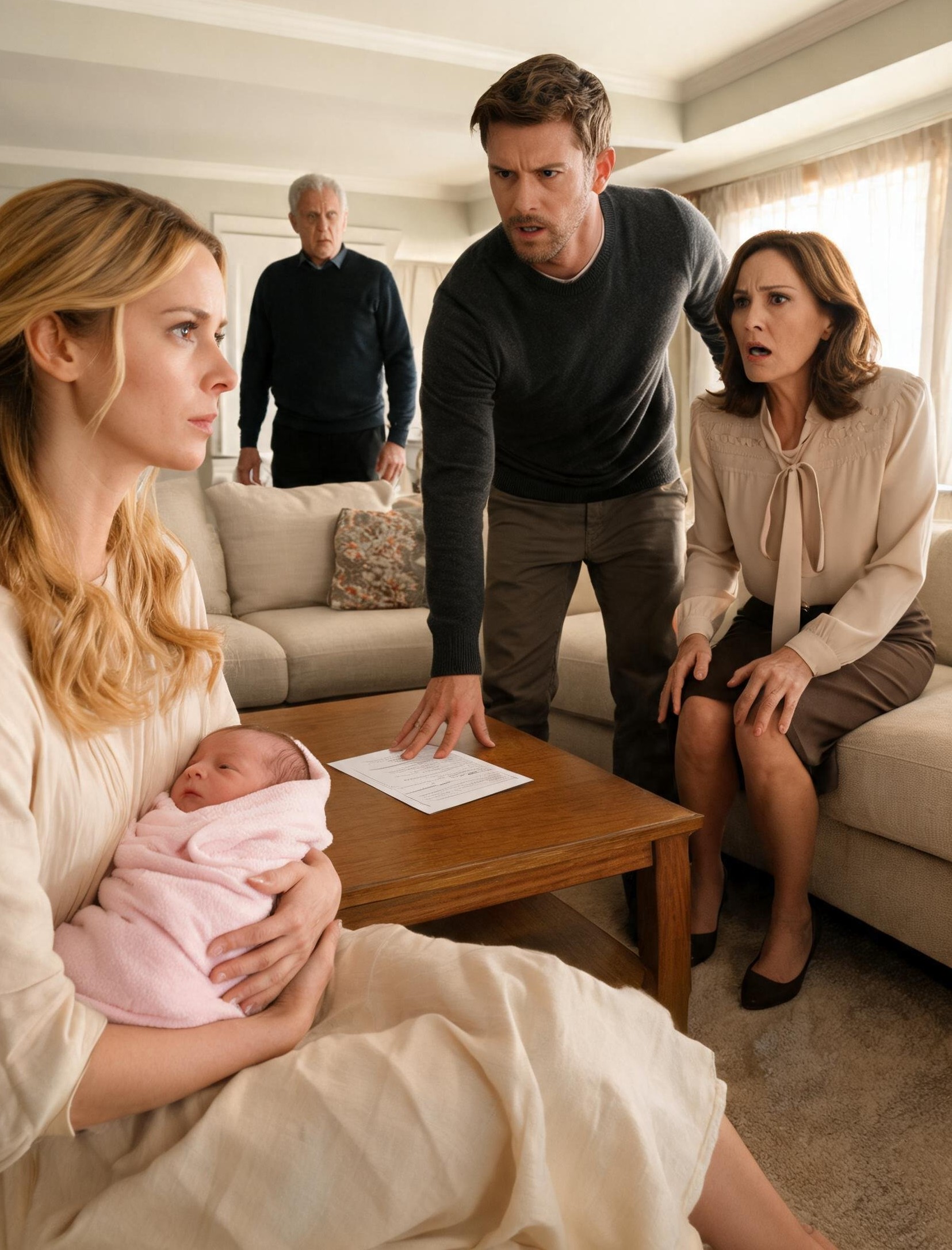
Three days after I gave birth, my mother-in-law looked me straight in the face, glanced at my newborn daughter, and told me to pack my things because “that baby might not even belong to this family.” My husband, Weston, stood six feet behind me and said nothing, which hurt more than the accusation because silence can sound exactly like agreement when you are exhausted, stitched, bleeding, and carrying a seven-pound baby against your chest. I had just walked through my own front door after leaving St. Catherine Medical Center in Charlotte, North Carolina, expecting a shower, clean sheets, and maybe two uninterrupted hours of sleep. Instead, Diane and Harold Sanders were sitting in my living room like a jury that had started deliberating before I arrived. And judging by the expression on Diane’s face, they had already found me guilty.
Harold stood beside the fireplace with his arms crossed over a navy sweater that probably cost more than our first apartment’s monthly rent, while Diane sat perfectly upright on my cream-colored couch with her purse beside her and her ankles crossed. “We’re not attaching the Sanders name to a child until we know she’s Weston’s,” Harold said, and he delivered the sentence with the calm confidence of a man announcing the weather. My daughter, Claire, made a tiny squeaking sound against my chest, and I automatically placed my palm over the back of her head. Weston finally moved, stepping into the room and saying, “Dad, what the hell is this?” Diane answered before Harold could, because Diane always answered questions that were meant for someone else.
“This is us protecting you,” she said, and her eyes never left my face. She explained that the Sanders Family Trust controlled several commercial properties, investment accounts, and voting shares in the distribution company Harold’s father had founded forty-two years earlier. She said there were rules about inheritance, rules about descendants, rules about protecting assets from “outside claims,” and she somehow managed to say all of it while looking at my three-day-old daughter like Claire was a suspicious invoice. Then Diane leaned forward, softened her voice, and delivered the insult she had obviously practiced. “If you have nothing to hide, Holly, you shouldn’t be offended.”
I didn’t scream. I didn’t beg Weston to defend me. I didn’t explain where I had been every night of my pregnancy. I didn’t list every appointment Weston had attended or every time he had felt Claire kick beneath his hand. I didn’t give Diane the emotional performance she had come to collect.
Instead, I looked at my husband and asked one question. “Did you know they were going to be here?” Weston’s face changed immediately, and that told me more than the answer did. “I knew Dad wanted to talk about the trust,” he said carefully, “but I didn’t know they were coming here today, and I definitely didn’t know they were going to say this.” Harold made an impatient sound and said Weston was being dramatic. Diane simply watched me, waiting for me to break.
“Pack a bag,” she said. “You and the baby can stay with your sister until this gets resolved.” That was the moment something inside me became very calm. Not numb, not weak, not frightened, just calm in the way I used to become before walking into a difficult negotiation at the architecture firm where I worked before maternity leave. I handed Claire to Weston, walked toward the kitchen, and ignored Diane when she asked where I was going. On the granite counter, underneath discharge instructions and a pharmacy receipt, was a plain white envelope Weston and I had received before leaving the hospital.
Two months earlier, Harold had made an offhand comment during dinner about the trust eventually requiring proof of parentage before any future beneficiary could be added. Weston had been furious, but I had told him I didn’t care, because I knew exactly who Claire’s father was and I refused to spend my pregnancy afraid of somebody else’s suspicion. Weston had arranged a voluntary parentage test through a hospital-affiliated laboratory before Claire was born, with the samples collected after delivery. He told me he wanted the issue dead before his father ever had a chance to weaponize it. The sealed report had been handed to us on discharge morning, and neither of us had even bothered to open it.
I walked back into the living room and held the envelope out to Weston. Diane’s eyes dropped to it first. Harold’s arms slowly uncrossed. Weston looked at me, then at the envelope, and I could see him understanding what I was doing. “Open it,” I said.
He tore the top carefully instead of ripping it. The room became so quiet I could hear Claire breathing through her nose. Weston unfolded the two-page report, read the first paragraph, then moved his eyes to the conclusion near the bottom. His jaw tightened. Then he looked at his mother.
“Probability of paternity,” he said, “greater than 99.99 percent.”
Harold stared at the rug. Diane blinked twice but said nothing. Weston placed the report on the coffee table between them, leaned down, and picked up Claire from my arms with the care of someone handling the most valuable thing he had ever owned. Then he looked at both his parents and said, “Get out of my house.” Diane started to protest, but Weston pointed toward the front door.
Harold told him not to be stupid. He reminded Weston that an emergency meeting of the Sanders trust was scheduled for Friday and that creating “family hostility” three days before a vote would have consequences. That sentence caught my attention immediately because Harold hadn’t said family dinner, apology, or conversation. He had said vote. I watched Diane look at him sharply, and for the first time since I walked into the house, I realized they were afraid of something bigger than Claire’s DNA.
Weston heard it too. “What vote?” he asked. Harold hesitated for half a second, which was half a second too long. Diane stood, picked up her purse, and told Harold they needed to leave. She walked past me without making eye contact, but when she reached the doorway, she stopped beside Weston.
“You think this paper solves your problem,” she whispered. “It doesn’t.”
Then she walked out.
The second the front door closed, Weston locked it, slid the deadbolt into place, and stood there with his forehead against the wood. I didn’t comfort him immediately because Claire had started fussing, and whatever disaster his parents had brought into our house could wait sixty seconds while my daughter ate. I settled into the armchair, tucked a blanket around her, and watched Weston pull out his phone. He called the locksmith who had installed our doors the previous year and asked him to change every exterior lock that afternoon. Then he removed the access code his parents had been given for emergencies.
“Did they have a key?” I asked. Weston nodded once. “Not anymore.” He sat opposite me and rubbed both hands over his face. “I should’ve thrown them out the second Dad opened his mouth.” I told him yes, he should have, and I watched the sentence hit him without softening it.
He apologized without defending himself. That mattered to me more than a dramatic speech would have. Weston had grown up in a house where Harold’s money entered every argument before Harold did, and Diane had spent thirty-three years teaching her son that keeping the peace was more important than identifying who had started the war. Weston knew that about himself. I knew it too.
At that afternoon, while the locksmith was replacing our deadbolt, Weston’s phone started vibrating on the kitchen island. His aunt called first, then his cousin Nathan, then a number I didn’t recognize, then another. Nobody asked how I was recovering. Nobody asked how Claire was doing.
They asked about Friday.
Apparently, Harold had called several relatives after leaving our house and told them Weston was “emotionally unstable” because of pressure surrounding the baby. Diane told another version in which I had produced a suspicious document and forced Weston to choose between his wife and his family. By dinner, I had somehow become the woman manipulating a sleep-deprived new father to seize control of an inheritance. Weston listened to three voicemails, deleted them, and turned off his phone. “They’re building a story,” I said.
He looked at me. “For what?” I pointed toward the paternity report. “I don’t know yet, but people don’t coordinate this quickly unless they need witnesses.” Weston’s expression changed. He immediately opened his laptop.
The trust documents were stored in a secure portal Weston rarely accessed because Harold had always managed the family’s legal affairs. It took twenty minutes to reset his password and another fifteen to locate the most recent governing agreement. I sat beside him with Claire asleep in a portable bassinet near my feet. We searched for the words paternity, descendant, beneficiary, incapacity, removal, and vote. What we found made Weston go completely still.
Friday’s meeting was not about adding Claire as a beneficiary. It was about extending Harold’s control as managing trustee for another ten years. Under the existing agreement, his authority expired at the end of the month unless a majority of adult beneficiaries voted to renew it. Weston owned the largest individual voting share after Harold. If Weston voted no, Harold needed almost every other beneficiary to support him.
There was more. Section Eleven allowed a trustee to temporarily suspend the voting rights of a beneficiary whose judgment was “materially compromised by fraud, coercion, incapacity, or an unresolved dispute concerning lineage.” The language was old, ugly, and broad. Weston read it twice. Then he looked at me with the same expression he had worn when his father mentioned Friday.
“They weren’t trying to prove Claire wasn’t mine,” he said. “They were trying to create a dispute long enough to stop me from voting.” I leaned back slowly. Suddenly Diane’s timing made perfect sense.
They had waited until I was three days postpartum. They had arrived without warning. They had demanded I leave the marital home. They had expected an argument, a separation, or some kind of public explosion Harold could describe to the other trustees as instability. And if Weston defended me too aggressively, Harold could claim his son was being coerced.
The sealed DNA report had destroyed the easiest version of that plan.
Weston called the trust attorney, Martin Keene, but Martin’s assistant said he was unavailable. Weston asked whether Friday’s vote would include a motion concerning his eligibility. The assistant went silent. Then she said she could not discuss trust matters without Martin’s authorization.
That silence was our answer.
The next morning, I woke after ninety minutes of sleep to find Weston sitting at the kitchen table with a legal pad, two cups of coffee, and every trust document printed in neat stacks. He had made a timeline. Harold’s first remark about “proof” had happened eight weeks earlier. The Friday vote had been scheduled six weeks earlier.
The dates overlapped too perfectly.
At nine, Weston called a lawyer who had no connection to the Sanders family, a woman named Melissa Grant whose firm specialized in estate disputes and fiduciary litigation. By noon, she was sitting in our dining room wearing a charcoal suit while Claire slept upstairs. Melissa read the trust, the lab report, and screenshots of messages from relatives. She asked very few questions.
Then she pointed to one sentence in Section Eleven.
“Your father can’t suspend you himself,” she said. “He needs the trust’s independent counsel to certify that a legitimate dispute exists.” Weston frowned. “Martin Keene.” Melissa nodded. “Exactly.”
I felt the room tighten.
“So Friday isn’t just a vote,” I said.
Melissa closed the document. “No, Holly. Friday may be an attempt to disqualify your husband before the vote ever begins.”
Weston looked toward the staircase where our daughter was sleeping.
Then his phone lit up with a message from Martin Keene.
DO NOT ATTEND FRIDAY’S MEETING UNTIL WE SPEAK PRIVATELY.
And beneath it was a second sentence.
DO NOT TELL YOUR FATHER I CONTACTED YOU.
Martin Keene refused to speak by phone. He asked Weston to meet him Thursday morning at a coffee shop twenty miles outside Charlotte, nowhere near the Sanders offices, and he specifically said not to bring Harold or Diane. Weston refused to go without his own attorney. Martin agreed immediately.
I stayed home with Claire, but Weston called me from Melissa’s car the moment the meeting ended. His first words were, “Dad lied about the trust.” I sat down on the edge of our bed.
Martin had shown them a memorandum Harold submitted two days before Claire’s birth. The memo claimed Weston had privately expressed doubts about whether I had been faithful during our marriage and requested guidance concerning Claire’s eligibility as a descendant. Weston had never said any such thing. The document had no signature from him.
But Harold had attached three screenshots.
Two showed messages from Weston’s old phone number. One said, “I don’t know what to believe about Holly anymore.” Another said, “Until the baby comes, none of us can know.” The third was a screenshot of a calendar entry supposedly showing a private meeting between Weston and Harold. Weston recognized the dates.
The messages were fake.
Melissa had already requested preservation of the trust’s electronic records, including metadata associated with Harold’s submission. Martin admitted that the screenshots had bothered him, especially because Harold had insisted they be kept confidential until the emergency meeting. Martin had contacted Weston after seeing how quickly the situation had escalated. He did not want his legal certification used as a weapon.
That was our first real victory.
Martin sent written notice that afternoon stating he would not certify any lineage dispute regarding Claire because current evidence established Weston’s paternity and because the underlying allegations appeared contested. Without Martin’s certification, Harold could not suspend Weston’s vote under Section Eleven. Twenty minutes after the notice went out, Harold called Weston eleven times. Weston did not answer once.
Diane called me instead.
I almost ignored it, but Melissa had told us not to block anyone yet because their messages could become evidence. I answered and put the call on speaker while Weston recorded the time and date. Diane began softly. “Holly, this has gone too far.”
“I agree,” I said.
She told me Harold had acted out of fear. She said the trust supported employees, properties, charities, and dozens of relatives, and that one reckless vote could damage generations of work. She never apologized for accusing me. She never apologized for entering my home three days after I gave birth.
Instead, she asked whether I could persuade Weston to skip Friday’s meeting.
I looked across the kitchen at Weston. He looked back at me but didn’t move. “Why would I do that?” I asked. Diane paused.
“Because you have a newborn,” she said. “You don’t need a war.”
That sentence told me everything I needed to know about Diane’s worldview. She believed peace meant everyone else surrendering before Harold had to experience consequences. She believed boundaries were aggression when they were drawn around her. And she believed motherhood had made me easier to frighten.
She was wrong.
“Then Harold shouldn’t have brought one into my living room,” I said, and ended the call.
Friday morning, Weston put on a dark suit while I stood beside the bassinet folding one of Claire’s blankets. He asked if I wanted him to stay home. I told him absolutely not. If he stayed because of what his parents had done, they would learn that cruelty worked.
I kissed him at the door and told him to vote exactly the way he would have voted before Claire was born.
The trust meeting took place in the top-floor conference room of Sanders Distribution Group. Melissa attended as Weston’s attorney. Martin attended as trust counsel. Harold sat at the head of the table.
Diane was there too, although she held no voting position.
Weston later told me the room felt less like a family meeting than a corporate hostage negotiation. Harold began by talking about stability, continuity, and the danger of impulsive change. He never mentioned me by name. He never mentioned Claire’s DNA report.
Then Weston asked Martin to distribute copies of Harold’s memorandum to every beneficiary.
Harold objected immediately.
Martin distributed them anyway.
Weston explained that he had never sent the messages attributed to him and had never asked his father to challenge Claire’s paternity. Melissa then announced that a forensic review of the electronic records had been requested and that any fabricated evidence submitted to influence fiduciary action could expose the responsible party to serious civil consequences. Nobody spoke for several seconds. Then Weston’s aunt Karen asked Harold a simple question.
“Did you create those screenshots?”
Harold did not answer.
He looked at Martin. Then Melissa. Then Weston.
Finally, he said, “I acted on information I believed to be accurate.”
It was the kind of sentence people use when the truth is standing too close.
The renewal vote failed.
Not narrowly either.
Three relatives who had planned to support Harold changed their votes after seeing the memorandum. Another abstained. Weston voted no.
Harold lost control of the trust at 11:43 Friday morning.
When Weston came home, he didn’t celebrate. He walked upstairs, washed his hands, picked up Claire, and held her against his chest for almost ten minutes without saying anything. I understood why. Winning something you never wanted to fight for doesn’t feel like victory at first.
That night, though, something happened that neither of us expected.
A courier arrived at our door with a padded legal envelope addressed to me.
Not Weston.
Inside was a handwritten letter from Weston’s grandmother, Evelyn Sanders, who had died nearly four years earlier.
And the first line said:
Holly, if you are reading this, then Harold finally used the baby clause.
I read the sentence three times before I continued. Evelyn Sanders had been ninety when she died, sharp until the final months of her life and far more observant than anyone in the family seemed to realize. She had always been kind to me, but we had never been especially close. I couldn’t imagine why she had written a letter specifically to me.
The letter was dated four months before her death.
Evelyn explained that Section Eleven had originally been created in 1989 after a distant cousin tried to insert a fraudulent heir into the trust. It was designed for actual fraud, not marital suspicion. Years later, Evelyn began worrying that Harold saw the provision less as protection and more as leverage. She had watched him use money to pressure relatives before.
She called it “the baby clause” because Harold once joked that the easiest time to control a man was when he was terrified of losing his inheritance and unsure of his own household.
My hands went cold when I read that line.
Evelyn had placed the letter with Martin Keene under instructions that it be delivered to Weston’s spouse only if Harold ever attempted to invoke Section Eleven against Weston’s child. Martin had released it after Friday’s meeting. There was no magical inheritance waiting for me. No secret fortune.
What Evelyn left us was better.
Evidence of pattern.
She listed two previous incidents in which Harold had threatened relatives with beneficiary disputes when they opposed him. Neither had become formal because both relatives backed down. One sold his voting interest. Another moved to Arizona and stopped attending meetings.
Suddenly, Harold’s confidence made sense.
This had worked before.
Weston sat beside me on the couch while I finished reading. “He didn’t invent this for us,” he said quietly. I shook my head. “No. We were just the first ones who made him finish what he started.”
Melissa received a copy of the letter that night. By Monday, she had contacted the other beneficiaries. Harold resigned from the board of Sanders Distribution Group before they could hold a removal vote.
Diane sent Weston a six-paragraph text accusing us of humiliating his father.
Weston replied with one sentence.
You humiliated yourselves in my home.
Then he muted her number.
For the first time since Claire’s birth, our house became quiet. Not the nervous quiet that follows a slammed door. Real quiet. I could feed my daughter at two in the morning without wondering whether another relative was going to call and demand an explanation for a lie I hadn’t created.
Weston took two weeks away from work.
We learned how to be parents.
We argued once about bottle sterilizers and once about whether the baby monitor volume was loud enough. We laughed when Claire sneezed so violently that she startled herself. We became ordinary again.
A month passed.
Then Harold asked to meet.
Melissa recommended a neutral location, so we agreed to a private conference room at her office. Diane came with him. Harold looked older than he had in our living room.
He apologized first.
He said he had allowed pressure surrounding the trust to distort his judgment. He admitted he had pushed a lineage question that should never have existed. He admitted he had wanted Weston’s voting rights delayed.
But when Melissa asked him directly whether he had created the fake screenshots, Harold stared at the table.
“No,” he said.
Weston’s eyes narrowed.
“Then who did?”
Harold looked at Diane.
It lasted less than a second.
Diane saw it.
Her expression hardened.
“I think this meeting is over,” she said.
Melissa stopped her before she could stand. “Mrs. Sanders, nobody has accused you of anything.”
Diane looked directly at her.
Nobody spoke.
Diane seemed to realize what she had just done.
Harold closed his eyes.
There are moments when a room changes because someone confesses. This wasn’t one of them. This room changed because a woman defended herself against an accusation no one had made.
Diane left without another word.
Harold remained seated.
He looked at Weston and said, “Your mother was trying to protect what she thought was ours.”
Weston’s voice stayed level. “By fabricating messages from me?”
Harold didn’t answer.
That was enough.
Over the next three months, the Sanders family changed in ways I never would have predicted. Harold stepped away from the company. A rotating group of beneficiaries took over temporary trust oversight.
Martin rewrote the procedures surrounding disputes so that no single trustee could manufacture an emergency around another beneficiary again.
And Weston did something his parents hated more than losing power.
He became happy without their approval.
We did not keep Claire from her grandparents forever.
But access came with boundaries.
They called before visiting.
They apologized directly.
They never mentioned bloodline, inheritance, family reputation, or the Sanders name around me again.
Slowly, cautiously, Diane began behaving like someone who understood that being a grandmother was a privilege instead of a title she could enforce.
For a while, I thought that might be the end of it.
Then, when Claire was seven months old, I received a certified letter from a law firm I had never heard of.
The envelope contained a notice stating that Diane and Harold Sanders intended to petition for court-ordered visitation.
That was bad enough.
The exhibit attached behind it was worse.
It was a DNA report.
And according to that report, Weston was not Claire’s father.
I didn’t panic. I didn’t call Diane. I didn’t call Harold.
I photographed every page, placed the originals back inside the envelope, and called Melissa.
She was at our house within an hour.
The report looked professional. It had Claire’s full name, date of birth, our hospital information, Weston’s name, laboratory seals, accession numbers, and a collection date matching the day after Claire was born. The conclusion stated that Weston Sanders was excluded as Claire’s biological father.
There was just one problem.
The real report was locked in our fireproof safe.
Melissa placed both documents side by side on our dining table.
Different accession numbers.
Same collection date.
Same laboratory.
Same child.
Weston stared at the second report for so long that I finally touched his wrist. “This is what they wanted the first time,” he said. I nodded.
Someone had created the evidence Harold needed.
But they had failed to use it before Friday’s vote.
The question was why.
Melissa contacted the laboratory’s compliance department before responding to the visitation petition. Because the case involved a potentially falsified medical record concerning a minor, the laboratory moved quickly. Two days later, a compliance officer joined us on a secure video call.
She confirmed our authentic report immediately.
Then she asked to examine the second report.
Her face changed.
“That accession number exists,” she said.
Weston leaned toward the screen. “So the report is real?”
“No,” she said. “The accession number is real.”
She explained that the number belonged to a second collection request entered into the system approximately twelve hours after Claire’s first sample was taken. The request had been canceled before testing. No valid result should have existed.
Melissa asked who submitted the request.
The compliance officer hesitated.
Then she said the laboratory would need written authorization before releasing the name because the record was now part of an internal investigation.
I looked at Weston.
Someone had tried to order a second paternity test while I was still in the hospital recovering from childbirth.
Someone who knew Claire’s exact hospital record number.
Someone who knew Weston had already requested testing.
Someone who believed they could get close enough to my newborn daughter to collect another sample.
The visitation petition suddenly looked very different.
Melissa filed our response the following morning. She attached the authentic DNA report, challenged the second document, and informed opposing counsel that its provenance was under investigation. Less than six hours later, Harold and Diane’s attorney withdrew from representing them.
He gave no public reason.
The visitation petition was dismissed without prejudice two days later.
Diane claimed she had no idea the DNA report was invalid.
Harold claimed he had never seen it until their lawyer prepared the filing.
For once, neither explanation interested me.
I wanted records.
Melissa subpoenaed communications related to the petition and sent formal preservation notices to Harold, Diane, the former trust office, and the law firm that had prepared the filing. The laboratory preserved its access logs. St. Catherine Medical Center opened its own investigation.
Then we waited.
Life kept moving because babies do not care about lawsuits.
Claire learned to sit.
Then crawl.
She developed a strange obsession with one wooden spoon in our kitchen and rejected every expensive toy anyone bought her.
Weston became the father I had always known he would be.
He worked fewer hours.
He stopped taking Harold’s calls out of obligation.
He started therapy, not because anyone forced him, but because he said he wanted Claire to inherit better habits than the ones he had received.
I watched him change.
I changed too.
Before Claire, I thought strength meant holding a family together.
After Claire, I understood that sometimes strength means refusing to hold together something that survives only by cutting you.
Nine months after she was born, Harold requested another meeting.
This time Diane did not come.
Harold looked exhausted.
He placed his phone on Melissa’s conference table and pushed it toward Weston.
“I should’ve given you this months ago,” he said.
There was a message thread on the screen.
The contact was saved as D.
The earliest messages were from the week before Claire’s birth.
D: Martin won’t move without documentation.
Harold: I’m working on Weston.
D: He won’t turn against her.
Harold: Then we only need doubt long enough to delay his vote.
D: I can get the hospital information.
Harold: Do not do anything stupid.
The next message arrived two days later.
D: It’s handled.
I felt my pulse beating in my throat.
Weston scrolled further.
There were messages about the screenshots.
Messages about wording.
Messages about what relatives should be told.
But there was nothing explicitly saying Diane had created the second DNA report.
Harold watched us read.
“She told me she had a contact who could help confirm whether the baby was Weston’s,” he said. “I thought she meant legally.”
Melissa’s expression didn’t move. “And when you saw fabricated messages supposedly sent by your son, you still used them.”
Harold looked down.
There it was.
Not redemption.
Not innocence.
Just a smaller piece of guilt than the one he had originally been carrying.
Weston stood.
“I don’t know if I’ll ever forgive you,” he said.
Harold nodded once.
Weston and I left together.
That could have been the ending.
Maybe in a cleaner story, it would have been.
Diane would have confessed, Harold would have apologized, the trust would have changed, and our daughter would have grown up hearing a sanitized version about how her grandparents once made a terrible mistake.
Real families rarely wrap themselves that neatly.
Three weeks later, Melissa called at in the morning.
Her voice was controlled.
“Holly, I need you and Weston in my office today.”
“What happened?”
“The hospital released its access audit.”
I looked across the kitchen at Weston feeding Claire pieces of banana.
Melissa went silent for one second.
“Diane’s name isn’t in it.”
I stopped breathing.
“Whose is?”
“I’m sending you the first page.”
My phone vibrated.
I opened the attachment.
The hospital had logged an unauthorized attempt to access Claire’s newborn record at a.m., roughly eleven hours after her birth. The user had opened the section containing identification details, specimen information, and the order for the original paternity test. The access came from a nursing workstation on the maternity floor.
The employee credential did not belong to Diane.
It belonged to a nurse named Rebecca Cole.
I had never heard that name.
Weston hadn’t either.
Melissa kept talking.
Rebecca had resigned from St. Catherine four days after Claire was born.
She had moved out of North Carolina less than a week later.
And according to investigators, nobody at the hospital could explain why she had accessed Claire’s chart.
That afternoon, Melissa obtained Rebecca’s employment file.
There was no obvious connection to Harold.
No obvious connection to Diane.
No obvious connection to the Sanders company.
Then I saw her emergency contact.
I recognized the last name.
I stared at the page.
She turned toward me.
I pointed at the line.
Rebecca Cole’s emergency contact was listed as Martin Keene Jr.
The trust attorney’s son.
The same Martin Keene who had warned Weston not to attend the Friday meeting.
The same Martin Keene who had protected Weston’s voting rights.
The same Martin Keene who had held Evelyn’s letter for four years.
Weston read the line over my shoulder.
His face went white.
My phone rang before any of us could speak.
Unknown number.
Melissa told me not to answer.
Then a voicemail notification appeared.
I pressed play on speaker.
A woman’s voice whispered through static.
“Holly, my name is Rebecca Cole. I worked at St. Catherine when Claire was born.”
She took a shaky breath.
“I didn’t fake the DNA report.”
Another pause.
“But I know who did.”
Weston gripped the edge of the table.
Rebecca continued.
“And before you trust Martin Keene again, ask him why your daughter’s name appeared in the Sanders trust seventeen months before she was born.”
The message ended.
Nobody moved.
I looked at Claire sleeping in her car seat beside us.
Seventeen months before she was born.
Before I was pregnant.
Before Weston and I had even started trying for a baby.
And suddenly I understood the most terrifying part of everything that had happened.
The accusation in our living room had never been the beginning.
It was only the moment we finally noticed the plan.
✓ Lynn R. Adams
Three Days After I Gave Birth, My In-Laws Ordered Me Out—Then My Husband Opened the Envelope They Never Expected Three days after I gave birth, my mother-in-law looked me straight in the face, glance…