They Tore Down Her Dam Over Unpaid Fees — Seconds Later, Their Entire Neighborhood Began to Vanish
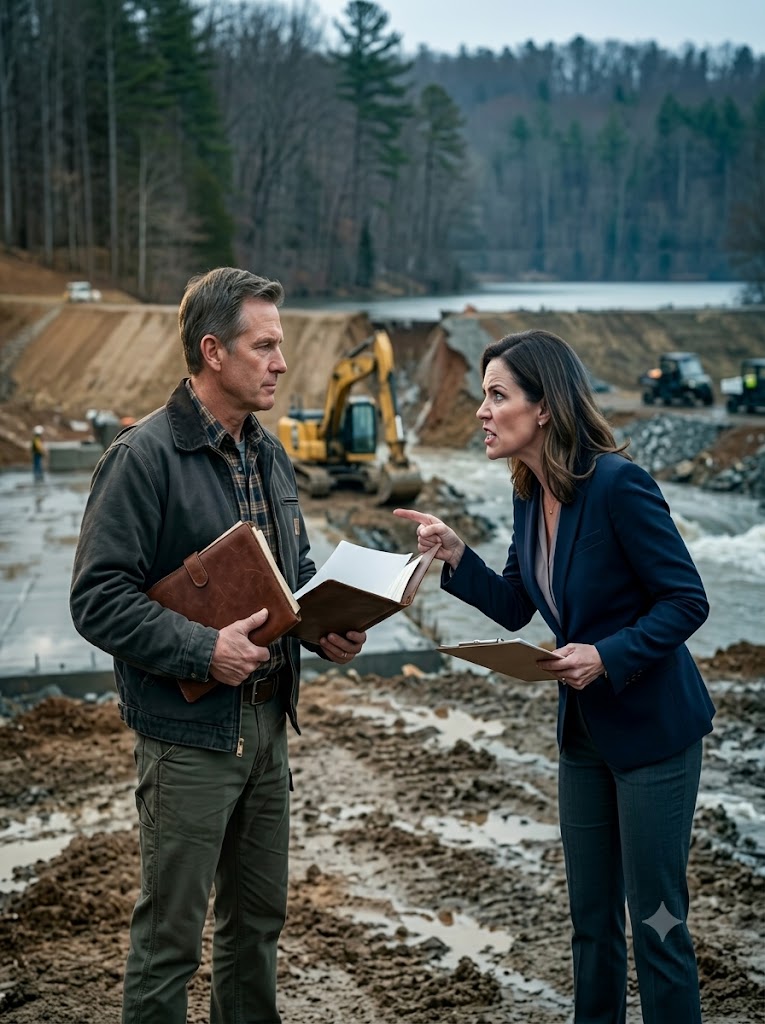
They Tore Down Her Dam Over Unpaid Fees — Seconds Later, Their Entire Neighborhood Began to Vanish
What would you do when the very structure they called useless and illegal was the only thing holding their world together?
The excavator’s bucket bit deep into the earthen wall, and I stood frozen on my porch watching every shovelful fall. “It’s for the common good!” the HOA president shouted over the roar of the engine, as if destruction could ever be good. “You refused to pay, so you get no protection!” He and the board had decided my small dam was a nuisance, a hazard, something they could sweep away to prove their power. They didn’t know it had been built to hold back more than water. They didn’t know it was the only thing standing between their homes and the valley’s buried past.
I did not scream or throw myself in front of the machine. I did not beg them to read the old engineering reports I had stacked on my desk. I did not list the names of the people who built this ridge and warned exactly what would happen if the barrier failed. I did not waste breath explaining science to men who only wanted to flex authority. I did not let them see my hands tremble even as the first crack spread across the dam’s face. I did not speak — because I knew the truth would speak louder than any warning I could give.
I watched the water rise behind the breach, slow and steady and inevitable. I watched the men laugh as the earth gave way, thinking the mess would be mine alone to clean. I watched them pack up their tools and dust off their hands, already celebrating a victory they would never live to enjoy. I stood perfectly still and waited for the moment they understood. I did not have to say a word. The land would say it all.
My name is Mara Hale. I bought this property on the upper edge of Willow Ridge three years ago — forty acres, a modest cabin, and a narrow stream I’d reinforced into a small dam and retention pond. The previous owner, an old civil engineer named Elias, had handed me a thick binder the day we signed. “Keep that dam strong,” he’d said, eyes steady. “Not just for you. For everyone downhill. This whole subdivision sits on old fill. Loose soil. Ancient slides waiting to wake up. That structure holds the slope. Don’t ever let anyone touch it.”
I followed his instructions exactly. I inspected the spillway every month. I cleared debris after storms. I kept the water level steady, never too high, never too low. And every year, I paid my dues — until this year.
The HOA board had raised fees without notice, doubled them without explanation, and refused to show me the budget. When I asked for receipts, they sent threats. When I questioned the spending, they labeled me delinquent. They tacked a notice to my door: Pay or we take action. I sent certified letters. I attended meetings. I quoted state law and county codes. They laughed in my face. “We make the rules here,” President Roland Voss told me. “And we decide what’s safe.”
Two days later, they showed up with heavy equipment. No permit. No inspection. No notice beyond the one I’d already disputed. Just men with machines and a hunger to prove they could.
The breach happened fast. Water burst through the gap they’d carved, brown and churning, rushing down the channel they thought was just a drainage ditch. I grabbed the binder, my emergency bag, and drove uphill to high ground, phone in hand, watching through the rearview mirror.
At first, nothing but muddy water. Then the ground rumbled. A low, deep vibration that traveled through the tires and up my spine. The retaining wall supporting the first row of houses bowed outward. Cracks snaked across driveways like lightning. A mailbox tilted, then fell. And then the slope simply gave way.
Not all at once — first a slow, sad crumbling. Then a roar as the saturated soil turned to slurry and began to slide, carrying fences, trees, and foundations with it. Neighbors poured out of their homes in robes and slippers, staring in horror. Voss stood in the street, jaw hanging open, unable to speak as the road before him split in two.
I called 911. I gave exact coordinates. I stayed on the line until dispatch confirmed rescue teams were rolling. Then I sat and watched as Elias’s warning unfolded exactly as he’d written it. The dam hadn’t just held water — it had slowed its descent, let the earth drink it in, kept the groundwater table steady and the slope compacted. Without it, every inch of rain held in the ground all at once, heavy and hungry, seeking the path of least resistance. And that path ran straight through their subdivision.
By sunset, three homes had partially collapsed into the slide zone. Five more were red‑tagged. Streets were buckled and impassable. Power lines dangled like frayed strings. The evacuation order covered nearly the entire development. And still, Voss tried to blame me. “She should’ve maintained it!” he shouted to a news crew, face streaked with mud and panic. “It was her responsibility!”
I stepped forward then, calm and steady, and held up the binder. “I maintained it perfectly. I have logs, photos, receipts, and inspection reports dating back three years. What you destroyed was engineered specifically to stabilize this slope. The county signed off on it in 1998. You didn’t remove a nuisance. You removed the only protection this neighborhood had.”
I laid out the facts — the original geotechnical surveys, the letters from the previous owner, the emails I’d sent asking for data they never provided. Reporters scribbled. Neighbors listened, their anger shifting fast from me to the men who’d endangered them.
That night, I sat in a hotel room, Elias’s binder open before me, and kept reading. Tucked in the back, beneath a faded map, was a note in his handwriting: They know. They’ve known since the subdivision was built. The developer cut corners. The permits were rushed. They built on a slide plain and hoped no one would notice. That dam was the only thing keeping the truth buried. If it falls, everything comes down.
My blood turned cold. They hadn’t acted out of ignorance. Not entirely. I dug deeper. I pulled county records. I cross‑referenced names. Roland Voss had been on the board when the development was approved. He’d worked for the construction company that built it. He’d signed off on reports that claimed the ground was stable — reports I now knew were falsified.
They hadn’t just been angry about fees. They’d been afraid I’d ask too many questions. Afraid I’d show those reports to someone who understood what they meant. Afraid the dam’s very existence would prove they’d gambled with every home in the neighborhood. Destroying it wasn’t punishment. It was a desperate attempt to hide the evidence by letting the land swallow it.
The next morning, the county engineer called me. His voice was grim. “Mara, what you sent matches what we just found in the archives. The whole lower section sits on ancient slide deposits. The dam was engineered as mitigation. Without it, we’re looking at continued movement — possibly for months. Maybe years.”
I shared everything publicly. I posted documents, maps, timelines. The story spread. Neighbors who’d sneered at me days earlier now stood beside me. Their anger was sharp and personal. They’d trusted these men with their homes, their savings, their children’s safety — and they’d been played.
But Voss didn’t back down. He doubled down. He called the records forgeries. He accused me of altering the site. He filed a restraining order claiming I was harassing the board. And he vanished from public view, appearing only in carefully worded statements blaming “unforeseen weather events.”
I kept digging. I found the original correspondence between the developer and the engineering firm. A handwritten addendum: Do not include slope stability warnings in final report. Dam will suffice as control structure. Keep it off disclosure forms. Signed by none other than Roland Voss.
He’d known. Every single day. He’d known and he’d built anyway. And when I showed up, careful and consistent, asking questions, he’d decided to eliminate the proof rather than answer them.
The district attorney opened an investigation. The state launched its own review. Class‑action lawyers began contacting families. And still, the ground moved. New cracks appeared daily. Another house shifted an inch overnight. Evacuation zones expanded. People were losing everything — and they were starting to realize I was the only one who could’ve stopped it.
Late one evening, a knock came at my temporary door. Not a neighbor. Not a reporter. A woman in a plain coat, eyes tired but sharp. “I worked with Voss at the company,” she said quietly. “I kept quiet for twenty years. But seeing those people lose their homes… I can’t anymore.”
She handed me a thumb drive. “Emails. Internal memos. Cost‑benefit analyses. They knew the dam was critical. They planned to remove it all along — once enough time passed that no one would connect it to the slides. Your dispute gave them the excuse they were waiting for.”
I plugged it in. File after file confirmed the worst. They’d targeted me specifically — inflated fees, fabricated violations, manufactured urgency — all to justify demolition before I could alert the authorities. I hadn’t run afoul of the rules. I’d run afoul of their schedule.
And there was more — a plan to divert the stream entirely, sell the exposed slope to a luxury builder, and walk away with millions before anyone realized the danger. The dam had stood in their way from day one. I was just the obstacle they’d used as cover.
I sat back, breath catching. This wasn’t negligence. It was calculated theft. And the cost had been paid in homes and hope and fear.
I sent copies to every authority I could reach. I shared the full archive publicly. The response was electric — and terrifying. Within hours, Voss’s home was surrounded by cameras. Board members resigned one by one. Arrest rumors spread fast.
But that night, my phone buzzed with a text from an unknown number: You have what you need. Walk away. More will get hurt if you keep pushing.
I replied: It’s already public. Too late to hide.
The reply came instantly: Nothing is fully public. Not yet. Look at file 47. The one you haven’t opened.
I pulled it up. A scanned letter, dated six months before the subdivision broke ground, addressed to Voss. One more condition: the Hale family must not own land on the ridge. If they hold the upper property, they control the water. Buy them out or push them out. They know too much.
I stared at the screen. Hale. My last name. Elias’s last name. We weren’t just neighbors. We were family — distant, but connected. And they’d targeted this land long before I arrived. Elias hadn’t just sold me a house. He’d passed me the guardianship of a secret generations old.
I called the woman who’d given me the drive. “What else is there?”
She hesitated. “They didn’t just target Elias. They waited for someone they could push around. Someone alone. Someone they thought wouldn’t fight. They didn’t know you were Hale too.”
My blood ran cold. They hadn’t destroyed the dam because of fees. They’d destroyed it because of who I was. And Elias hadn’t died peacefully in his sleep, as I’d been told. His death certificate said heart failure — convenient, common, hard to question. But the note in file 47 said: The previous owner is gone. The path is clear.
I grabbed the drive, backed everything up, and prepared to leave. But as I reached the door, headlights swept across the room. A vehicle idled outside — not an official car. Not a neighbor. Dark, unmarked, waiting.
My phone buzzed one last time: You think this ends with Voss? He’s not the top. He never was. They’re coming for the rest of the evidence now. And they already know where Elias kept the original — buried where the stream bends, beneath the stone marked with three lines.
I froze. That spot. I’d seen it. I’d walked past it. I’d never guessed what lay beneath. And now they were going there right now — not just to destroy what remained, but to finish what they started twenty years ago.
✓ Lynn R. Adams
They Tore Down Her Dam Over Unpaid Fees — Seconds Later, Their Entire Neighborhood Began to Vanish What would you do when the very structure they called useless and illegal was the only thing holding…