They Tore Down Her Bridge on Christmas Morning — Until 299 Families Learned Who Truly Controlled Their Only Escape
They Tore Down Her Bridge on Christmas Morning — Until 299 Families Learned Who Truly Controlled Their Only Escape
What do you do when the people who swore to protect you cut off your only way out — and you find out they never had the right to own it in the first place?
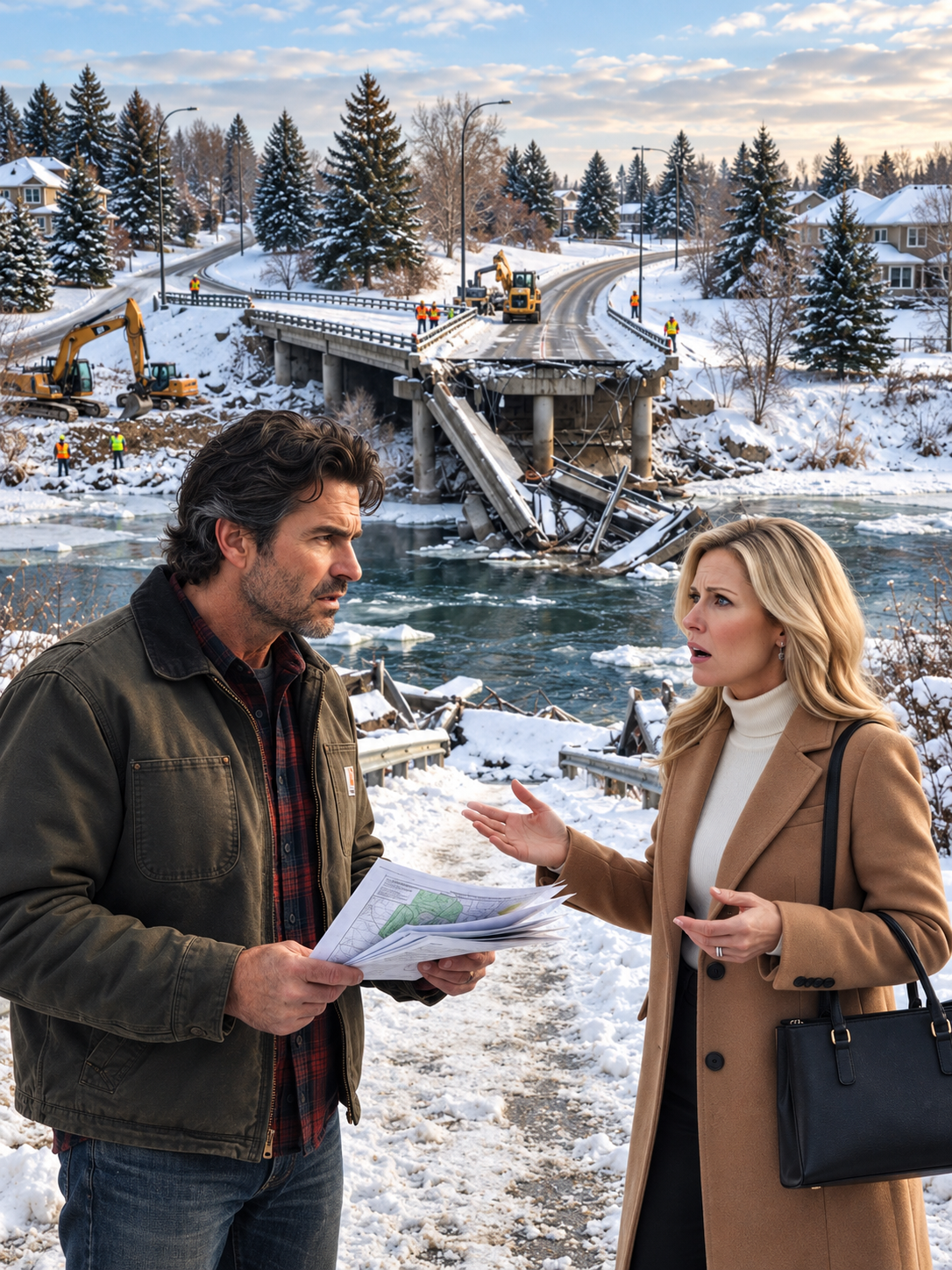
I woke up to the sound of cracking wood and grinding metal before the sun came up on Christmas Day. I pulled on my coat, stepped out onto the porch, and watched in horror as the excavator tore apart the planks my grandfather had laid by hand sixty years earlier. The HOA president stood on the far bank, hands on hips, and shouted across the rushing water: “Public safety hazard! We’re doing this for the good of everyone!” He didn’t know that bridge wasn’t just a path to the main road — it was the only thing connecting three hundred families to the outside world, and I held the deed that proved it had never been theirs to touch.
I did not scream or run down the bank throwing accusations. I did not beg them to stop or tell them stories about my grandfather’s hands. I did not let them see how cold my chest felt or how tight my throat grew. I did not waste breath arguing with men who had already made up their minds to destroy what was mine. I did not demand they rebuild it right then — I asked them to show me the paper that gave them the right to take it down. I did not know their answer would unravel everything this neighborhood had believed for twenty‑five years.
I walked back into the house and pulled the old leather binder from the highest shelf. I traced the inked lines, the faded signatures, the boundaries written in language no one had bothered to read in decades. I compared the plat map to the subdivision papers. I matched dates, names, and signatures. I did not look for a loophole — I looked for the truth. And what I found was bigger than a bridge.
I sat at my kitchen table long after the excavator left, the sound of the river filling the silence, and realized they hadn’t just targeted my crossing. They had targeted all of us. And they had been waiting for this moment since the day the first house was built.
My name is Clara Moore. My family has lived on this side of the valley since 1922. The subdivision came in the late nineties — neat streets, matching mailboxes, a gate that never quite closed. The developers built a second road entrance on the far side, but it washed out in a storm three years later and was never repaired. Since then, every single resident relied on the Moore Bridge to get to work, to school, to the hospital, to everything. And the HOA had just demolished it on Christmas morning without a warning, without a vote, without a plan.
By noon, cars lined up on both sides of the river. People stood in the cold, phones in hand, calling the board, the sheriff, the county — and getting the same answer: The board declared it unsafe. The crossing is closed. No further comment.
I drove to the nearest access point and stood before the crowd — neighbors I’d waved at, baked cookies for, shared holidays with. “They said it was a hazard,” I told them, holding up the binder. “But the county inspection from six weeks ago says otherwise. It passed. Fully. And more than that — this bridge sits on private land deeded to my family in 1947. The HOA does not own it. They never maintained it. They never paid for it. And they never had the legal authority to remove it.”
Murmurs rippled through the crowd. People turned to Roland Voss, the board president. He stepped forward, red‑faced and sharp. “That’s a technicality! The easement gives us control! The road belongs to the community!”
“The easement allows public access,” I said, steady and clear. “It does not give you ownership. It does not give you permission to destroy the structure. And it certainly does not give you the right to cut off three hundred families from the world beyond this valley.”
He laughed, brittle and loud. “You’re one person. We’re the board. We decide.”
“That’s what I thought too,” I said. “Until I read the original subdivision agreement. The one signed in 1998. It states clearly: If primary access is lost or closed, all common property reverts to the original landowner. The original landowner is my grandfather. And I am his sole heir.”
Silence fell so deep you could hear the water rushing below. Someone gasped. A woman stepped forward, voice trembling. “What does that mean?”
“It means,” I said, “that when they knocked down this bridge, they didn’t just break a promise. They triggered a clause that transfers every street, every park, every green space, and every road in this entire subdivision into my name. All of it.”
Voss went pale. “That’s… that’s impossible. We own this. We pay dues!”
“You pay for maintenance,” I said. “You never owned the land beneath your homes. The developer kept it. He sold the houses, but not the ground. And when he died, it all went to my grandfather. And now it belongs to me.”
The crowd shifted fast — confusion turning to alarm, alarm turning to anger. “We’ve been paying for twenty‑five years!” “Where were the disclosures?” “Why didn’t anyone tell us?”
Voss backed away. “This is a lie. A forgery. We’ll see you in court.”
“Take me to court,” I said. “But every lawyer I’ve spoken to says the language is clear, the signatures are authentic, and the clause is ironclad. You tore down the bridge. You triggered the transfer. And now — you answer to me.”
I didn’t gloat. I didn’t demand anyone move out. I went home and posted the full documents online — the deed, the agreement, the inspection report, everything. I sat back and watched the truth spread across neighborhood group chats and news feeds faster than winter floodwater.
That evening, a knock came at my door. It wasn’t a neighbor. It was a woman I’d seen at board meetings — quiet, usually sitting in the back, never speaking. “I was the secretary,” she said, voice low. “I saw the emails. Voss didn’t declare the bridge unsafe. He got an offer. A huge offer. A developer wants to build a private resort on the far side of the ridge. They need this valley — all of it. And they told him to cut off access so property values would crash.”
My blood ran cold. “Who?”
She handed me a printed page. A shell company registered to an address downtown. A name I recognized — connected to Voss’s brother, to the abandoned road project from years ago, to the same family that had tried to buy my grandfather’s land three times before.
“They’re counting on panic,” she said. “People will sell cheap just to get out. They’ll buy every lot, close the valley to outsiders, and build walls. And Voss? He gets paid millions. He knew the clause existed. He thought you’d never find it. He thought you’d just leave.”
I stayed up all night digging. I found the offer letter. The timeline. The bank transfers. The plan was precise: demolish the bridge → cut access → force mass sell‑off → seize the valley → build an exclusive resort with no public entry. And they’d timed it for Christmas because they knew everyone would be distracted, families would be visiting, and no one would have time to organize before the first deadline hit.
The next morning, the first listing appeared — a house down the road, priced forty percent below market. Then another. And another. Panic was setting in. I called an emergency meeting at the community center and laid out the full truth — the scheme, the buyers, the clause, the resort.
“I am not asking you to trust me,” I told them. “I am asking you to look at the documents. To read the agreements. To see who has been working for you — and who has been working against you. The bridge can be rebuilt. Better, stronger, permanent. But only if we stand together. If we sell now, we lose everything — our homes, our community, our right to decide what happens here.”
The room was quiet for a long moment. Then someone stood. “I’m not selling.” “Neither am I.” “We rebuild.” “We fight.”
But not everyone agreed. That night, I found a note taped to my door: You hold the deed. They hold the power. Don’t make them angry.
I kept digging. I found something deeper — a handwritten note tucked in the margin of the original agreement, dated the day before signing: The buyer knows the clause. He is gambling no one will ever enforce it. If the bridge falls, the valley changes hands. Tell no one. Signed by my grandfather.
He had known. He had written it himself. And he had left it for me.
Two days later, the sheriff arrived at my door. “Cease and desist,” he said. “The developer is claiming the land was transferred to them three years ago. They have a deed. They have signatures. They’re ordering you to vacate the property.”
I took the paper. The signature was my grandfather’s — but the date was three years after he died. It was a forgery. Bold, blatant, clumsy. And it had been filed with the county clerk’s office by none other than Roland Voss.
I gathered everything — the original will, the death certificate, the handwriting analysis, the witness statements, the emails proving the plot. I sent copies to the DA, to the state attorney general, to every news outlet in the region. The story exploded. Reporters showed up. Investigators called. Neighbors stood guard at the bridge site.
But the threats escalated. My power was cut. My tires were slashed. Someone threw a rock through my window with a message scrawled on it: Walk away. You can’t win.
I didn’t walk away. I filed a counterclaim. I requested a temporary restraining order. And I prepared to rebuild the bridge — legally, safely, with the community standing beside me.
Then late one night, my phone rang. An unknown number. A voice I knew — the county clerk, the man who had filed the forged deed. “Don’t do it,” he whispered. “The transfer isn’t just about the resort. They’re covering up something beneath the valley. Something buried long before any of us were born. If you dig too deep, you won’t just stop a sale. You’ll expose a secret powerful people have killed to keep.”
“What is it?” I asked.
Silence. Then: “The bridge isn’t just a crossing. It’s a marker. It sits exactly above where the tunnel entrance was sealed in 1955. What’s down there… it’s not empty. And they don’t want anyone to know it still goes all the way through the mountain.”
The line went dead.
I sat in the dark, the phone in my hand, and remembered the stories my grandfather used to tell — the old passage, the men who walked into the mountain and never came out, the promise that one day it would be needed again. I’d thought they were fairy tales. Now I knew: they were warnings.
They hadn’t just destroyed the bridge to cut off access. They’d destroyed it to hide the entrance. And they knew exactly what would be found if anyone ever started digging where the planks used to be.
✓ Lynn R. Adams
They Tore Down Her Bridge on Christmas Morning — Until 299 Families Learned Who Truly Controlled Their Only Escape What do you do when the people who swore to protect you cut off your only way out — …