They Threw Her Out at 19, So She Bought a $10 Rusted Hut—Then the Deed Inside Took Everything Back
They Threw Her Out at 19, So She Bought a $10 Rusted Hut—Then the Deed Inside Took Everything Back
Three days after burying her mother, nineteen-year-old Grace Monroe came home from the cemetery and found every piece of clothing she owned stuffed into black contractor bags on the front lawn.
Her aunt Denise stood in the doorway with Grace’s suitcase beside her and said, “Your mother spent twenty years taking from this family. You don’t get to keep doing it just because she finally died.”
Grace didn’t cry.
That was the first thing that frightened Denise.
The second was that Grace didn’t argue.
She simply looked at the six trash bags sinking into the wet October grass, then at her uncle Rick standing behind Denise with his arms crossed, then at her cousin Mason leaning against Grace’s mother’s old Subaru as if he already owned it.
Rain clicked against the porch roof.
The Monroe farmhouse sat on 312 acres outside Millhaven, Missouri, land that had been in the family for nearly a century.
Grace had grown up believing it belonged to everyone.
That was what her mother, Claire, had always said.
“This land fed us before we were born,” Claire used to tell her. “So we don’t get to act like we invented it.”
Apparently Denise remembered the sentence differently.
“The car stays,” Denise said.
Grace glanced at the Subaru.
“My mom paid for it.”
“It was registered through the farm company.”
Grace nodded once.
“And my laptop?”
“Farm property.”
“My grandmother’s sewing machine?”
“House property.”
“The cedar box Mom kept in her closet?”
Denise’s mouth tightened.
“Family property.”
That one mattered.
Grace had seen her mother take the cedar box down only twice in her life.
Once when Grace’s grandmother Eleanor died.
Once six months before Claire herself died.
Both times, Claire had locked her bedroom door.
Grace looked past Denise into the hallway.
The space where the cedar box had sat on the antique console table was empty.
Something cold settled inside her.
Something quieter.
Something with edges.
“You have until dark,” Denise said.
Grace bent and picked up the first garbage bag.
Mason laughed.
“That’s it?”
Grace didn’t look at him.
“What did you expect?”
“I don’t know. Screaming. Begging. Maybe some speech about how Aunt Claire sacrificed everything.”
That made Grace stop.
Only for a second.
Claire had sacrificed everything.
At twenty-seven, she had left nursing school when Eleanor suffered a stroke.
At thirty-one, she had turned down a job in Kansas City because Rick said the farm couldn’t afford outside bookkeeping.
At thirty-eight, she had refinanced her own car to cover payroll during a bad harvest.
At forty-three, when Denise wanted to sell twelve acres to a gas-station chain, Claire had fought it because Eleanor had once used the old tenant houses there to shelter women escaping violent husbands.
And during the final fourteen months of Claire’s cancer, she had worked from a recliner with a blanket over her knees because Rick kept telling her the farm books were “too complicated” for anyone else to understand.
Grace knew because she had watched it happen.
She had watched her mother answer payroll emails after chemotherapy.
She had watched her mother drive Eleanor to neurologists.
She had watched her mother cook Thanksgiving dinner while Denise arrived carrying one bottle of wine and left with three containers of leftovers.
She had watched Rick call Claire “the dependable one” whenever he needed something.
She had watched Mason joke that Claire was “basically the family secretary.”
And now the dependable one was dead.
Now the secretary was dead.
Now the woman who never sent an invoice was dead.
Now the woman who never demanded credit was dead.
Now everybody who benefited from her silence had decided her silence meant she owned nothing.
Grace picked up the second bag.
Denise mistook that silence for surrender.
That would become the most expensive mistake of her life.
By that evening, Grace owned everything she could carry.
Four trash bags of clothes.
A backpack.
A pair of work boots.
Thirty-eight dollars in cash.
Her mother’s cheap silver necklace.
A framed photograph she had slipped from the kitchen before leaving.
And a folded yellow receipt from the Millhaven County Treasurer’s Office that she had almost forgotten existed.
Grace found it while sitting beneath the covered picnic pavilion at Riverside Park, where she planned to sleep.
She had emptied her backpack looking for a phone charger.
The receipt fluttered out.
COUNTY SURPLUS PROPERTY AUCTION.
Former Monroe Pump Shelter.
Minimum Bid: $10.
Grace stared at it.
Two weeks earlier, while Claire was still alive but unconscious in hospice, the county had published a list of tiny tax-forfeited parcels.
Grace had noticed the Monroe name.
She had driven past the parcel once.
Calling it a pump shelter was generous.
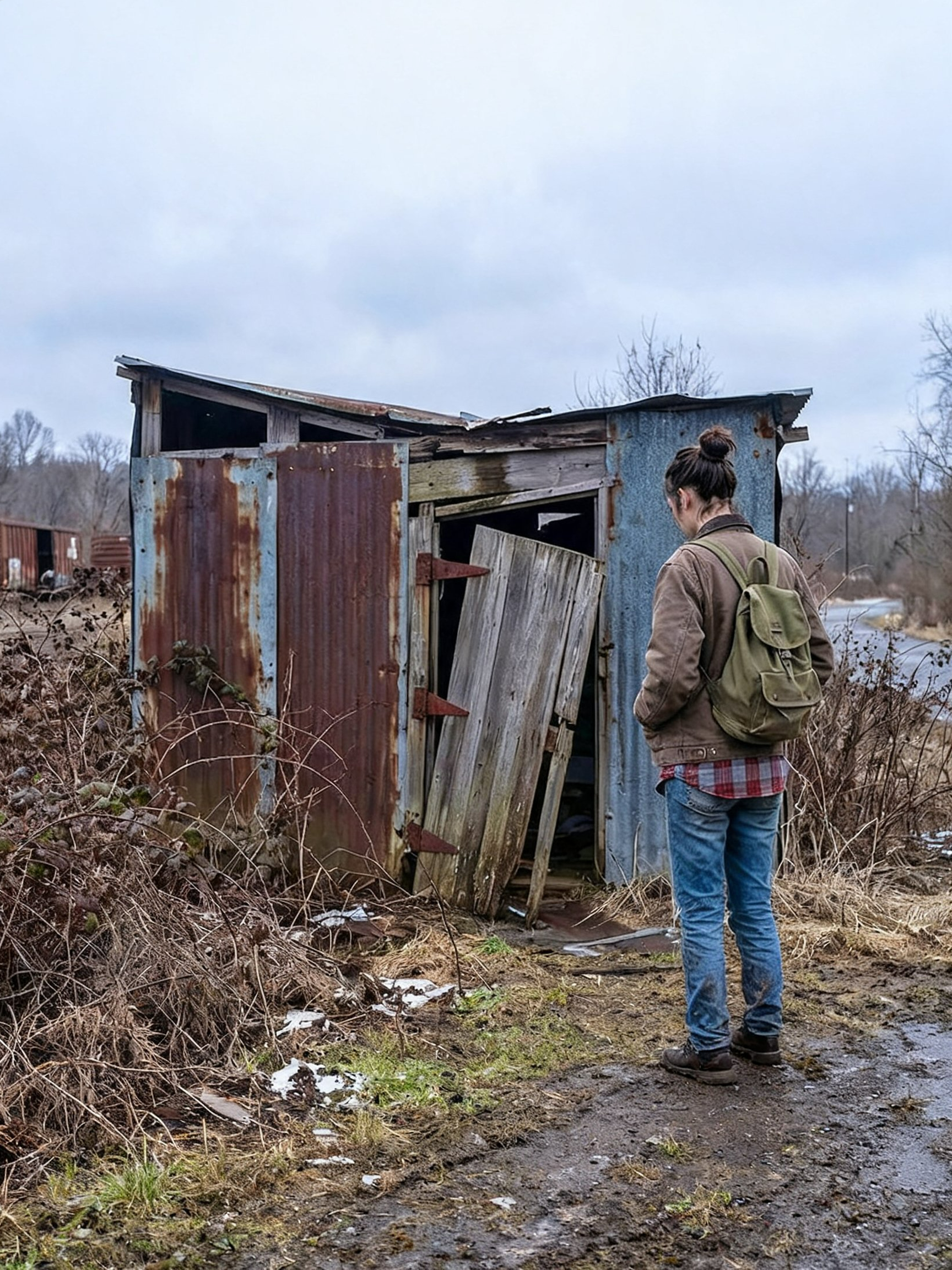
It was a rusted metal hut at the edge of the northern woods, maybe fourteen feet by twenty-two, with corrugated siding, a crooked chimney, a caved-in corner of the roof, and weeds as tall as Grace’s shoulders.
Everyone called it the Tin Shack.
No utilities.
No real driveway.
Denise had laughed when Grace mentioned the auction.
“Ten dollars is nine dollars too much.”
Grace looked at the receipt again.
The auction started at nine the next morning.
At , she walked into the county administration building wearing yesterday’s jeans and carrying her entire life in a backpack.
Six people were there to bid on old vehicles and equipment.
Nobody wanted Lot C-17.
When the clerk announced it, he looked over his glasses.
“Former agricultural utility parcel. Point-one-eight acres. Structure condemned. Buyer assumes cleanup obligations. Opening bid ten dollars.”
Grace raised her hand.
A man in a camouflage cap chuckled.
The clerk waited.
“Any advance?”
“Going once.”
Grace could hear her heart.
“Going twice.”
Someone coughed.
“Sold. Ten dollars.”
The clerk brought the stamp down.
Grace Monroe became a landowner before breakfast.
It left her with twenty-eight dollars.
She slept there that night.
The hut smelled like iron, mouse nests, and wet leaves.
Wind entered through three different holes.
There was no electricity.
No running water.
The floor was a mix of cracked concrete and old timber.
Grace dragged in a discarded foam camping pad from behind a thrift store, wrapped herself in two coats, and used her backpack as a pillow.
The temperature dropped to thirty-eight degrees.
She lay awake listening to acorns strike the metal roof.
At a.m., she started laughing.
Not because anything was funny.
Because four days earlier she had lived in a seven-bedroom farmhouse on land worth millions.
Now her legal address was a condemned sheet-metal box she had bought for less than lunch.
Her mother would have hated that.
Then Grace imagined Claire seeing the absurd little place and saying what she always said when something looked hopeless.
“Well. It has good bones.”
That made Grace cover her mouth.
She let herself cry for exactly ninety seconds.
Then she stopped.
At sunrise, she began cleaning.
She borrowed a broom from the woman who ran the laundromat.
She found scrap plywood behind a hardware store.
She worked two lunch shifts at Miller’s Diner in exchange for cash and leftover soup.
The diner owner, Ruby Salazar, did not ask why a nineteen-year-old girl was washing her hair in the employee bathroom sink.
She simply handed Grace a key.
“Back door opens at five-thirty,” Ruby said. “Coffee’s free before six.”
On the third day, Grace found the iron ring.
It was beneath a warped plank near the hut’s western wall.
At first she assumed it belonged to an old utility hatch.
She pried around it with a tire iron.
The plank lifted.
Underneath sat a rectangular steel box embedded in concrete.
Not a toolbox.
Grace froze.
Rust covered the dial, but the body was intact.
Someone had wrapped a strip of waxed canvas around the lid.
On the canvas, almost erased by time, were two handwritten letters.
Eleanor Monroe.
Grace sat on the floor.
For several minutes, she did nothing.
Her grandmother had been dead nine years.
Eleanor had built fences herself.
She had shot copperheads with a .22.
She had kept cash in coffee cans because she trusted banks only slightly more than raccoons.
And she had loved Claire more than she ever knew how to say.
Grace ran one finger across the initials.
Then she remembered something.
The cedar box.
When Grace was twelve, she had seen Eleanor give Claire a tiny brass key.
Claire had placed it in the cedar box.
Grace stood so quickly she hit her head on a rafter.
The key was in the farmhouse.
If Denise hadn’t destroyed it.
Grace did not go back.
Instead, she photographed the safe and drove to the public library with Ruby after the diner closed.
Grace searched the county property database.
Lot C-17 appeared immediately.
0.18 acres.
Transferred to Millhaven County through tax forfeiture eighteen months earlier.
Prior owner: Monroe Agricultural Holdings LLC.
Before that: Monroe Family Trust.
Grace clicked deeper.
The records became older.
Scanned deeds.
Parcel maps.
One document from 1978 contained a phrase that made her sit forward.
“Caretaker Parcel C.”
Not pump shelter.
Caretaker Parcel.
She opened the image.
The scan was terrible.
Grace enlarged it until the letters blurred.
Parcel C shall remain separately describable and shall not merge by presumption with surrounding acreage.
She read it again.
Then again.
Why would anyone legally forbid an eighteen-hundredths-of-an-acre shack from merging with a 312-acre farm?
Grace printed the document.
Twenty cents.
She had six dollars left.
The next morning she went to the courthouse records room.
An elderly clerk named Mr. Bowman watched Grace ask for deed books from the 1970s and 1980s.
“You doing a school project?”
“Genealogy?”
“That usually means lawsuit.”
Grace almost smiled back.
For four hours, she traced references from one document to another.
Eleanor Monroe had inherited the land in 1976 from her father, Samuel Whitaker.
In 1978, Eleanor established something called the Whitaker-Monroe Stewardship Trust.
Grace found only references.
Not the trust itself.
She found conservation restrictions.
A prohibition against certain industrial uses.
A twenty-foot access easement from County Road 14 to Parcel C.
She found a legal description covering the northern 186 acres.
Then she saw a notation stamped beside a deed from 1989.
SEE TRUST INSTRUMENT BOOK 411 PAGE 88.
Grace carried the slip to Mr. Bowman.
“I need Book 411.”
He stopped chewing his pen.
“Old trust books aren’t digitized.”
“Can I see it?”
He looked at the number again.
Then at Grace.
“You a Monroe?”
He disappeared for twelve minutes.
When he returned, he carried a gray archival box.
Book 411 was bound in cracked red leather.
Page 88 contained only a summary.
WHITAKER-MONROE STEWARDSHIP TRUST.
Settlor and Initial Trustee: Eleanor Jean Monroe.
Successor Trustee: Claire Anne Monroe.
Secondary succession defined in Schedule B.
Purpose: preservation, charitable residential use, agricultural stewardship, emergency habitation.
Grace stopped breathing.
Emergency habitation.
She remembered the old tenant cottages.
Women arriving after dark.
Children sleeping in borrowed pajamas.
Claire loading grocery bags into cars without asking questions.
Denise had called it Eleanor’s “stray people habit.”
Grace had been too young to understand.
Eleanor had not simply been helping people informally.
She had created something.
Something legal.
“Where’s Schedule B?” Grace asked.
Mr. Bowman flipped through the book.
“Not here.”
“Could be incorporated by reference. Could have been sealed. Could’ve been filed separately.”
“Could it be in a private safe?”
Mr. Bowman looked at her.
“That’s oddly specific.”
Grace packed her papers.
She returned to the hut before dark.
For three nights she tried opening the safe.
She watched lock videos at the library.
She cleaned the dial with penetrating oil Ruby found in her garage.
She tried Eleanor’s birthday.
Claire’s birthday.
Grace’s birthday.
The farm’s founding year.
On Friday afternoon, a black Range Rover pulled onto the grass outside the hut.
Denise stepped out wearing cream pants and boots that had probably never touched mud voluntarily.
Rick got out of the passenger side.
Mason stayed behind the wheel.
Grace was on the roof replacing a sheet of corrugated metal she had bought used for twelve dollars.
Denise stared at her.
“You actually live here?”
Grace drove another screw.
“What do you need?”
Rick looked around.
“You bought this parcel?”
“For ten dollars.”
Denise laughed.
“I told you it was worthless.”
Grace climbed down.
Her aunt’s gaze moved toward the open doorway.
Grace had already replaced the loose plank over the safe.
“You came here to tell me that?”
“No.” Denise removed an envelope from her purse. “We’re clearing up your mother’s affairs. There was some personal debt. Medical bills. Farm advances. We’re willing to waive anything you might technically owe the family if you sign this.”
Grace opened it.
QUITCLAIM AND RELEASE.
In exchange for five hundred dollars, Grace would waive all potential interest in Monroe Agricultural Holdings, Eleanor Monroe’s estate, Claire Monroe’s estate, associated trusts, easements, claims, rights, contingent inheritances, and “unknown interests.”
Unknown interests.
Grace looked up.
“Five hundred dollars?”
Denise sighed.
“Grace, you’re living in a shed.”
“You have no money.”
“No degree.”
Grace nodded.
“No job worth mentioning.”
“I have two.”
Denise’s jaw moved slightly.
Rick stepped forward.
“Your aunt is trying to help you.”
Grace looked back at the document.
Associated trusts.
Maybe not everything.
But they knew enough to want a release.
Grace folded the paper.
“I’ll think about it.”
Denise smiled.
There it was.
She believed hunger was working.
She believed cold was working.
She believed humiliation was working.
“Don’t take too long,” Denise said. “We close with Vale Crest next Friday.”
Grace’s eyes rose.
“Close what?”
For the first time, Denise hesitated.
Only half a second.
“The farm.”
Grace said nothing.
Mason leaned from the driver’s window.
“Eighty-six million, if you’re curious.”
Rick shot him a look.
Grace felt the ground tilt beneath her.
Vale Crest Communities.
She knew the name.
Luxury subdivisions.
Golf communities.
Private lakes.
The company had been buying farmland outside Kansas City and St. Louis for years.
Denise smiled again, colder this time.
“The farm was never going to survive forever. Mom was sentimental. Claire was worse. We’re being realistic.”
“You’re selling all 312 acres?”
“Most of it.”
“What about the north cottages?”
“They’re collapsing.”
“They sheltered families.”
“They housed freeloaders.”
Grace looked at her aunt.
Denise looked back without shame.
That told Grace more than any confession could.
She handed the release back.
“I’ll think about it.”
“You do that.”
The Range Rover drove away.
Grace stood beside her ten-dollar hut until the taillights disappeared.
Then she walked inside.
She lifted the floorboard.
And for the first time, she noticed something stamped into the steel safe beneath Eleanor’s initials.
Not numbers.
A sentence.
WHEN THEY SELL THE LAND, OPEN THIS.
Grace sat down hard.
At the next morning, she walked into the farmhouse without knocking.
Denise was in the kitchen drinking coffee.
Rick was reading something on his tablet.
Neither expected her.
“I need my mother’s cedar box.”
Denise set down her cup.
“It belonged to her.”
“It belonged to Mom before Claire.”
“Then it should have been inventoried.”
Rick looked up.
Grace continued.
That changed the room.
Denise folded her arms.
“Who have you been talking to?”
“Nobody important.”
That was not entirely true.
Mr. Bowman had given her the number of a legal-aid attorney in Columbia named Marjorie Kane.
Grace had called once.
Marjorie had listened for seven minutes, then said, “Do not sign anything. Photograph everything. And never tell people which document you’re missing.”
Grace had taken that advice seriously.
Denise walked toward her.
“You need to understand something. Your mother had no ownership stake when she died.”
“You’re not inheriting this farm.”
“You cannot stop the sale.”
Grace nodded.
Denise’s irritation sharpened.
“Why do you keep saying okay?”
“Because I heard you.”
That was the moment Grace realized silence had become a weapon.
Angry people expect resistance.
They push against it.
They reveal themselves against it.
Give them nothing, and they often push too far.
Rick closed his tablet.
“Grace, this is becoming unhealthy. Go build whatever little life you’re building. Your mother would want you to move on.”
Grace looked at him.
“My mother worked here until eleven days before she died.”
Rick said nothing.
“She handled your taxes.”
“She handled payroll.”
Rick shifted.
“She handled the orchard insurance claim.”
Denise’s expression changed.
“She cared for Grandma.”
Grace’s voice remained quiet.
“She kept the tenant cottages usable. She paid the power bill on two of them herself. She organized the emergency housing fund. She refinanced her car during the drought so your employees got paid on time.”
“Enough,” Denise said.
Grace turned toward her.
“No. I think I finally understand why you need it to be enough.”
Denise stepped closer.
“You don’t know anything about running this place.”
“You’re right.”
“You don’t know what the farm owes.”
“Probably more than it should.”
Denise’s face went still.
Grace saw it.
A tiny reaction.
She walked toward the stairs.
Mason appeared at the top.
He carried the cedar box.
Grace stopped.
Mason looked down at it, then at Grace.
“What’s this worth to you?”
Denise snapped, “Mason.”
But Grace saw something more important.
The brass latch was broken.
They had opened it.
Mason grinned.
“Not much inside. Some pictures. Old letters. Weird key.”
Grace felt every muscle in her body tighten.
“Where’s the key?”
Mason reached into his pocket.
A tiny brass key hung from his finger.
Grace forced herself not to move.
“Five hundred dollars,” he said.
“You offered her five hundred for every claim she might have,” Grace said to Denise. “Now he wants five hundred for a key you say belongs to you?”
Nobody answered.
Grace smiled faintly.
“Interesting.”
Mason’s grin vanished.
She turned around and walked out.
“Grace,” Denise called.
She kept walking.
She didn’t stop.
That afternoon, Denise sent Mason to the hut with the cedar box.
The key was inside.
No money requested.
Grace photographed everything before touching it.
Then she called Marjorie Kane.
“Good,” the attorney said. “Now don’t open the safe alone.”
Marjorie arrived at the next morning in a dented blue Honda.
She was sixty-two, five feet two inches tall, and wore sneakers with a gray business suit.
She brought a locksmith and a portable scanner.
The brass key entered a hidden keyway beneath the safe’s dial plate.
The mechanism clicked.
Grace’s hands began trembling.
Marjorie noticed.
“You want me to do it?”
Grace shook her head.
She lifted the lid.
Inside were three oilskin packets.
A leather ledger.
A sealed letter addressed to CLAIRE.
A second sealed letter addressed:
TO CLAIRE’S CHILD, IF CLAIRE IS GONE.
Grace stared at it.
Marjorie touched her shoulder once.
“Take your time.”
Grace opened the letter.
Eleanor’s handwriting leaned sharply to the right.
My dear girl,
If you are reading this, then Claire is dead, or somebody has made it impossible for her to protect what I asked her to protect.
I am sorry for both possibilities.
Do not confuse the farm with the trust.
Do not confuse possession with ownership.
And do not let anyone rush you because they say they have already sold what was never fully theirs to sell.
The north land was never meant to make our family rich.
It was meant to make sure a woman with nowhere to go still had somewhere to stand.
Your mother understood that.
Denise never did.
Rick will call it sentimental nonsense.
A developer will call it underused acreage.
A banker will call it collateral.
The law calls it something else.
Read Schedule B.
Do not warn them until you have counsel.
If they attempt a commercial transfer, the restriction activates automatically.
If they transfer after notice, do not interrupt them too early.
Let them prove what they intended.
Remember this especially:
The person who appears weakest is often the only person nobody bothered to watch.
Grandma Eleanor
Grace read it twice.
Then she handed it to Marjorie.
The lawyer’s eyebrows rose.
“Oh,” she said.
That one syllable changed Grace’s life.
Schedule B was in the second packet.
Twenty-three pages.
Recorded copies.
Notarized amendments.
Parcel maps.
The trust’s succession terms.
Marjorie read silently for nearly forty minutes.
Grace sat across from her on an upside-down milk crate.
Finally Marjorie looked up.
“You bought this hut for ten dollars?”
“From the county?”
“And you’re Claire’s only child?”
Marjorie leaned back.
Then she laughed.
Not loudly.
Almost in disbelief.
“Your aunt is about to have a very bad month.”
Grace did not smile.
“What does it mean?”
Marjorie placed one finger on the page.
The original 1978 trust covered 186 northern acres.
Its purpose was agricultural stewardship and emergency residential use.
Eleanor later transferred day-to-day farming rights to the family company.
But she never transferred full beneficial control of the north tract.
The family could farm it.
Maintain it.
Lease portions under restrictions.
But commercial subdivision triggered a reversion.
“Reversion to whom?”
“The charitable trust.”
“Who controls the trust?”
Marjorie turned the page.
Claire was first successor trustee.
After Claire’s death, the position passed to Claire’s eldest surviving adult descendant who held title to Caretaker Parcel C.
Grace stared at her.
Marjorie tapped the floor.
“The parcel under the hut.”
Grace’s mouth went dry.
“What if I hadn’t bought it?”
“The trusteeship would remain vacant until a qualifying successor acquired Parcel C or a court appointed someone.”
“The county owned it.”
“Because the farm company lost it for unpaid taxes.”
“Looks that way.”
Grace thought of Denise laughing.
Ten dollars is nine dollars too much.
Marjorie continued.
“Your grandmother intentionally kept this parcel separate. It is effectively a succession key.”
Grace looked toward the rusty wall.
“So when I bought it…”
“You became eligible.”
“Automatically?”
“Subject to notice and acceptance, but yes, this language is strong.”
“And the sale?”
“If Vale Crest is buying the entire property for residential commercial development, the north 186 acres revert fully into trust control.”
Grace stared.
“That’s more than half the farm.”
“They think they’re selling all of it for eighty-six million dollars.”
“And they close Friday.”
Marjorie’s expression hardened.
Grace remembered Eleanor’s sentence.
If they transfer after notice, do not interrupt them too early.
Let them prove what they intended.
Grace looked at the lawyer.
“What happens if they sign before they know we found this?”
Marjorie smiled without warmth.
“Now you’re asking the right question.”
For the next six days, Grace said nothing publicly.
That nearly destroyed Denise’s nerves.
Grace went to work.
She repaired the hut roof.
She installed a secondhand woodstove.
She scrubbed mildew from the walls.
She framed one interior partition using salvaged lumber.
At night, she scanned documents.
Marjorie quietly filed Grace’s acceptance as successor trustee.
Certified notices went to the county recorder and the title insurer.
One notice also went to First Prairie Bank, which was financing part of Vale Crest’s acquisition.
Marjorie did not send Denise a dramatic letter.
She sent exactly what the law required.
Nothing more.
Meanwhile Denise celebrated.
A white event tent appeared behind the farmhouse.
A catering company arrived for Friday’s closing party.
Mason posted a photo beside a Vale Crest sign with the caption:
BIG THINGS COMING.
Grace saw it while eating meatloaf in the diner kitchen.
Ruby looked over her shoulder.
“You gonna tell them?”
“After they tell everybody else.”
Ruby slowly smiled.
“I like your mother’s daughter.”
Friday arrived bright and cold.
Grace worked the breakfast shift until nine.
At , three black SUVs entered the Monroe farm.
At , Vale Crest executives arrived.
At 10:06, Rick texted Grace for the first time since throwing her out.
Last chance. Sign the release today and we’ll make it $2,500.
Grace showed Marjorie.
The attorney said, “Keep that.”
At 11:12, Mason posted another picture.
Champagne glasses.
Blue folder.
Denise in a white blazer.
Trent Vale, founder of Vale Crest Communities, holding a pen.
DONE DEAL, the caption read.
Grace put her phone face down.
Marjorie sat across from her in a booth at Miller’s Diner.
Grace finished her coffee.
They drove to the farm.
The celebration had already begun.
Forty people stood beneath the event tent.
County contractors.
Bank representatives.
A land planner.
Two real estate brokers.
Family friends who had ignored Claire during chemo but had somehow found time for champagne.
A large rendering showed the future development.
VALE CREST AT MONROE RIDGE.
Gated entrance.
Artificial lake.
Four hundred eighty luxury homes.
The old tenant cottages were gone.
In their place sat pickleball courts.
Grace studied the rendering for three seconds.
Then she walked toward the tent.
Denise saw her first.
The satisfaction on her face was almost beautiful.
She thought Grace had come to surrender.
“I knew you’d reconsider,” Denise said.
Grace stopped beside the signing table.
Mason laughed.
“Told you.”
Trent Vale turned.
He was in his late forties, silver-haired, tan, expensive without needing labels.
“You must be Grace.”
She looked at him.
“Have we met?”
“No. Denise mentioned you.”
“I’m sure she did.”
He smiled carefully.
“Family transitions are difficult.”
Grace glanced at the blue folder.
“Did you close?”
Denise exhaled dramatically.
“Yes, Grace. It’s over.”
“You signed?”
“Funds released?”
Rick stepped forward.
“That’s none of your business.”
Marjorie appeared beside Grace.
“It is now.”
The title company attorney noticed her.
His face changed.
“Marjorie?”
“Hello, Paul.”
Denise frowned.
“You know each other?”
Paul did not answer.
Marjorie opened her briefcase.
“I represent Grace Monroe in her capacity as successor trustee of the Whitaker-Monroe Stewardship Trust.”
Silence moved through the tent.
Not ordinary silence.
The kind that spreads when fifty people realize one sentence may have just cost somebody millions.
Denise laughed.
“There is no trust.”
Paul closed his eyes.
Just for a second.
Grace saw it.
Marjorie saw it too.
“Oh,” Marjorie said. “There most certainly is.”
Trent Vale turned to his attorney.
“What is she talking about?”
Paul looked toward the bank representatives.
One of them had already pulled out his phone.
Marjorie placed certified documents on the table.
“Recorded March 14, 1978. Amended June 2, 1989. Succession schedule recorded by reference and supported by original notarized copies. The north 186 acres are burdened by a charitable-use trust and conditional reverter.”
Rick’s face reddened.
“That was dissolved.”
“We have documents.”
Denise looked at Paul.
Paul looked sick.
Marjorie continued.
“Commercial residential transfer outside the permitted family agricultural structure triggers automatic reversion of beneficial title and control to the trust.”
Trent stared at Denise.
“You told us all restrictions had been extinguished.”
“They were.”
Marjorie looked at Grace.
Grace understood.
This was one of the moments Eleanor had warned her about.
Let them prove what they intended.
Grace turned to Denise.
“Did you know the north acreage had once been held in trust?”
Denise’s eyes flashed.
“Everybody knew Mom had some ridiculous charity paperwork.”
“Did you disclose it?”
“It wasn’t valid.”
“That wasn’t my question.”
Mason stepped in.
“Grace, shut up.”
Trent Vale looked at him.
That was the first mini-collapse.
The developer no longer stood with the Monroes.
He stood three feet away from them.
Distance can be a verdict before a judge ever speaks.
Grace asked again.
“Did you disclose it?”
Denise looked around at the guests.
Her celebration.
Her champagne.
Her giant rendering.
Her neighbors.
Her banker.
Her moment.
She made the mistake angry people always make when humiliation feels worse than danger.
She chose pride.
“No,” Denise said. “Because it was worthless. Eleanor was senile by then, Claire kept pretending it mattered, and I wasn’t going to let two dead women ruin an eighty-six-million-dollar transaction.”
Nobody moved.
Marjorie’s gaze met Grace’s.
There it was.
Not the entire case.
But enough.
Paul whispered something obscene.
Trent Vale turned to his attorney.
“Freeze everything.”
The banker said, “Funds have already—”
“I said freeze everything.”
Denise stared at him.
“You can’t do that.”
He looked at her.
“If you sold me land you did not control, I can do considerably more than that.”
Rick pointed at Grace.
“She bought a shack four days ago and now she owns half the farm? That’s insane.”
Grace finally looked at him.
Her voice was calm.
“I don’t own it.”
That confused everyone.
Even Denise.
Grace continued.
“That’s the part you never understood.”
She touched Eleanor’s trust document.
“No one person owns it.”
The land belonged to a purpose.
For decades, Eleanor had allowed family farming to support that purpose.
Claire had maintained it quietly.
Emergency housing.
Transitional shelter.
Temporary rent-free cottages.
Legal support funds.
A safe address women could use when they had nowhere else to receive mail.
Grace’s mother had not been wasting money.
She had been carrying out the trust.
When Denise and Rick took control of the family company, they slowly stopped funding it.
Two cottages closed.
Then three.
The emergency fund disappeared into general farm accounts.
And now they had attempted to convert the land into luxury housing.
They had not simply cheated Grace.
They had erased the people the land was meant to protect.
That was why Grace did not want an eighty-six-million-dollar check.
She wanted the land back.
The closing collapsed by 12:40.
By , Vale Crest filed notice of a title dispute.
By , First Prairie Bank froze a pending credit line to Monroe Agricultural Holdings.
At , Denise called Grace seventeen times.
Grace answered the eighteenth.
“You ruined us,” Denise said.
Grace sat inside the hut beside the woodstove.
“You knew what would happen.”
“You let us sign.”
“You could have stopped it earlier.”
“Why didn’t you?”
Grace looked at Eleanor’s letter.
“Because I wanted you to stop.”
Grace continued.
“You had the trust references in the farm records. You had Mom’s files. You had the cedar box. You knew enough to ask questions. You chose not to.”
“You vindictive little—”
Grace ended the call.
Two days later, someone smashed the hut’s front window.
Grace did not accuse anyone.
She installed a camera.
Three nights later, a truck drove slowly past at a.m.
The plate belonged to Mason.
Grace sent the footage to Marjorie.
Mason did not return.
The lawsuit began in November.
The Monroes argued Eleanor lacked capacity when she amended the trust.
Marjorie produced medical records showing Eleanor was cognitively competent at the time.
They argued the trust had been abandoned.
Grace produced twenty-seven years of checks Claire had written for cottage utilities and maintenance.
They argued the charitable purpose no longer existed.
Ruby brought Grace a box of letters.
Her mother had stayed in Cottage Three in 1998.
Grace had never known.
Ruby testified that Eleanor and Claire gave her and her two children a safe place after Ruby’s husband broke her jaw.
Then a retired teacher testified.
Then a nurse.
Then a woman who now ran a dental office.
Then a fifty-six-year-old grandmother who had arrived at Monroe Farm in 1987 with a six-month-old baby and seven dollars.
Twenty-three former residents came forward.
Some had stayed three nights.
Some three months.
One nearly a year.
They remembered Eleanor.
They remembered Claire.
Nobody remembered Denise helping.
That mattered too.
In January, Vale Crest sued the Monroe family company for fraud and breach of contract.
In February, First Prairie Bank discovered that several farm loans contained representations stating there were no undisclosed trust restrictions.
In March, Rick stopped appearing at the diner.
In April, Mason sold his new truck.
In May, Denise offered Grace $3.2 million to resign as trustee.
Grace declined.
The offer rose to five million.
She declined again.
Then seven.
Grace read the letter twice before placing it in a folder.
Ruby stared at her.
“You’re nineteen.”
“Twenty now.”
“You could take seven million dollars and never scrape grease off this diner floor again.”
Grace wiped the counter.
“Probably.”
“You gonna?”
Ruby nodded.
Grace smiled.
“You’re supposed to tell me I’m crazy.”
“Oh, you’re crazy. But not about this.”
The judge issued his ruling on June 18.
The courtroom was full.
Grace wore the only blazer she owned.
She had bought it for twenty-four dollars.
Denise wore navy.
Rick looked ten years older than he had the previous fall.
Mason sat behind them.
Trent Vale attended with three attorneys.
The judge spoke for forty-three minutes.
The trust was valid.
The charitable purpose remained legally enforceable.
Grace’s succession as trustee was valid.
The commercial transfer had triggered the reversion provisions.
The north 186 acres returned to full trust control.
The attempted Vale Crest conveyance was void as to those acres.
The remaining farm acreage stayed with the family company, subject to separate litigation and debt.
The judge also ordered a forensic accounting of funds that should have supported the charitable housing purpose.
Denise stared forward.
Grace did too.
Then the judge said something nobody expected.
“The evidence suggests that Claire Monroe personally subsidized trust obligations for many years while receiving neither reimbursement nor recognition.”
Grace’s throat tightened.
The judge continued.
“Whatever this court may later determine regarding financial damages, the record is already clear on one point. The trust survived because Claire Monroe treated a legal duty as a moral one long after others treated it as an inconvenience.”
Grace lowered her eyes.
That was the only moment she nearly broke.
Not when Denise threw her out.
Not when she slept in thirty-eight-degree weather.
Not when the window shattered.
Not when seven million dollars sat in front of her.
But when a judge said her mother’s name in a room full of people who had spent years acting as though Claire had merely answered phones.
After court, Denise waited beside the marble stairs.
Grace looked at her.
“You got everything.”
“You got the land.”
“It was never mine.”
Denise laughed bitterly.
“Still repeating that?”
“Do you know what this did to us?”
Grace looked at the woman who had thrown her into the rain with contractor bags.
Denise’s face tightened.
Grace continued quietly.
“That’s why I gave you fourteen separate chances to stop fighting.”
For the first time, Denise had no answer.
Grace walked away.
The forensic accounting took another ten months.
It uncovered missing trust funds.
Not enough for a sensational criminal scandal.
Enough for settlements.
Enough to show that Claire had personally covered $214,000 in expenses over seventeen years.
Enough to show the farm company had redirected money from the emergency housing program to general operations.
Enough to force Denise and Rick into a repayment agreement.
Vale Crest settled separately.
The company had lost planning costs, engineering costs, and financing fees, but its lawyers also recognized something practical.
The trust land sat exactly where the development’s northern access road had been planned.
Rather than litigate for years, Vale Crest paid the trust $11.8 million to acquire limited infrastructure easements over a narrow section outside the residential core.
Grace did not celebrate the number.
She used it.
First, she restored two original cottages.
Then she met architects.
Grace rejected the first proposal because it looked like an apartment complex.
She rejected the second because it put a security desk at the entrance that felt like a hospital.
The third architect, a woman named Hannah Pierce, listened when Grace said, “People arriving here already feel like their lives have been taken away. I don’t want them walking into a building that reminds them they’re a problem.”
Together, they designed something different.
Twenty-four small cottages.
Each had a porch.
Two bedrooms.
A lock controlled only by the resident.
There was a childcare house.
A legal-aid office.
A community kitchen.
A workshop.
A small health clinic two days a week.
They preserved the largest oak trees.
They restored Eleanor’s old Cottage Three.
And in the center of the property, Grace built a long brick building with classroom space, job training rooms, counseling offices, and a library.
Above the entrance, small metal letters read:
CLAIRE HOUSE.
Nothing else.
No giant donor wall.
No Monroe family crest.
No photograph of Grace.
When a reporter asked why she didn’t put her own name somewhere, Grace replied, “I didn’t earn the land. I just found the paperwork.”
The reporter laughed.
Grace didn’t.
Construction took two years.
Grace worked during all of it.
Not symbolically.
She learned framing.
Basic plumbing.
She took community-college classes at night.
She earned certification in nonprofit administration.
She still worked occasional Sunday breakfasts at Miller’s because Ruby refused to let her “become fancy.”
The ten-dollar hut remained standing.
Everyone told Grace to tear it down.
It was ugly.
Rust streaked the metal siding.
The chimney leaned slightly.
The roof never quite looked straight, no matter how many times she repaired it.
Grace restored it instead.
She insulated the walls.
Installed electricity.
Kept one section of original corrugated steel exposed.
Repaired the floor.
But she left the loose plank exactly where it had been.
Underneath sat the empty steel safe.
On October 10, three years after Grace bought the hut, Claire House officially opened.
Cars lined the old farm road.
Former residents came with children and grandchildren.
Ruby wore a red dress and complained about her shoes.
Mr. Bowman, the county clerk, stood near the library holding a piece of cake.
Marjorie Kane arrived late and blamed a judge.
The county newspaper sent two reporters.
So did a station from Kansas City.
Grace hated microphones.
She tolerated one.
A reporter asked, “Did you ever imagine this when you were homeless at nineteen?”
Grace looked across the property.
Children were drawing with sidewalk chalk.
A woman was carrying groceries into Cottage Seven.
Two teenage girls stood on a porch arguing about where to hang string lights.
The old tenant cottages had new paint.
The garden beds were full.
Claire House glowed in the October afternoon.
“No,” Grace said.
“What did you imagine?”
Grace thought about the first freezing night inside the hut.
“A door that locked.”
The reporter lowered the microphone.
For once, no better question came.
At sunset, Grace walked away from the crowd and went to the hut.
She still used it as a private office.
Eleanor’s original letter hung in a frame beside the desk.
Grace had never framed the trust documents.
Those stayed locked away.
Paper had already spent enough time being underestimated.
Someone knocked.
Marjorie entered carrying a large brown envelope.
“You look worried,” Grace said.
“I am deciding whether I’m worried.”
“That usually means I should be worried.”
“Probably.”
Marjorie placed the envelope on the desk.
The return address belonged to First Prairie Bank’s archival records division.
Grace frowned.
“The bank?”
“They’re digitizing old collateral files because of the litigation changes.”
“They found a document in a sealed loan packet tied to your mother.”
Grace sat down.
Marjorie did not.
That worried her more.
Grace opened the envelope.
Inside was a mortgage instrument.
Property description attached.
CLAIRE ANNE MONROE.
Principal amount:
$1,900,000.
Grace stared at it.
“I’ve never seen this.”
“Neither have I.”
She turned the page.
The collateral description was not the main farm.
It referenced a parcel Grace did not recognize.
NORTH RESERVOIR TRACT 19-B.
Eighty-four acres.
Marjorie placed another page beside it.
Grace saw her mother’s signature.
Perfect at first glance.
Claire Monroe.
Then Grace noticed the date.
Her skin went cold.
The mortgage had been signed April 16.
Claire had died the previous October.
Six months earlier.
Grace read the date again.
Then a third time.
Outside, people were still laughing.
Music drifted across the property.
Somewhere near Claire House, a child screamed with happiness.
Grace turned to Marjorie.
“Who owns Tract 19-B?”
“We don’t know yet.”
“Was it part of Grandma’s trust?”
“Not according to any map we’ve seen.”
“Then why is my dead mother borrowing $1.9 million against it?”
Marjorie’s expression was unreadable.
“That’s the question.”
Grace flipped through the packet.
Loan officer.
Insurance certification.
Every page looked official.
Too official.
Then she reached the final sheet.
A handwritten internal memo.
BORROWER REQUESTS NO FAMILY NOTIFICATION.
AUTHORIZED BY D. MONROE.
Grace stopped.
A shadow crossed the doorway.
Grace looked up.
A man stood outside the hut.
Late sixties.
Silver hair.
She recognized him from the opening ceremony.
Lowell Price.
Former vice president of First Prairie Bank.
He had handled the Monroe farm loans for nearly twenty-five years.
Grace had invited him because he had sent a polite note congratulating the trust on the opening.
Now he looked pale.
He stared at the mortgage in Grace’s hand.
Then at Marjorie.
“You weren’t supposed to receive that today,” he said.
Grace’s pulse slowed.
That was how fear worked on her now.
The worse something became, the calmer she got.
Marjorie stepped toward him.
“What exactly does that mean?”
Lowell backed up.
“I should leave.”
Grace rose.
She did not block the door.
She did not raise her voice.
She did not accuse him of fraud.
She simply picked up the mortgage, walked toward him, and held out the page with her mother’s signature.
Then Grace asked the quietest question she had asked since the day her family threw her into the rain.
“Mr. Price… could you help me understand one little thing?”
He looked at the page.
Grace pointed to the date.
“My mother had been dead for six months when this was signed.”
Lowell’s face emptied.
Grace watched his eyes move toward the road.
Toward his car.
Toward escape.
Then she turned to the handwritten authorization.
“And before you go…”
She pointed to Denise Monroe’s initial.
“…could you tell me why my aunt authorized a $1.9 million mortgage on land nobody has ever told me exists?”
Lowell whispered one sentence.
And suddenly the ten-dollar hut, the 186 acres, the failed eighty-six-million-dollar sale, the trust, the lawsuits, the missing money—all of it became smaller.
Much smaller.
Because Lowell looked Grace directly in the eyes and said:
“Grace… your mother didn’t own Tract 19-B.”
He swallowed.
“According to the original file, you do.”
✓ Lynn R. Adams
They Threw Her Out at 19, So She Bought a $10 Rusted Hut—Then the Deed Inside Took Everything Back Three days after burying her mother, nineteen-year-old Grace Monroe came home from the cemetery and …