They Served Her Divorce Papers After She Gave Birth—Then Learned the Quiet New Mother Owned Their Entire Future
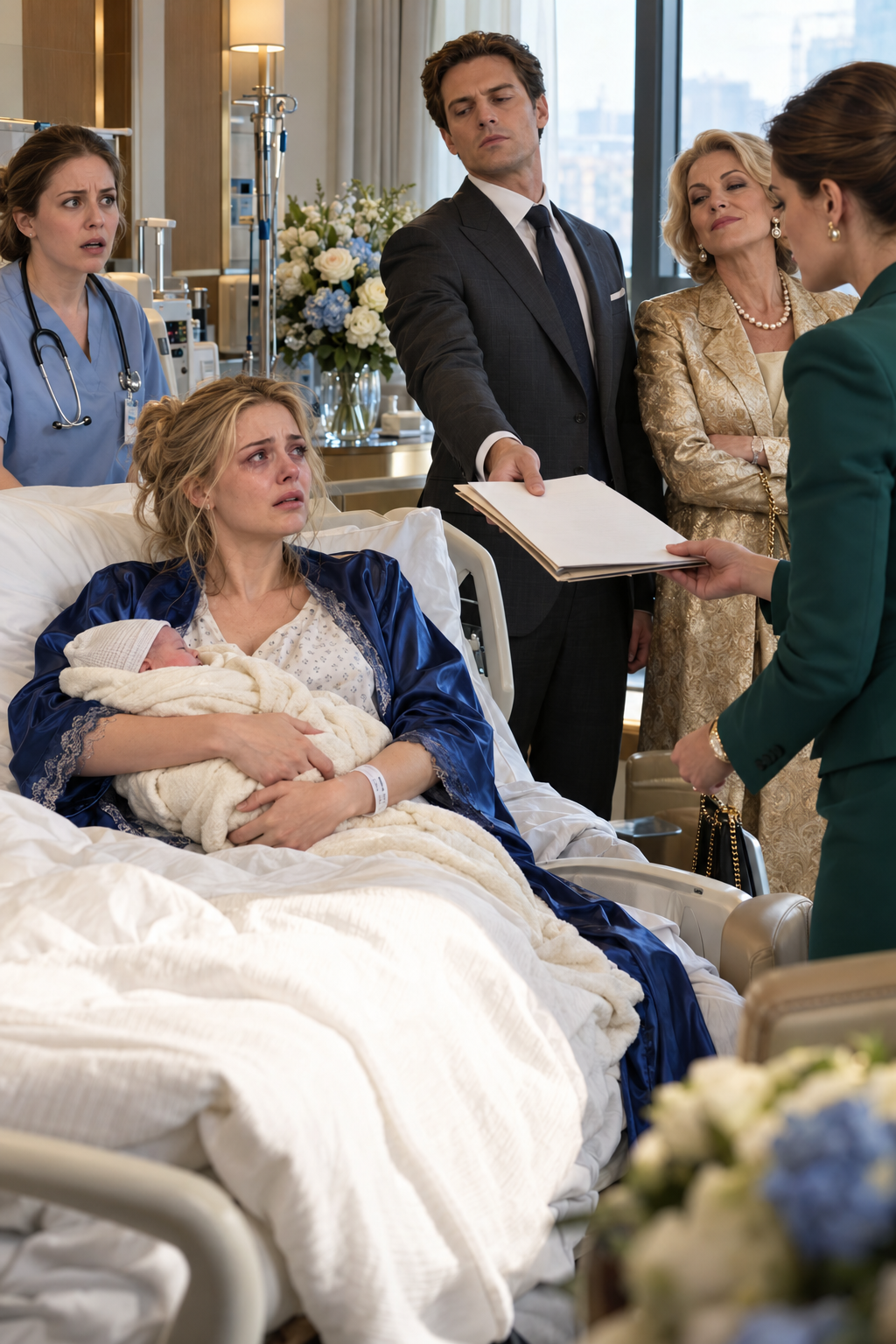
They Served Her Divorce Papers After She Gave Birth—Then Learned the Quiet New Mother Owned Their Entire Future
The first thing Evelyn Mercer saw after giving birth to her daughter was not her husband’s face.
It was a manila envelope sliding across her hospital blanket.
Her husband, Grant Vale, stood beside the bed in a charcoal suit, staring down at her as if the woman who had spent fourteen hours bringing his child into the world had become an administrative problem.
“These are divorce papers,” he said.
Evelyn looked at him.
Then at the envelope.
Then at the bassinet beside her, where their daughter slept beneath a pale pink hospital blanket.
Grant’s mother, Judith, stood near the window in a cream pantsuit, one hand resting over the expensive leather purse hanging from her arm. Grant’s older brother, Preston, leaned against the wall. His sister Celeste sat in the visitor’s chair, scrolling through her phone as though she were waiting for a delayed flight.
Even the family attorney had come.
Five people.
One exhausted woman.
One newborn child.
And not one of them looked embarrassed.
“You knew this was coming,” Judith said.
Evelyn’s eyes moved slowly toward her.
“No,” Evelyn replied.
Her voice was hoarse.
It was also strangely calm.
Grant exhaled impatiently.
“Don’t make this dramatic.”
The sentence almost made the nurse near the doorway stop walking.
Evelyn did not react.
Grant continued.
“We’ve been unhappy for a long time. Mom and I discussed this weeks ago. We decided it would be cleaner to handle everything now.”
“We?” Evelyn asked.
Grant hesitated.
Judith answered for him.
“Our family.”
Evelyn looked from one face to another.
Preston avoided her eyes.
Celeste did not.
Celeste smiled.
It was small.
That smile told Evelyn more than Grant’s lawyer ever could.
This had not been a sudden decision.
This had been planned.
“You waited until after I delivered?” Evelyn asked.
Grant rubbed the bridge of his nose.
“You were pregnant. Serving you before the birth would have looked cruel.”
For the first time, something almost like disbelief crossed Evelyn’s face.
Judith stepped closer.
“We are trying to spare everyone unnecessary ugliness.”
Evelyn stared at her.
There was blood still drying beneath the hospital dressing.
Her body shook from exhaustion beneath the blanket.
Thirty-seven stitches held together injuries Grant had not even asked about.
She had not slept in almost two days.
Their daughter was five hours old.
And Judith Vale was explaining kindness.
Grant picked up the papers and placed them directly into Evelyn’s hands.
“There’s a proposed settlement. It’s generous.”
Evelyn looked down.
She did not open it.
“What do you consider generous?”
“Three hundred thousand dollars.”
That time, Preston looked uncomfortable.
Evelyn raised her eyes.
Grant had purchased a watch six months earlier for nearly half that amount.
Judith spoke quickly.
“You came into this marriage with very little.”
That was when Evelyn’s fingers tightened around the envelope.
Not enough for anyone else to notice.
But enough.
“You lived in Grant’s home,” Judith continued. “You benefited from the Vale name. You were introduced to people you never would have met otherwise. You traveled. You attended events. You had access to a lifestyle far beyond the one you were born into.”
Evelyn said nothing.
Judith mistook silence for surrender.
She always had.
“You’ll receive the three hundred thousand if you sign promptly,” she continued. “You will also receive monthly support for the baby. Reasonable support. Obviously, Grant cannot be expected to finance whatever lifestyle you imagine after the divorce.”
Grant glanced toward the bassinet.
“You’ll need to move out of the house after discharge.”
Evelyn finally looked at him.
“How long?”
“Seventy-two hours.”
The room went quiet.
Even Celeste lowered her phone.
Evelyn had spent six years decorating that house.
She had chosen the nursery wallpaper herself.
She had planted magnolia trees along the east lawn.
She had slept on the floor beside Grant after his father died because he said the bed felt too empty.
She had refinanced the house with money Grant believed came from an investment account she had built before their marriage.
She had quietly paid the contractor when the Vale family’s cash flow collapsed during the company’s expansion.
She had saved the house twice.
Grant was giving her seventy-two hours to leave it.
“With a newborn?” she asked.
Grant’s face hardened.
“You can stay with your mother.”
“My mother is dead.”
“Yes, I know that.”
Evelyn waited.
Grant did not apologize.
Something inside her became completely still.
Judith misread that stillness too.
“You have friends.”
Evelyn turned her head toward the small overnight bag sitting beside the hospital chair.
Inside the bag, beneath a folded nursing gown and a package of diapers, was a narrow black velvet box.
Inside the box was an old brass key.
And beneath the key was a letter written eight years ago by a dead man who had once controlled more money than every person in that hospital room could imagine.
The letter began with six words.
If they mistake kindness for weakness…
Evelyn had not read the rest in years.
She did not need to.
She knew every sentence.
Her grandfather had made sure of that.
Grant pointed toward the divorce papers.
“My lawyer needs an answer by Friday.”
Evelyn looked at him.
Then she asked, very softly:
“Is that what you really want?”
The question sounded weak.
Almost pleading.
Grant relaxed.
Judith did too.
They had been waiting for tears.
They had been waiting for bargaining.
They had been waiting for Evelyn to become the grateful nobody they had always believed they had rescued.
Grant folded his arms.
Evelyn nodded once.
That frightened the nurse.
But apparently no one else.
Eight years earlier, Evelyn Mercer had walked away from a fortune on purpose.
Not legally.
Not permanently.
But publicly.
Her grandfather, Theodore Mercer, had built Mercer Continental from a regional logistics company into an empire spanning freight infrastructure, hospital systems, commercial property, renewable energy, and private equity.
Financial magazines estimated his personal fortune at $8.4 billion before his death.
They were wrong.
Theodore enjoyed being underestimated.
His granddaughter had inherited that habit.
Evelyn’s father, Theodore’s only son, had died when she was nineteen.
Her mother followed four years later after a sudden brain aneurysm.
By twenty-three, Evelyn was the only direct Mercer heir.
Everyone expected her to become a socialite.
Or a boardroom princess.
Or a headline.
Instead, she asked her grandfather for something no one else had ever requested.
“I want to know whether people like me,” she told Theodore one night in his library, “before they know what I can do for them.”
Theodore had stared at her for a long time.
Then he smiled.
“That will hurt more than you think.”
“No, sweetheart. You don’t.”
He had been right.
Evelyn moved to Philadelphia under her mother’s maiden name.
She took a job in healthcare operations.
She rented a small apartment.
She drove a used Subaru.
She dated men who thought dinner at a two-hundred-dollar restaurant was extravagant.
Then she met Grant Vale.
At first, he had seemed different.
He was ambitious without appearing cruel.
Confident without being loud.
He worked twelve-hour days trying to rescue Vale Biomedical, the medical device company his late father had nearly driven into bankruptcy.
On their third date, Grant confessed that he hated wealthy people.
Evelyn nearly choked on her wine.
“They live in another universe,” he said. “They think money means they’re smarter than everybody.”
“What if someone inherited it?” she asked.
“Because then they confuse luck with achievement.”
Evelyn remembered going home that night and staring at the black velvet box in her dresser.
She almost told him.
Instead, she waited.
She wanted to know who Grant was when there was nothing obvious to gain from loving her.
For a while, he was wonderful.
Then came the sacrifices.
Small ones first.
Then larger.
Evelyn had stayed quiet when Grant asked her to leave a promotion because his schedule was “more important.”
Evelyn had stayed quiet when she used her private funds to save the first Vale Biomedical payroll and allowed Grant to believe an investor had stepped in.
Evelyn had stayed quiet when Judith mocked her inexpensive wedding dress, never knowing Evelyn’s grandfather had offered her any designer in New York.
Evelyn had stayed quiet when she postponed graduate school to help Grant prepare presentations for investors who later praised his brilliance.
Evelyn had stayed quiet when Grant’s family began calling her “simple,” because admitting the truth would have destroyed the only experiment she had ever truly cared about.
Could they love her without the money?
For six years, she got her answer slowly.
Then, five hours after childbirth, they finally answered it all at once.
Theodore Mercer died eleven months before Evelyn’s daughter was born.
He was ninety-one.
He died in his own bed, looking through open French doors toward the Virginia mountains.
Evelyn sat beside him.
By then, Grant had become too busy to visit.
Judith had called Theodore “that old country grandfather of yours.”
If only she had known.
Theodore held Evelyn’s hand on his final afternoon.
“You still haven’t told them.”
Evelyn looked toward the mountains.
“I kept thinking Grant would become the man I married again.”
Her grandfather squeezed her fingers.
“People do not become what they were. Sometimes they simply stop hiding what they are.”
She swallowed.
“I have a baby coming.”
“He’s excited.”
“I hope he deserves to be.”
Those were Theodore’s final harsh words about Grant.
The rest were for Evelyn.
He told her that love was not measured by endurance.
He told her patience could become self-betrayal if stretched too far.
He told her never to confuse keeping peace with preserving dignity.
Then he asked his attorney, Malcolm Reyes, to bring the black velvet box from the safe.
Inside was the brass key.
Theodore placed it in Evelyn’s palm.
“This key opens the private drawer in my desk at Mercer House. Inside are the final trust instructions.”
His grip tightened.
“If they ever discover what you have and become greedy, the trust protects you.”
Evelyn nodded.
“If they try to coerce you into transferring your separate inheritance, the trust protects you.”
She nodded again.
“If they attempt to exploit illness, pregnancy, childbirth, incapacity, grief, or your child—Malcolm has everything he needs.”
Evelyn stared at him.
Theodore’s eyes were clear.
“Everything?”
“Everything.”
He had designed the estate with brutal precision.
The Mercer fortune was not sitting in one bank account.
It was a network of voting shares, real property, family partnerships, foundations, bonds, secured debt, and controlling interests.
Evelyn became the beneficial owner after Theodore’s death, but much of the control remained dormant until she chose to assume it publicly.
There was one unusual provision.
Theodore called it the Dignity Clause.
If any spouse, spouse’s family member, trustee, manager, business partner, or affiliated entity attempted through fraud, coercion, concealment, or abuse of a vulnerable medical period to seize Evelyn’s protected inheritance, every optional extension of Mercer-controlled credit and every revocable family guarantee involving that party could immediately be reviewed, suspended, or terminated according to existing contracts.
Nothing illegal.
Nothing magical.
Just leverage.
Real leverage.
The kind built carefully over decades.
Theodore had looked at her as though he could already see the future.
“Mercy should always be your first instinct.”
He coughed.
“But never your only one.”
Three hours later, he died.
Two days after the hospital ambush, Evelyn carried her daughter into the Vale residence.
Grant had not come to pick them up.
He sent the driver.
Her name was Rose.
Evelyn had known her for four years.
Rose opened the back door of the SUV and looked at the sleeping infant.
“She’s beautiful.”
“Her name is Hope.”
Rose smiled.
“That fits.”
Evelyn looked through the windshield toward the massive limestone house.
A moving truck waited in the driveway.
Rose’s smile disappeared.
Evelyn did not ask what it meant.
She already knew.
Grant had started packing her belongings.
Judith was inside directing the movers.
Of course she was.
The nursery had been half emptied.
Evelyn found Judith standing beside the crib while two men carried boxes into the hallway.
“You cannot remove the crib,” Evelyn said.
Judith turned.
“We purchased it.”
“No. I purchased it.”
Judith frowned.
“Well, it was purchased for this house.”
Evelyn looked at the engraved wooden railing Theodore had secretly ordered from a craftsman in Vermont.
Her grandfather had never lived to see Hope sleep in it.
For the first time since the hospital, anger entered Evelyn’s expression.
“Put it back.”
One mover froze.
Judith laughed.
“Excuse me?”
Evelyn stepped forward.
“I said put it back.”
The man carrying one side immediately lowered it.
Something in Evelyn’s voice made him obey without looking toward Judith.
Judith’s face tightened.
“This behavior is precisely why Grant wants a clean break.”
Evelyn turned toward her.
“What behavior?”
“This hostility.”
Evelyn almost smiled.
“You served me divorce papers while I was still bleeding from childbirth.”
Judith glanced toward the movers.
“Keep your voice down.”
That said everything about Judith Vale.
Cruelty was acceptable.
Witnesses were not.
Grant entered from the hallway.
“What’s happening?”
“Your wife is making a scene.”
Evelyn looked at him.
“Your mother is dismantling Hope’s nursery.”
Grant sighed.
“We need the room cleared eventually.”
A different silence this time.
Grant looked toward Judith.
Judith looked at the floor.
Evelyn understood.
“Who’s moving in?”
He rubbed his jaw.
“Vanessa may be staying here temporarily.”
Evelyn knew the name.
Vanessa Cole.
Vale Biomedical’s new vice president of strategic development.
Thirty-four.
Always close to Grant at company events.
Always touching his sleeve.
Always laughing half a second longer than necessary.
Evelyn had asked Grant about her once.
He called Evelyn insecure.
“How long?” Evelyn asked.
Grant’s voice dropped.
“How long have you been sleeping with her?”
Judith snapped, “That is inappropriate.”
Evelyn turned.
“In my daughter’s nursery?”
Judith’s face changed.
Grant stepped forward.
“Nothing happened in the nursery.”
Evelyn stared at him.
That was not a denial.
Not remotely.
Grant’s shoulders dropped.
“About seven months.”
Seven months.
Evelyn had been four months pregnant.
She felt something deep beneath her ribs.
Not heartbreak.
That had happened quietly over years.
This was confirmation.
“Does she know you served me after delivery?”
“She knows the marriage was over.”
“You know it was.”
Evelyn looked directly into his eyes.
“I knew you were selfish. I knew your family looked down on me. I knew you had become obsessed with status.”
She shifted sleeping Hope gently against her chest.
“I didn’t know you were a coward.”
Grant’s face flushed.
“There she is.”
“The real Evelyn.”
For some reason, that almost made her laugh.
If Grant knew how little of the real Evelyn he had ever seen, he would not have said it so confidently.
Judith stepped between them.
“You have until Sunday evening.”
It was Friday.
Three days.
Evelyn glanced around the nursery.
Then at the house she had saved.
Then at the family who believed they were throwing a penniless postpartum woman onto the street.
“All right,” she said.
Judith blinked.
Grant seemed surprised too.
Evelyn walked toward the closet.
Grant followed.
“Where are you going?”
“That’s it?”
She stopped.
He almost sounded disappointed.
“Were you hoping I’d beg?”
“Yes, you were.”
Grant said nothing.
Evelyn opened the closet.
Behind several maternity dresses was the hospital bag.
She reached inside.
Her fingers closed around the black velvet box.
Grant noticed it.
“What’s that?”
Evelyn looked at him.
“A family thing.”
He snorted.
“Your family doesn’t have anything worth hiding.”
She held his gaze for three seconds.
Then she slipped the box into her coat pocket.
“No,” she said.
“You’re probably right.”
By Sunday morning, Evelyn had moved into a two-bedroom furnished apartment overlooking Rittenhouse Square.
Grant assumed Rose had helped her find it.
Judith assumed Evelyn was spending most of her settlement in panic.
Celeste joked in the family group chat that Evelyn would be “back in the suburbs once reality hit.”
None of them knew the building belonged to Mercer Residential Partners.
None of them knew Evelyn technically owned the floor beneath her feet.
None of them knew the man who greeted her in the private elevator lobby was Malcolm Reyes, Theodore Mercer’s attorney.
He was seventy-two now.
Silver-haired.
And almost impossible to surprise.
He looked at baby Hope asleep against Evelyn’s shoulder.
“Your grandfather would have been unbearable.”
Evelyn smiled for the first time in days.
“He would have bought her a pony.”
“Five ponies.”
“He hated horses.”
“He loved excess when it annoyed other people.”
Evelyn laughed softly.
Then the laugh disappeared.
Malcolm studied her.
“They served you in the hospital?”
“How many hours after delivery?”
“And the proposed settlement?”
Evelyn handed him the papers.
He read them at the dining table.
His expression did not change until page twelve.
Then he removed his glasses.
“Interesting.”
“They want you to represent that neither you nor any entity under your control has any undisclosed financial interest that could affect the marital estate.”
Evelyn sat across from him.
“Grant doesn’t know.”
“Then why include it?”
“Because someone suspects.”
Evelyn thought about Preston.
Unlike Grant, Preston had always been suspicious of coincidences.
The mysterious lender who saved Vale Biomedical.
The investors who appeared when the company needed them.
The unusually favorable property financing.
The quiet woman married to his brother who never seemed particularly impressed by money.
“Preston,” she said.
Malcolm nodded.
He continued reading.
Then he stopped again.
This time his expression became cold.
“They also included a temporary custody proposal.”
Evelyn’s stomach tightened.
“What does it say?”
Malcolm slid the page toward her.
Grant wanted primary physical custody once Hope reached six months.
The stated reason was “housing stability and superior family resources.”
Evelyn read the sentence twice.
Then a third time.
They had not merely thrown her out.
They planned to use the fact that they threw her out as evidence that Grant should keep her child.
For the first time, her hand trembled.
Malcolm saw it.
“That changes things.”
Evelyn looked up.
“What do you mean?”
“Until now, I believed you might still choose restraint.”
Evelyn looked down at her daughter.
Hope yawned.
One tiny fist opened against Evelyn’s sweater.
Evelyn remembered fourteen hours of labor.
Grant checking emails.
Judith complaining that the private suite was too small.
The nurse placing Hope against her chest.
The manila envelope arriving five hours later.
The half-dismantled nursery.
Vanessa moving in.
And now custody.
“They can take the house,” Evelyn said.
Malcolm waited.
“They can keep the furniture.”
He said nothing.
“They can say whatever they want about me.”
Her voice lowered.
“But they don’t get to manufacture instability and then use it to take my daughter.”
Malcolm leaned back.
Evelyn reached into her pocket.
She placed the black velvet box on the table.
Then opened it.
The brass key caught the afternoon light.
“It’s time.”
Mercer House sat on four hundred acres outside Charlottesville, Virginia.
The property had belonged to Theodore for fifty-three years.
Grant had never been there.
Judith believed Evelyn’s grandfather had lived in “some farmhouse.”
Evelyn arrived Monday afternoon with Malcolm and Hope.
Inside Theodore’s library, everything remained almost exactly as he had left it.
The old leather chair.
The green banker’s lamp.
The enormous walnut desk.
Evelyn stood in front of it for a long moment.
Then she inserted the brass key into a lock hidden beneath the central drawer.
A narrow compartment opened.
Inside was a sealed cream envelope.
Her name was written across the front in Theodore’s handwriting.
Nothing else.
She sat down.
Malcolm moved toward the window to give her privacy.
Evelyn opened it.
The letter was three pages.
She read every word.
Near the bottom was the warning she remembered.
If they mistake kindness for weakness, do not waste your life explaining the difference. Let consequences explain it for you.
Below that:
The money is not the inheritance. Choice is the inheritance. The ability to leave a room where someone believes you have nowhere else to go—that is the inheritance. The ability to protect the vulnerable when powerful people rely on their vulnerability—that is the inheritance. The ability to say no without fearing homelessness, hunger, humiliation, or abandonment—that is the inheritance.
Evelyn covered her mouth.
She cried then.
Not for Grant.
Not for the marriage.
For Theodore.
For the fact that he had understood exactly what wealth should mean.
Not yachts.
Not jewelry.
Not revenge.
When she finished reading, Malcolm placed a thick file on the desk.
“This is the current Mercer exposure to Vale Biomedical.”
Evelyn opened it.
The number at the bottom surprised even her.
“Eight hundred and forty million?”
“Direct and indirect.”
“Debt acquisition. Convertible notes. Real estate guarantees. Bridge financing. Several funds your grandfather controlled purchased Vale obligations during restructuring.”
Evelyn looked up.
“Does Grant know Mercer is behind it?”
“He knows multiple lenders are involved.”
“But not that I control them.”
“What about the headquarters?”
“Mercer Commercial owns the land.”
Evelyn stared.
“The building?”
“Vale Biomedical owns most improvements. The ground lease belongs to us.”
She almost laughed.
Grant had spent years bragging about “his” twenty-two-story headquarters.
The land beneath it had been hers the entire time.
Malcolm opened another folder.
“And the expansion loan Grant expects to close Thursday?”
“The lead guarantor is Northstar Capital.”
“I’ve heard the name.”
“You own seventy-one percent.”
Evelyn closed her eyes.
The old man had placed invisible guardrails around her life without ever interfering with it.
Malcolm slid one final document forward.
“Your grandfather’s foundation also controls a fourteen-percent voting position in Vale Biomedical through charitable investment vehicles.”
“Fourteen?”
“Grant owns eleven.”
“And Preston?”
Evelyn leaned back slowly.
Grant Vale believed Evelyn had entered his world with nothing.
In reality, she had spent years sitting silently at his dinner table while owning more influence over his company than he did.
Malcolm folded his hands.
“What would you like to do?”
Evelyn thought about revenge.
For perhaps ten seconds.
Then she thought about the employees.
Three thousand four hundred people worked for Vale Biomedical.
People with mortgages.
Health insurance.
Retirement accounts.
Destroying Grant’s company would hurt them too.
“No scorched earth.”
Malcolm nodded once.
“I expected that.”
“Protect the employees. Protect active clinical contracts. Protect vendors who did nothing wrong.”
“And Grant?”
Evelyn looked toward Theodore’s empty chair.
“Let him keep exactly what he legally owns.”
Malcolm’s mouth moved slightly.
It was almost a smile.
“That may be considerably less than he imagines.”
By Tuesday, Grant believed he had won.
Vanessa had moved two suitcases into the house.
Judith ordered new bedding for the primary bedroom.
Celeste posted a photograph from the Vale kitchen with a caption about “fresh chapters.”
Preston was already discussing how Grant could restructure certain assets before the divorce became contentious.
The entire Vale family operated on one shared assumption.
Evelyn needed them more than they needed her.
Grant called her Tuesday night.
“Did you sign?”
“I’m reviewing it.”
“You don’t need a lawyer for a simple settlement.”
“I have one.”
“Malcolm Reyes.”
Grant repeated the name.
It meant nothing to him.
Preston, sitting across the kitchen island, heard it.
His face changed.
Grant noticed.
Preston held up one finger.
Grant put the call on speaker.
Evelyn continued.
“I’ll send a response tomorrow.”
Grant’s confidence returned.
“Good. Evelyn, I don’t want this to become ugly.”
“Think about Hope.”
“We can be adults.”
“I’m glad.”
Evelyn was quiet for a second.
Then she asked:
“Are you certain the house belongs to you?”
He frowned.
“What kind of question is that?”
“A simple one.”
“Of course it belongs to me.”
“And Vale Biomedical?”
Grant laughed.
“What about it?”
“Are you certain you know who owns it?”
Preston stood so fast his stool scraped the floor.
Grant’s smile disappeared.
“What are you talking about?”
“Good night, Grant.”
She hung up.
Grant stared at the phone.
Preston was already searching Malcolm Reyes online.
Ten seconds later, all color left his face.
Preston turned the screen around.
Malcolm’s biography appeared beneath a photograph.
Former General Counsel, Mercer Continental.
Trustee, Theodore J. Mercer Family Trust.
Chairman, Mercer Legacy Foundation.
Grant looked at it.
Then at Preston.
Preston searched Evelyn’s full maiden name.
Evelyn Anne Mercer.
A photograph appeared from eleven years earlier.
A young woman standing beside Theodore Mercer at a university commencement.
Grant stopped breathing.
Preston opened another article.
Mercer Heiress Avoids Public Life Following Parents’ Deaths.
There she was.
Same smile.
Grant sank onto the stool.
Vanessa walked into the kitchen.
“What happened?”
No one answered.
Judith came downstairs ten minutes later.
She read the articles.
Then reread them.
Then announced that they were probably inaccurate.
Preston looked at her.
“She would have told us.”
“Would she?”
“Of course.”
Grant suddenly remembered the black velvet box.
The mysterious investors.
The first payroll rescue.
The refinanced house.
The times Evelyn had known things about commercial credit she supposedly had no reason to understand.
The way powerful people at charity galas sometimes looked at her twice.
The old man Grant had once ignored at a fundraiser because Evelyn introduced him merely as Malcolm.
His stomach turned.
“How much?” Vanessa asked quietly.
No one answered.
She asked again.
“How much is she worth?”
Preston found another financial report.
The Mercer network’s total family-controlled assets were estimated above eleven billion dollars.
Judith sat down.
For perhaps the first time in twenty years, she had nothing to say.
“She lied to me.”
Preston stared at him.
“She lied for six years.”
“You handed her divorce papers five hours after she gave birth.”
“That doesn’t change—”
Preston rarely raised his voice.
This time he did.
“Stop talking like we’re the injured party.”
Judith snapped, “She deliberately deceived this family.”
Preston turned on her.
“And what exactly did we lose because she didn’t tell us she was rich?”
Judith opened her mouth.
Nothing came out.
Preston laughed bitterly.
“That’s what I thought.”
Grant stood.
“This changes nothing.”
But everyone in the room knew it changed everything.
Then his phone rang.
The expansion loan had been placed under review.
Thirty seconds later, Preston’s phone rang.
The ground lease on Vale Biomedical headquarters had entered a compliance audit.
Then Judith received an email regarding a philanthropic board position funded by the Mercer Legacy Foundation.
Vanessa stared at Grant.
“What did you do?”
Grant looked toward the nursery upstairs.
The nursery they had nearly emptied before Evelyn’s stitches had healed.
And for the first time, he understood that Evelyn’s silence had never been helplessness.
It had been restraint.
The divorce hearing began three weeks later.
By then, the story had not reached the press.
Evelyn insisted on privacy.
She did not want Hope’s birth turned into public entertainment.
Grant arrived with Judith, Preston, Celeste, Vanessa, and three attorneys.
Evelyn arrived with Malcolm and one family-law attorney.
No entourage.
No designer spectacle.
No dramatic entrance.
She wore a navy dress.
Her hair was pulled back.
She carried Hope’s diaper bag herself.
Judith watched her cross the courthouse hallway.
Then she walked over.
“We need to talk.”
Evelyn stopped.
Judith lowered her voice.
“I understand emotions were running high after the delivery.”
Evelyn looked at her.
Judith stiffened.
“We could have handled certain things more gracefully.”
“You dismantled my newborn daughter’s nursery.”
“That was a misunderstanding.”
“You gave me three days to leave.”
“The marriage had ended.”
“You planned to use the housing instability you created to seek custody.”
Judith’s expression faltered.
Evelyn leaned slightly closer.
“You thought I was poor enough to control.”
Judith glanced around.
“That is not fair.”
Evelyn nodded.
“It wasn’t.”
Then she walked away.
Inside the courtroom, Grant’s attorneys immediately changed strategy.
The three-hundred-thousand-dollar offer disappeared.
Now Grant claimed Evelyn’s concealment of extraordinary wealth constituted marital fraud.
His lawyer argued that Grant had entered the marriage without informed knowledge of her financial circumstances.
Evelyn listened without expression.
Then Malcolm passed her attorney a document.
The attorney stood.
“Your Honor, we would like to submit Mr. Vale’s prenuptial agreement.”
Grant frowned.
He and Evelyn had signed one at Judith’s insistence two weeks before the wedding.
Judith had demanded it because she feared Evelyn might someday take Vale money.
The agreement declared that all premarital property, inheritances, trust interests, gifts, undisclosed separate assets, and income directly derived from those assets would remain solely with the original owner.
Grant’s lawyer stopped speaking.
The judge read the relevant paragraph.
Then looked over his glasses.
“Mr. Vale signed this?”
“Yes, Your Honor.”
Judith whispered something to Grant.
His attorney shook his head.
Evelyn remembered the day Judith pushed the agreement across the table.
“You have to understand,” Judith had said. “Families like ours have to protect what we built.”
Evelyn had almost smiled then too.
Families like ours.
Now those same words returned with exquisite symmetry.
The judge continued.
“Mr. Vale expressly waived future claims to inheritances whether known or unknown at the time of marriage.”
Grant’s attorney changed direction again.
They claimed Grant’s household provided stability Evelyn could not match because she had moved shortly after childbirth.
Evelyn’s attorney stood.
“Your Honor, Mrs. Vale moved because Mr. Vale ordered her out of the marital residence within seventy-two hours of hospital discharge.”
Grant looked down.
“We have text messages confirming the deadline, photographs of movers dismantling the nursery, and testimony from the household driver.”
Rose sat in the back row.
Judith turned around.
Rose looked directly at her.
No apology.
Then came the affair.
Then the planned installation of Vanessa in the marital home.
Then the settlement clause asking Evelyn to waive financial disclosures.
Then the internal email Preston had reluctantly produced during discovery.
It had been sent by Judith.
Once she signs, we control the house, the baby schedule, and the narrative. Without money, she won’t fight long.
The courtroom went silent.
Judith closed her eyes.
Grant whispered, “Mom.”
She did not look at him.
Evelyn did.
That email hurt more than she expected.
Not because Judith hated her.
Evelyn had known that.
Because Hope had been reduced to leverage.
The judge looked toward Grant’s table.
“I have significant concerns about the proposed custody arrangement.”
Grant’s lawyer asked for a recess.
During the break, Grant found Evelyn alone near a courthouse window.
Hope was with Malcolm in a private room.
Grant stopped several feet away.
“Can we talk?”
Evelyn said nothing.
“I didn’t know about Mom’s email.”
“You knew about the custody plan.”
He looked down.
“Then the email changes very little.”
Grant rubbed his hands together.
“I was angry.”
“You were confident.”
He looked at her.
Evelyn’s voice remained calm.
“You thought I couldn’t survive without you. That’s different from anger.”
“I made mistakes.”
“You had an affair while I was pregnant.”
“You served me in a hospital bed.”
“You moved her into our home.”
“You tried to take Hope.”
His eyes filled.
That was the first thing that seemed genuinely to break him.
“I was never going to take her from you.”
“You asked for primary custody.”
“My lawyer said—”
Evelyn shook her head.
“Do not make your lawyer carry your character for you.”
Grant looked toward the floor.
For a long moment, neither spoke.
Then he asked the question Evelyn had once expected to feel triumphant hearing.
“How rich are you?”
She almost laughed.
Not because it was funny.
Because even now, he did not understand.
“It doesn’t matter.”
“It matters to me.”
That was the tragedy.
Grant stepped closer.
“Was any of it real?”
Evelyn studied his face.
“All of it?”
“My love was.”
He swallowed.
“Then why didn’t you tell me?”
“Because I wanted one person to choose me before they chose Mercer.”
“At first.”
He flinched.
Evelyn looked through the courthouse window at the gray October sky.
“You know what the worst part is?”
Grant waited.
“It isn’t Vanessa.”
His face tightened.
“It isn’t the divorce papers.”
She turned toward him.
“It isn’t even the fact that your mother hated me.”
“What is it?”
“I spent years making your life easier in ways you never noticed, and every time life became easier, you decided it was evidence that you were exceptional.”
Grant said nothing.
“I protected your pride until your pride became the weapon you used against me.”
He wiped his eyes quickly.
“Can I fix this?”
There it was.
The question he should have asked years earlier.
Evelyn thought about Theodore’s letter.
The money is not the inheritance.
Choice is the inheritance.
She could choose now.
Not because she had billions.
Because she finally understood that staying was also a choice.
And she no longer wanted it.
“No,” she said.
Grant closed his eyes.
Evelyn walked back into the courtroom.
The divorce was finalized four months later.
Evelyn received no portion of Grant’s separate assets.
She asked for none.
Grant received no portion of hers.
The prenuptial agreement Judith had demanded made certain of that.
The marital house presented one final surprise.
Grant believed he owned it outright.
He did not.
Years earlier, during Vale Biomedical’s cash crisis, Grant had used the residence as collateral.
The underlying note had eventually been acquired by a Mercer-controlled fund.
Evelyn could have forced a sale.
She did not.
Instead, she offered Grant a refinancing window at market terms.
Thirty days.
No punishment.
Just fairness.
Grant failed to qualify without the financial guarantees he had once enjoyed through anonymous Mercer support.
The house was sold.
Evelyn did not buy it.
Vanessa left before the listing photographs were taken.
She had apparently loved Grant less once Grant ceased looking inevitable.
Preston resigned from Vale Biomedical and later sent Evelyn a handwritten apology.
Not an excuse.
An apology.
She accepted it.
Celeste never apologized.
Judith attempted several times.
Evelyn never knew whether Judith regretted what she had done or merely regretted doing it to a billionaire.
That distinction mattered.
So Evelyn remained polite.
And distant.
Grant retained visitation with Hope.
Evelyn never weaponized their daughter against him.
That surprised Judith more than anything.
“You could have destroyed him,” Malcolm once said.
Evelyn looked at Hope crawling across the rug in Theodore’s old library.
“That would have made me like them.”
Vale Biomedical survived.
That surprised Grant.
Mercer funds could have tightened every loan.
Instead, Evelyn restructured the company under independent management.
Grant lost the CEO position after an internal board review exposed years of reckless leverage, conflicts involving Vanessa, and financial decisions concealed from directors.
But the factories stayed open.
The engineers kept their jobs.
The pension obligations were protected.
Thousands of employees who had nothing to do with the Vale family’s cruelty did not pay for Grant’s mistakes.
That was the part Theodore would have liked best.
The fortune had become justice without becoming revenge.
Eighteen months later, Evelyn stood on the lawn at Mercer House watching Hope toddle between rows of white chairs.
The Mercer Foundation was opening a national legal assistance program for women facing housing and custody coercion during pregnancy and postpartum recovery.
Evelyn named it the Hope Initiative.
No one outside Malcolm knew why.
The program funded emergency housing.
Legal counsel.
Medical advocacy.
Short-term financial protection.
Not because every frightened woman needed billions.
Because none should need billions to be treated with dignity.
Grant attended the opening.
He stood near the back.
Older somehow.
He had spent the previous year rebuilding his career at a smaller medical technology company.
No executive jet.
No inherited boardroom.
For the first time in his adult life, he had to discover who he was without the architecture that had always made him look powerful.
After the ceremony, he approached Evelyn beneath the magnolia trees.
Hope was chasing fallen leaves nearby.
“She looks like you,” he said.
“She has your chin.”
Grant smiled.
“Poor kid.”
Evelyn laughed despite herself.
They stood in silence.
Not comfortable.
Not hostile.
Something beyond both.
Grant looked toward the house.
“I think about that day in the hospital a lot.”
“I keep trying to understand who I was.”
Evelyn glanced at him.
“Did you figure it out?”
“Someone who thought kindness meant permission.”
That answer surprised her.
Grant looked toward Hope.
“I’m sorry.”
Evelyn did not say it was okay.
It was not.
She did not say she forgave everything.
Forgiveness was not a receipt someone demanded after paying with regret.
But she nodded.
“I believe you’re sorry.”
For Grant, it was enough.
He started walking toward Hope.
Then stopped.
He hesitated.
“Was there ever a moment, after you opened those divorce papers, when you thought about telling us who you really were?”
Evelyn looked toward Mercer House.
Toward the windows of Theodore’s library.
Toward the place where an old brass key still rested inside a black velvet box.
Then she looked at the man who had once believed he could determine her worth by the amount he thought she possessed.
“In the hospital.”
Grant frowned.
“Why didn’t you?”
Evelyn smiled faintly.
“Because I needed to know one last thing.”
She looked toward Hope.
Then back at him.
“If I had told you I was a billionaire before you walked out of that room…”
Grant went very still.
Evelyn’s voice softened.
“…would you have stayed because you loved me?”
She paused.
“Or because you finally understood what leaving me would cost?”
Grant opened his mouth.
No answer came.
Evelyn nodded once.
That was the answer.
She walked across the lawn toward her daughter.
Hope saw her coming and stretched out both arms.
Evelyn lifted her.
Behind them stood a house worth millions.
Beyond it sat companies worth billions.
An empire most people would have called Theodore Mercer’s greatest inheritance.
They were wrong.
His greatest inheritance was the thing Evelyn had finally learned to use.
The freedom to walk away before cruelty convinced her she deserved it.
The freedom to protect her daughter without becoming cruel herself.
The freedom to help strangers who had no secret fortune waiting behind a locked drawer.
The freedom to stand before people who had spent years looking down on her and discover that their opinion had never determined her height.
Hope rested her head on Evelyn’s shoulder.
Grant remained beneath the magnolia tree, alone with a question he would probably spend the rest of his life answering.
Evelyn did not turn around.
She had already spent too many years looking backward.
And this time, when she walked away, nobody could tell her she had nowhere else to go.
Because the fortune had never been the proof that she mattered.
It had only given her the power to make sure she never forgot again.
✓ Lynn R. Adams
They Served Her Divorce Papers After She Gave Birth—Then Learned the Quiet New Mother Owned Their Entire Future The first thing Evelyn Mercer saw after giving birth to her daughter was not her husban…