They Mocked Her for Chasing Water in a Dying Valley — Two Years Later She Bought Every Acre They Owned
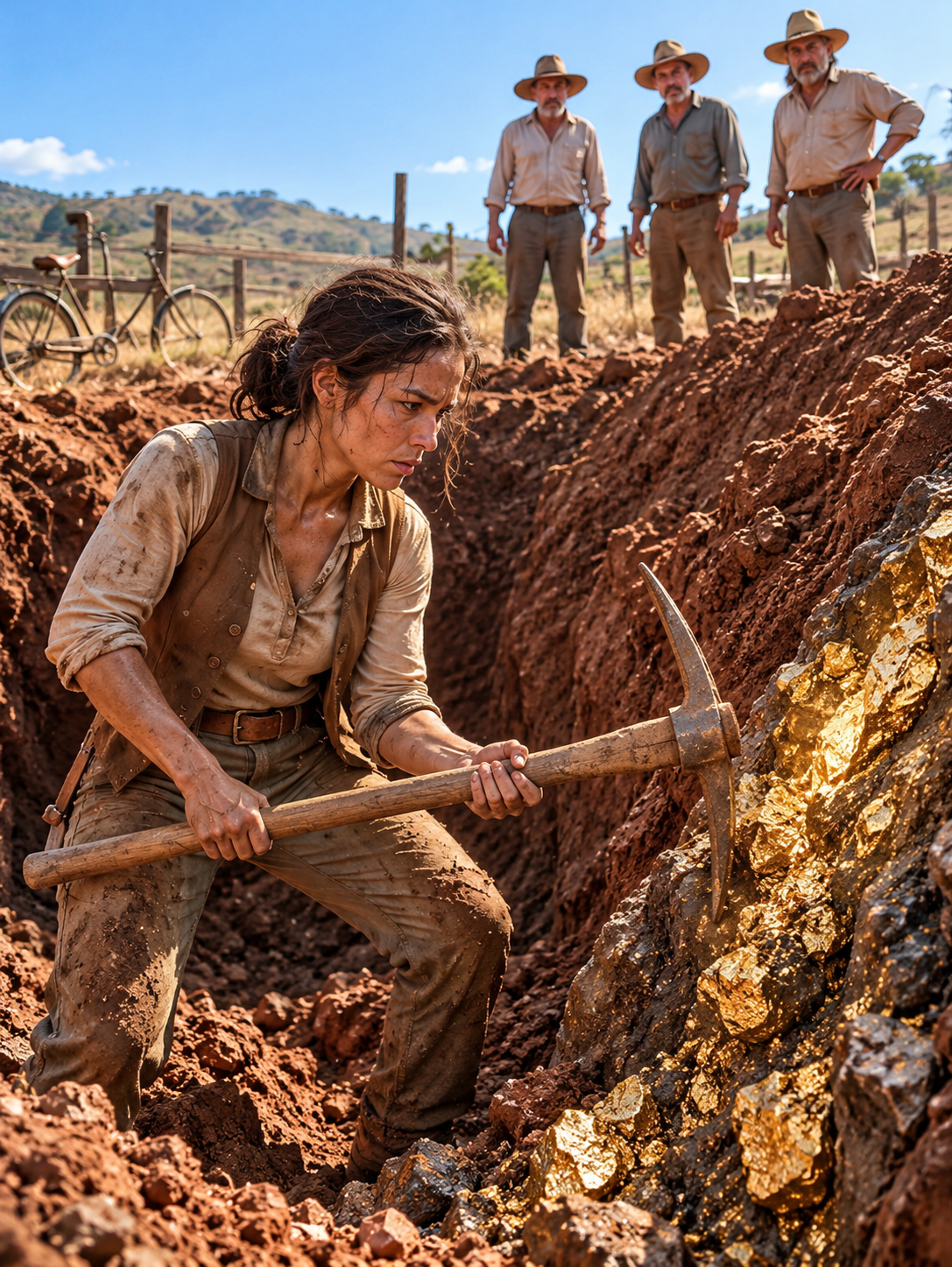
They Mocked Her for Chasing Water in a Dying Valley — Two Years Later She Bought Every Acre They Owned
What would you do when the people who call you foolish have never bothered to look beneath the dust they walk on?
The jeep slowed beside me in a cloud of grit and heat. “Still hunting for a miracle, Maya?” Tucker called, grinning from the driver’s seat. “This land’s been dry for thirty years. Give it up before you waste whatever’s left.” His brother Jeb snickered in the passenger seat. “Go get a city job, girl. Leave the farming to folks who know what they’re doing.” They drove off laughing, leaving me standing there with my survey map and my grandfather’s journal, and the quiet certainty they were wrong.
I did not yell after them or stamp my foot in anger. I did not fold the map and walk away. I did not let their laughter turn my resolve to dust. I did not apologize for believing what my grandfather wrote down. I did not stop measuring, digging, or watching the ground for signs they could not see. I did not forget that the truth does not shout—it waits for those who know how to listen.
I walked the dry creek bed at dawn when the air was cool and the stones spoke in silence. I knelt where the earth held a darker hue long after sunset. I traced the faint curve of a ridge that did not show on any modern map. I did not look for water where it used to be. I looked for where it had always been—hidden, patient, and waiting for someone wise enough to find it.
I studied the old notes by lantern light. I cross-referenced rainfall records and rock formations. I learned what the valley had forgotten: water does not vanish. It only changes where it flows.
My name is Maya Carter. I inherited forty acres of parched hillside at the edge of Red Pine Valley—land everyone called worthless. The wells had failed. The creek had dried. The neighbors had pulled out one by one, leaving only Tucker and Jeb Bennett, who owned the biggest spread and controlled the last remaining irrigation line. They’d told me from day one: Sell to us. Leave. This place is dead.
But Grandfather had left me more than land. He’d left a journal filled with sketches, measurements, and a promise: The water never left, Maya. It went deep. Follow the fault line to the old oak grove. Dig there.
I didn’t have money for fancy equipment. I worked with a shovel, a hand auger, and a second‑hand depth finder I’d saved six months to buy. I walked the lines Grandfather had drawn. I checked the way the vegetation changed—lusher, deeper green, in a narrow strip no one else seemed to notice. And every time I passed the Bennetts’ gate, they called out jokes. “Found an ocean yet?” “Building a swimming pool?” “When you gonna learn?”
I smiled and kept walking.
At twenty‑two feet, the auger pulled up damp, dark clay. At thirty‑one, it hit sand that glistened. At forty, water rose up the shaft—clear, cold, and steady. I lowered a bucket and drew it up. I drank. It tasted of stone and time and promise.
I capped the well. I covered the opening. I told no one.
I saved every cent from my part‑time job at the feed store. I bought solar panels. I laid pipe at night, quiet as moonlight. I planted drought‑resistant nut trees and berry bushes—species Grandfather had noted thrived in the valley’s ancient soil. I built a small greenhouse and sold seedlings. I kept my harvests modest and my business under the radar. When neighbors asked, I said I was “managing on very little.” They nodded, pitying, and turned away.
The first year was hard. I hauled rocks. I mended fence. I worked from dawn until dark. But the trees rooted deep. The well held steady. And slowly, quietly, the numbers turned green.
The second year brought the change everyone had feared. The Bennetts’ main well dropped fast. The shared irrigation line slowed to a trickle. Their corn curled in the heat. Their pastures turned brown. They drilled deeper and hit nothing but hard rock. They raised water prices. They rationed. They fought with the few remaining families. And still the water fell.
By mid‑summer, they were desperate. I saw them standing by my gate one afternoon—Tucker red‑faced, Jeb tight‑jawed, both trying to look like they weren’t begging. “Your trees are green,” Tucker said, forcing a smile. “What are you doing?”
“Deep roots,” I said. “Careful planting.”
Jeb stepped closer. “We know you’ve got water. Sell it to us. Fifty thousand a season. More if you need it.”
I shook my head. “I’m using it.”
“One hundred thousand,” Tucker cut in. “Don’t be foolish. You can’t run this whole valley alone.”
“I’m not trying to,” I said. “I’m taking care of what’s mine.”
They stormed off. That night, I called the land broker. “I want to make offers,” I said. “All of it. Every parcel listed for sale.”
Prices were collapsing. Farms that had been in families for generations were slipping away. I made offers through a trust—no name attached, no face known. The owners signed quickly, relieved to recover something. One by one, the deeds transferred. And then came the final one: the Bennetts’ main farm.
They drove up to my gate the day the paperwork was filed. Tucker was shaking. “This isn’t real! Some investor bought it—who is it?”
I held up the deed. “It’s me.”
They stared. “You? You had nothing two years ago!”
“I had water,” I said. “And you had eyes only for what you could take. You never looked deeper.”
Jeb’s voice cracked. “You planned this. All along.”
“I tried to warn you,” I said. “I told everyone the water was still here. No one listened.”
I did not evict them. I did not shut the gate. I sent each family a letter instead: I would not sell water. I would share it—on new terms. Sustainable pumping. Rotation of crops. Restoration of the creek bed. A community stewardship board. If they stayed, they would help heal the land. If they left, I would return the fields to native grass and let the water flow where nature chose.
Tucker called me a tyrant. Jeb called me a thief. But by the end of the week, they both signed. They had no choice.
The valley began to change. We planted cover crops. We dug shallow retention ponds. We let the land rest. Slowly, the dust settled. The creek bed held water longer each month. The air felt softer. And for the first time in years, neighbors spoke to one another without anger.
But not everyone was pleased.
Late one night, I heard the dogs barking. I stepped outside and saw tire tracks cutting across my orchard—fresh, deep, running straight toward the main well. I ran. The padlock was broken. The well cap was loose. Someone had poured something heavy and acrid down the shaft. I called the county environmental team immediately. We closed the well. We took samples. And we waited.
The results came back: industrial runoff. A signature chemical used at the county quarry—one that had been operating without proper oversight for years. Not a random act. A deliberate contamination.
I pulled Grandfather’s journal again. Tucked between pages was a clipping I’d never fully read—an old newspaper notice about the quarry expansion, and a handwritten note in the margin: They know the water runs beneath their pits. They will poison it to hide the truth.
I cross‑checked dates. Names. The quarry leaseholder was the same man who’d approved the Bennetts’ well permits year after year. The same man who’d publicly dismissed my well as “a fluke” and “a danger to the valley supply.” He hadn’t just known. He’d been betting on the land drying up so he could buy it all—cheap—and expand the quarry across the entire valley floor.
My well was the only thing standing in his way. And now he’d tried to ruin it.
That evening, a car pulled up to my house. The man himself—silver suit, cold smile—walked to my porch. He laid an envelope on the rail. “Walk away, Maya,” he said quietly. “Sell the land to me. Take the money. Disappear. Or the well stays poisoned.”
I did not touch the envelope. “You’ll be exposed,” I said. “There are samples. Records. Witnesses.”
He smiled. “Records can vanish. Witnesses can change their minds. And you—one girl against the whole system? Think carefully.”
He drove off. I stood in the fading light, the truth settling heavy and sharp. This was never just about water. It was about what lay beneath the soil—minerals, rights, fortunes far larger than any harvest. And the Bennetts? They hadn’t just been foolish. They’d been working for him all along, helping drive everyone out so he could take everything.
I reached for the phone. I had calls to make. But as I lifted it, a text arrived from an unknown number: He didn’t just poison the well. He’s got the creek diverted too. Check the north ridge before sunrise. There’s a pipe they never recorded.
I stepped out onto the porch. The valley lay quiet below. Somewhere in the dark, someone was watching. And I knew—whoever sent that message was not just helping me. They were warning me. Because there was something else hidden up there. Something far worse than a pipe. And if I went alone, I might not come back.
✓ Lynn R. Adams
They Mocked Her for Chasing Water in a Dying Valley — Two Years Later She Bought Every Acre They Owned What would you do when the people who call you foolish have never bothered to look beneath the d…