They Laughed When She Bought the Dead Man’s Ranch—Until She Uncovered the Greatest Treasure Hidden Beneath the Texas Hills
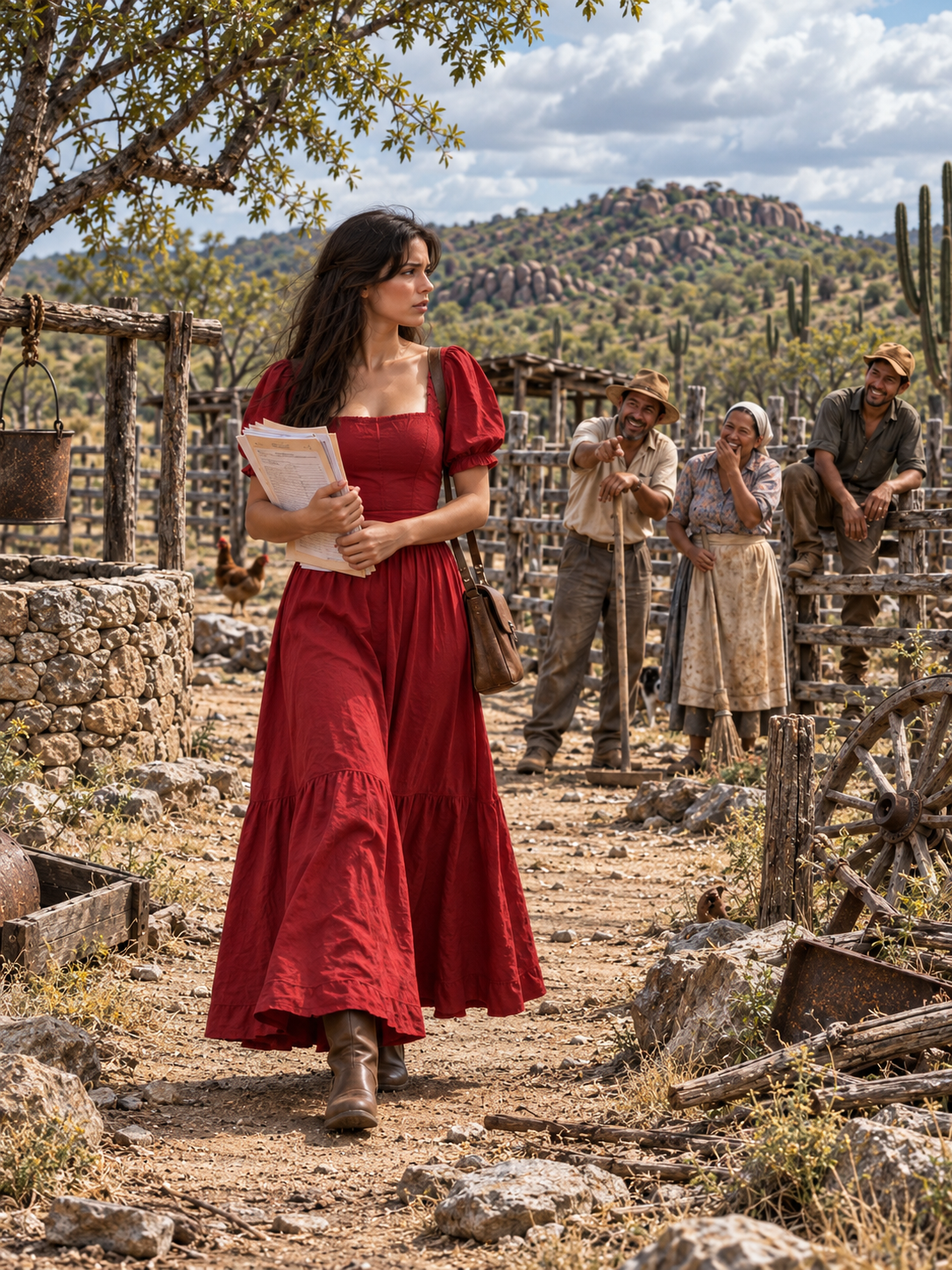
They Laughed When She Bought the Dead Man’s Ranch—Until She Uncovered the Greatest Treasure Hidden Beneath the Texas Hills
The auctioneer actually stopped speaking long enough to laugh when thirty-one-year-old Rachel Morgan raised her hand and offered $9,700 for the abandoned Whitaker ranch.
Three men near the back of the county hall laughed with him.
One of them called out, “Lady, the coyotes don’t even want that place.”
Rachel did not turn around.
She kept her hand raised.
The ranch had been abandoned for almost eleven years.
Its farmhouse leaned toward the south.
Its windmill had not turned since anyone could remember.
The old barn had lost half its roof.
The creek was dry.
The fencing was almost gone.
And according to every person in Dry Creek, Texas, the only thing buried on those 640 acres was debt.
Yet when the auctioneer dropped the hammer and declared the property sold, one man stopped laughing.
His name was Wade Caldwell.
He owned more land than anyone else in the county.
He also walked directly to Rachel after the sale and offered her $75,000 for the ranch before she had even signed the final papers.
That was the moment Rachel knew she had not bought garbage.
She had bought something somebody wanted very badly.
“I’ll give you seventy-five cash,” Wade said.
Rachel looked at the legal folder in his hand.
“You came prepared.”
“I buy land.”
“You knew I’d win?”
“I knew nobody sensible would bid against you.”
“Then why offer me eight times what I paid?”
“Because I’m generous.”
Rachel looked at him for a second too long.
Men who describe themselves as generous usually want something.
“I’ll think about it.”
“Offer expires tonight.”
“Then it probably wasn’t a very serious offer.”
His smile thinned.
“Miss Morgan, you’re new here.”
“So I’ve been told.”
“You don’t know that property.”
“I know the deed.”
“You know paper.”
“I like paper.”
He stepped closer.
“That ranch will eat money.”
“Then you should be relieved I bought it.”
Wade stared at her.
For one second, his expression lost the polished calm.
Then it returned.
“Midnight.”
He tapped the folder.
“After that, seventy-five becomes fifty.”
Rachel smiled.
“Then after midnight, I’ll save you twenty-five thousand dollars.”
She walked away.
Behind her, someone laughed again.
This time it was not at Rachel.
It was at Wade.
That mattered.
If an entire Texas town believed Rachel had wasted her last savings on a dead man’s worthless ranch, why was the richest landowner in the county desperate to buy it before sunset?
Rachel Morgan had arrived in Dry Creek with one pickup truck, one cattle dog named Scout, and $14,212 left from the insurance settlement after her mother’s medical bills.
That was all.
No husband.
No children.
No trust fund.
No hidden millionaire father.
Just enough money to start over badly.
She had spent the previous eight years in San Antonio working as a property records analyst for a regional title company.
Most people found deeds boring.
Rachel found people boring.
Deeds were better.
They remembered things.
They did not flatter.
They did not panic.
They did not change stories after money appeared.
They simply sat in courthouse files until somebody bothered reading them.
That was why she came to Dry Creek.
Not because of the ranch.
Her mother, Elaine Morgan, had grown up there.
She left at nineteen.
Never returned.
Whenever Rachel asked why, Elaine said only:
“Some towns remember the wrong things.”
Elaine died the previous spring.
Three months later, Rachel found a yellow envelope taped beneath the bottom drawer of her mother’s dresser.
Inside was a photograph of a ranch house.
On the back:
WHITAKER PLACE — IF IT EVER SELLS, READ THE WATER RECORDS FIRST.
No explanation.
Then an old county parcel number.
Rachel spent two nights researching.
The Whitaker ranch belonged to Harold Whitaker, a widowed rancher who died without close family.
His estate sat unresolved for years because of tax liens, a disputed access road, and one minor boundary issue.
Finally the county scheduled an auction.
Rachel came to watch.
Then she read the deed history.
And something bothered her.
The ranch was listed as 640 acres.
But an 1958 survey referenced 707.
Sixty-seven acres had disappeared from later tax maps.
Not physically.
Or administratively.
That was clue number one.
Clue number two appeared in water records.
Dry Creek Ranching District classified Whitaker as low-value grazing land.
Yet a 1963 drilling report described artesian flow from Well No. 4.
Three hundred forty gallons per minute.
That was not a dry ranch.
That was serious water.
Later reports showed the well “abandoned.”
Then Rachel found her mother’s name.
Elaine Whitaker.
Rachel stared at the screen.
Her mother’s maiden name had been Whitaker.
She knew that.
But Harold?
Her mother always said she had no living relatives.
Apparently not true.
Elaine Whitaker signed a water-right declaration as witness when she was seventeen.
Harold Whitaker signed as owner.
Relationship?
Rachel searched census records.
Harold had one younger brother.
Thomas Whitaker.
Elaine’s father.
Rachel’s grandfather.
Now the dead rancher was her great-uncle.
And nobody had mentioned him.
That changed the auction from curiosity to obligation.
Not because she thought there was treasure.
Because her mother had left a trail.
And Rachel had spent her career following trails other people ignored.
The Whitaker ranch sat eleven miles outside town.
The entrance gate hung sideways from one hinge.
WEEDS covered the cattle guard.
The dirt road twisted through mesquite, prickly pear, and dry grass.
Scout stood with front paws against the passenger window, staring.
“You’re optimistic.”
Scout sneezed.
The house appeared after half a mile.
White paint gone gray.
Tin roof rusty.
Wraparound porch sagging.
One upstairs window broken.
The barn behind it looked worse.
Rachel parked.
The silence was huge.
Then she saw fresh tire tracks.
Wide truck tires.
Less than a day old.
She walked around the house.
Back door locked.
Front locked.
No obvious damage.
Then Scout growled.
Toward the barn.
Rachel stopped.
Someone had been there recently.
She called county dispatch.
Non-emergency.
“Hi, I just purchased the Whitaker property at auction. There are fresh vehicle tracks and I want the condition documented before I enter.”
The dispatcher sounded surprised.
“You bought Whitaker?”
Small towns.
Within twenty minutes Deputy Aaron Collins arrived.
Thirty-eight.
Sunburned neck.
He looked at Rachel’s truck.
Then the property.
“You’re the woman from the auction.”
“Apparently famous already.”
“Dry Creek gets bored.”
“Good to know.”
She showed deed paperwork.
Aaron walked property with her.
No intruder.
But barn padlock had been recently cut and replaced.
Not original rust.
Rachel photographed it.
“Did county secure this?”
“Estate attorney?”
She called.
Nobody authorized new lock.
Aaron cut it.
Old tractor.
Broken tack.
Empty stalls.
Nothing dramatic.
Then Scout pulled toward rear wall.
Rachel followed.
One section of dirt floor had been recently disturbed.
About four feet wide.
Ten feet long.
Fresh enough that soil had not settled.
Aaron noticed.
“You planning excavation?”
“Then somebody was.”
Rachel did not dig.
She called estate attorney.
Then her own title contact.
Then documented everything.
Wade’s truck tracks?
Could not prove.
Maybe workers.
Maybe treasure hunters.
Maybe kids.
Rachel refused to turn suspicion into fact.
That afternoon, Wade Caldwell arrived anyway.
Same white King Ranch pickup from auction parking lot.
Rachel watched him approach.
“You changed your mind?”
He looked toward barn.
“Already exploring?”
His eyes flicked to disturbed dirt.
Rachel saw.
“Just curious.”
“You know the barn?”
“Everyone does.”
“Were you here recently?”
He laughed.
“That wasn’t an accusation.”
“It sounded like one.”
“Then your hearing is dramatic.”
Wade smiled despite himself.
“You’re going to be trouble.”
“I’m going to read.”
That bothered him more.
He raised offer.
Rachel almost laughed.
“Land assemblage.”
“With what?”
“My western acreage.”
“Your western acreage doesn’t touch this parcel.”
His face changed.
Interesting.
He had not expected her to know.
“Future acquisition.”
“Of whose land?”
“Possibly Delgado.”
The Delgado ranch sat between them.
Could happen.
“Then buy Delgado first.”
Wade leaned on fence.
“You paid under ten thousand dollars.”
“I’m offering you eleven times that.”
“You could leave town with a profit.”
He stopped smiling.
Rachel looked across the dry pasture.
“My mother told me to read the water records.”
That was a calculated reveal.
Not too much.
Just enough.
Wade’s face went still.
She had found the pressure point.
“Your mother?”
“Elaine Morgan.”
He knew the name.
“That explains it.”
“Offer stays open twenty-four hours.”
“You said midnight.”
“I’m flexible.”
“That makes one of us.”
Rachel watched his truck disappear.
Then wrote one sentence in her notebook.
WADE KNOWS ELAINE.
That evening she stayed at the Dry Creek Motel rather than the ranch.
Locked original documents in motel safe.
Uploaded copies.
Called a hydrologist in Austin.
Dr. Natalie Brooks agreed to review public records.
Rachel sent everything.
Then she called her aunt Carol, her mother’s older cousin in Oklahoma.
“Do you remember Harold Whitaker?”
“Why did Mom never talk about him?”
“Where are you?”
“Dry Creek.”
“Oh, Rachel.”
“I bought his ranch.”
Carol whispered something Rachel could not hear.
“You should sell it.”
“Because your mother spent her whole life trying to stay away from that place.”
“That’s not what she wrote.”
“What did she write?”
Rachel did not answer.
Carol changed tone.
“Harold and your grandfather fought.”
“About what?”
Rachel leaned back.
“So water.”
“What happened?”
Carol sighed.
“Your grandfather Thomas sold part of his interest.”
“The Caldwell family.”
Connection.
“Late seventies.”
“What interest?”
“I don’t know.”
“I don’t know.”
“Minerals?”
“I don’t know.”
“Probably.”
“Mom witnessed documents.”
“Did she agree?”
That word came fast.
“She hated it.”
“Because she thought Thomas was being cheated.”
“By Caldwell?”
Another silence.
Rachel wrote.
“Which Caldwell?”
“Wade’s father. Robert.”
Robert Caldwell died ten years ago.
So Wade inherited motive, maybe not wrongdoing.
“What did Harold do?”
“Refused to sign.”
“So Thomas sold only what he owned.”
“Supposedly.”
That word mattered.
“Supposedly?”
Carol lowered voice.
“There was always an argument about the north section.”
“The missing sixty-seven acres?”
Carol went quiet.
Rachel sat up.
“You know about them.”
“Everybody in family did.”
“Where did they go?”
“Nobody knew.”
“Land does not disappear.”
“In Dry Creek, paper used to.”
Rachel wrote that down too.
Then Carol said something Rachel did not expect.
“Your mother went back once.”
Rachel was six.
“Harold called her.”
“Something he found under the old spring house.”
Rachel froze.
“I don’t know.”
“You expect me to believe that?”
“I stopped asking after your mother came back.”
“What happened?”
“She was terrified.”
Not helpful.
Carol ended with:
“If you stay, don’t trust people just because they knew Elaine.”
That warning lodged deeper than Wade’s offers.
The next morning Natalie called.
“You have a weird property.”
“Good weird?”
“Potentially expensive weird.”
Rachel sat up.
“The artesian report is legitimate.”
“How good is three forty gallons per minute?”
“For domestic use? Huge.”
“For ranching?”
“Still substantial.”
“For development?”
“Depends on sustainability and rights.”
“Could well still exist?”
“Why marked abandoned?”
“That’s strange.”
“There’s no plugging certificate.”
Rachel stared.
“A well listed abandoned should have one?”
“So maybe it wasn’t abandoned.”
“And rights?”
“How messy?”
“Your 1979 declaration appears senior to many surrounding permits.”
Rachel knew enough water law to ask carefully.
“Senior as in priority?”
“Potentially.”
“In Texas groundwater rules vary by district.”
“So do not tell me I own half the county’s water.”
Natalie laughed.
“Good. You don’t.”
“Thank you.”
“But if the well produces what historical records claim, the property itself could support significant agricultural or permitted commercial use.”
“How significant?”
“Don’t sell for $110,000.”
Mini-payoff number one.
Rachel smiled.
“Already didn’t.”
Then Natalie added:
“There’s something else.”
“Of course.”
“The 1963 well log mentions cavernous limestone at 412 feet.”
“Could indicate karst system.”
“Underground cavity?”
“Treasure?”
Natalie laughed.
“Water is treasure in Texas.”
That line stayed.
Maybe mother’s “greatest treasure” was not gold.
Maybe water.
That afternoon Rachel searched courthouse archives physically.
Old plat books.
Deed indexes.
Found 1978 instrument.
Thomas Whitaker granted Robert Caldwell “temporary grazing access and conditional stock-water use.”
Not transfer.
Yet 1982 tax maps suddenly showed Caldwell parcel enlarged by sixty-seven acres.
The missing land.
Rachel’s pulse sharpened.
She requested recorded deed supporting boundary change.
Clerk searched.
No conveyance.
No court order.
Only assessor map adjustment.
Tax maps are not title.
Somebody had treated an administrative line like ownership for decades.
Who currently paid taxes?
Caldwell Ranch Holdings.
Interesting.
Adverse possession claim possible.
But not simple if original use permissive.
Rachel called an attorney.
Melissa Grant.
Property specialist in Austin.
She drove down next day.
Reviewed documents.
Then smiled.
“You bought yourself a lawsuit.”
“How much?”
“Depends whether Caldwell fights.”
“Can he win?”
“Possibly.”
“I hate that word.”
“Lawyers survive on it.”
Melissa explained.
Tax payment.
Possession.
All mattered.
But temporary grazing agreement undermined hostile-possession timeline if use began with permission.
Could later become adverse if clearly repudiated.
Evidence needed.
“Does the sixty-seven acres matter beyond acreage?”
Rachel showed water map.
Melissa’s expression changed.
The disputed tract included the original spring-house location and likely Well No. 4.
Wade did not just want dirt.
He wanted the well.
That explained urgency.
Still needed proof.
Rachel drove to ranch with Aaron present because new lock appeared again.
This time no forced entry.
Someone had left gate closed but chain different.
She replaced lock and installed cameras.
Then searched for spring house.
Old survey coordinates.
Mesquite thicket north of barn.
She found stone ruins half-buried.
Square foundation.
Collapsed tin roof.
Concrete cylinder.
Well casing.
Not abandoned.
Still there.
A metal tag:
WHITAKER #4.
Rachel felt a thrill.
She called Natalie.
Professional testing only.
No opening random well.
Water district notified.
Licensed well contractor came.
Cap intact.
Pressure present.
Flow test two weeks later.
Not 340 gallons per minute.
Natalie watched gauge.
“This is remarkable.”
“Safe water?”
“Need chemistry.”
“Excellent.”
“How valuable?”
“Depends what you do with it.”
That answer was becoming theme.
Water samples showed very good quality.
Low salinity.
No major contamination.
Sustainable yield still unknown.
Aquifer modeling required.
Then Wade showed up during test.
He stopped truck at fence.
Rachel walked toward him but stayed on her side.
He stared at flowing discharge pipe.
“You opened it.”
“Licensed contractor.”
“That well belongs to Caldwell Ranch.”
“Show deed.”
“We’ve paid taxes forty years.”
“Show deed.”
“You think a county map is wrong for four decades?”
“Convenient.”
“Paper does not become accurate from old age.”
He stepped closer.
“My father maintained that tract.”
“Under Thomas Whitaker’s permission.”
“That ended.”
“After Thomas died.”
“Show notice.”
Melissa had coached Rachel.
Do not argue facts not proven.
Ask documentation.
Wade hated documentation.
He finally said:
“Two hundred fifty thousand.”
Rachel stared.
“For the whole ranch?”
“Why increase?”
“Because legal disputes are expensive.”
“So you’ll pay me more to save me from dispute you plan to create?”
He almost smiled.
“You are quick.”
“Still no.”
He looked toward water.
“You don’t know what you have.”
Rachel said:
“Neither do you.”
His expression answered.
He knew more.
Not everything.
Rachel’s opening anaphora arrived that night as she sat alone on the porch of a house everyone mocked.
She had no working kitchen yet.
No reliable roof.
No certainty about the disputed land.
But she finally understood why her mother had left a clue instead of a confession.
She had inherited a question.
Not a fortune.
And Rachel made herself a promise.
She would not sell because someone laughed.
She would not sell because someone threatened.
She would not sell because someone offered fast money.
She would not sell because the town preferred an old story.
She would not sell until she knew exactly what Harold Whitaker had protected.
That was the moment the ranch stopped feeling like a mistake.
It became a case.
Rachel was good at cases.
She started with Harold’s house.
The interior was mostly intact.
Old furniture covered in sheets.
Rodent damage.
One bedroom locked.
One desk drawer locked.
She found keys in kitchen tin labeled BOLTS / KEYS / THINGS I’LL FORGET.
Harold had humor.
The locked bedroom belonged to Elaine.
Her mother.
Still preserved.
High school yearbook.
A denim jacket.
Rachel stood in doorway and felt sixteen years old again.
Her mother had kept an entire life secret.
On desk sat one photograph.
Elaine beside Harold.
Behind them:
Spring house.
Written on back:
WE WERE RIGHT.
About what?
Desk drawer contained letters.
Thomas Whitaker to Elaine.
You do not understand business.
Robert Caldwell offered fair money.
Harold is poisoning you against family.
Stop going to courthouse.
The sixty-seven acres are mine to manage.
But if Thomas owned them, why no deed?
Elaine’s reply draft:
You signed access, not ownership.
Harold showed me original survey.
Robert changed assessor map after you let him graze north pasture.
This was evidence.
Not definitive.
But contemporaneous.
Rachel scanned.
Sent Melissa.
Then found Harold’s later note:
Elaine discovered spring chamber.
Robert heard.
That phrase again.
Spring chamber.
Not just well.
Rachel called Carol.
“What was under spring house?”
Carol started crying.
That startled Rachel.
“Your mother made me promise.”
“She is dead.”
“So is Harold.”
“What did they find?”
Carol whispered:
Rachel went still.
Actual gold?
“What kind?”
“I don’t know.”
“I never saw it.”
“Then why say gold?”
“Because Elaine came home with yellow rock.”
Could be pyrite.
Could be calcite.
Could be anything.
Rachel kept voice steady.
“Did anyone test it?”
“He said it wasn’t enough to mine.”
So probably minor.
“Then why terrified?”
“Because Robert Caldwell wanted the spring house after that.”
Maybe gold rumor caused land grab.
But Wade’s current interest likely water.
One historical mystery could distort everything.
Rachel hired geologist Natalie for full site review.
They inspected spring ruins.
No unauthorized excavation.
Historical limestone cavity around well.
Natalie found quartz fragments but no significant gold geology typical? Texas has limited gold. Could be Spanish cache? User wants greatest treasure of sertão, adapted American maybe not literal gold? Need plausible. Maybe “treasure” is rare aquifer plus hidden Spanish silver? But only 1-2 twists. Could be underground cavern with old gold coins hidden by cattle smugglers. Let’s keep hidden treasure culturally plausible: 19th-century stagecoach payroll gold stored in spring chamber? However user’s premise “maior tesouro do sertão” can be treasure. We can make historical cache with evidence and legal handling. But antagonist Wade’s motive could be water + he thinks cache. Need not overcomplicate.
Natalie tested yellow rock from bedroom box?
Rachel later finds rock sample in Harold’s desk labeled FOOL’S GOLD.
So gold rumor false.
Twist one: everyone thought treasure gold, actual valuable aquifer. But title says she revealed greatest treasure. Could be water. Yet reader expects treasure. We can make secondary actual buried collection of historical gold certificates? Maybe too many.
Let’s set main twist: hidden cavern holds enormous naturally pure underground spring and a sealed 1930s bank vault with bearer gold? Hmm.
Maybe “treasure hidden under ranch” is rare underground water plus lost state land grant proving 4,800-acre mineral/water rights. That feels more grounded and valuable. The “gold” could be yellow rock intentionally decoy.
Let’s continue.
Natalie found rock sample in desk.
EL AINE’S GOLD.
Assay sheet attached.
Iron pyrite.
Gold content negligible.
Rachel laughed.
Her mother’s “gold” was fool’s gold.
So why everything?
Then backside of assay sheet:
THE GOLD WAS NEVER THE POINT. TEST WATER BELOW 600 FT.
Harold knew.
Deep aquifer.
Second drilling record at 684 feet showed another zone.
Flow estimate:
Over 1,100 gallons/minute.
That is huge.
But Well No.4 only 412ft. Deeper aquifer not currently tapped.
Could this be legal? Need permits.
This water could supply towns/ranches. But extraction limits.
Natalie said:
“If data holds, this may be one of the strongest private groundwater sources in district.”
✓ Lynn R. Adams
They Laughed When She Bought the Dead Man’s Ranch—Until She Uncovered the Greatest Treasure Hidden Beneath the Texas Hills The auctioneer actually stopped speaking long enough to laugh when thirty-on…