They Laughed When a Homeless Navy SEAL Inherited a Desert Ruin, Until His Dog Found the Name the Navy Had Buried
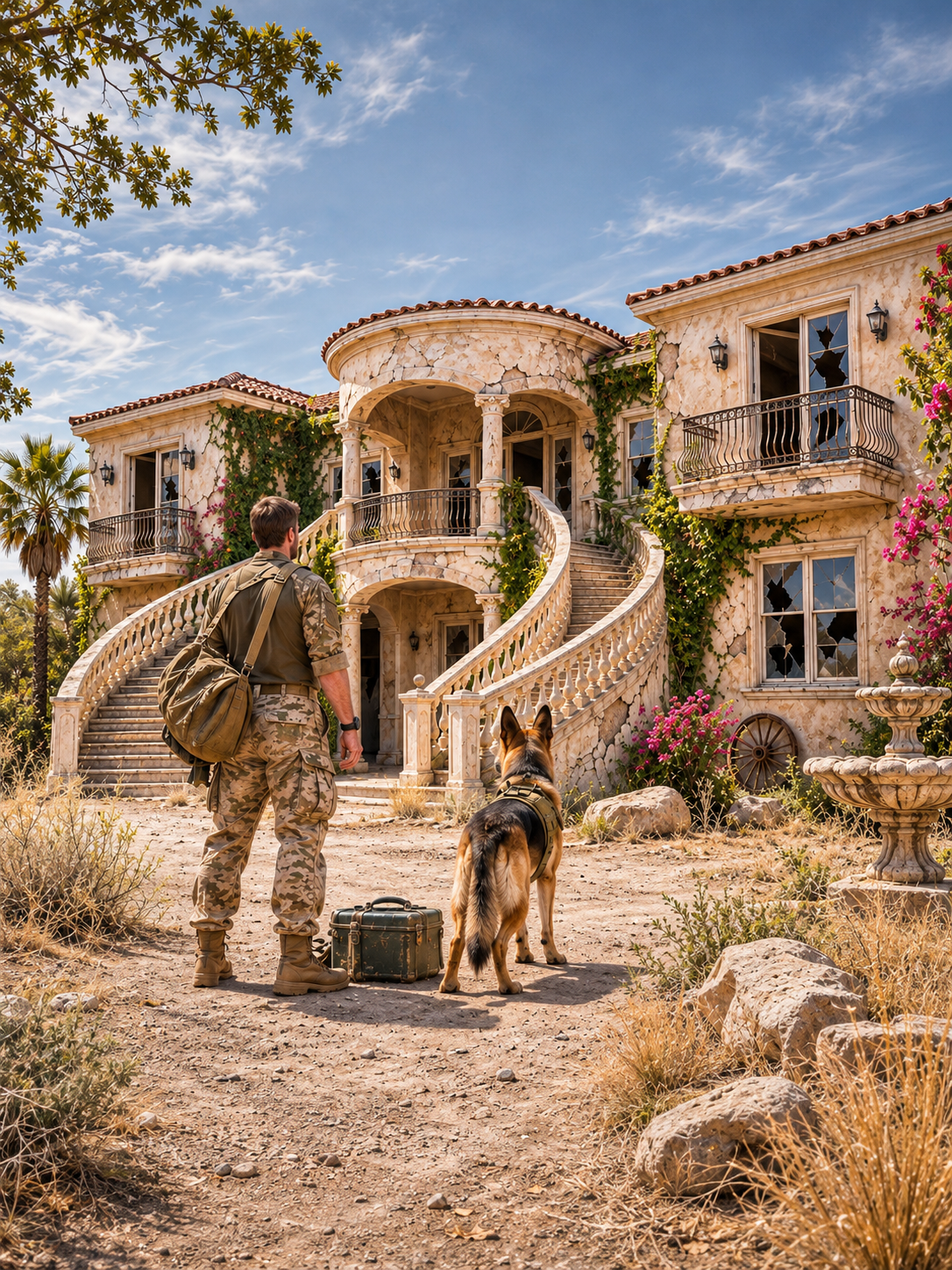
They Laughed When a Homeless Navy SEAL Inherited a Desert Ruin, Until His Dog Found the Name the Navy Had Buried
The man at the diner offered Logan Pierce twenty dollars for the mansion he’d inherited, then asked whether that included the dog.
The room laughed. Before Logan could answer, the woman filling his coffee set a photograph on the counter and said, “Your uncle told me if anybody came to buy the house before you got here, I should show you who was standing behind him.”
Behind the man in the photograph stood Eli Navarro, the teammate Logan had watched go into a black body bag eight years earlier.
Logan moved the coffee cup so its wet base wouldn’t touch the picture.
The man at the end of the counter put his twenty back in his shirt pocket. He had a sunburn in the shape of an open collar and a short pencil tucked behind his ear. He looked at the photograph without leaning in.
“Marcus had lots of pictures,” he said.
The waitress took the pot back to its warmer. “Marcus didn’t give me lots of them.”
Logan kept his hands flat on the counter. There was something wrong with the date stamped in the lower right corner. He read it twice and still got the same month. November. The Navy had sent Eli’s mother a folded flag in September.
He studied the face again. There was a shadow under Eli’s nose where he’d always cut himself shaving. At the top of his work shirt, under the button, was a fold in the fabric that came from leaving a pair of reading glasses hooked there and taking them out. Eli could shoot a quarter from a distance Logan would never have bet money on. He’d needed glasses to read instructions off a box of instant oatmeal by the age of thirty-one.
“Who took it?” Logan asked.
“My son Dalton.” The waitress turned so Logan could see her name tag. Clara. “He drove oilfield trucks before he went to Idaho. He took pictures at loading docks so the company wouldn’t tell him he was short a pallet. He said your uncle asked him to take this one a little wider.”
The man with the twenty pushed his coffee away. He gave Clara an extra dollar for it, though she’d already rung him up.
“Tell Dalton I said hello,” he said.
Clara put his dollar in the drawer. “He’ll be interested to hear it.”
The bell rang as he went out. Across the street a gray pickup lit up, idled for a while, and pulled away.
Titan had been lying under Logan’s stool, far enough from the counter that Clara could pass with a plate. He got to his feet when the truck moved. His ears came up, the right one a little slower than the left. Then he sat again and leaned the blunt weight of his shoulder against Logan’s shin.
The bus from Phoenix had dropped them both on blacktop you could feel through the soles of your boots. It was the first week of May in Dry Mesa, Arizona. Logan had thirty-seven dollars after the fare, a duffel bag that pulled apart if he put his whole weight on the zipper, and three tins of food for the dog. The local veterans’ outreach desk had forwarded the inheritance letter to the shelter where he’d been staying. The woman who found him a spot for Titan at the foot of his cot asked him to promise he would call if the house didn’t have a roof.
He had promised to call if the roof was gone.
He had promised to call if there was no running water.
He had promised to call if the bus dropped him in a town that rolled up its sidewalk before he got there.
He had promised to call if his uncle’s lawyer had made a mistake and the key in the envelope belonged to somebody else.
He had promised to call when he had an address she could put down without crossing out the last one.
Nobody had thought to ask him to call if a dead man was waiting for him at the diner.
Logan slid the photograph into the estate envelope. Clara put a glass bowl down for the dog. She filled it with water first, then fetched two ice cubes and dropped them in where he could hear them.
“His name’s Titan,” Logan said.
“He can have the whole bowl.”
Clara made a sandwich and passed it across the counter in waxed paper. The price on the board was eight dollars. She rang him up for a side of toast. Logan saw her do it and laid eight down when she turned away.
“Who’s the fellow who wants to buy my house?” he asked.
“Judd Hanley. He rents the yard behind the old tire place. Does haul-outs and salvage. He came in Thursday with a man who wanted him to drive up there and see whether the gates would clear a flatbed.”
“Who’d he come with?”
“The man paid by card. It had a company name printed along the bottom. Basin Recovery.”
That was the name on the truck behind Eli in the photograph. The letters were mostly blocked by two people. Logan had read them as scenery first. He took another look at the photo without taking it out of the envelope.
“You want to tell me why it matters?” Clara asked.
“When I last saw him, there was a corpsman keeping both hands on a dressing so tight he left an impression.” Logan glanced at the empty stool. “I didn’t know the people who carried him away.”
Clara put the coffee pot down. She had the same tired look in a different way now.
“Let me charge your phone,” she said. “There’s a socket under the register. The wash road is four miles from here. I can drive you once Cheryl gets in.”
He accepted the charge, the ride, and a little bag of ice for Titan. On the bus he’d seen a dark streak of fur beside the dog’s collar that turned out to be salt. He took care of that first. He wet a paper towel, got down next to Titan, and worked the fur clean with two fingers. Titan had come to him through a foster program a year and a half after Logan got out. The woman who drove him over said the important thing was to wait until he went to sleep before you decided how gentle he could be. Logan waited three weeks for Titan to sleep with his feet out.
At four, Clara stopped her station wagon outside a wrought-iron gate at the top of Red Ridge. Most of the gate was on the ground. One leaf still hung from a hinge. Somebody had used a short length of orange cord to tie it open.
A sandstone house sat at the top of a steep dirt courtyard. It was two stories high on the road side and one story where the hill rose behind it. There was a fountain with a tile fish lying on its side in the basin. The house had two chimneys, one cracked. Along the porch roof, four stone arches cast clean shadows on three boards that had pulled away from the wall.
“Your uncle made those arches look bigger with a string of lights,” Clara said. “Christmas of ninety-nine. I drove past with my kids twice.”
Logan looked at the circle of gravel beside the gate. There were fresh tire marks over older ones. Some had the black dirt embedded in them that had been tracked out of the oil yard at the bottom of the hill. He took a photograph and thanked Clara for the ride.
Before she left, she dug an old business card out of her glove box. She wrote a new number on the back.
“Derek Shaw,” she said. “Marcus left his name with me. He’s the guy who used to write about soldiers going missing. You can try him before you come down the hill. He’ll ask you what you can show him.”
She sat there with both hands on the wheel.
“You’ve got anybody waiting to hear whether you got here?”
“A woman in Phoenix.”
“Tell her the house has walls.”
He did. He kept the message to one line and waited until the little check mark came up. The attorney had transferred the house through his uncle’s estate and asked Logan to provide a forwarding address. There had been no other request in the packet. Just a brass key with a small bead of dark green paint on one side and a typed caution about the roof. Marcus Hail had been his mother’s brother. When his mother spoke of him in the last two years of her life, she did it while washing things already clean.
Once, when Logan was thirteen, his mother had put a birthday card from Marcus through the paper shredder, envelope and all. Logan went back later and tried to fit the pieces together. He remembered one printed line about the price of stamps and two words in his uncle’s handwriting. Still here.
He carried his duffel to the porch in the shade. Titan followed as far as the first stone step. There he went still. His nose rose until the tip of it pointed between two rocks where a decorative iron vent had pulled away from the foundation.
“Hold on,” Logan said.
Titan sat. When Logan turned, the dog stayed in the same place with his head angled up. Wind sighed through the opening. Along the big stone immediately above it, there was a bright new scuff in the desert varnish.
Logan took his flashlight out and crouched. A pale shape lay several feet down, below the iron. He moved the light. The shape didn’t move with it. It was paper.
The light also caught something clear and frayed stretched across the inside of the vent.
Logan took a picture. Then he got up and looked at the porch from the road. A silver loop drooped below the bottom stair. It was cheap fishing line. It ran through a drilled hole in the vent frame, under the step, and out to a dry sprig of desert broom. A man walking through the brush in the direction Titan’s nose had pointed would have kicked it right out of the ground.
He followed the line with his eyes until it disappeared inside the porch. From there he couldn’t tell what it was tied to. He decided he didn’t need to.
He moved Titan back to the fountain and set both duffel straps on the ground. From the higher part of the courtyard he could see the rear of the property. An outbuilding stood behind the kitchen, under the ledge where the hill gave way to a dry wash. Its roof was flat and looked sound. The door had a green edge.
He tried the key. It turned smoothly enough that he took it out and looked at the cut again before he pushed the door open.
Inside was a camp chair, a rollaway bed, and two sealed jugs of water standing on a shelf. A little pile of dirt had blown in under the door. Someone had pinned an envelope to the wall above the bed with a thumbtack.
His uncle had written Logan in neat letters, with the L almost twice the height of everything else.
There were four lines on the page.
You can sleep here. The big house needs work.
Take any problem you have to people who can sign their names to the answer.
The blue book tells you what I saw.
Titan can get under the porch. Keep him out of it anyway.
Logan touched the last line and let his hand fall. He’d spoken to Marcus once in nineteen years. The conversation had lasted ninety seconds, on an evening outside the veterans’ center when the wind blew paper plates across the lot. A stranger had called to ask how much Titan weighed. Logan knew who it was when the man asked if his mother used to keep a pair of shoes under her headboard. The call had ended just after Logan gave him the answer.
He checked the back of the paper. There wasn’t any more.
Across the yard, Titan had found a band of shade along the side of the fountain. He stood in it now, watching the road.
One vehicle came up the hill, its windshield bright until it passed beneath the roots of a dead cottonwood. Then a second came into view below it. Both stopped outside the gate. A man got out of the first truck and took a linen jacket off the back of his seat.
Behind him, Judd Hanley stood in the sun with a tape measure in his hand.
The man with the jacket looked up at the house, then at Logan. He was in his late sixties, broadly built, gray at the temples. He walked with the easy familiarity of a man who remembered where somebody kept the light switch in a house he’d once owned.
“Mr. Pierce,” he called. “I’m Cal Rusk. I worked with Marcus.”
Logan set one hand flat against Titan’s shoulder as the dog came to his side.
Rusk came as far as the ruined tile fish. He held up a blue folder, blank except for a bend in one corner where it had pressed against his glove box.
“Your uncle sold me everything below grade,” he said. “I came to arrange a time to collect it.”
“Show me where he signed it,” Logan said.
Rusk handed him two pages. The top page addressed whoever had authority over the estate. The second had a table of locations and a number next to each. At the bottom it mentioned a separate signed agreement held in the offices of Basin Recovery.
“I’d have to ask my attorney to send the original,” Rusk said.
“I’ll wait.”
“He may want to talk to the estate directly. Who’s handling it for you?”
Logan put the pages together with the numbers facing in. “The person who handled it for Marcus.”
Rusk smiled. “I know it isn’t easy coming up with an address after the Marston place. If you intend to stay here, we could bring a trailer up from our yard. Water too. Some of our guys would be happy to look at those beams above the porch.”
Marston was the woman who ran the shelter in Phoenix. Her name wasn’t on the title papers.
Logan turned so the porch was fully in view behind him. There was a straight line from where Judd was standing to the little scuff above the iron vent. He looked at Judd’s hands. Judd had retracted the tape measure all the way.
“Have you been inside already?” Logan asked him.
Judd looked at Rusk.
“Here’s what I can do,” Logan said. “Leave your contact information. I’ll call after the estate attorney shows me the signed agreement. Until then I want both of you off the property.”
Rusk watched him. “Marcus likes to make you think everything here has to do with family.”
“Liked,” Logan said.
The man took the jacket off his arm and folded it over the other way.
“Did they let you keep the clothes you came in with last time, at Marston?” he asked. “I’m trying to remember if they do that during the summer.”
Logan took a picture of the first truck’s plate. Then he took one of the second truck’s. When he looked back, Rusk had started walking. Judd went out ahead of him and lifted the loose reach of the gate a few inches, enough for Rusk to pass without getting his cuff dirty.
They waited at the bend for a couple of minutes. Logan went inside the little outbuilding. He could see through its dusty side window when they started down again. The last burst of sun from the second truck went straight into his face. He blinked and saw an afterimage of the same shape his eyes had held eight years before, the view out of a dark aircraft when its rear ramp came down.
He put a bowl on the floor and poured water into it. Titan didn’t drink until Logan sat down. Then he drank noisily, lifting water over the rim and letting it spread beneath the bed.
Logan called the attorney and got a returned call before dark. Elaine Foster had known Marcus long enough to send him his own signed receipts for Christmas when he was late paying her. She found both pages that Logan had photographed in a letter Basin sent her after Marcus’s funeral.
“I asked for the signed contract,” she said. “They sent me the same two pages again. He never mentioned giving anybody title to the contents of the house. Did you let them in?”
“They didn’t get past the fountain.”
“Keep them there. If one of them tells you there’s a copy with my signature, call me and ask me to read it to you.”
“Did he tell you about a blue book?”
“He said he’d left you a place to sleep.” Elaine stopped as if she meant to leave it there. “At the end I drove him out to Red Ridge once a week. He could get out to the wash in one trip if he’d eaten his dinner. I used to wait in the car.”
“Which wash?”
“The one behind the property. Past the kitchen. It has its own turnoff.”
Logan told her about the line, the vent, and the shape he’d seen below the porch. Elaine called the sheriff’s office while Logan moved his duffel inside and put the chair in the middle of the room. He set his phone on it with the screen up so he could see it from the windows and spend a little time where he wasn’t holding it.
Deputy Lena Ortiz got there at seven. She’d gone to school with Clara’s son. She took his name down and repeated the spelling twice while Logan held a flashlight on her notebook. Then she looked at the fishing line. On the far end of it, behind the iron vent, she found a small box with a battery and a light hidden under a piece of tape. She called for someone to come take a closer look before she went near it. Logan stood back and held the gate when the second vehicle came up.
By nine, Ortiz could show him what they’d found. It was a wireless motion alarm that would have sent a signal if a person or dog pulled the line. Someone had anchored the box with a roofing staple in rotten wood. When the deputy turned the box over there was a price sticker from a hardware store sixty miles up the highway. She asked Logan if he wanted to stay at his little building while she checked the wash road.
“For tonight,” he said. “I’ve got the dog.”
She moved her flashlight down. Titan was standing with both front feet on the flat stone below the porch where he’d first stopped. The vent was still open. A fine stream of pale grit came out of it between his paws. His head was tilted sideways.
“I think there’s air blowing through a piece of paper down there,” Logan said.
Ortiz swept the flashlight along the bottom of the foundation. There was an air gap where a stone had split. Logan heard the paper move just as the light hit it.
“Does that ever happen when it’s still up here?” she asked.
Logan went back to the outbuilding for a piece of receipt paper. He held it to the gap, watched it pull one way and go slack, then pull again.
“There’s a way for air to get in from the other side,” he said.
Ortiz straightened. “I’ll take a look from outside. That’s all I’m doing tonight.”
He told her fine. She took one truck and had the other deputy wait in the lot.
From his bed he could hear Titan turn around every time the wind hit the door. He ate the sandwich Clara had wrapped and left the last bit of turkey on the waxed paper. The overhead bulb wouldn’t come on. After a while his eyes got used to the dark and he could tell precisely how far it was from the chair to the window.
He had learned to do that in shelters. Once you knew where everything was, a room allowed you to close your eyes.
That night, the sheriff found a service entrance behind the house. It was built into the hill where the wash ran lowest. From the dirt road it looked like an old pump shed with the roof gone. There was a steel stair beneath it, a fire door at the foot, and a narrow window wired through the glass. The door had a brass cylinder. Ortiz took a picture of it and sent the picture to Logan.
Green paint had worked its way into the ring around the keyway.
At eight in the morning, Elaine and a man named Vernon Booth arrived from town. Vernon was a retired building inspector who still did paid assessments for estate sales. Logan offered to keep track of his hours until he could pay. Vernon said Elaine had already covered the call through the estate. He checked the little house first, giving Logan the written all-clear he’d needed to sleep in the bed the previous night. Then he went around the rear with Ortiz and came back with a tape measure looped over two fingers.
“There’s an old reinforced water vault under there,” he said. “The framed house sits above it. Somebody built a separate room against the outside wall. I’d leave the porch alone. The service stair at the wash end will hold if the bolts are sound. The dog can wait here till you know what you’re looking at.”
Clara drove up half an hour later with a sack of egg sandwiches. Titan spent that morning with her in the shade by the fountain. She tucked a towel around the steel bowl so it wouldn’t rock every time he tried to drink. Logan handed her his leash and walked down to the old shed with the others.
The key opened the door.
Vernon took two careful steps down the inside with a light in one hand. He asked them to wait. On his way back up he had a cobweb stretched across the front of his cap. He said there was room to walk on the floor, that they should stay in the part he’d looked at, and that anybody who wanted a look at the rest was going to need people with the equipment to do it.
Logan went in with Ortiz.
Their lights swept a long rectangular room with pipes hung in metal straps along the ceiling. On one side, an old pressure tank lay disconnected against a block wall. The air smelled of wet cement even though there hadn’t been enough rain in weeks to darken the rocks. At the far end, a narrow opening ran toward the vent beneath the porch. One side of a sheet of paper lay over the opening. Every time air moved in the room it lifted, showing penciled numbers written in a column.
That was the paper Titan had heard.
Logan crouched beside it.
It was a list of five names, with a number beside each in his uncle’s slanted hand. There were little circles next to two of the numbers. The third name was familiar enough that Logan saw it even while the paper was rising.
Eli Navarro.
He asked Ortiz to photograph the paper where it was. Then he put a hand on the concrete and stayed low long enough to read all five names. He knew only one of the others. A flight mechanic named Aaron Gant, whose dad had sent a big box of peppered jerky every Christmas. Men who didn’t know Gant used to stop by and ask if there was any left.
Clara’s photograph of Eli was still folded inside Logan’s envelope. He wanted to take it out. He let it stay where it was and asked Ortiz to move the pool of light toward the nearest shelf.
A blue cloth book lay on it alongside a small document box. Below the shelf were six dull metal cases. All six bore pieces of white tape with numbers that matched an inventory on a clipboard. At the bottom of the inventory somebody had written estimated recovered value, $6,700,000. Ortiz read it twice.
Neither of them touched the handles.
The top case was open a fraction where a screw had come out of one hinge. Ortiz moved her light enough to see what lay just under the lid. The surface inside was dark at first. Then a low streak of yellow appeared along the corner of a bar.
Elaine stood at the head of the stair when Logan came back. He gave her the dollar figure and told her there was a second inventory they hadn’t seen. She walked out to her car without hurrying. When she came back she had a flip notebook and two telephone numbers. Logan told her to use the one for the sheriff first. He wanted the case to begin with a person he’d met.
From the doorway he could see Clara crouching in the shade with Titan’s leash in one hand. She had set one heel under the towel by the water bowl. Titan’s eyes went to Logan. He waited until Clara stood before he moved.
At eleven, the sheriff’s office documented everything the four of them had seen. They left the cases sealed for a specialist. The book and the loose paper were photographed, packed, and logged. A supervisor agreed that Logan could have the case number and photographs of a few handwritten pages that appeared to belong to the estate, pending a review of the records. Elaine made sure he had a signed receipt for every item.
The first page of the book, from a brief look while the deputy held it open, had contained a sketch of the pipes in the vault. Marcus had put a star beside an unlabeled shutoff. On the opposite page, he had written a note with Eli’s name.
Navarro asked if there was anybody I could get word to. He said no family addresses out loud. Only said Pierce. Said he would know which hand.
Logan went back to the outbuilding and opened the photograph of Eli. He sat on the foot of the rollaway bed with Titan’s head on his boot and counted the fingers resting against the loading dock railing.
The last two on Eli’s right hand were bent under, as if he were holding something he didn’t want to drop. He had lost feeling in part of that hand three months before the operation. It was why Logan had been the one he asked to tighten that same hand around the lower buckle of a life vest. Nobody in Eli’s family knew about it. He had planned to tell his mother while he was home on leave.
Logan put the photograph down.
Above him, buses from Phoenix to every small place on that stretch of highway went by at intervals posted in the shelter. He could take any one of them, turn up with Titan, and ask for the cot back. It had taken him a year to learn to ask for a thing like that.
He reached for the card Clara had given him and called Derek Shaw.
When the man answered, Logan gave him his own name. He said he had a photograph of a missing man on a loading dock. He said there were serial numbers in a notebook from his uncle’s house that seemed to tie it to an inventory.
“Which missing man?” Derek asked.
“Eli Navarro.”
There was a long break. In the background, Logan could hear a television turned down so far he could make out only the audience.
“Who told you he was missing?” Derek said.
“I was there when they took him off an aircraft. They told me he died.”
“His mother’s last letter says his remains could not be located.”
Logan looked at the two bent fingers.
“He was in a bag,” he said.
“Can I see the photo?”
“I can send it.”
“Wait,” Derek said. “What did you see before the bag closed?”
“His face.”
“What did you see him do?”
Logan drew his foot out from under Titan’s head. The dog blinked once and turned his cheek against Logan’s ankle again.
“He moved his hand.”
Derek gave Logan an address and told him to come before lunch. It was a small stucco house between a feed mill and a place that replaced windshields. The yard had two mulberry trees and a sign in the window that said the thermostat was broken and the doorbell didn’t work. Under the sign somebody had taped a second note asking people to knock anyway.
Clara lent Logan her station wagon. She made him move the blanket in the back so Titan could get his feet underneath him when the car turned.
“You ever driven one of these?” she asked.
“I learned on one.”
“Floor it over a speed bump and it’ll teach you again.”
She’d left a full tank in it. When Logan reached between the seats to adjust the mirror, the diner’s deposit envelope slid out where she’d tucked it. He put it back in the same place. It would have embarrassed her to see him hand it to her in front of anyone.
Derek opened the front door on the fourth knock. He wore glasses that changed thickness right in the middle and made half an eyebrow vanish. There was a radio on behind him. Logan could hear somebody calling in about a red flag warning.
“Where did you get the case number?” Derek asked.
“From the sheriff.”
“You can show me the receipt?”
Logan took it out. Derek checked the phone number on the bottom. Then he let him in.
The living room contained a table, one old brown couch, and eight boxes marked with the year somebody was last heard from. Logan set the photograph on the table. Derek went to the window to get a piece of cardboard and slid it carefully beneath the picture before he touched it. When he had the photograph bracketed between the cardboard and a little clip, he went very still.
“What’s that?” Logan asked.
“Door number.”
Behind Eli’s right shoulder, a corrugated metal loading bay bore a yellow numeral. It was partly covered by a stack of plastic cases. Derek walked to the box stamped with the year of the photograph and found a letter the same size as a folded tax form. He took it out with both hands.
“This came to a woman named Rosa Navarro. It’s a notice about some personal property they said they couldn’t return, because the storage site had been cleared.” Derek pointed at an address on the bottom. “This is Basin Recovery’s loading annex. She called the number on the notice because it said there was a pair of reading glasses. Nobody had told her he wore glasses.”
Logan looked down at Titan, who had his eyes half shut. It mattered suddenly that Marcus had asked who should be told. He’d asked a man who might have thought his mother was expecting him home.
“You know what Basin was hired to do over there?” Logan asked.
“I know what they put on their invoices. Move supplies. Secure equipment left on bases. There’s a year they invoiced twice for some of the biggest shipments. My editor put it down to a computer error until the contracting office told us the invoice numbers had both been paid.”
“What happened to the story?”
“One of my sources was fired. The other stopped talking to me. Somebody put the name of the younger man’s daughter on the answering machine here. Her name wasn’t in his personnel file.”
Logan brushed a crumb from the table without looking at it. “Cal Rusk knew where I’d been sleeping.”
“He would. The old base contractor closed. They opened two outfits with the same initials. One hauls salvage. One does transports for veterans’ programs and county agencies.” Derek rested two fingers against the cardboard so the photograph wouldn’t slide off. “Marcus said Rusk once signed for a pallet and five men on the same piece of paper. Do you know when that would’ve been?”
“September,” Logan said. “Maybe October.”
“Your uncle told me November.”
Logan had to sit down to make sense of the order of those months. For eight years, September had ended with Eli in that bag. He could still see the dirty white laminate of the cheap table where one of the medics had taken his own watch off and set it down to keep it from tearing a glove. When somebody told Logan to move his boots, he’d moved both at once and nearly lost his balance.
“I don’t know what happened to him after he went off the plane,” he said.
“Marcus did.”
Logan’s hand went toward the estate envelope. He stopped. The book was with the sheriff and he had three pages of notes. There was an entire box down there they hadn’t opened.
“I want Rosa to see the photograph before anybody who carries a camera,” he said.
Derek nodded. “Call her from here. Let me tell her how I know you.”
Rosa Navarro lived outside Tucson. It took her six rings to answer, and then she asked Derek if it was about a letter he’d found. He said someone she would remember was sitting next to him. Logan heard a long rustle. He thought she was moving the phone from one ear to the other. When she spoke again he could tell she’d sat down.
“Did you get the wrong house when you drove out here that Christmas?” she asked him.
He knew exactly what she meant. He had brought a jar of spiced peanuts to her house two years after Eli died. He had driven past the brick pillar eight times before he pulled into a gas station, left the jar beside a trash can, and went home. He’d sent her a card the next morning saying he couldn’t find the house.
“I found it,” he said.
“Oh,” she said. She sounded relieved to have that cleared up. “I left the lights on.”
He told her what he thought he’d seen on the plane. He kept going through the part about Eli’s hand because she was listening in such complete silence he could hear a television in another room. Then he described the picture, where it had come from, and what he could say about the date.
“Does he look sick?” she asked.
“Looks like he needs to put some weight on.”
“Is he standing up by himself?”
“Yes, ma’am.”
She considered both answers. Logan expected her to ask about the date again. Instead she asked whether the photographer could send her a copy big enough to look at.
Derek set that up with Dalton. He called the number Clara gave him, checked it against the number Dalton had used years earlier, and put him on speaker while he pulled the original files from an old laptop. The picture of the dock had been taken on November twelfth. There were fourteen other frames from the same job. One showed the truck’s full registration. Another showed the cases as they went in.
Dalton apologized for taking so long. On the other end, a little boy kept calling him to see something on his cereal box.
“You have anything from the next time you drove there?” Logan asked.
“I quit doing overnights after that one.”
“Two men came with a transfer cage and wanted room in the back of my trailer. I said it was loaded to the line. When the gate went up I saw the guy in the cage had a wristband with his name written on it. I left the gate opened up on purpose. I said I wouldn’t leave till someone called a doctor and a light came on in that office way down the dock. They came right over. Then I went.”
Derek had picked up his pencil, but the last two things Dalton said hadn’t made it onto the paper yet.
“What name was it?” Logan asked.
“It had a G or a C in it. Two As. I looked at it long enough to see his name was twice as long as they’d made room for.”
Logan said, “Was it Gant?”
Nobody spoke. Then the little boy in Idaho asked again if his father could see the puzzle.
“I’ll call back,” Dalton said. “My wife’s going to be home in five. I didn’t tell her anything about what was on that dock.”
Derek set his phone down without hanging up until he saw the screen change. He put a circle around the G and the C on his paper.
“He went home,” Logan said.
“The driver. He could have said he never saw anything.” Logan looked at the little pencil Derek had used. “He quit overnights so he’d be home.”
They were still sitting there when Elaine called from the county offices. She had brought the sequence of dates to an investigator assigned to the vault. Inside the document box they had located a transport log and the numbered seals that went with its cargo entries. The sheriff’s investigator was coordinating with a federal office. Elaine asked Logan to come sit in while they showed him two pages, since he could identify a signature on the first one.
He told her they would be there in twenty minutes. Then he called Clara to tell her where he was taking her car.
“I don’t need the car,” she said. “Do you have food?”
“Derek has half a bag of carrots.”
“He still lives like that?” She sounded genuinely put out. She told him to look under the blanket in the back seat. There were two wrapped sandwiches, a bruised apple, and a dog biscuit in a white paper bag.
Before they left the table, Derek got an email from Rosa. She asked for two copies of the picture if it wasn’t too much trouble. She wanted one to mail to Eli’s sister. She said she had already decided where to put the other.
At the county offices, a woman named Hannah Velez introduced herself without a title first. She let him choose where to sit around the little table. Ortiz came in and took a chair near the door where she could see his hands. Logan was grateful for it. He had slept badly and sometimes his fingers closed before he knew what he was holding.
The first page was a copy of a shipping manifest. There was a stamp from a military freight contractor in one corner and a list of five inventory numbers. The corresponding names appeared on the second sheet, with transport dates and then a destination Logan knew now. Bay Seven. Basin’s Arizona annex.
The signature at the bottom of the first page belonged to a dispatcher Logan had seen every morning for nearly a year. She had a four-year-old named Jessa who lived with her parents while she was overseas. When the unit came home the dispatcher’s husband made a big sign he let Jessa paint herself, and he left so much of the paper so full of paint that it was wet when he held it up.
“I’ve seen her signature,” Logan said. “I don’t think that’s it. She prints her name after she signs it. Always turned the form sideways. The first letter there starts at the top. Hers starts about halfway down.”
Velez wrote it down. She pointed to a second name typed in a box above it. That was the name that matched the contract.
“The figure in the vault,” she said. “Were the cases open when you went down?”
“One lid cracked. Could see metal.”
“Did you move it?”
“Do you recognize the word Wexler?”
“I saw it on a shipping label once.”
It came back in pieces. Sealed crates had been strapped to a truck near the runway before dawn. Eli had stepped in front of the driver and asked where the cases were going. A man had told him there was a new authorization number and held a book so the front of it faced his chest. Eli had waited there with his glasses in his hand while the driver went and fetched the instructions. Logan went to get another officer. When he came back there was only a patch of exhaust on the ground.
Velez showed him a photograph of a broken metal clip from one of the cases in the vault. The number beside it was visible under a stripe of cement dust.
“The gold bars carry the same marks as some recovered material Wexler was supposed to deliver to a government warehouse,” she said. “The warehouse never got it. We have a receipt showing destruction of the same sealed containers, signed for by Basin.”
“They were moving the cases after they closed the warehouse,” Logan said. “Eli knew they’d already signed them all off.”
Velez looked up from her paper. “Can you tell us that on the record?”
“I can tell you what I saw. Eli wanted to see a paper. The driver went to get it. By the time I got another person out to the truck, the cases were gone.”
Ortiz slid a pen across the table. He wrote the two things he knew on separate lines so nobody would have to guess what one had to do with the other.
Then he took Derek’s address from his pocket and asked Velez if she wanted to talk to the driver who saw a man in a cage.
They were still at the table when somebody from dispatch asked Ortiz to come outside. Logan recognized her pace after only two steps. Slow enough to hear through a car door, fast enough to get ahead of a voice trying to catch up.
She came back.
“There’s a fire on Red Ridge,” she said.
Logan had left Titan with Derek at the house, where a swamp cooler ran under the living room window. That was the first thought he had. He said it out loud so it wouldn’t get lost. Velez had her hand flat against the door, ready to hold it for him.
“Titan’s with Derek,” he told her.
Then he stood up and followed Ortiz out.
From the county road, the first thing Logan could see was the smoke pouring out of the door of the place where he’d slept. It was bending toward the big house. For a while the two buildings looked joined.
He stopped Clara’s wagon where the firefighters left room to turn. Ortiz caught up in her truck before he reached the gate.
“My guys took the evidence out at one thirty,” she told him. “Every one of those cases got a seal. The last truck was down before the first call came in.”
“Who made the first call?”
“Clara. She could see it from the highway.”
Logan looked for Clara and saw her standing by the larger fire engine, holding her apron folded into a strip across her mouth. She took it down when she saw him. A black streak crossed both her cheeks where she’d held it.
“Titan wasn’t here,” he told her.
He watched her shoulders drop. Then she took a breath and pointed down the side of the house.
“There’s a truck out there that didn’t come up from the highway,” she said. “I saw it when I stopped. Behind the other building, with the cab facing in.”
Logan relayed it to the fire captain, a woman with a white stripe across her helmet. She sent two people along the outside of the lot while her crew ran a hose up behind the little building. Logan and Ortiz walked as far as the deputy’s truck. From there he could see a flatbed almost the same color as the slope below it.
It was Judd Hanley’s. The rear wheels were lifted an inch or two above a shallow trench. The driver’s door was open. He saw someone beside it waving a hand.
“Did he tell you if anyone was with him?” Ortiz called to the firefighters.
One of them held up a glove and said he was trying to find out.
Wind flattened the smoke against the wash. Judd took a couple of steps toward the upper road, then lost his footing and caught himself on the flatbed with the crook of his elbow.
“Ask him if he can see you,” Logan called. The nearest firefighter tried. Judd could hear him. He kept going forward until he’d come as close as he dared to the low fire in the brush.
On the side where Logan was standing, a freestanding stone wall ran the length of the courtyard. There was a sharp drop at the end. The fire captain had marked the wall as the farthest place the unprotected people could stand while her crew worked. Logan walked that line and called to Judd from there. He told him to get both arms down by his sides and follow the firefighter he could hear. Every time Judd stopped to think, he’d take two steps backward.
“You’ve got somebody coming for you,” Logan said. “You keep saying where you are.”
Judd let go of the truck. One of the firefighters got a hand on him and led him over the loose rock. He had a strip of cloth stuck on the back of one hand. His hat was gone.
After they got him to the ambulance, Clara came to the low stone wall where Logan was still standing. The nearest timber in the small roof was going fast. It was one piece of wood turning into three pieces of wood while they watched. The sheet of roofing fell straight down. Logan looked away.
“Did you have anything you needed in there?” Clara asked.
“I’ve got one.”
Logan rubbed the curved corner of a stone. “I just put things into drawers.”
“I saw.” She held her apron down by one end so the other end could dry. “One of those drawers was just water bowls.”
They stood there until the nearest hose went slack and someone came to take it away.
Judd wouldn’t go with the ambulance until he’d talked to Ortiz. From where Logan stood he could see the deputy take out her notebook. Judd pointed up the service road, past the old pump shed. Then he pointed to the inside of his cab. The captain sent a firefighter to show Ortiz where to step around the hose once the lower part of the property had cooled enough. A few minutes later the deputy came back with a small video card in an evidence envelope.
What Judd told them came out in bits. Rusk had offered to forgive money Judd owed on the flatbed if Judd got him through the service stair. He’d wanted the blue book. He had brought a man along who never took his hat off. While they were looking for the key, the man came down from the little house smelling of fuel.
Judd said he tried to start the truck before he saw smoke.
He had been in the truck for more than a minute while the other two men could still have got out by the same road. They took Rusk’s truck and left. A camera Judd used for disputes with other drivers had recorded both of them getting in, the license number, and a line of dark smoke rising over the cab. It also recorded a stretch of quiet just after he went up on the rocks. During that stretch of quiet, he’d called both men by name and asked them to come back.
The next day, the sheriff closed the road to the mansion so people would stop coming up to take pictures of the fire. Logan went to the diner and helped Clara open. He cleaned the counter while she mixed a tub of biscuit dough. She handed him a yellow order pad to put under one crooked table leg. By seven, he could talk to her without having to watch what his hands were doing.
Derek came in after the breakfast crowd, carrying a small notebook and his second good shirt in a dry-cleaning bag. He put the shirt where Titan wouldn’t sleep on it. The notebook held numbers for an investigative reporter who had covered military procurement and a lawyer working with three of the families. Elaine had given him the names already cleared to contact.
“Everybody keeps asking for somebody to go first,” he said.
Logan tipped the coffeepot back and watched Derek move his cup closer.
“Call the people who go on record,” he said.
“The inspector’s office got the documents yesterday. The families have what they can see about their cases. The reporter has your uncle’s name and a signed statement from the original driver. We can give her a lead from you if you want. She needs to hear where your knowledge ends.”
Logan sat beside him. “I can do that.”
Outside, a man was nailing a board across the bottom of the tire shop’s old sign. You could see where the nail points pushed through the soft wood. The man looked over to the diner between strikes. Logan recognized him as one of the men who’d laughed at Judd’s offer for the house. When he came in for coffee, he kept his hat in both hands below the counter.
“I guess I owe you something,” he told Logan.
Logan waited.
The man turned his hat a quarter turn. “I told my kid I could tell who was a bum from the way he held a bag. He saw you help Judd yesterday.”
“Anybody would’ve told him which way to walk.”
“Somebody had to.”
The man offered Logan a few hours in his shop cleaning rust off a pump. Logan asked how much he paid. When they agreed on a number the man put his hat back on and asked how far it was to the temporary place where Logan was staying. He had a twin bed in his garage and a spare dog blanket. He said he could bring both over with the pump if there was room.
Derek took Logan’s statement at a booth after lunch. He wrote down the sound the aircraft ramp made, who told Logan to move, and the shape of Eli’s curled fingers. When he asked about the bag, Logan put his hand on the table and told him what he had said to himself after the men were gone.
If he moved, somebody would have told me.
He had said it long enough to stop looking for the answer.
The story ran that Friday without photographs of the men still being sought. The picture of Bay Seven showed the number, the painted corner of Basin’s truck, and the hand that had caught the rail. Rosa had approved that much.
Basin’s lawyers called the evidence improperly obtained. The next week an old dispatcher went with an attorney to see Velez and swore that she hadn’t signed for the transfer. She brought three checks and the permission slip from her daughter’s first field trip. Each one had the same little hesitation in the first letter of her name.
Rusk stopped answering questions through the company. On a Tuesday in June, Logan went to deliver a pump and saw Rusk’s truck in the government vehicle lot, boxed in between a van and a utility trailer. Elaine told him later that Rusk had been arrested in the fire case. There were other matters under investigation, and he’d have years to answer for some of them if the papers held up. Logan put the pump on the delivery bench and asked the man who’d sent him if there were any more.
The gold stayed in custody. People came from as far away as Flagstaff to look at the house as though a little of it might have run down in the rain. Clara got tired of telling them there was nothing for sale. She put a coffee can on the counter with a card that said MARCUS KEPT RECIPES TOO. ASK ME ABOUT THOSE. Mostly she gave people the recipe for biscuits they could make from the carton. A woman from Phoenix made them and wrote her a nice letter.
Logan read Marcus’s full statement later that summer. The book took less than an hour if you read only the writing and about a week if you looked up from the page every few minutes. Marcus had driven cargo between the annex and the abandoned house after he discovered what had been changed in the manifests. He had moved the half-dozen cases one at a time. He recorded who looked at him after they came off the truck. Eli had been assigned to the yard and was forbidden to make calls. He had asked for Logan so often that Marcus started coming on Tuesdays, when there was a supervisor who’d let them talk in the open for longer.
There was a two-page gap when Marcus had gone back to collect names. At the beginning of the next entry he had written Bay Seven empty. Ask about Del Marston list.
The name Marston made Logan pick up the book and find the place in the light where he could see the ink. Del Marston was the woman who ran the shelter. She had got him the inheritance letter.
He told Velez. She asked whether there were other references to her. They found none. The transport contractor that had once run a shuttle out of the shelter had lost the contract several months before Logan arrived. Del said she could put together a list of its old routes, but the people who had driven them used company phones and nobody knew whose schedules were whose. The question went into the case with a thin black mark beside it.
Once the engineers cleared the front courtyard, Logan took a lease on a one-room place over Clara’s garage. He left his work boots on the mat outside, carried two bags of groceries up, and made himself put the milk away before he sat down. Titan found a square of sun beside the kitchen table. After a week he started sleeping with his hind feet out.
Clara charged him the same rent she’d charged the college student who used to take her Sunday shifts. Logan asked what the student had done about the soft step halfway up the stairs. Clara said he had learned to skip it. By the following Friday Logan had replaced it with a piece of lumber he’d carried home from work. Underneath the new tread he found two washers and a penny that had been there long enough to leave a green ring in the wood. He put the penny on the sill where Clara would see it if she used the stairs.
On his first night upstairs he brought a chair down to the yard so Titan could see the old tire place without having to stand on the stairs. Someone was still working behind the fence. There was a hollow double knock as one man folded up a ladder and another caught the end that would have hit the ground. Logan sat through that noise and two car doors and the sound of Clara squeezing water out of the hose. Then he called the shelter in Phoenix.
“I have a roof,” he told Del.
“Do you want me to wait while you find something wrong with it?”
He looked up. He’d carried a bucket around the room that afternoon when it started to rain. He’d set it in three likely places before he ended up using it to wash the floor.
“Put the address down,” he said. “I’ll spell it for you.”
She took it down in pencil first. He knew because he could hear her put the pencil away and click a pen.
The delivery address worked. The first thing anyone mailed him there was the electricity bill. The second was a card from Rosa with a photograph of the folded flag in the glass case on her mantel. The space right beside it was filled by the loading dock picture. Rosa had found a frame wide enough for both of Eli’s bent fingers.
By October the old fountain at Red Ridge stood level again. The house was still fenced off. A crew from the county had built a short walk safe enough to get a wheelchair from the gate to the courtyard. Five wooden chairs sat in an alcove beside the fountain, where the shade reached before lunchtime. A small stainless steel plate by the entrance listed the five names from Marcus’s paper, under the words If you have information, call. The number went to a real desk. Logan had called it himself twice to make sure somebody would pick up.
Rosa came on a Thursday with an extra sweater in a grocery bag. Clara walked her from the lot. At the chairs, Rosa asked which place had the best view of the road. She wanted to see the people coming before they got right up to her. Logan set the chair she’d picked several inches farther out. Titan waited for him beside it, tail sweeping the little folds in Rosa’s skirt.
They stayed until the sun moved off the fountain. Nobody came through the gate after four. Clara went down the hill to see if the pie had set. Logan had his key in his hand. It still had the little green bead on it. He’d stopped using it for the vault months before, but he liked the weight of it.
Rosa’s phone rang while he was waiting for her to reach the gate. She checked the screen and said it was a local number. She’d given out a lot of those lately. She took the call beside the dry fountain so she could hear.
“Hello,” she said. Then she sat on the edge of the fountain without putting a hand down first.
Logan took one step toward her. She looked up. Her mouth was open enough that he thought at first she was trying to draw in air.
“He wants to talk to the man he called Bird,” she said.
Nobody had called Logan that since the night Eli died.
He took the phone. “Who is this?”
“Ask me where I got your nickname,” the voice said.
“Where’d you get it?”
“You slept three nights in the hangar with a sparrow down your shirt. I kept telling the guys you were going to smother it. It got out in my locker.”
Logan shut his eyes long enough to see a square of yellow sunlight on a metal door. “How’s your hand?”
“Which one?”
There it was. The same inflection on the last word, right as he was thinking of something else.
“Eli,” Logan said. “Where are you?”
“I had a phone number for my mother but never a phone I could use. I took this one out of a coat. You’re both there?”
“I’m with her.” Logan held the phone far enough away that she could hear. “What do you need us to do?”
“Write down the time,” Eli said. His breath came fast on the mic. “Write down that I called while I was still inside.”
Logan looked at the display. Five eighteen. He said it back to Eli and waved Rosa toward the little strip of desk by the entrance where there was a pen on a chain.
“Can you see a door number?”
“The last place they kept me is where you slept,” Eli said. “That place in Phoenix with the dog cots by the loading ramp. The rooms behind the kitchen. There are people back there they’ve been moving around since Bay Seven.”
Del would have known. Or Del thought the contractor had left. Logan looked at the brass key in his hand and the letters on a plaque he had finished paying for on Tuesday.
“I’ll get somebody to the door,” he said.
“Wait,” Eli told him. “They gave me a different name to use when I get moved. The driver’s got a picture of you clipped to the dash. I saw your name on the form when he came to get me. They’re supposed to bring us both back.”
A hospital-white van turned off the road below the Red Ridge gate. It didn’t have a siren. The driver paused just short of the cattle guard and raised a hand in greeting.
Titan stood. Logan heard a seat belt release on the other end of the call.
Eli said, “Logan. If you can see him, then he can see me too.”
The side door of the van slid open.
✓ Lynn R. Adams
They Laughed When a Homeless Navy SEAL Inherited a Desert Ruin, Until His Dog Found the Name the Navy Had Buried The man at the diner offered Logan Pierce twenty dollars for the mansion he’d inherite…