They Fined Her $250 a Day for Her Private Dock — Until She Closed the Lake and Exposed Their Century‑Old Lie
They Fined Her $250 a Day for Her Private Dock — Until She Closed the Lake and Exposed Their Century‑Old Lie
What do you do when the people claiming to own the water never actually had the right to take it in the first place?
The notice was taped to my dock post in bold red ink: $250 daily fine. Remove structure in 7 days or face lien and foreclosure. I stood there, wind off the water stinging my face, and read it twice. My grandfather built this dock with his own hands in 1957. My father taught me to fish from it. I sat on those planks every summer evening watching the sun sink low. And now the HOA was calling it “unauthorized encroachment” — as if three generations of my family had never been here at all.
I did not tear the planks up in a rage and throw them into the waves. I did not storm the next board meeting screaming until security escorted me out. I did not beg neighbors to take my side or flood the group chat with angry paragraphs. I did not write checks to buy time or apologize for something I never did wrong. I did not let them see how tight my chest felt or how much their lies stung. I did not fight their rules — I went looking for the truth that came before them.
I drove to the county seat at dawn and sat in the records room until the clerk turned the lights out. I traced the deeds back, one by one, page by page, name by name. I compared lot lines to water lines, modern maps to hand‑drawn surveys fading to brown. I did not just want to win — I wanted to know why they were so desperate to take what was mine.
I sat at my kitchen table late into the night, spread papers across the wood, and followed the trail where it led — not to the HOA, not to the developer, but further back, to a signature in 1927 and a promise written in ink that someone had counted on no one ever reading.
My name is Elara Voss. I bought this property from my parents five years ago — the house where I grew up, the shoreline where I learned to swim, the dock that had stood longer than any of us. The subdivision formed in the nineties. The HOA formed with it. For decades, they never touched the dock. Then the new board got elected — Roland Hale, president, a man who’d never so much as dipped a toe in the water here before buying his lot two years ago. And suddenly, everything was against the rules.
First the letter. Then the fine. Then the notice that they would remove it themselves and bill me.
I went to the meeting calm and prepared. “My deed includes fifty‑five feet of shoreline and riparian rights,” I said, laying copies on the table. “That means the water access is mine. Always has been.”
Hale smiled, cold and smooth. “Your deed says shoreline. It does not say dock. And lake access is a shared amenity. Your structure blocks navigation. It blocks views. It blocks our profit.”
“Your profit?” I asked.
“Plans are moving forward,” he said, vague but sharp. “This section is being redeveloped. Your dock is in the way.”
I left that night with more questions than answers. Why now? Why this dock? Why me?
I dug deeper. I pulled the original subdivision plat from 1992. The developer had filed a document claiming “all water rights transferred to the homeowners association for common benefit.” That was the line they quoted. That was the foundation of every fine. But when I pulled the underlying land deed — the one from 1927, before the subdivision existed — I found the exception.
Riparian rights retained by the upland owner. No conveyance of water access shall be valid unless signed by the owner of record at the time of transfer.
The developer had never gotten that signature. He’d simply written the transfer into the documents and hoped no one would check. The HOA did not own the lake. They did not control the shoreline. And they had no legal authority to fine me for anything I built on my own land.
But there was more. I followed the chain further. The developer had sold “shared lake access” to every lot — a premium price, tens of thousands of dollars per home — for something he never actually owned. And the board knew. Hale knew. They weren’t just enforcing rules. They were covering up a fraud that had been running for thirty‑four years.
I didn’t confront them right away. I posted nothing. I said nothing. I built.
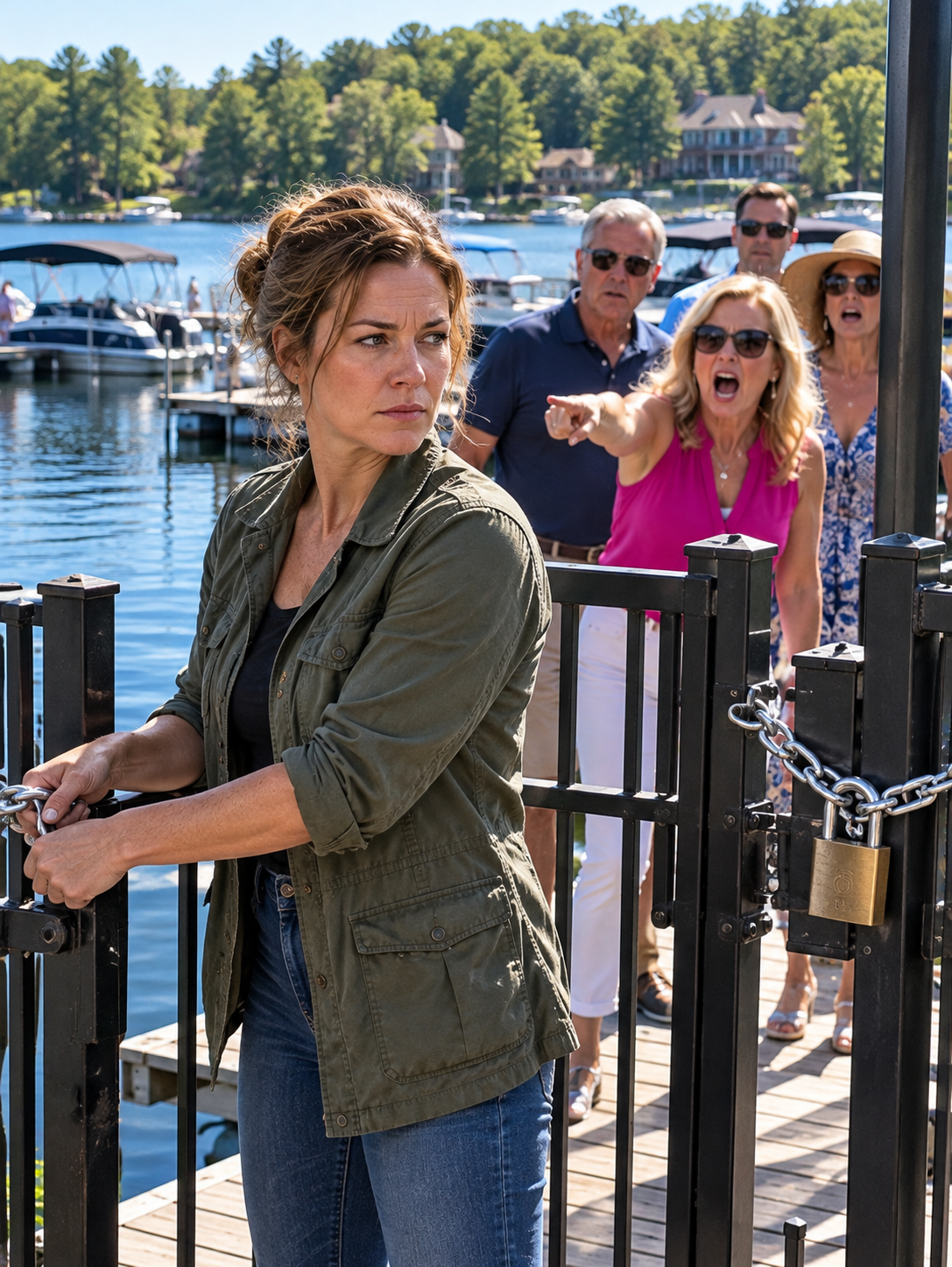
I ran a sturdy post‑and‑chain gate across the narrow access path that led from the common area to my shore. I installed a sign: Private Property — No Trespassing — Rights Reserved. I put up a camera. I locked it tight. And I waited.
The reaction was immediate.
Neighbors pounded on my gate. “You’re blocking the lake!” “We paid for this!” “Open it now or we call the sheriff!”
Hale arrived an hour later, face red. “Remove this obstruction immediately. You are endangering the amenity.”
“This is my land,” I said from the other side of the gate. “The lake access you sold them was never yours to give. The records are clear. If you want to share the water, buy it from me — legally, fairly, in writing — or stay off.”
He laughed. “You can’t do this. We’ll sue you into bankruptcy.”
“Sue,” I said. “And I’ll show the court exactly what you’ve been selling for thirty‑four years. How much do you think every homeowner here will want back?”
He paled. That was it. That was the threat he couldn’t argue his way past.
The sheriff came. He reviewed the documents. He looked at the old deed. “She’s within her rights,” he told the crowd. “This is private property. The HOA’s claim is disputed. Until a court says otherwise, stay out.”
The murmurs shifted. People turned to Hale. “What does he mean ‘disputed’?” “Did we pay for something you didn’t own?” “Show us the deed.”
Hale stalled. “Technicality. Old paperwork. Don’t listen. We’ll fix it.”
But I wasn’t done. That night, I posted everything online — the 1927 deed, the 1992 filing missing the signature, the fine notices, Hale’s own email mentioning “redevelopment.” I titled it: The Lake You Paid For Was Never Yours.
It spread by morning. Neighbors read. They pulled their own deeds. They called lawyers. And the questions turned sharp.
What redevelopment? Hale had spoken of it casually, but now no one knew details. I dug into county planning records and found the application — filed by a shell company, dated two weeks earlier: Shoreline Residences — 42 luxury units, private marina, restricted public access. The same names appeared on the company registration: Hale, the treasurer, the architectural review board chair.
They weren’t just blocking me. They were planning to fence off the entire shoreline, build for profit, and tell everyone it was “necessary improvements.” And my dock stood exactly where their main marina was meant to go.
The fines weren’t about rules. They were about clearing the path.
I held a community meeting at my house. Sixty people showed up. I laid out the timeline slow and clear. When I finished, the room was quiet, then angry.
“We paid extra for lake views,” one man said. “For access.”
“Thirty thousand on my lot alone,” said another. “And it was never real?”
“Not from the start,” I said. “But we can fix it. Together. We can file a class action. We can demand the developer’s successors buy the rights properly. We can write new agreements that are fair, legal, and shared. But we can’t let them build over us first.”
That night, Hale sent a single line by text: You’ve made a powerful enemy. Open the gate or regret it.
I didn’t reply. I reinforced the gate. I added motion lights. I backed up every file to three separate drives.
The first incident came two nights later — a cut lock, a plank pried loose. I sent footage to the sheriff. No one was charged.
Then the planning commission meeting. Hale stood and presented the marina plan as “long‑awaited improvement.” Half the room stood up and read from my documents. The vote was tabled pending review.
Hale cornered me in the parking lot. “Walk away,” he said, low and tight. “Sell to the developer. Keep your dock. Make a profit. Or you lose everything in court.”
“Why not just buy the rights properly?” I said. “Pay the fair market value to the people who actually own them. Me. And the other three families whose original deeds reserved them.”
He sneered. “Because then we don’t control it.”
I didn’t flinch. “Then you don’t get it.”
I kept digging. I found something deeper — a handwritten note tucked in the margin of the 1927 deed, signed by the original landowner: The water belongs to the people who live beside it. Not to those who buy and sell paper. And beneath it, in different ink, dated 1956 — my grandfather’s handwriting: I was told to erase this. I won’t.
Someone had known. Someone had tried to warn. And the same family name — Hale — appeared on the opposing side, then too.
I pulled the chain further. The developer’s partner in 1992 was Roland Hale’s father. The shell company now? His son. This wasn’t a new scheme. It was the same family, same lie, same land, waiting for the right moment to finish what they started three generations ago.
They hadn’t just targeted me. They’d targeted my grandfather, my father, and me — anyone who held the shoreline they wanted.
I shared the family connection. The outrage grew. Local media picked up the story. State regulators opened an inquiry. Hale’s marina plan stalled. But the threats escalated.
My tires slashed. My mailbox smashed. A sign planted in my yard: LEAVE OR WE HELP YOU.
I didn’t leave. I organized. We formed a riparian rights coalition. We met with lawyers. We prepared our own proposal — shared access, fair compensation, permanent protection from development.
Then came the night I found the loose board beneath my dock. Not rotted. Pried open. Tucked inside, wrapped in oilcloth, was a metal box. Inside — a ledger, dating back to 1955. Payments. Names. Dates. Hale Sr. — $500 — silence. Witness — relocated. Survey altered.
My grandfather had written every entry. He’d known. He’d kept the proof. And he’d hidden it where they would never look — beneath the planks they’d wanted to tear down for decades.
The final entry, dated the year he died: They will come for it when I’m gone. Tell Elara — the lake is not the prize. The truth is. And they will do anything to bury it.
I sat on the dock, the ledger in my lap, and realized the stakes had shifted. They weren’t just trying to take the land. They were trying to destroy the evidence that proved they’d stolen it before I was born.
That evening, I saw the lights — not from the road, but from the water. A boat moving slow, without running lights, drifting toward my shore. I grabbed the ledger, my phone, and my keys. I backed out of the driveway just as the first flame caught the edge of the dock.
They hadn’t come to talk. They’d come to erase it all — the planks, the box, the proof, me.
I watched from the treeline as the fire spread fast, consuming the structure my grandfather built. But they were too late. The ledger was safe. The copies were safe. And the truth was already out.
Then my phone buzzed — a message from an unknown number: You saved the book. But you missed the last page. It was never just the lake. It’s the land too. Every foundation. Every pipe. Every house. They’re all built on filled wetland that never should have been approved. And they know it’s sinking.
I froze. I looked at the row of houses along the shore — Hale’s included. The cracks in the driveways. The bowed deck posts. The shifting foundations no one would admit to seeing.
They weren’t just covering up a land dispute. They were covering up a disaster. And when the truth comes out, the lake won’t be the only thing that swallows them.
✓ Lynn R. Adams
They Fined Her $250 a Day for Her Private Dock — Until She Closed the Lake and Exposed Their Century‑Old Lie What do you do when the people claiming to own the water never actually had the right to t…