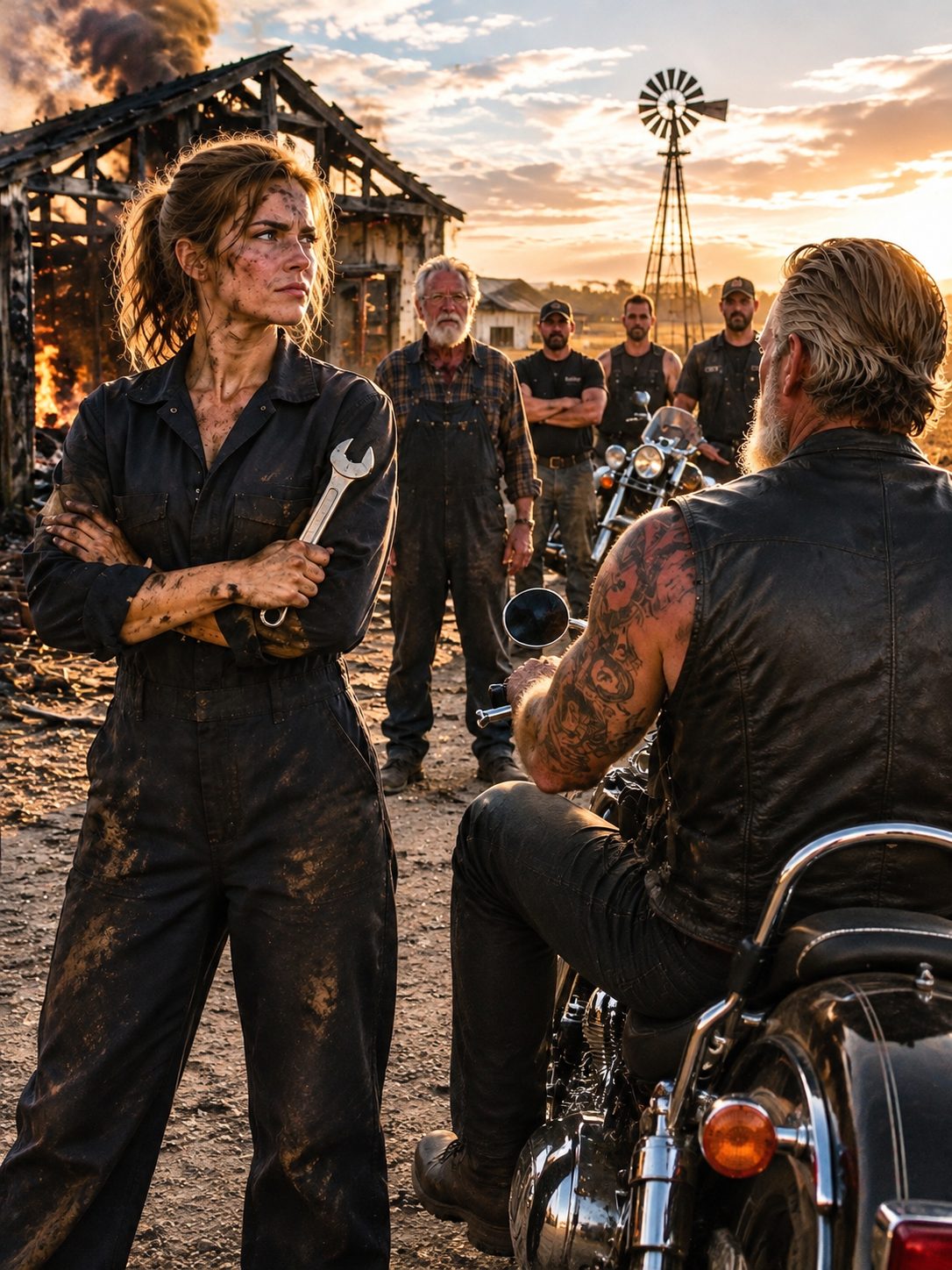
They burned the sidewall of my father’s garage to make me sell, then left me standing
IF FACEBOOK BROUGHT YOU HERE, HERE’S THE CONTINUATION YOU’VE BEEN WAITING FOR. ENJOY! 👇
Dominic Labelle arrived the following evening. I heard the motorcycles before I saw them: a steady rumble building from the south. A column of riders came over the rise, more than I could count. Most stayed on the road, engines idling in a line. Three pulled onto the gravel.
Dominic was in his late fifties, broad-shouldered, with gray in his beard. I recognized him from a photograph folded beneath the note in the coffee can: Dad, younger, standing at the edge of a group of men, wearing the same riding jacket that hung in the back room. Dominic studied the burned wall for a long moment, then looked at me.
“You look like him,” he said. “Around the eyes.”
I told him everything: the three offers, the men at midnight, the fire, the town council announcement, and a visit months earlier from Corporal Shawn Peltier of the local RCMP detachment. Two men had been looking around the property, and when Peltier responded to my complaint, he’d been polite and professional. Before leaving, he’d suggested that a young woman running a garage alone might find the work easier with more community support. He had also asked whether I’d considered Northwall’s offer.
Dominic listened without interrupting. Then he asked for the name of the municipal inspector who had approved Northwall’s staging-facility plan. I found the town council minutes on my laptop. The inspector was Rod Tully.
Dominic introduced the two men who had arrived with him: Barrett and Shep. Barrett carried a laptop bag; Shep quietly took up a position near the road-facing door. Dominic asked whether the nearby gas station had cameras. The Esso across the road belonged to Orville Keane, one of Dad’s longtime customers.
Orville had two exterior cameras. Their angle caught the edge of my lot. I went across and knocked on his door. He watched the footage twice with me. It showed the truck, the three men getting out, and one carrying an accelerant container toward the wall. It showed the fire catching and the truck leaving.
“I’ll give you whatever you need,” Orville said. “Roy built my first truck’s engine from scratch when I was twenty-two. I’m not going to let someone burn down his garage.”
Barrett spent three hours extracting the footage. It wasn’t perfect evidence by itself, but it could become powerful beside the rest. Meanwhile, he found that Rod Tully had accepted a private consulting contract from ClearBridge Advisory Services six months before approving the facility plan. ClearBridge shared a registered address with an entity belonging to Northwall’s parent company, Stonebridge Capital.
Dominic had made calls, too. Stonebridge had pursued similar land-acquisition projects in three provinces. The pattern was familiar: offers, regulatory approvals secured ahead of public announcements, then pressure on owners who refused to sell. Two complaints about earlier projects had gone to the Alberta Energy Regulator and been closed without findings.
“In this corridor, at least six properties changed hands under circumstances people weren’t comfortable with,” Dominic told me. One owner had sold after finding his equipment tampered with. “Nothing provable. Just a message.”
I thought about the families who had disappeared from community events. I asked Dominic if I could contact the people in Dad’s binders, not to ask them for anything, but to tell them someone was finally looking at the whole picture.
“Do it,” he said.
I started with June Bertrand, a farmer two kilometers north. She had watched Northwall survey crews walk her fence line and had kept a notebook of dates and small observations, even though her daughter thought she was being paranoid. June brought the notebook to the garage and spent two hours with Barrett.
Sandra Vos had sold a ten-acre parcel eight months earlier. She described receiving letters, then a visit from a man discussing property values and infrastructure timelines. Three weeks later, her water license was challenged by an anonymous complaint to the provincial water authority. The complaint disappeared into bureaucracy when she tried to trace it.
“I sold because I couldn’t afford to fight a water-license case,” she told me. “They made the fight more expensive than the land.”
Bev Nolan, who ran the town’s community association, had noticed that three of the six families who sold had stopped attending events. They hadn’t necessarily moved away; they were ashamed of how they’d been pressured. Nobody wanted to admit they’d left because they were scared.
By the third day, Barrett had contacted Priya Weston, an investigative journalist in Calgary who had been building a file on Stonebridge Capital for fourteen months over a separate project in Saskatchewan. When she heard what we had, she said, “I’ve been waiting.”
Priya asked whether residue from the accelerant was still on the wall. I hadn’t touched it. She arranged for a fire investigator to come the next day. She explained that the footage, the inspector’s consulting contract, the water-license complaint, and the other owners’ accounts were not separate stories. Together, they showed a pattern crossing provincial lines.
The local RCMP might be compromised, I told her. Priya said the RCMP’s commercial crime section was not local. If I was willing to speak on the record, the evidence could reach the Alberta Energy Regulator and investigators who were outside the town’s immediate influence.
“I’m on the record,” I said.
Barrett traced Northwall’s Alberta operations to Preston Harwick, a forty-three-year-old land-acquisition executive with fifteen years in resource extraction. On the fourth morning, Harwick called from a blocked number. He expressed regret that things had become complicated, carefully referenced the garage fire without admitting anything, and raised Northwall’s latest offer: $390,000, up from $280,000 in February. He suggested it could be adjusted further to reflect my “demonstrated commitment” to the property.
I told him the call was being logged. I said the gas-station footage had been provided to an investigator, the residue was with a certified fire investigator, and the inspector’s conflict was under review. I told him the pattern had been connected by names, dates, and corporate entities.
“The offer isn’t something I’m going to consider,” I said. “What I would consider is whether you want to be the person whose name appears at the top of this, or the person who called voluntarily before the filing.”
Then I ended the call.
Dominic had been standing by the bay door and had heard most of it. He said that was the moment they understood I wasn’t going to behave like an isolated property owner. Their operation depended on people making isolated decisions. Once the owners, records, and evidence came together, their model began to break.
“My father would have hated making that call,” I said.
“I know,” Dominic replied. “He’d have done it anyway.”
The Alberta Energy Regulator opened a formal inquiry six days after my call with Priya. The RCMP’s commercial crime section opened a parallel file four days later, prompted by the regulatory inquiry and Barrett’s documentation of the ClearBridge connection.
Corporal Peltier was placed on administrative leave pending a review of his conduct. Rod Tully resigned from his inspector’s position in November. Preston Harwick wasn’t arrested immediately. The legal process moved through disclosure requests and corporate-structure questions, slowly and deliberately.
Priya’s investigation ran in December. Her article named Stonebridge Capital and Harwick and documented a decade of similar conduct across three provinces. She used fourteen months of reporting, my account, and information from June, Sandra, Bev, and other property owners.
The broad-shouldered man who had carried the accelerant to my wall was charged in January. The security footage wasn’t perfect, but it didn’t have to stand alone. It was consistent with the other evidence, and the intimidation they’d staged became part of the case that opened a wider investigation.
In February, Sandra called me with a settlement offer. She’d been sitting with the papers for a week. She said no amount could change what had happened, but her daughter wanted her to use the money for something that made the harm less invisible.
“What would you do with it?” she asked.
“A legal fund for property owners,” she said after thinking it through. “So the next time someone manufactures a water-license challenge and tells a person they can’t afford to fight, they can afford to fight.”
I looked at Dad’s three service binders. “I think my father would have funded that.”
Sandra accepted the settlement and put the idea into motion.
The garage wall was repaired in March, not by a contractor but by the community. Bev organized it through the community association. On Saturday morning, eleven people arrived at eight with coffee and tools borrowed from their own sheds. June spent four hours handing up boards and holding measurements despite her sore hip. Orville crossed the road during his midmorning break, nailed up three boards, and went back to the station without ceremony.
The new wall went up clean. I mounted the pegboard myself, matching the old dimensions, and hung the tools where Dad had always kept them: socket sets on the left, torque wrenches in the center, specialty tools on the right.
I left one hook empty. Dad’s old spanner had hung there before the fire. It was now blackened and warped beyond use, resting in a jar on the service desk. I kept the empty space because some things deserve to stay visible.
Dominic came back in April, alone, in a truck rather than on his motorcycle. He spent seven hours working beside me on a differential rebuild for a farmer two townships over, who had become a customer after hearing what happened from Orville. We worked mostly without talking. When the job was done, we sat on the tailgate and drank good coffee.
“You’re going to be all right,” Dominic said.
“Roy would have been.”
“He taught me how to be.”
Dominic told me again about the night outside Lethbridge when Dad had stepped in to help him. Afterward, Dominic had asked why. Dad had considered the question carefully and answered, “Because you needed someone, and I happened to be there.”
Dominic had promised that night that if Roy ever needed the club, they would come, no matter how much time passed. He had meant it. He had kept the number, just as Dad had kept his.
“Don’t wait until you have no other choice,” Dominic told me. “Your father waited because he didn’t need to call. That’s different from not calling when you do.”
I promised I would call if I needed to.
The following October, as the light faded early over Alberta, I was closing the bay door when I heard motorcycles coming from the south. A long column passed through Red Willow, headlights bright in the dusk. They didn’t stop or turn into the lot. They simply rode past the garage at an easy pace, one after another. I lost count somewhere past fifteen.
The sound faded toward the highway junction. I stood in the open bay door looking down the road. Behind me were Dad’s service ledgers, the repaired wall, the pegboard, and the empty hook. The old spanner sat in its jar, and every other tool was exactly where Dad had kept it, exactly where I kept it now.
The road grew quiet again.
I turned back to the work. There was still a brake job to finish before dark. Orville was bringing his truck in Monday morning, and June had called about a winter-tire swap. The work was long and the margins were thin, but the garage was full of names in three binders, people who had trusted Dad and now trusted me.
I was exactly where I was supposed to be.
The bay door rolled shut with the solid, reliable sound of something built to last. Inside, the shop light came on, warm and steady, over the concrete floor my father had poured with his own hands twenty-two years earlier.
Some things, when you refuse to let them be taken, become more than what they were. They become proof that standing still, quiet and certain, without flinching, is its own kind of power.
The following October, the motorcycles returned—not to rescue me, not to threaten anyone, but simply to ride past the garage where Roy Callister had built his life. Their headlights moved through the fading Alberta light, and I understood that the promise my father had kept in reserve had not ended with him.
The garage was still standing. The community had helped repair it, the evidence had reached investigators, and the people who had been pressured were no longer carrying their stories alone.
I still had work to do, bills to pay, and customers waiting for their vehicles. But I no longer mistook being alone for being powerless.
Final I had thought the fire was meant to destroy my father’s garage. It was meant to make me believe I had no choice but to sell. Instead, it brought back a promise made decades earlier between two men who understood what it meant to stand beside someone in trouble.
Dominic and the Iron Wolves didn’t take my father’s place. They helped me finish the work he had started, and they reminded me that the people who care about a place can be just as important as the person who owns it.
My father had left me a garage, three binders of records, and one phone number marked “in case.” I finally understood why he’d kept it.
THE END. I’ve shared the complete story, and I truly hope it touched your heart. If this story moved you, please , like, and share the post. Thank you for reading! ❤️
✓ Lynn R. Adams
IF FACEBOOK BROUGHT YOU HERE, HERE’S THE CONTINUATION YOU’VE BEEN WAITING FOR. ENJOY! 👇 Dominic Labelle arrived the following evening. I heard the motorcycles before I saw them: a steady rumble buil…