They Bulldozed My Farm Gate and Gave Me 72 Hours to Leave—Then My Father’s Forgotten Deed Stopped Their $8 Million HOA Project
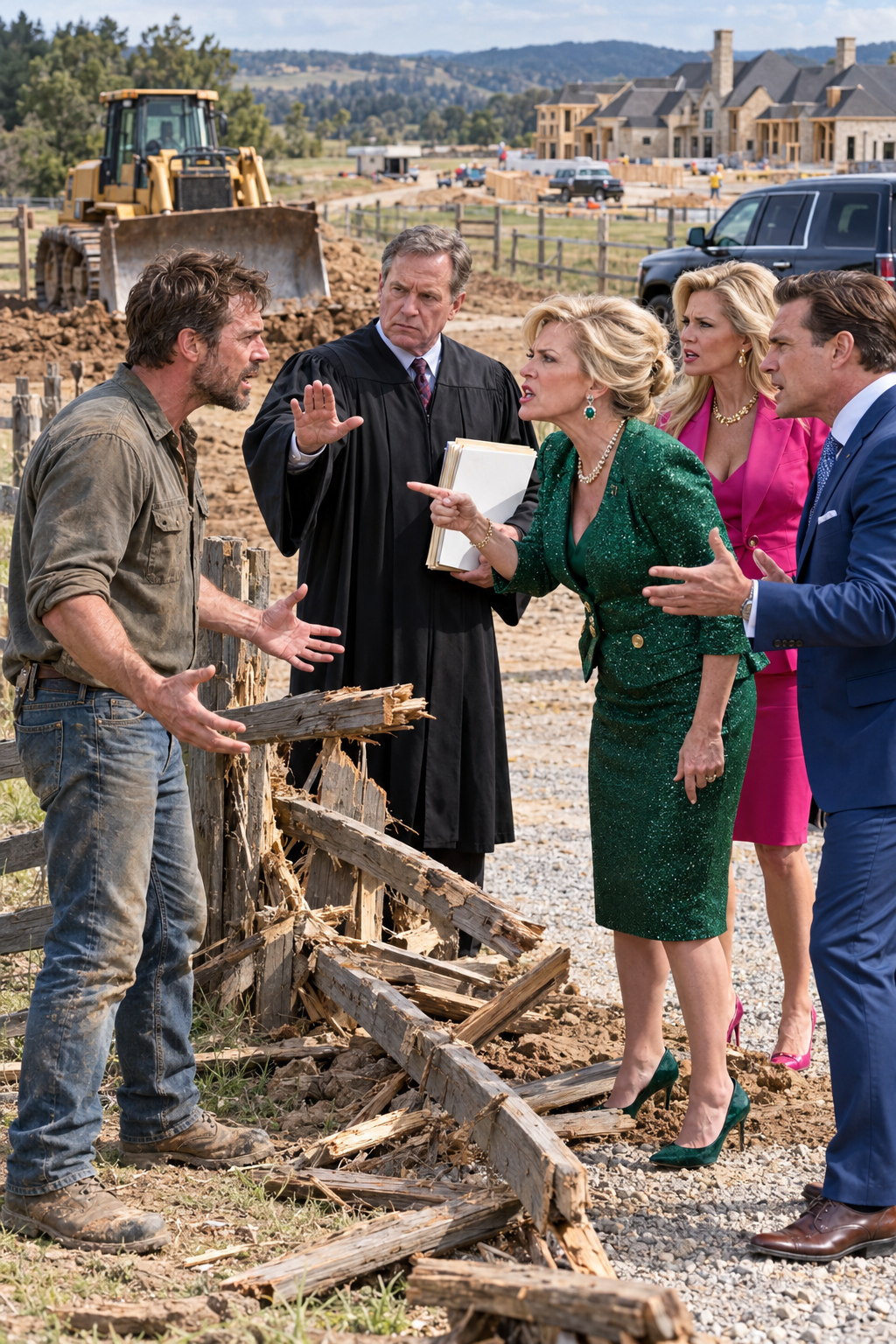
They Bulldozed My Farm Gate and Gave Me 72 Hours to Leave—Then My Father’s Forgotten Deed Stopped Their $8 Million HOA Project
The bulldozer crushed my father’s iron farm gate at on a Tuesday morning.
By , a woman in a white designer blazer was standing on my driveway, telling me I had seventy-two hours to abandon the land my family had owned for ninety-three years.
And by noon, I discovered that the people trying to steal my farm had already borrowed eight million dollars against property they didn’t own.
My name is Daniel Mercer.
I’m forty-three years old, a former civil engineer, and the third generation of Mercers to work a piece of land outside Franklin, Tennessee.
I don’t scare easily.
I don’t raise my voice when somebody threatens me.
And I learned a long time ago that the most dangerous person in a dispute isn’t the one making the biggest noise.
It’s the one who knows where the paperwork is buried.
That morning, I was standing in my kitchen with a mug of black coffee when I heard the first metallic crack.
It sounded like somebody had dropped a shipping container onto concrete.
Then came the grinding.
The engine.
The unmistakable scream of steel being torn apart.
I looked through the window.
A yellow Caterpillar excavator was parked across my driveway.
Its bucket had already ripped one of the gateposts out of the ground.
The left half of my father’s wrought-iron gate lay twisted in the gravel.
The right half was hanging from a single bent hinge.
Behind the excavator stood three men wearing reflective vests.
Two black SUVs.
And a woman I recognized immediately.
Patricia Whitfield.
President of the Willow Creek Estates Homeowners Association.
Sixty-one years old.
Perfect silver-blonde hair.
Expensive sunglasses.
And the kind of smile people wear when they believe their lawyer is more important than your property rights.
I set down my coffee.
Put on my boots.
Picked up my phone.
And walked outside.
“STOP THE MACHINE!” I shouted.
The operator looked toward Patricia.
Not toward me.
That told me almost everything I needed to know.
Patricia raised one hand.
The excavator stopped.
She walked toward me with a leather folder tucked beneath her arm.
“Good morning, Mr. Mercer.”
I looked past her at the broken gate.
“Who authorized this?”
She smiled.
“That would be the Willow Creek Estates Development Committee.”
“This is private property.”
“Not anymore.”
She opened her folder.
Inside was a document bearing the words FINAL PROPERTY TRANSITION NOTICE.
She held it toward me.
I didn’t take it.
“Your farm falls within the approved expansion corridor for the Willow Creek Heritage Living Project,” she said. “You’ve received multiple notices.”
“I received three letters from your HOA telling me to join an organization I don’t belong to.”
“Those were compliance notices.”
“They were junk mail.”
Her smile tightened.
“Mr. Mercer, I understand this is emotional for you.”
I looked at the destroyed gate.
Then back at her.
“You’re standing on my property with construction equipment. This isn’t an emotional conversation. It’s a legal one.”
She glanced at the men behind her.
One of them shifted uncomfortably.
Patricia lowered her voice.
“The development has already been approved. We’re building a private wellness center, walking trails, luxury guest cottages, and an expanded community clubhouse.”
“On whose land?”
“Land incorporated into the Willow Creek development boundary.”
“That’s not what I asked.”
She leaned closer.
“You have seventy-two hours to vacate the affected portion of the property.”
I stared at her.
“My house?”
“Your residence will be addressed during the second phase.”
Something cold settled in my stomach.
Recognition.
This woman wasn’t negotiating.
She was announcing a decision she’d already made.
I looked toward the excavator.
Its bucket was still resting on the remains of the gate my father had welded by hand in 1987.
“Turn your equipment around,” I said.
Patricia gave a small laugh.
“Daniel, don’t make this difficult.”
I pulled out my phone.
“Your name is Patricia Whitfield. You’re president of Willow Creek Estates HOA. It’s a.m. on October sixth. You’ve entered Mercer Farm without permission and destroyed my gate.”
Her smile disappeared.
“Are you recording me?”
“You don’t have my consent.”
“We’re outside, and I’m documenting what is happening on my property.”
She took a step backward.
“You’re going to regret this.”
I looked directly into the camera.
“Please repeat that.”
She said nothing.
Behind her, one of the construction workers slowly removed his hard hat.
I kept recording.
I recorded the damaged gate.
The equipment identification numbers.
The license plates.
The workers.
The temporary construction sign leaning against the fence.
And the freshly painted orange stakes running through my eastern pasture.
Then I noticed something.
The stakes didn’t stop at the driveway.
They continued toward the old springhouse.
Across the creek.
And into the bottomland where my father had buried his dog, Ranger, beneath a white oak tree.
I lowered the phone.
“How much of my property are you planning to take?”
Patricia closed her folder.
“Approximately forty-six acres.”
My farm contained seventy-two.
She wanted almost two-thirds of it.
I looked at her for a long moment.
Then I asked one question.
“Who told you those forty-six acres were available?”
For the first time that morning, Patricia hesitated.
Only a second.
But I saw it.
“Our legal team has verified the boundaries.”
“Which legal team?”
“That’s confidential.”
“Property records aren’t.”
Her expression hardened.
“Mr. Mercer, you’re interfering with an approved eight-million-dollar development.”
I nodded slowly.
“Eight million.”
“That’s correct.”
“Then I suggest you call whoever approved the financing.”
“Because somebody made a very expensive mistake.”
She laughed.
And that was the moment I decided not to tell her what I knew.
Because there was something Patricia Whitfield didn’t understand about Mercer Farm.
My father hadn’t simply left me seventy-two acres.
He had left me a filing cabinet.
Fourteen survey maps.
Three generations of tax records.
A leather-bound notebook.
And one sealed envelope with five words written across the front.
DO NOT LOSE THIS DEED.
I had never opened that envelope.
Not because I didn’t care.
Because Dad had told me there would be a time when I needed it.
And until that morning, I’d never believed him.
My father, Thomas Mercer, was not a wealthy man.
He drove the same blue Ford F-150 for twenty-two years.
He repaired tractors instead of replacing them.
He wore work boots until the soles separated.
And when developers started buying the farms surrounding ours, he refused every offer.
They offered him money.
They offered him partnerships.
They offered him a retirement house in Florida.
They offered him more than our farm had ever earned in a decade.
He said no.
Every single time.
I used to think he was stubborn.
Now I was beginning to understand that stubbornness wasn’t the reason.
I remembered what he told me three weeks before he died.
We were sitting on the back porch.
He had a blanket across his knees.
The October air smelled like wet leaves and woodsmoke.
He pointed toward the eastern pasture.
“One day, somebody’s going to tell you that land isn’t yours.”
“Then I’ll show them the deed.”
He shook his head.
“Not the regular deed.”
“What does that mean?”
He looked at me.
“Promise me something, Danny.”
“Anything.”
“Don’t sell the east field.”
“Don’t sign anything they bring to your door.”
“And if they ever come with machines…”
He stopped coughing long enough to squeeze my wrist.
“Find the blue envelope.”
I thought he was confused.
He was seventy-eight.
His heart was failing.
And the medication made him tired.
So I promised.
Then I forgot about it.
Until Patricia Whitfield drove a bulldozer through his gate.
I stood there watching her SUV leave the property that morning.
The excavator remained parked beside the driveway.
The operator had shut it down after I called the Williamson County Sheriff’s Office.
A deputy arrived twenty-six minutes later.
His name was Aaron Collins.
He was in his early thirties, with a calm voice and a habit of listening before speaking.
He examined the gate.
Took photographs.
And asked Patricia to explain why her contractors had entered my property.
She handed him the same folder.
He read the first page.
Then the second.
Then looked at me.
“Mr. Mercer, do you have documentation showing ownership?”
“Can you get it?”
I went inside and returned with my current recorded deed, property tax statement, and a survey from 2019.
He compared the documents.
Patricia folded her arms.
“Officer, this is a civil matter.”
“Deputy,” Collins corrected.
She blinked.
He continued reading.
“This document you’ve provided appears to be an HOA development resolution.”
“That isn’t a court order.”
“It’s supported by our legal counsel.”
“That doesn’t make it permission to enter somebody else’s land.”
Her cheeks turned pink.
“You’re misunderstanding the development agreement.”
Collins handed the folder back.
“Ma’am, I’m not making a final property determination here. But I am telling you to stop work until this is resolved.”
Patricia stared at him.
“You realize how much money is involved?”
“That doesn’t change my instruction.”
I almost smiled.
Then Patricia turned toward me.
“You’ve made a serious mistake.”
I said nothing.
She stepped closer.
“Do you know what happens when a small landowner challenges an eight-million-dollar project?”
I met her eyes.
“Usually somebody starts checking the title.”
She didn’t like that answer.
Not even a little.
By ten o’clock, the construction crew had left.
The excavator remained on a flatbed trailer near the county road while its owner arranged to retrieve it.
The deputy gave me an incident number.
I photographed the damage again.
Then I walked to the barn.
I hadn’t entered Dad’s old office in almost six months.
It was a narrow room built into the rear corner of the barn.
One window.
A wooden desk.
Two metal filing cabinets.
A faded Tennessee Volunteers calendar from 2018.
And a photograph of my parents standing beside the farm gate on their twentieth wedding anniversary.
Mom had died in 2009.
Dad followed fourteen years later.
I was their only child.
The farm was the last place in the world where I could still feel both of them.
I stood beside the desk for a moment.
Then opened the bottom drawer.
There were old tractor manuals.
Insurance policies.
Receipts for fencing supplies.
A yellow envelope containing photographs of the creek after the 2010 flood.
And underneath everything, a blue envelope.
My father’s handwriting covered the front.
DO NOT LOSE THIS DEED.
My fingers went still.
I sat down.
Carefully opened the envelope.
And pulled out a document that was older than the house I lived in.
The paper had yellowed.
The ink had faded.
But the county recording stamp was still visible.
June 18, 1931.
I read the first paragraph.
Then the second.
Then I stopped breathing for a moment.
Because the document didn’t just describe Mercer Farm.
It described the land beneath Willow Creek Estates.
I read the legal description three times.
Then I reached for Dad’s survey maps.
The oldest map showed a creek winding south through open farmland.
The newer map showed the same creek disappearing beneath the roads and houses of Willow Creek Estates.
And across the top of the 1931 document was a phrase I had never seen before.
RESERVATION OF UNDERLYING FEE TITLE AND CONDITIONAL RIGHT OF REVERTER.
I wasn’t a lawyer.
But I had worked on municipal infrastructure projects for seventeen years.
I knew enough about land records to recognize when something deserved professional attention.
I also knew one thing with absolute certainty.
Patricia Whitfield had no idea what was in my hands.
I took pictures of every page.
Made digital copies.
Put the original inside a fireproof document case.
Then called the only attorney I trusted.
Her name was Rebecca Shaw.
She had handled Dad’s estate.
She was fifty-two, sharp-eyed, and completely unimpressed by people who used expensive suits as substitutes for evidence.
When she answered, I told her what had happened.
She listened without interrupting.
Then I mentioned the blue envelope.
“What kind of deed?” she asked.
“I think you need to see it.”
“Email me the first page.”
There was silence.
Long enough that I thought the call had disconnected.
“I’m here.”
“What is it?”
“Daniel, where did you find this?”
“Dad’s office.”
“Is this the original?”
“I believe so.”
Another pause.
Then she said something that made my skin prickle.
“Don’t let anybody know you have this.”
I looked toward the barn window.
“Because if this document is what I think it is, Willow Creek’s entire development may have a title problem.”
“Potentially much bigger than forty-six acres.”
I looked down at the old map.
“How much bigger?”
Rebecca exhaled.
“Daniel, I need you in my office. Bring everything.”
I glanced at the clock.
Less than five hours after Patricia Whitfield destroyed my gate.
“How soon?”
I locked the barn.
Placed the fireproof case on the passenger seat of my truck.
And drove toward Franklin.
I didn’t know it yet.
But somebody had already noticed the envelope was missing from my father’s office.
And by the time I reached Rebecca’s building, the first threatening message was waiting on my phone.
It came from an unknown number.
No greeting.
No signature.
Just eleven words.
YOUR FATHER WAS WARNED. PUT THE BLUE ENVELOPE BACK.
I stared at the screen.
Then looked in my rearview mirror.
A black Chevrolet Tahoe was parked across the street.
Its engine was running.
And the driver was watching my truck.
I didn’t get out.
I called Rebecca.
“Are you upstairs?”
“Can you see the street?”
“Because I think somebody followed me.”
There was a pause.
Then her voice changed.
“Daniel, listen carefully. Don’t bring the deed inside yet.”
I looked at the Tahoe.
The driver’s window lowered.
A man wearing dark sunglasses raised his phone.
He took a photograph of me.
Then drove away.
Rebecca spoke again.
“I’m here.”
“There’s something I need to tell you about your father’s estate.”
“I received a call this morning.”
“From who?”
“An attorney representing Willow Creek.”
My grip tightened around the steering wheel.
“What did he want?”
“He asked whether your father left behind any documents from 1931.”
I looked at the fireproof case.
“How would he know?”
“I asked him the same question.”
“What did he say?”
Rebecca’s answer came quietly.
“He said those documents were supposed to have been destroyed forty years ago.”
I didn’t speak.
For the first time that day, I felt something more unsettling than anger.
Because somebody hadn’t just planned to take my land.
Somebody had been waiting for my father to die.
And now they knew I had found what he left behind.
I carried the document case into Rebecca’s office through the rear entrance.
Her assistant, Melissa, locked the door behind me.
Rebecca was waiting in her conference room.
A large monitor displayed the Williamson County property records website.
There were two cups of coffee on the table.
Neither had been touched.
“Show me the original,” she said.
I placed the case down.
And handed her the deed.
She put on reading glasses.
For nearly ten minutes, the only sound in the room was the hum of the air conditioner.
Then she reached for a legal pad.
“Daniel, your grandfather was Samuel Mercer?”
“And his father was William Mercer?”
“Did your father ever explain how Willow Creek Estates was developed?”
“Only that the land used to belong to our family.”
“That’s an important distinction.”
She turned the deed toward me.
“This instrument appears to reserve certain property interests while allowing a specific use of the adjoining tract.”
“What kind of use?”
“A residential agricultural community. That’s the language used in the original instrument.”
“Willow Creek is a residential community.”
“Today it is.”
She tapped a paragraph.
“But the document also contains restrictions concerning commercial development, transfer of certain easements, and conversion of the property into a privately operated resort.”
I leaned forward.
“That’s exactly what Patricia is building.”
“Does that mean we own Willow Creek?”
Rebecca shook her head.
“Not automatically. These provisions are old, and their enforceability will depend on the chain of title, subsequent conveyances, and Tennessee law. Some rights may have expired or been extinguished. We need a title examiner.”
I appreciated that answer.
She wasn’t selling me a fantasy.
She was telling me what we could prove.
Then she pointed to another section.
“But this part is different.”
It concerned a strip of land along the eastern boundary of Mercer Farm.
A corridor running from the county road to the old creek crossing.
According to the 1931 document, the Mercer family had retained ownership of that corridor.
The adjoining property had been granted a limited right of passage for agricultural and residential access.
Not ownership.
Not development rights.
And certainly not the authority to demolish structures and take possession.
Rebecca pulled up a modern parcel map.
She highlighted a narrow strip of land.
It ran directly beneath the proposed entrance to Willow Creek’s new development.
Then she opened the HOA’s publicly filed site plan.
I recognized the drawing immediately.
The proposed wellness center.
The guest cottages.
The clubhouse.
The landscaped walking paths.
And a new entrance road.
A road that crossed the very strip of land described in my father’s deed.
Rebecca looked at me.
“Daniel, this is the part that concerns me.”
“Because the development company appears to have represented that it controls this corridor.”
“Doesn’t it?”
“Based on what you’ve shown me, that claim needs serious investigation.”
I stared at the screen.
The new entrance road was not a minor feature.
It was the main access point for construction vehicles.
The planned emergency access route.
The entrance to the guest cottages.
And the only road shown connecting the new resort facilities to the county highway.
I looked at Rebecca.
“If they don’t own that corridor…”
She finished the sentence.
“They may not have the legal access their approved plans depend on.”
I sat back.
For a moment, I thought about the gate.
My father’s gate.
The one he’d welded with his own hands.
Patricia had ordered it destroyed because it stood in the way of a road she wanted.
But the gate wasn’t the obstacle.
The deed was.
And unlike the gate, the deed couldn’t be flattened by a bulldozer.
Rebecca began making calls.
First to a title examiner.
Then to a surveyor.
Then to the county planning department.
I watched her work.
She didn’t threaten anyone.
She didn’t announce a lawsuit.
She asked questions.
Specific questions.
Questions that required written answers.
At p.m., she received a copy of the development company’s recorded financing documents.
She read them silently.
Then turned the screen toward me.
“Daniel, I think you should see this.”
The borrower was Willow Creek Heritage Development LLC.
The principal financing commitment was eight million dollars.
The collateral description included several parcels associated with the proposed expansion.
And attached to the loan documentation was a title certification.
I recognized the name on the certification.
Not because I’d met him.
Because I’d seen it on the bottom of Patricia’s HOA letters.
Charles Whitfield.
Attorney at Law.
Patricia’s husband.
I looked at Rebecca.
“Her husband certified the title?”
“His firm issued the legal opinion attached to the financing package.”
“Is that allowed?”
“Relationships alone don’t establish wrongdoing. But if he overlooked a recorded interest, the lender will want an explanation.”
She highlighted a sentence.
The borrower represented that it possessed sufficient legal rights to develop and access the project property.
Then read it again.
Eight million dollars.
A private development.
A disputed access corridor.
And the HOA president’s husband signing off on the legal rights.
Suddenly Patricia’s confidence made sense.
She wasn’t just trying to push a stubborn farmer out of the way.
She was trying to remove the one visible problem before anybody looked too closely at the paperwork.
Rebecca leaned back.
“We need to move carefully.”
“What do you recommend?”
“An emergency application to prevent further entry and damage, a formal notice of the title dispute, and immediate preservation of evidence.”
“How long?”
“We can start today.”
She studied me.
“You’re very calm.”
I looked at the photograph of my father’s gate on my phone.
She waited.
“I’m just not going to give them the reaction they’re hoping for.”
That afternoon, Rebecca’s office sent preservation notices to the HOA, the development company, and its contractors.
We requested copies of the surveys, title opinions, easement documents, construction permits, and all communications concerning the Mercer property.
We notified the lender that a recorded instrument raised questions about the proposed access corridor.
We also filed the appropriate papers to seek temporary protection against further construction on my land.
By , Patricia Whitfield had called me eleven times.
I didn’t answer.
At , she sent a text.
Daniel, this has gone far enough. You are creating unnecessary problems for an entire community.
I took a screenshot.
At , another message arrived.
The HOA is prepared to discuss reasonable compensation if you cooperate immediately.
I forwarded it to Rebecca.
At , Patricia called again.
This time, Rebecca told me to answer with her listening.
I put the phone on speaker.
“Mr. Mercer,” Patricia said.
“Mrs. Whitfield.”
“I understand you’ve retained counsel.”
“That seems rather aggressive.”
“You demolished my gate.”
“We’ve already discussed the gate.”
“No. You told me I had seventy-two hours to leave.”
“That was a preliminary notice.”
“It was delivered with a bulldozer.”
Her breathing changed.
“Daniel, I’m trying to resolve this amicably.”
“Then communicate with my attorney.”
“I don’t think you understand the consequences of what you’re doing.”
“Explain them.”
“More than two hundred homeowners are depending on this project.”
“Did they vote to take my farm?”
“Did they?” I repeated.
“The board approved the development.”
“That’s not what I asked.”
Her voice sharpened.
“The community has invested a tremendous amount of money.”
“Then the community deserves accurate information.”
Another silence.
Then she said something strange.
“Your father understood how things worked around here.”
I looked at Rebecca.
She raised one finger, telling me to keep listening.
“What does that mean?” I asked.
“Thomas was a practical man.”
“He knew when a fight wasn’t worth having.”
I glanced at the old deed.
“My father never mentioned you.”
Patricia gave a short, humorless laugh.
“Of course he didn’t.”
Then she ended the call.
Rebecca and I sat quietly.
Finally, she said, “That was interesting.”
“Which part?”
“Her reference to your father.”
“She sounded like she knew him.”
“Not that I know of.”
Rebecca wrote something on her legal pad.
“Let’s find out.”
I drove home after sunset.
The broken gate was still lying beside the driveway.
I stopped my truck.
And walked toward it.
The old iron was cold beneath my hand.
Dad had made the gate from salvaged steel.
He’d spent three weekends measuring, cutting, and welding it.
I was fourteen when he finished.
He let me paint the numbers on the center panel.
The year his grandfather recorded the deed.
I had always assumed it was a sentimental tribute.
Now I wasn’t so sure.
I ran my fingers over the twisted metal.
Then noticed something.
The center panel hadn’t been crushed.
It had been torn free.
The section with the numbers was missing.
I searched the grass.
The gravel shoulder.
The excavator had destroyed most of the gate.
But somebody had removed the panel bearing the date.
I took another photograph.
Then called Deputy Collins.
He answered on the third ring.
“Everything okay, Mr. Mercer?”
“Somebody took part of the gate.”
“What part?”
“The center panel.”
“Could it have been moved with the debris?”
“Possibly. But I photographed it this morning. It was still attached after the machine stopped.”
“Send me the pictures.”
“Interesting,” he said.
“That’s one word for it.”
“Do you have cameras?”
“Two covering the driveway.”
“Check them.”
I walked to the house.
Opened the security system.
And scrolled through the morning footage.
The first video showed the excavator arriving at .
The second showed Patricia stepping out of her SUV.
The third showed the gate being crushed.
Then I found a clip recorded at .
After the deputy had left.
Before the equipment was removed.
A man in a gray work jacket walked toward the broken gate.
He looked around.
Picked up the center panel.
And carried it toward a white pickup truck parked near the road.
He placed the panel in the truck bed.
Then drove away.
I paused the footage.
And felt my jaw tighten.
The truck had a magnetic sign on the door.
WHITFIELD PROPERTY SERVICES.
I sent the clip to Deputy Collins.
Then to Rebecca.
Her response came almost immediately.
Preserve the original recording. Do not contact them.
I sat at the kitchen table.
Looked at the empty driveway.
And thought about what Patricia had said.
Your father understood how things worked around here.
Something about that sentence bothered me.
Not just the words.
The familiarity.
The certainty.
As though she believed Dad had once agreed to something.
I opened the leather notebook from his filing cabinet.
The first pages contained ordinary farm records.
Hay yields.
Fence repairs.
Fuel purchases.
Cattle vaccinations.
Then, about halfway through, the entries changed.
There were dates.
And short notes written in Dad’s careful block lettering.
March 12, 1986.
Whitfield meeting. Refused corridor release.
April 3, 1986.
Charles returned. Offered $40,000. No.
May 19, 1986.
County records checked. Original reservation still recorded.
Forty years ago.
I turned the page.
June 2, 1986.
Patricia came alone. Said development would happen with or without us.
My stomach tightened.
Patricia hadn’t discovered Mercer Farm last month.
She had been trying to get control of it for four decades.
I kept reading.
June 17, 1986.
Gate completed. Survey markers reset.
June 20, 1986.
Someone removed east boundary stakes.
July 8, 1986.
Charles threatened court. Told him to file.
Then the entries stopped.
For nearly six years, the notebook returned to ordinary farm business.
Until one entry in 1992.
October 14.
Bank man came with Charles. Asked again about 1931 instrument. Told them the original is safe.
Below that, Dad had written one sentence.
They cannot build what they want without my signature.
I stared at those words.
Then turned the page.
A photograph fell out.
It was old.
Faded at the edges.
Four people stood in front of the farmhouse.
A younger Charles Whitfield.
And a woman I didn’t recognize.
She had dark hair.
A burgundy jacket.
And one hand resting on the hood of a black sedan.
On the back, Dad had written:
October 1986. The day they stopped pretending.
I studied the photograph.
The woman looked familiar.
But I couldn’t place her.
Then my phone rang.
“Daniel, I need you to listen carefully.”
“I’m listening.”
“Our title examiner found something.”
“The 1931 deed wasn’t the only instrument recorded that year.”
I sat upright.
“What else?”
“A separate agreement concerning the creek crossing and the development corridor.”
“Does it help us?”
“Potentially. But there’s a problem.”
“What problem?”
“Someone filed an affidavit in 1987 claiming your grandfather’s reserved rights had been extinguished.”
I looked down at Dad’s notebook.
“Who filed it?”
“Charles Whitfield.”
I closed my eyes.
Rebecca continued.
“That affidavit was later referenced in several transactions. It may explain why the developer believed the corridor was available.”
“Was it valid?”
“That’s what we’re investigating.”
I looked at the old photograph.
“Rebecca, Dad’s notebook says Charles offered him forty thousand dollars in 1986 to release the corridor.”
“That could be important.”
“He refused.”
“Document that page.”
“And there’s something else.”
“Patricia was involved back then.”
Rebecca went quiet.
“How do you know?”
“She came to the farm in June 1986.”
“Do you have proof?”
“Dad wrote it down.”
“Bring me the notebook tomorrow.”
I looked at the photograph again.
“And Rebecca?”
“I think somebody removed part of my gate because of the date welded into it.”
“Why would they care about the date?”
“I don’t know.”
I turned the photograph over.
Looked again at the handwritten caption.
The day they stopped pretending.
“But I’m starting to think the gate was never just a gate.”
The next morning, I woke to the sound of tires on gravel.
For one second, I thought Patricia had sent the construction crew back.
I grabbed my phone.
Looked through the bedroom window.
A dark blue pickup was parked outside.
A man stood beside it holding a cardboard box.
I recognized him immediately.
Earl Patterson.
Seventy-four years old.
Retired county surveyor.
My father’s oldest friend.
Earl had helped Dad rebuild the barn after a tornado in 1998.
He’d taught me how to read contour lines when I was twelve.
And he’d been one of the six men who carried Dad’s coffin.
I opened the front door.
He looked older than the last time I’d seen him.
His shoulders were hunched.
His hands shook slightly.
But his eyes were clear.
“Morning, Danny.”
“What are you doing here?”
He looked toward the broken gate.
Then at me.
“I heard what happened.”
I stepped aside.
He didn’t move.
Instead, he looked toward the county road.
Then lowered his voice.
“Before I do, tell me something.”
“Did you find the blue envelope?”
I stared at him.
He nodded slowly.
“Your dad said you would.”
“How did you know about it?”
Earl looked at the cardboard box in his hands.
“Because I was there when he made the copies.”
I felt a chill.
“Copies of what?”
“The records Charles Whitfield wanted buried.”
I glanced toward the road.
“Come inside.”
Earl followed me into the kitchen.
I poured him coffee.
He sat at the table and placed the box between us.
For a moment, neither of us spoke.
Then he said, “Your father made me promise something.”
“If anybody ever came after this farm, I was supposed to bring you this.”
He pushed the box toward me.
Inside were rolled survey drawings.
A yellowed field notebook.
Three envelopes.
And a small brass key.
I picked up the key.
“What’s this?”
Earl shook his head.
He pulled out the oldest survey.
Unrolled it.
And placed two coffee mugs on the corners.
The map showed Mercer Farm in 1931.
To the east was a large tract labeled Willow Creek Agricultural Reserve.
A narrow corridor connected the county road to the creek crossing.
I recognized it immediately.
The same corridor Rebecca had highlighted.
Earl pointed to the map.
“Your great-grandfather owned this entire valley.”
“I knew that.”
“He sold most of it during the Depression.”
“I knew that too.”
“But he didn’t sell everything.”
I looked at the narrow strip.
“The corridor.”
Earl nodded.
“And the springhouse tract.”
“The springhouse is on my property.”
“Today it is.”
“What does that mean?”
He took a slow breath.
“Back then, the creek crossing and springhouse were part of a larger agreement. Your great-grandfather wanted the families living east of the creek to have access to water and the county road.”
“He allowed them passage. But he kept ownership of the corridor and certain rights tied to the creek.”
“Because he didn’t trust the company buying the land.”
I looked at the map.
“Apparently he was right.”
Earl gave a sad smile.
“More right than he knew.”
He reached into the box.
Pulled out a folded letter.
Handed it to me.
The paper was dated September 4, 1986.
It was addressed to Thomas Mercer.
From Charles Whitfield.
I read the first paragraph.
Charles offered to purchase the reserved corridor and obtain a release of all related claims.
The amount was $40,000.
The second paragraph stated that the development company needed the release to complete its proposed road improvements.
The third paragraph contained a warning.
If Mr. Mercer refused, the company would pursue alternative legal remedies.
I looked up.
“Dad never signed.”
“So what happened?”
Earl rubbed his forehead.
“They found another way.”
“What way?”
He looked at me for a long moment.
Then said, “They created a document claiming the rights had already ended.”
I thought about Rebecca’s call.
“The 1987 affidavit.”
Earl nodded.
“Your dad challenged it.”
“Then why is it still in the records?”
“Because the challenge never got resolved the way it should have.”
Earl looked toward the window.
“Because somebody at the county office made sure it didn’t.”
He didn’t continue.
He rubbed his hands together.
“Back then, I was a junior surveyor. I didn’t have much authority. But I saw the maps. I saw the original stakes. And I saw the replacement survey they used.”
“Replacement survey?”
He pulled out another document.
This one was dated February 1987.
At first glance, it looked ordinary.
Property lines.
Measurements.
Surveyor’s certification.
But when Earl placed it beside the 1931 map, I saw the difference.
The original corridor was thirty feet wide.
The 1987 survey showed it as part of the adjoining development parcel.
The boundary line had shifted.
Not by a few inches.
By thirty feet.
Across more than half a mile.
I looked at Earl.
“That’s not a surveying error.”
“Who signed it?”
He pointed to the bottom.
I read the name.
Then looked up.
“That’s your signature.”
Earl’s face went pale.
I stared at him.
For the first time since he’d arrived, I didn’t know what to say.
He swallowed.
“I didn’t sign that survey, Danny.”
I looked at the document again.
His name was printed beneath a signature.
His old professional license number appeared beside it.
But the handwriting didn’t match the notes in his field book.
Earl pointed to the certification date.
“February nineteenth, 1987.”
“I was in Vanderbilt University Medical Center that entire week.”
He reached into the box.
Pulled out an old hospital discharge summary.
I examined the dates.
February 16 through February 24.
Earl had undergone emergency surgery.
The survey was supposedly signed while he was recovering in a hospital bed.
I looked at him.
“Did you report it?”
“What happened?”
“The county said it was an administrative discrepancy. The developer said a clerk had used the wrong signature block. I was told the map would be corrected.”
Earl shook his head.
I sat back.
There it was.
Not a theory.
Not a vague family rumor.
A specific document.
A specific date.
A signature Earl denied making.
And a hospital record that could support his account.
I took a breath.
“Why didn’t Dad tell me?”
Earl’s eyes filled.
“He tried to keep you out of it.”
“Because somebody threatened your mother.”
The kitchen went quiet.
Outside, a truck passed on the county road.
I heard the tires on the pavement.
The distant barking of my neighbor’s dog.
The ticking of the clock above the refrigerator.
Then I asked, “What kind of threat?”
Earl looked down.
“Your mom worked at Franklin Elementary back then.”
“One afternoon, somebody followed her home.”
I felt my jaw tighten.
“She never got a good look. A dark sedan. Two men. They followed her for almost fifteen miles.”
“Did she call the police?”
“What happened?”
“Nothing they could prove.”
Earl paused.
“Three days later, somebody left a dead calf at the end of your driveway.”
I stared at him.
Dad had never told me that.
Mom had never told me.
I was four years old in 1987.
Too young to remember.
Earl continued.
“Your father stopped going to meetings after that. But he never signed away the land.”
I looked at the old survey.
“Instead, he kept the records.”
“Every last one.”
I reached for my phone.
“Rebecca needs to see this.”
Earl put his hand on my wrist.
“She will.”
I looked at him.
“But first, Danny, there’s something else you need to understand.”
“The people building that resort aren’t making the same mistake Charles made forty years ago.”
“What do you mean?”
“They know the corridor is disputed.”
“Then why bulldoze the gate?”
Earl looked at me with an expression I hadn’t seen before.
“Because they thought destroying the old entrance would make it easier to argue the corridor had been abandoned.”
I glanced toward the driveway.
The twisted gate.
The missing center panel.
The orange survey stakes.
“They wanted to change the physical evidence.”
Earl nodded.
“And they were counting on you not knowing the history.”
I looked at the documents spread across my kitchen table.
Then I did something that surprised him.
Not because anything was funny.
Because for the first time, I understood why Patricia had been so desperate.
She wasn’t trying to acquire my land.
She was trying to erase the proof that she hadn’t acquired it.
I called Rebecca.
Told her Earl was with me.
Told her about the survey.
The hospital record.
The forged signature allegation.
And the original field notes.
She asked us to come in immediately.
But before we could leave, another vehicle pulled into the driveway.
A silver Mercedes.
Patricia Whitfield stepped out.
She wasn’t alone.
A man in a navy suit followed her.
Gray-haired.
Carrying a leather briefcase.
Charles Whitfield.
I recognized him from the photograph.
He looked older now.
But the same narrow face.
The same heavy eyebrows.
The same expression of controlled irritation.
Patricia saw Earl standing in the doorway.
She stopped.
For one brief second, her composure broke.
He didn’t answer.
Charles looked at him.
Then at me.
“Mr. Mercer,” he said. “We need to talk.”
I stepped onto the porch.
“Contact my attorney.”
Charles gave a practiced smile.
“This doesn’t have to become adversarial.”
“You destroyed my gate.”
“We’re prepared to compensate you for that.”
“How much?”
Patricia opened her mouth.
Charles raised one hand.
She stopped.
“Let’s not reduce this to a dispute over a gate,” he said.
I looked at him.
“Then what would you call it?”
“A misunderstanding involving historical property boundaries.”
I almost laughed.
“That’s an interesting way to describe a bulldozer.”
Charles ignored that.
“We’ve reviewed the relevant documents. There may be an opportunity for everyone to move forward without litigation.”
“Everyone?”
“Your family. The community. The development partners.”
I folded my arms.
“What are you offering?”
Charles opened his briefcase.
Removed a document.
And held it out.
“A settlement.”
I didn’t take it.
“Read the amount.”
He glanced at Patricia.
Then back at me.
“Two hundred and fifty thousand dollars.”
Earl shifted behind me.
I kept my expression neutral.
“For what?”
“Your cooperation in resolving the access issue.”
“Be specific.”
Charles hesitated.
“A release of any remaining claims concerning the eastern corridor.”
I looked at Patricia.
She stared at the porch floor.
“Two hundred and fifty thousand,” I repeated.
“That’s correct.”
“Yesterday, your wife gave me seventy-two hours to leave.”
Patricia looked up sharply.
“That was—”
Charles cut her off.
“Patricia.”
I continued.
“Today you’re offering me a quarter of a million dollars for a signature.”
Charles smiled.
“That’s a generous offer.”
“Then you must really need the signature.”
His smile disappeared.
I looked at the document.
“Leave it with my attorney.”
“We’d prefer to handle this privately.”
“Because public litigation could damage property values.”
“Whose property values?”
“Everyone’s.”
“Mine too?”
Charles didn’t answer.
I stepped down from the porch.
Not close enough to threaten him.
Just close enough that he could hear every word.
“Mr. Whitfield, I have a question.”
“Go ahead.”
“Where were you on February nineteenth, 1987?”
His face changed.
Only slightly.
But enough.
“Because somebody filed a survey that day.”
Earl stepped forward.
Charles looked at him.
The silence between them was thick.
I continued.
“A survey carrying Earl Patterson’s signature.”
Charles said nothing.
“Earl says he didn’t sign it.”
Patricia’s hand tightened around her purse.
I watched Charles.
“Would you like to explain that?”
He closed his briefcase.
“This conversation is over.”
“That’s fine.”
He turned toward the Mercedes.
Patricia followed.
But halfway down the steps, she stopped.
She looked back at me.
“You have no idea what you’re getting involved in.”
I met her eyes.
“Then maybe you should stop making it my problem.”
She opened her mouth.
Then closed it.
They drove away without leaving the settlement document.
Earl stood beside me.
“Two hundred and fifty thousand,” he whispered.
I watched the Mercedes disappear.
“That’s their opening number.”
“You think they’ll offer more?”
“I think they’re terrified of what happens if I don’t sign.”
I turned toward the kitchen.
“Let’s find out why.”
By noon, Rebecca had the survey documents.
She called in an independent title examiner named Michael Grant.
Michael was sixty, soft-spoken, and wore wire-rimmed glasses.
He had spent thirty-two years tracing complicated property histories across Middle Tennessee.
He spread the documents across Rebecca’s conference table.
Then began building a timeline.
The original conveyance.
Charles Whitfield’s purchase offer.
The disputed survey and affidavit.
A refinancing transaction referencing the affidavit.
The incorporation of Willow Creek Estates HOA.
A new development company acquired several adjoining parcels.
The HOA approved preliminary plans for the Heritage Living Project.
Eight-million-dollar financing arranged.
And then my gate.
Destroyed two days earlier.
Michael studied the maps.
He compared the legal descriptions.
Checked the recording references.
And made several phone calls.
At , he leaned back.
“I found the problem.”
Rebecca looked up.
“Which problem?”
Michael gave a tired smile.
“The one nobody bothered to fix.”
He turned his laptop toward us.
A county record displayed a corrective survey filed in 1993.
It referenced the disputed 1987 map.
And stated that certain boundary representations were not supported by the original recorded instruments.
I leaned forward.
“Does that mean the 1987 survey was invalid?”
“It means the county record contains a later correction that directly conflicts with the boundary the developer is relying on.”
“Why didn’t anyone catch it?”
Michael shrugged.
“Different indexing systems. Different parcel identifiers. Old records digitized at different times. It happens.”
Rebecca looked at the screen.
“But the title opinion should have addressed the conflict.”
Michael shook his head.
“Not in the materials you’ve shown me.”
I stared at the corrected map.
The eastern corridor was clearly marked.
MERCER RESERVED STRIP.
Thirty feet wide.
Extending from the county road to the creek.
And the proposed development entrance ran straight across it.
I looked at Rebecca.
“Can we stop construction?”
“We have a strong basis to ask the court to preserve the status quo while the title dispute is resolved.”
“How quickly?”
“The emergency hearing is scheduled for tomorrow morning.”
Michael wasn’t finished.
He opened another file.
“There’s something else.”
I looked at him.
“The lender’s appraisal assumes the project has unrestricted access through this corridor.”
Rebecca frowned.
“Unrestricted?”
He highlighted a section.
“The valuation depends on that entrance serving the guest cottages, wellness center, and clubhouse.”
I looked at the proposed site plan.
The new buildings were arranged around a loop road.
That loop road connected to the county highway through the corridor.
Without it, the entire site design would have to change.
Potentially dramatically.
Michael pointed to the southern boundary.
“There is another possible route, but it crosses a steep ravine and a protected drainage area. Building a compliant road there would require new engineering, approvals, and substantial expense.”
“How substantial?” I asked.
He shook his head.
“I’m not qualified to estimate construction costs.”
I appreciated that.
Everybody in that room knew the difference between evidence and speculation.
Rebecca looked at me.
“Daniel, the important thing is that the project financing and approvals may rely on a property right they haven’t established.”
“Then we make sure the court sees that.”
The next morning, I arrived at the Williamson County courthouse at .
I wore a navy suit.
A white shirt.
And my father’s old silver watch.
Rebecca met me outside.
Earl was already there.
So was Michael.
Across the parking lot, Patricia Whitfield stood beside Charles.
Two other attorneys were with them.
And a man in a charcoal suit who kept checking his phone.
I didn’t recognize him.
Rebecca followed my gaze.
“That’s Andrew Bell.”
“Regional development director for the lending group.”
I looked at him.
“The bank sent somebody?”
“Apparently.”
Inside the courtroom, the judge listened to both sides.
Rebecca presented the recorded instruments.
The conflicting surveys.
The photographs of the gate.
The video of the demolition.
And the proposed site plan.
Charles argued that the developer had relied on longstanding property records and believed it possessed valid access rights.
Rebecca didn’t interrupt.
She waited.
Then she asked one question.
“If the developer believed it already owned or controlled the corridor, why did its counsel offer my client two hundred and fifty thousand dollars yesterday for a release?”
Charles stood.
“Settlement discussions are not evidence of liability.”
The judge raised a hand.
“Counsel, let’s stay focused on the relief requested.”
Rebecca nodded.
“Your Honor, the question before the court today is not final ownership. It is whether construction should continue while serious title questions remain unresolved.”
The judge examined the documents.
Then asked Charles whether the developer had a recorded easement authorizing the proposed new entrance road.
Charles referred to the 1987 survey and subsequent transactions.
Rebecca presented the 1993 corrective record.
The judge read it.
Then looked up.
“Mr. Whitfield, was this corrective filing addressed in your title opinion?”
Charles glanced at his associate.
“We’re reviewing that issue, Your Honor.”
The judge paused.
Then said, “I would suggest you review it promptly.”
Nobody laughed.
Nobody moved.
But I saw Patricia’s face tighten.
The judge issued a temporary order preventing further construction, demolition, or alteration within the disputed corridor pending the next hearing.
The court did not award me ownership of anything new.
It did not declare the entire HOA invalid.
It did not decide whether every old restriction remained enforceable.
But it stopped the machines.
And because the proposed entrance crossed the disputed corridor, the developer had to suspend work dependent on that access until the legal issue could be resolved.
For the first time in two days, I felt my shoulders relax.
Rebecca gathered her papers.
Earl squeezed my arm.
“Your dad would’ve liked that,” he whispered.
I looked at the judge’s order.
Then I glanced across the aisle.
Patricia was staring at me.
Frightened.
And that frightened me more than anything she’d done so far.
Outside the courthouse, Andrew Bell approached us.
“Mr. Mercer?”
“I’m Andrew Bell. I represent the lending group involved in the Willow Creek project.”
“I’d like to speak with your attorney.”
Rebecca stepped forward.
“I’m Rebecca Shaw.”
He handed her a business card.
“We’re conducting an internal review of the project’s title and access representations.”
“That’s appropriate,” Rebecca said.
Andrew nodded.
“Until that review is complete, certain construction disbursements will be suspended.”
I looked at him.
“How much financing?”
“I’m not authorized to discuss confidential account details.”
Rebecca said, “We understand.”
Andrew glanced toward the courthouse doors.
Charles and Patricia were coming outside.
He lowered his voice.
“Off the record, I would encourage you to preserve every original document you have.”
Rebecca’s expression sharpened.
Andrew looked at me.
Then back at her.
“Because the materials we’ve reviewed contain inconsistencies.”
“What kind?”
He hesitated.
“I can’t discuss specifics yet.”
Then he walked away.
Patricia saw him leave.
Her face went white.
Charles caught up with him near the parking lot.
They spoke for less than a minute.
I couldn’t hear the words.
But I saw Charles point toward me.
Andrew shook his head.
Then got into his car.
Patricia stood motionless.
Rebecca watched the exchange.
“Interesting,” she said.
I looked at her.
“That’s becoming your favorite word.”
She almost smiled.
“Get used to it.”
By Friday afternoon, the story had spread through Willow Creek Estates.
Someone posted a photograph of the demolished gate in the neighborhood Facebook group.
The caption read:
HOA DEVELOPMENT HALTED AFTER FARMER CLAIMS ACCESS ROAD IS HIS PROPERTY.
Within an hour, the post had more than three hundred comments.
Some residents accused me of holding the community hostage.
Others asked why the HOA had demolished private property without a court order.
One woman wrote that she’d paid a $12,000 special assessment toward the new amenities.
Another said her assessment was $8,500.
A retired teacher asked why homeowners hadn’t been shown the complete development financing documents.
Then someone posted the HOA’s latest newsletter.
It included a rendering of the new wellness center.
A landscaped pool.
Stone walkways.
Guest cottages.
And the words:
YOUR COMMUNITY. YOUR FUTURE. YOUR LEGACY.
Underneath was a statement from Patricia Whitfield.
The project remains fully authorized, and the board expects construction to resume shortly.
I forwarded the post to Rebecca.
She replied with three words.
Do not engage.
So I didn’t.
I fed the cattle.
Repaired a section of fence.
Checked the water troughs.
And spent Saturday morning clearing storm debris from the creek.
But on Sunday, something happened that changed the tone of the entire dispute.
A woman knocked on my front door.
She was in her late fifties.
Short brown hair.
A green cardigan.
She introduced herself as Linda Harper.
“I live in Willow Creek,” she said.
“May I speak with you?”
“About what?”
She looked toward the driveway.
“The project.”
I stepped aside.
She sat at the kitchen table.
Refused coffee.
And placed a folder in front of me.
“I’ve been the HOA treasurer for six years.”
That got my attention.
“All right.”
She folded her hands.
“I resigned yesterday.”
She looked down.
“Because I finally read the loan documents.”
I didn’t speak.
She continued.
“The board told us the project was being financed through a combination of reserves, assessments, and a private development partnership.”
“Wasn’t it?”
“Not exactly.”
She opened the folder.
Inside were meeting minutes.
Budget summaries.
And a copy of a board resolution.
“The HOA guaranteed certain obligations associated with the development.”
I looked at the document.
“If the project fails, homeowners could face additional financial exposure.”
“How much?”
She swallowed.
“I don’t know the full amount.”
I looked at her.
“Does the community know?”
“Patricia said the details were commercially sensitive.”
I leaned back.
“How many homeowners?”
“Two hundred and forty-six.”
I thought about the Facebook comments.
The special assessments.
The retirees.
The families.
The people who had purchased homes believing their HOA was maintaining roads and landscaping.
Not guaranteeing obligations connected to an eight-million-dollar resort project.
Linda’s eyes filled.
“I didn’t come here to ask you to give up your land.”
“Then why did you come?”
“Because I think the board has been lying to us.”
She slid another document across the table.
“This was included in a packet for a closed board meeting.”
I read the heading.
PROJECT ACCESS RISK MITIGATION.
The document outlined several strategies for resolving the eastern corridor issue.
One involved purchasing the land.
Another involved negotiating an easement.
A third recommended what it called accelerated site clearance and physical integration of the existing access point.
I read that sentence again.
“Physical integration?”
Linda nodded.
“That’s what they called it.”
I looked at her.
“Was this approved?”
She hesitated.
“Patricia told us the legal team had authorized it.”
“Did you vote?”
“Three board members voted in favor of proceeding.”
“How many opposed?”
“Me and a man named Robert Jenkins.”
I looked at the document.
“Did anybody mention demolishing my gate?”
Linda lowered her eyes.
“Not in those words.”
“What words did they use?”
She swallowed.
“Removal of obsolete access barriers.”
I sat very still.
My father’s gate.
The one he’d built in 1987.
The one carrying the date of the original deed.
They had called it an obsolete access barrier.
I looked at Linda.
“Thank you for bringing this.”
She nodded.
“I know this doesn’t undo what happened.”
“But I thought you should know something else.”
“Patricia told the board that your father had already agreed to surrender the corridor.”
I felt my pulse change.
“She said the agreement was made in 1987.”
“Did she show you a document?”
Linda shook her head.
“Did anyone ask?”
“Robert did.”
“What happened?”
“She said the document was held by the development company’s attorney.”
I thought about Charles.
The disputed survey.
The 1987 affidavit.
The $250,000 offer.
Then I asked, “Linda, did Patricia ever say why the project needed to begin so quickly?”
She looked at me.
“The lender had a deadline.”
“What deadline?”
She hesitated.
“October fifteenth.”
I glanced at the calendar.
Nine days away.
“What happens October fifteenth?”
“Patricia said the development company had to demonstrate control of the access corridor before the next funding release.”
I looked toward the broken gate.
Now I understood the timing.
The sudden notices.
The seventy-two-hour demand.
The bulldozer arriving before sunrise.
They hadn’t been acting out of confidence.
They’d been acting under pressure.
I walked Linda to her car.
Before she left, she looked back at me.
“Mr. Mercer?”
“Do you think the homeowners are going to lose everything?”
I considered the question.
Then answered carefully.
“I don’t know what the financial outcome will be.”
She nodded sadly.
“But I do know this,” I said.
“They shouldn’t have to pay for decisions they weren’t allowed to understand.”
She looked at me for a long moment.
Then drove away.
That evening, Rebecca called.
“Daniel, Linda Harper contacted my office.”
“I told her to.”
“Good. She’s willing to provide the documents through counsel.”
“Can we use them?”
“We’ll review their authenticity and how they were obtained. But they may help establish what the board knew before construction.”
I looked at the old deed on my desk.
“Rebecca, I think they destroyed the gate because of the lender’s deadline.”
“That would explain the urgency.”
“Does it change anything?”
“It may become relevant.”
She paused.
“There’s another development.”
“The lender has formally notified the developer that additional project disbursements are suspended pending title review.”
I looked toward the eastern pasture.
“So the eight million…”
“The financing hasn’t disappeared, Daniel. But the project can’t simply draw on the funds as though nothing happened.”
“Understood.”
“And the county has requested revised access documentation before allowing work on the entrance to resume.”
I let out a slow breath.
For the first time, the project was facing consequences that couldn’t be dismissed with an HOA newsletter.
The court had stopped construction on the disputed corridor.
The lender had suspended disbursements.
The county wanted proof of access.
And the homeowners were asking questions.
Patricia Whitfield had tried to bulldoze her way through a property dispute.
Instead, she’d driven straight into the one document her husband had spent forty years trying to work around.
I should have felt victorious.
But something was still wrong.
I kept thinking about the missing gate panel.
Why take it?
Why risk being recorded?
Why would a thirty-nine-year-old piece of iron matter to a developer with millions of dollars at stake?
That night, I went back to Dad’s office.
I opened the leather notebook.
Read the 1986 entries again.
Then found something I’d overlooked.
On the page describing the gate’s completion, Dad had written:
June 17, 1986.
Gate finished. Center plate secured. Earl knows where.
I stared at the sentence.
Center plate secured.
Not welded.
I remembered helping Dad paint the gate.
The center panel had been thicker than the rest.
It carried the numbers 1931.
And Dad had insisted I never paint over the small brass rivets along its lower edge.
I had asked him why.
He told me they were part of the design.
I was fourteen.
I believed him.
Now I picked up my phone.
Called Earl.
He answered after six rings.
“Earl, what was inside the center panel of my father’s gate?”
Long silence.
Then he said, “Who told you there was something inside?”
I closed my eyes.
“Dad’s notebook.”
Earl whispered something I couldn’t hear.
“Where’s the panel?”
“What do you mean, gone?”
“Somebody took it after the demolition.”
His breathing changed.
“Did you see who?”
“Whitfield Property Services truck.”
I’d never heard Earl curse before.
Then he said, “Danny, you need to call Deputy Collins.”
“Because that panel wasn’t decorative.”
I gripped the phone.
“What was in it?”
Earl didn’t answer immediately.
When he finally spoke, his voice sounded twenty years older.
“Your father put something there in 1986.”
“A copy of a document.”
“What document?”
“The one Charles Whitfield tried to buy from him.”
I stared at the notebook.
“The deed?”
“Then what?”
Earl took a shaky breath.
“An agreement signed before the 1987 survey was filed.”
“Between who?”
“Your father and the original development company.”
“What did it say?”
Earl hesitated.
“Daniel, I don’t want to discuss that over the phone.”
I looked toward the barn.
“Then come over.”
He lowered his voice.
“Because somebody’s outside my house.”
My blood went cold.
“A black SUV. It’s been sitting across the street for almost an hour.”
“Call 911.”
“I already did.”
“Lock your doors.”
“They’re locked.”
Then I heard something.
A sharp knock.
Not from my house.
Through Earl’s phone.
Three hard knocks.
He stopped speaking.
Another knock.
Then a man’s voice.
“Earl Patterson? We need to speak with you.”
I grabbed my truck keys.
“Earl, don’t open the door.”
He whispered, “Danny, there’s something you need to know.”
“The document in the gate…”
Then he said, “It wasn’t just about the corridor.”
My heart pounded.
“What was it about?”
Earl’s voice dropped to almost nothing.
“The original ownership of Willow Creek.”
I stopped moving.
He continued.
“Your father found out something in 1986. Something that would’ve stopped the development before the first house was built.”
“What did he find?”
Another knock.
This time, a heavy metallic sound.
Earl gasped.
Then whispered, “They know.”
“They know you found the blue envelope.”
I heard glass break.
A chair scraped across the floor.
Then a crash.
The phone hit something hard.
I heard Earl shout.
Then another man’s voice.
“Where is the key?”
The brass key.
The one Earl had brought in the cardboard box.
It was sitting on my kitchen table.
I looked at it.
A small, ordinary key.
No markings.
Just a number stamped near the head.
I grabbed it.
“Earl!” I shouted into the phone.
Then the line disconnected.
I called 911.
Gave them Earl’s address.
Explained what I’d heard.
Then called Deputy Collins.
He answered immediately.
“Mr. Mercer?”
“Someone’s at Earl Patterson’s house. I think he’s in danger.”
“Dispatch just sent units. Stay where you are.”
“I heard glass breaking.”
“Daniel, do not drive over there. Let us handle it.”
I looked at the key in my hand.
“Deputy, I think they’re looking for something.”
“What key?”
“I don’t know.”
“Where is it?”
“Keep it secure. Don’t go anywhere alone.”
The call ended.
I stood in the kitchen.
The house was silent.
Outside, the wind moved through the trees.
I looked at the old deed.
The survey maps.
The notebook.
The brass key.
And the photograph of Dad standing beside the gate.
Then I noticed something in the background of the photograph.
A small wooden building near the creek.
The old springhouse.
The same building Patricia’s construction stakes had surrounded.
I picked up the photograph.
Turned it over.
There was writing beneath the date.
Almost invisible.
I held it beneath the kitchen light.
Three words.
Locker seventeen. Springhouse.
My pulse quickened.
I looked at the brass key.
For a moment, I simply stood there.
Then I remembered something else.
When I was a kid, Dad never let anybody inside the springhouse.
Not even me.
He said the old floor was unsafe.
The building had been locked for as long as I could remember.
I had always assumed it contained abandoned plumbing equipment.
Now I wasn’t so sure.
I put the key in my pocket.
Grabbed a flashlight.
And walked toward the back door.
Then my phone vibrated.
An unknown number.
A photograph appeared.
It showed Earl Patterson sitting in a wooden chair.
His face was bruised.
His glasses were broken.
Behind him stood a man wearing black gloves.
Below the photograph was a message.
WE HAVE EARL.
BRING THE ORIGINAL DEED AND THE KEY TO THE SPRINGHOUSE.
COME ALONE.
I stared at the screen.
Then another message arrived.
YOU HAVE THIRTY MINUTES.
I looked toward the dark pasture.
The springhouse stood beyond the creek.
About eight hundred yards from my back porch.
I could see its roofline between the trees.
For forty years, my father had kept a secret there.
For two days, Patricia Whitfield had been desperate to erase it.
And now somebody was willing to hurt an old man to get inside.
I took a screenshot of the messages and forwarded them to Deputy Collins and Rebecca.
Then I called 911 again.
I wasn’t going to walk blindly into a trap.
But I wasn’t going to abandon Earl either.
While the dispatcher kept me on the line, I opened the photograph on my phone.
Zoomed in on the wall behind Earl.
There was a small window.
A wooden shelf.
And something hanging beside the door.
A red metal sign.
I enlarged it.
The lettering was blurry.
But I could make out two words.
PUMP HOUSE.
Earl wasn’t being held in some unknown basement.
I knew that room.
It was the old pump house on the neighboring property, less than a mile from mine.
I told the dispatcher.
She asked me to stay inside.
Then, through my kitchen window, I saw headlights moving slowly along the far edge of my pasture.
Not toward the house.
Toward the springhouse.
Two vehicles.
Both with their headlights switched off before they reached the creek.
I stepped away from the window.
And heard a soft electronic chime from my security monitor.
Motion detected.
Eastern pasture.
I opened the camera feed.
Three men were walking toward the springhouse.
One carried a crowbar.
Another held a flashlight.
The third wore a dark jacket with a white company logo.
WHITFIELD PROPERTY SERVICES.
I sent the live camera information to Deputy Collins.
Then I watched the men stop outside the springhouse door.
The man with the crowbar raised it.
But before he could strike, the third man reached into his pocket.
He pulled out a phone.
Made a call.
And waited.
A few seconds later, my own phone rang.
Patricia Whitfield.
I stared at her name.
Then answered.
Her voice was calm.
“Mrs. Whitfield.”
“I think it’s time we stopped playing games.”
I looked at the camera feed.
The three men stood motionless outside the springhouse.
“Where’s Earl?”
“He’s safe.”
“Put him on the phone.”
“That isn’t possible right now.”
I glanced at the clock.
Twenty-three minutes remaining.
“What do you want?”
“You know what I want.”
“The deed?”
“The deed is only part of it.”
I looked toward the springhouse.
“What else?”
She paused.
Then said something that made my stomach turn.
“Your father should have told you the truth about this property.”
I gripped the phone.
“What truth?”
“Daniel, the farm was never the real issue.”
I watched the man with the crowbar shift his weight.
“The corridor?”
“The resort?”
“Then what?”
Patricia exhaled.
“Your father kept something that didn’t belong to him.”
I looked at the key.
She hesitated.
Then whispered, “The original agreement.”
“Between who?”
“Your grandfather and the people who built Willow Creek.”
“Why would that matter now?”
Her voice changed.
The confidence was gone.
For the first time, she sounded almost desperate.
“Because if that agreement becomes public, the resort project won’t be the only thing that collapses.”
I looked at the camera feed.
The men were still waiting.
“Then maybe it should become public.”
“Daniel, you don’t understand.”
“Then explain it.”
She went silent.
For several seconds, all I could hear was her breathing.
Then she said, “There are two hundred and forty-six families living on land that may never have been legally transferred.”
I didn’t move.
My mind went back to the 1931 deed.
The disputed 1987 survey.
The 1993 correction.
The old agreement.
The hidden key.
And the original ownership of Willow Creek.
I looked at the photograph of my father.
He was smiling beside the gate.
One hand resting on the center panel.
The panel somebody had stolen.
The panel containing a copy of a document Charles Whitfield had tried to buy.
I swallowed.
“Patricia, are you telling me the HOA doesn’t own the development land?”
She didn’t answer.
“Are you telling me the homeowners’ titles are defective?”
Still nothing.
Then she whispered, “I’m telling you that your father was the only person who knew how to fix it.”
I stared at the phone.
Her voice cracked.
“Now he’s dead.”
A sudden noise came through the camera feed.
One of the men at the springhouse had turned toward the trees.
A flashlight beam swept across the creek.
Then another.
The men began moving backward.
I heard a distant engine.
Blue lights appeared between the trees.
Deputy Collins.
Backup units.
The men scattered.
One ran toward the creek.
Another dropped the crowbar.
The third sprinted toward a pickup parked beyond the fence.
Patricia heard something through her own phone.
“What’s happening?” she demanded.
I looked at the screen.
“Your contractors are having a bad evening.”
She cursed.
Then hung up.
I stayed inside as instructed.
For the next forty minutes, deputies searched the property.
Two men were detained near the creek.
A third escaped into the woods.
Earl was found alive at the old pump house.
He was shaken and injured, but conscious when paramedics reached him.
Deputy Collins called me shortly after midnight.
“He’s going to the hospital,” he said. “He’s asking for you.”
I closed my eyes.
“Thank God.”
“Daniel, we also found something at the pump house.”
“A folder.”
I looked at the kitchen table.
“What kind of folder?”
“Documents. Old ones.”
My pulse quickened.
“Did they belong to Earl?”
“We’re still determining that.”
“One page has your father’s name on it.”
I sat down.
“What does it say?”
“I’d rather not discuss evidence over the phone.”
“But there’s something you should know.”
“The name on the document isn’t Thomas Mercer.”
“It’s Samuel Mercer.”
“My grandfather?”
I looked at the 1931 deed.
“What’s the document?”
Collins hesitated.
Then said, “It appears to be an agreement concerning the transfer of the Willow Creek property.”
I stared at the wall.
“Who signed it?”
“Your grandfather.”
Another pause.
Then he said, “A woman named Eleanor Whitfield.”
I had never heard that name before.
Not Eleanor.
Not in any of Dad’s stories.
Not in the estate papers.
Not in the county records I’d reviewed.
“Who was she?” I asked.
“I don’t know yet.”
The call ended a minute later.
I sat alone in the kitchen.
The brass key rested beside my father’s watch.
The blue envelope lay open.
The house was silent.
Then my laptop chimed.
An email from Rebecca.
Subject: URGENT — FOUND THE SECOND INSTRUMENT.
I opened it.
There was one attachment.
A scanned document from 1931.
The first page contained the names of the original parties.
Samuel Mercer.
Eleanor Whitfield.
And a third person.
A name I recognized immediately.
Not from the HOA.
Not from the development company.
From my own family.
I leaned closer.
Read the name again.
Then checked the signature.
My hands went cold.
Because the third signature belonged to my grandmother.
Margaret Mercer.
And beside her name, in a line marked LEGAL BENEFICIARY, was a handwritten notation.
SOLE BENEFICIAL INTEREST HELD IN TRUST FOR HER DESCENDANTS.
I stared at it.
Then scrolled to the final page.
There was a paragraph underlined in red.
A provision requiring disclosure of the agreement before any commercial redevelopment of the original Willow Creek tract.
Below it was a handwritten note.
Not from my father.
From Rebecca.
Daniel, this may explain the entire dispute. Do not sign anything. We need to talk immediately.
I reached for my phone.
Before I could dial, a new email arrived.
This one had no subject.
No sender name.
Just a scanned photograph.
It showed my father standing beside Charles Whitfield in 1986.
Between them was a woman wearing a burgundy jacket.
The same woman from the photograph in Dad’s notebook.
But this version was clearer.
Her face was unmistakable.
And when I looked at the caption beneath the photograph, I finally understood why Dad had written that they stopped pretending.
The caption read:
MARGARET MERCER — ELEANOR WHITFIELD’S DAUGHTER.
My grandmother.
The woman who had raised my father.
The woman whose maiden name I’d always believed was Collins.
She was a Whitfield.
I sat frozen.
Then I looked back at the agreement.
At the trust language.
At the old photograph.
At the name of the woman who had been standing beside my father and Charles Whitfield forty years ago.
My grandmother hadn’t merely witnessed the original deal.
She was connected to both families.
And if the document was genuine, her descendants might hold rights nobody had disclosed for generations.
Then another message appeared.
This time, it contained only one sentence.
YOUR FATHER WASN’T THE LAST MERCER WHO REFUSED TO SIGN.
I stared at the screen.
A second message followed.
ASK REBECCA WHAT HAPPENED TO YOUR GRANDFATHER IN 1987.
My breath caught.
My grandfather had died in 1987.
Dad always said it was a heart attack.
He’d been sixty-nine.
I had never questioned it.
I looked toward the window.
Then at the springhouse beyond the dark pasture.
The police had stopped the men from breaking in.
Earl was alive.
The eight-million-dollar project was frozen.
And I finally had a key to the building my father had kept locked for forty years.
But now I was beginning to understand something far worse.
The deed hadn’t started this fight.
It had only brought an old one back into the open.
My phone rang.
I answered immediately.
“Did you see the email?” she asked.
“Daniel, don’t go near the springhouse.”
“Because I found the original trust reference.”
I gripped the phone.
“What does it say?”
She took a breath.
“Your grandmother wasn’t the only beneficiary.”
I stared at the old photograph.
“Who else?”
Rebecca went silent.
Then she asked a question that made the room seem to tilt beneath me.
“Daniel, did your father ever tell you that he had a brother?”
I stopped breathing.
“My father was an only child.”
“That’s what his estate paperwork says.”
“Then why are you asking?”
“Because the original trust names two Mercer sons.”
I looked at the document on my laptop.
My father’s name.
Thomas Mercer.
And beneath it, a second name.
A name that had been crossed out in black ink.
Rebecca continued.
“Daniel, the second son was declared dead in 1987.”
My mouth went dry.
“The same year my grandfather died?”
I looked at the springhouse camera.
A deputy was standing outside the locked door.
His flashlight illuminated the old wooden frame.
Then the camera picked up movement behind him.
A dark sedan stopped near the creek.
A man stepped out.
Gray-haired.
Wearing a brown jacket.
He walked toward the deputy with both hands visible.
The deputy raised his flashlight.
The man said something.
I couldn’t hear it.
Then he reached into his jacket and removed a folded piece of paper.
The deputy examined it.
Looked toward my house.
And reached for his radio.
Rebecca was still speaking.
“Daniel, are you there?”
I stared at the screen.
“There’s something else about the second son.”
She whispered, “The death certificate was amended last month.”
I felt my heart hammer.
“Amended how?”
“The state record no longer lists him as deceased.”
I looked back at the man beside the springhouse.
He had turned toward the security camera.
He knew exactly where it was.
Then he lifted one hand.
And held up a small brass key.
Identical to mine.
Rebecca said, “Daniel, your father’s brother may still be alive.”
The man looked directly into the camera.
Then pointed toward my house.
My phone vibrated.
A message from an unknown number.
I opened it.
Three sentences.
MY NAME IS JAMES MERCER.
I’M YOUR UNCLE.
AND IF YOU OPEN LOCKER SEVENTEEN BEFORE I GET THERE, YOU’LL FIND OUT WHY YOUR FATHER SPENT FORTY YEARS TELLING EVERYONE I WAS DEAD.
✓ Lynn R. Adams
They Bulldozed My Farm Gate and Gave Me 72 Hours to Leave—Then My Father’s Forgotten Deed Stopped Their $8 Million HOA Project The bulldozer crushed my father’s iron farm gate at on a Tuesday morning…