The young Marine at the VIP stairs told me I didn’t belong there, even though I was the air show’s guest of honor; then an announcement made thousands of people turn toward the woman he had just waved away…
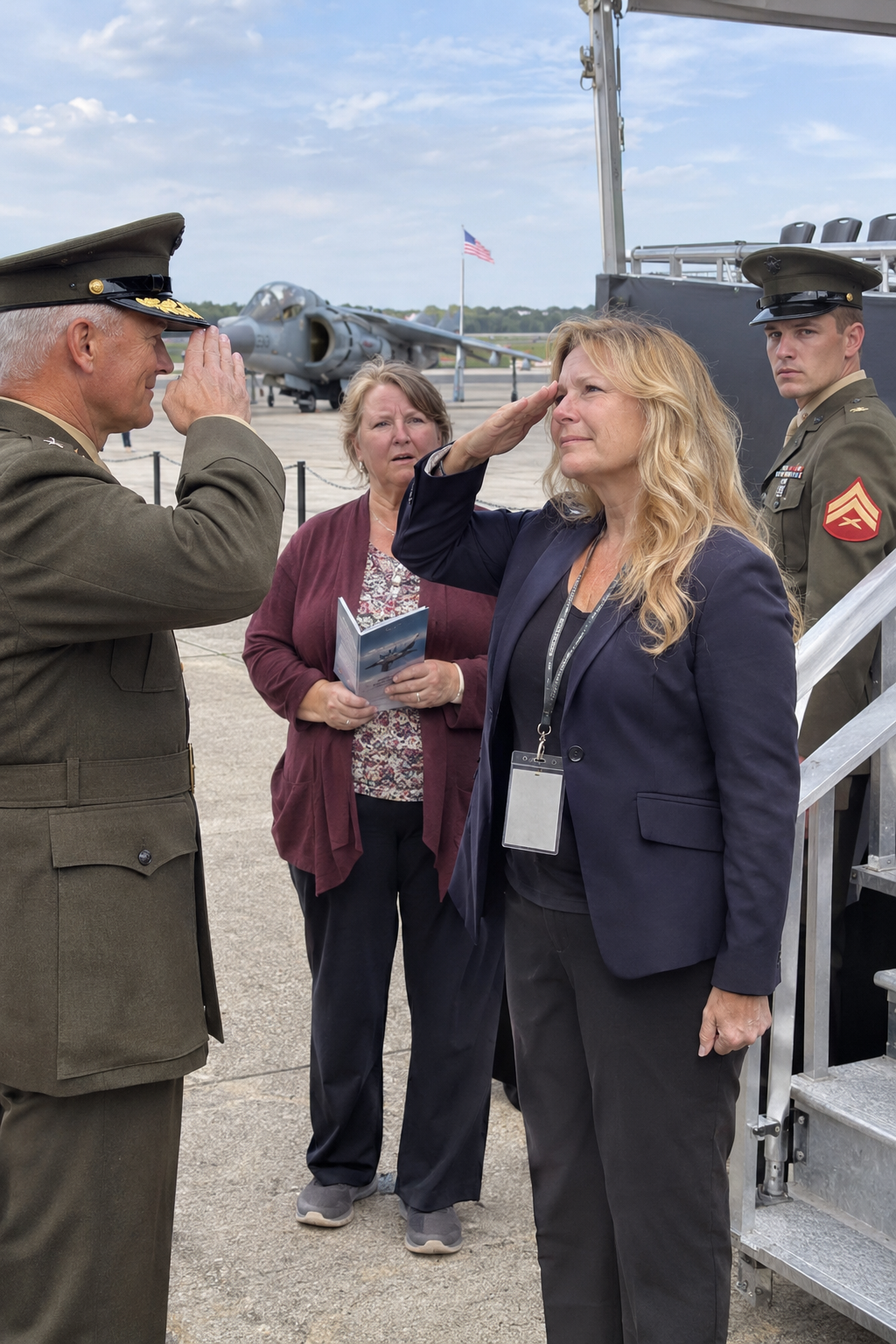
The young Marine at the VIP stairs told me I didn’t belong there, even though I was the air show’s guest of honor; then an announcement made thousands of people turn toward the woman he had just waved away…
My name is Vera Castayano. I’m 58, a retired Marine Corps brigadier general, and my family spent decades dismissing my career as expensive joy rides. I served anyway, even when they treated it like a joke.
In 1979, when I was 11, we lived close enough to a Marine air station that Harriers rattled the dishes as they came over our house. I’d sit on the back step, waiting for that deep roar and watching the sky long after the aircraft disappeared. I knew I wanted to fly one before I knew what it would cost to say so.
My father, Salvator Castayano, had spent 20 years in the Marine Corps carrying a rifle, and he respected Marines who fought on the ground. “Planes are taxis,” he’d say over dinner. “The Corps is the man who gets off the plane.” My older brother Wesley, four years ahead of me, repeated the line because making Dad laugh mattered more to him than understanding his little sister.
Once Wesley picked up a plastic model jet I’d bought with three weeks of allowance and mocked it in Dad’s voice. Dad laughed, and I stared at the empty place on the shelf where my airplane had been. My mother, Estelle, said nothing at the table, but she never confused quiet with surrender.
When I was 14, Mom came into my room carrying a library book about naval aviation and an empty shoe box. She told me to keep every clipping about anything I might accomplish, whether anyone else cared to look or not. Then she said, “You don’t have to win them over, Vera. You just have to go.”
At my high school graduation in 1986, an aunt asked what I planned to do. I said I wanted to fly Marine jets, and Wesley, already home from a short enlistment that hadn’t gone as he hoped, laughed that I’d be lucky to fold maps. Dad kept eating. That silence hurt longer than Wesley’s joke.
I got through college on a scholarship and spent summers in the Platoon Leaders Course at Quantico. I came home tired, sore, and proud, while Wesley asked whether I’d washed out yet. By 1990, I was wearing a second lieutenant’s bars, and my father’s entire response was, “We’ll see if it sticks.”
Flight school was hard, and some instructors made it clear they didn’t expect a woman to belong in their cockpits. The aircraft, at least, made no such judgment. I studied, practiced, took the criticism I could use, and earned my naval aviator wings in 1992.
I mailed home a photograph from winging day, grinning in my flight suit. Mom framed it, but I later learned Dad had removed it and put it in a drawer. She eventually put a picture of the dog in the empty frame so she wouldn’t have to keep looking at the space he’d made.
In 1994, I was a captain selected to fly the AV-8B Harrier, the very aircraft I’d watched from the back step. My family still insisted Vera played airplanes, no matter what I sent home.
At a holiday dinner in 2001, Wesley asked how much my flights cost the taxpayer and called them “expensive joy rides.” The table laughed, so he used the joke again, then for years afterward. Mom saved every article in shoe boxes, telling me she would keep the proof whether anyone wanted it or not.
Between 2003 and 2005, I flew the Harrier in combat over Iraq, becoming the first woman to do so from our home air station. I earned a Bronze Star and two Air Medals. Those were not stories I brought to dinner, where no one had ever asked a sincere question about what I did.
One night in late 2004, Marines on the ground were pinned down under fire from two directions. I heard the strain in a young Marine’s radio call, delivered close air support, and heard his voice come back steady when the firing stopped. He thanked me, and I carried the sound of that relief home far longer than I carried any applause.
Those Marines had rifles in the dirt, just as Dad had taught us to honor. My job was to help them come home. I couldn’t find a way to explain that to a table where my brother still thought a combat flight was a paid amusement ride.
I took command of a squadron as a lieutenant colonel in 2007 and commanded a group as a colonel in 2013. Dad died in 2015 at 79 without ever telling me he was proud. I wore my dress blues to his funeral and stood at his grave knowing that the words I’d hoped for would never come.
In 2019, I became a brigadier general. When Mom told Wesley about my star, he asked, “A general of what? Airplanes?” I retired in 2022, after four decades of service, and thought I’d finally made peace with the difference between what I’d done and what my family chose to see.
Then, in spring 2026, my old air station invited me back as guest of honor at its anniversary air show. Mom, now 84, wanted to attend, and Wesley, 62, agreed to drive her. I accepted because the flight line had always felt like home, even when my family didn’t.
I arrived through the gate around seven that morning, three hours before the public opening, in a plain navy blazer, slacks, and comfortable shoes. A credential marked GUEST OF HONOR hung from my neck, but I didn’t want to begin the day with speeches. I wanted a few quiet minutes with the aircraft.
The static displays still smelled of cold metal, grass, and fuel. I stood beside a Harrier, laid my palm against its cool intake, and thought of the little girl whose toy airplane had been taken from her hands. For a moment I was simply someone who had once belonged in the sky.
As the field began filling, I walked toward the raised VIP reviewing stand, where the organizers had reserved my seat. A young corporal, perhaps 21, stood at the stairs directing people. When I approached, he stepped in front of me and said the section was reserved and spectators belonged down on the flight line.
I lifted the credential so he could read it. “I’m in the right place,” I said, but he barely glanced before replying, “Doesn’t matter who printed that. Step down. You’re holding up the guests.” He waved me toward the general-admission crowd and turned to greet two men in sport coats behind me.
I could have introduced myself by rank. Instead, I stepped aside, unwilling to make a young Marine’s bad judgment into a public confrontation. I stood about 15 feet from the stairs and watched the people settle as the loudspeakers crackled awake.
The announcer was Hank Delgado, an old air-station voice I recognized instantly. After welcoming the families, he began introducing the day’s guest of honor: the first woman to fly the AV-8B Harrier in combat from that station, a combat aviator who had commanded a squadron and a group and become a Marine Corps general. Then he called out, “Brigadier General Vera ‘Saber’ Castayano!”
People looked at the empty place on the reviewing stand, then began searching the crowd. A woman near me checked my photograph in her program, touched my sleeve, and whispered, “Ma’am, that’s you.” Heads turned toward me, and the corporal followed their gaze until he saw the woman in the navy blazer he’d just sent away.
Major General Lionel Frost, the two-star reviewing officer who had flown with me years earlier, came down the stairs without waiting for anyone to fetch me. He stopped in front of the corporal, told him to move aside, then walked straight to me and came to attention. In front of thousands, he saluted and said, “General Castayano, ma’am, welcome home. We’ve been waiting for you.”
I returned his salute with a steady hand, though something inside me had shifted. For four decades I’d hoped my father might look up from his plate and acknowledge what I was doing; now a friend had crossed a crowded flight line to do it publicly. The corporal was standing nearby, pale and rigid, and I knew what everyone expected me to do next. Part 2…..
IF FACEBOOK BROUGHT YOU HERE, HERE’S THE CONTINUATION YOU’VE BEEN WAITING FOR. ENJOY! 👇 I looked from Lionel to the corporal. He’d been so certain I didn’t belong at the stairs, and now he seemed afraid even to move his eyes. I knew I could make that moment follow him for years with a single complaint, but I also knew what it felt like to have someone decide who you were without bothering to check.
My old squadron mate, retired Colonel Priya Anand, reached us through the crowd. She had driven three hours for the ceremony, and her dry observation cut close: “Forty years, and they still make you show your papers at the door.” I smiled, but the words reminded me that the corporal hadn’t invented the habit of dismissing me; he had only repeated it once.
Priya had met people who questioned whether I belonged in a cockpit. She’d also watched me do the work when the stakes were higher than a reserved seat. But my father’s voice was the one I heard in my memory, and Wesley was sitting just a short distance away in the family section, watching strangers recognize the sister he’d spent a lifetime belittling.
I made my way up the steps with Lionel, and Staff Sergeant Nadia Cordero arrived to take charge of the corporal. She was the noncommissioned officer responsible for the usher detail, and she immediately started moving him away from his post. His name, she told me, was Corporal Hargrove.
“Staff Sergeant, a word,” I said. She stopped and faced me, clearly expecting that I’d want to make a formal issue of his mistake. I said I did not want him relieved or written up just to satisfy me, though I understood that his chain of command would decide what correction was appropriate. I asked her to let him stay on the detail.
Then I spoke to Hargrove himself. “You did your job badly for about thirty seconds,” I told him. “I did mine for about thirty years. Neither one of those is the whole of a person.” His jaw tightened, and he managed a quiet “Yes, ma’am.”
I asked whether he could spend the rest of the program beside me at the rail, helping the guests he had been assigned to assist. Nadia considered it, then agreed to the arrangement. I wasn’t asking anyone to ignore security or pretend he’d made the right call; I wanted him to learn from it without becoming the day’s public spectacle.
The opening flight was a section of Harriers. When the lead aircraft transitioned into a hover in front of the stand, the boards vibrated beneath our feet and Hargrove’s expression changed completely. He watched with the same open wonder I’d felt on the back step in 1979.
“You feel that in your chest?” I asked him above the noise. He nodded, eyes still on the jet. I told him that nobody on the stand had been born knowing everything, and that his responsibility was to check the credential in front of him rather than trust a quick assumption about the person wearing it.
He looked down at his own hands for a moment. “I should’ve read yours, ma’am,” he said. It was more than I’d needed him to say, and I let him watch the rest of the flight without turning his embarrassment into a lesson for the entire audience.
From where I stood, I could see Mom in her wheelchair among the reserved seats. Wesley was nearby in a folding chair, leaning forward with his elbows on his knees. He had come because Mom wanted to be there, not because he had ever asked to hear about my service, and I wondered what he thought of the young Marine I’d chosen to keep at my side.
During a pause in the flying, Hank handed Lionel the microphone. Lionel read through my record in the careful, unhurried way one Marine uses when speaking about another Marine’s service. He described the deployments to Iraq, the close air support, the Bronze Star and two Air Medals, my pioneering Harrier flight, and the commands I had held before becoming a general.
With every passage, the crowd applauded. I didn’t need the medals explained to me; I remembered the people and decisions behind them. What took my breath away was hearing that history spoken clearly in front of the same family that had spent years reducing it to a punchline.
Lionel mentioned the Marines who had returned from combat because support arrived when they needed it. I remembered that strained voice on the radio in 2004 and the relief when it came back through my headset. No one at my father’s table had ever asked about a night like that, and I was grateful Lionel was speaking of the Marines on the ground, not just the pilot overhead.
When Lionel finished, the people around us stood. I looked toward the family section and saw Wesley still sitting, hands clasped between his knees. I couldn’t tell exactly what was passing through his mind, but I knew he had just heard more about my professional life in a few minutes than he’d allowed me to say in decades.
I didn’t feel the satisfaction I might once have expected. I thought of the boy Wesley had been, desperate for our father’s approval, and the man he’d become by copying every one of Dad’s dismissals. He’d lost the habit of asking questions about me so thoroughly that a public account of my work sounded like news.
After the flying, the organizers arranged a receiving line. Neighbors, veterans, and visitors shook my hand, and some told me they’d heard about my service for years without knowing the details. A few had heard Wesley’s old joke at cookouts, and now they spoke to me about the Marines I had flown for and how much it meant to see someone from our town honored.
Wesley stood off to the side while the line moved. Eventually he approached with his hands in his pockets and said, “Quite the show. Taxpayer money well spent, I guess.” I recognized the rhythm at once: the same joke he’d been making since 2001, offered as if the last few hours had never happened.
Nobody near us laughed. Wesley glanced around, and I watched him register that the room wasn’t willing to help him make me small. I didn’t raise my voice or try to embarrass him; I simply said, “You can keep the joke, Wes. I don’t need you to put it down anymore.”
He looked at me, waiting for an argument, but I had none to give. For years I’d softened my answers so other people wouldn’t have to confront how they treated me. That day I wanted to enjoy the air show without becoming responsible for rescuing my brother from an uncomfortable silence he’d created himself.
Mom had watched from her wheelchair by the rail. When I reached her, she took my hand, her eyes wet, and said, “You didn’t even raise your voice.” I told her I’d had a long time to learn when talking helped and when it didn’t.
She squeezed my fingers, then said something I hadn’t expected. “I kept everything, Vera. All of it. It’s in the car.” Across the pavement, Wesley was still standing alone, and Mom was already looking toward him as if she knew exactly what she wanted him to do next.
Part 3 Mom had brought one of her shoe boxes to the show. The original box she gave me at 14 had filled decades earlier, and she was now on her third or fourth, storing articles, photographs, and base-paper clippings nobody else in our family had bothered to read. She asked Wesley to bring the box from the car, then set it in his hands.
“You should read what I kept,” she told him. “Since you never asked.” Her voice was quiet, as it always had been when she wanted someone to pay attention, and Wesley looked from her to me before opening the lid.
On top was a yellowed article from 2005, with a photograph of me in my flight suit beside a Harrier. The headline identified me as the first woman from that air station to fly the aircraft in combat. Wesley read it slowly, then lifted another clipping and another, as if each page were changing the meaning of the one before it.
He sat on the bumper of the car with the box on his lap. Mom stayed nearby in her wheelchair, and I leaned against the side of the car without telling him what he ought to feel. For once he was seeing my career in its own words instead of through our father’s contempt.
One small piece stopped him. It had been printed in 2004, about the close-air-support mission when Marines on the ground were trapped under fire. The article couldn’t tell the entire story of that night, but the few paragraphs were enough to say why I was there and what had happened when our support reached them.
Wesley read those paragraphs twice. I watched his finger rest on the edge of the paper, and I thought about the young Marine whose voice had settled once the firing stopped. My brother had spent years laughing about the price of a flight without asking whose lives the flight might protect.
He turned the clipping over, then looked down into the box. “Dad never said any of this about you,” he said finally. “I think I just kept doing his job after he died.” I had imagined apologies from Wesley in younger years, angry ones and heartfelt ones, but I had never imagined hearing him describe his own behavior so plainly.
I sat beside him on the bumper. “I’m not asking you to salute me, Wes,” I said. “I never wanted that. I’m asking you to stop subtracting me every time my name comes up.”
He nodded and closed the lid carefully, aligning the edges instead of dropping it shut. We didn’t hug; our family had never been good at that, and I wasn’t going to pretend forty years could be fixed on one afternoon. We sat together as a Harrier was towed toward the hangar, and for once neither of us needed to make a joke to fill the silence.
When the crowds had gone, Mom took the box home. I went home too, with the afternoon still in my ears: the aircraft, the applause, Lionel’s welcome, and the sound of Wesley admitting what he’d done. None of those things erased the family dinners or the years in between, but I didn’t feel the old need to argue with their memory.
A few weeks later, an envelope arrived with the air station’s return address. Corporal Hargrove had written to me by hand on lined paper. He remembered what I’d told him about the difference between the easy call and the right one, and he asked how someone like him could begin working toward a place in a cockpit.
He wanted to fly. I sat at my kitchen table with the letter open, remembering how it felt to be young and sure of a dream while older people told you to stay in your place. The same Marine who had waved me away from the VIP stairs was now asking for a way forward.
I wrote back that evening, also by hand. I told him flight school involved far more than handling an aircraft: studying when you were exhausted, learning from mistakes, accepting correction, and getting up after days when you were certain you didn’t have another attempt left. I told him he would meet people who made assumptions about him, and not to make their opinions the measure of his work.
I also told him to look closely at the person standing in front of him, especially when he felt certain he already knew the answer. “Check the lanyard,” I wrote. “Do the work of making the right call.” Then I passed along the words Mom had given me with that empty shoe box: “You don’t have to win them over. You just have to go.”
I included my phone number and told him to call when he reached his first serious obstacle. I couldn’t promise admission to any program or make the military’s decisions for him. What I could do was explain the path honestly and answer questions that I’d once had to answer alone.
Around the same time, Wesley called me. He spent ten minutes talking about ordinary things before asking what it felt like to bring a Harrier into a hover. I explained the controls and the peculiar sensation of holding an aircraft nearly still in the air, and he listened without interrupting or reaching for a joke.
It wasn’t an apology in the form I’d once wanted, but it was the first sincere question he’d ever asked about my flying. I could hear him trying to make room for a sister he had already decided he knew. The conversation wasn’t graceful, and that was part of why I believed it.
Mom said during a later call that I could throw the shoe boxes away now that the family had finally seen what she’d saved. “Keep them,” I told her. “Not as proof anymore. Keep them as a story.” She was pleased by that, and we talked for a while about the clippings she’d almost lost during moves and the ones she’d carefully flattened after reading.
One evening I drove to the air-station fence and watched the sun drop behind the flight line. A jet returned from a late training flight, its roar vibrating through the chain-link fence beneath my fingers. The sound brought me back to the girl on the back step, the one who thought the whole world was waiting for her father’s approval.
I stood there thinking about the man who’d never given it, the brother who was finally learning to ask, my aging mother, and the young corporal writing about flight school. The runway was still where it had always been. I had spent forty years doing the work I loved, and that truth hadn’t depended on anyone at our dinner table seeing it.
Final A few months later, I met Hargrove again at the air station. We sat with his flight-school application information spread between us, and I walked through the steps and requirements with him, answering what I could and telling him where he needed official guidance. He had prepared questions, and this time he checked every detail before moving on.
I told him the road was demanding and that good intentions didn’t replace qualifications or training. He listened, asked about the mistakes I had made as a young aviator, and wrote down the advice he thought might help. I didn’t know whether he would ever earn wings, and I didn’t pretend I could guarantee it; what mattered was that he was willing to do the work.
That fall, our family gathered for dinner. It was smaller than the old holiday tables and a little less guarded, and Mom sat where she could see all of us. A young man engaged to one of Wesley’s children turned to my brother during the meal and asked what his sister had done for a living.
I reached for my water glass, expecting the old line before I even looked up. Wesley turned toward me instead and said, “This is my sister Vera. She flew Harriers in combat. First woman to do it off that line.” His voice was ordinary, almost matter-of-fact, but he let the words stand exactly as they were.
Nobody laughed, because there was no joke. The young man asked me about the aircraft, and I answered while Wesley listened. When I glanced across the table, Mom was looking at me, and the slight lift of her eyebrows told me she had heard the change too.
We didn’t make a celebration out of one sentence. Wesley still had years of habits behind him, and I had years of hurt that weren’t going to disappear because one dinner went well. But the old “joy rides” line never returned, and that quiet absence mattered more than any speech he might have rehearsed.
Mom lived to see that change. She was 84 at the air show and knew, as the year went on, that she didn’t have unlimited time left. One afternoon when we were sitting together, she took my hand the way she’d done beside the reviewing stand and looked at me with the same calm certainty she’d had when I was 14.
“I told you,” she said. “You just had to go.” I thought of the book she’d brought into my room, the empty box, and the decades she’d spent saving my name when other people in our house tried not to hear it. She hadn’t waited for a general’s star or a crowd to decide I was worth believing in.
For years, I had measured one missing thing against everything else: my father’s pride. I could no longer ask him for it, and I couldn’t reclaim all the dinners when Wesley had turned my life into a punchline. But I could recognize the people who had seen me clearly, including the Marines on the ground, the friends who flew beside me, and the mother who put a shoe box in my hands.
I also knew what I wanted to do with the time ahead. I wanted to answer Hargrove’s questions when he called, enjoy the ordinary conversations Wesley was slowly learning to have, and keep Mom’s clippings where someone else might someday open them. They were never just proof that I had flown; they were proof that one person had been paying attention all along.
Sometimes I still remember the sound of the Harrier crossing our roof when I was eleven. The dishes would hum, Dad would have his opinion, Wesley would laugh, and I’d slip back outside to watch the sky. I couldn’t make them believe in that girl then, but I could keep the promise I made to her.
And I did. I went to flight school, flew the missions, brought my aircraft home, led other Marines, and stood on that reviewing stand without making a frightened young corporal pay for my family’s mistakes. My father never said the words I had hoped to hear, but by the time the crowd turned and called my name, I was beginning to understand something better: my life had been real and worthwhile long before anyone applauded.
THE END. I’ve shared the complete story, and I truly hope it touched your heart. If this story moved you, please , like, and share the post. Thank you for reading! ❤️
✓ Lynn R. Adams
The young Marine at the VIP stairs told me I didn’t belong there, even though I was the air show’s guest of honor; then an announcement made thousands of people turn toward the woman he had just waved…