The Twenty-Five Women Who Returned to Eli Caldwell’s Desert Well _065
## Part 2 – What They Carried at Dawn
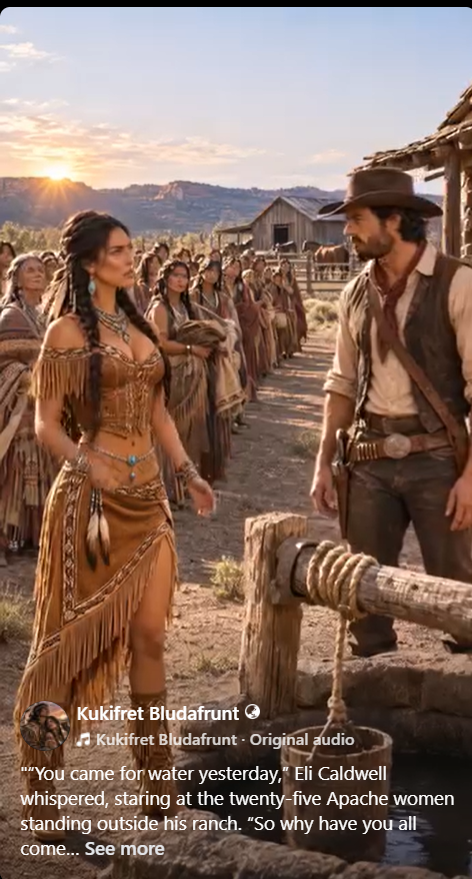
All twenty-four women behind the eldest suddenly began to move.
Eli Caldwell raised the rifle before he realized what they were doing.
Then his finger went still beside the trigger.
The women were not advancing toward him.
They were kneeling.
One after another, beneath the pale Arizona sunrise, they lowered bundles from their shoulders and placed them carefully upon the ground.
Blankets.
Baskets.
Small clay jars.
Bundles of dried plants tied with cord.
A wooden box with iron hinges.
Two sacks that appeared to contain cornmeal.
A rolled piece of canvas.
And, at the very end of the line, carried between two younger women, a narrow wooden cradle with no child inside it.
The sight of the empty cradle struck Eli harder than any weapon could have.
He slowly lowered his rifle.
The eldest woman—the one who had left the bracelet beside his boots the day before—watched him with the patient expression of someone waiting for a frightened animal to understand that a hand had been extended rather than raised.
Eli swallowed.
“What is this?”
No one answered.
The desert seemed to hold its breath with them.
Then a young woman near the back stepped forward.
She might have been twenty. Perhaps younger. Dust clung to the hem of her long skirt, and dark hair was braided over one shoulder.
Unlike the others, she spoke English.
“They are asking whether they may stay until tomorrow.”
Eli looked from her to the gathering.
“Stay?”
“Rest.”
“Here?”
She nodded.
He stared across his property as though someone might have hidden a second ranch nearby while he slept.
“There are twenty-five of you.”
“Yes.”
“I’ve got one house.”
“We don’t need your house.”
“One barn.”
“We don’t need your barn.”
“One well.”
At that, the young woman’s expression changed.
It was subtle.
Pain, perhaps.
“That,” she said, “is why we came.”
Eli felt his grip tighten around the rifle stock again.
The eldest woman spoke quietly in Apache.
The younger woman listened.
“My name is Lena,” she said afterward. “Her name is Nalin.”
Eli looked toward the woman who had given him the bracelet.
“Nalin?”
The older woman inclined her head.
“And yesterday?” he asked. “You knew my well was here.”
Lena hesitated.
That hesitation troubled him more than any answer would have.
“Someone told us.”
“Who?”
Another pause.
“Your wife.”
For several seconds Eli heard nothing at all.
Not the horses shifting inside the barn.
Not the waking birds among the mesquite.
Not the faint rush of wind dragging sand over hard earth.
Only those two words.
Your wife.
Eli’s face hardened.
“My wife’s dead.”
Lena’s eyes lowered.
“We know.”
His rifle came upright again—not pointed at anyone, but no longer relaxed at his side.
“Then you had better explain yourself.”
Nalin spoke quickly.
Lena answered.
“She is trying to.”
“No. You’re telling me my wife sent twenty-five women to my ranch three years after I buried her.”
“That isn’t what I said.”
“It sounded exactly like it.”
Nalin stepped closer.
Eli tensed.
She stopped several yards away, reached into a small pouch at her waist, and removed a folded scrap of cloth.
Inside was a tarnished brass button.
Eli recognized it before Lena said anything.
The rifle nearly slipped from his hand.
A flower had been scratched into the metal.
Not professionally.
Not evenly.
Five crooked petals around a dented center.
Anna had done that during their second winter together while laughing at how plain his coat looked.
“You wear the same brown every day,” she had teased. “At least let one button have some character.”
The button had disappeared years ago.
Eli had assumed it had fallen somewhere along the trail.
He stared at it now in Nalin’s palm.
“Where did you get that?”
Nalin spoke.
Lena translated.
“From your wife.”
Eli’s voice became almost inaudible.
“When?”
“Four years ago.”
Before the sickness.
Before the grave.
Before his world had become the ranch, the fences, three horses, and a silence so complete that sometimes he realized days had passed without hearing his own voice.
Lena continued carefully.
“She met Nalin near the northern wash.”
Eli looked at the older woman.
“Anna never told me.”
“No,” Lena said.
“Why?”
Lena exchanged words with Nalin.
The answer took longer.
“Because she promised she wouldn’t.”
Eli laughed once, but there was no humor in it.
“That sounds convenient.”
Lena did not flinch.
“Nalin’s people were traveling. One child was sick. They were short of water. Your wife showed them this well.”
Eli looked toward the stone circle behind the house.
The same well.
“She brought them here?”
“No. She brought water to them.”
He remembered.
A summer morning.
Anna had left before dawn with two canteens and returned after noon with both empty.
He had asked where she had gone.
She had answered, “Walking.”
He had teased her about walking fifteen miles with two canteens.
She had merely smiled.
He had forgotten the exchange until now.
“Nalin never forgot,” Lena said. “Your wife told her that if she was ever desperate, there was water here.”
“Why keep that secret?”
This time Lena did not translate immediately.
Instead, she looked directly at him.
“Because kindness can become dangerous when too many frightened people hear about it.”
Eli understood the implication.
The Arizona Territory was filled with stories carried faster than truth—stories of raids, reprisals, soldiers, settlers, disappearances, suspicion.
Fear had made enemies of people who had never spoken to one another.
Anna, apparently, had known that.
Nalin knelt beside the bundles.
She placed the brass button carefully on the woven bracelet Eli still carried in his shirt pocket.
Then she spoke.
Lena translated.
“Yesterday was not only about water.”
Eli looked sharply at her.
“What else?”
“Our camp is two valleys east. A spring we have relied on is nearly dry. Some of our families are moving farther south.”
“Families?”
“Women. Children. Older people.”
Eli scanned the ridge instinctively.
“Where are the men?”
“Some are hunting. Some are elsewhere. Some families have none.”
The answer was neither defensive nor detailed.
Eli appreciated that.
Lena continued.
“Nalin came first because she remembered your wife. She needed to know whether Anna’s promise still lived here.”
The words hit him strangely.
Anna’s promise.
Still lived here.
Eli glanced at the house.
For three years he had thought nothing lived there.
Not really.
He slept in it.
Ate in it.
Occasionally repaired it.
But living had been something Anna and their little boy Matthew did.
Eli merely occupied the rooms they had left behind.
He looked again at the twenty-five women.
“So yesterday was a test.”
Lena considered the word.
“A question.”
“And cleaning my barn was what?”
At last, something resembling amusement touched Lena’s face.
“An answer.”
Eli almost smiled despite himself.
Almost.
He nodded toward the bundles.
“And all this?”
“Thanks.”
“For water?”
“For keeping your wife’s word when you didn’t know you were keeping it.”
That silenced him.
The sunrise had strengthened, turning the eastern cliffs copper and gold.
Eli suddenly felt foolish holding the rifle.
He leaned it against the porch.
Several shoulders among the women visibly relaxed.
That embarrassed him even more.
“All right,” he said. “One day.”
Lena translated.
A murmur moved through the gathering.
Not cheering.
Relief.
Eli pointed toward the cottonwoods beyond the barn.
“You’ll get shade there by noon. Ground’s softer too.”
Lena relayed the message.
The women began collecting their bundles.
Eli watched as the ranch transformed.
Canvas appeared between trees.
Blankets were spread.
Cooking stones were arranged.
Women moved with quiet efficiency, neither invading his space nor waiting helplessly for instruction.
Two asked through Lena if they could draw water.
Three others gathered fallen branches.
Several began repairing worn sandals.
Nalin walked to the barn.
Eli followed.
Inside, she examined the tack she had apparently cleaned the day before.
“You did this?”
She smiled.
“Some.”
“You were here for hours.”
Another smile.
He shook his head.
“I never heard you.”
Lena, standing nearby, translated his remark.
Nalin answered.
Lena laughed.
“What?”
“She says you make enough noise for three men when you repair fences.”
Eli stared at Nalin.
The older woman’s expression remained perfectly solemn.
Then her eyes betrayed her.
Eli barked out a laugh.
The sound startled him.
It startled the horses too.
He could not remember the last time he had laughed loudly enough to frighten anything.
By afternoon, the ranch smelled of roasted corn, dust, sage, wood smoke, and something cooking slowly in one of the clay pots.
Eli repaired the fence.
This time, however, he was not alone.
A woman named Sela—who knew no English and apparently believed his method of setting posts was ridiculous—watched him struggle for several minutes before taking the digging bar from his hands.
She indicated a different angle.
Eli frowned.
She insisted.
Ten minutes later the post stood straighter than any of the previous six.
Eli looked at it.
Then at her.
She raised an eyebrow.
“All right,” he muttered. “Don’t get proud.”
She could not understand the words.
She understood the tone perfectly.
By late afternoon, three more posts had been set.
Around sunset, Lena brought him a bowl.
“What is it?”
“Food.”
“I can see that.”
“Then we’re already making progress.”
He accepted it.
“Where’d you learn English?”
“My father traded in Tucson sometimes.”
“Your father here?”
“No.”
Something in her expression discouraged another question.
They ate beneath the cottonwoods.
Eli remained on the edge of the group at first.
Yet food passed toward him.
Someone handed him a cup.
A small girl—perhaps seven years old—had apparently arrived from somewhere beyond the ridge during the afternoon with two elderly women.
The number at the ranch was no longer twenty-five.
It was thirty-two.
Eli noticed.
Lena noticed him noticing.
“Only for supper,” she said.
He stared at her.
The corner of her mouth lifted.
“For now.”
He should have objected.
Instead, he found himself looking at the little girl.
She was trying to balance three pebbles on her knee.
Matthew used to do that.
Anything could become a game in his hands: stones, beans, nails, spoons.
Eli looked away quickly.
Lena saw.
She said nothing.
That kindness—saying nothing—hurt more than questions would have.
Night came slowly.
One by one, fires diminished beneath the cottonwoods.
Eli returned to the porch.
Nalin followed him.
She carried the wooden box with iron hinges.
The same one Eli had noticed at dawn.
She placed it on the table.
“What is that?”
Nalin called softly for Lena.
When the young woman arrived, Nalin spoke for nearly a minute.
Lena’s expression grew solemn.
“She says this belongs to you.”
“I’ve never seen it.”
“She says your wife left it with her.”
Eli stopped breathing normally.
Nalin pushed the box toward him.
It had no lock.
Just a small iron clasp.
His hand hovered above it.
“What did Anna leave with her?”
Lena shook her head.
“Nalin doesn’t know. She promised not to open it.”
“For four years?”
“Yes.”
“Why give it back now?”
Lena translated.
Nalin’s answer was short.
“She was told to return it when you finally opened the well to strangers.”
Eli stared at her.
Anna had planned this?
No.
Impossible.
His wife could not have known who would come.
Could not have known when.
Could not have known whether Eli would still own the ranch.
His fingers touched the clasp.
The metal was cool.
He opened the box.
Inside lay a folded letter.
His name was written across the front.
Not in Lena’s handwriting.
Not Nalin’s.
Anna’s.
ELI.
He sat down hard.
For a long moment he could not unfold it.
Then he did.
The letter began with five words.
_My darling, if Nalin returned…_
Eli’s vision blurred.
He forced himself to continue.
_…then I was right about you._
He closed his eyes.
Nalin and Lena waited.
Eli opened them again and read the next lines.
Then he froze.
Because the letter did not speak first about water.
It did not speak about the Apache women.
It did not even speak about Anna’s promise.
Instead, Anna had written:
_There is something beneath our house that I never told you about._
And beneath those words she had drawn a map.
A map of Eli’s own ranch.
With a black X directly beneath Matthew’s old bedroom.
**–END OF PART 2– CLICK “NEXT” AT THE BOTTOM OF THE PAGE TO CONTINUE READING**
✓ Lynn R. Adams
## Part 2 – What They Carried at Dawn All twenty-four women behind the eldest suddenly began to move. Eli Caldwell raised the rifle before he realized what they were doing. Then his finger went sti…