The Stranger He Saved Returned With Three Hundred Silent Riders _065
### Part 2 – The Debt No One Could Repay
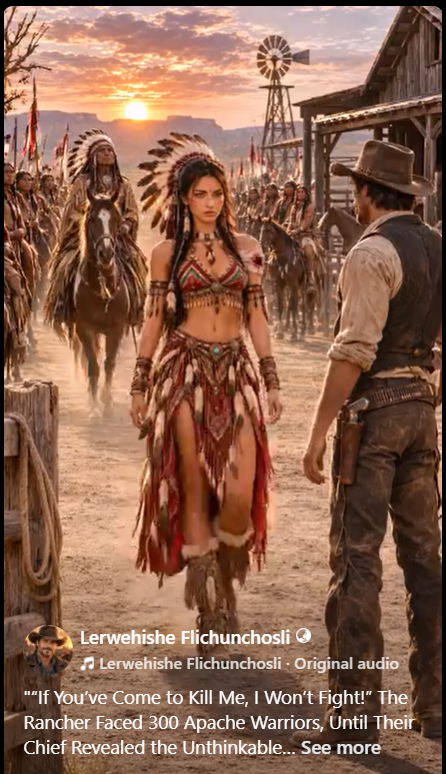
The Chief slowly raised his hand again.
Behind him, hundreds of riders shifted in their saddles, leather creaking softly in the pale morning air.
The young woman stepped closer to Corvin.
And when the Chief finally spoke, the words were nothing like anything Corvin had prepared himself to hear.
“We came,” the older man said, “because she asked us to.”
Corvin blinked.
For several seconds, the statement seemed too simple to understand.
He looked from the Chief to the woman whose shoulder he had bandaged the previous afternoon, then toward the wide circle of mounted warriors surrounding his ranch.
“She asked three hundred men to ride out here?”
A murmur passed among several riders.
Not laughter exactly.
But something close.
The wounded woman’s guarded expression changed for the first time. One corner of her mouth rose.
The Chief studied Corvin.
“She said you would ask that.”
Corvin lowered his hands carefully.
“I’m beginning to think she knows me better than she ought to.”
The woman said something quietly in her own language.
The Chief answered her, and this time a few riders openly smiled.
Corvin felt his fear changing shape. It had not disappeared. Three hundred strangers still surrounded his home, and he still understood almost nothing about why they had come.
But the atmosphere was no longer that of men preparing for battle.
It felt almost ceremonial.
The Chief dismounted.
The action startled Corvin more than a drawn weapon might have.
Once the older man’s boots touched the ground, several riders behind him followed.
Not all.
Only six.
They approached slowly and stopped at a respectful distance.
The young woman spoke.
This time the Chief translated.
“She says yesterday she was separated from those traveling with her when her horse stumbled in broken ground. She hurt her shoulder. She walked until she could not.”
Corvin nodded.
“I found her near my north fence.”
“She remembers.”
“I imagine she does.”
The Chief glanced at the woman, and she spoke again.
“She says you saw who she was.”
Corvin frowned.
“I saw someone hurt.”
The Chief’s eyes sharpened.
“That is what she told us.”
A quiet stillness fell.
Corvin became aware of the morning breeze moving through the cottonwoods near the well.
The Chief continued.
“She told us you brought water before asking her name.”
Corvin shrugged.
“She needed water.”
“You gave cloth from your own house.”
“It was clean.”
“You had a rifle close enough to reach.”
Corvin glanced toward the stable.
“I suppose.”
“You did not bring it.”
“I wasn’t expecting trouble.”
The Chief looked at him for a long moment.
“Perhaps that is why she wished us to meet you.”
Corvin rubbed the back of his neck.
“Chief, with respect, there are easier ways to introduce yourself.”
The young woman spoke again.
This time the Chief actually laughed.
It changed his entire face.
“She agrees.”
A ripple of laughter spread among the nearest riders.
Corvin exhaled.
He had spent the last several minutes expecting to die and now found himself standing in the middle of his ranch yard entertaining three hundred people.
“Then perhaps somebody ought to tell me her name.”
The Chief looked toward the young woman.
She answered him directly.
The older man nodded.
“Her name is Nita.”
Corvin looked at her.
“Nita.”
She repeated it, touching her chest.
Then she pointed toward him.
“Corvin.”
His eyebrows rose.
“You knew that already?”
She nodded.
“How?”
Nita pointed toward the small painted board hanging beside the stable door.
CORVIN TORNE – HORSES & CATTLE.
Corvin closed his eyes.
“Of course.”
The Chief smiled faintly.
“My daughter notices things.”
Corvin opened his eyes.
His daughter.
The words changed everything.
He looked again at the woman he had found bleeding beside the fence.
Then at the Chief.
Then at the enormous gathering behind him.
Suddenly the number of riders made more sense.
Not complete sense.
But enough.
“You came because she is your daughter.”
“No.”
The Chief’s response was immediate.
Corvin waited.
The older man turned and looked across the gathered riders.
“I came because she is my daughter.”
He looked back.
“They came because of what she told them.”
Corvin’s confusion returned.
“And what exactly did she tell them?”
The Chief’s expression grew serious.
“That you did not ask what she could give you.”
Corvin said nothing.
“She told us you did not demand gratitude. You did not follow her. You did not tell her she owed you. You did not make your kindness a bargain.”
The Chief stepped closer.
“There are debts a man can repay with horses. There are debts he can repay with food. There are debts he can repay with labor.”
He paused.
“But she said what you gave her did not feel like a debt.”
Corvin glanced toward Nita.
Her fierce expression had softened.
“I only wrapped a shoulder.”
The Chief shook his head.
“No. You allowed a frightened person to remain a person.”
The simple words landed harder than Corvin expected.
He looked away.
For reasons he could not explain, he thought suddenly of his father.
Elias Torne had been a hard man, though not an unkind one. He had believed every favor created an obligation and every obligation had a price. Growing up, Corvin had learned that nothing came freely.
Not praise.
Not forgiveness.
Not help.
Perhaps that was why he had always hated being owed.
Maybe it was also why he had never understood why other people found that strange.
“I still don’t understand why everyone came.”
The Chief nodded toward the riders.
“Some wished to see the man themselves.”
Corvin swallowed.
“All of them?”
“More wanted to come.”
Corvin stared.
Nita laughed openly now.
It was the first sound he had heard from her other than brief words in her own language.
And somehow it made the entire impossible morning feel human.
Then the Chief’s expression darkened.
“There is another reason.”
Corvin’s unease returned.
Of course there was.
The older man glanced toward the distant eastern ridge.
“Your ranch is in danger.”
Corvin followed his gaze.
“From what?”
“Not us.”
“That much I gathered.”
The Chief continued.
“Three days ago, men were seen marking land east of here. They carried survey chains. Papers. They were asking about water.”
Corvin looked toward his well.
Water was the one thing his ranch possessed in abundance.
The house was small.
The barn needed repairs.
The fences leaned in several places.
But the spring beneath the northern rise had never failed, even in dry summers.
“What men?”
“White men.”
Corvin sighed.
“That narrows it down.”
The Chief’s mouth almost curved.
“One wore a silver watch. One had a red scarf. Another carried a ledger.”
Corvin’s expression changed.
Nita noticed.
So did her father.
“You know them?”
“Maybe.”
Corvin walked toward his porch.
For a moment several warriors shifted, but the Chief made a small gesture and they relaxed.
Corvin climbed the steps and pulled a folded paper from beneath an iron horseshoe nailed beside the door.
He returned and handed it to the Chief.
The older man did not take it.
Instead, Nita did.
She unfolded the document.
It was an offer to purchase Corvin’s ranch.
The price was generous.
Too generous.
The letter had arrived six weeks earlier from a company called the Meridian Western Development Association.
Corvin had ignored it.
A second offer had followed.
Then a third.
Each higher than the last.
“I figured they wanted grazing land,” Corvin said.
The Chief watched him.
“They want the spring.”
Corvin frowned.
“For what?”
No one answered immediately.
Then one of the six men who had dismounted stepped forward.
He was younger than the Chief but older than Nita, with a narrow face and thoughtful eyes.
He spoke English carefully.
“Railway.”
Corvin turned.
The man continued.
“Not here. South.”
He pointed toward the horizon.
“But railway needs water. Towns grow beside railway. Cattle stations. Machines. Men.”
Corvin stared toward the low hills beyond his pasture.
He had heard rumors about possible rail expansion, but rumors traveled faster than trains ever did.
“Meridian doesn’t own a railroad.”
The younger man shook his head.
“No. But someone paying Meridian does.”
The Chief spoke to him.
After a short exchange, the man introduced himself.
“Thomas.”
Corvin nodded.
“You speak English well.”
Thomas gave him a level look.
“I have had practice.”
Corvin immediately wished he had not sounded surprised.
Thomas seemed to notice his discomfort and spared him by continuing.
“The company has been buying land quietly. Not only ranches. Paths. Springs. places used by many people.”
The Chief said something low.
Thomas translated.
“They have papers claiming rights farther west than they own.”
Corvin’s unease deepened.
“How do you know?”
Nita answered.
In English.
“Because I took one.”
Everyone turned toward her.
Corvin stared.
“You speak English?”
“A little.”
“You let your father translate all morning?”
She looked completely unashamed.
“A little.”
Thomas coughed into his fist, hiding amusement.
Corvin pointed at her.
“You are trouble.”
Nita’s smile disappeared as quickly as it had come.
From beneath a fold of her clothing, she pulled a creased sheet of paper.
She handed it to Corvin.
He unfolded it.
At first he saw survey numbers, property lines, initials.
Then his stomach tightened.
His name was written near the center.
CORVIN TORNE.
Beside it was a notation:
REFUSES SALE. WATER ACCESS ESSENTIAL. TITLE VULNERABLE.
Corvin read the final words twice.
“My title is legal.”
Thomas stepped nearer.
“Perhaps.”
“Not perhaps. I paid for this ranch.”
“With whom?”
“A land office in Redstone.”
Thomas and the Chief exchanged a look.
Corvin noticed.
“What?”
Thomas hesitated.
“The Redstone land office burned last winter.”
“I heard.”
“Most records were destroyed.”
Corvin’s mouth went dry.
“My deed wasn’t.”
“You have it?”
“In the house.”
Thomas’s eyes narrowed slightly.
“The original?”
Corvin did not answer.
Because suddenly he remembered exactly what the clerk had told him eight years earlier.
The original record would remain at the land office.
Corvin had been given a certified copy.
A perfectly acceptable document.
Unless the original no longer existed.
Nita pointed to the paper.
“They know.”
Corvin looked at her.
“You stole this from them?”
“I found it.”
“That means yes.”
She looked toward the hills.
“They followed.”
Corvin understood.
“That’s how you got hurt.”
Nita nodded.
“You weren’t just traveling.”
“No.”
“You were spying on them.”
The Chief said something sharply.
Nita answered with equal sharpness.
Thomas looked uncomfortable.
Corvin glanced between them.
“What are they saying?”
Thomas considered pretending not to understand the question.
Then apparently decided against it.
“Her father says she took a foolish risk.”
“And she says?”
“That she found the paper.”
Corvin waited.
Thomas sighed.
“And therefore it was not foolish.”
Despite himself, Corvin laughed.
The Chief did not.
Nita did.
Then Corvin’s laughter faded.
“If Meridian thinks my title is vulnerable, they may try to challenge ownership.”
“Or buy the debt,” Thomas said.
“What debt?”
Thomas looked toward Corvin’s house.
“You have none?”
“No mortgage.”
“Taxes?”
“Paid.”
“Loans?”
“No.”
The Chief spoke quietly.
Thomas translated.
“Then someone believes there is another claim.”
Corvin folded the paper.
“There isn’t.”
But even as he said it, an old memory surfaced.
His mother’s cedar chest.
A yellowed envelope.
A sentence written in his father’s hand.
Never sell the northern spring.
He had always thought it was sentimental advice from a dying man.
His parents had worked the land before Corvin bought out the final claim.
The spring had kept their animals alive during the drought year.
Why wouldn’t his father have wanted it preserved?
But now the words felt different.
Never sell the northern spring.
Not the ranch.
The spring.
Corvin looked toward the northern rise.
Nita followed his gaze.
“What is there?”
“Water.”
“Only water?”
Corvin hesitated.
“As far as I know.”
The Chief said something.
Thomas translated.
“He asks if you will show us.”
Corvin almost refused out of instinct.
The spring had always felt private, a small green hollow protected by stone where his mother once washed clothes and his father cooled milk cans.
But these people had come to warn him.
And Nita had nearly been injured bringing him proof.
“Come on.”
The Chief selected Thomas, Nita, and three others.
The remaining riders stayed near the ranch.
Corvin saddled his horse.
As he tightened the cinch, Nita stepped beside him.
“You thought we would kill you.”
Corvin looked at her.
“There were three hundred of you.”
“Two hundred eighty-seven.”
“That makes me feel much better.”
She smiled.
“You shouted loudly.”
“I was making a final statement.”
“It was not very good.”
He stared at her.
“You’re surprisingly critical for someone whose life I supposedly saved.”
She climbed onto her horse using only one good arm.
“Maybe you did not save it.”
“Your father said—”
“He worries.”
“And you don’t?”
Nita looked toward the northern ridge.
“Sometimes.”
Then she rode ahead.
Corvin shook his head.
“Trouble,” he murmured.
Thomas, passing beside him, said, “Yes.”
Corvin looked over.
Thomas’s expression remained perfectly solemn.
For the first time that morning, Corvin suspected he might actually enjoy these people.
They reached the spring thirty minutes later.
The hollow was shaded by cottonwoods and low juniper.
Clear water emerged between pale stones, forming a narrow pool before disappearing beneath reeds and flowing toward the pasture.
The Chief dismounted.
So did Thomas.
Nita walked to the water.
Corvin stood beneath the cottonwoods, remembering childhood afternoons when the world had seemed no larger than this hidden place.
The Chief moved toward the western bank.
Suddenly he stopped.
He knelt.
His hand brushed dirt away from a flat stone.
Corvin approached.
“What is it?”
The Chief looked at him sharply.
Then he scraped away more earth.
Lines appeared beneath the dust.
Not natural cracks.
Carved marks.
Nita knelt beside him.
Her face changed.
She whispered something.
Thomas stepped closer.
“What?”
Corvin asked again.
Thomas looked at him.
“This stone is old.”
“I know. It’s been here my whole life.”
“No.”
Thomas crouched.
“The marks.”
The Chief cleaned another section.
A pattern emerged: a circle crossed by three lines, beside a series of symbols Corvin did not recognize.
Corvin frowned.
“What does it mean?”
The Chief did not answer.
He looked across the pool toward the opposite bank.
Then he walked around the water and stopped beneath an enormous cottonwood.
He pointed.
Half buried beneath the roots was another carved stone.
Then another.
The stones formed a rough line.
Nita’s breathing changed.
Thomas whispered, “Boundary.”
Corvin looked at him.
“Boundary of what?”
Before Thomas could answer, hoofbeats sounded above the hollow.
Everyone turned.
One of the Apache riders appeared at the ridge.
He rode down quickly and spoke to the Chief.
The older man’s face tightened.
“What happened?” Corvin asked.
Thomas translated.
“A rider came to your ranch.”
“Who?”
The scout answered.
Thomas looked at Corvin.
“A man from Redstone.”
Corvin waited.
“He brought a legal notice.”
“What kind?”
The scout continued.
Thomas’s expression became grave.
“The county says another party has filed ownership papers for your land.”
Corvin stared at him.
“That’s impossible.”
Nita stepped beside him.
“Who?”
Thomas asked the scout.
The answer came quickly.
Then Thomas turned toward Corvin.
“The claimant’s name is Elias Torne.”
The world seemed to go silent.
Corvin felt the blood leave his face.
Nita saw it.
“Who is Elias Torne?”
Corvin looked toward the carved stones, then toward the spring his father had once warned him never to sell.
When he finally answered, his voice was barely audible.
“My father.”
Thomas frowned.
Corvin swallowed.
“He has been dead for twelve years.”
And beneath the roots of the old cottonwood, something metallic glinted in the newly disturbed earth.
**–END OF PART 2– CLICK “NEXT” AT THE BOTTOM OF THE PAGE TO CONTINUE READING**
✓ Lynn R. Adams
### Part 2 – The Debt No One Could Repay The Chief slowly raised his hand again. Behind him, hundreds of riders shifted in their saddles, leather creaking softly in the pale morning air. The young …