The sirens came while the grill was still smoking. Marjorie Vance told the deputies that Malcolm
Part 2: A troubling HOA pattern emerges through years of petty complaints
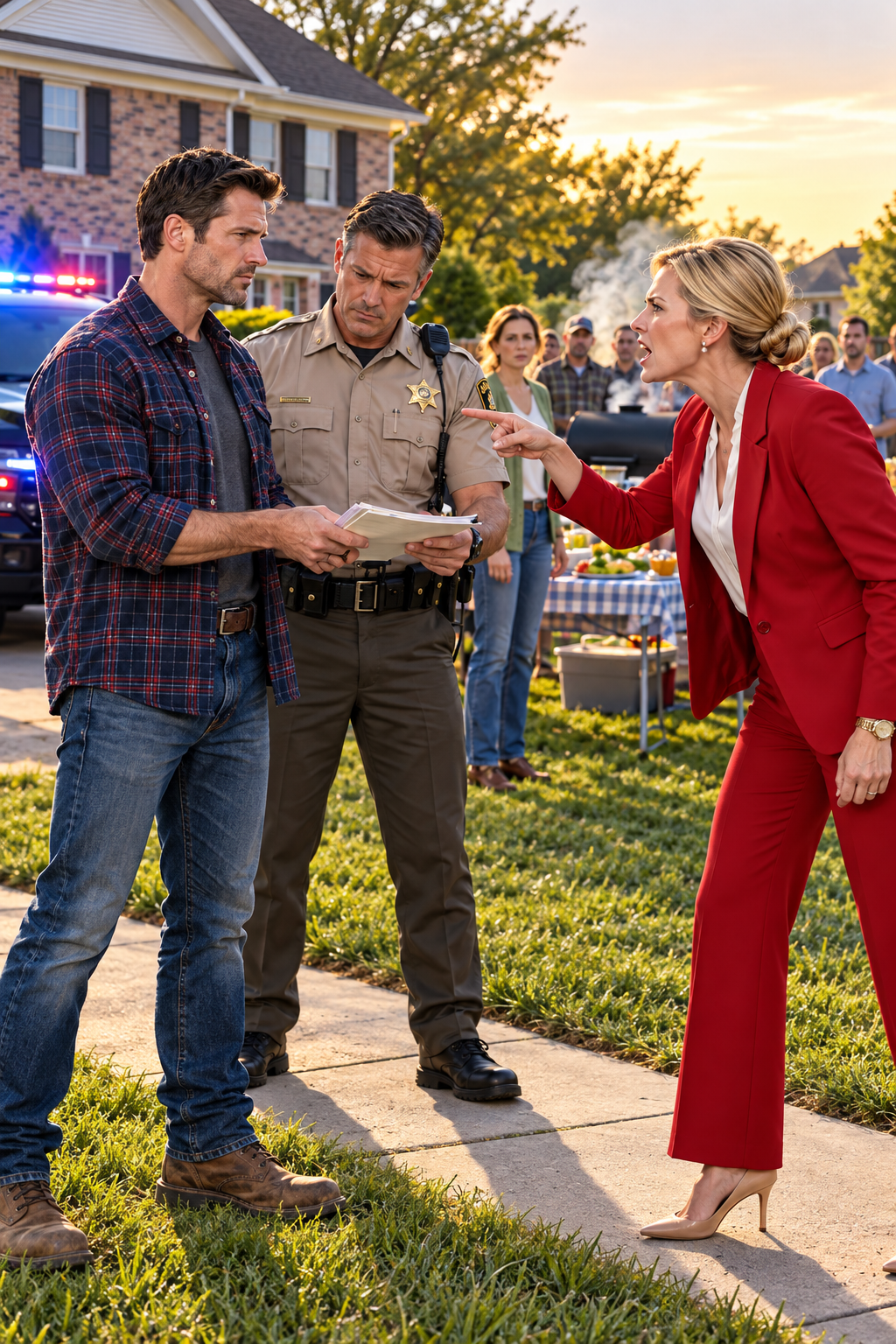
The first patrol car arrived within minutes, followed by a second. The guests fell quiet, and one of them turned down the music until it was barely audible. Marjorie approached the officers before they had time to speak with Malcolm, explaining that the gathering was unauthorized and that the association had issued repeated warnings. A deputy asked Malcolm for identification, which he provided without resistance. The officer looked around the yard and saw the grill, folding chairs, and guests all within the property boundary.
Malcolm asked the deputy one simple question: what law had he broken? Marjorie interrupted, insisting that the homeowners association’s rules were enforceable. The deputy did not argue with her, but asked whether she had copies of the warnings. Malcolm went inside and returned with an envelope Ara had kept in their records folder. The letter mentioned only that a grill was visible from the street; it did not prohibit cookouts, gatherings, or guests.
The letter had arrived months earlier, after Malcolm moved the grill from the front patio to a side area of the yard. He had complied with the request, even though the letter did not cite a clear covenant or penalty. Since then, Marjorie had sent notes about a hedge’s height, a delivery van parked too long, and a holiday wreath hung at a slight angle. Malcolm had addressed each specific issue when the association identified a written rule. Ara kept copies, not because she expected a crisis, but because she believed memory became unreliable when arguments repeated.
Marjorie described the letter as one of several warnings, but the envelope contained no others. One guest, Terrence, who had known Malcolm since college, quietly told Ara that he had never seen a disturbance at their home. Another guest stood with arms folded, watching the officers compare the letter with Marjorie’s claims. The deputy handed Malcolm’s identification back and said he could not see grounds for an arrest or citation. For a moment, it seemed the matter might end there.
Then Sheriff Dorian Whitlock’s vehicle arrived. He stepped out without hurry, surveyed the yard, and looked first at the house rather than at Marjorie. He walked past the grill, the quiet guests, and the table of food, then asked, “Who owns this property?” Marjorie answered that the HOA had jurisdiction over the neighborhood. The sheriff looked at her and said, “That’s not what I asked.”
Part 3: Sheriff Whitlock finds the deed Marjorie never expected to see
Malcolm asked the sheriff for thirty seconds and went back inside. Marjorie muttered that he was stalling, but Sheriff Whitlock waited without reacting. The guests exchanged uneasy looks while the smoke thinned over the fence. Malcolm returned carrying a worn brown folder, its corners softened by years in a closet. He set it on a small table near the porch and opened it without ceremony.
Inside lay a warranty deed, a folded property survey, and a plat map marked with handwritten notes. Several pages carried the county recorder’s seal. Sheriff Whitlock picked up the deed and read carefully, moving through the legal descriptions line by line. Marjorie stepped closer, craning to see the papers. The moment she recognized the tract name, her posture changed.
She insisted that the HOA covenants still applied. The sheriff asked to see the association’s founding declaration, the document that defined its jurisdiction and explained which properties it governed. Marjorie said she had a copy at the association office but had not brought it. He asked why she had called the police before producing the document that supposedly gave her authority. No one answered.
Malcolm explained that his property had once been an independent tract before the subdivision was built around it. The original landowner, Augustus Vale, had sold most of his acreage to a development company but kept one parcel separate. Years later, Malcolm purchased that parcel and its existing home, assuming it was an ordinary sale. His closing attorney had flagged a special notation in the chain of title, but Malcolm had filed it away as a curiosity because he had no interest in fighting with the neighborhood.
The sheriff radioed the county records division and gave them the parcel number listed on the deed. While he waited for confirmation, he read the survey and compared it with the association’s boundary map Marjorie had on her phone. The county response confirmed a special-use designation that made the HOA’s authority over the parcel less straightforward than Marjorie had claimed. The sheriff lowered the radio and looked at Malcolm. “Where did you get this deed?” he asked. Malcolm answered, “From the man who owned the tract before the subdivision existed.”
Part 4: An old landowner’s careful carveout complicates the association’s authority dramatically
Augustus Vale had owned the larger tract for decades, back when the area beyond town was quiet and undeveloped. When growth finally reached his land, he sold most of it to a developer that planned the neighborhood now surrounding Malcolm’s house. But Vale did not sell everything. He retained one parcel and wrote specific terms into the original deed, ensuring that the separate tract would not automatically fall under whatever community governance came later.
The subdivision’s streets, matching mailboxes, and neat lawns were built years after Vale’s transaction. The homeowners association formed after the first houses were already occupied. Over time, residents assumed every home within the surrounding streets fell under the same rules. The association’s records repeated that assumption, but the original parcel description did not fit neatly inside its boundary. The distinction had been present on paper from the beginning, yet few people had reason to examine it.
Malcolm’s attorney had noticed the unusual designation when he bought the house. She had advised him to keep the closing documents and verify the association’s authority if any conflict arose. Malcolm had not treated the clause as a weapon or tried to use it to avoid every neighborhood standard. He had simply wanted a home where he and Ara could live quietly. When the HOA made a reasonable request, he complied; when Marjorie demanded more, he began asking for the exact rule.
The sheriff read the founding declaration page by page. The association’s listed boundary did not clearly include Malcolm’s parcel in the way Marjorie had assumed. Further into the document, a reference to the old development company caught his attention. That company had transferred land to the association through several amendments, but the records did not show a clear transfer of governance over the separate Vale parcel. The sheriff asked Marjorie whether she had ever checked the original deed before issuing enforcement letters.
Marjorie said she believed the HOA covered the whole neighborhood. Malcolm replied that belief was not the same as a recorded boundary. The sheriff told them the deed did not make Malcolm immune from every local law or every properly enacted regulation. It did, however, raise a serious question about whether the association had legal standing to enforce its private covenants on this property. He said the question needed a formal legal review, not an argument on the sidewalk.
Part 5: Buried meeting minutes expose a legal question the board ignored
The sheriff asked Marjorie to bring him to the association office so they could review the founding documents. He left one deputy at the house while Malcolm returned to the backyard and asked the guests to stay. The drive to the office was short and silent. Marjorie unlocked a metal filing cabinet and began pulling out folders with visibly unsteady hands. The office smelled of stale coffee and old paper beneath buzzing fluorescent lights.
The founding declaration was near the front of the cabinet, followed by amendments, meeting minutes, and a list of properties included in the association. Malcolm stood near the doorway until the sheriff waved him closer. They sorted through years of routine records: landscaping budgets, pool maintenance, meeting agendas, and enforcement logs. Most pages had nothing to do with the dispute. Then a line in the minutes from years earlier caught the sheriff’s eye.
A board member had asked whether Malcolm’s parcel fell under the association’s jurisdiction. The minutes recorded a resolution requiring legal review before any enforcement action proceeded. The following year’s records contained no evidence that the review had ever occurred. Still, enforcement letters had continued, including the recent warning about the grill. The sheriff held the page up and asked Marjorie why the question had never been resolved.
“I don’t know,” she said, her voice quieter than before. Malcolm found a later amendment that appeared to have been stamped and filed, but its legal description was vague. It might have included the parcel; it might not. The document required an attorney’s interpretation before anyone could rely on it. Marjorie turned to Malcolm and asked whether he thought the papers made him untouchable. “No,” he said. “I think you should have checked before calling the police.”
The sheriff stepped between them and reminded both that property rights, HOA rules, local laws, and civil disputes were separate matters. None of them could be settled by raised voices or flashing lights. He searched the final folder and found a photocopy of Augustus Vale’s original deed. A clause near the end confirmed that Vale had retained specific rights over the smaller parcel when he sold the surrounding land. Those rights had not been clearly transferred to the association in later records.
The sheriff checked the parcel number, dates, county seal, and chain of title against the records division’s response. The details aligned. He read the clause aloud, making clear that it did not excuse Malcolm from every valid neighborhood standard. It did establish that the association’s assumed authority over this particular parcel had never been properly documented. Marjorie stared at the pages, realizing that some letters sent under her authority might have exceeded what the association could lawfully demand.
Part 6: Neighbors, witnesses, and records reshape the dispute beyond backyard smoke
The sheriff made his position clear before leaving the office. There was no basis to detain or cite Malcolm for a quiet cookout held on his own property. The HOA could not turn a civil disagreement into a criminal matter simply by calling the police. Any dispute over the association’s authority would need to be resolved through legal channels after a complete review of the documents. He instructed the association to pause further enforcement against Malcolm until its attorney examined the parcel history.
When they returned to the house, the guests had resumed talking, though the afternoon had changed. The grill had cooled, and the food had begun to lose its warmth. Sheriff Whitlock placed a hand briefly on Malcolm’s shoulder and gave him a copy of the parcel’s historical record. He told him to keep the paperwork close. Malcolm smiled faintly and said, “I always do.”
Marjorie returned to the edge of the property later, this time without her phone raised or her arms folded. She admitted she should have checked the records before calling the police. Malcolm told her that was all he had wanted from the beginning. They stood in a silence that was no longer openly hostile, but neither knew what to say next. Behind them, the guests had relit the grill, and conversation slowly returned to the backyard.
Marjorie asked whether Malcolm intended to fight the HOA. He said he would if he had to, but he would rather learn how to live beside his neighbors. He did not want a public feud or a campaign to humiliate her. He wanted the association to understand the limits of its authority and to treat his home with the same respect it demanded from others. Marjorie nodded, though she did not promise anything that afternoon.
Word of the encounter traveled through the neighborhood over the next several days. Some residents stopped by to apologize for assuming Malcolm was difficult or uncooperative. Others said nothing, hoping the story would fade. Malcolm and Ara did not feed the gossip or describe the sheriff’s visit as a victory. They went back to their routines, tending the yard, greeting neighbors, and keeping copies of every letter that arrived.
Part 7: The association begins reviewing decades of assumptions and disputed enforcement
The HOA board authorized a full legal review of its founding documents and parcel boundaries. Its attorney examined the original declaration, Vale’s deed, the later amendments, and the unresolved meeting-minute entry. Several enforcement letters connected to Malcolm’s home were reconsidered. The review took weeks because the land had passed through several hands and the paperwork had never been consolidated. No one could responsibly declare the entire property exempt from every rule until the documents had been interpreted.
The attorney’s preliminary report found that the association could not assume jurisdiction over Malcolm’s parcel based solely on its location within the surrounding neighborhood. The separate tract required further clarification, and the board had to establish what covenants, if any, applied through later recorded agreements. Until that work was complete, the association agreed to stop issuing violations tied to private backyard activities that did not create a safety concern or break local law. The sheriff’s office did not decide the civil question; it had only made clear that the cookout was not a criminal offense.
At a board meeting, Marjorie presented the review findings. She explained that the association had relied on an assumption passed down through years of enforcement rather than confirming the original boundary. Several members were embarrassed that the warning had been ignored in the minutes. One asked why the legal review required by the earlier board had never happened. Marjorie admitted she did not know, and for once she did not try to make uncertainty sound like certainty.
The board voted to review every property boundary connected to the old Vale tract. It also adopted a new process requiring staff to cite the precise covenant and provide the relevant record before issuing a violation notice. Residents would receive a chance to respond before the association contacted law enforcement. Marjorie supported the changes, though the neighbors’ trust in her had been shaken. Her leadership would be judged by what she did next, not by how confidently she had spoken before.
Malcolm received a written acknowledgment that the cookout had not violated any law and that the association was pausing enforcement while the parcel review continued. The letter did not settle every question about the covenants, but it corrected the claim that the HOA could simply order him to stop ordinary activity on his property. Ara placed the document in their folder beside the first grill warning. For her, the paper mattered because it replaced a vague accusation with a clear record. Malcolm understood that the issue was larger than a single afternoon.
Part 8: Malcolm chooses coexistence, letting truth restore peace at home again
The legal review eventually clarified the boundary and the specific restrictions, if any, that applied to the Reeves property. Some general local rules remained in force, as they would for every homeowner. But the association could not enforce private covenants against Malcolm’s parcel without a valid recorded basis. The board withdrew several old notices and agreed to consult its attorney before sending any new one. Marjorie’s authority did not disappear, but it became bounded by documents rather than assumption.
She visited Malcolm and Ara on a quiet evening after the review was complete. She apologized for calling the police before confirming whether the association had jurisdiction. She also admitted that she had treated their repeated requests for written rules as defiance. Malcolm accepted the apology without pretending the experience had been harmless. Ara told Marjorie that she hoped the next family would not have to wait for flashing lights before anyone looked at the records.
The sheriff stopped by a few weeks later, not in response to a complaint, but to return a certified copy of the historical parcel file. He reminded Malcolm that the documents did not make him exempt from ordinary law. They simply described where the association’s authority began and ended. Malcolm thanked him for keeping the distinction clear. Sheriff Whitlock said that was the point: a badge could respond to a call, but it could not rewrite a deed.
The neighborhood slowly returned to its familiar rhythm. Lawns were trimmed, mailboxes matched, and people waved across driveways. A few residents still discussed the cookout, but the story lost its sharp edges as daily life resumed. Malcolm and Ara hosted friends again when they wanted to, keeping the gathering peaceful because that was how they liked it, not because Marjorie had demanded it. They did not turn their property history into a weapon against the association.
One Saturday, Malcolm stood beside the smoker while Ara arranged food on the folding table. Terrence brought a bowl of potato salad, and the paper lanterns swayed gently along the porch rail. No sirens came. The smoke drifted over the fence, and a neighbor walking past gave them a friendly wave. Malcolm looked at the folder inside the house, where the old deed and the sheriff’s record now rested together.
For years, the family had believed that calm compliance would be enough to prevent conflict. The cookout taught them that quiet people still had to speak when someone crossed a boundary. But they had not needed to shout or threaten anyone; they had needed to preserve the documents and insist on a fair process. Marjorie had learned that confidence was no substitute for checking the record. And the neighborhood learned that respect worked best when it ran in both directions.
As the afternoon light turned amber, Sheriff Whitlock’s cruiser passed slowly at the end of the block. He glanced toward the backyard and saw Malcolm standing exactly where he had been when the first patrol car arrived, tongs in hand. The sheriff lifted two fingers from the steering wheel in greeting. Malcolm returned the gesture, then turned back to the grill. Sometimes the truth waited quietly in a worn folder until someone finally asked the right question.
✓ Lynn R. Adams
Part 2: A troubling HOA pattern emerges through years of petty complaints The first patrol car arrived within minutes, followed by a second. The guests fell quiet, and one of them turned down the mus…