The Signature in the Snow
Part 2: Elena survives the mountain while Adrian manufactures her death
Jonah warmed me slowly beside a stone fireplace and contacted Marcus through emergency military channels rather than broadcasting my survival across local dispatch frequencies. Marcus had once supervised my instructor program and remained one of the few people Adrian considered part of my distant military past. When Marcus answered, he told me rescue teams had found blood, burned clothing, bone fragments, and personal jewelry inside the damaged cabin. Authorities were treating the scene as a probable fatality. I touched my throat and realized my wedding necklace was missing; Adrian had likely taken it while I slept in the passenger seat.
I asked Marcus to keep my survival secret until after the memorial because Adrian would destroy documents, move money, or disappear if he learned the mountain had failed. Marcus objected that withholding confirmation from Margaret meant letting her grieve a death that had not happened. I nearly abandoned the plan when I imagined her sitting beside an empty coffin. Then investigators found Adrian had increased my insurance coverage eight months earlier using an electronic authorization I never signed. He had transferred our house into a private trust, opened foreign accounts, bought tickets to Milan for himself and Bianca, and arranged expedited benefit processing before any remains were identified.
Bianca worked for the insurance company administering my military-linked policy, giving her access to claim requirements, beneficiary procedures, and emergency-death exceptions. Adrian supplied my schedule, marriage records, property information, and apparent confirmation of the circumstances around my disappearance. Investigators traced a bone fragment to an unidentified body held at a private medical facility connected to a charity where Adrian served as treasurer. Someone had planted remains to make a cabin fire look convincing. Bianca prepared a preliminary report saying the fragments were “consistent with adult female remains,” technically vague but persuasive enough to accelerate payment. The policy was worth nearly two million dollars, yet the accounts suggested Adrian expected more than insurance money.
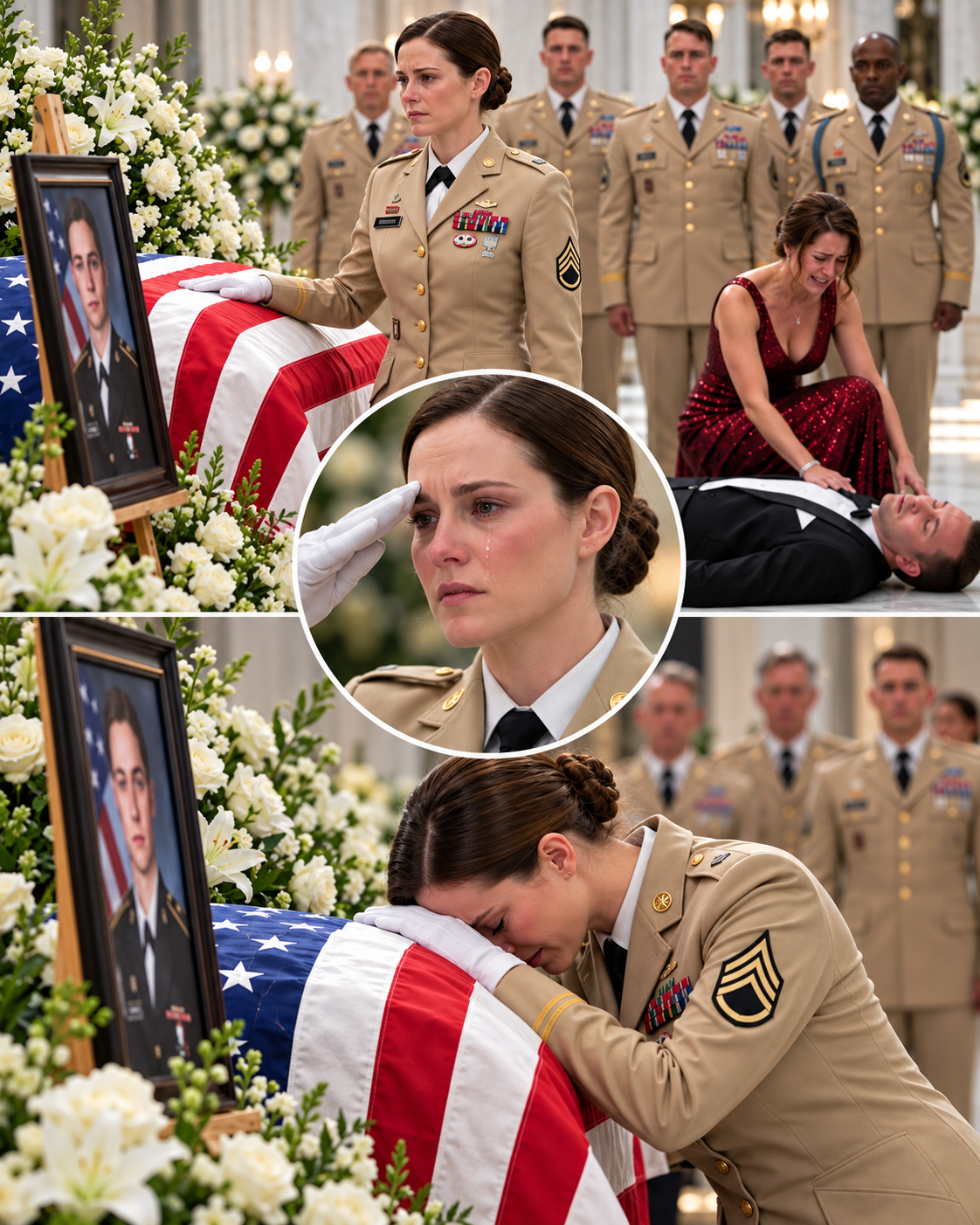
At the funeral, Adrian described me as the strongest person he had ever known and said his only regret was failing to protect me. I listened without the anger I expected. His performance was too polished to remain personally devastating: pauses rehearsed for sympathy, stories edited to elevate himself, my service reduced to decoration around his grief. A microphone hidden in a floral arrangement captured Adrian asking Bianca when the insurance money would clear. She answered midnight and confirmed their flight the next morning. Adrian then asked whether my mother suspected anything. Bianca said Margaret could barely stand.
A message hit Adrian’s phone, showing the words I had carved into the cabin wall. His face drained of color. A second image showed Bianca meeting another man outside the insurance office. Investigators had identified him as her legal husband and financial partner; she planned to disappear with the money without Adrian. Their staged grief broke apart as Adrian accused her of using him. She reminded him that he had locked me inside the cabin, forged the rescue story, and arranged the remains while she handled the claim. Marcus looked at me and said they had finally given us both voices describing the conspiracy.
Part 3: The empty coffin becomes a trap neither conspirator expects
The final scene at the funeral had been designed to shake Adrian without endangering mourners. An undercover military investigator lay inside the coffin beneath realistic prosthetics and my recovered black dress. As guests approached for a final farewell, the lid shifted slightly, settled, then rose again. Adrian backed away so violently he struck a flower stand. Bianca stared as if her calculations had abandoned her. Several relatives gasped when the lid opened and a dark-haired woman slowly sat upright. Adrian screamed before the investigator removed her mask.
Federal and military investigators entered through every door. Marcus announced that Adrian and Bianca were under arrest for conspiracy, insurance fraud, theft of military benefits, falsification of evidence, obstruction, and attempted murder. Bianca ran toward a side exit, but agents caught her. Adrian stayed frozen beside the open coffin, staring into its white silk lining. Then the funeral-home doors opened and I walked in wearing my service uniform over a brace. Every step hurt, but not enough to keep me from seeing my mother’s face. Margaret made a sound I would remember for the rest of my life and rushed to hold me.
Adrian whispered “No” as if the word could restore the story he had prepared. I told him the blizzard had finished someone before sunrise, but it had finished the wife who still believed our marriage could be saved. Lieutenant Cross had walked out. The room should have ended there, yet Bianca began laughing while agents secured her wrists. She looked at me with the confidence of someone who believed everyone else had discovered only the smallest part of the truth. “Adrian didn’t choose me,” she said. “He was paid to deliver you.”
Every phone inside the funeral home rang at the same moment. A distorted voice said Lieutenant Elena Cross had survived and Phase One had failed. Every screen went black and displayed a broken circle crossed by three vertical lines. I recognized the symbol from an abandoned Alaskan bunker where three soldiers disappeared during a classified survival exercise twelve years earlier. Bianca said no one behind the operation had expected me to die in the cabin. The storm, stolen gear, isolation, staged remains, and false story were a field test to see whether I still had the survival traits someone had tracked for years.
Masked operators stormed the funeral home through smoke-filled windows, ignoring mourners and targeting Bianca. I shielded Margaret behind the coffin, disabled one attacker, and chased Bianca through the preparation corridor when two operatives cut her restraints. I caught her by the loading door and demanded the name of whoever selected me. “Your father,” she answered. Before she could explain, a masked operative fired a dart into her neck. She collapsed, clutched my sleeve, and whispered, “Black Ridge. Subject Seven.” Then she said I was Subject Seven. The attacker escaped, and I noticed Margaret staring at the symbol with recognition.
Part 4: A forgotten experiment reveals where my childhood began
Before I could question Margaret, a caller told Marcus to bring Subject Seven to Black Ridge alone before midnight or my mother would die. Margaret vanished from the doorway while every agent searched the funeral home. Marcus admitted Black Ridge officially did not exist, but twenty-four years earlier it had operated as an unofficial endurance research site in northern Montana. The project studied survival, interrogation resistance, environmental stress, and psychological adaptation. It began with soldiers who signed broad classified waivers, then crossed boundaries nobody wanted preserved in ordinary archives. I asked whether they had used children. Marcus’s silence answered before he spoke.
Adrian had been moved into secure federal custody, and I questioned him because he might be our only route to Margaret. He admitted a man named Silas Voss had contacted him eight months earlier with money, a new identity, foreign protection, and information about the resentment Adrian already carried toward my military career. Voss wanted to know how I behaved when exhausted, whether betrayal made me reckless, whether I panicked in confined spaces, and how quickly I adapted when equipment failed. Adrian believed Voss wanted me dead, though Silas hinted I might survive. He still locked me inside the cabin because Bianca convinced him death would guarantee the insurance payment.
I asked Adrian whether he ever loved me. He said he thought he loved how safe he felt standing beside me. It was the first answer honest enough to replace twelve years of excuses. Before I left, he said Silas had a photograph of Margaret outside a military research facility the night before my wedding. The organization had monitored not only my military career but major events in my personal life. Marcus met me in the corridor with a thirty-five-year-old photograph of Margaret, Daniel, a younger Marcus, and several children dressed in identical gray clothing. The broken-circle symbol was painted on the wall behind them.
Seven names appeared beneath the photograph. The last entry read ELENA—SUBJECT 7, although I had always been told I was born in Virginia to Margaret and Daniel Cross. Marcus explained my biological mother was Dr. Livia Cross, a military physician assigned to Project Aegis. Margaret was a nurse who helped Daniel smuggle me out after discovering children were deliberately exposed to deprivation and fear. Silas Voss appeared in the same photograph as Subject One, a boy believed dead when the facility closed. I demanded to know why Margaret and Daniel took me instead of reporting the program. Marcus said the director had authority to erase complaints, records, careers, and sometimes people.
A phone hidden in the file activated with a live feed of Margaret tied to a chair in a concrete room. She was bruised but conscious. An older, silver-haired man stepped into the frame and greeted me as his “little sister by design.” Six adults bearing the broken-circle symbol stood behind him, all connected to the original cohort or later experiments. Silas ordered me to come to Black Ridge if I wanted Margaret alive. Before the feed ended, I studied the frightened adults behind him. They did not look triumphant. They looked like soldiers waiting for orders they hated but no longer remembered how to refuse.
Part 5: Black Ridge reveals why Elena was watched for years
I reached Black Ridge three hours before midnight, officially alone while Marcus followed at a distance with a covert team using no military networks. Someone inside intelligence channels had already helped the funeral attackers. A steel entrance hidden behind a frozen waterfall opened before I touched it. Silas stood inside without armor or a visible weapon, looking almost disappointed by how unsurprised I seemed. He said I resembled Livia. I told him my mother’s name was Margaret, because biology could not erase the woman who raised me. Silas called Margaret my rescuer rather than my mother.
The corridors held observation windows, isolation rooms, restraint chairs, medical chambers, and equipment old enough to look historical until I imagined children inside it. Silas said Aegis began with the stated goal of creating operatives resistant to extreme climates, interrogation, sleep deprivation, and fear. Children adapted faster because their identities had not fully formed. I accused the survivors of becoming the people who tortured them. Anger broke Silas’s composure; he believed outsiders could not judge choices made inside pain. He led me to a circular command room where Margaret sat tied to a chair and six surviving subjects lined the wall.
I ran to Margaret, who apologized for hiding the truth. I told her secrets could hurt without changing the fact that she had saved my life. Silas showed me recordings collected over decades: training exercises, deployments, arguments with Adrian, visits to the hospital, surveillance from my home, and footage of my escape from the avalanche. I had been the only Aegis child raised outside Black Ridge, surrounded by attachment instead of controlled suffering, yet I had become stronger than subjects shaped entirely by deprivation. Silas had arranged the cabin as a final comparison between the program’s theory and Margaret’s experiment in ordinary love.
Adrian’s greed made him easy to recruit; Bianca’s access made the false death useful; the funeral let Silas observe whether I pursued vengeance or protected civilians. He expected rage. I noticed a woman near the door avoiding his eyes and a scarred man clenching his fists whenever guards moved closer. Their loyalty rested on fear, not agreement. Silas said Aegis had never truly ended; it moved through classified prisons, contractors, interrogation sites, and research grants under new names. He claimed he meant to expose it. Margaret interrupted: he no longer wanted exposure.
A map appeared with military communications hubs, hospitals, electrical grids, and transportation centers marked in red. Silas planned a seventy-two-hour collapse to force former officials into the open, even if ordinary people died. A countdown began with seventeen minutes remaining. He offered me leadership over the subjects if I accepted that only catastrophe could break the institutions that buried Aegis. I told him he had tested whether betrayal would break me and whether love had weakened me. Then I drove my forehead into his face, took a guard’s weapon, and fired at the command console. The countdown continued; the master relay sat two hundred feet beneath us.
Part 6: Elena stops a national attack beneath her mother’s prison
Marcus, Margaret, a scarred Aegis survivor named Mara, and I descended six levels as temperatures fell and emergency lights flickered. Mara admitted Silas told them his targets were abandoned installations, not functioning hospitals, grids, and transportation centers. They believed him because people shaped by one enormous betrayal sometimes accepted another lie if it promised purpose. At the lowest level, a circular steel door bore faded lettering: ENVIRONMENTAL ENDURANCE CHAMBER. Margaret stopped there and told me Livia had died inside. She had tried to free the children. General Alaric Voss, Silas’s father and the Aegis director, locked her in during a lethal cold-cycle test.
The chamber opened onto a vast shaft crossed by frozen steel walkways. The relay lay roughly two hundred feet below, and the elevator no longer worked. I clipped onto a maintenance cable and started down despite my injured ankle. Marcus objected that I was still recovering from exposure. I told him to get Margaret out if the chamber sealed. He reminded me I had not outranked him in fifteen years. “Tonight I do,” I answered. Halfway down, the environmental system activated, blasting cold air through the shaft as a steel door began closing above me.
Silas’s voice came over an old intercom, accusing me of predictable self-sacrifice. I told him survival and hiding were not the same thing; he had spent his life using dead children to justify choices they never made. With barely three minutes remaining, I reached the terminal and found shutdown required two valid subject authorizations. Mara squeezed through before the door sealed and descended the ladder. “Someone should finally come for the people Aegis abandoned,” she said. The system rejected our fingerprints because Silas had deleted the surviving subjects from its active files. Thirty seconds remained.
I found another input labeled PRIMARY GENETIC LINE, cut my palm on broken metal, and pressed blood to the scanner. Livia had helped design the early security system before turning against Aegis. The terminal confirmed her genetic line and froze the countdown with three seconds left. The attack stopped, but Silas’s destruction sequence began. Steel supports cracked as the mountain prepared to collapse. A maintenance conduit led toward an underground river beyond the shaft. I told Mara we would jump. We hit freezing water just before the chamber collapsed and were dragged through darkness, where I refused to release her even when my shoulder struck rock.
The current eventually threw us beneath a sheet of ice and into open moonlight. We crawled onto the bank as Black Ridge folded inward behind us. Marcus and Margaret escaped through upper tunnels; several subjects surrendered. Recovered archives revealed decades of illegal research, but no body belonging to Silas was found. Three days later, Marcus arrived at my hospital room with a burned photograph labeled SILAS AND ELENA—THE ONLY SUCCESSFUL PAIR. DNA showed Silas and I shared the same biological mother. He was my half brother. The revelation did not excuse the kidnapping or attempted attack, but it changed the boy staring at me from the photograph.
Part 7: Silas’s last test reveals the father I never knew
I visited Adrian in federal detention carrying divorce papers. He looked thinner, sleepless, and stripped of the expensive symbols he used to project control. He admitted Silas chose him because resentment already lived inside him, then fed it until my strength felt like an insult instead of something he once admired. I told him manipulation influenced choices without making them somebody else’s. Adrian agreed and did not ask forgiveness. Then he revealed Silas had contacted him through the prison messaging system. The message said my final test would begin when I discovered my father.
Silas sent coordinates to an unnamed grave outside Helena. Marcus and Margaret came with me. Beneath the snow we found a metal box beside a stone marked only with my birth date. It held a recorder of Livia’s voice. She explained I had not been designed as a matching subject for Silas, despite what Aegis claimed. She had conceived me because she loved a young intelligence officer investigating the program from within. She wanted at least one child in Black Ridge to enter the world through love, not experimentation. She named my biological father: Thomas Reed. Marcus staggered because Thomas had been his older brother.
Livia said Thomas believed I had died until shortly before his own death, when Margaret secretly told him I had survived and Daniel Cross had become my father in every ordinary way that mattered. Thomas chose not to reclaim me because I knew another man as Dad. He stayed distant partly to protect me from Aegis and partly because he believed parenthood could not be reduced to DNA. I barely had time to absorb the loss of a father I never knew before Silas’s voice came through the recorder. A distant rifle shot struck Marcus in the shoulder. I dragged him behind the grave while Margaret applied pressure and searched the ridge.
The weapon was an automated rifle platform controlled remotely. Nearby, a phone showed Silas watching us, and a second feed displayed Mara trapped beside a vehicle near children leaving a school. Silas claimed the vehicle was packed with explosives and said the remote shutdown remained with him, at the mountain cabin where Adrian had first abandoned me. I accused him of forcing a choice between Marcus and strangers in danger. “I already know what you’ll choose,” he said. A helicopter waited in a nearby field. I hated leaving Marcus, though ambulances were approaching, because Silas had found a way to make compassion feel like a weapon.
During the flight, Silas said I always chose strangers over blood. I told him I chose whoever faced immediate danger, not the people whose DNA matched mine. He sounded almost proud. The helicopter landed beside the cabin where my marriage had ended. I entered with my pistol raised and found Silas beside the iron stove. The explosives around Mara’s vehicle were real, he said, but the immediate trigger was not; I could cancel the threat. Then he showed me a dead-man switch connected to encrypted Aegis archives. If his heartbeat stopped, thousands of files would flood public networks, exposing not only guilty officials but survivors, witnesses, children, and protected identities.
Part 8: The final cabin reveals the architect behind Aegis
Silas had built a problem violence could not solve. I lowered my weapon slightly and realized he had brought me back not for another survival test but because pain had left him unable to distinguish truth from revenge. He wanted me to choose whether the archives should be released or destroyed. He believed Margaret’s love had given me judgment Aegis never taught him. I told him the operation was no longer a test of me; it was his test of whether he could become anything besides what Black Ridge created. For the first time, he looked less like a mastermind than an exhausted man who did not know how to ask his sister for help.
Headlights appeared outside. Adrian stepped into the cabin carrying a weapon, despite being a federal prisoner. He said people connected to Aegis had engineered his escape and promised him a new identity if he finished the assignment. Silas looked genuinely surprised; the order had come from someone above him. An elderly man entered behind Adrian with a cane and two armed guards. General Alaric Voss had never died. He had allowed Silas to believe he was dismantling Aegis because each rebellion revealed hidden files, surviving subjects, compromised officials, investigators, and enemies Alaric wanted identified.
Alaric regarded me with clinical fascination and called me Subject Seven, speaking of my marriage, cabin escape, funeral, and Black Ridge assault as successful data points. Silas stared at him, horrified to learn that even his rebellion had been part of the experiment. Alaric ordered Adrian to shoot me. Adrian’s weapon trembled. I told him no one else could make the choice for him—not Silas, not Alaric, not resentment, and not me. Adrian whispered that he knew. He turned toward Alaric, but a guard fired first, and Adrian fell near the doorway as I knocked the guard’s weapon away.
Silas attacked the second guard while Alaric reached for the archive controls. In the confusion, Silas pinned his father against the wall with both hands at his throat. Alaric urged him to kill, whispering that murder would prove Aegis had made him what it intended. I called Silas by name and told him that if he killed his father just to prove something, Alaric would own even that final decision. Silas let go. Alaric reached for a hidden pistol, but the wounded Adrian grabbed his ankle long enough for me to disarm him. Emergency teams arrived soon after, securing Alaric, Silas, the guards, and the dead-man device.
Medics stabilized Adrian. He asked if choosing differently once meant he had passed some final test. Silas said there had never been a test designed for him. Adrian laughed at the cruelty of that truth. He survived and returned to federal custody. His one better choice was recorded honestly without erasing the choice that started everything. Alaric was prosecuted through protected federal proceedings. Investigators reviewed the Aegis files under court supervision, releasing evidence about crimes without exposing survivors who had never agreed to become public evidence. Silas surrendered and provided names, access keys, and archives. Cooperation reduced uncertainty; it did not cancel responsibility.
Part 9: Elena walks out of the storm without becoming its prisoner
Aegis survivors received medical care, legal support, compensation pathways, and access to the records that had been hidden behind classification for decades. Mara helped establish a center for people harmed by secret programs and their families. Silas remained in custody, and I visited him once a month—not because I had pardoned him, but because I refused to accept Aegis’s lesson that people had only two choices: ownership or abandonment. Marcus recovered from the gunshot and told me stories about Thomas, the biological father who investigated Aegis, loved Livia, learned I had survived, and stepped back because Daniel Cross had already become the father I trusted. Margaret remained simply Mom, even after telling me how she carried me through a maintenance tunnel and drove fourteen hours, afraid military police would stop us.
Adrian pleaded guilty to attempted murder, insurance fraud, conspiracy, and falsifying evidence. His testimony helped prosecutors convict other Aegis participants, but cooperation did not turn him into a hero. Investigators recovered foreign accounts, reversed the fraudulent property transfers, and found evidence that Bianca and her legal husband had participated in other suspicious insurance claims. I testified truthfully that Adrian later helped stop Alaric from shooting me. Prosecutors acknowledged the act without treating one moment of courage as payment for planned murder. The marriage ended through a simple divorce decree while Adrian remained in custody. I kept neither his surname nor hatred as a permanent occupation.
The hardest recovery began after the operations ended. Silence in my home brought back the cabin. Unfamiliar cars made me check exits. Ordinary snowstorms sometimes woke me convinced someone had removed the telephone. Military therapists treated hypervigilance as a habit that had once kept me alive, not a weakness to be ashamed of. I returned gradually to training instead of accepting an administrative promotion designed to protect me from the field. My first class stood in fresh snow while mountains rose beyond the training ground. One young sergeant finally asked the question I would remember longer than any commendation: “What matters most when everyone thinks you’re finished?”
Years earlier, I would have answered with a list: shelter before food, fire before comfort, water before hunger, movement before surrender. After Adrian, Bianca, Silas, Black Ridge, Margaret, Livia, Thomas, Marcus, and Alaric, my answer had changed. “Survival isn’t only staying alive,” I told the class. “It’s deciding what kind of person walks out of the storm.” Nobody wrote the sentence down immediately. I liked that. Some lessons needed to become choices before they became notes. When class ended, I watched the soldiers walk toward the vehicles together, carrying their packs and checking on one another.
That evening, I called Margaret and listened to her complain about the hospital food. I called Marcus to confirm his shoulder was healing. Then I wrote to Thomas in a letter I would never send, telling him I understood why he had stepped back, even if I wished he had found another way to stay near me. I did not know whether Silas would ever become someone I could trust, or whether he would spend his life answering for the harm he caused. I did know that what happened to me did not get to decide what I would do next. The storm had taken my marriage, my old name, and the story I believed about my childhood. It had not taken my choice.
✓ Lynn R. Adams
Part 2: Elena survives the mountain while Adrian manufactures her death Jonah warmed me slowly beside a stone fireplace and contacted Marcus through emergency military channels rather than broadcasti…