The Secret Caleb Mercer Carried Into His Marriage in the Snow _065
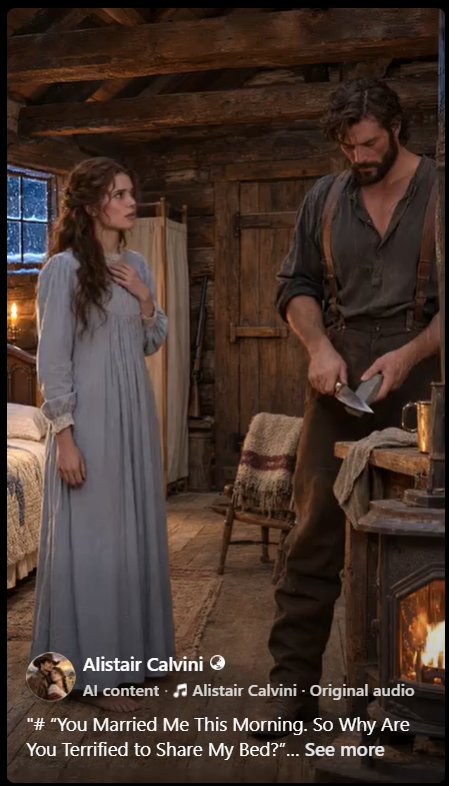
Part 2 – The Promise Beneath the Scar
“Because there’s something I’ve been hiding from you since the moment we met.”
The words seemed to remain suspended between them.
Eleanor’s fingers tightened around the edge of the table.
Outside, the storm drove itself against the cabin walls with such force that the logs creaked. The lamp flame wavered. Snow hissed against the glass.
Yet none of it seemed as loud as Caleb’s breathing.
He stood several feet from her, hands empty now, his knife lying harmlessly beside the whetstone.
Eleanor forced herself not to move.
“What have you been hiding?”
Caleb lowered his head.
“The reason I answered your letter.”
Her confusion deepened.
“My letter?”
“The .”
Eleanor remembered it immediately.
Six months earlier, sitting at the narrow writing desk in her aunt’s Baltimore boardinghouse, she had composed the most humiliating thirty-seven words of her life.
Educated woman, twenty-six, experienced in household management and bookkeeping, seeks correspondence with respectable Western gentleman interested in marriage. Character more important than wealth.
She had nearly burned the paper afterward.
Instead, she had mailed it.
Three weeks later, a reply had arrived from a man named Caleb Mercer.
His letters had been brief.
Plain.
Almost painfully sincere.
He owned a cabin, forty acres of workable land, some timber rights, and a small interest in a sawmill. He did not drink. He did not gamble. He attended church when weather allowed. He could cook “well enough to remain alive.”
That line had made Eleanor laugh for the first time in weeks.
Their correspondence had continued.
And eventually, Caleb had proposed.
“You said you saw my ,” Eleanor whispered.
“I did.”
“But?”
Caleb looked toward the fire.
“But your name was the reason I answered.”
A strange chill moved through Eleanor that had nothing to do with winter.
“You knew me?”
“No.”
“Then how did you know my name?”
His jaw tightened.
“I knew your father.”
Eleanor stared at him.
For several seconds she genuinely wondered whether the storm had swallowed part of his sentence.
“My father?”
“Yes.”
“That’s impossible.”
“No.”
“My father lived his entire adult life in Maryland.”
“He didn’t.”
The answer was so quiet that it frightened her more than if he had shouted.
Eleanor straightened.
“My father was an accountant.”
“He was.”
“He worked for Whitmore Shipping.”
“He did.”
“He died four years ago.”
Caleb’s expression softened.
“I know.”
Something inside Eleanor recoiled from the tenderness in his voice.
“How?”
Caleb walked slowly toward the hearth.
He did not come closer to her.
Instead, he leaned one hand against the mantel.
“When I was seventeen, I worked at a mining camp sixty miles north of here.”
Eleanor said nothing.
“There was an accident.”
His hand rose unconsciously toward his collar.
For the first time, Eleanor understood.
“The scar.”
Caleb nodded.
“A support beam gave way underground. There was a lantern fire afterward. Nothing like the stories people tell about it now, but bad enough.”
His fingers closed around the fabric of his shirt.
“I got trapped.”
The cabin seemed to shrink around them.
“How long?”
“Nearly a day.”
Eleanor’s face softened despite herself.
Caleb continued before she could speak.
“Your father was there.”
She frowned.
“My father?”
“He wasn’t working the mine. He was inspecting accounts for investors back East. He was supposed to leave that morning.”
Caleb gave a faint, humorless smile.
“He missed his stage because he wouldn’t leave until they accounted for every man underground.”
Eleanor could almost hear her father’s voice.
Thomas Whitmore had possessed an infuriating habit of counting everyone twice before beginning a journey.
Children.
Bags.
Porters.
Meals.
Coins.
Once, when Eleanor was fourteen, he had delayed a ferry because an elderly stranger had dropped her spectacles.
“That sounds like him,” Eleanor whispered.
Caleb looked at her.
“He heard there was one worker missing.”
“You.”
“Yes.”
“And he stayed?”
“He did more than stay.”
Caleb pulled a chair away from the table but did not sit.
“He argued with the foreman until they organized another search. When the men said part of the tunnel was unstable, your father went with them.”
Eleanor’s lips parted.
She had never heard this story.
Not once.
“My father went underground?”
“He found me.”
The wind gave a low howl around the chimney.
Caleb’s eyes drifted somewhere beyond the room.
“I remember seeing his lamp before I remember seeing his face.”
He swallowed.
“I thought I was dying. Couldn’t breathe properly. Half my shirt had burned. I asked him if he was an angel.”
Despite the tension, Eleanor almost smiled.
“What did he say?”
Caleb’s mouth twitched.
“He said, ‘Certainly not. An angel would have had the sense to remain aboveground.’”
A sound escaped Eleanor.
Half laugh.
Half sob.
She covered her mouth.
That was precisely the kind of thing her father would have said.
Caleb turned away, perhaps giving her privacy.
“He stayed with me until they got me out. Paid the doctor when the company wouldn’t. Wrote to me afterward.”
“Why?”
“I asked him the same thing.”
Caleb finally sat.
“He said because somebody ought to.”
Eleanor closed her eyes.
For four years she had carried a picture of her father made from familiar pieces.
Ledger books.
Pipe smoke.
Ink-stained fingers.
His gentle irritation whenever she beat him at chess.
His inability to remember birthdays unless he wrote them down.
Now there was another piece.
A younger Thomas Whitmore descending into a damaged mine for a boy he did not know.
“Why didn’t he ever tell us?”
“I don’t know.”
Caleb rubbed one hand over the other.
“We exchanged letters for years. Not many. Two or three a year.”
Eleanor opened her eyes.
“What did he write about?”
“Work. Weather. Books sometimes.”
Caleb hesitated.
“You.”
Her heart stumbled.
“Me?”
“He was proud of you.”
Her throat tightened.
“He complained you argued too much.”
“That sounds more like him.”
“He said you were smarter than most men who mistook confidence for intelligence.”
Eleanor looked away quickly.
The room blurred.
Caleb’s voice softened.
“When his letters stopped, I wrote twice. Both came back.”
“You didn’t know he had died?”
“Not until later.”
“How did you find out?”
“A Baltimore newspaper.”
Eleanor stared.
Caleb folded his hands.
“I kept watch for your family name afterward.”
“For four years?”
“Yes.”
“Why?”
That was the question.
The real one.
Caleb looked at the floor.
“Because of a promise.”
Eleanor felt the uneasiness return.
“What promise?”
“When I was nineteen, your father came west again.”
She blinked.
“Again?”
Caleb nodded.
“He visited this mountain.”
“My father was here?”
“He stayed three weeks.”
“Why?”
“He never told me everything.”
Caleb’s brow furrowed.
“But before he left, he made me promise something.”
“What?”
“If a Whitmore ever came west needing help, I was to offer it without asking for payment.”
Eleanor stared at him.
“And when you saw my marriage …”
“I recognized your name.”
“You decided to rescue me.”
“No.”
The force of the answer surprised them both.
Caleb stood.
“I decided to write.”
“That seems a narrow distinction.”
“It mattered to me.”
“Why?”
“Because I didn’t want you marrying me out of gratitude.”
Eleanor’s eyes flashed.
“I certainly didn’t.”
“I know.”
“I married you because your letters made you seem decent.”
“I hoped so.”
“And because I was nearly penniless.”
His expression tightened.
“I know that too.”
She stepped closer.
“So you knew I was desperate.”
“Yes.”
“And you never told me you had known my father.”
“No.”
“Why?”
“Because then you might wonder whether every kind thing I did was because of him.”
Eleanor stared at the enormous man before her.
“And wasn’t it?”
Caleb looked at her at last.
“No.”
The answer was barely louder than the storm.
“No, Eleanor.”
Something changed in the air.
A warmth unrelated to the stove moved across her face.
Caleb appeared to realize what he had admitted.
He retreated half a step.
“That still doesn’t explain the knife,” Eleanor said.
His ears reddened again.
“No.”
“Or why you’re terrified of sleeping beside me.”
“No.”
“Then explain that.”
Caleb became very still.
The secret concerning her father had been difficult.
Whatever came next seemed worse.
He walked to the table and turned the knife so the handle faced away from him.
“I have nightmares.”
Eleanor waited.
“About the mine?”
“Sometimes.”
“And?”
“I move in my sleep.”
She frowned.
“Move?”
“Walk sometimes.”
“That’s hardly a reason to sleep on the floor.”
“It is when I don’t always know where I am when I wake up.”
His voice dropped.
“Two years after the accident, I woke from a nightmare and knocked my bunkmate across the room.”
Eleanor’s expression changed.
“I didn’t mean to hurt him. I thought the tunnel was collapsing.”
“How badly was he injured?”
“Bruised shoulder.”
“That was all?”
“That was enough.”
Caleb shook his head.
“I haven’t shared sleeping quarters since.”
Eleanor looked toward the bed.
Suddenly his nervousness made sense.
The chimney inspection.
The door hinges.
The rifle.
The sharpening.
“You sharpen things when you’re frightened?”
Caleb looked embarrassed.
“Keeping my hands busy helps.”
A reluctant smile appeared on Eleanor’s face.
“You might consider knitting.”
His head snapped toward her.
She could not stop herself.
Caleb stared for half a second.
Then a laugh emerged from him.
Deep.
Rusty.
Almost startled.
Eleanor smiled wider.
The terrifying mountain man had a pleasant laugh.
She stored that discovery away.
Then she became serious.
“You could have told me.”
“I should have.”
“Yes.”
“I thought you’d be afraid.”
“I was afraid.”
His face fell.
“Not of you.”
He looked up.
“Of what I didn’t understand.”
The words seemed to strike him with unusual force.
Eleanor walked to the bed and took one pillow.
She placed it on the far side.
“You may sleep there.”
Caleb stared.
“Eleanor—”
“With conditions.”
His posture straightened as though receiving military orders.
“You stay on your side.”
“Yes.”
“If either of us becomes uncomfortable, we say so.”
“Yes.”
“If you begin wrestling imaginary mine timbers, I reserve the right to throw a pillow at you.”
His lips twitched.
“Fair.”
“And the knife stays on the table.”
“Yes.”
She looked at him.
“You don’t frighten me nearly as much now that I know you’re frightened too.”
For a moment, Caleb could not answer.
Then he nodded.
They prepared for bed awkwardly.
Painfully politely.
Caleb removed his boots.
Eleanor turned away while he changed his shirt behind the canvas screen.
When he emerged, she caught sight of the scar.
It began high along his shoulder and disappeared beneath the collar of his undershirt, pale against his skin.
She did not stare.
He noticed that kindness.
They climbed into opposite sides of the bed.
Between them lay enough empty mattress for a third person.
The storm continued.
Minutes passed.
Eleanor listened to Caleb breathe.
He seemed determined to remain completely motionless.
“You can breathe normally,” she whispered into the darkness.
“I am.”
“No human being breathes like that.”
A pause.
Then he exhaled.
Eleanor smiled against her pillow.
Another long silence followed.
“Caleb?”
“Yes?”
“Did my father ever mention why he came back to this mountain?”
The breathing stopped again.
“No.”
“Nothing?”
“He asked strange questions.”
“What kind?”
“Property records. Survey lines. Old mining claims.”
Eleanor turned toward him.
In the dim firelight, she could see only the outline of his face.
“Was he investing?”
“I don’t think so.”
“Then what was he doing?”
“I never knew.”
Eleanor stared into the darkness.
Her father had spent three weeks on this mountain.
He had never told his family.
He had exchanged letters with Caleb for years.
And before leaving, he had extracted a promise concerning the Whitmores.
Why?
Sleep seemed impossible now.
She finally turned onto her back.
That was when she remembered.
The envelope.
Eleanor sat upright.
Caleb reacted instantly.
“What is it?”
“My trunk.”
“What about it?”
She threw aside the blanket.
“There’s something inside.”
“Eleanor?”
She hurried across the cabin.
Caleb lit the lamp while she knelt beside the large leather trunk she had brought from Baltimore.
Her hands trembled as she opened it.
Dresses.
Books.
Her mother’s silver brush.
A bundle of letters.
At the very bottom lay a slim wooden box containing the few possessions she had kept from her father’s study.
She opened it.
There.
A sealed envelope yellowed by time.
She had found it behind a loose drawer panel after his funeral.
There had been no address.
Only a name.
At the time, the name had meant nothing to her.
Now Eleanor lifted the envelope.
Caleb saw it.
Every trace of color vanished from his face.
Across the front, in Thomas Whitmore’s unmistakable handwriting, were two words.
CALEB MERCER.
Caleb whispered, “Where did you get that?”
“My father’s desk.”
He stood slowly.
Eleanor turned the envelope over.
The seal remained unbroken.
Four years.
Her father had left a letter for the man she would one day marry.
Neither of them spoke.
Finally Eleanor slid one finger beneath the brittle edge of the paper.
Caleb caught his breath.
She broke the seal.
And from inside the envelope, something small and metallic fell onto the floorboards.
A brass key.
A tag was tied around it.
Eleanor bent and lifted it toward the lamp.
Three words had been written on the tag.
MERCER. NORTH WALL.
Caleb stared at it.
Then at Eleanor.
“There’s no lock in my north wall.”
The storm thundered outside.
Eleanor looked slowly toward the far side of the cabin.
“No,” she whispered.
“But perhaps there’s something behind it.”
**–END OF PART 2– CLICK “NEXT” AT THE BOTTOM OF THE PAGE TO CONTINUE READING**
✓ Lynn R. Adams
Part 2 – The Promise Beneath the Scar “Because there’s something I’ve been hiding from you since the moment we met.” The words seemed to remain suspended between them. Eleanor’s fingers tightened a…