The Secret Beneath Naira’s Blanket and the Promise Mateo Kept _064
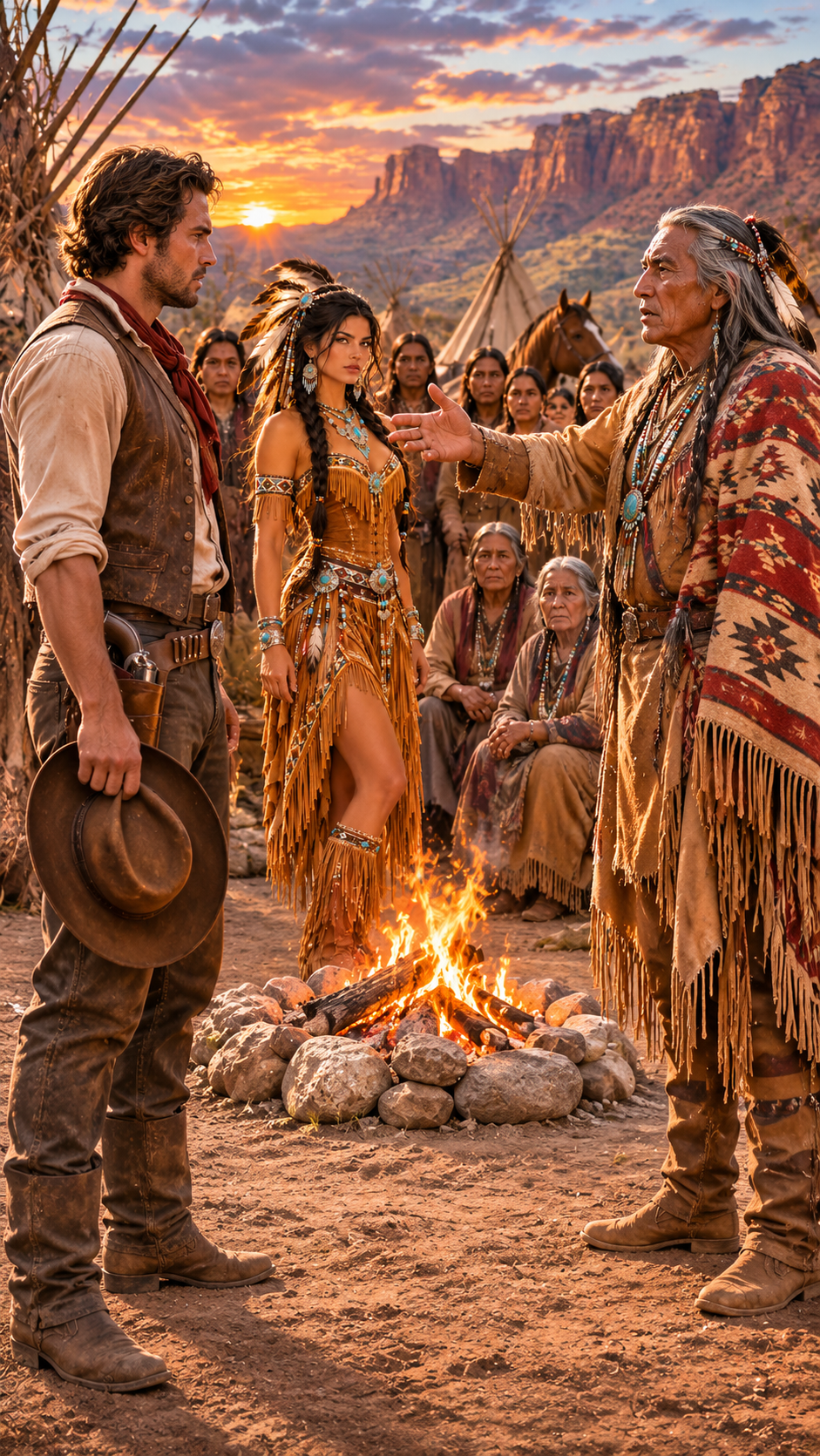
## Part 2 – The Book No Warrior Wanted Opened
Naira slowly began drawing the object into the morning light.
I expected a knife.
Perhaps a pistol.
The way the warriors had stepped backward, I was prepared for almost anything.
Instead, she lifted a narrow book bound in dark, weathered leather.
For several seconds, I simply stared.
It was no larger than a church Bible, though far thinner. Its corners had been reinforced with brass, and a faded cord had been wound twice around the cover.
I looked from the book to the men around us.
“You’re afraid of a ledger?”
Nobody answered.
Naira’s honey-colored eyes remained on mine.
“Not the book,” she said.
“Then what?”
“What is written inside.”
Chief Chaska stood beside the fire with his face turned toward the mountains.
I had known the man less than an hour, yet I already understood enough to see that whatever his daughter held caused him pain.
Naira untied the cord.
One warrior muttered something in Apache.
Another answered sharply.
Tala, the little girl I had brought through the storm, came running toward us.
An older woman caught her gently by the shoulders.
Naira opened the cover.
The first pages were filled with writing.
Some of it was English.
Some Spanish.
There were names.
Dates.
Numbers.
And carefully drawn maps.
I frowned.
“What is it?”
“My mother’s record.”
Chaska finally looked at us.
“Naira.”
His voice was quiet.
She did not close the book.
“You said he should choose,” she replied.
“I said he should know enough to choose.”
“That is not the same thing.”
Father and daughter held one another’s gaze.
For the first time, I understood that the proposal around the fire had not been entirely Chaska’s decision.
There was an old disagreement here.
I had walked straight into the middle of it.
I lowered my hat to my side.
“Maybe somebody ought to start at the beginning.”
Naira looked at me.
Then she nodded.
“My mother’s name was Eleni.”
I waited.
“She spoke English and Spanish. Before she married my father, she worked as an interpreter for traders, soldiers, surveyors and anyone who paid for words.”
I glanced toward Chaska.
He remained silent.
“When I was nine,” Naira continued, “she began keeping records of agreements made between our families and people coming through this land.”
“What kind of agreements?”
“Water rights. Grazing routes. supply exchanges. Safe passage.”
Her fingers rested on the leather cover.
“She discovered that the same men who spoke one promise here sometimes wrote something very different when they returned to Tucson.”
I felt something settle heavily inside me.
My own ranch had taught me the importance of paper.
A spoken agreement could disappear with the man who made it.
Ink survived.
“What did your mother do?”
“She copied everything she could.”
I looked at the warriors.
“And they’re frightened because?”
“Because their fathers’ names are in here too.”
That changed the silence.
Several men looked away.
Naira spoke carefully, without accusation.
“Some made agreements they later denied. Some accepted payment meant for whole families and kept portions for themselves. Some trusted men they should not have trusted. Some were simply desperate.”
A tall warrior near the fire spoke.
I did not understand him.
Naira answered in Apache.
His face hardened.
“What did he say?” I asked.
“He said old mistakes should remain buried.”
“And you?”
“I said buried mistakes still shape where people walk.”
The man turned away.
There was no threat in the exchange.
Only shame.
That, somehow, felt more powerful.
I looked again at the book.
“Why would this make them afraid to marry you?”
Naira hesitated.
Then she smiled faintly.
“You still think this is about marriage.”
“I was invited to acquire a wife under somewhat unusual circumstances. I’ve had difficulty thinking about anything else.”
That earned the smallest laugh from Tala.
Even Chaska’s mouth almost moved.
Naira closed the book.
“The men were not afraid I would harm them.”
She glanced around the settlement.
“They were afraid that if they married me, the book would enter their household.”
Understanding came slowly.
“You refused to give it up.”
“Yes.”
“And any man who married you would inherit every argument connected to it.”
“Yes.”
I scratched my jaw.
“That is less terrifying than I expected.”
One of the warriors said something.
Naira’s eyes brightened.
“What?”
“He says you should wait until you have read page forty-two.”
“I’ll prepare myself.”
For the first time, tension around the fire loosened.
Only slightly.
Chaska motioned to Naira.
“Show him.”
She looked uncertain.
“Father—”
“You wanted truth.”
Naira reopened the ledger.
She turned carefully through the brittle pages until she reached a section near the middle.
Then she handed it to me.
My stomach dropped.
There, written in Eleni’s careful Spanish, was a familiar name.
MOLINA.
I stared.
My own family name.
Beneath it:
RAFAEL MOLINA — AGREEMENT REGARDING SANTA CATALINA SPRING.
My father.
I forgot about the warriors.
Forgot Chaska.
Forgot everything except the handwriting.
“What is this?”
Naira answered gently.
“Your father came through this territory eleven years ago.”
“No.”
The word left me before I could stop it.
“He never came this far east.”
“He did.”
“He would have told me.”
“Perhaps.”
I looked at the page again.
My father had died when I was nineteen.
He had been stern, hardworking, proud of his land.
He had also been the man who taught me never to sign anything I had not read twice.
The entry described an agreement allowing Molina cattle to use a seasonal spring during drought years in exchange for flour, medicine and repair work at two wells.
I read it twice.
Then a third time.
“That sounds fair.”
“It was,” Naira said.
Relief came too quickly.
She touched the bottom of the page.
“There is another entry.”
Dated six months later.
RAFAEL MOLINA RETURNED WITH SURVEYOR GIDEON VOSS.
CLAIMED SPRING AS PART OF NEWLY REGISTERED PRIVATE PARCEL.
My mouth went dry.
“That can’t be right.”
Naira said nothing.
“He wouldn’t steal water.”
Chaska finally spoke.
“No one said he did.”
I looked at him.
“What does that mean?”
“Your father argued with the surveyor.”
Naira turned the page.
There was more.
RAFAEL MOLINA REFUSED VOSS’S MAP.
SAID THE BOUNDARY HAD BEEN ALTERED.
VOSS THREATENED TO FILE WITHOUT HIM.
I exhaled.
“My father objected.”
“Yes.”
“Then why is his name in this book like it means something shameful?”
Naira looked at me steadily.
“Because three weeks later, the altered map was filed anyway.”
“And?”
“It carries Rafael Molina’s signature.”
I stared at her.
“That’s impossible.”
“Perhaps.”
“You think somebody forged it?”
“My mother believed so.”
Hope came back.
Then vanished when I saw Naira’s expression.
“What?”
“My mother could never prove it.”
I gave the book back.
Around us, morning had continued as though nothing had changed.
Children carried baskets.
A woman stirred cornmeal near a smaller fire.
Somewhere a horse shook its mane.
Yet I felt as if the ground beneath me had shifted.
“The spring,” I said. “Where is it now?”
Chaska pointed north.
“Beyond the ridge.”
My heart sank.
“My ranch.”
Naira nodded.
“Your north well is fed by the same underground source.”
I looked toward the distant horizon.
The dying well.
The cracked soil.
The twenty thirsty cattle.
The road I had risked crossing Apache land to reach sooner.
Suddenly all of it was connected.
“If the old agreement was valid…”
Naira finished the thought.
“Your family may never have owned exclusive rights to that water.”
I paced away from the fire.
I needed space.
Instead, Tala followed me.
She reached for my sleeve.
I looked down.
“You have unfortunate timing, little one.”
She said something I could not understand.
Naira translated from behind me.
“She says Lucero needs water.”
I almost laughed.
Of all the complicated problems in the world, my horse’s needs remained wonderfully simple.
I led him toward a trough.
Naira walked beside me.
“I’m sorry.”
“For what?”
“For showing you.”
“I asked for the truth.”
“You did not know what it would cost.”
I stopped.
“Is that why your father offered this marriage?”
Naira looked toward Chaska.
“Partly.”
“Because of the land?”
“No.”
“Then why?”
She folded her arms against the morning chill.
“My father believes that if our families are tied together, the dispute over the spring can finally end without lawyers, soldiers or surveyors.”
I stared at her.
“So this is a land agreement disguised as matrimony.”
Her face changed immediately.
“That is what I told him.”
I regretted the words.
“Naira, I didn’t mean—”
“Yes, you did.”
She turned away.
I caught up.
“I’m angry.”
“So am I.”
“At him, not you.”
“That distinction may matter to you more than it does to me.”
She kept walking.
I stopped her with words rather than my hand.
“You said if I agreed, we could learn whether we trusted each other.”
She turned.
“I meant it.”
“So did I.”
“What does that change?”
“It means I’m not marrying a boundary line.”
Something softened.
I continued.
“And you’re not marrying a well.”
Naira’s mouth twitched.
“That is fortunate. Your well sounds unimpressive.”
“It has become increasingly disappointing.”
She laughed despite herself.
That laugh changed everything.
Not completely.
But enough.
By afternoon, I had been given a shaded place to rest.
Nobody guarded me.
Nobody needed to.
Leaving immediately would have meant crossing open desert in the hottest part of the day.
Naira came carrying food.
Roasted corn.
Beans.
Dried fruit.
She sat several feet away.
“May I ask something?”
“You have survived everything else today.”
“Why does your father want you married so badly?”
She looked surprised.
“You assume he does?”
“He offered you to a dusty stranger after approximately fifteen minutes.”
“He did not offer me.”
I considered.
“He strongly suggested the possibility.”
“That is closer.”
She looked toward Tala, who was playing with two children.
“My sister died four years ago. Tala is her daughter.”
“I’m sorry.”
“Her father died before she was born.”
“So Chaska raised her?”
“With all of us.”
“And you?”
“Tala sleeps in my home.”
The pieces began arranging themselves.
“Your father worries about what happens to her.”
“Yes.”
“And to you.”
“Yes.”
I tore a piece of corn bread.
“Still doesn’t explain why me.”
Naira studied me.
“Because Tala trusted you.”
“That seems a dangerous basis for marriage.”
“Children notice things adults explain away.”
“That sounds like something your mother might have written.”
“It is.”
I smiled.
Naira looked down.
“There is another reason.”
“What?”
“Three men have asked to marry me.”
“I thought no warrior would.”
“They asked before learning I would not surrender the ledger.”
“Oh.”
“The first wanted me to burn it.”
“Poor opening strategy.”
“The second said he would keep it for me.”
“That sounds better.”
“He meant locked where I could not use it.”
“Less impressive.”
“The third agreed it was mine.”
I waited.
“He later asked my father whether I could be persuaded to stop reading it aloud at meetings.”
I laughed.
Naira gave me an offended look.
“I’m sorry.”
“You are not.”
“No.”
She shook her head, but she was smiling.
“And you?” she asked. “Why did you agree?”
“My ranch.”
“That is not the whole answer.”
I looked toward Tala.
“No.”
“You could have taken three extra days around our land.”
“Twenty cattle might not have survived.”
“That still is not all.”
She was annoyingly perceptive.
I sighed.
“Because your father said you could refuse.”
Naira became still.
“If he had said you had no choice, I would have left.”
“Even if your cattle died?”
“I’d like to think so.”
“You are not certain.”
“I’m not going to pretend certainty makes me noble.”
She considered that.
Then she nodded.
“That answer I believe.”
When evening came, Chaska summoned us.
We sat outside beneath a sky turning purple above the red cliffs.
He spoke first to Naira in Apache.
She replied.
Their exchange lasted several minutes.
I understood only my own name.
Finally Chaska looked at me.
“You will stay three days.”
“Is that a command?”
“A request.”
“What happens after three days?”
“You decide whether to return home alone.”
“And if I want Naira to come?”
He looked at his daughter.
“She decides.”
Naira crossed her arms.
“That seems considerably more reasonable than your first speech.”
Chaska sighed.
“I am capable of improvement.”
“Slowly.”
“Like your grandmother.”
Naira smiled.
Something warm moved through me.
Family.
Complicated, stubborn family.
It made me miss my own.
Then Chaska’s expression became serious.
“During these three days, you will see the spring.”
I nodded.
“You will see the original markers.”
“All right.”
“And you will read the rest of Eleni’s ledger.”
Naira glanced at him.
“Father.”
“He needs to know.”
“Know what?”
Chaska’s eyes settled on me.
“The entry about Rafael Molina is not the reason this book became feared.”
I looked at Naira.
Her face had lost all color.
“What haven’t you told me?”
She stood.
“Enough for one day.”
“Naira.”
“Tomorrow.”
She walked away.
I looked at Chaska.
He stared into the fire.
“What is on page forty-two?”
The old chief did not answer.
Late that night, unable to sleep, I stepped outside.
The settlement was quiet.
Moonlight covered the canyon.
I found Naira sitting alone near the cliff.
I approached slowly.
“May I?”
She nodded.
I sat.
For a while neither of us spoke.
Then she handed me the ledger.
It was already open.
Page forty-two.
I looked down.
There was no list of dishonest warriors.
No stolen land agreement.
No accusation against my father.
There was a birth record.
NAIRA ELENI CHASKA.
Below it, written years later in different ink:
FATHER BY BLOOD: GIDEON VOSS.
I read the line again.
The surveyor who had filed the false map.
The man who had tried to take the spring.
I looked at Naira.
She was watching the desert.
“Chaska is not your father?”
“He is my father.”
Her voice was firm.
“But not by blood.”
“No.”
“And Gideon Voss?”
“Was.”
I closed the book.
Suddenly I understood why the warriors feared the ledger.
Not because Naira was dangerous.
Because her existence carried two histories people preferred to keep separate.
Apache and white.
Promise and betrayal.
Love and deception.
“What happened to Voss?”
Naira looked at me.
“That,” she whispered, “is the secret my mother never wrote down.”
Then she reached into the folds of her clothing and placed a brass surveyor’s compass in my hand.
Scratched across the back were two words.
MATEO MOLINA.
My own name.
Written years before I was born.
**–END OF PART 2– CLICK “NEXT” AT THE BOTTOM OF THE PAGE TO CONTINUE READING**
✓ Lynn R. Adams
## Part 2 – The Book No Warrior Wanted Opened Naira slowly began drawing the object into the morning light. I expected a knife. Perhaps a pistol. The way the warriors had stepped backward, I was p…