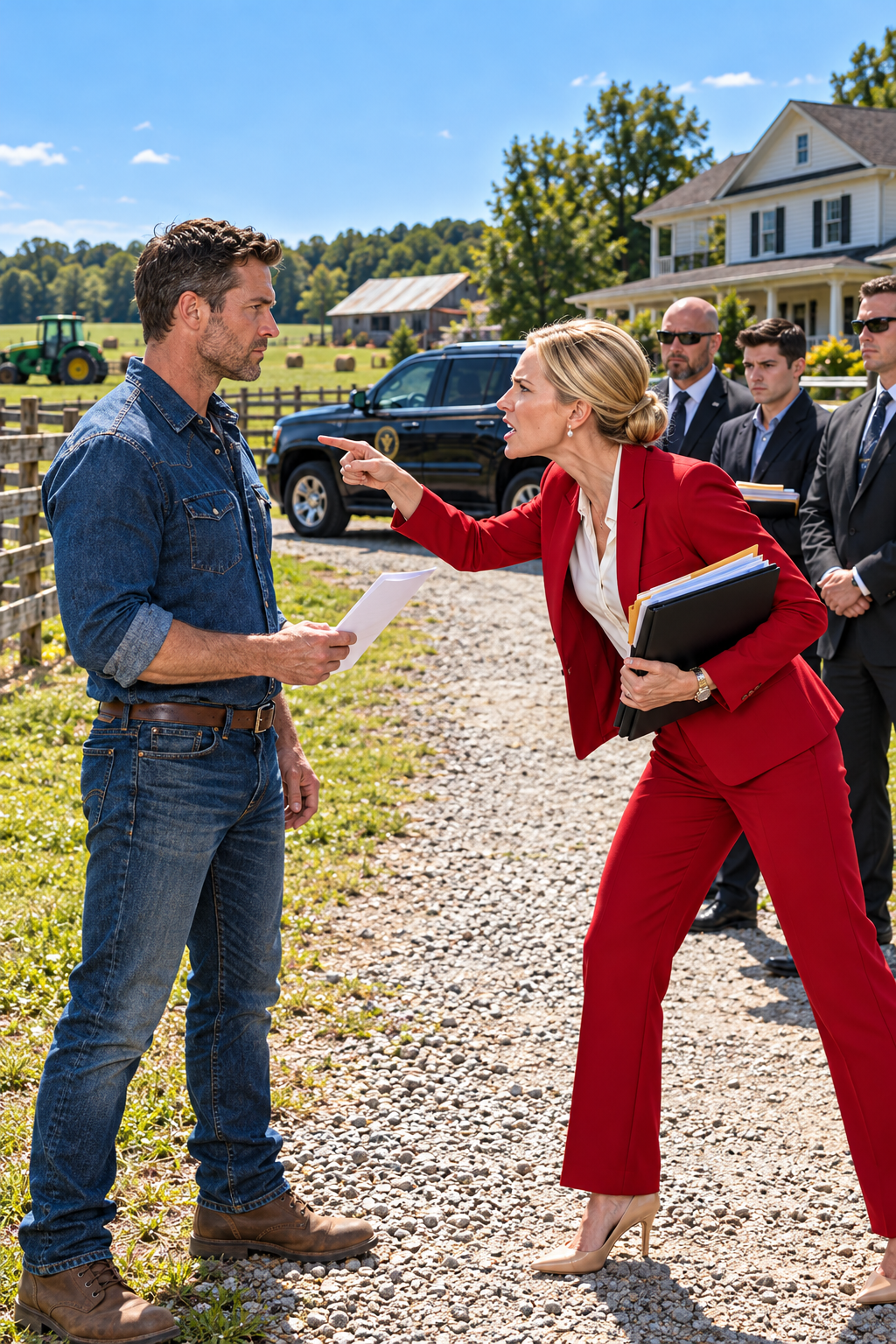
The president of Foxmere Hills arrives at Brooks Talmage’s farm with guards,
Part 2: Brooks discovers the lease Marjorie pretends no longer matters
Twelve years earlier, Foxmere Hills had been growing quickly, but the association lacked the cash to buy land for a community hall. Its founding board approached Talmage Farm and negotiated a twenty-year lease covering 8.6 acres, enough for a conference room, banquet space, and ballroom. The association agreed to pay $11,800 each month, and the rent had arrived faithfully for more than a decade. Eight years remained on the contract, which had been written carefully after the original board considered expanding into nearby farmland. Brooks’s father had insisted that renting one parcel must never give the tenant control over the rest of the farm.
Ellis read the lease twice, then explained why the distinction mattered. Talmage Farm did not appear in the Foxmere Hills declaration, and no document showed Brooks or his father had ever agreed to become members. A planning map created by the association could not change the county’s recorded boundaries or place private land under HOA control. More importantly, the lease specifically prohibited the association from using its status as tenant to claim ownership, easement rights, or management authority over the rest of the property. Marjorie’s threat was not simply an embarrassing mistake; it might be evidence that the association had materially violated its own contract.
Ellis advised Brooks not to terminate anything yet, even though the notice made his anger rise with every rereading. Instead, they requested records that the lease required Foxmere Hills to maintain, including permits, insurance certificates, payment histories, renovation plans, and commercial rental agreements. The paperwork could show whether Marjorie’s mistake was isolated or part of a longer pattern. Brooks kept copies of the lien notice, saved the envelope, and wrote down the names of the guards who had watched her deliver it. He had no interest in winning an argument at the gate if the association could later deny what happened there.
That evening, Brooks drove past Grand Hall on his way back from town and saw the parking lot filled to its painted lines. An electronic marquee advertised a private corporate exposition for 1,100 guests, though the lease reserved the building for community functions and required the landlord’s written consent for outside commercial use. Brooks had never granted that consent. As he took photographs of the sign, a delivery truck rolled around the back of the hall and continued along a fresh road cut through the pasture. He recognized the fence line where the road had crossed his land, and the sight transformed a legal worry into something painfully concrete.
He returned the next morning with cedar posts, wire, tools, and a copy of the county plat, then rebuilt the fence where it had been removed. Three hours later, Marjorie appeared again, furious that trucks serving her event could no longer use the route she called the association’s service road. Brooks laid the plat on the hood of his truck and traced the road’s path with one finger. The line crossed Talmage Farm without an easement, permission, or even a call asking to use it. Marjorie threatened another $25,000 fine for obstructing association operations, and Brooks asked how she could fine him for blocking trucks from land she had never been allowed to cross.
Part 3: Cameras reveal years of trespass and hidden construction
Marjorie ordered one of her guards to cut the padlock on Brooks’s gate, but the man hesitated long enough for the command to fall apart. She finally returned to the SUV and drove away, leaving Brooks beside the new fence with his hand resting on a fresh cedar post. That afternoon, an email arrived announcing an emergency HOA meeting to formally approve the lien against his farm. Ellis urged Brooks to let the association speak in its own records and to avoid giving Marjorie an excuse to portray him as the aggressor. Brooks followed that advice and pulled six months of security footage from cameras mounted near his barns.
The footage showed delivery trucks crossing the property dozens of times, often before sunrise. Construction crews had hauled steel beams through the pasture, followed by workers carrying equipment toward the rear of Grand Hall. Brooks watched one clip twice as a section of roof rose higher than it had been in the previous season. New industrial air-conditioning units appeared on the building, and a mezzanine had been added to the back without any notice to the landowner. Each video came with a date and time, creating a record that did not depend on anyone’s memory or willingness to tell the truth.
The most alarming discovery came from the association’s own promotional material, which advertised events for more than 1,000 people. Grand Hall’s original occupancy permit capped attendance at roughly 620. If the building had been altered without proper inspections, Ellis warned, the consequences could involve structural safety, insurance coverage, and fire regulations at the same time. Brooks sent Foxmere Hills a written request for the records the lease required, giving the association a chance to explain or correct the problem. Marjorie replied with one dismissive sentence: the HOA had no obligation to explain its internal operations to him.
Ellis pointed out that the lease required exactly the records she refused to provide. He began assembling a timeline: the baseless claim of authority over the farm, the unauthorized service road, the commercial events, and the refusal to disclose permits and insurance. Each item stood on its own, but together they suggested an association that had stopped treating the lease as a binding agreement. Meanwhile, the building’s day-to-day manager, Troy Weller, agreed to speak privately with Brooks. Troy seemed less angry than frightened, and he kept glancing at the office door as though Marjorie might walk in.
Troy described pressure to finish the mezzanine before event season, even when contractors warned that additional inspections were needed. The sprinkler system had not been properly extended to cover the new level, he said, and two emergency exits had been moved during construction. A rear exit was now partly blocked by a storage area added without anyone reconsidering what the doorway was for. Brooks wanted to call the county immediately, but Ellis told him to preserve the evidence and follow the lease’s notice procedures. Together they prepared a formal notice of material default, listing what Foxmere Hills had to fix and the deadline for doing so.
Part 4: Marjorie escalates the fight instead of fixing her violations
The notice demanded that the association withdraw its lien, stop using land outside the leased boundary, produce its permits and insurance records, and correct any unauthorized changes to Grand Hall. It also required Foxmere Hills to end commercial rentals that lacked Brooks’s written consent. Ellis framed each demand around a specific section of the contract, so the association could not claim it had misunderstood what was required. Marjorie received the notice on Monday morning. That afternoon, she called an emergency board session and described Brooks as an enemy of the entire community.
She urged the board to spend another $250,000 suing him, insisting the money would protect property values. Cynthia Norwood, the association treasurer, voted against the proposal and asked why the HOA was spending residents’ money to defend a lien its lawyers had not yet reviewed. Two directors began to waver, but Marjorie claimed emergency executive authority that the bylaws did not appear to give her. The measure passed after she promised that a judge would never allow a single farmer to threaten a multimillion-dollar community facility. That night, Troy sent Brooks a photograph showing preparations for the hall’s largest event yet, a gathering expected to draw 1,400 guests in eleven days.
The photograph changed the pace of the dispute, but Brooks still refused to act impulsively. Ellis explained that the building’s attendance limit and incomplete safety work could not be ignored simply because the HOA had planned a major event. Brooks had not built the hall, altered its structure, or advertised the crowd, but he was the landowner and had a duty to take credible safety concerns seriously. They sent the records to the appropriate county offices and asked for an inspection, making clear that they were reporting observed conditions rather than asking officials to take sides. The officials set a date to review the permits and inspect the building.
Marjorie responded by filing a lien against Talmage Farm for more than $211,000. The amount included her invented fines, legal fees, and what she called enforcement costs, despite the absence of any document tying Brooks’s farm to the association’s rules. Ellis began drafting a motion to remove the lien and seek damages for filing it without a valid basis. Brooks stayed focused on the records, though the threat felt different when he saw it attached to his property in the county system. A paper claim could still trouble a lender, scare a buyer, or force a family to spend money proving what should have been obvious.
At the inspection, county officials asked for the original permits and compared them with the building as it stood. They measured the mezzanine, checked the emergency exits, and examined the sprinkler coverage while residents watched from the parking lot. The inspectors did not arrive to settle the lease dispute, and Brooks did not ask them to do so. Their review, however, confirmed that the alterations required further approval and that the advertised event size could not be supported by the current occupancy documentation. A red notice went up at the entrance, and the 1,400-person event was canceled.
Part 5: A safety inspection closes Grand Hall before its biggest event
The canceled event set off a wave of calls that reached the HOA before the red notice had even been photographed. Clients demanded refunds, vendors asked who would cover preparation costs, and residents with birthdays and anniversaries suddenly had no booked venue. A catering company had already purchased food for 1,400 guests, while a lighting contractor had installed equipment that now had nowhere to go. Foxmere Hills had spent months promoting Grand Hall as the crown jewel of the community. In one afternoon, its biggest booking became a public sign that the building might not be safe to occupy.
Marjorie stood across the parking lot and shouted that Brooks would lose his farm before the dispute ended. She pointed toward him as if he had personally placed the red notice on the doors, though county officials had done their own inspection. Cynthia walked over and told Marjorie, in front of residents and vendors, that the board had discovered records Marjorie had concealed from them. Brooks left before the argument could become a spectacle, carrying his copy of the inspection notice back to his truck. He had not wanted the event canceled; he had wanted the lease respected and people kept out of a building with unresolved safety problems.
Cynthia spent two nights reviewing the financial software, bank statements, invoices, and meeting minutes. She found that Grand Hall had generated more than $780,000 in outside commercial revenue over fourteen months, revenue Marjorie had used to avoid raising resident dues. The association had also spent roughly $460,000 on the expansion, even though Cynthia could not find a full board resolution authorizing it. Some payments appeared to have been approved by Marjorie alone, while the bylaws required additional signatures. The money had not vanished, but the approvals and paperwork were incomplete enough to make every large invoice a new question.
Emails made the situation worse. One contractor had warned Marjorie that the mezzanine needed further inspection before it could safely handle a large crowd. Marjorie replied that a delay would ruin event season and told the crew to keep moving. The insurer had requested updated information after the renovation, but the records did not show that the full scope of the work had been disclosed. Cynthia printed each message and placed it beside the corresponding invoice, keeping the dates visible so no one could dismiss the material as rumor. When the emergency board meeting began, she arrived with binders instead of accusations.
Marjorie tried again to blame Brooks, though he was not at the meeting. Ellis had sent the board a factual timeline that began with the first threat at the farm gate and ended with the closure of Grand Hall. The timeline showed repeated opportunities for Foxmere Hills to withdraw the lien, stop crossing the pasture, disclose records, or address the inspection concerns. The association had ignored each opportunity and expanded the dispute instead. As directors turned the pages, the story stopped looking like an attack from outside and began to look like a crisis Marjorie had created inside.
Part 6: Cynthia’s audit exposes the association’s growing financial crisis
The association’s own independent counsel reviewed the material and advised the board to stop defending the lien. No one could locate a recorded document proving that Talmage Farm had ever joined Foxmere Hills or accepted its covenants. The lien’s legal foundation was collapsing, while the lease that allowed Grand Hall to exist remained clear about the land’s boundaries. The association now faced another difficult question: what could it do with a building it might no longer have the right to use? Marjorie still assumed Brooks would need the hall’s rent badly enough to offer a new deal.
That assumption was not entirely foolish; the building was large, expensive, and now closed. But the question was no longer whether the hall could earn money under Marjorie’s plan. It was whether the association could satisfy the lease, repair the building, and rebuild trust after using the farm without permission. The new board could not simply sign another check and pretend the past had not happened. Residents wanted an accounting, vendors wanted payment, and county officials still expected a real plan for the unapproved construction. Brooks, meanwhile, had no reason to rescue the association from consequences it had chosen.
When Marjorie finally returned to the farm gate, she came with an attorney and no security guards. She asked Brooks to discuss a new lease, and he agreed to hear them in the farm office. Their first offer was to refund the fines and remove the lien, but Brooks said the fines had never been legitimate and the lien should never have been filed. Their second offer raised the monthly rent and included a payment they described as compensation for the trouble. Brooks listened until they finished, then told them money was not the central issue.
For twelve years, the old lease had worked because both sides accepted the boundaries it set. Marjorie had used her position as tenant to claim authority over land that belonged to her landlord, while the association altered and commercialized its leased property without following the contract. Brooks explained that he had not ended the lease to take Grand Hall for himself. He had acted because the association had decided the agreement mattered only when it served Marjorie’s plans. The attorney tried to steer the meeting back toward a compromise figure, but Brooks asked them to resolve the facts before they discussed another rent check.
Ellis placed the lease’s final clause on the table. It said permanent improvements could not be removed in a way that damaged the underlying land, and it assigned responsibility after termination to the party whose default caused it. That meant the hall could not serve as a threat against Brooks or a bargaining chip against his farm. He gave them conditions for any further discussion: withdraw the lien, acknowledge that the farm was outside HOA jurisdiction, close the unauthorized road, and restore the damaged land. Marjorie could not represent the association in those negotiations.
Part 7: Residents vote to remove the president who started the crisis
Marjorie stared at the final condition, understanding that Brooks wanted the authority she had misused taken away from her. The next association meeting drew a crowd large enough that residents had to rent a conference room elsewhere. Cynthia presented the timeline, emails, invoices, and financial approvals in a steady voice that left little room for performance. She described the unsupported lien, the commercial events, the unapproved road, and the construction concerns. People who had once believed Marjorie’s assurances began comparing the dates with the newsletters and event announcements they had received.
One resident asked what might have happened if Marjorie had withdrawn the lien the first day Brooks challenged it. The association’s independent attorney answered that much of the crisis might have been avoided. Marjorie rose to defend herself, saying she had acted to protect property values and keep dues low. A longtime resident pointed out that the community had lost access to its largest gathering space, was facing vendor claims, and had no clear estimate for repairs. “What property value are we protecting?” he asked, and the room fell silent.
The final vote was not close. Marjorie was removed as president, and the remaining board acted quickly to withdraw the lien, close the unauthorized service road, abandon its claim over the farm, and end its litigation against Brooks. It also opened a formal audit into the Grand Hall renovation and the commercial bookings. Brooks was out in the fields when Ellis called with the news. He looked toward the dark outline of the hall and said the board’s vote was their business, not his.
The decision did not reopen Grand Hall or settle every invoice. Technical reviews showed that the sprinklers, mezzanine, emergency exits, and electrical work all needed further attention, while the building required additional permits before it could host large crowds. Foxmere Hills had to refund clients and negotiate with vendors, even as residents asked how the spending had been approved. Some smaller events found new venues, but families had to change plans they had booked months earlier. The harm from Marjorie’s decisions reached people who had never spoken to Brooks or cared about the boundary dispute.
The association hired auditors to trace each payment and review the renovation records. The final accounting found verbal change orders, invoices paid before inspections were complete, and contractors hired without competitive bids. It did not prove every accusation residents had whispered, but it confirmed that basic safeguards had failed. The association’s new board stopped trying to save the commercial event business Marjorie had built without proper approval. The old hall remained closed while everyone worked out what it would take to make the structure safe and what use the land could support.
Part 8: A new board faces the cost of Marjorie’s choices
The new board and Brooks signed a settlement after months of review. Foxmere Hills abandoned its claim to continued use of Grand Hall under the old lease, agreed to remove the lien, and accepted responsibility for restoring the areas it had damaged. The settlement also stated plainly that Talmage Farm stood outside the association’s boundaries, without an expanded control zone or HOA fines. The service road was closed permanently, and workers repaired the fence line. Brooks kept a signed copy in the same fireproof box where his father had stored the lease.
Grand Hall, once Marjorie’s favorite proof of power, sat behind a fence with its doors locked. The association could have spent heavily to repair and recertify it, but the cost would have fallen on residents already facing refunds, legal fees, and unpaid vendor claims. The new board chose not to revive the commercial event business. Instead, it focused on resolving obligations, answering questions, and setting clearer approval procedures for future projects. The choice disappointed some residents who loved the hall, but they understood that keeping it open without proper inspections was not a responsible option.
Months later, Marjorie drove past the farm for what would be her last visit. Brooks was taking down an old wooden sign that had once pointed visitors toward Foxmere Grand Hall. She stopped on the shoulder and called out that he had destroyed something the community had spent twelve years building. Brooks turned, calm and tired rather than triumphant. “I leased them land for twenty years,” he said. “They decided the last eight years of that agreement weren’t worth honoring.”
Marjorie did not answer at once. Behind her, the hall’s windows reflected the late afternoon light but revealed no movement inside. Brooks returned to his work, leaving her with the distinction she had tried to erase: the building had been the association’s, but the ground beneath it was never theirs. She eventually drove away without another threat, and he finished removing the sign. There was no celebration at the farm, only the quiet return of a boundary that should never have been challenged.
In the months that followed, contractors assessed the hall, removed unauthorized additions, and began work to bring the site into compliance. The land was reassessed for a use better suited to the surrounding farms, while the association continued its audit and answered civil questions about how the project had been managed. Marjorie lost her presidency and the authority she had once carried into meetings. The association’s legal and financial problems did not disappear when she left, but they could finally be addressed without pretending the lease was meaningless. The community began, slowly, to rebuild trust through records, votes, and rules applied evenly.
Part 9: Brooks restores the fence and leaves the lesson standing
By the following spring, grass had begun to cover the old service road, and the fence stood straight along the property line. Brooks mounted a new sign at the entrance: Talmage Farm, Private Property, Not Part of Foxmere Hills. He did not add a warning or a story about Marjorie, because the county plat and the signed settlement said everything necessary. The farm looked much as it had before the gated community arrived: open pasture, machine sheds, weathered barns, and long fields rolling toward the horizon. Grand Hall remained visible in the distance, but it no longer dictated what happened on Brooks’s land.
Some residents still drove past and wondered how a dispute over one notice had grown into a closed building, a board removal, and a costly audit. The answer was not that Brooks had discovered a clever trick or used some hidden power. He had read the contract, kept the documents, recorded the trespasses, and allowed the association’s own choices to become part of the record. Marjorie had believed that money and a confident voice could move a property line. The lease, the county records, and the people who finally examined them told a different story.
The new board sent residents a formal letter explaining that Talmage Farm had never been a community asset. The lease had given the association a defined parcel for a defined term, and it had not created a right to govern the rest of the property. The emergency lien had been withdrawn, the unapproved road closed, and future commercial use of the hall abandoned. The letter also acknowledged that the association had failed to follow its own safeguards. For residents who had spent months hearing fragments of the story, the written account offered a clear beginning to the repair.
Brooks kept the original lease in his office, its pages soft at the corners from years of careful storage. His father’s penciled word, Never, remained beside the clause that protected the rest of the farm. It had not been a prediction that Foxmere Hills would someday become an enemy; it was a reminder that good agreements needed clear lines. Brooks sometimes wondered whether his father had imagined a day when someone would try to erase those lines. He never asked, because the answer would not change what the contract had required.
At sunset, Brooks locked the farm office and looked once toward the hall. Its windows caught the last orange light, then darkened as the sun sank behind the tree line. He turned back toward home, leaving the building and its future to the association that had once claimed more than it owned. He had not taken Foxmere Hills’ land or ordered its residents to follow his rules. He had simply refused to surrender his family’s ground because someone had decided the map should say something different.
The fence remained where it belonged, and the grass continued to grow across the route trucks had once used without permission. Years later, new residents would pass the sign and know that the farm was private property, not a neighborhood amenity waiting to be claimed. The lesson endured because it had been written into the settlement as well as the memories of the people who watched the dispute unfold. Authority could be borrowed, leased, or granted, but it could not be invented by a person who wanted more. Brooks had asked Marjorie one quiet question at the gate, and the answer had taken months to arrive: she had never held the power she thought she did.
✓ Lynn R. Adams
Part 2: Brooks discovers the lease Marjorie pretends no longer matters Twelve years earlier, Foxmere Hills had been growing quickly, but the association lacked the cash to buy land for a community ha…