The officer came to my porch with a badge, a forged order, and instructions to clear
Part 2: The HOA sent fines for a barn older than its neighborhood
The first letter arrived a few weeks later, printed on Ridgeline Estates letterhead and addressed to me by name. It accused me of maintaining an unapproved agricultural structure, meaning the barn my grandfather had built in 1961. That barn had stood through decades of storms, droughts, and repairs, long before the subdivision had a name. I threw the notice away, assuming someone had made a mistake. A week later, a second letter arrived, warning that failure to comply would result in fines of $250 per week.
I threw that one away, too, but the fines kept coming. Every Monday there was another envelope, another violation notice, and another demand bearing Brenda’s signature. The claimed balance climbed from $250 to $500, then $750, as though I were a tenant behind on inspections instead of an owner on my own land. By the end of the second month, the letters had formed a stack nearly an inch high on my kitchen counter. I told myself an HOA couldn’t claim authority over a parcel that had never joined the subdivision, and I expected the whole thing to disappear.
When it didn’t, I called the county and explained the situation. The person who answered was polite, sympathetic, and unable to help. “We don’t handle HOA disputes,” she told me. “That’s a civil matter between you and the association.” I hung up and looked at the letters spread across my counter, understanding that nobody was going to make Brenda stop just because her claim seemed absurd. Ignoring her wasn’t solving anything; it was giving her time to make the paper trail look official.
I went to my office filing cabinet and pulled out the oldest document in it: my grandfather’s original deed. He had saved everything, from tax receipts and fence permits to water-rights filings, and the deed was tucked into a manila envelope labeled in his pencil handwriting, “Deed. Do not lose.” It described eighty-five acres by metes and bounds and showed the parcel recorded independently. There was no HOA covenant, no restriction, and no reference to Ridgeline Estates. The next morning, I drove to the county recorder’s office with the deed and one of Brenda’s letters.
A clerk named Patty had worked behind that counter for twenty years. She checked my parcel against the subdivision plat, then printed a certified survey map. My ranch was outlined in blue, Ridgeline Estates in red; the lines met at a boundary, but there was no overlap. “Crawford Ranch is its own independently platted parcel,” Patty said. “It’s never been part of the Ridgeline subdivision.” For the first time in weeks, I felt as if I had something solid beneath my feet again.
Part 3: Brenda ignored the county map and filed a lien anyway
The following Thursday, I went to the Ridgeline Estates board meeting with the deed and certified map. There were about fifteen residents in the community center, and Brenda sat at the head table beside two board members who seemed content to let her speak for them. When the floor opened, I stood and explained that the HOA had been sending fines for a structure on land outside its jurisdiction. I placed the deed and map in front of Brenda and asked her to stop the notices. One board member picked up the survey and studied the colored boundaries.
Brenda didn’t even glance at it. She said the HOA had conducted its own survey and that her attorney would review my claim. I reminded her this wasn’t just a claim; it was a certified county map. She turned to the room and moved on to the next agenda item. I left with my documents, thinking the official record would be enough to end the dispute. Two weeks later, a notice from the county recorder arrived, informing me that a $14,500 lien had been filed against Crawford Ranch.
I read the amount several times before I called Patty. She confirmed the filing and explained that Brenda had listed accumulated fines, administrative charges, legal costs, and penalties. The weekly fines had totaled roughly $3,000, but the lien added more than $11,000 in charges for services never provided, assessments never authorized, and legal costs that did not appear to exist. I sat at my grandfather’s table with the notice in front of me, staring at a claim against land my family had owned free and clear for decades. Whatever this was, it was no longer just a stack of nuisance letters.
I needed a lawyer, so I took the lien, the deed, the survey, and every violation notice to Glenn Harker, an attorney in town known for handling property disputes. He read the filing twice, removed his glasses, and told me the county had no record of any HOA covenant for my parcel. “She filed a lien against land she has no authority over,” he said. “That isn’t just overzealous. It’s fraudulent.” Then he opened the county database and searched Brenda’s name across the recorder’s filings.
Within minutes, he found two more liens. Both targeted separate parcels next to Ridgeline Estates that were not part of the subdivision. The same pattern appeared in each: violation notices, escalating fines, then a lien padded with invented fees. One lien was for $9,000; the other was for $6,200. I stared at the screen, realizing Brenda had not made one bad filing against me. She had used the same process against other property owners, and it had worked.
Part 4: A retired couple paid because Brenda threatened their home
Glenn printed the other filings and gave me the names of the owners. One was a family trust holding an empty lot. The other belonged to Ed and Carol Henderson, a retired couple living on five acres south of the subdivision. I called Ed from my truck that afternoon. He was seventy-one, and his voice grew quieter as I described why I was calling. “We got the same letters,” he said. “The notices, then the fines, then the lien.”
Brenda had gone to their door herself and warned Carol that if they did not pay, the HOA would put their home into foreclosure. She told them she had seen people lose their houses this way. The Hendersons didn’t know whether she was telling the truth, but they couldn’t afford to take the chance. They paid $9,000. Ed said Carol cried while she wrote the check at their kitchen table, because they were on a fixed income and the money represented years of careful saving.
After I hung up, I sat in the truck beside the road and looked toward the ranch. A retired couple had paid thousands because a woman with no legal authority over their property had threatened to take their home. The HOA notices were only the beginning; Brenda had created a system that turned fear into money. Glenn told me we could challenge my lien and file a civil complaint, but that process might take months or a year. Criminal charges could take just as long to reach a prosecutor’s desk, especially if the case was treated as a private property dispute.
I asked whether federal investigators might care. Glenn thought for a moment, then pointed out that Brenda had mailed the notices as part of a scheme to collect money through false filings. If the mailings were knowingly fraudulent, mail fraud could bring federal attention. That evening, I laid everything across the kitchen table: my deed, the certified survey, the letters in their postmarked envelopes, the lien notice, the other filings, and my notes from Ed’s call. I added the signed statement Ed mailed me two days later, describing Brenda’s threat and the money he and Carol had paid.
I opened the FBI’s online tip form and spent two hours entering dates, amounts, names, and the connection between the notices and the liens. At 11:15 that night, I pressed submit. I hoped someone would take the evidence seriously, but I had no way of knowing whether the report would be read soon enough to matter. Nine days later, after checking the south fence, I found a laminated notice zip-tied to my gate. It gave me ten days to comply or face seizure of my “non-compliant structures.”
Part 5: Brenda forged a county order and recruited an officer
The notice claimed that Ridgeline Estates was working “in partnership with county code enforcement.” It carried a case number, county-style formatting, and Brenda’s signature. I took it to Glenn’s office without a word. He checked the paper, compared its language with county documents, and searched the supposed case number in the official system. There was no matching case. “This isn’t a county enforcement order,” he said. “She made it look like one.”
Glenn pointed out that county officials did not issue orders in partnership with private associations. The number was fabricated, and the language was designed to scare people who would not know how to check. Then he told me an officer named Dale Mercer had contacted the sheriff’s department about serving the same order on a ranch property. Brenda had apparently handed him the notice as if it were legitimate. Mercer believed he had lawful authority to enforce it and was planning to come to my ranch.
A real officer with a real badge was on his way to seize property based on a document Brenda had made herself. Glenn told me to call the FBI field office directly instead of waiting for someone to review the online form. I called and gave the intake agent my complaint number, then explained the false liens, the forged notice, the invented case number, and the officer who had been asked to execute it. After a short hold, the agent transferred me to Special Agent Caldwell. He said my report had already reached investigators building a regional inquiry into fraudulent HOA filings and fabricated enforcement actions.
The FBI had been tracking similar complaints across several counties. Caldwell asked if he and another agent could come to the ranch that week to review the original documents and take a formal statement. I glanced at the laminated notice, counted the days, and realized Thursday would be day nine of Brenda’s deadline. I agreed. The next five days felt longer than the months that had come before, because I knew Mercer might arrive before the FBI, and I could not predict which one would reach my driveway first.
I kept working the ranch, but every car on the gravel road made me look toward the window. I put the documents in chronological order on the kitchen table, from my grandfather’s deed to the newest notice. I included the Hendersons’ notarized statement, the survey, the three liens, all fourteen letters, and the fake enforcement order. On Tuesday, my neighbor Walt told me the HOA had held an emergency board meeting about my “noncompliance” and voted unanimously to authorize immediate enforcement. The board had only three members, but Brenda had made sure her paperwork suggested a process had been followed.
Glenn called later that afternoon with more troubling news: Brenda had moved up the timeline and told Mercer to come Thursday morning. That was the same morning Caldwell and his partner planned to arrive. I called the agent and explained the timing. “Don’t change anything,” he told me. “We’ll be there early. If the local officer arrives while we’re on site, we’ll handle it.” I spent Wednesday night listening to the cattle shift in the dark and thinking of my father walking this land before me.
Part 6: The FBI arrived before the officer could enforce Brenda’s lie
Thursday morning, I was awake by . The cattle had been fed, coffee was on, and the kitchen table was laid out like an evidence room. I placed my grandfather’s deed on the left, Brenda’s forged notice on the right, and arranged everything else between them by date. At , an unmarked black SUV rolled up the gravel drive. Special Agent Caldwell stepped out with Agent Rivera, who carried a briefcase and camera bag.
I led them through the hallway, past photographs of three generations of Crawfords, and into the kitchen. For two hours, they reviewed the papers and asked careful questions about dates, amounts, and conversations. Caldwell wanted facts, not my conclusions. Rivera photographed every document front and back and took detailed notes. They verified that the supposed case number did not exist and that the county had never agreed to an enforcement partnership with the HOA.
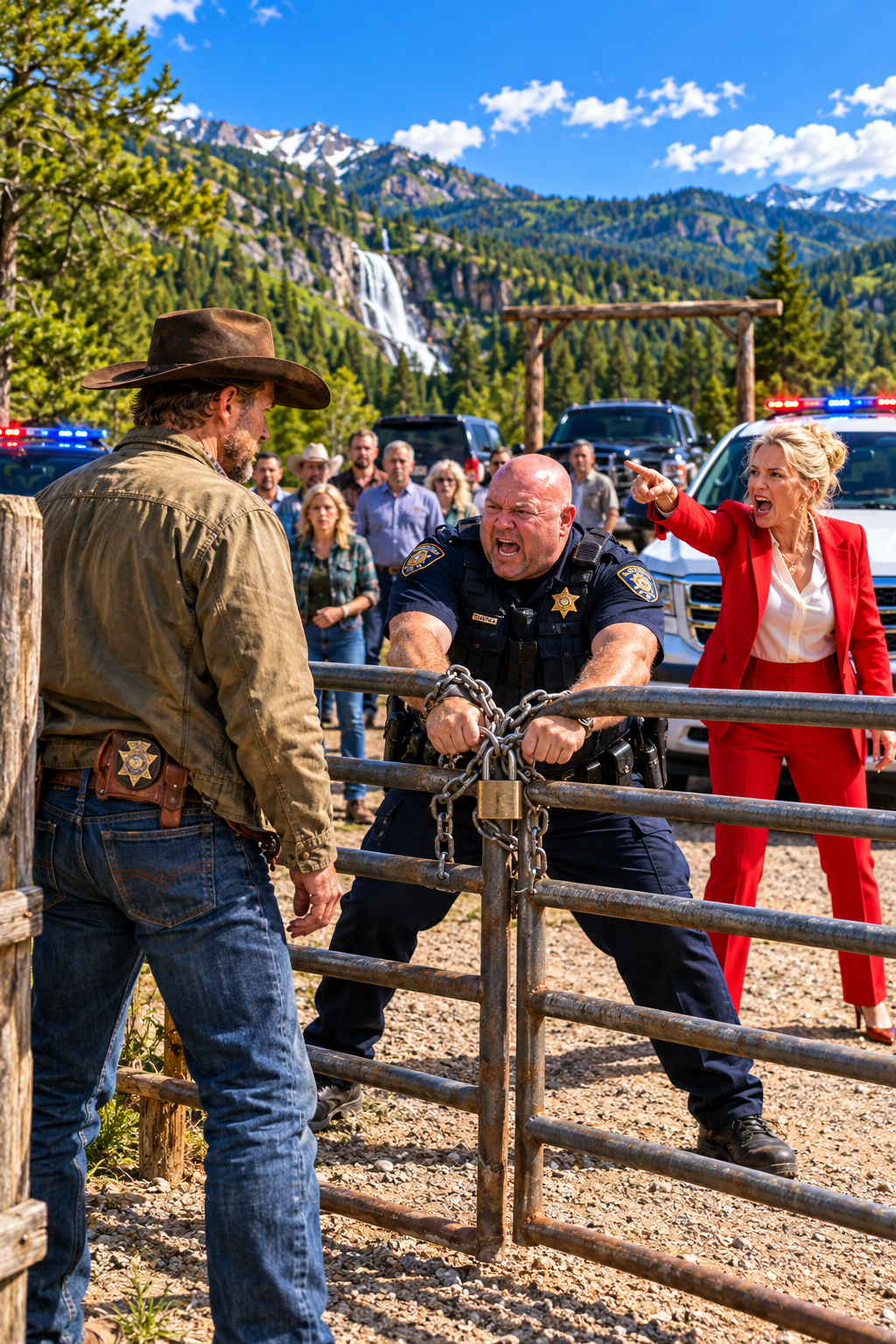
Then I heard a different sound on the gravel, heavier and more deliberate than a neighbor’s truck. A county squad car pulled in behind the FBI vehicle, its lights off and engine running. Officer Mercer stepped out with papers in his hand and walked up the porch steps as if he believed he was carrying the law with him. Caldwell and Rivera looked at me, and I nodded toward the door. Mercer knocked three times, the sharp knock of someone executing an order rather than asking a question.
I opened the door. “Mr. Crawford, I’m here to execute the enforcement order,” he said, holding up the document Brenda had given him. “The HOA board authorized immediate action on noncompliant structures. I need you to step aside.” Then he looked past me into the kitchen and saw two federal agents seated at the table. Caldwell stood, showed his credentials, and identified himself and Rivera as FBI special agents investigating fraudulent HOA filings connected to my property and others.
Mercer looked from their badges to the papers spread across the table. The confidence drained from his face when Caldwell asked to see the order. He handed it over, and Caldwell placed it beside the copy I had removed from the gate. The matching documents looked like two copies of the same counterfeit. Caldwell explained that the case number was nonexistent, there was no joint agreement with the county, and no lawful seizure action had been filed.
Part 7: The officer became a witness to the scheme
Mercer stood in my kitchen, holding his empty hand where the order had been. He admitted Brenda had given him the document personally and told him the county had authorized the seizure. She said the HOA and county had a joint enforcement agreement, that the order had been reviewed, and that he only needed to serve it and report back. Caldwell wrote down Mercer’s exact words. Then he spread my deed, the certified survey, the liens, the Hendersons’ statement, and the fake notice across the table.
The deed showed that Crawford Ranch had been independently platted since 1958. The survey confirmed the ranch and subdivision shared only a boundary line. The three liens targeted properties beyond the HOA’s recorded limits, and the Hendersons had paid $9,000 after Brenda threatened foreclosure. The order in Mercer’s hand had been created to look like a county action and persuade an officer to seize land the HOA did not control. Mercer looked at the evidence and understood that every statement Brenda had made to him was false.
Caldwell asked three direct questions: Did Brenda say the county authorized the seizure? Did she present the document as a real government order? Did she direct him to come to my property, clear the structures, and report back? Mercer answered yes each time. He then turned to me and apologized, admitting he should have verified the order himself before driving out. I told him Brenda had designed it to look official, but he still seemed ashamed that he had nearly helped take a family’s land on the strength of a paper she had made at home.
Caldwell explained that Mercer was not a target of the investigation; he had been deceived, but his account mattered to the federal case. Mercer agreed to provide a formal statement. Rivera called the field office and confirmed that warrants were being drafted for filing false instruments, mail fraud, and making false statements to a law enforcement officer to provoke an unlawful seizure. Caldwell looked at me and said the enforcement action was void; no county order existed, and the ranch had always been mine. My kitchen table, once buried beneath threats, now held federal evidence.
That afternoon, Brenda called my phone. I watched her name appear on the screen and let it ring until voicemail. Her message was cheerful and businesslike; she wanted Mercer to tell her whether the “situation” at the ranch had been resolved. The next morning, two FBI agents knocked on Brenda’s front door with a federal warrant. She had expected HOA business; instead, she was arrested on federal charges connected to the liens, mailings, and forged enforcement notice.
Part 8: The ranch remained ours after the false liens disappeared
Brenda was removed as HOA president that same week. The board did not hold a dramatic vote or send a public statement; its members stopped answering her calls, stopped responding to her emails, and changed the lock on the community center. A federal judge vacated the three liens, and the county expunged them from the records. Patty called me when my lien was officially cleared and said she had never seen one removed so quickly. I told her federal involvement had probably helped move things along.
The Hendersons received their $9,000 back as restitution ordered in Brenda’s case. Ed called me when the check arrived, with Carol nearby, and thanked me for believing them and following through. I reminded him that his notarized statement had helped build the case. Mercer cooperated with investigators and submitted a detailed account of what Brenda had told him. His department reviewed his failure to verify the document, but Caldwell explained that it had been deliberately designed to look authentic, and Mercer was cleared of criminal liability and disciplinary action.
A month later, Mercer called to apologize again. I told him the apology in my kitchen had been enough, and we left it there. Ridgeline Estates elected a new president, a retired accountant named Donna, who actually read the bylaws before trying to enforce them. The new board hired an independent licensed surveyor to verify the boundary. The results matched the county’s findings: Crawford Ranch was a separate parcel and had never been part of Ridgeline Estates.
The board sent me a formal letter acknowledging that my land was not subject to its jurisdiction, bylaws, fines, or enforcement actions. I framed it and hung it in my office beside my grandfather’s original deed from 1958. One document had begun our family’s life on that land; the other confirmed, sixty-six years later, that no HOA could simply claim it. These days, when I see Donna walking her dog on the Ridgeline side of the fence, we wave and keep going. That is the right amount of interaction between a rancher and an HOA.
My kitchen table is clear again, holding only coffee and the morning light. I still walk the fence line before sunrise, following the same route my father walked and his father before him. The cattle care nothing about liens or warrants; they want grass, water, and quiet. The barn is still standing in the same place it has stood since 1961, its weathered boards repaired where needed. Brenda called it an unapproved structure, but to me it is simply the barn my grandfather built—and the land around it is still Crawford land.
✓ Lynn R. Adams
Part 2: The HOA sent fines for a barn older than its neighborhood The first letter arrived a few weeks later, printed on Ridgeline Estates letterhead and addressed to me by name. It accused me of mai…