The night Silver Ridge’s biggest gala was supposed to dazzle four hundred guests,
Part 2: The gala plan depends on erasing a protected drainage basin
Silver Ridge had been built across a series of terraces cut into a sloping landscape, with homes, roads, and common areas arranged to follow the hillside. The design looked graceful from the entrance, where stone pillars and flowering trees framed the neighborhood’s curved streets. Beneath that polished surface ran a system that most residents never saw and rarely thought about. Storm drains carried rainwater into underground pipes, which emptied into a drainage ditch on the western side. That ditch fed Caleb’s pond, where water could collect before leaving through a controlled outlet into the creek.
The pond was not a decorative feature, although from the road it could look like a rough patch of reeds and standing water. It held runoff during heavy storms, slowing the flow before it reached homes and buildings lower on the slope. A shallow emergency spillway gave excess water a safer route if the basin rose above its normal level. Caleb had owned the parcel long enough to understand how the system behaved in different seasons. When the pond filled after a storm, he often told neighbors, that meant it was doing exactly what it was built to do.
Deardra had come to see the Grand Pavilion as the achievement that would define her presidency. She wanted the opening gala to feel less like a neighborhood event and more like a major regional premiere. A raised stage would face the event center, with white tents, cocktail stations, and a row of decorative lights stretched across the grounds. Valet parking would guide guests past a photo backdrop bearing the Silver Ridge name. Local sponsors had already paid for packages built around the outdoor setting and the promise of an unforgettable evening.
At a board meeting, Deardra had presented a rendering showing the pond replaced by lawn. A director asked whether the area was part of the stormwater system. Deardra called it a mud hole and said drainage upgrades had made the old basin unnecessary. No engineer had confirmed that claim, and no county official had approved altering the site. Caleb had already sent the board a written request to leave the pond undisturbed, but no one replied. The meeting moved on to decorations and sponsor seating while his message sat unanswered in an inbox.
For three days, the trucks worked from dawn until dusk. Nearly 4,800 cubic yards of fill went into the basin, while crews scraped away native vegetation and buried the emergency spillway. They redirected the main inlet into a smaller temporary culvert that had never been designed for the same volume of water. Neighbors walking along the road watched the familiar pond disappear, assuming the association had quietly approved a routine upgrade. Caleb continued recording, saving copies of his footage away from the farm office. He also called Bethany Crowell, the civil engineer who had helped design parts of Silver Ridge’s original drainage system.
Part 3: An engineer warns the buried pond could redirect floodwater
Bethany arrived with a set of old plans and walked the perimeter without speaking. She checked the slope where the spillway had been, crouched to study the new culvert, then paced the site again as if hoping the ground might contradict what she saw. The basin, she explained, had been one of three connected safeguards. Underground pipes moved the water, the pond held it, and the spillway protected the hillside if the basin reached capacity. Deardra had removed the last two protections while leaving the entire neighborhood’s runoff pointed at the same low ground.
“A light shower may get through,” Bethany told Caleb, “but a serious storm could overwhelm that culvert almost immediately.” She spread an elevation map across the hood of his truck and traced the land with a pencil. Without the basin, water would not simply vanish because the pond had been filled. It would seek the lowest path downhill. That path ran toward the Grand Pavilion, whose southern side sat only a few feet below the old pond bank. Bethany’s voice hardened as she studied the contours: if the pond no longer existed, the event center could become the new pond.
Caleb sent Deardra and every board member an urgent written warning. He included the engineer’s assessment, photographs of the buried spillway, and the county plat identifying the pond as a permanent stormwater detention area. Deardra replied within minutes, saying the project had already been approved and that no further input was necessary. She did not address the engineering concerns or provide the approval documents. Later that day, treasurer Laura Hensley quietly contacted Caleb. She had never seen the board formally vote to fill the basin, she said, and Deardra had told directors that all permits were secured before the project was even discussed.
Caleb forwarded the plat and the photographs to Russell Avery, the county’s stormwater management official. Russell came to the property, measured the new elevations, and inspected the temporary culvert. His conclusion was immediate: the replacement could carry only a fraction of the flow the original system had been designed to handle. He issued a formal notice of deficiency, ordering the association to halt the work, avoid events on the altered site, restore the spillway, and submit certified engineering drawings. For the first time, Caleb believed the machines might stop before the damage grew worse.
They returned the following morning. Deardra told the board Russell’s notice was only an administrative review, not an order they had to obey. With ten days left before the gala, she argued that halting work would waste money and embarrass the community in front of its sponsors. Then Silver Ridge sent Caleb a violation notice of his own, citing overgrown grass, mismatched fencing, visible farm equipment, and a standing water hazard. He stared at the final item, almost laughing at the irony. The association was filling his pond while accusing him of maintaining it.
Part 4: Financial records show Deardra bypassed the board’s approval
Bethany found that Caleb’s pond had been listed in the stormwater compliance records submitted to the lender when Silver Ridge financed the Grand Pavilion. The bank had approved a $4.2 million loan partly on the assumption that the existing drainage system would remain intact. Deardra was dismantling the infrastructure that had helped justify the building’s construction. Russell sent another warning, explaining that a failure in the altered system could direct uncontrolled water toward structures southeast of the basin. Those structures could only mean the Grand Pavilion. Deardra opened the message, the system recorded that she had read it, and the trucks kept coming.
By the weekend, the pond had disappeared beneath graded soil and fresh sod. Decorative lamp posts lined a stone path, and workers were raising a tented stage where water used to collect. Deardra walked through the finished grounds with a photographer, describing the site as a transformation from useless swamp to community showcase. Caleb stood behind his fence and documented each new feature. Bethany then spotted a decorative stone wall built directly across the mouth of the old emergency channel. If water rose quickly, the wall could hold it back like a small dam until pressure forced a breach toward the pavilion.
Laura brought Caleb copies of the gala budget and vendor agreements. The full board had approved $85,000 for the event, but Deardra had signed additional contracts that pushed spending past $250,000. One line item, labeled landscape rehabilitation and drainage improvement, totaled nearly $61,000. That money had paid for the fill and the construction covering the pond. Laura discovered that Deardra had divided the work into smaller contracts, each just below the threshold requiring a full board vote. The project had never received proper authorization; Deardra had signed off herself.
Caleb urged Laura to preserve every record before confronting Deardra. Accusations without documents would give the president another chance to control the story, while invoices, emails, and approvals could establish exactly what happened. Laura made copies of contracts, payment records, and messages, storing them somewhere the association president could not access. Bethany kept reviewing the engineering file, and Russell continued sending notices. Each warning described the same danger in different terms: the pond’s capacity was gone, the new culvert was too small, and the Pavilion sat in the path of runoff.
Then the forecast began to change. A large storm system was moving toward the county, and its projected rainfall increased with every update. Bethany watched the radar and calculated that a slow-moving storm could dump more water in a few hours than the culvert could carry. Caleb sent Deardra one final message, asking her to remove the material blocking the spillway before the rain arrived. She accused him of trying to sabotage the gala and confirmed the event would proceed as planned. Caleb saved her reply alongside the notices and photographs.
Part 5: The gala begins as dark clouds gather over Silver Ridge
On the evening of the gala, the Grand Pavilion glowed beneath strings of lights, its white façade bright against the darkening hillside. Luxury cars lined the entrance while valet attendants directed guests toward the lawn. A band tested its sound equipment beneath the main tent, and servers arranged trays beside the raised stage. Deardra moved through the crowd in an evening gown, greeting sponsors as if she were unveiling a resort. Caleb did not attend; he stood on his land beside Bethany, watching the clouds gather over the ridge.
At , the first drops fell. Guests looked up, then returned to their conversations when the rain seemed light. By , the showers had thickened, and Bethany’s flashlight caught water racing through the northern ditch faster than it should. The temporary culvert was already running full. Caleb watched water spread across the graded ground where the pond had been, gathering along the edges of the sod. An event staffer urged Deardra to move the outdoor program inside, but she refused to abandon the centerpiece she had paid to create.
By , the pooling water had reached the tent perimeter. Deardra came outside, finally seeing what the staff had been warning her about. She ordered more pumps, but Bethany told Caleb that pumps could not replace a two-acre detention basin. Thunder rolled above the hillside, and lightning briefly revealed streams of runoff converging from three drainage lines. The water struck the raised fill where the basin had been, hit the stone wall over the old spillway, and began searching for another route downhill.
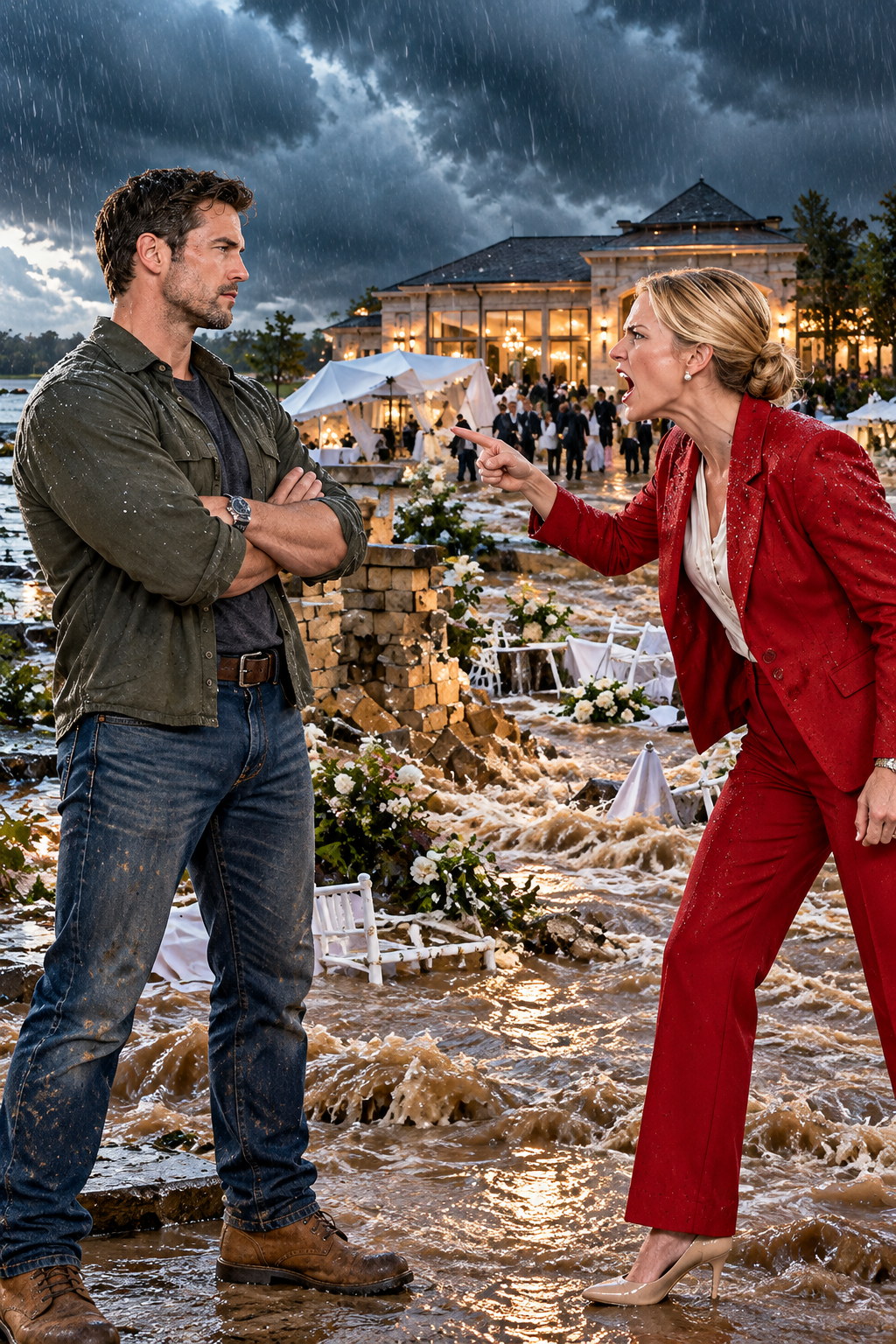
That route led toward the Grand Pavilion. Water pushed around the temporary culvert, crossed the fresh landscaping, and swept chairs and decorations toward the building. Guests rushed from the lawn as staff tried to guide them through the ballroom doors. The wall held for several minutes, then began to crack along one side. A surge of water broke through, carrying mud and debris across the southern entrance. Inside, guests climbed onto chairs as the first water ran beneath the doors.
Caleb called emergency services and gave them the access route that avoided the flooded service road. Bethany relayed what she could see from the property line, including the collapsing wall and the rising water around the building. He did not cheer or shout at Deardra; he focused on getting people out safely. Fire and rescue crews arrived as the storm intensified, helping guests through the north entrance and moving them to higher ground. The water had returned to the site, but now it was pouring through the building Deardra had tried to protect from the pond.
Part 6: Floodwater reaches the Pavilion during Deardra’s gala
The flood did not arrive as one dramatic wave. It advanced in surges, filling low parts of the lawn, pushing against doors, and forcing its way through service corridors. Staff members formed a line to guide guests toward the north side, where emergency vehicles could reach them. The band had stopped playing, and the only sounds were alarms, rain, and shouted directions. Deardra stood under the portico, soaked through, staring at the water crossing the property she had promised sponsors would remain dry.
One guest slipped near the entrance, and two staff members helped him up before guiding him toward a rescue vehicle. Firefighters checked the ballroom and side rooms, making sure no one had remained behind. The event’s carefully staged tables floated out of position, and the lower section of the pavilion took on water. Outside, the temporary wall crumbled further, sending another rush of muddy runoff across the grounds. Caleb stayed with Bethany beyond the fence, giving responders the original access notes and pointing out the drainage lines.
By midnight, the rain eased. The storm had left mud in the pavilion’s lower rooms, damaged electrical equipment, and torn apart sections of the new landscaping. The building remained standing, but the southern slab and surrounding ground needed close inspection. Russell arrived after the worst had passed and documented the damage. He did not blame the weather alone; he photographed the buried spillway, the undersized culvert, and the broken wall. Each feature matched the warnings he had already sent before the gala.
Deardra told reporters that Silver Ridge had suffered an extraordinary storm and that no one could have predicted the damage. Caleb made no public statement. Bethany had already mapped the water’s path, and Russell had records showing the association had received multiple warnings. The event staff and vendors began clearing what they could, while residents called one another to confirm that friends and family had made it home safely. In the morning, the Pavilion’s doors were closed, and a notice restricted access pending a full structural and drainage assessment.
The storm had not ended the dispute; it had made the evidence impossible to ignore. County officials examined the culvert, the filled basin, and the path water had taken to the Pavilion. Residents who had assumed the pond was being improved began asking why the work had happened without a public vote. Laura began organizing the financial records she had copied before the gala. Caleb hired counsel to protect his property rights and help ensure the drainage basin would be restored properly. Deardra, for the first time, could not control the story by speaking first.
Part 7: An audit uncovers ignored warnings and unauthorized contracts
Russell’s initial report confirmed that the altered drainage system could not handle the stormwater flow it had been designed to manage. The county issued a restoration order requiring the association to remove the unauthorized fill, rebuild the basin, restore the spillway, and install a properly sized culvert. Independent engineers would have to oversee the work and certify that the system met approved specifications. The Grand Pavilion stayed closed while inspectors assessed the ground beneath its southern side. What had begun as a landscaping project now involved engineering, property, insurance, and the future of the community’s largest building.
Laura’s audit found that the gala budget had more than tripled without a full board vote. The supposedly routine landscaping contracts had been split into smaller pieces, each signed by Deardra alone. She had also signed a certification stating that Silver Ridge controlled the work site and possessed the required approvals. The association did not own Caleb’s land, and the county had never approved the pond’s removal. Laura preserved the certification and sent the records to the association’s attorney. The board suspended Deardra’s contract-signing authority while it investigated.
More messages surfaced when counsel requested that all association communications be preserved. Deardra had asked the county whether the basin could be filled temporarily for the gala and restored afterward. The written answer was no. Mason had warned that he lacked certified drainage drawings, and Deardra told him to proceed because the event date could not move. An event coordinator had suggested shifting outdoor activities to the northern parking area when the forecast worsened. Deardra rejected that option because sponsors had paid to use the new “garden pavilion,” a name she had given to Caleb’s land.
Promotional materials called the lawn a private event space belonging to Silver Ridge. The deed showed otherwise. Sponsors had been sold access to a property the association did not own, while the lender had relied on stormwater documentation that the association had now altered. The insurance company issued a reservation-of-rights letter while it reviewed whether the loss was covered. Residents began to understand that the storm was only one part of the crisis. The deeper problem was a chain of decisions made without authority, without approval, and despite clear warnings.
At an emergency board meeting, Deardra accused Caleb of exploiting a natural disaster to damage Silver Ridge. Caleb offered no speech in response. Bethany placed two maps on the screen: the original system with water flowing into the basin, and the altered site with runoff directed toward the Grand Pavilion. “We are not debating a theory,” she said. “We are looking at gravity.” Russell presented the warnings, while Laura showed the invoices and the read receipt proving Deardra had opened his message hours before the gala.
Part 8: A courtroom weighs the warnings against the storm
The board voted to remove Deardra’s signing authority and later removed her as president. The Pavilion remained closed after a structural assessment found that water intrusion had contributed to erosion beneath the southern half of the building. Repairs would require a new retaining wall, work on a damaged slab, and a complete redesign of the drainage around the site. The bank demanded a remediation plan because the Pavilion secured its loan and was no longer producing income. The insurer continued reviewing whether intentional alterations and ignored warnings affected coverage.
Caleb filed a civil claim seeking restoration of the pond, repair of his damaged land, engineering expenses, and appropriate legal costs. He did not ask for a windfall or demand that the association pay him for the entire value of the Pavilion. He wanted the drainage system returned to safe working order and his property restored. The county’s order required the same basic outcome: remove the fill, rebuild the basin, restore native vegetation, and have independent engineers verify the work. Silver Ridge now had to confront the cost of undoing what Deardra had done.
In court, the association’s attorneys argued that the storm had been extraordinary and that the fill project had been intended as temporary. Caleb’s attorney answered that the question was not whether the storm was severe, but whether the unauthorized changes had increased the damage. Bethany testified about the original design, the capacity of the basin, and the location of the spillway. She compared those specifications with the filled site and the undersized culvert. “The storm supplied the water,” she said. “The changes determined where that water went.”
Russell testified that the county had issued several warnings before the gala. The court reviewed the email in which Deardra asked whether the detention area could be filled temporarily, followed by the county’s unambiguous refusal. It also reviewed her instruction to continue the work because the event date could not move. Asked why he had not simply removed the fill himself, Caleb explained that contractors controlled the active work site and the county had ordered the association to halt the project. He had documented the damage, hired an engineer, contacted officials, and warned the board at every stage.
The judge asked three direct questions: Had Caleb consented to the pond being filled? Had the county approved the work? Had the board formally voted to authorize the project? Each answer was no. The record showed that Deardra had received warnings and chosen to proceed anyway. The court ordered the association to pay the full cost of restoring the detention basin to county standards, along with proven damages tied to the trespass and unauthorized alteration. Separate questions about insurance and personal liability would continue through their own processes.
Part 9: The pond returns as Silver Ridge rebuilds its safeguards
The courtroom decision did not repair the land overnight. Excavators returned to the site and removed the fill in careful stages, bucket after bucket, while engineers checked elevations against approved drawings. The old basin gradually reappeared beneath the soil that had covered it. Workers rebuilt the emergency spillway, installed a culvert sized for the expected flow, and restored vegetation that could hold the banks in place. This time, the county reviewed the plans before the work began and inspected the finished system afterward.
The rebuilt basin was slightly larger than the original, with reinforced edges, elevation markers, and a water-level monitoring system. A maintenance path gave crews access without disturbing the surrounding land. A new sign explained that the site was a stormwater control structure and could not be filled, altered, or obstructed. Residents who once walked past without noticing the pond stopped to read the sign. They could finally see that what had looked like an ordinary wet patch had been protecting homes, roads, and the Grand Pavilion itself.
The association overhauled its project procedures after the audit. Any work affecting drainage required independent engineering review, and changes involving easements required legal verification before contracts could be signed. Large contracts required a documented board vote, and the new rules prohibited dividing projects to avoid approval thresholds. Laura became interim president but refused to call herself a hero. She admitted that the board had granted too much unchecked authority to one person because it was dazzled by an ambitious project. The residents had a responsibility to ask questions before another decision became irreversible.
Caleb declined invitations to join the board. He had never wanted authority over Silver Ridge or a role in its daily affairs. He wanted his property respected and the drainage system restored to the condition its designers intended. Laura and the new board signed an agreement confirming the boundaries and acknowledging the association’s limited easement. Caleb kept a copy with his deed and the original engineering plans. The papers mattered, but so did the fact that the new board had finally listened.
Months later, another heavy storm settled over the neighborhood. Caleb watched from his window as water rushed down the drainage ditch and entered the rebuilt basin. It rose one foot, then two, then three, spreading through the pond instead of toward the Pavilion. The controlled outlet released the water gradually into the creek. The event center, still undergoing repairs, stayed dry. There were no rescue vehicles, no flooded ballroom, and no guests scrambling through the rain.
Bethany visited after the storm passed and stood beside Caleb, looking across the quiet water. “Still looks like a mud hole,” she said. Caleb smiled. “It is,” he replied. “It’s just the most expensive mud hole Silver Ridge ever tried to erase.” Deardra drove past the restored site once, months after leaving the presidency, and glanced at the county sign before continuing down the road. Caleb remained on his land as the water level slowly fell, the system doing exactly what it had been built to do.
✓ Lynn R. Adams
Part 2: The gala plan depends on erasing a protected drainage basin Silver Ridge had been built across a series of terraces cut into a sloping landscape, with homes, roads, and common areas arranged …