The night my fiancé was supposed to propose at our city’s design gala, he was kissing my best friend in a car outside the airport.
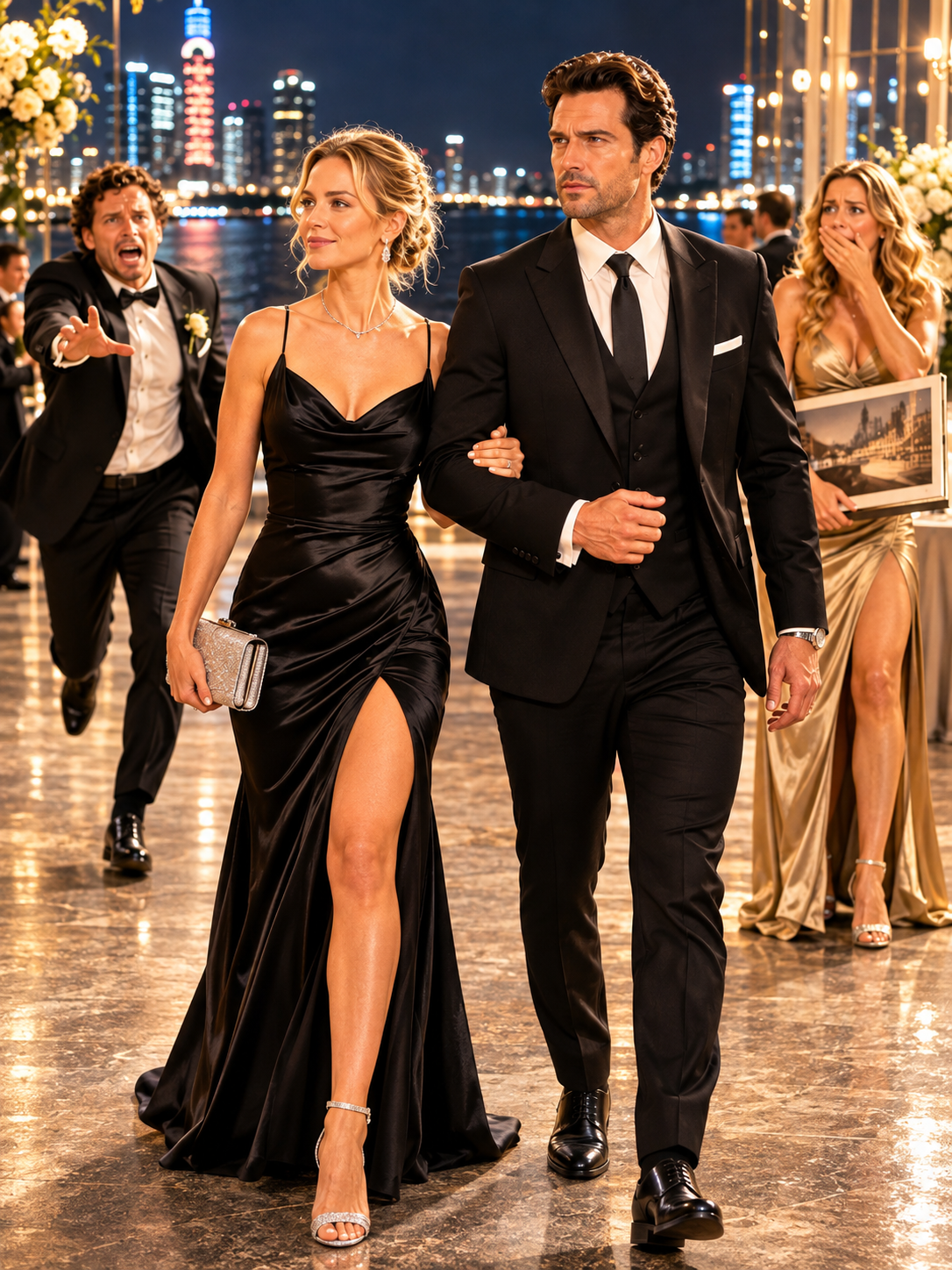
IF FACEBOOK BROUGHT YOU HERE, HERE’S THE CONTINUATION YOU’VE BEEN WAITING FOR. ENJOY! 👇 A colleague caught me near the coat check and started asking where Gavin was. She stopped halfway through mentioning the proposal when she saw my face. “Change of plans,” I told her, and kept walking.
My mother, Karen, was waiting by the exit with my father, Gerald. Gavin had called her from the airport, claiming Kora was upset and he’d only gone to help her. Mom suggested that perhaps I’d misunderstood what I’d seen, while Dad stood beside her staring at the floor.
I showed Mom the photograph: the kiss, the airport canopy, and Kora’s bracelet. I didn’t mention the forged agreement or the payment instructions because I wanted to know what Gavin would say if he thought I knew only about the affair. Mom’s first clear instruction was not to post the picture because I needed to protect my public image.
“I intend to protect quite a few things,” I told her. “My image is on the list.” I hugged Dad, and he held on longer than usual, but neither of us had words for what had happened.
I went home and managed six hours of sleep. In the morning Gavin messaged from an unfamiliar number saying he was giving me space and would return in a week. He specifically asked me not to do anything impulsive with the firm’s accounts.
That request told me how comfortable he’d become making decisions about my company. Kora called three times and eventually left a voicemail accusing me of punishing her for falling in love. She hoped I would someday be generous enough to understand her side, as if the eight months of deception were a misunderstanding I could resolve with kindness.
I saved the voicemail and sent Gavin’s message to Una. At the studio I told the team Gavin was no longer affiliated with Thalia Ren Design, that our projects would continue, and that payroll and client relationships were being protected. I asked everyone to forward unusual instructions from Gavin to Yuki without deleting or changing anything.
Yuki handed me a printed accounting report afterward. Gavin had approved thirty-four invoices over fourteen months, totaling $218,000, to Shore Creative Partners for consulting work nobody could identify or confirm had been delivered. The company had been registered eight days after he started discussing Riverside Commons with prospective city contacts.
I stood beside the studio printer and read the invoice dates twice. These weren’t just one desperate afternoon’s paperwork; they described a pattern that stretched across the months when Gavin was making wedding plans with me. Una arranged for the records to be preserved and reviewed rather than letting anyone rush to conclusions about what could be recovered.
Two days later, a local design blog published an anonymous piece suggesting my firm was in crisis without its business development director. Lark, one of our junior designers, stopped me in the hallway and said people were calling me cold. She wasn’t accusing me; she looked worried about how much I was carrying.
“Would crying have kept $480,000 from leaving the account?” I asked. She shook her head, and I told her I would have time to cry when the injunction cleared. Then we went back to work, because the people who would use Riverside Commons were still counting on us.
Part 3 Hugo came to the waterfront site on a Wednesday wearing work boots and carrying two coffees. He’d guessed wrong about how I took mine, and when I pointed it out, he simply exchanged cups with me. We walked along the planned accessible route, talking about paving and glare rather than Gavin.
At the midpoint Hugo showed me a specification that had troubled him during final review. My original paving material minimized reflected glare for visitors with low vision, after three vendor conversations and two material tests. The version submitted to the city had replaced it with a cheaper surface that looked similar on paper but performed differently in direct sunlight.
I opened the revision history on my tablet. Gavin’s login appeared beside the change, without an explanatory note or approval from the design team. Hugo said he’d compared the original proposal against the submitted version and wanted to inspect the site before raising every concern.
We spent three hours tracing the differences. There were twelve unauthorized changes, four of them significant enough to undermine the accessibility we had promised. All had been entered during Gavin’s solo revision sessions while I was away, and the financial records suggested the resulting cost differences had been channeled through his consulting invoices.
I sat on a concrete barrier near the pier and looked out at the gray-green river. The money frightened me, but those paths were the part that hurt most. Someone could have reached the waterfront we’d promised and found that the design bearing my name still excluded them.
“Did you suspect this before the gala?” I asked Hugo. He said he’d noticed discrepancies in the final review but needed to verify them before accusing anyone. He remembered me saying that a person who visits a site makes different decisions from someone who only reads reports, so he’d come to look.
He didn’t tell me everything would be fine. He helped identify what was wrong, and he listened when I explained why each detail mattered. For the first time in days, I could concentrate on the work without wondering whether the person beside me was trying to take it away.
Gavin came back on Sunday, a day earlier than promised, accompanied by a lawyer and a prepared statement. His building badge no longer worked. He left me a four-minute voicemail that began with an apology, moved through explanations, and ended with threats about the damage I was supposedly doing.
He insisted the intellectual property transfer had been my idea and that Kora had only helped arrange it. He said I had talked about stepping away from the firm and that he still loved me. I forwarded the recording to Una rather than argue with a man who was now describing my forged signature as a favor.
By the end of that week, the court had made the injunction protecting the disputed intellectual property transfer permanent. Gavin contacted two major clients and described the firm as undergoing a leadership transition. One called me directly, and I invited the client to walk the Riverside Commons site with us.
We spent two hours discussing paths, entrances, materials, and maintenance. The client renewed the retainer without my asking. I didn’t celebrate with champagne; I went back to the office and checked that the latest specifications matched what we’d promised.
Part 4 Six weeks after the gala, the city’s Department of Public Works held a quarterly stakeholder presentation. It was supposed to be a routine ninety-minute progress update for contractors, investors, council members, and community advocates. Gavin had registered Shore Creative Partners as a project design consultant using another purported countersignature from me.
He arrived with Kora, who had recently relaunched her personal brand as Accessible Future. She carried three large presentation boards into the room and arranged them at the front. Two showed concepts derived from sketches I’d shared privately with her eighteen months earlier over dinner, before those ideas had appeared in any formal submission.
I recognized the lines immediately. I remembered that dinner, too, and how pleased I’d been that my closest friend seemed interested in the details of my work. Hugo, seated in the third row, texted me to ask whether I recognized the boards, and I answered that I did.
Gavin began by calling Shore Creative Partners a collaborative extension of Riverside Commons. He spoke about teamwork and his own involvement from the beginning, carefully suggesting that he had created the design without quite saying so. Then a council member asked who actually held the registered rights to the accessible framework.
“That’s in transition,” Gavin answered. When the council member asked what that meant, he looked at Kora. She looked back, and I saw her hesitate before deciding how much of his story she wanted to defend.
I requested the floor and placed two documents on the presentation table. One was the firm’s original rights registration, naming Thalia Ren Design as the sole holder. The other was the project revision history, showing twelve timestamped changes associated with Gavin’s login and preserved in our records.
I told the room that Riverside Commons involved public money and a public promise, and that the registered design belonged to my firm. I explained that the revision record showed changes made without authorization and that the original evidence was preserved with counsel. I didn’t mention the affair or the bracelet because neither belonged in a public project review.
Gavin said Kora could explain the early design process. She responded more sharply than I expected: “You told me the design was already yours.” She said he’d shown her emails claiming I had handed over creative control and promised she’d become lead designer on future phases.
Gavin tried to tell her she’d misunderstood. Kora interrupted and said she still had his texts. The room grew so quiet that I heard someone shift a chair, and a council member asked them both to sit down.
I returned to my seat beside Hugo. I had presented the ownership records and the design changes; I didn’t need to join their argument. Watching them contradict each other in front of the people they hoped to impress was less satisfying than I’d imagined, mostly because I was thinking about how close we’d come to building the wrong park.
Part 5 The city began an audit review the following week. The proposed $480,000 payment redirection was reversed, and Shore Creative Partners was dissolved. The $218,000 in questionable invoices became the basis of a civil claim, while Gavin’s professional license was referred to the state review board.
Kora’s Accessible Future launch fell apart when the printing vendor, responding to an inquiry, confirmed that files used for her presentation boards contained metadata from my firm’s server. I didn’t call her to ask why she’d taken my private sketches. By then I had learned that another explanation from her wouldn’t restore what we’d had.
I issued one statement through the firm’s official account: Thalia Ren Design remained the sole registered designer and rights holder for Riverside Commons, and the project would proceed on schedule. I didn’t address the gossip or identify the people involved. Our work would have to speak for itself, which was how I’d always wanted it.
We restored the original low-glare paving specification and corrected the other accessibility changes. The project reached completion six weeks after the stakeholder presentation, $90,000 under budget. Those savings funded a maintenance and operations program staffed by people from the surrounding neighborhood.
I walked the finished path with Yuki before the crews packed away their equipment. We checked the slopes and turning spaces the same way we’d checked them on paper for years. For once, the design and the ground beneath our feet matched.
Three months after the presentation, Hugo asked me to dinner. “A real dinner,” he said, meaning no agenda, no folder, and no site visit. I accepted, but told him that if he ever made a decision about my life because he thought his position entitled him to, there wouldn’t be a second dinner.
“That’s a reasonable place to start,” he said. Our first dinner lasted two and a half hours, and he asked questions without trying to finish my answers. He didn’t send a car I hadn’t requested or call my staff to arrange my evening.
Six weeks later a photographer caught us leaving a concert. Hugo offered to have his communications office issue a statement, but I told him two people attending a concert wasn’t a story. He accepted that, and we went home separately without turning our private lives into a public announcement.
Gavin’s version eventually appeared on a gossip site through a mutual acquaintance. He claimed Hugo had been pursuing me before our engagement ended and had engineered the breakup to take advantage of me. The rumor circulated for five days, but none of us fed it with a public argument, and it faded.
Final One early spring evening, six weeks before Riverside Commons was scheduled to open to the public, I was reviewing the entrance doors at the site. The construction lights reflected in the river, and a crew was testing a hinge that kept sticking. I’d refused to approve a cosmetic adjustment because a door that caught during testing would catch on opening day for someone who just wanted to see the water.
Hugo found me beside the entrance and stood quietly while the crew worked. After a while he said he wanted to ask me something that had nothing to do with the project. I told him to ask.
“Would you want to build something with me that doesn’t appear in a contract?” he said. There was no ring, no audience, and no grand gesture. He left the question open for me to answer in my own time.
I remembered the gala restroom and the sound of my voice asking Una to protect the company. I remembered telling my staff the truth without waiting for permission, and all the years before that when I’d surrendered small decisions because defending them seemed harder. I knew now what that kind of patience had cost me.
“Yes,” I told Hugo. “But I want to be the one who decides what we build and what it costs.” He said he wouldn’t want it any other way, and that he’d come to Riverside Commons for the design; everything afterward was something he’d chosen to show up for.
A crew member called that the hinge was seated correctly. The door opened, closed, and opened again without catching, and I watched a third successful test before initialing the result on my tablet. Only then did I turn back toward Hugo.
He was watching the crew, waiting with me to see whether the repair would hold. I reached for his hand, and he took it without turning the moment into a performance. We stood beside the wide, smooth path leading to the river, with nothing between us that either of us had to surrender.
THE END. I’ve shared the complete story, and I truly hope it touched your heart. If this story moved you, please , like, and share the post. Thank you for reading! ❤️
✓ Lynn R. Adams
IF FACEBOOK BROUGHT YOU HERE, HERE’S THE CONTINUATION YOU’VE BEEN WAITING FOR. ENJOY! 👇 A colleague caught me near the coat check and started asking where Gavin was. She stopped halfway through menti…