The night I went into labor with a ten-pound baby, I expected my husband to hold
Part 2: Emergency surgery reveals what Preston refused to see
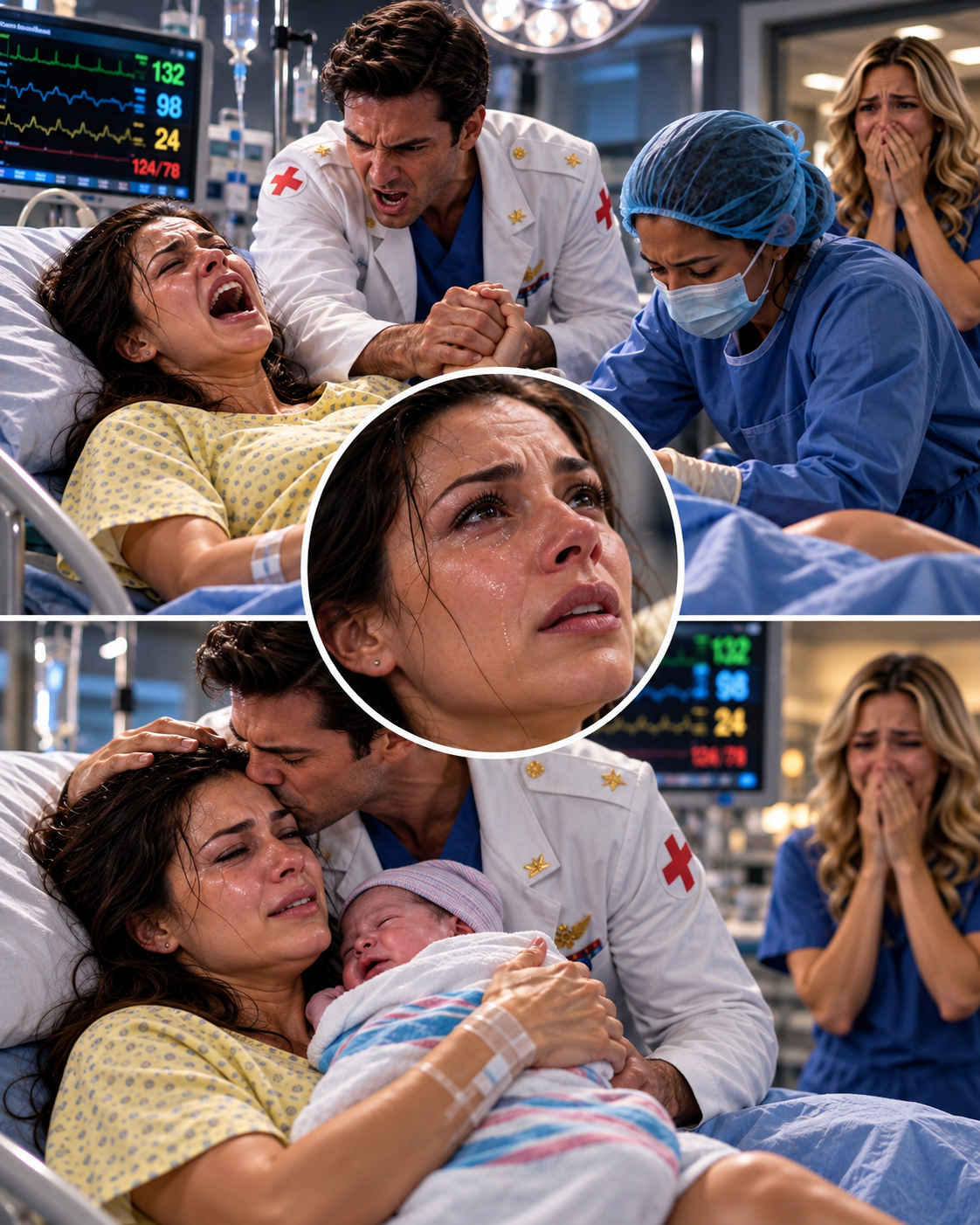
I did not hear my heart stop, but nurses later told me the continuous alarm silenced the room before training took over. One nurse began compressions, another opened the hemorrhage cart, and Dr. Evelyn Rhodes arrived while Preston stood at the foot of my bed with my blood on his gloves. She had trained both of us during residency and could make an operating room reorganize itself with one sentence. She looked at my vitals, the blood loss, and the notes documenting repeated requests for surgery. Then she asked Preston why I had not been taken to the operating room.
He tried to explain that natural delivery had remained clinically possible. Evelyn did not ask whether delivery was possible; she asked whether it was safe. The charge nurse confirmed that she had recommended surgery after my vitals worsened and Preston refused despite my consent. Another nurse confirmed that he had ordered my pain medication reduced after the dispute involving Khloe. Evelyn looked at him for several seconds, then ordered him removed from my case. He protested that he was my husband. “Then you had two reasons to protect her,” Evelyn said, “not none.”
I regained a weak pulse long enough to reach the operating room. An examination confirmed severe internal injury and bleeding that could not be controlled conservatively. Evelyn explained that she might have to perform a hysterectomy to save my life. I understood every word. Preston and I had once talked about having another child, a daughter whose room would be across from her brother’s. In less than a minute, the future I had carried privately disappeared. Before anesthesia took me under, I managed to ask, “My baby?”
Evelyn promised our son was alive and being cared for. She operated while hospital administrators began reviewing what happened before I coded. A nurse found an empty oxytocin syringe under the medication cart, with no matching entry in my chart. The label bore Khloe’s initials, and the small crescent wounds on my arm matched the length of her nails. When investigators questioned her, she first claimed someone had used her supplies. Then she admitted giving an extra dose because labor was “taking too long.” Preston stared at her as if the woman he had defended had become a stranger.
Khloe’s composure broke. She shouted that I had tried to ruin her career with the charting report and said I enjoyed making younger physicians feel powerless. She claimed I deserved to know what it was like when no one listened. Preston told her he had never authorized retaliation. She laughed and reminded him that he had called me controlling, arrogant, and impossible to challenge. Then she repeated something he had said privately: that labor might teach me what it felt like to lose authority. The hallway fell silent. Anger in a message was one thing; anger used to guide medical decisions was another.
Before dawn, Evelyn found Preston in an administrative conference room. I had survived two cardiac arrests, massive blood loss, emergency surgery, and twenty-three units of blood products. He dropped into a chair and asked whether he could see me. Evelyn said I would decide when I woke. Then she told him the hysterectomy had been unavoidable. He covered his face and said he had never intended for that to happen. Evelyn answered that intention mattered less once he ignored warnings for reasons unrelated to medicine. He had not meant for me to die, but he had accepted the possibility.
Part 3: I wake alive and discover my marriage was already gone
When I regained consciousness, I heard the faint whimper of a newborn beside my bed. My throat burned from the breathing tube, my abdomen felt as if it were filled with fire, and every instinct told me not to move. I forced my eyes toward the bassinet. My son lay wrapped in a pale-blue blanket, one tiny hand curled beside his cheek. A nurse saw me looking and said he was stable, breathing well, and already showing a stubborn personality. I began crying before I realized tears were running toward my ears. I had survived, and he was there.
After the breathing tube came out, I named him Samuel Vance. I used my last name because seeing Pierce on his identification bracelet made something inside me recoil. The nurse paused for only a second before writing it down. Everyone on the floor already knew what Preston had done. He requested access repeatedly, but hospital security refused while risk management, child-protection staff, and police reviewed the delivery. I felt no heartbreak when they told me he could not enter. I felt relief, and that relief told me more about my marriage than seven years of photographs ever had.
My attorney, Melissa Grant, arrived that afternoon with the yellow emergency envelope I had left with hospital legal services three weeks earlier. I had prepared it after seeing messages between Preston and Khloe on our shared tablet. Their conversations began with flirting and hotel arrangements, then turned toward me. Khloe complained about my investigation into her altered chart, and Preston called me controlling, promising he would “handle Elena.” One message said labor might finally force me to depend on him. I had read that sentence seventeen times before telling myself he was only venting.
The envelope contained copies of those messages, documentation of Khloe’s previous medication irregularities, photographs of suspicious chart edits, and a notarized statement authorizing review if anything happened to me during childbirth. I had not filed a full complaint against Preston because part of me still believed he would confess to the affair and let us separate without destroying our careers. I feared confronting him while heavily pregnant could make home unpredictable. Emergency physicians are trained to consider the worst case, even when they desperately want a better one. Preparing the envelope was the only reason investigators knew where to begin.
Hospital auditors uncovered two earlier cases involving Khloe. One concerned Margaret Cole, an elderly patient who suffered an unexpected cardiac arrest after stabilizing under my care. Preston later amended Margaret’s chart, attributing the event to an unusual reaction and closing questions I had raised. Another patient survived an undocumented infusion error that disappeared from internal reporting after Preston personally reviewed the chart. The scandal was no longer just about an affair or a delivery. There might be a pattern of dangerous mistakes protected because Preston preferred protecting Khloe to admitting what she had done.
Preston sent word that he needed to speak to me about Samuel. Khloe had shown him something before labor began, he said. I agreed to a supervised conversation because information about my child mattered more than anger. Preston entered without his white coat and stopped when he saw Samuel sleeping against my chest. He apologized, but the words sounded useless beside the monitors keeping me stable. Then he admitted Khloe had accessed prenatal samples and arranged a private test. She had shown him a report suggesting Samuel was not biologically his.
Part 4: A false paternity test reveals why he punished me
For several seconds, I thought pain medication had made me misunderstand. Accusing me of infidelity while carrying on an affair with his intern seemed too grotesque, even for the man beside my bed. Preston said Khloe had obtained the sample because rumors at the hospital suggested I had been involved with another doctor. I asked why he had trusted a woman already under investigation for changing records. He lowered his eyes. The truth was simple enough that he could barely say it: he had wanted the result to be true.
Preston admitted his resentment toward my career had been building for years. I became department chief before he received the administrative position he expected, although he had always presented himself as proud of me. Every compliment from his father about my judgment felt like criticism of him. Every resident who asked my opinion became proof that I overshadowed him. Khloe recognized his insecurity and fed it, telling him I mocked him privately and planned to leave once I had enough professional status. When she produced the false test, he treated suspicion as certainty. During labor, each request I made sounded to him like another command from the wife he believed had betrayed him.
He insisted he had never wanted me dead. I told him death did not need to be his goal when he knowingly accepted it as a possible consequence. I had asked for surgery; the nurses had asked for surgery; another physician had supported it, and my worsening condition was documented. He ignored them because some part of him enjoyed seeing me powerless. Preston began crying and admitted that for several minutes, hearing me beg had made him feel stronger than he had felt in years. That confession ended our marriage more completely than the affair.
The hospital repeated the paternity test using secured samples collected directly from Samuel, Preston, and me with independent witnesses. The result was clear: Preston was Samuel’s biological father. The first report had been fabricated, using blood from another infant entered under Samuel’s identification number. Investigators traced the sample to a three-month-old child recently missing from temporary foster placement after treatment at a private pediatric clinic where Khloe volunteered. Preston stared at the report and asked how it could have happened. No one had an answer yet.
Security logs showed Khloe’s badge entering the newborn preparation area after Samuel’s birth, during an eleven-minute camera reboot. She had not taken Samuel, but investigators believed she had used the access to confuse paternity and identification records. The foster baby was still missing, which meant someone else might be helping her. While detectives prepared to question Khloe again, she escaped during transport after pretending to suffer a pregnancy complication. Police soon confirmed she was fourteen weeks pregnant with Preston’s child. The news did not hurt me the way Preston expected. Our marriage had already ended on the delivery table.
What frightened me was the possibility that Khloe had manipulated hospital systems, tampered with infant records, harmed previous patients, and disappeared while another baby remained missing. Detective Marcus Hale took charge of the expanding investigation. Within a day he uncovered a connection that changed everything: Khloe’s mother, Vivian Bennett, had worked as a maternity nurse almost thirty years earlier. She had lost her license after accusations that she abducted a newborn named Preston Pierce. The old case had been sealed, but an archive could be reopened. No one expected it to explain the present.
Part 5: The intern Preston defended had chosen him long before their affair
The old file said Vivian became obsessed with the newborn and claimed he belonged to her. Investigators found no birth record supporting her claim. Preston’s father, Richard Pierce, was one of the hospital’s most influential administrators and argued that the incident involved a mentally unstable nurse. Preston was recovered within days, Vivian was fired, and Richard used his influence to avoid a public trial. The family version became a cautionary tale: a disturbed nurse had once tried to steal Preston. Khloe grew up hearing a different story.
Detective Hale reopened maternity records. They showed Caroline Pierce had delivered a boy with a severe congenital heart defect on the same night Vivian reportedly gave birth privately under another physician’s care. Caroline’s baby died within hours, and Richard feared his wife would not survive losing another child. Records suggested he arranged a switch, replacing the dead Pierce infant with Vivian’s healthy newborn and later removing evidence of Vivian’s delivery. The woman accused of stealing Preston may have been trying to recover her own son. The discovery turned an old family story into a possible crime.
Khloe apparently learned the truth while sorting her mother’s belongings years later. Rather than pursue it legally, she built her life around revenge. She entered medical school, targeted the hospital system, and maneuvered into Preston’s orbit after studying his marriage, his ambitions, and his relationship with Richard. Their affair was not simply a romance that turned destructive. It was part of a plan to make the Pierce family destroy itself. Preston had been seduced by the person who knew exactly how much he craved admiration.
When police searched Khloe’s apartment, they found hidden copies of Richard’s records, photographs of Preston dating back years, and journals describing me as “the final obstacle.” She resented me not only because I reported her chart alterations, but because Preston remained emotionally tied to our marriage even while betraying it. The false paternity test was meant to make him turn fully against me and recreate the fear Vivian experienced when another family claimed her child. Khloe had not expected his resentment to push him into decisions that nearly killed me. She had poured poison into a weakness that was already there.
Preston learned his true parentage under police supervision. He denied it until DNA testing confirmed Vivian Bennett was his biological mother. The mythology of the Pierce family collapsed in less than forty-eight hours. At a supervised hospital meeting, Preston told me he understood why Khloe hated him. I reminded him that understanding her trauma did not erase her choices. Discovering his stolen childhood did not erase his, either. I filed for divorce and requested temporary sole decision-making authority for Samuel while the legal and professional cases continued.
Before leaving, Preston asked whether I thought he was becoming like Richard. I told him something worse: Richard stole another woman’s child because he believed his family deserved one; Preston stole my right to safe treatment because he believed his anger deserved obedience. Both acts began with a man deciding another person’s body mattered less than his need for control. He did not contest my request for temporary custody. Even he understood that a man who let resentment guide medical care could not expect immediate trust. Outside, the investigators were still searching for Khloe and the missing foster child.
Part 6: Khloe returns for my baby and exposes her mother’s final plan
Three weeks after delivery, I left the hospital in a wheelchair with Samuel against my chest. Reporters crowded the sidewalk, and Dr. Rhodes walked beside us as if daring anyone to come closer. My body survived, but recovery was slow; some nights, the fetal monitor’s alarm seemed to return inside my dreams. I moved into a secured apartment near my sister, changed every access code, and learned that asking for help did not make me weak. Detective Hale checked in regularly because Khloe and Vivian were still missing. Police believed they were working together.
The first direct threat arrived in an unmarked envelope. Inside were Samuel’s original identification bracelet and a photograph of Vivian holding a newborn decades earlier. On the back, someone had written, “A mother always knows her own child.” My heart stopped until an emergency test confirmed the baby in my apartment was Samuel. The bracelet had been taken during the delivery-room confusion and kept as leverage. Vivian did not need to take my son to make me feel the fear of losing him. She only needed me to imagine it.
A faded building in the photograph led investigators to Saint Agnes Home for Mothers, an abandoned maternity residence outside the city. Police expected an empty building. Instead, they found old bassinets, stolen hospital bracelets, photographs of mothers, falsified records, and supplies that suggested someone had been staying there. Images of Preston covered one wall. A photograph of me holding Samuel sat in the center. I remained behind the command perimeter until I heard Vivian’s voice over the tactical team’s radio. She was asking for me by name.
Against orders, I moved close enough to speak while officers kept their distance. I told Vivian I believed her about what Richard had done. The words seemed to confuse her more than threats would have. She was holding the missing foster infant, and she threatened to inject the baby if anyone approached. She cried as she described decades of being called unstable, dishonest, and dangerous when she said her child had been stolen. Richard ruined her career, bought silence from employees, and used the failed abduction accusation to make sure no one trusted her again.
I told her that what happened to her was monstrous, but harming another mother would not turn suffering into justice. Vivian looked at the infant and said I could not understand because I still had my son. Then Preston stepped from behind the police line under escort. He called Vivian “Mother” for the first time in his life. She seemed to collapse at the sound. DNA had confirmed what she had spent decades trying to prove, and the son she thought was lost stood twenty feet away telling her Richard had lied.
Vivian loosened her grip. I took the foster infant as officers moved in. She surrendered without resisting, then touched Preston’s cheek and whispered that he had her eyes. When they led her away, he began to cry. Three separate legal cases followed. Khloe faced charges connected to medication tampering, kidnapping, evidence manipulation, and unauthorized access. Hospital investigators confirmed she had given me an undocumented drug and altered records in Margaret Cole’s case. Preston admitted he had later changed Margaret’s chart because he believed Khloe’s first serious mistake should not destroy a promising career.
Part 7: The trial makes every doctor answer for the decisions they made
Preston pleaded guilty to charges connected to reckless medical conduct, evidence suppression, and obstruction. As part of the settlement, he surrendered his medical license. At sentencing, he asked to address me, but he did not try to explain himself as misunderstood. He said my success had made him feel small, Khloe made him feel admired, and labor put me in a position where I depended on him. He confused dependence with power. Then he admitted he would spend the rest of his life remembering that he heard me beg and chose not to listen. No apology could reverse the hysterectomy or restore the trust he had broken.
Khloe refused to accept responsibility, arguing that Vivian’s trauma had shaped everything she did. Jurors heard recordings, reviewed hospital logs, and read messages where Khloe encouraged Preston’s suspicion while planning to ruin the Pierce family. She received a lengthy prison sentence after conviction on the most serious charges. Vivian’s case was handled differently. Psychiatrists documented severe trauma and deterioration connected to decades of institutional gaslighting, but the court still held her responsible for the kidnapping and threats. She was placed in a secure psychiatric facility. Justice turned out to be more complicated than revenge.
The hospital settled lawsuits brought by several families, including Margaret Cole’s daughter. It created an independent review process for situations where a physician had personal authority over a high-risk patient who was also a partner or relative. Nurses gained the power to activate emergency escalation without approval from the attending physician whose judgment they were challenging. Staff received protected reporting channels for retaliation and chart manipulation. Dr. Rhodes became chair of a patient-safety commission. She called the reforms inadequate, but necessary.
I did not return immediately to my role as chief of emergency medicine. Certain alarms still made my body react before my mind caught up. Instead, I helped build a patient-advocacy unit for people facing medical coercion, retaliation, or conflicts between personal relationships and clinical authority. Margaret Cole’s daughter donated a photograph of her mother in a classroom surrounded by children. We placed it near the entrance with a simple message about speaking up when something felt wrong. The work gave meaning to what happened without requiring me to pretend the suffering had been useful.
A year after Samuel’s birth, Preston wrote to ask whether he could begin supervised contact if the court approved. I did not answer immediately. Being Samuel’s biological father did not automatically make Preston safe. Evaluations, therapy, and monitored communication continued for months before the court approved short supervised visits. I watched the first one from behind observation glass. Preston held his son and cried, but he did not ask me to comfort him. I did not feel forgiveness. I felt certain that the boundaries were necessary.
Part 8: My son grows up knowing love never requires silence
Three years later, the Vance Patient Advocacy Center opened its fourth regional office. I stood beneath a glass wall engraved with a sentence Dr. Rhodes helped choose: No authority is greater than a patient’s right to be heard. Samuel was three, fearless, and fascinated by stethoscopes. He knew his father lived somewhere he could not visit freely, and I answered his questions with simple truths he could understand. I refused to build his childhood on secrets. Secrets had already done enough damage.
Preston continued his sentence and took part in ethics programs for incarcerated healthcare workers. I never mistook accountability for redemption, but I acknowledged the work when it was real. Vivian eventually moved from secure hospitalization into long-term supervised treatment. She wrote me one letter apologizing for using Samuel as a symbol in a conflict that began before he was born. I did not promise forgiveness. I answered that telling the truth was a better inheritance than repeating the harm. That was all I could offer.
Detective Marcus Hale stayed in our lives after the case closed, first because of paperwork and then because Samuel adored the wooden police car Marcus gave him for his second birthday. Marcus never tried to rescue me, which may have been why I trusted him. When I woke from nightmares, he did not tell me I was safe as if those words could order my body to believe him. He sat nearby until I decided whether I wanted company. Friendship became something quieter and stronger.
We married four years after Samuel’s birth in a small garden ceremony with Dr. Rhodes, my sister, a few friends, and Samuel carrying the rings in a box he nearly dropped twice. We made no grand promises about never failing each other. I had learned that promises could become substitutes for daily choices. Marcus said disagreement would never become punishment and my voice would remain mine, even when he disliked what I said. I promised him the same. Samuel asked if we could serve cake before taking photographs, and we agreed it was the best idea of the afternoon.
On his tenth birthday, Samuel visited the advocacy center and stopped at the display explaining the reforms that followed his birth. He had recently learned a careful version of what happened and understood his biological father had once been a doctor who made terrible choices. He asked whether Preston had loved me when he hurt me. I said I believed Preston felt something he called love, but love without respect, responsibility, and safety could become destructive. Samuel thought about that for a long moment. Then he asked whether I had been brave in the delivery room.
For a second, I remembered gripping the rail, pleading with the man I trusted, trying to stay alive long enough to hear my son cry. I told Samuel I had been frightened, angry, confused, and exhausted. He frowned and said none of those things meant I had not been brave. Across the room, Marcus smiled because our son had inherited the habit of correcting physicians. I laughed until tears filled my eyes. That evening, Samuel found an injured bird beneath the oak tree and carried it carefully in his cupped hands.
He asked whether it would survive. I told him I didn’t know, but we could still help. Together we prepared a box and called a wildlife rehabilitator. As I watched him protect something vulnerable without demanding anything in return, I thought about how different strength looked to me now. For years, the memory of Samuel’s birth began with Preston’s order and ended with the monitor screaming. Eventually that changed. I remembered the nurse who challenged an unsafe decision, Dr. Rhodes running toward danger, my attorney preserving evidence, strangers donating blood, and my son’s first cry reaching me through the darkness.
Most of all, I remembered that even when I was restrained, dismissed, and terrified, I kept telling the truth about what my body was experiencing. No one could give those hours back. But they could no longer define me. The marriage built on pride ended in that delivery room. The life built on truth began there, too.
✓ Lynn R. Adams
Part 2: Emergency surgery reveals what Preston refused to see I did not hear my heart stop, but nurses later told me the continuous alarm silenced the room before training took over. One nurse began …