The night I dropped a coffee
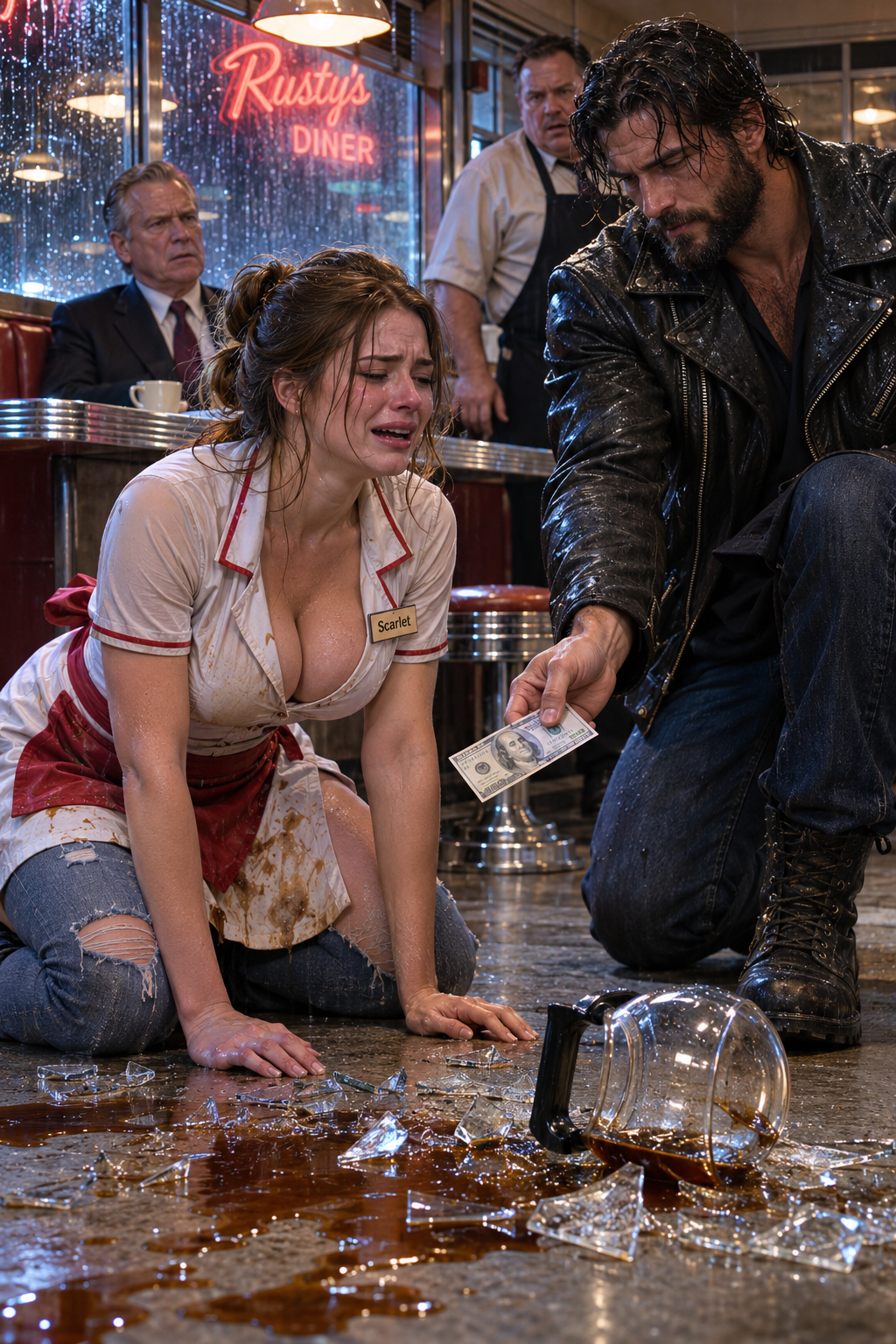
The night I dropped a coffee pot at Rusty’s Diner, my boss threatened to fire me while my little sister struggled to breathe in a hospital bed. Then a silent biker stood up and reached into his jacket….
By the time the rain started pounding the windows at Rusty’s Diner, I had been awake for almost two days. My name is Scarlet Miller, and back then I was working the late shift on Highway 41 because the tips were the only money I could count on. My seventeen-year-old sister, Charlie, was in the hospital across town, and every hour away from her felt wrong.
Charlie was the last person who deserved to be lying under fluorescent lights with a machine helping her breathe. She had always been the one who could make me laugh when our apartment seemed too quiet. Lately, though, her chest rose and fell with so much effort that I had started watching every breath, as if concentrating hard enough could keep the next one coming.
Her doctors called it pulmonary fibrosis. They talked about damaged lungs, medications, and eventually a transplant list, but the words I heard most clearly came from the hospital billing department. I was $140 short for the next round of medicine they said she needed. In my apron pocket was a final notice I had folded so many times the paper had gone soft.
Our landlord had also taped a three-day eviction warning to our apartment door. I kept trying to decide which disaster to handle first: the rent, the medication, or the fact that I could barely see straight from lack of sleep. I hadn’t told Charlie about the eviction. She was already frightened enough, and when she asked how things were going at work, I always said, “Fine.”
Tuesday nights were normally quiet at Rusty’s. A couple of truck drivers would drift in, drink coffee, and leave before midnight. That night the storm had stranded half a dozen locals inside, their wet coats hanging from the backs of booths. Everybody seemed annoyed by something, and my manager, Greg Henderson, had been taking it out on me since I clocked in.
Greg liked reminding us that broken dishes came out of somebody’s paycheck. He said it loudly enough for customers to hear, as though embarrassment made people work faster. I knew I should have asked to go home when my hands started trembling, but going home meant losing the hours I needed. So I kept refilling mugs and wiping down the same clean stretch of counter.
In the corner booth sat Arthur Pendleton, a wealthy real estate developer who made a point of checking his gold watch whenever he wanted service. He wore expensive clothes to a roadside diner and spoke to the staff as though we were all keeping him from a much more important evening. I had served him enough times to recognize the impatient tapping before he even opened his mouth.
“Sweetheart, my coffee’s cold,” he called across the room. I grabbed the glass pot, looked at what remained inside, and promised I’d be right there. My legs ached, and I could feel the hospital notice against my apron every time I moved. I was trying to remember whether the pharmacy closed early the next morning when the front door swung open.
A gust of wind drove rain across the floor. The man who stepped inside was so tall he seemed to fill the doorway. Mud covered his heavy riding boots; his leather jacket was soaked through, and dark, shaggy hair hung around a thick beard. There were no motorcycle-club patches on his jacket, nothing to say where he’d come from or where he was headed.
He looked around once with pale blue eyes, then chose an empty stool at the far end of the counter. Water dripped from his clothes onto the floor, but he didn’t seem to notice. Conversations grew quieter. Even Greg, who never missed a chance to scold somebody, suddenly found something urgent to scrub on the kitchen grill.
I wasn’t frightened so much as uncertain. The stranger had the kind of stillness that made everybody else feel noisy, and I couldn’t tell whether he was angry or simply exhausted. I walked over anyway, keeping the coffee pot in one hand and a menu in the other. “Can I get you something?” I asked.
“Black coffee,” he said. That was all. His voice was deep and rough, and he didn’t look up when I set a cup in front of him. A little coffee splashed into the saucer because my hand wouldn’t hold steady. I apologized and reached for my rag, but he was already looking past me at the rain-dark highway.
For one brief moment I wished he would ask why I looked so tired. Then I felt ashamed of wanting sympathy from someone who didn’t know me. He was just a customer trying to get warm. I had a job to do, a sister waiting at the hospital, and no room in my life for another conversation I couldn’t finish.
“Scarlet!” Arthur shouted. “Are you deaf? I asked for coffee.” His voice cut across the diner, and I turned before I had properly shifted my feet. The toe of my shoe caught a raised tile. I remember the weight of the glass pot sliding out of my hand and the awful instant when I knew I couldn’t catch it.
It hit the floor with a crack that silenced the whole room. Glass scattered across the linoleum, and hot coffee splashed against my lower legs. I grabbed the counter to keep from falling, then sank down because the sting was sharp enough to make my knees buckle. Arthur leaped back from the spill, looking first at his trousers and then at me.
“Clumsy idiot,” he snapped. Greg came through the swinging kitchen doors before I could even gather the pieces safely. He looked at the broken pot, the puddle spreading toward the booths, and the customers watching us. Not once did he ask if I’d been burned.
“That’s coming out of your paycheck,” he said. “The pot, the mess, all of it. And if you can’t pay for what you break, you’re done here.” I tried to stand, but the floor felt unsteady. I was thinking about the $140, the three-day notice, and the medicine waiting behind a pharmacy counter while Charlie lay in that hospital bed.
“I don’t have the money,” I told him. My voice was hardly more than a whisper. Greg crossed his arms. Arthur said I was ruining his appetite and told Greg to fire me. I could feel everyone’s attention on the back of my neck, but nobody moved to help me. I had never felt so exposed in a room full of people.
I crouched beside the spill, careful not to put my hands on the glass, and tried to get my breathing under control. Losing that paycheck meant falling further behind, and falling behind meant Charlie might go without the medication her doctors were insisting on. My eyes burned, but I kept my head down. I didn’t want Mr. Pendleton to see me cry.
Then a metal stool scraped across the floor. The tall biker had stood up. Greg stopped talking, and Arthur went quiet. I heard heavy boots approaching and stared at the wet tiles, bracing for another complaint about the mess. Instead, the man reached into his jacket and took out a worn wallet.
He placed a folded hundred-dollar bill on a clean table near me. For a second, his hard blue eyes met mine, and his expression softened in a way I still remember. He didn’t ask for his change, give me advice, or tell Greg what he thought of him. He simply turned, walked out through the diner door, and disappeared into the rain.
A motorcycle engine rumbled to life outside and faded along Highway 41. I stayed where I was, staring at the bill. It could cover the broken coffee pot and leave enough to help me buy Charlie’s medicine. But why had a complete stranger given me that money—and why had he left before I could even learn his name? Part 2…..
I learned his name two days later. The first thing I did after the biker left was hand the hundred-dollar bill to Greg. I wasn’t willing to lose my job over a coffee pot. Greg took what he said I owed, and between the money left from the bill, what I had saved, and that night’s tips, I finally managed to pay the balance for Charlie’s medicine. I finished my shift almost numb, cleaned the coffee off my legs, and went straight to the hospital pharmacy the next morning.
When the pharmacist gave me the medication, I stood there holding the bag with both hands. It was such a small thing to carry after all the worry it had caused. Upstairs, Charlie was resting with an oxygen cannula beneath her nose, her face pale against the pillow. I sat beside her bed and watched her chest rise and fall until she opened her eyes.
“You’re thinking too loud,” she whispered. I brushed a loose blond curl away from her forehead and told her about the stranger on the motorcycle. I called him my guardian angel, partly to make her smile. But even as she laughed weakly, I kept thinking about the money I hadn’t needed to spend. Thirty dollars remained in my wallet, and it didn’t feel right to keep it without trying to give it back.
By Thursday morning I had decided to look for him. I knew next to nothing about motorcycles, but there was one place in town where people brought theirs for repairs: Bill’s Auto and Cycle Repair. Bill listened while I described the tall man, the black bike, and the eyes I couldn’t seem to forget. Then he put down his oily rag and nodded.
“Dominic Reynolds,” he said. “Rides a custom old Knucklehead. Bought a cabin out by Miller’s Creek a few weeks ago.” He told me Dominic kept to himself, shopped at odd hours, and never talked much about where he’d been. Then Bill lowered his voice. “People say he did time. A serious prison. I’d stay away if I were you.”
I thanked him, but the warning didn’t change why I had come. Whatever Dominic’s past was, it wasn’t what I had seen at the diner. The man who had helped me hadn’t asked for a story, a favor, or even a thank-you. He had seen me on the worst night I could remember and left before anyone could make a spectacle of him.
The road to Miller’s Creek was muddy from the storm. My old sedan scraped the ground twice before I reached a small cabin tucked among the trees. Its roof and porch looked newly repaired, with chopped firewood stacked neatly beside the door. A black motorcycle rested under a cover nearby. I put the thirty dollars in my coat pocket and climbed the steps.
Before I could knock, the door opened. Dominic filled the doorway in a faded gray T-shirt, his tattooed arms bare, a mug of coffee in one hand. He looked just as imposing without the wet leather jacket. “You shouldn’t be here,” he said. I told him who I was, although I could see from his face that he remembered.
“I came to thank you,” I said, and held out the money. “The coffee pot didn’t cost as much as you left. I used the rest to get my sister’s medicine, but this part belongs to you.” He glanced at the cash and shook his head. “Keep it.” He started to close the door, and I asked him to please hear me out.
I explained that I didn’t want to take advantage of him. I needed help that night, yes, but I wanted him to know what his kindness had done. His expression changed when I mentioned Charlie. He looked past me toward the pharmacy bag lying on the passenger seat of my car and asked whether my sister was being treated at the respiratory clinic printed on it.
I nodded. He asked, very quietly, whether she had pulmonary fibrosis. I was startled that he even knew the term. Then he asked her age. “Seventeen,” I answered. He looked away so quickly I almost missed the pain that crossed his face. After a long silence, he stepped aside and said another storm was coming. I could come in for a minute.
The cabin was clean and spare, with little furniture and stacks of thick books against the walls. I noticed medical journals, anatomy books, and volumes on chest surgery. They looked worn, as though somebody had read them again and again. I turned toward him, still holding the thirty dollars. “Who are you?” I asked.
“Bill probably told you I was in prison,” Dominic said. I admitted he had. “Five years in a federal penitentiary,” he replied. My stomach tightened. He watched me for a moment, then added, “Before that, I was Dr. Dominic Reynolds. I was head of cardiothoracic surgery at Seattle Grace.”
I stared at the medical books and then back at the quiet man by the stove. It was hard to put the surgeon and the biker together in my mind. “What happened?” I asked. Dominic set down his mug and looked at me as if he had spent years deciding never to answer that question again.
“A seventeen-year-old girl died on my operating table,” he said. “Her name was Lily. And I was the one who turned off the machines keeping her alive.”
Part 3 I felt my hand close around the money in my pocket. Dominic must have seen my expression, because he didn’t move toward me or try to make himself sound innocent. He pulled out a chair and told me what had happened, beginning with Lily’s illness rather than his conviction.
Lily had cystic fibrosis and a severe, drug-resistant lung infection. By the end, she had spent forty-two days on extracorporeal life support, and the medical team believed her lungs could not recover. She was in terrible pain. Dominic said Lily had made her wishes clear while she was still able to speak, and her chart contained a do-not-resuscitate order and a written advance directive concerning continued treatment.
Her father was Senator Richard Hayes. According to Dominic, the senator would not accept that his daughter was dying. When the hospital’s ethics committee supported a plan consistent with Lily’s stated wishes, Hayes threatened the institution’s funding and the doctors’ careers. Administrators backed away from the decision. Dominic said he was ordered to keep life support going despite the conclusions of the care team.
One night, he disabled the alarms, held Lily’s hand, and withdrew the machines. She died within minutes. He described the room, then stopped talking for so long that the fire was the only sound in the cabin. I couldn’t tell him that what he’d done was right; I hadn’t been there, and Lily’s medical wishes did not erase the legal questions surrounding a minor’s care. But I could see that her death had never stopped living with him.
Dominic said Hayes pushed for his prosecution and that Lily’s directive was kept from becoming part of his defense. The hospital board testified against him, portraying him as a doctor acting recklessly and alone. He was convicted of involuntary manslaughter, lost his license, and served five years in federal prison. After his release, he bought a motorcycle, found this town, and tried to leave medicine behind.
“That’s why I helped you,” he said. “I know what it looks like when someone has nothing left.” He told me again to keep the thirty dollars and get back to Charlie. I should have thanked him and gone. Instead I thought about my sister’s worsening breathing, the medicine I had fought so hard to buy, and how every visit to Oakidge Memorial ended with another worried shrug.
“Our doctors say her pulmonary fibrosis is idiopathic,” I told him. “They say we’re waiting for a transplant, but she might not last that long.” I asked him to read her records, not to take her on as a patient or treat her in secret. He refused at first. He wasn’t licensed, and after everything that had happened to Lily, he wanted nothing to do with another decision about somebody’s life.
I almost left. Then I said, “You lost Lily. Please help me find out whether there’s anything they missed with Charlie.” Dominic stared at the floor, then moved a pile of kindling off the table. “Bring me what you have,” he said. “I can’t promise you’ll like what I find.”
I hurried to my car and returned with the thick manila folder I’d been carrying from appointment to appointment. It held Charlie’s blood tests, imaging reports, and the notes I had requested from the hospital. Dominic began reading. The change in him was immediate: his shoulders straightened, he stopped speaking, and he compared pages with the concentration of somebody returning to a language he had once known by heart.
After half an hour, he stopped at a high-resolution CT scan and asked who was managing Charlie’s lung care. “Dr. Philip Weber,” I answered. Dominic studied the scan again, then pointed to a pattern of abnormal shadows and the eosinophil results in her bloodwork. He said the findings did not prove idiopathic pulmonary fibrosis and raised an urgent possibility her doctors needed to investigate.
“An aggressive fungal infection,” he said. “Possibly Aspergillus. It can look like scarring, and the steroids she is getting could make certain infections worse.” He made clear that scans and blood counts alone could not settle the diagnosis; Charlie needed a qualified specialist and immediate testing. But his concern was unmistakable. The medicine I had been desperate to afford might be helping the wrong disease.
I asked what to do. Dominic told me to take the records back to the hospital and insist that the team review the possible infection before continuing the same treatment without question. He wouldn’t pretend that looking at a file gave him the authority to direct her care. He did, however, know a specialist who might listen. I left the cabin carrying the folder against my chest, frightened by what I had learned and even more frightened that we might already be too late.
The following Tuesday, my phone rang with an emergency alert from Oakidge Memorial. Charlie’s oxygen level had fallen into the sixties. Staff were preparing to place a breathing tube. I drove straight to the hospital, barely remembering the road, and ran to the intensive care unit on the third floor.
Through the glass of room 312, I saw nurses working around my sister’s bed. Dr. Weber was readying the equipment, and Charlie looked smaller than I’d ever seen her. I told him about the suspected fungal infection and begged him to reconsider the steroids, but he dismissed me as hysterical. An orderly tried to guide me away from the bed. I thought I was about to watch them make a decision without hearing a word I’d said.
Then the ICU doors opened, and Dominic Reynolds walked in.
Final He wasn’t wearing his leather jacket. He had on a dark button-down shirt, and his sleeves were rolled above the tattoos on his forearms. Dr. Weber looked up and went pale. He recognized Dominic at once and demanded to know why a man without a medical license was standing in his intensive care unit.
Dominic didn’t touch the ventilator or try to take control of Charlie’s treatment. He told Weber that the CT findings, blood tests, and steroid exposure raised serious concern for an invasive fungal infection and that the team needed an urgent second opinion. Weber ordered security to remove him. Dominic took out his phone and said he had already sent Charlie’s records, with my permission, to Dr. Harrison Caldwell, the chief of pulmonology at Johns Hopkins and his former mentor.
Caldwell’s voice came through the speaker. He had reviewed the available images and results, and he agreed that the team needed to investigate possible aspergillosis and reconsider the immunosuppressive treatment. He cautioned that airway decisions had to be based on Charlie’s immediate condition, not on a blanket rule against ventilation. What mattered now was getting an experienced, licensed team to reassess her before proceeding with the same plan.
For the first time, Weber listened. The hospital team arranged urgent infectious-disease and pulmonary input, began the appropriate testing, and changed course under its own physicians’ supervision. They treated Charlie for suspected Aspergillus with intravenous voriconazole and reviewed her steroid regimen. She received high-flow oxygen while the doctors closely monitored whether she would still need intubation. Dominic stayed nearby, but he never laid a hand on the equipment.
Those hours felt longer than any shift I’d worked at Rusty’s. I sat in a plastic chair and watched numbers rise and fall on the monitor. Slowly, with treatment and careful respiratory support, her oxygen saturation climbed through the seventies, into the eighties, and eventually settled near ninety-one. I didn’t know yet what the tests would show or how long her recovery might take. I only knew that she was still with me.
That evening, Charlie was more stable, and the new treatment was giving her doctors reason for cautious hope. I found Dominic in the hallway looking out toward the parking lot. “She’s going to make it,” I said, hoping I wasn’t speaking too soon. He gave me the smallest smile. “She’s a fighter,” he said. “Just like her sister.”
I asked how he’d reached someone at Johns Hopkins so quickly. Dominic told me Caldwell had once been his mentor and one of the few people who had believed his account of Lily’s case. He hadn’t been able to stop the hospital board years earlier, but when Dominic called about another seventeen-year-old girl in danger, he had agreed to review the records. I could hardly imagine what it had cost Dominic to make that call after swearing he would never return to medicine.
Then he told me he was leaving town. Dr. Weber was humiliated and angry, and Dominic feared that his presence at the hospital could bring trouble with the authorities supervising his release. I caught his arm before he could walk away. “Where will you go?” I asked. “Somewhere quiet,” he answered. He gently freed his arm and asked me to take care of Charlie.
Before he left, he mentioned that he’d spoken to a hospital administrator: Arthur Pendleton. I stared at him. The same Arthur who had shouted at me over cold coffee also held authority at Oakidge Memorial. Dominic said Pendleton owned a local medical-supply company that benefited from the expensive drugs Weber had continued prescribing, creating a financial arrangement that deserved investigation.
Dominic told me he had confronted Pendleton about the apparent kickbacks and warned that he and Caldwell would report the arrangement to federal medical-fraud investigators if more bills or eviction pressure were used against me. I didn’t know what evidence those investigators would ultimately accept, and I never saw a courtroom judgment. What I did know was that the hospital stopped sending demands to my apartment, and the immediate threat of losing our home fell away.
Dominic offered a small nod and stepped into the elevator. The doors closed before I could find words big enough for everything I owed him. He had walked into Rusty’s on a rainy night, left a hundred dollars on a table, and then risked the quiet life he’d built to make sure somebody listened when I said my sister needed help.
Three months later, I was sitting in a booth at Rusty’s instead of serving coffee. Charlie was across from me, sharing a plate of fries. Her cheeks had color again, and she could breathe without the oxygen tank that had followed her through those frightening weeks. We still had follow-up appointments and plenty of questions for her doctors, but she was home, laughing at something I’d said, and that was more than I had dared to expect.
A motorcycle rumbled down Highway 41 outside. I turned toward the window before I could stop myself. I couldn’t know for certain whether it was Dominic on his way toward the mountains, but I smiled anyway. Some people change your life without asking to be remembered. I will always remember the man who left a hundred-dollar bill beside broken glass and gave my sister a chance to come home.
THE END. I’ve shared the complete story, and I truly hope it touched your heart. If this story moved you, please , like, and share the post. Thank you for reading! ❤️
✓ Lynn R. Adams
The night I dropped a coffee pot at Rusty’s Diner, my boss threatened to fire me while my little sister struggled to breathe in a hospital bed. Then a silent biker stood up and reached into his jacket…