The Navy captain blocked the operations center door, called me a lost pilot, and demanded my call sign in front of everyone, never imagining those two words would bring back a night he had spent fifteen years trying to understand…
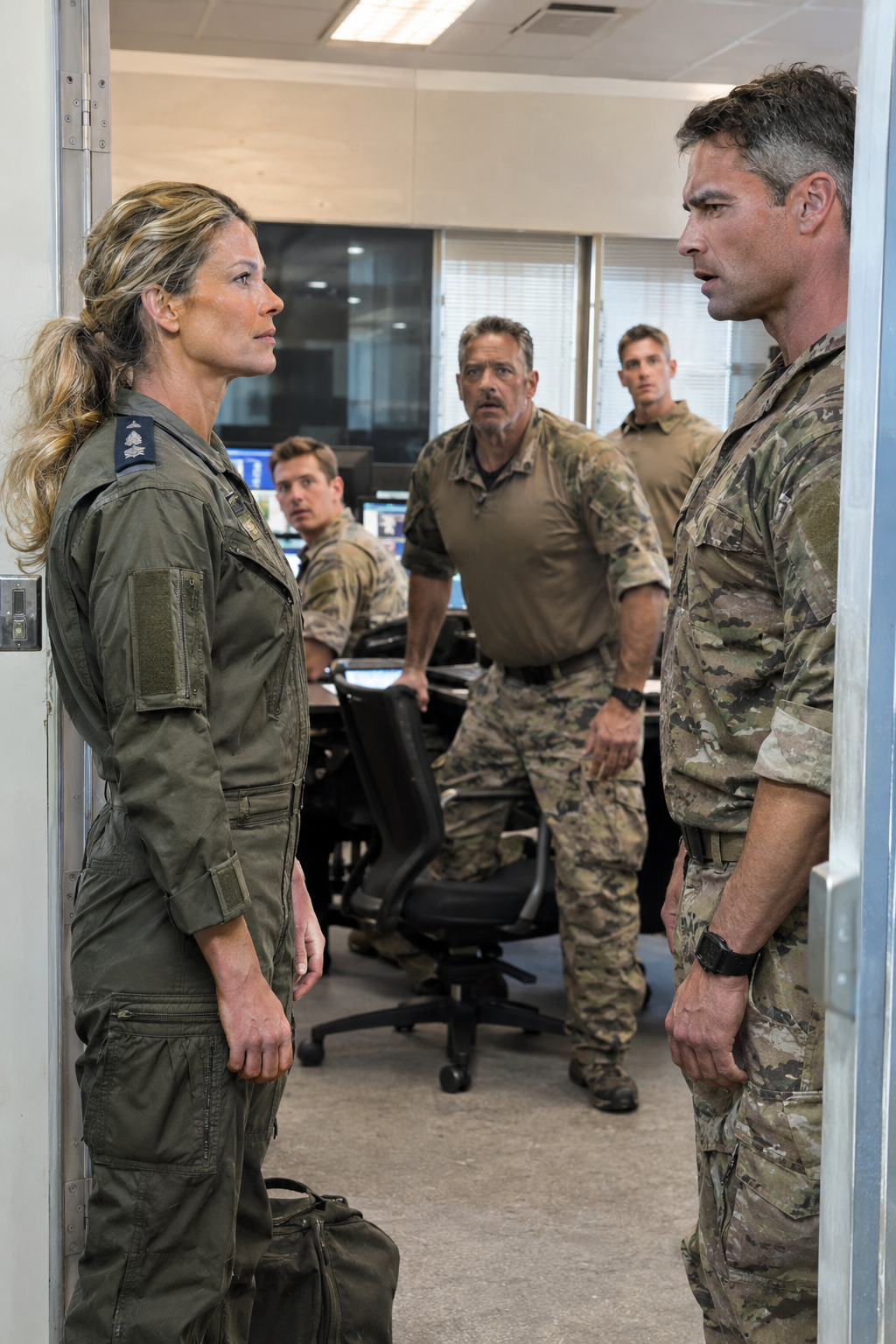
The Navy captain blocked the operations center door, called me a lost pilot, and demanded my call sign in front of everyone, never imagining those two words would bring back a night he had spent fifteen years trying to understand…
My name is Camille Brandt. In 2026, I was 46 years old, an Air Force colonel with 24 years of service, when a Navy captain decided I didn’t belong in the operations center I had come to command. Before I tell you what I said to him, you need to know how long I’d been hearing that I didn’t belong.
In the summer of 1991, when I was 11, my father took me to the flight line at the Air Force base where he worked. He was a crew chief, the sort of man who could hear an engine cough and know what needed fixing. I stood behind a yellow line, feeling the thunder of a cargo plane in my ribs, and told him I wanted to fly.
He laughed, not unkindly. “Crew chiefs keep them flying, Camille. Pilots just borrow them. Combat flying is a man’s headache.” He said I would want something steadier, and I believed he meant to protect me. That didn’t make the words hurt less.
My younger brother, Hollis, was four years behind me and dreamed of flying airliners. At dinner, Dad talked with him about routes, seniority, pensions, and getting home at night. When I talked about flying, Dad reached for the potatoes and said, “We’ll see.”
When I was 12, Dad taught me to safety-wire a bolt at the hangar on a quiet Saturday. On my third try, he gave a small grunt of approval that meant more to me than a speech. He could trust my hands around an airplane; he just couldn’t imagine me in its cockpit.
At 15, I rebuilt a lawnmower engine in our garage and started it on the first pull. Dad called it a nice hobby. Afterward my mother, Glenda, sat beside me on an overturned bucket and said, “Your father loves you. He just measures the world by what can go wrong. Don’t let his fear become your ceiling.”
I watched jets take off beyond the base fence and made a promise I didn’t share with anyone: one day I would be the person leaving the ground. I couldn’t let Dad’s fear choose my life.
A scholarship put me on the path to an Air Force commission. Dad was proud I’d earned it, then immediately suggested logistics or aircraft maintenance. When I accepted a pilot slot instead, he warned me again that I didn’t need to prove anything. I told him I wasn’t proving a point. I was choosing my work.
I was commissioned a second lieutenant in spring 2002, at 22. Dad attended with tears in his eyes, but spent much of the day listing the dangers ahead. Hollis, then 18, announced he’d entered a civilian flight academy, and Dad lit up. “Now that’s flying you can build a life on,” he said.
Pilot training was harder than I’d imagined. I was often the only woman in a room where every bad day seemed to count twice, so I studied late and rehearsed procedures until they followed me into sleep. In a stairwell after one awful day, I met Tessa Coyle, another exhausted trainee. We became the kind of friends who answer the phone on the first ring.
I earned my wings in 2003, at 23. Dad came to that ceremony too, and I watched him explain to another parent how worried he was about my future. Somewhere during the reception, I stopped trying to fly well enough to make him comfortable and started flying for the people who would depend on me.
In 2004, after becoming a first lieutenant, I was selected to fly gunships. They were not sleek fighters; they were heavy aircraft circling above troops in the dark, providing carefully coordinated support when those troops needed it most. I called home, foolishly hoping the news might finally sound like success.
Dad said I’d thrown away a safe career to play soldier. Hollis laughed. “They’re going to figure out you don’t belong, Cam. Save yourself the embarrassment.” I hung up, looked at the flight schedule above my desk, and went back to work. My family didn’t get to cast the deciding vote on my life.
I first deployed in 2006, newly promoted to captain, at 26. During that tour, ground troops asked our gunship to remain above them longer than planned. I kept assuring them we were staying. Someone started calling me “Sticky,” for the pilot who wouldn’t leave, and “Six” became part of my call sign as I grew into command responsibilities.
Sticky Six followed me through the years. The men below knew the voice better than the face. What mattered was that they could depend on us.
There was one night in 2011 I carried differently from all the others. A small SEAL element was trapped in a dry riverbed, and the decisions we made overhead mattered to every man down there. I rarely spoke about that night afterward, even to Tessa. I never knew the young ground commander’s face.
By 2012, I was a major with a Distinguished Flying Cross tucked away in a drawer. I commanded a gunship squadron as a lieutenant colonel in 2018 and made full colonel in 2024. My record included 22 combat sorties and mountains of paperwork that never made a good dinner-table story.
Hollis became a capable regional airline captain, and Dad told everyone about his son the pilot. When I visited, he still asked whether my job was dangerous and whether I’d thought about doing something safer. He seldom asked what I actually did. I learned to keep the most important parts of my life to myself.
Then, in 2026, I was assigned as incoming commander of the Joint Special Operations Air Detachment at Camp Lemonnier in Djibouti, on the Horn of Africa. It was a serious responsibility, with aircrews supporting missions where timing and trust could mean the difference between coming home and not coming home.
I arrived tired from travel, in a flight suit with subdued colonel’s insignia, carrying my helmet bag. On my first morning I headed for the joint operations center to report in. The access roster hadn’t yet caught up with my arrival. I expected to sort that out.
The room beyond the doorway was all screens, consoles, cool air, and people concentrating on urgent work. But before I could cross the threshold, a man stepped squarely into my path. He was Navy Captain Hugh Lockwood, a SEAL and the special operations task force commander working in that building.
He looked at my helmet bag, then my flight suit, without taking a proper look at my rank. “You’re not on my access list,” he said, loudly enough for the nearby staff to hear. “This is an operational space, not a terminal.” I could feel heads turn toward us.
I understood that secure rooms require verified access. What bothered me was the certainty with which he’d decided I was some careless stranger. He didn’t ask for my orders or give me a chance to explain why I was there. He treated the answer as settled before he’d heard it.
“What’s your call sign?” he demanded. “I don’t have time for lost aircrew.” Behind him, the operations center grew painfully quiet. I’d spent years learning that a raised voice didn’t require a raised voice in return, and I wasn’t going to start shouting in my new workplace.
I set my helmet bag on the floor. It wasn’t a dramatic gesture; I just wanted both hands free and a moment to look him in the eye. I thought of the nights I’d answered radios over men I’d never met, and I gave the same answer I had always given.
“Sticky Six,” I said.
At the back of the room, a master chief shot out of his chair so abruptly it rolled into the wall. “Say that again, ma’am,” he said. “Sticky Six,” I repeated, looking toward him. His expression changed first, then the faces of the men beside him.
Captain Lockwood stopped blocking the doorway with quite so much certainty. “That was the gunship,” he said, his voice suddenly thin. “The voice over the wadi.” He stared at me, then stepped back. “You saved my whole team.” The door was finally open, but I hadn’t yet begun to understand what this meeting would ask of us both. Part 2…..
IF FACEBOOK BROUGHT YOU HERE, HERE’S THE CONTINUATION YOU’VE BEEN WAITING FOR. ENJOY! 👇 I picked up my helmet bag and said, “Excuse me, Captain. I need to finish in-processing. I believe I’m expected.” Lockwood moved aside, and I walked through without asking anyone to make a scene. The room stayed strangely still behind me.
I hadn’t recognized him. Fifteen years earlier, the SEAL lieutenant on the radio had been only a voice; now he was a Navy captain wearing the weight of an entire task force on his shoulders. I knew he had remembered the worst night of his life. I wasn’t yet sure what he would do with the memory of our doorway.
That afternoon, people kept finding reasons to stop by my workspace. Some introduced themselves with excessive formality, while others offered a quick nod. A young airman placed a cup of coffee beside my papers and hurried away before I could thank her. I was the same tired woman who’d arrived that morning; only the room’s opinion of me had changed.
That evening, Tessa knocked on the door of my quarters. She’d been stationed at Camp Lemonnier already, and the story had reached her before dinner. She dropped into the only chair and said, “He tried to throw you out of the place you’re supposed to lead?”
“He didn’t know who I was,” I answered. Tessa folded her arms. “That’s not an excuse, Cam. That’s the problem.” I sat on the edge of the bed, thinking about all the times people had decided what I was worth without asking a question.
After a while, Tessa asked about the wadi. We had known each other since pilot training, yet I’d told her only fragments. So I told her how, in 2011, our gunship had been orbiting over a small SEAL team when the mission went wrong and enemy fighters trapped the men in a steep-sided, dry riverbed.
The attackers held higher ground on both sides, and some were frighteningly close to the SEALs, about 40 meters away. The young lieutenant on the radio asked for supporting fire. In the dark, with friendly troops so near the threat, every decision demanded careful coordination with the ground commander and every member of my crew.
I remembered my sensor operators calling out movement on the slopes and the flight engineer watching our fuel. I remembered the lieutenant’s controlled voice as he told me where his men were pinned down. I’d learned that the person on the radio could offer more than firepower; sometimes a steady report of what was happening kept panic from spreading.
“Keep your people low and close,” I told him that night, coordinating what we could safely do. Our crew continued providing support while the team worked toward an escape route. I wasn’t alone in those decisions. Every voice in the aircraft mattered, and the men on the ground had to trust what they were hearing.
Then our fuel margin began disappearing. The tanker wasn’t where we had expected it to be, and the choice became painfully narrow. We could leave the men without our coverage to seek fuel, or remain while they moved out of the riverbed and accept a far tighter return than any of us wanted.
I discussed the numbers with my crew. We stayed until the lieutenant reported that his team was clear, then turned toward the tanker and made it home with very little room to spare. Only after the wheels touched down did I feel how tightly I’d been holding myself together.
The lieutenant had thanked us over the radio. He said he didn’t know who I was, but he would never forget that voice. I had no way to know he would become Hugh Lockwood, or that one morning in Djibouti he’d tell the same woman to get out of his operations center.
Tessa listened without interrupting. When I finished, she sat forward, her elbows on her knees, and said, “So he spent fifteen years remembering Sticky Six, but couldn’t recognize the person standing in front of him.” I looked at my helmet bag beside the door. “Neither could my family,” I said.
Later that night, I called home. Mom asked about my flight, the heat, and whether I was eating properly, then handed the phone to Dad. He asked if the new assignment was dangerous. After I told him I was doing well, he said, “You could still come home and find something safe. You’ve done enough.”
For once, his words didn’t send me searching for a better way to explain myself. “I love you, Dad,” I said. “I’m exactly where I’m supposed to be.” When the call ended, I understood I could keep loving him without spending another year waiting for permission to be proud of my own life.
Part 3 A few weeks later, the change-of-command ceremony made my appointment official. Major General Yolanda Puit, the Army two-star commanding the joint task force in the region, read the orders and addressed the assembled personnel. She mentioned that some had met their new air detachment commander before knowing who she was.
“This is Colonel Camille Brandt,” she said. “Some of you know her as Sticky Six. A lot of people are alive because her crew stayed when it mattered.” Lockwood stood among the officers and heard every word without looking away. I appreciated that more than I expected.
He approached me afterward to apologize. Then he came back another day and tried again, plainly troubled by what he’d done. I didn’t need him to carry shame around like extra luggage, and I certainly didn’t need him reminding me of the doorway every time we had work to do.
The third time, I stopped him. “Hugh, don’t do it to the next person. When someone you don’t recognize comes to your door, verify their access, of course, but don’t decide they are worthless before they speak. Treat the next young pilot better than you treated me. That’s the apology I can use.”
He considered it, then nodded. “Yes, ma’am.” It was the first answer he’d given me that felt like we could build a working relationship. The point wasn’t to embarrass him in front of his people; it was to stop a bad habit from following him into the next room.
Around that time, Hollis called about my new command. “So you’re flying a desk now?” he joked. “Finally a job Dad won’t worry about.” I could hear the familiar grin, and for a moment I almost laughed along as I always had.
Instead I told him, “I command the air detachment that supports people when things go wrong. I called to share good news. If you can’t do that, I won’t keep making my work smaller to make this conversation easier.” He went silent and then said he needed to go.
The family group chat was quiet for two days. I didn’t feel victorious; I felt oddly unsettled, as though I’d put down a heavy bag and was still bracing for its weight. Mom checked in without asking me to take back a word. I was grateful for that.
At Camp Lemonnier, Lockwood began briefing his SEALs on the importance of treating unfamiliar aircrew and support staff with respect. Master Chief Eddie Salito, who had been in that wadi as a younger man, told new operators why the call sign mattered. He remembered the enemy closing to roughly 40 meters and the crew continuing its orbit until his team escaped.
I once heard Eddie telling the story at lunch and kept walking rather than interrupt him. What struck me wasn’t hearing my name praised. It was the simple fact that the men on the ground had always understood the purpose of the work my family kept treating as a dangerous phase.
Then word of my assignment began traveling back home in less official ways. A pilot friend of Hollis’s heard our surname and asked whether he was related to Sticky Six. Hollis initially laughed, thinking it had to be some mistake, until he saw the genuine respect on his friend’s face.
Hollis later admitted that he lay awake that night thinking about how casually he’d teased me. He’d always been Dad’s obvious success story, the son with a sensible flying career. Now a stranger was telling him about the sister whose work he’d barely bothered to understand.
Dad had his own uncomfortable encounter at the Veterans of Foreign Wars hall. A younger veteran heard the name Brandt and asked if he was related to the gunship pilot called Sticky Six. Dad told him I was his daughter, and the man’s reaction made him realize there was a whole part of my life he had never thought to ask about.
He went home, found Mom in the kitchen, and asked whether we had any articles or records of my service. Mom went to the high shelf of her closet and brought down a shoebox she’d been quietly filling for nearly twenty years. She set it on the table and left him alone with it.
Inside were clippings, copies of letters I’d sent home, and a copy of a commendation she’d kept. Dad sat there for hours reading. He had spent decades listening for danger whenever I described my work, and now he was reading the achievements he’d been too frightened to see.
When Mom told me, I pictured him at the kitchen table under the old light. The discovery didn’t erase how many times I’d walked away from that table feeling unimportant. It was painful, in a different way, to realize he was finally ready to know the person I’d become.
Part 4 I asked Mom why she’d never told me about the box. “I didn’t think showing it to him before he was ready would change his mind,” she said. “But I wanted the truth to be there if he ever went looking.” I sat with that for a while, remembering how often her quiet encouragement had carried me farther than Dad’s advice.
I had spent so much energy noticing the pride I wasn’t getting that I’d almost missed the loyalty I was. Mom had kept every scrap she could find while the rest of us avoided a difficult conversation. I called her again the next morning just to say thank you.
Back at the detachment, the real test of my relationship with Lockwood came during an operation involving his SEALs and our aircrews. I couldn’t share the operational details, but it required the two groups to coordinate carefully and trust one another’s decisions. There was no room for the pride he’d shown at the doorway.
The operation went well. Afterward, Lockwood found me while I was finishing paperwork and offered his hand. “It’s an honor to work with you, Colonel,” he said. This time there was no long apology attached, and I was glad to shake it.
A few days later, Hollis called again. He sounded tired, and he didn’t start with a joke. “I’ve been thinking about why I kept putting you down,” he said. “I think I needed your career to seem smaller so mine would feel bigger. That was unfair to you. I’m sorry, Cam.”
I didn’t rush to make him feel better. “Thank you for saying it,” I told him. “We can’t pretend all those years didn’t happen, but we can start again.” He answered, “Slowly?” and I said, “Slowly is fine.”
Dad found it harder to speak. He wrote a letter instead, in the square, careful handwriting I’d known since childhood. It arrived at Camp Lemonnier, and I opened it sitting on the edge of my bed, expecting some familiar warning about my safety.
“I spent thirty years keeping other people’s airplanes safe,” he wrote, “and I never trusted my own daughter in the sky. Your mother kept a box. I read it. I didn’t know because I never asked. I was afraid, and I called that love. I let my fear become your ceiling.”
He went on to say he’d been wrong and that he was proud of me. He wished he’d said it when I first told him I wanted to fly. I read the letter twice and set it beside me, because for once his words weren’t trying to pull me back to the ground.
The letter didn’t repair everything. It did give us somewhere honest to begin. I kept it, even after the folds grew soft from being opened, and when I called Mom she could hear in my voice that I was willing to come home and try.
Work continued. New aircrew arrived, and I made a point of welcoming them before demanding that they prove they belonged. Lockwood began doing the same. He was a capable commander, and I found that I respected the effort it took for him to change a habit in front of the people who knew him.
Eventually Lockwood rotated to another assignment. Before leaving, he told the incoming task force about the day he’d mistaken the pilot who had helped save him for someone who didn’t belong. He didn’t tell it to make himself look good; he told it so they would pause before doing what he’d done.
I stood in the back as he spoke. Hearing him admit the mistake in public meant more than any private apology. Afterward I began sharing my own mistakes with new aircrew, too, because the lesson was bigger than one captain or one doorway. You can’t lead people well if you’ve already decided they aren’t worth noticing.
In early autumn, I scheduled leave to visit my family. I knew that hearing Dad say he was proud in a letter was different from meeting his eyes over the breakfast table. I packed the letter in my bag anyway, uncertain whether we’d know how to talk without falling into the same old roles.
Final Mom met me at the front door and held me longer than she usually did. Hollis was behind her, looking awkward and genuinely pleased. He hugged me and called me “Colonel” with a half-smile, not as a joke at my expense but as a little sign that he finally understood.
Dad was quieter. He asked about the trip, carried my bag inside, and didn’t launch into warnings about danger. At dinner, Hollis asked about the people I worked with and actually listened to the answer. Mom kept resting her hand on my arm as though she couldn’t quite believe we were all sitting together this way.
The next morning, Dad asked me to ride with him. He drove to a small civilian airfield outside town, where a few single-engine airplanes sat near a windsock. We walked to the fence, and for a while he stared toward the runway, the same way he’d stood beside me when I was 11.
“Tell me about that night,” he said at last. “The riverbed. I’ve heard it from strangers, and I read what I could. I want to hear it from my daughter.” He was looking straight ahead, which I knew made the asking easier for him.
So I told him about the men trapped below us, the flashes on the ridges, the lieutenant on the radio, and the fuel that kept getting lower. I told him about the crew beside me and the decisions we made together. My voice faltered at moments, but he waited instead of changing the subject.
When I finished, Dad asked how I had managed the risk of supporting troops with enemy fighters so close. I told him no pilot gets certainty handed to her, and no commander works alone. “You taught me to respect machines and pay attention to every detail,” I said. “I had to learn to trust my own judgment, too.”
He turned away from the runway and looked at me. “I was wrong, Camille,” he said. “I spent all those years keeping airplanes flying, and I couldn’t accept that my daughter belonged in one. I’m sorry I made you wait so long to hear me say I’m proud of you.”
I’d already built a life without those words. That didn’t mean I had stopped wanting them. We stood quietly at the fence as a small airplane lifted into the blue sky, and for the first time the silence between us felt like company instead of distance.
Before we left, Dad asked a friend who owned a battered little training plane whether I might sit in it. His friend said yes. Dad held the door while I eased myself into the narrow pilot’s seat, and he leaned in to look at the instrument panel as if we’d returned to that Saturday when he’d taught me to safety-wire a bolt.
He tapped the fuel gauge. “Don’t run this one down to the edge,” he said. “You’ve got nothing left to prove.” We both laughed, and I heard what was different. He was still my cautious father, but this time he wasn’t asking me to give up flying. He was standing beside the aircraft instead of between me and it.
The rest of my leave was ordinary in the best way. We ate together, Hollis asked questions without trying to win a comparison, and Mom watched Dad say he was proud of me more than once. None of us could recover the years we’d missed, but we stopped adding new ones to the loss.
I returned to Camp Lemonnier and finished my tour doing the job I’d come to do. I kept Dad’s letter, Mom’s story about the shoebox, and the memory of Hugh Lockwood stepping back from that doorway. They reminded me that people can be wrong about us, and sometimes, with effort, they can learn to see us clearly.
When I think about the call sign Sticky Six now, I don’t picture a room falling silent. I think of the men in the wadi, the crew working beside me, my friend who listened, and my mother quietly saving pieces of a life she believed in. I think of the girl behind the yellow line, and I’m glad she kept her promise to herself.
THE END. I’ve shared the complete story, and I truly hope it touched your heart. If this story moved you, please , like, and share the post. Thank you for reading! ❤️
✓ Lynn R. Adams
The Navy captain blocked the operations center door, called me a lost pilot, and demanded my call sign in front of everyone, never imagining those two words would bring back a night he had spent fifte…