The morning my parents dismissed my graduation as a “loser’s parade,”
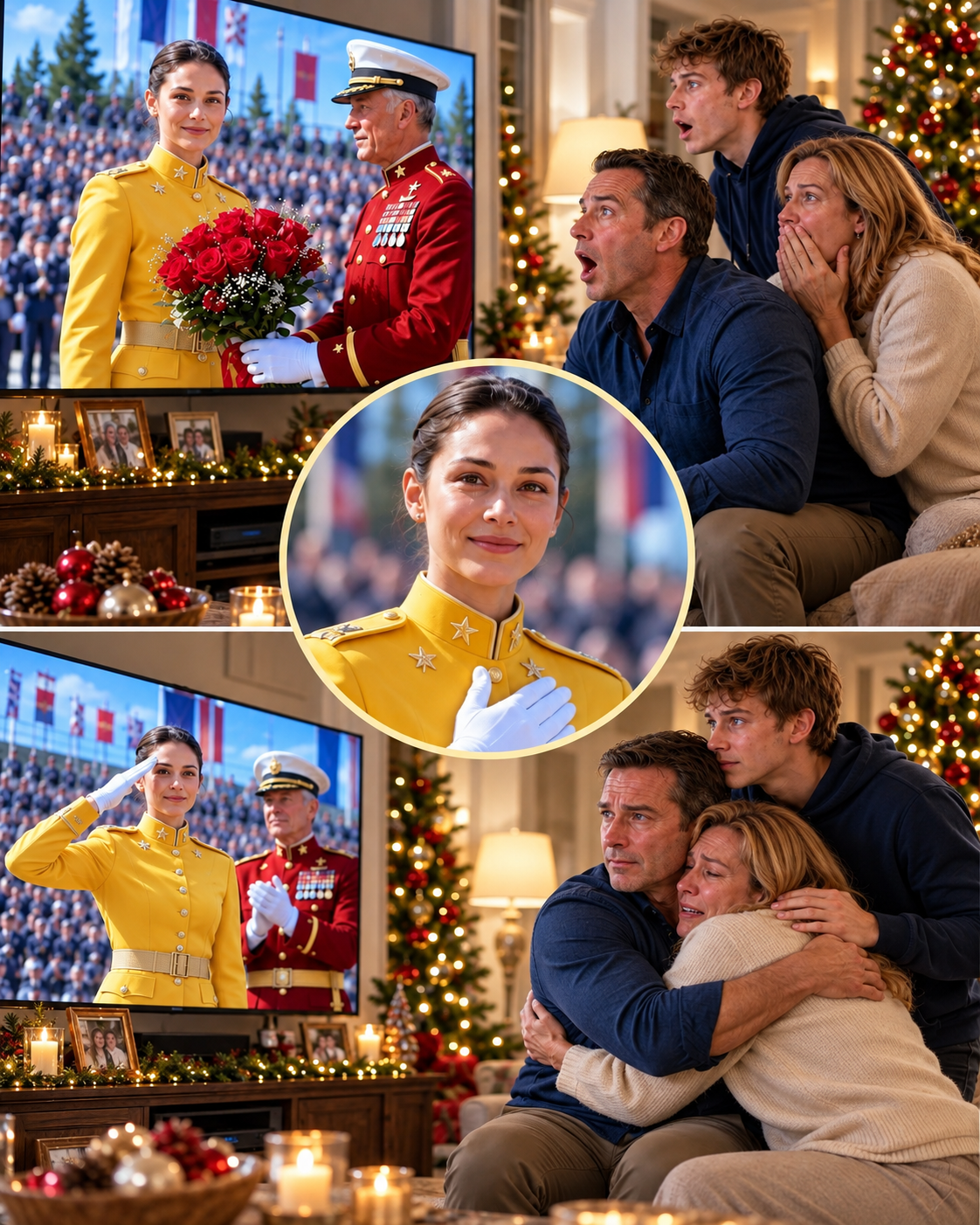
Part 2: A colonel’s salute uncovers the secret my father buried
Tyler still wore his jersey from the game his team had lost by twelve points. A blue-frosted cake sat on the counter with “Great Season, Tyler!” written across it, and its bright frosting hurt more than I expected. My mother said they were proud of me now, but I told her choosing the game after promising to attend my graduation had been a decision, not an accident. Dad ignored that and demanded to know how well I knew Colonel Pierce. I said Pierce had mentored me for two years, reviewed my evaluations, and recommended me for commissioning, and watched alarm replace anger in my father’s expression.
Dad reached for my folder and ordered me to reject my assignment to Washington. He said Pierce had manipulated me and that I had no idea what kind of man I had allowed into my life. I asked how an insurance salesman from suburban Virginia knew a senior Marine officer well enough to fear him. Before he could answer, headlights swept across the living-room wall and three firm knocks sounded at the front door. Colonel Pierce stood on the porch in dress uniform beside a gray-haired attorney named Margaret Hale, carrying a leather case and no patience for pretending we were strangers.
“Daniel,” my father said, almost too quietly to hear. “Richard,” Pierce replied, and the name landed between them like a confession. Margaret opened her case and said it concerned Captain Laura Bennett, a name that made my mother start crying. Inside was an old photograph of a younger Pierce beside my father and a dark-haired woman whose eyes and cheek dimple looked like mine. Dad finally admitted he had served in the military and that Laura had given birth to me. He said she disappeared overseas eighteen years ago after staying behind during a compromised extraction, while my mother said she had raised me because Laura asked her to protect me.
Pierce told her that was not what Laura had asked. Margaret laid out a sealed declaration bearing my birth name, Emma Laura Bennett, along with a protected trust and instructions to tell me the truth when I turned eighteen or received my commission. The papers showed that my parents had agreed to disclose it months earlier. I asked why Dad had mocked the military, dismissed my academy achievements, and acted as if my success offended him. “I wanted that world buried,” he said, but Pierce replied, “You wanted Laura buried.” Their argument spilled into a secret operation, false coordinates, and a woman both men said they had tried to protect. Then Tyler stepped forward with an envelope he had found in Dad’s safe, addressed to me in a handwriting no one recognized.
Part 3: A hidden letter turns my childhood into evidence
Dad lunged for the envelope, but Pierce caught his wrist before he could reach it. Margaret demanded to know why a letter linked to a missing intelligence officer had been kept in a private safe for eighteen years. Dad claimed it had arrived after Laura’s funeral with no return address, and Tyler said he had recently overheard him planning to destroy it. The envelope held a brass key engraved with the number 417 and a handwritten note addressed to “My dearest Emma.” Its first line said that if I was reading it, either the people Laura trusted had finally chosen honesty or their lies had fallen apart.
Laura wrote that I had been born into a danger I did not create, and that I must never believe she had abandoned me or died overseas. She named a deposit box that could explain what happened and warned me not to trust anyone simply because he wore a uniform. Then came the sentence that made every person in the room look at my father: “Especially not the man who calls himself your father.” Dad denied betraying Laura, and Pierce accused him of connecting himself to the false extraction coordinates. When Dad called Laura confused and unreliable, Pierce hit him once, sending the white roses from my graduation skittering across the floor.
Margaret stopped them before the fight worsened, and Dad revealed that the operation, called Project Starling, had targeted an international network trafficking weapons, intelligence, and false documents. The adults contradicted one another about my birth, leaving me unsure whether Laura had been my biological mother, whether I had been an infant rescued during the operation, or whether the guardianship papers had been designed to confuse anyone searching for me. Federal agents arrived to question Richard about Laura’s disappearance and the hidden records. As they led him out, he told me someone had searched for the missing child connected to Project Starling for eighteen years. Mom collapsed after the agents left, while Tyler stood beside her with a worried look I had never seen on his face.
My phone buzzed as Pierce asked who had contacted me. I said it was nothing, but the message showed a photograph of me on the graduation field, taken from beyond academy security. The sender claimed Laura was alive and promised I could meet my “real mother” at the Jefferson Memorial at midnight. Another message told me to ask Pierce what “Starling” meant and warned me not to trust him. Tyler caught me changing into civilian clothes and admitted Dad had spent years calling me arrogant whenever I succeeded. He gave me his car keys, and I drove toward Washington with the brass key pressed against my leg, determined to hear the truth from someone who had not been allowed to explain it.
Part 4: A midnight meeting makes the past speak
At 11:57 p.m., the Jefferson Memorial stood nearly empty under a pale moon. I waited beneath the statue, every lesson about operational security telling me I had followed an anonymous stranger to a perfect place for an ambush. A woman in a gray coat stepped from behind a column, silver threading her dark hair and a scar tracing one side of her face. I recognized her eyes from the photograph before she said her name: Laura Bennett. To prove she was no stranger, she described how I had stopped crying as an infant whenever birds gathered outside an open window, and told me she had called me her little starling.
I wanted to run into her arms and strike her for leaving me at the same time. Instead, I asked why she let me believe she was dead while I grew up with people who ignored, feared, or resented me. Laura said her disappearance was meant to keep me alive, because people tied to Project Starling believed both mother and child had died. She admitted she had chosen the wrong guardians, then told me Richard had hidden evidence and accepted money for his silence. Before she could explain, she named Daniel Pierce as the man who had transmitted the false extraction coordinates.
A shot struck the marble column where my head had been. Laura shoved me down and fired toward a shadow; black vehicles closed in from both sides of the memorial, and Pierce emerged with federal agents. He ordered me away from Laura, who accused him of betraying the mission. Pierce said he had transmitted coordinates supplied through Richard’s credentials, while Laura had altered parts of the operation without telling the whole team. When I demanded answers, he described Project Starling as an infiltration of the criminal network, not a routine investigation. Laura had posed as the partner of its leader, Adrian Vale, and discovered his crimes were larger than authorities understood.
Laura admitted Adrian was my biological father, but another burst of gunfire forced us to flee before she could say who altered the information. Pierce drove us away while Laura pressed cloth to a wound in her shoulder. She gave me a metal token and said the place named in her letter was a decoy; the real evidence waited in locker 417 at Union Station. Pierce threw my phone from the car after explaining the messages had likely exposed our location. At an underground garage, Margaret was waiting with Tyler, who complained I had taken the car he had given me. His joke nearly made me laugh, but Laura warned me not to open the locker without her. I told her I had waited eighteen years and would not let another adult postpone the truth.
Part 5: Locker 417 reveals the brother I never knew
Pierce and I reached Union Station before dawn and found locker 417 in an old corridor near the lower platforms. Laura’s token opened a compartment holding a black case, passports, photographs, coded ledgers, a sealed recorder, and a birth certificate listing me as Emma Laura Bennett, daughter of Laura Bennett and Adrian Vale. A photograph clipped behind the certificate showed Adrian beside Laura, looking younger and almost relaxed. Pierce stared at him in alarm because Adrian’s face looked uncannily like Tyler’s. My brother had always been told he resembled Richard, so he stared at the picture as if it might change if he looked long enough.
The recorder came to life when I touched a control. A man’s voice said that if Emma had opened the box, then both of his children had finally found each other. It said we were not adoptive siblings; Tyler and I were twins. Margaret confirmed that our legal birth records had been altered for our protection and that we were both born on June fourteenth, during the operation’s final phase. Laura had been told that keeping the children together might make them easier for Adrian’s organization to locate. Tyler sat against the lockers, and years of rivalry began rearranging themselves: our matching nervous finger taps, shared fear of thunderstorms, and nightmares that sometimes woke us at the same hour.
Mom had known we were twins, while Richard apparently knew only that we were both connected to the operation. The recorder continued, saying someone inside Laura’s command had manipulated the extraction and separated the children. A section containing the crucial name had been damaged so neatly that it looked deliberate. Beneath the recorder, I found an old Harrison Military Academy insignia belonging to General Marcus Thorne, the commandant who had approved my scholarship and placed me on the intelligence track. Hours earlier, he had introduced me as valedictorian. Now I wondered whether he had encouraged my talent or simply watched the daughter of Laura Bennett grow up.
Pierce received word that Laura had left the secure medical facility before her wound was treated. Before we could decide where she had gone, General Thorne appeared in the corridor with two armed men and congratulated me on my speech. He admitted he had used Project Starling to divert weapons and intelligence through Adrian’s network, and had manipulated Richard’s credentials to hide his own communications. He said the twins had been separated as leverage because Adrian wanted a son to inherit his criminal empire. “Tyler was the one they were searching for,” he said, as Laura appeared on an upper balcony and fired at one of his men. Pierce engaged the other; Thorne fled toward a departing train, and Tyler grabbed my hand. “Together?” he asked. “Together,” I answered, no longer as his rival, but as his twin.
Part 6: Project Starling exposes the men behind our lies
We caught the train as it entered a tunnel and found Thorne holding Laura at gunpoint inside an almost empty carriage. Pierce stood several feet away, searching for an angle that would not get her killed. Thorne spoke as if we had arrived late to one of his lessons. Adrian, he said, had built his empire around succession and believed sons should inherit power. When he discovered Laura had delivered twins, he demanded the boy, so Laura told him both babies had died and Richard altered records to hide Tyler. Dad’s warning that someone had searched for the missing child suddenly made sense; I had assumed the danger centered on me.
Laura said Richard had once loved her, then took in both children partly out of loyalty and partly out of guilt. Pierce believed the affection had curdled into resentment whenever my achievements reminded Richard of the woman he had lost. That did not excuse Dad’s cruelty, but it gave it a shape: he had punished me for resembling Laura and, in doing so, made me feel responsible for a grief I had never known. The train lights flickered. Pierce attacked Thorne, Tyler kicked the fallen weapon beneath a seat, and Laura reached for the emergency brake. The struggle spilled into the next carriage before a shot hit Pierce beneath the ribs.
I pressed my hands to the wound while waiting for help. Pierce admitted Adrian had contacted him two months before graduation, offering information about Thorne in exchange for seeing his children. Pierce delayed the meeting because he could not tell whether Adrian wanted reconciliation, recruitment, or revenge. When Laura asked where Adrian was, Pierce answered: Harrison Military Academy. The academy where I had expected to find order and purpose had become another stage for adults to settle their secrets. After sunrise, federal teams moved us into protective custody as news reports connected my speech to reopened allegations involving espionage, military corruption, and a missing international trafficker.
My mother arrived under guard and finally answered the question that had hurt more than any classified detail. She had favored Tyler because he seemed to need her, while looking at me reminded her of Laura, the woman Richard loved before her. My awards made me seem stronger and harder to control, she said, and that frightened her. Tyler replied that she had kept him dependent because it made him easier to love. I told her she had not protected us so much as protected herself from the truth. Then a secure call arrived from Adrian, demanding Tyler come to Harrison Academy; a video showed Richard bound in the chapel beside Thorne. Laura wanted us to stay behind, but Tyler said adults had made decisions for us in secret for eighteen years. I agreed, and a federal operation moved toward the academy with us attached under strict conditions.
Part 7: Harrison Academy becomes the battlefield
Storm clouds gathered over Harrison Academy as we entered the chapel. Dad sat bound beneath stained-glass windows, Thorne stood armed beside him, and Adrian Vale waited near the altar. He looked at Tyler with unmistakable emotion and called him “son.” Tyler answered that his name was Tyler Whitaker, not Vale. Dad said he had saved a child from becoming another version of the criminal before us. When I asked Adrian what he thought he had saved me from, his certainty broke; standing beside Laura, I looked so much like her that he could no longer pretend his children were merely symbols in a succession plan.
Thorne interrupted, but Laura began listing his crimes: falsified coordinates, stolen intelligence, separated children, and weapons diversions. Adrian realized the general had lied to him, too. I played the recording from the locker, and Adrian immediately said the voice was not his. Thorne had fabricated it to manipulate us and control when the twins learned the truth. His last hold over the room gone, he raised his weapon. Dad threw his chair into Thorne’s legs, and the chapel erupted as Tyler charged Adrian, Laura tackled Thorne, federal agents entered through the side doors, and I crawled toward my father to cut his restraints.
Thorne broke free and fired in my direction. Dad moved between us and took the bullet in his chest. I caught him beneath the academy banners he had mocked that morning. He told me he had always known I was extraordinary; he had watched my speech secretly before Tyler’s game ended. My strength reminded him of Laura and made him feel unnecessary, he admitted. Medics arrived while he was still conscious, and he raised two trembling fingers in a broken salute. I returned it, unable to decide whether it meant forgiveness, goodbye, or recognition arriving eighteen years too late. Nearby, Adrian turned against Thorne, was wounded in the struggle, and died after telling Tyler not to inherit the empire built in his name.
Thorne dragged Laura toward the bell tower. I followed despite Tyler shouting after me, unwilling to watch another adult disappear with the truth. Rain swept through the open arches as Thorne held Laura against the railing and told me courage would not make me powerful. “Truth will,” I said. Margaret had already begun broadcasting pieces of Thorne’s recorded confession through the academy’s emergency system. Hearing his own words, he faltered; Laura struck him, and he slipped over the edge, catching my wrist. I could have let go, but I held on until Laura helped pull him back and agents arrested him. When the storm began to break, Tyler wrapped his arms around Laura and me. The people Project Starling had divided stood together without another secret between us.
Part 8: Living with the truth asks more of us than surviving
Three weeks later, the academy held a memorial for Project Starling’s victims and for people freed after Thorne’s records exposed trafficking routes across several countries. Prosecutors prepared charges that could keep him in prison for life and dismantle what remained of Adrian’s network. Pierce survived emergency surgery; Dad survived after his heart stopped for ninety-four seconds on the way to the hospital. During my first visit, Richard said he did not expect me to forgive him. I told him it could take years, and that forgiveness might never look the way he hoped. For once, he accepted that my feelings were mine to decide.
Mom entered therapy, cooperated with investigators, and admitted helping conceal our identities. She avoided prison because she had not taken part in the original criminal conspiracy, but Tyler and I moved out. Legal consequences and the work of repairing a relationship were not the same thing. We rented an apartment near Washington while I prepared for my assignment and Tyler enrolled at community college. He chose social work, surprising everyone who had assumed basketball was his only ambition. “I spent eighteen years confusing attention with love,” he told me. “I want other kids to learn the difference sooner.”
Laura lived nearby under her restored identity, but being reunited did not make us a family overnight. She was my mother, a survivor, a stranger, and the person who had left me with guardians who hurt me. Some days we talked for hours about books, military history, food, and the years she had spent under false identities. Other days, seeing her brought every missed birthday back. She let my anger sit beside her love without demanding gratitude. Pierce returned gradually to public service and supported an independent review of the ways Thorne had used the academy to monitor me. Tyler and I learned to be siblings without the roles our parents had assigned us; Mom and Dad began trying to rebuild separately from us, without expecting us to make the work easier.
At the memorial, I carried a prepared speech to the same parade field where my graduation video had gone viral. I folded the pages when I saw Laura beside Tyler, Pierce near Margaret, and my parents seated several rows behind them. I introduced myself as Emma Laura Bennett Whitaker, choosing both names because I would decide which parts of my history I carried. Blood could be hidden, manipulated, or misunderstood, I told the crowd; family was better measured by people who told the truth, respected your choices, and stood beside you without claiming ownership. The speech everyone thought was about rejection had always been about recognition: one person’s absence could hurt without proving that no one else would show up. This time, I looked across the stands and found no empty chairs beneath my name.
Part 9: Every filled chair proves I can choose my family
After the ceremony, Laura gave me a small wooden box. Inside was a silver starling pendant she had worn during Project Starling and meant to give me on my eighteenth birthday. “You’re late,” I said. “Very,” she answered, without dressing eighteen lost years up as a noble sacrifice. She waited instead of reaching for me, so I chose to close the distance and hug her. Tyler joined from one side, Mom approached from another, and Dad arrived with a cane, still recovering from the bullet he had taken in the chapel. No one knew quite how all of us were supposed to fit into one picture.
Tyler broke the awkwardness by announcing that standing apart looked ridiculous and pulling Mom into the group. Pierce tried to slip away, claiming the situation already had enough federal scrutiny without photographic evidence. I caught his sleeve and reminded him that his salute had started the chain of events. Margaret took the photograph anyway, capturing people who were neither healed nor unchanged, but who had stopped insisting that family required everyone to remember the past the same way. Months later, I reported to Washington and placed the photograph beside the white rose Pierce had saved from graduation night. The starling pendant rested at my throat.
My new assignment involved strategic analysis. For the first time, it did not feel like a way to prove my worth to my parents, because their approval no longer measured my achievements. Tyler visited between classes with coffee and news that Dad was walking without the cane and Mom had begun volunteering at a youth center. He invited everyone to dinner at Laura’s place, including Pierce. Dad apologized to Pierce for blaming him and admitted that he had resented me for reminding him of Laura, just as he had resented Tyler for needing him. “Fear felt easier when I could blame somebody else,” he said. The evening was awkward: Mom cried, Tyler complained no one had asked about his coursework, and Margaret criticized nearly every legal decision our family had made.
Laura and Richard argued about the guardianship agreement, and somehow that discomfort felt more honest than any perfect family dinner I could remember. Nobody asked me to perform gratitude, success, forgiveness, obedience, or strength in order to keep my chair. Near midnight, Laura and I stepped outside beneath a dark sky where a flock of starlings crossed above the trees. She said she had believed disappearing would keep me safe, then learned that safety without truth could become another kind of captivity. I told her that returning did not erase leaving, but leaving did not decide what we could build next. Inside, Tyler called us back because Mom was cutting a cake that read, “Welcome Home, Emma and Tyler.” I touched the pendant and joined the family I no longer had to excuse or escape, knowing strength did not mean marching alone; it meant choosing who deserved to walk beside me.
✓ Lynn R. Adams
Part 2: A colonel’s salute uncovers the secret my father buried Tyler still wore his jersey from the game his team had lost by twelve points. A blue-frosted cake sat on the counter with “Great Season…