The morning Karen Sutcliffe tore down my grandfather’s bridge, she believed she
Part 2: The HOA claimed authority over land it never owned
I brought my deed, the subdivision plat, and the original map to the HOA’s March meeting. Nine board members sat around a table in the clubhouse, and Karen listened while I explained that my parcel had never been part of their subdivision. A couple of board members leaned in to study the documents. Karen didn’t touch them. “We’re not relitigating the shoreline tonight,” she said, and announced the demolition was already scheduled.
That answer bothered me more than the violation notice. Devol County didn’t issue demolition permits over the phone; someone had to submit an application and certify that the property owner had consented. I was the property owner, and nobody had asked me anything. The next morning, I hired Filamina Greer, a lawyer whose office sat above a hardware store. She listened without taking notes, then told me I was the fourth person from the lake to sit in her office and the first with a deed to the water.
“I don’t want your deed,” she said. “I want theirs.” An HOA could govern only the land legally included in its subdivision, so she and I spent the day in the county records room tracing every instrument recorded against Milbrook Harbor Estates. There were nine: later development phases, common-area dedications, a utility amendment. Greer set them aside one by one, then stopped. Parcel 26-084 appeared in none of them. It had never been annexed, included, or released from the community; it had simply never been part of it.
For a moment, that felt like victory. Then I remembered the bridge in the creek and understood that being right had not stopped the hammer. Greer sent a cease-and-desist letter, and I went to the county permitting office to ask about the demolition file. The code officer, Pervis Tandy, pulled the folder while I stood across the counter. His expression changed as he read. “That’s not a good huh,” I said. “No,” he replied, turning the papers around so I could see the permit and a checked box stating that owner consent was attached.
The consent page was blank: no name, no signature, no date. Tandy suspended the permit pending review, and by Wednesday the machines were gone. I called Shep Dunigan, a stonemason who had restored a mill wall in the next county. He waded into the channel, examined the surviving stones, and said most of the arch could be rebuilt if we recovered it before winter. Then he put a hand under the surface and found the sill in better shape than the arch had been. That night, for the first time in weeks, I slept.
Karen didn’t back down; she changed tactics. The board imposed retroactive fines of $300 a day and recorded a $24,600 lien against Burnside Landing. It also revoked the recreational license that let my commercial guests use the lake. Two days later, I arrived with a boat trailer and found the road across HOA common land blocked by a steel gate, chained and tack-welded shut. It was the only way to reach the public road without driving fourteen miles around the lake.
My daughter Sylvia and my employee Adeline began recording the cancellations. I told Adeline to put the notepad away, but I still saw the shrinking bookings in the quiet spaces around the shop. Then Doretta Snavely, an East Shore resident who had opposed Karen for years, came in for bait she didn’t need. She waited until we were alone and told me she had overheard Karen call the bridge demolition “phase one.” The word stayed with me long after Doretta left. Nobody called something phase one unless something else was coming.
Part 3: Phase two threatened the lake, the cabins, and the clubhouse
Greer called me into her office when the county file arrived. She had three pages laid out on her desk, squared at the corners, and told me to sit down before she showed me. The first was the demolition application signed by Karen. The second was the consent page, still blank. The third was the permit’s environmental checklist, where someone had checked “No” beside the question asking whether the work affected an impoundment or other regulated water-retaining structure.
“She read the question,” I said. “She had to read it to check it.” Greer agreed, but said that wasn’t the part she wanted me to see. The last sheet was a work order from Van Horn Demolition and Excavating, signed by Karen and billed to the clubhouse project. It described work “all of it down to the creek bed.” I called the contractor from Greer’s parking lot. He told me a second phase was planned for the end of May: the abutments and whatever lay beneath them.
I drove home in the rain, put on waders, and walked out into the channel. I hadn’t run my hands across the sill since I was a boy, but I followed it all the way across its thirty-one feet of dressed stone. Then I measured its elevation twice against the county benchmark. The top sat at 812.5. The clubhouse intake, according to the association’s own construction drawings, sat at 800.6—more than eleven feet lower.
I worked through the numbers on the back of a receipt, and my hands began to shake. If Van Horn removed the sill, the lake would drain toward the old creek bed, dropping eight or nine feet in a matter of hours. My cabins would sit above mud; my marina would become useless. But the clubhouse would lose its water, too. Its intake would be left high and dry, cutting off the pool, kitchen, bathrooms, and sprinklers that depended on the lake Karen had treated like community property.
I found her on the clubhouse terrace the next morning, with sprinklers ticking across the lawn behind her. I told her to cancel phase two and explained the elevations. I offered to bring an engineer to inspect the sill that very day. Karen looked at me as if I were trying to sell her something. “You’re threatening me with a rock in a creek,” she said. Then she closed her binder and accused me of suddenly calling my property critical infrastructure because it had become a liability.
Greer ordered a complete title search against the association’s property. The documents from 2019 were being digitized and weren’t yet available, so we had to wait. We didn’t have time to wait: Van Horn’s barge was penciled in for the end of May. Greer filed for an emergency injunction, arguing that the stonework was a dam recognized by the state. The structure had once carried inventory number DV1136, assigned when the state catalogued impoundments in the 1970s.
At the hearing, Greer built her case around that number. Karen’s attorney answered with the state’s 2011 inventory showing DV1136 had been removed. The state could not locate a responsible owner, he said, and had found no maintained embankment or operating spillway. The HOA also produced an engineering letter describing the submerged masonry as streambed armoring—but the letter was based on photographs, not a site inspection. The judge would not issue an injunction while the engineering question remained disputed. A full hearing was scheduled for June 10, after the contractor’s planned work.
Part 4: With court delayed, I chose to make my warning undeniable
Outside the courtroom, Karen’s lawyer quietly advised Greer to prepare for the site to be cleared before June. Karen stood near the elevator and told a board member I was fighting over “a pile of rocks.” That week brought more trouble. The county red-tagged a temporary crossing I’d built to reach the north cabins after the bridge was destroyed. The work was unpermitted fill in a waterway, and the county could not ignore a written complaint just because the HOA had acted badly first.
Then my bank called about the seasonal line of credit. The recorded lien had frozen the renewal, even though Greer was challenging its validity. I used that credit to buy bait, fuel, and insurance every spring. Meanwhile, more than sixty percent of the June cabin bookings were gone. People had heard the lake might be drained, and no one wanted to drive hours to fish a mud flat. One night I sat on the recovered archstones, listening to the cold move through the dark, and realized I was doing the arithmetic of a man preparing to quit.
My daughter Sylvia was nineteen, and I had promised her the camp could be hers if she wanted it. I had meant it when I said it. Now I was imagining what the property would be worth without water and wondering whether there would be anything left for her to inherit. That was when I stopped trying to believe the law would get there in time. I could not keep Karen from ordering the work, but I could make certain she knew exactly what it would do before she signed off.
Greer revised the letter I drafted and sent it by certified mail to Karen, every board member, Van Horn, and the HOA’s insurance carrier. It didn’t argue over jurisdiction; it laid out measurements. The sill’s elevation was 812.5, the clubhouse intake was 800.6, and removing the sill would drop the pool below the intake. We attached survey notes, photographs with a scale rod, and a simple cross-section drawing. The letter said plainly that the clubhouse would have no water supply if the structure were removed.
Karen signed the green card on May 14. Two days later, a board member passed me her reply: “If the pond drops, we’ll fill the pool with a hose.” I felt no hope, only certainty. Then Elizabeth Caro, the HOA’s longtime recording secretary, came to the bait shop carrying two pages she had kept in a folder since 2019. One was a memorandum from the association’s engineering firm warning that the clubhouse intake depended on the privately owned structure and recommending either a proper water-line connection or an agreement with my family.
The second page was the minutes from a board meeting. Karen had moved that the engineering memo not be included in the packet distributed to members, because it might frighten them about the assessment. The motion had passed four to two. Caro said she had kept the folder because she could not forget what happened when the board buried the warning. I called the engineer who had written the newer letter to the judge and learned he had never visited the site; the HOA had sent him photographs of the collapsed arch, not the submerged sill.
Greer filed a report with the state dam-safety division. An engineer named Adair Linquist called the next morning and asked only whether the structure was still holding water. When I said yes, she scheduled a site visit for May 26. For thirty hours, I thought we might have made it in time. Then Karen moved the demolition up to May 23—three days before Linquist’s inspection and one day before the clubhouse’s grand-opening gala.
Part 5: Karen signed the release after receiving the warning
Van Horn had asked for paperwork before sending the crew back. He wanted a written release, confirmation of the property line, and an indemnity. Karen signed it on the hood of his truck, barely looking at the page. I stood close enough to hear the pen click when she handed it back. She walked away toward the tent crew as if a signature could make the lake behave differently.
On Thursday, I moved my life onto dry land. Sylvia helped me pull the boats up the ramp, and we unbolted both floating docks and dragged them into the field. We drained the cabin pump and carried what we could away from the shoreline. Sylvia asked why we were doing all this two days before Memorial Day weekend. I told her the truth: I didn’t know how fast the water would go.
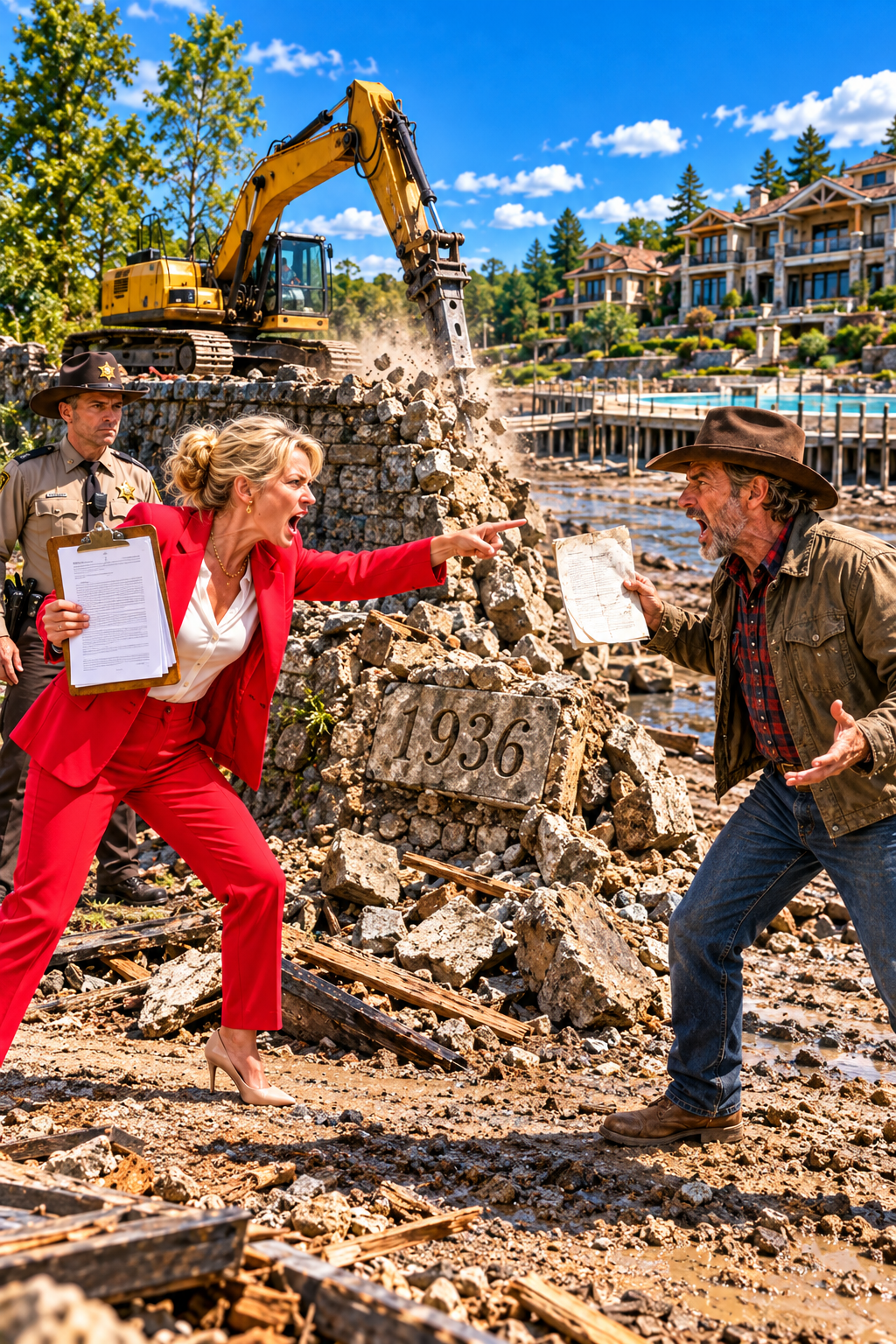
Friday, May 23, dawned gray and still. At two in the afternoon, Van Horn’s crew set a breaker on a barge and began working the abutments loose. By four, they were attacking the sill. I stood on my bank with my phone recording, because Greer had told me to document everything and because I needed to do something with my hands. At twenty minutes before six, the machine lifted the last block of my grandfather’s foundation from the creek.
There was no dramatic crash. The water simply changed its pitch, from lapping against the bank to a low, steady rush, like a bathtub finally draining. Someone on the crew whistled and pointed at the opening. The operator shut down, and I stayed on the bank until darkness settled, listening to my lake disappear. At six the next morning, the water was down nine feet. Where my cove had been, a bowl of gray mud stretched toward the old creek channel.
A wet line marked the rock above my head—the place where eighty-eight years of water had stood. Across the exposed lake bed, the clubhouse marina hung from its pilings over mud, its gangways tilted at sharp angles. Four boats lay on their sides, and the imported beach had become a streak of black silt. The zero-edge pool had drained through its own overflow and sat empty, full of leaves. At 10:06, the clubhouse intake pump started, sucked air, and screamed until it tripped off.
Karen arrived in a navy dress, carrying a seating chart for the gala. She walked down to the marina, stepped into the mud in her heels, and kept going. Soon after, she called the sheriff’s office and claimed I had drained the lake. Deputy Isidor Krebs found me on my own bank. He had bought bait from me for nine years, but he still had to investigate the complaint.
I showed him my video: the barge, the breaker, the last stone being lifted. Then I gave him the release Karen had signed on Van Horn’s truck. Krebs read it twice, looked across the mud at the ruined marina, then looked back at the paper. The truth was right there in black ink, but neither of us yet knew how much more of it was about to come out.
Part 6: My father’s hidden agreement proved Karen knew the truth
At that morning, Greer called with news from the county index. The 2019 records had finally come online, and she had found an agreement recorded against the HOA’s parcel in November of that year. It was titled “Water Intake License and Non-Interference Agreement,” and it had been signed by my father, Truman Burnside, nine months before he died. The association acknowledged that the Burnside family owned the structure and lake bed, and that the clubhouse intake depended on water held back by that structure.
The agreement also said the HOA would not alter, remove, or interfere with the structure. Karen had signed as president. There was an exhibit: a cross-section of the sill, marked with the exact elevation I had measured. I sat on the tailgate of my truck with my hand over my eyes. My father must have believed the matter was settled; he recorded the agreement and came home without telling me. He had trusted that a signed paper meant something.
Karen had signed the drawing of the very stone she had just ordered removed. Then she had told a judge the submerged masonry was only streambed gravel. Greer and I went to the clubhouse terrace, where the board, the contractor, the deputy, and the gala crew were gathering in confusion. Karen tried to argue that the state had delisted the dam in 2011. Greer pointed to the agreement and reminded her she had signed it.
“That’s a schematic,” Karen said. Greer answered that the drawing showed the elevation, the license, and the association’s promise not to interfere. She also reminded Karen about the county permit, the blank owner-consent page, and the certified letter she had signed for on May 14. Karen turned toward the board and called me a man protecting his business. From the back of the terrace, Elizabeth Caro spoke up: “Karen, I still have the 2019 memo.”
The engineer from the state arrived shortly before ten. Adair Linquist walked alone through the mud, measuring the channel and examining the surviving masonry. Then she came up to the terrace and asked who had authorized the removal. Karen began to answer, but Linquist interrupted with the explanation none of us could ignore: delisting a dam from an inventory did not change the physics of the water behind it. The structure had held back ninety-six acres since 1936.
Linquist wrote for a while at the terrace table. That afternoon, the state issued an emergency order requiring restoration of the impounding structure to its original crest elevation, with engineered plans and state oversight. The order named the HOA and the person who authorized the demolition as responsible parties. The gala was canceled; without water, the commercial kitchen and restrooms could not operate. The insurer reserved its rights and then denied the claim, citing intentional action and prior written notice.
Part 7: The community paid for the damage its president caused
One detail from that morning still matters to me. The catering manager had 240 meals ready and nine young workers in white shirts, with no water in the building and nobody paying attention to them. My camp had a drilled well unrelated to the lake. Sylvia and I took two hundred feet of hose and every fitting we could find, ran the line across Blackberry Ford Road, and connected it to the clubhouse kitchen. Karen watched from the terrace and never came down.
Two hundred and forty people from Milbrook Harbor Estates drank water supplied by the bait shop its president had spent months trying to erase. The gala was canceled by noon, and the tent came down the same day it went up. The clubhouse remained closed for eleven weeks. The state required the HOA to rebuild the sill properly, and the first bid came in at $486,000. The health department also refused to approve the old surface intake again, which meant the association had to connect to the county trunk line after all.
The insurance company did not pay. Its adjuster pointed to the intentional demolition, the written warning, and Karen’s signed receipt. The board faced a special assessment of $4,300 per household across 208 homes. That was when the residents finally saw Caro’s 2019 engineering memo and the minutes showing how Karen had kept it out of their meeting packet. They learned the association had known the intake was dependent on my family’s structure for years.
The recall vote took place on June 14 in a rented hall, because the clubhouse still had no water. Doretta told me afterward that she spoke for six minutes about the “viewshed” Karen had wanted so badly. The vote was 172 to 28. Karen lost both the presidency and her board seat, and the management company terminated its contract with her separately. The county referred the false permit certification and blank consent page to the state’s attorney for review; that process moved at its own pace.
I saw Karen once more, carrying a banker’s box out of the HOA office. I was stopped at the light on Blackberry Ford Road, and she saw me through the window. Neither of us said anything. The light changed, and we drove in opposite directions. Greer got the lien removed, the red tag lifted from my temporary crossing, and the gate cut open in daylight by an HOA contractor.
The association paid for the season I had lost and for rebuilding the bridge. I didn’t ask for anything beyond the lake, the road, and the work needed to restore what had been destroyed. Greer thought I should demand more. I told her I wanted a lake and a road, not a settlement that would leave me staring at an empty basin. In the end, the sill was rebuilt by June 30, with a new engineered core and my grandfather’s face stones reset along the downstream side.
Part 8: The lake returned, and the bridge rose again
Linquist inspected the work and said it was good enough to keep the original stone rather than throw it away. Then we waited. Ninety-six acres of water could not return in a weekend, but through July it crept up the banks an inch or two a day. Sylvia marked the waterline with chalk each Sunday, watching it rise toward the old gray band. By the first week of August, the chalk marks had disappeared beneath the surface.
In September, Shep Dunigan rebuilt the arch with the original stone. About sixty percent of the old voussoirs were sound, just as he had predicted in April, and he cut replacements from the same quarry seam. The keystone had spent five months face down in the mud. Shep cleaned it with a wire brush and a bucket, then turned it over so we could see the carving: “1936 EB.”
He asked where I wanted it placed. I told him to put it where my grandfather’s crew had set it. When the final stone settled into place, the bridge looked older than the clubhouse and stronger than the whole fight that had tried to erase it. The camp reopened the following spring with twelve cabins, eighteen boats, and bait tanks running again. Adeline pulled the cancellation notepad from the register drawer and threw it away without a word.
Most mornings, I take a boat out before opening the shop. I pass under the arch, steer into open water, and cut the motor about a hundred yards beyond the bridge. From there, I can look back and see the span with the fog resting over the pool beneath it. Sometimes I imagine my father at the dock, showing a six-year-old boy how to tie a cleat hitch. I still miss him, but I understand a little better why he trusted the paper he had filed.
People ask what I learned from the whole thing. I don’t have a speech prepared, and I don’t pretend the outcome made the months of fear or the damage to my business worthwhile. I learned that a thing can look like decoration until somebody tears it away and everyone discovers what it was holding. Karen thought she was removing an eyesore; she exposed the risk her own board had hidden, and the promise she herself had signed.
The bridge is standing again, and the lake is back where it belongs. The HOA has a proper water connection, its residents know what their assessment paid for, and my daughter can decide for herself whether she wants to carry the camp into the future. The carved year on the keystone is sharp enough to read from the bank. Every time I pass beneath it, I remember that the stone did more than carry a road: it held up a lake, a family, and a truth no one could keep buried forever.
✓ Lynn R. Adams
Part 2: The HOA claimed authority over land it never owned I brought my deed, the subdivision plat, and the original map to the HOA’s March meeting. Nine board members sat around a table in the clubh…