The morning I discovered a brand-new community pavilion standing on the fifteen acres
Part 2: The HOA president claimed my dead uncle had surrendered ownership.
I called attorney Randolph Bane the morning after finding the pavilion because he had represented my family for years and knew more about Texas land disputes than anyone I trusted. His office occupied a weathered brick house near the courthouse, with crooked bookshelves, outdated coffee, and a receptionist named Linda who took one look at my expression and asked whether somebody had stolen my tractor. I dropped the deed, photographs, and county mapping screenshots on Randolph’s desk, then watched him study everything without saying a word. He finally removed his glasses and asked whether I had signed any agreement allowing Oakluff Preserve to use the property. When I said absolutely not, he leaned back and replied, “Then somebody has a very expensive explanation to make.”
Randolph warned me that online mapping systems were useful for identifying problems but could not replace a proper boundary survey or establish ownership by themselves. He explained that we needed to examine recorded deeds, subdivision plats, possible easements, permit records, and anything Karen claimed Uncle Ray had signed. I wanted him to send a bulldozer immediately, but he reminded me that an unauthorized structure did not automatically give me unlimited permission to destroy it without legal consequences. The correct approach was to preserve evidence, issue formal notice, obtain a professional survey, and pursue a court order if the association refused to cooperate. I hated hearing that justice might take longer than outrage, but I trusted Randolph enough to follow his instructions.
We sent the HOA a written demand identifying the suspected encroachment, requesting all documents supporting its claimed right to use the land, and instructing it to stop additional construction. Karen called me less than two hours after receiving notice, sounding almost offended that I had consulted an attorney rather than accepting her explanation. She repeated that my uncle had always supported the neighborhood and insisted property boundaries could become complicated when communities expanded. Then she announced that the association possessed documentary proof of Ray’s permission and promised to email it immediately. I waited beside my truck until the attachment arrived, opened it, and stared at a photograph of an old postcard.
The postcard showed a beach sunset on one side and a brief handwritten note on the other thanking someone for keeping a recreational area tidy. It carried no signature, no date, no parcel description, and no language granting permission to build anything, much less permanently occupy my uncle’s land. Karen nevertheless described it as sufficient evidence of a longstanding community agreement, which made me wonder whether she believed her own story or simply assumed nobody would challenge it. Randolph examined the attachment and said a vague postcard was not a recorded easement, a deed, or reliable proof of the permission Karen claimed. He then instructed me to stop speaking with her directly unless the conversation could be properly documented.
I returned to Ray’s property that afternoon and walked the southern boundary with a notebook, measuring tape, and camera. Fresh survey flags stood near the tree line, although neither Randolph nor I had requested any work that would explain their presence. Beyond the pavilion, someone had cleared a narrow path toward an adjoining section of woodland, suggesting the project might eventually expand farther into my uncle’s acreage. I photographed every marker and noticed freshly disturbed soil beside an old fence post where Ray had carved his initials decades earlier. The post was still there, but somebody had wrapped fluorescent tape around it as though preparing to move or replace it.
That evening, an unfamiliar number appeared on my phone, and when I answered, nobody spoke for several seconds. Finally a nervous male voice told me to investigate something called the Quiet Revisions Project before the county published another round of property-map updates. I asked who he was, but he ignored the question and said the changes were not limited to my parcel. Before hanging up, he warned that Karen had friends inside the office responsible for maintaining the digital mapping records. I stood alone beneath the cedar trees listening to the disconnected call and realized the pavilion might be only the visible corner of something much larger.
Part 3: Fake violations and mysterious threats revealed an organized land grab.
The harassment began three days after Randolph sent the formal notice, when a county environmental inspector arrived at my locked gate claiming someone had reported an uncovered well. I knew the complaint was false because Ray had sealed the old well with a bolted steel cover years earlier, and I personally checked it whenever I visited. Nevertheless, I allowed the inspector to examine the area after confirming his credentials and documenting the visit on my phone. He found the cover secure, but his report still referred to an alleged safety concern requiring further review. I sent the paperwork to Randolph before the inspector’s truck had disappeared around the bend.
Two days later, another complaint accused me of dumping household garbage along the wooded boundary. I drove to the property and discovered three ripped trash bags beside a service path, filled with fast-food containers and household waste I had never seen before. Before moving anything, I photographed the bags, recorded their location, and notified the appropriate office that I disputed responsibility for the dumping. Then a third letter arrived alleging illegal tree removal, even though I had not cut down a single tree. It was beginning to feel less like ordinary bureaucracy and more like someone deliberately constructing a reputation for me as a reckless, irresponsible landowner.
Randolph spread the complaints across his conference table and studied their dates, language, and supporting photographs. He noticed that several reports contained nearly identical descriptions despite supposedly coming from unrelated sources, and one photograph included a vehicle that resembled an SUV parked outside the Oakluff clubhouse. He cautioned that suspicion was not proof of coordination, but he agreed the pattern justified public-records requests and formal complaints about possible misuse of enforcement procedures. We requested inspection histories, communications concerning my parcel, and records identifying recent mapping changes affecting the subdivision. Karen responded through an HOA attorney by accusing me of intimidating community volunteers and interfering with neighborhood improvements.
Her accusations appeared in the association newsletter before I had received a complete response from the county. According to Karen, an aggressive neighboring landowner was attempting to deprive Oakluff families of a beloved recreation facility. She described years of community picnics, children’s birthdays, and charitable gatherings supposedly held at a pavilion whose lumber still smelled freshly cut. Residents began driving past my gate, sometimes slowing to photograph the property as though they expected to catch me committing some terrible offense. One evening, a white SUV with dark windows followed my truck for nearly three miles before turning away when I pulled into a busy gas station.
I reported the incident and installed cameras covering the gate and main access road. That weekend, one camera recorded a person entering the property after midnight and attaching an orange warning tag to my fence. The tag said the land was subject to further review but identified no issuing agency, case number, or legal authority. Randolph told me not to assume the person was connected to Karen until we had reliable identification, although he agreed the warning appeared designed to intimidate rather than inform. I began sleeping poorly, checking the cameras whenever my phone vibrated, and wondering whether Uncle Ray had faced similar pressure during his final months.
The answer came unexpectedly when I visited Earl Dawson, one of Ray’s closest friends and a retired Army mechanic who lived several miles away. Earl remembered Karen visiting Ray during his illness and asking whether he would consider allowing the HOA to manage a portion of the land. Ray refused because he wanted the property kept intact for whoever inherited it, and Earl recalled him saying that people who offered to maintain land for free usually expected something more valuable in return. He also remembered a county employee visiting Ray after a hospital stay, supposedly to discuss a minor mapping correction, although Ray had refused to sign the papers presented. That memory gave Randolph another lead, and it gave me the first real evidence that the dispute had begun before my uncle died.
The following morning, I found a manila envelope taped inside my gate. There was no return address, only a handwritten warning telling me not to trust the digital maps and a small USB drive sealed in a plastic pouch. I did not connect an unknown device to my own computer because I had enough problems without introducing malicious software into my business systems. Instead, I photographed the package, called Randolph, and delivered it to a qualified forensic technician who could examine it safely while preserving potential evidence. By that afternoon, the technician confirmed that the drive contained recordings and documents that appeared directly connected to the Quiet Revisions Project.
Part 4: A hidden digital file exposed the mastermind behind county corruption.
Randolph called me into his office the next morning, and I knew from his expression that the USB drive had revealed something serious. The forensic technician had copied the contents using a documented process, preserving the original device and recording file information so investigators could later evaluate authenticity. We watched the first recording together, a screen capture showing a county mapping interface with several internal draft layers. One draft shifted the displayed boundary between my land and Oakluff Preserve, while a later version extended the proposed adjustment farther into my property. The recordings did not themselves prove the official recorded boundary had changed, but they showed someone had been preparing misleading digital representations that favored the HOA.
The second file contained audio recorded during what appeared to be a private discussion between Karen and a county employee. Karen’s voice was unmistakable as she demanded another boundary adjustment, while the nervous man warned that the changes could expose everyone involved if an audit examined the editing history. She dismissed his concern and said officials would treat the alterations as routine corrections if questions arose. Then she made a statement that turned my stomach: the landowner would eventually break once the fines became expensive enough. Randolph stopped the recording and looked at me without speaking because the meaning was already clear.
A third folder contained spreadsheets identifying properties bordering Oakluff Preserve, including parcels belonging to elderly owners, heirs living outside Texas, and people facing unresolved inheritance issues. My uncle’s property appeared near the bottom with a note describing his recent death and predicting minimal resistance from the beneficiary. Other entries recommended administrative pressure, voluntary purchase offers, or boundary-review requests depending on how difficult the owners might be to persuade. One draft message discussed obtaining practical access to selected parcels before pursuing formal changes, suggesting the pavilion was intended to establish a visible claim that could later be used in negotiations. These documents transformed my understanding of Karen from an arrogant neighborhood president into someone apparently willing to exploit grief, illness, and bureaucratic confusion for financial advantage.
Randolph immediately contacted the proper investigative authorities and arranged to provide the preserved files along with our records. He explained that the audio and spreadsheets would require authentication, witness interviews, and careful comparison with actual county systems before anyone could responsibly announce criminal wrongdoing. Meanwhile, he wanted an independent survey performed using recorded plats, original monuments, and established surveying methods rather than relying on disputed online graphics. He called Carl Dawson, a licensed surveyor whose reputation for precision extended across the county, and asked him to inspect the land as quickly as his schedule permitted. Carl arrived the following afternoon with professional equipment, two assistants, and a faded hat that looked older than my truck.
We spent hours following fence remnants, locating old monuments, comparing recorded descriptions, and establishing the relationship between the existing pavilion and the legal boundary. Carl was methodical, checking measurements twice and refusing to make assumptions when weathered markers complicated the work. Eventually he produced a preliminary drawing showing that the nearest permanent portion of the pavilion extended approximately twelve feet into my parcel. Its roof, landscaping, and surrounding improvements occupied additional land beyond the original clearing, making the encroachment substantial rather than incidental. Carl said the finalized survey would include his professional certification and could be used in the legal proceeding.
With that evidence, Randolph sought judicial relief requiring the HOA to stop using the disputed area while the property-rights question was resolved. He also pursued disclosure of permits, contractor records, payment authorizations, and the documents Karen claimed gave the association permission to build. The HOA continued insisting that residents possessed longstanding community rights, but it could not produce a recorded easement or signed agreement from Ray. Investigators separately began examining whether county personnel had improperly altered mapping information or coordinated with private parties. For the first time, Karen faced questions from people she could not intimidate with a neighborhood newsletter.
I drove to the property that evening and found Earl standing beside the old fence line, studying the new survey stakes. He asked whether the investigation had confirmed what Ray suspected, and I told him we had discovered enough to understand why my uncle refused Karen’s offers. Earl nodded slowly and said Ray had fought hard throughout his life to own something nobody could take away casually. Then he warned me that people accustomed to controlling everyone around them often became most dangerous when they realized their authority was slipping. I promised him I would finish what we had started, but I intended to finish it in a courtroom rather than surrendering my future to anger.
Part 5: Her emergency HOA meeting collapsed when I revealed the truth.
Karen called an emergency association meeting the following Thursday, advertising it as a community response to threats against the Oakluff pavilion. Randolph forwarded me the announcement because the language described me as a hostile landowner attempting to seize neighborhood property, an accusation that reversed everything the evidence showed. The meeting was scheduled at the clubhouse, and residents were encouraged to attend with photographs of events supposedly proving the pavilion’s historical significance. I wanted to confront Karen in front of everyone, but Randolph suggested we avoid unnecessary confrontation while the legal process continued. I agreed to attend peacefully and bring the certified survey once Carl completed it.
By the time I arrived, luxury SUVs and polished sedans lined both sides of the road outside the clubhouse. Through the windows, I could see approximately fifty residents seated beneath a projector screen while Karen stood at the front wearing a cream-colored suit. She spoke about shared values, protecting children’s recreational spaces, and resisting outsiders who wanted to destroy the neighborhood’s traditions. Then she displayed the disputed digital parcel map, with the altered boundary conveniently surrounding the pavilion. Several residents applauded when she announced that official records supported the HOA’s ownership claim.
I waited until the presentation reached the question-and-answer period before entering through the public doorway. Karen’s smile stiffened when she saw me, and she immediately announced that the meeting was intended for association members only. I told her I understood and asked whether the board would accept a copy of the certified boundary survey through its attorney. Several residents turned toward me, and one older man asked why a new survey existed if the property line was already settled. Karen interrupted him, insisting the new document had been commissioned by someone with an obvious financial interest.
I placed the survey on a nearby table and explained that Carl Dawson had located the recorded boundary using physical monuments and established methods. I did not ask anyone to accept my word because the supporting documentation was available for independent review. A board member named Todd Bentley stepped forward, examined the map, and asked Karen why her presentation showed a different boundary from the one on the licensed survey. She claimed the surveyor had made a mistake, but Todd pointed out that the HOA’s own original subdivision plat appeared consistent with Carl’s conclusion. The confidence in her voice disappeared almost immediately.
Then a woman near the back asked whether Karen had obtained written permission from Uncle Ray before construction. Karen repeated the story about his longstanding support, but several residents wanted to know why no signed agreement had been produced. I explained that my attorney had formally requested every relevant document and that the only item initially supplied was an unsigned postcard. The room filled with whispers as people realized the association might have spent substantial money building on property it did not own. Karen responded by accusing me of spreading misleading information and threatened to sue if I continued.
Todd asked the treasurer how much the pavilion had cost, and the answer changed the atmosphere more than any speech could have. The HOA had committed over one hundred thousand dollars to construction, landscaping, equipment, and promotional materials. Residents who had been willing to applaud Karen’s emotional presentation suddenly wanted to know whether their annual dues had financed an unauthorized project. A woman whose husband had recently lost his job demanded to see the construction contract and board minutes approving the expenditure. Karen insisted everything was properly documented, but the treasurer refused to confirm that any recorded property agreement existed.
I left before the meeting ended because the argument belonged to the association’s members, not to me. In the parking lot, Todd followed and quietly asked whether I would provide the survey to an independent attorney representing concerned residents. I told him Randolph could coordinate that request, then drove home without celebrating. The following morning, Todd called to explain that the board had voted to suspend pavilion events pending legal review, and Karen had stormed out before the discussion concluded. It was the first time anyone inside Oakluff had openly challenged her leadership.
That afternoon, Randolph received another anonymous communication offering to identify the county employee involved in the mapping changes. The sender claimed Karen had pressured more than one person and promised that original messages could confirm who directed the project. Randolph forwarded the information to investigators rather than attempting to arrange a private confrontation. The pressure on Karen was building from every direction: property owners, association members, county administrators, and legal counsel. Yet instead of retreating, she began preparing one final attempt to preserve the pavilion and her authority.
Part 6: A bulldozer arrived as Karen’s carefully constructed kingdom collapsed.
The court eventually issued an order resolving the immediate property dispute, confirming my right to exclusive possession of the encroached area and requiring the HOA to remove the pavilion within a specified period. The association was given an opportunity to arrange lawful removal and restoration, but repeated delays and disputed contractor arrangements prevented compliance. After further proceedings, the judge authorized a supervised removal process under conditions protecting public safety, preserving relevant evidence, and limiting damage beyond the disputed structure. Randolph reviewed the order with me carefully because he knew how badly I wanted the pavilion gone. Only when the required notices were complete did I contact Mitch Harlan, a demolition contractor I had known since my first construction job.
Mitch inspected the site with Carl’s survey and a structural specialist, then explained that the pavilion would require controlled dismantling before heavy machinery could clear the remaining materials. Its brick columns, reinforced slab, electrical fixtures, and bolted equipment created hazards that made a reckless bulldozer charge unacceptable. I admitted that part of me wanted to watch one enormous blade push the entire thing over, but Mitch reminded me that winning a legal dispute was no reason to injure someone or create another one. We developed a removal plan with barriers, utility checks, debris containment, and an authorized work area. Randolph coordinated notice to the association and local authorities so nobody could later claim the work occurred secretly.
On the scheduled morning, I reached the property before sunrise and stood beside the gate listening to insects in the cedar trees. Mitch arrived with a flatbed trailer carrying a yellow bulldozer, followed by trucks transporting workers, dismantling equipment, and safety fencing. The engine’s low rumble echoed across the clearing, bringing back the memory of seeing those deep machinery tracks on my first visit. This time, however, the equipment was there with permission from the actual landowner and a court order governing the work. I watched Mitch unload the machine and felt something inside me begin to loosen.
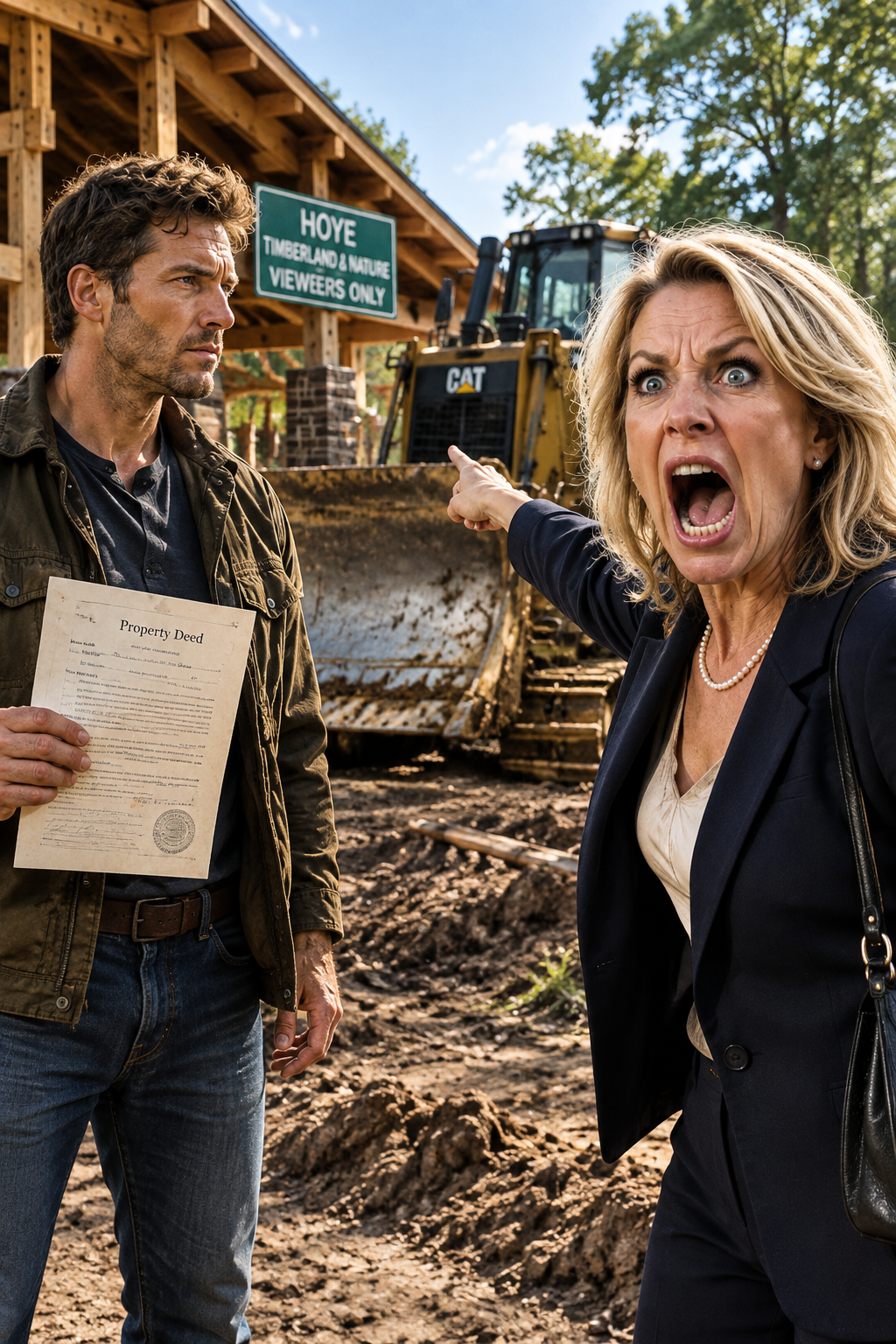
Karen arrived less than twenty minutes later, accompanied by several residents who had apparently received frantic messages warning that the pavilion was being destroyed. Her cream suit had been replaced by a beige pantsuit, and she marched toward the work area with her phone raised like a weapon. She shouted that community property was being demolished illegally and demanded that Mitch stop immediately. The crew halted while Randolph, who had arrived separately, showed her attorney the court authorization and explained the safety boundaries. Karen refused to acknowledge the documents and tried to push past the temporary barrier.
Mitch shut down the bulldozer while workers moved away from the immediate area. I told Karen to remain outside the marked zone because heavy equipment made it dangerous, but she accused me of threatening her. When two sheriff’s deputies arrived to address the disturbance, she demanded that they arrest me for stealing association property. The deputies reviewed the court order, spoke with the contractors, and instructed everyone to respect the designated work area. Karen continued shouting until one deputy warned that further interference could result in her removal.
The confrontation became uglier when Karen attempted to grab the survey folder from Randolph’s hands. A deputy stepped between them, and Karen stumbled backward into the muddy edge of the access road, losing one shoe as she struggled to regain her balance. Several residents raised their phones, while Todd hurried forward and begged her to stop making the situation worse. Karen accused everyone of betraying her and demanded that the board terminate its relationship with the attorney who had advised compliance. Then she tried crossing the safety barrier again, and the deputies escorted her away from the work site.
Once the area was clear, Mitch resumed the authorized demolition. Workers had already removed detachable fixtures, and the bulldozer pushed the remaining debris into controlled piles while the crew managed dust and recovered materials. Each collapsing section reminded me of the violation I felt upon discovering the building, but the moment was less joyous than I expected. I realized the pavilion itself had never been the real enemy; the danger came from people who believed their convenience entitled them to rewrite somebody else’s ownership. When the last substantial section was cleared, I stood beside the open earth and quietly thanked Uncle Ray for leaving me something worth defending.
Part 7: Her lawsuit backfired as the corruption investigation reached court.
Three days after the demolition, Oakluff Preserve served me with a civil lawsuit seeking hundreds of thousands of dollars for property destruction, lost community use, emotional distress, and alleged interference with association operations. Even Randolph appeared impressed by the audacity of suing over removal carried out pursuant to a court order. He explained that the association’s claims would have to confront the existing judgment, the removal authorization, and the evidence of unauthorized construction. We responded through formal legal channels and sought recovery of eligible costs arising from the encroachment and resulting litigation. The process was expensive and exhausting, but I no longer feared that Karen’s loudest accusation would automatically become the accepted truth.
The discovery process revealed that the pavilion contract had been approved using a site plan that did not match the original recorded plat. Financial records showed payments to consultants connected to disputed mapping work, while internal communications revealed that Karen had repeatedly pressed board members to proceed despite unresolved ownership questions. Several directors testified that she assured them legal permission already existed, although they had never personally reviewed a signed agreement. Todd provided meeting minutes documenting his requests for clarification before construction began. Each document made the association’s position harder to defend.
Meanwhile, county investigators examined the Quiet Revisions files, interviewed personnel, and compared internal editing logs with the records preserved by the forensic technician. The investigation identified unauthorized changes to draft geographic information layers and communications suggesting those edits were intended to influence decisions concerning selected parcels. Officials emphasized that the recorded deeds themselves had not been automatically rewritten by digital map changes, but the altered graphics could still mislead residents and administrators who relied upon them. That distinction mattered because Karen’s apparent scheme depended on creating a convincing illusion of ownership before pursuing additional legal or administrative pressure. Investigators also reviewed complaints filed against other landowners to determine whether public systems had been deliberately misused.
A county employee eventually cooperated with investigators and confirmed that Karen had encouraged him to modify draft map layers in ways that favored Oakluff Preserve. He acknowledged making unauthorized edits and described meetings in which Karen discussed using the revised maps during property negotiations. His testimony did not eliminate his own responsibility, but it helped investigators connect the documents, recordings, and digital logs into a coherent timeline. The employee identified additional communications concerning elderly owners and vacant properties, including my uncle’s parcel. Hearing that Ray had been specifically targeted while seriously ill left me angrier than anything Karen had said directly to my face.
The civil case moved forward through hearings in which the association struggled to identify any lawful basis for its original construction. Randolph presented the deed, certified survey, recorded subdivision documents, notice history, court authorization, and evidence of the organization’s continued refusal to comply voluntarily. The association argued that its members had relied on Karen’s representations and should not bear the full consequences of her misconduct. The judge acknowledged the difficult position of residents who had not knowingly participated in wrongdoing, but made clear that community enthusiasm could not create ownership rights over another person’s land. The association’s central claims against me failed, and the remaining dispute concerned recoverable costs and damages.
Karen’s personal legal situation became more serious when prosecutors filed charges related to alleged fraudulent records, conspiracy, and misuse of governmental processes. She denied wrongdoing and claimed subordinates had misunderstood routine requests, but the evidence under review included her own communications. I watched the proceedings from the back of the courtroom rather than allowing myself to become a central character in every headline. The woman who once controlled entire HOA meetings through confidence and intimidation now had to answer questions under rules she could not rewrite. Whatever the ultimate criminal outcome, the authority she had enjoyed inside Oakluff was already gone.
The association reached a financial settlement covering specified legal expenses, removal costs, and restoration obligations, while its insurers and remaining directors addressed the consequences of the pavilion project. Residents faced an unpopular special assessment after discovering that association reserves could not absorb every expense. I felt sympathy for homeowners who had trusted their board and never approved of trespassing, even though several had once applauded Karen’s attacks against me. Todd and other reform-minded members organized an election, replaced the leadership, and adopted stricter requirements for land purchases, construction approvals, and independent legal review. For the first time, Oakluff Preserve began acting like a community rather than one woman’s private kingdom.
Part 8: The final boundary marker became a promise to my uncle.
By the following spring, the clearing had begun recovering from the construction damage and demolition work. Mitch returned with a smaller crew to finish grading, remove buried debris, restore drainage, and prepare the disturbed soil for native vegetation. Carl verified the permanent boundary markers, and I installed a secure fence along the section most affected by the encroachment. I also planted wildflower seeds near the cedars, choosing varieties Ray used to admire while sitting on his porch in the evenings. Watching the first green shoots appear felt more satisfying than any photograph of the demolished pavilion.
Earl visited the property on a bright Saturday morning and brought an old metal lunchbox filled with photographs he had found among his belongings. The pictures showed Ray as a young soldier, Ray beside a tractor with my father, and Ray standing in the southern clearing long before Oakluff Preserve existed. In one photograph, I recognized the cedar tree nearest the former pavilion, its branches smaller but unmistakable. Earl explained that Ray once planned to build a simple picnic shelter there for family gatherings, but never completed the project because life kept demanding his attention elsewhere. I sat on the tailgate studying the photograph and realized I finally knew what I wanted to do with that part of the land.
Instead of building another enormous structure, I commissioned a modest open-sided shelter using local timber and stone. It stood away from the surveyed boundary, required the appropriate approvals, and was designed for family picnics rather than exclusive neighborhood events. Mitch helped with the groundwork, Earl supervised the grill installation as though commanding an Army repair unit, and Randolph insisted on inspecting the paperwork before anyone poured concrete. We named it Ray’s Place and placed a small bronze plaque near the entrance. The inscription read, “For those who know that freedom begins with respecting another person’s ground.”
The first gathering brought relatives I had not seen in years, neighbors from outside Oakluff, old friends of Ray, and several people who had helped during the legal dispute. We cooked barbecue, told stories, and watched children chase each other across the grass without worrying about private security patrols or HOA rulebooks. Todd arrived with his wife and apologized again for the association’s conduct, although I told him I understood he had spent months trying to correct problems he did not create. He brought a handwritten letter from the new HOA board acknowledging the surveyed boundary and committing to respect neighboring property rights. I placed it with the legal records and invited him to stay for dinner.
Over the next two years, I gradually improved the property without turning it into the expensive retreat developers kept suggesting. I repaired Ray’s old equipment shed, cleared trails through the cedar woods, restored a section of the fence, and arranged conservation guidance for areas supporting native plants and wildlife. My construction business continued operating, but I began spending more weekends outside Austin because working on the land gave me a connection to Ray that no inheritance document could capture. Sometimes Earl joined me, bringing coffee and complaining that modern tools were made for people who had never learned patience. On other afternoons, I worked alone and enjoyed the quiet my uncle had protected for decades.
The legal case eventually reached its conclusion through court proceedings and negotiated resolutions that left Karen without the position, influence, or reputation she once used to intimidate people. County policies were strengthened to improve logging and review of mapping changes, and the new Oakluff board adopted independent survey requirements before undertaking projects near property boundaries. Other landowners who had appeared in the Quiet Revisions documents received information allowing them to investigate their own records and seek legal advice. I was relieved to know the conflict had produced something more useful than a single successful lawsuit. The exposure of the scheme helped make it harder for anyone to repeat the same conduct against another vulnerable family.
On the third anniversary of Ray’s death, I installed one final sign near the southern boundary. It was made from weather-resistant steel, with clear lettering that simply identified the property as private land and directed visitors to seek permission before entering. I considered adding a sarcastic reference to Karen or the expensive pavilion, but eventually decided my uncle would have preferred a sign that explained ownership without preserving the memory of the people who violated it. Mitch helped secure the posts while Earl watched from a lawn chair, offering unsolicited engineering advice. When the work was finished, I stepped back and felt the strange satisfaction of seeing an ordinary boundary properly marked.
That evening, long after everyone had left, I walked through the clearing with a cup of coffee and stopped beside the cedar tree from Earl’s photograph. The sunset turned the grass copper, and a light breeze moved through the branches above the modest shelter we had built. I remembered my first morning on the land, the enormous unauthorized pavilion, the members-only sign, and the fury of being told that a dead man’s property belonged to strangers. Then I remembered the survey stakes, the courtroom documents, the whistleblower evidence, the bulldozer, and the people who had helped me keep anger from becoming recklessness. The land was quiet again, but this time the quiet felt secure rather than abandoned.
I placed my hand against the cedar’s rough bark and thought about how Uncle Ray had spent his life defending the simple right to live on his own terms. Karen believed power meant pushing boundaries until other people became too frightened or exhausted to resist, while Ray believed boundaries mattered precisely because they limited what one person could demand from another. My inheritance had taught me the difference more clearly than any argument ever could. I did not defeat Karen by shouting louder, threatening harder, or using a machine bigger than hers; I defeated her by refusing to let false documents, intimidation, and manufactured authority replace the truth. And when I walked back toward my truck beneath the fading Texas sky, I knew the most valuable thing my uncle had left me was not fifteen acres of land, but the responsibility to protect every honest inch of it.
✓ Lynn R. Adams
Part 2: The HOA president claimed my dead uncle had surrendered ownership. I called attorney Randolph Bane the morning after finding the pavilion because he had represented my family for years and kn…